Summary
Table of Content

Whiskey Market
Get a free sample of this report
Form submitted successfully!
Error submitting form. Please try again.
Thank you!
Your inquiry has been received. Our team will reach out to you with the required details via email. To ensure that you don't miss their response, kindly remember to check your spam folder as well!
Request Sectional Data
Thank you!
Your inquiry has been received. Our team will reach out to you with the required details via email. To ensure that you don't miss their response, kindly remember to check your spam folder as well!
Form submitted successfully!
Error submitting form. Please try again.
Whiskey Market Size
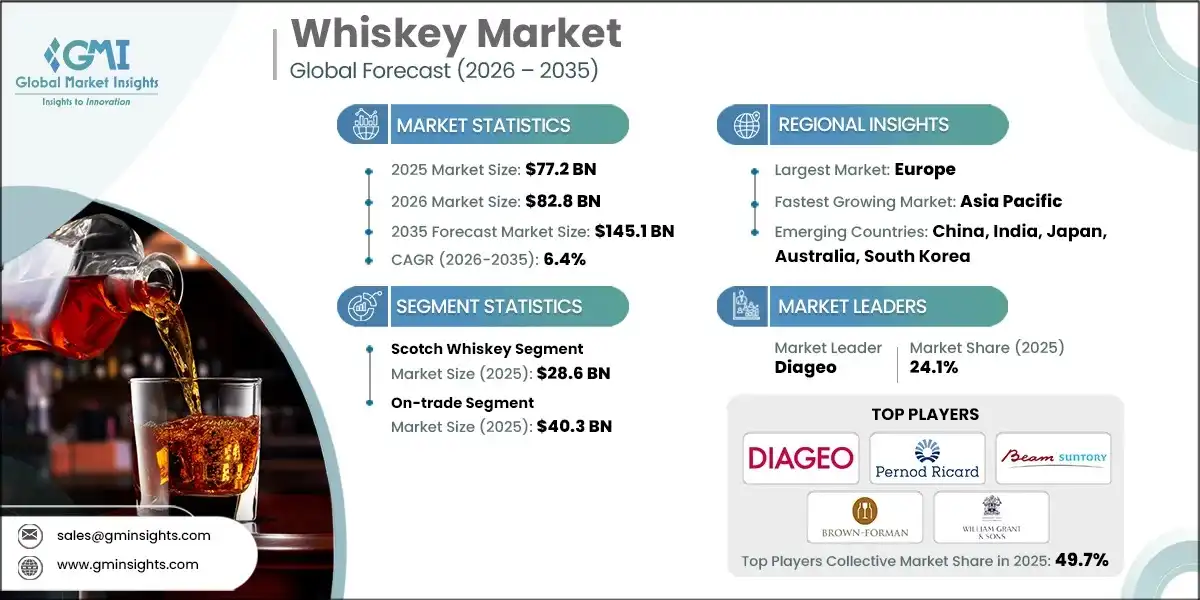
The global whiskey market size was valued at USD 77.2 billion in 2025. The market is expected to grow from USD 82.8 billion in 2026 to USD 145.1 billion in 2035, at a CAGR of 6.4% according to the latest report published by Global Market Insights Inc.
Whiskey Market Key Takeaways
Market Size & Growth
- 2025 Market Size: USD 77.2 Billion
- 2026 Market Size: USD 82.8 Billion
- 2035 Forecast Market Size: USD 145.1 Billion
- CAGR (2026–2035): 6.4%
Regional Dominance
- Largest Market: Europe
- Fastest Growing Region: Asia Pacific
Key Market Drivers
- Rising demand for premium whiskey.
- Interest in aged and specialty spirits.
- Expansion through e-commerce.
Challenges
- High production and aging costs.
- Increasing market competition.
Opportunity
- Expansion into emerging markets.
- Innovation in flavors and techniques.
- Adoption of sustainable practices.
Key Players
- Market Leader: Diageo led with over 24.1% market share in 2025.
- Leading Players: Top 5 players in this market include Diageo, Pernod Ricard, Suntory Holding Limited, Brown-Forman, William Grant & Sons, which collectively held a market share of 49.7% in 2025.
Get Market Insights & Growth Opportunities
- Whiskey is a distilled alcoholic beverage made from a fermented mash of grain i.e. barley, corn, rye, or wheat. Such whiskies are aged in casks that are usually wooden and made of oak, giving them those different tastes, colours, and aromas.
- Whiskey styles are diversified and localized to certain regions, like Scotch, bourbon, Irish whiskey, with each having its own tradition and specializing in local ingredients and aging regulations. It is craft, geography, and weaning that give whiskey its diversity and global appeal.
- The whiskey market has seen steady increase over the past decade, supported by consumer interest in premium spirits, craft manufacture, and heritage marketing. Whiskey has strong more cultural connection to guide, and people who wants to explore. This gives rise to its position in the list of stable alcoholic beverages.
- Whiskey is generally enjoyed slowly, allowing the drinker to fully appreciate in aromas and flavour as each sip is consumed. Many enjoy comparing different varieties against each other to see the differences in what smoothness, sweetness, or smokiness means, which makes tasting a very fun and educational experience. As people try more types, they start noticing the way in which the different ingredients, aging, and craftsmanship contribute to the final drink.
To get key market trends
Whiskey Market Trends
- Consumers continue to search for high-quality premium whiskey which includes aged and limited-edition classifications. This has led distilleries to concentrate on their craft, their aging techniques, and packaging, hence results in shaping the market. Premiumization is a way through which brands will use to distinguish themselves and charge higher rates against competition in the market.
- Innovative flavours, barrel finishes, and aging processes seem to be the latest trends. Whiskeys are characterized by factors such as fruit-infused, smoked, or spiced varieties which draw the interest in younger and experimental consumers and allow greater categories of offerings in the market.
- The other trends which are boosting the market are sustainability, in which distilleries are adopting green packaging, renewable energy, and grains responsibly sourced. Consumers are drawn to those brands that are environmentally responsible, influencing their purchasing decisions and forming long-lasting customer loyalty toward the brands.
- The whiskey industry has been catered by digital trend such as e-commerce, virtual tastings and social media marketing which are shaping the market. On online platforms, brands can communicate directly with consumers on a global basis, promoting new releases and creating lively conversations around their brands, hence increases the market growth.
Whiskey Market Analysis
Learn more about the key segments shaping this market
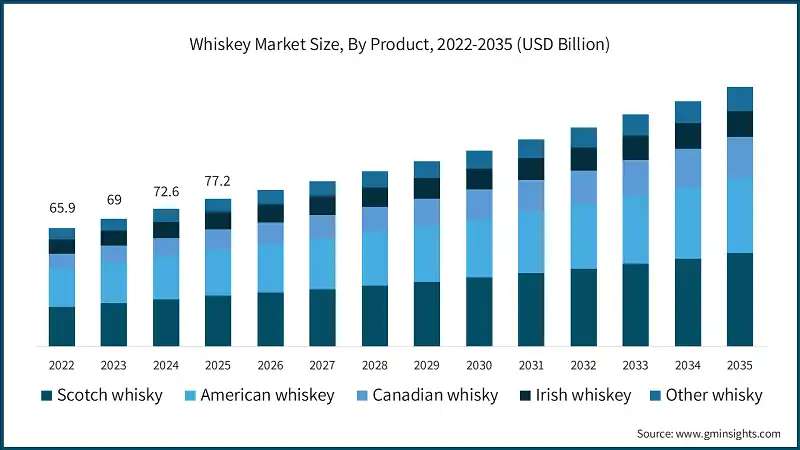
The whiskey market by product is segmented into scotch whisky, American whiskey, Canadian whisky, Irish whiskey and other whisky. Scotch whiskey holds the largest market value of USD 28.6 billion in 2025.
- American whiskey is growing fast because bourbon and Tennessee whiskey are used for cocktails and have sweet taste that is soft and easy on the palate. Scotch whiskey is holding steady, while some of the higher demand for single malts can be attributed to consumers seeking premium and aged options. The Irish whiskey segment is among the fastest growing because it is smooth and easy to drink, appealing to novice consumers. Canadian whisky is slowly growing aided by its smooth profile and cocktail applicability.
- Other whiskey like Japanese whisky is experiencing growth as it is associated with quality and craftsmanship, but due to supply constraint keep volume smaller. Flavoured whiskey is expanding rapidly, since younger consumers prefer sweeter, fun, and easy-to-drink alternatives. RTD whiskey is also expanding rapidly, since consumers seek convenient drinks that don’t require mixing. These newer segments attract beginners and casual drinkers and help broaden the overall whiskey market. In conclusion, while premium Scotch, Japanese, and American single barrels are growing due to quality and flavour.
Learn more about the key segments shaping this market
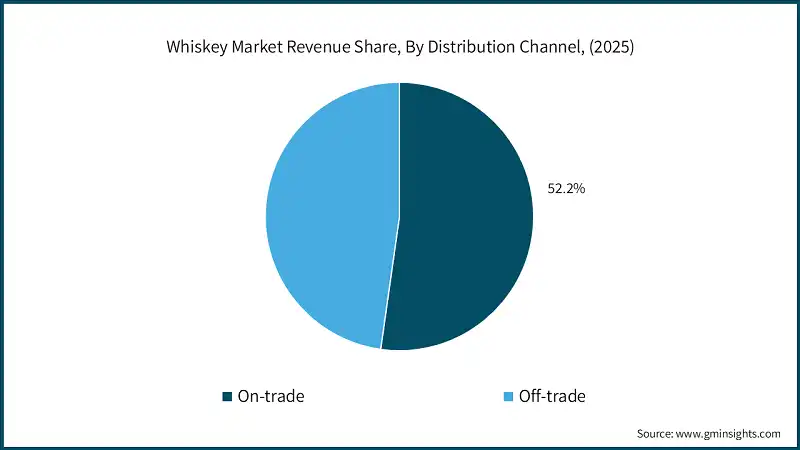
The whiskey market by distribution channel is segmented into On-trade and Off- trade. On-trade holds the largest market value of USD 40.3 billion in 2025.
- The on-trade whiskey segment is growing which is propelled by premiumization and experiential drinking. Consumers visit bars and restaurants which result in more adoption of premium and super-premium whiskeys, whiskey flights, and crafted cocktails raising more spending per occasion.
- The off-trade segment continues to grow faster and is the growth driver of the whiskey market. The growth here basically results from new-age consumption trends, convenience, competitive pricing, and wider product availability through retail and e-commerce. Consumers have started buying more whiskey for home drinking and cocktail experimentation, while online sales expansion, with premium options now being available at retail results in growth in this channel.
Looking for region specific data?
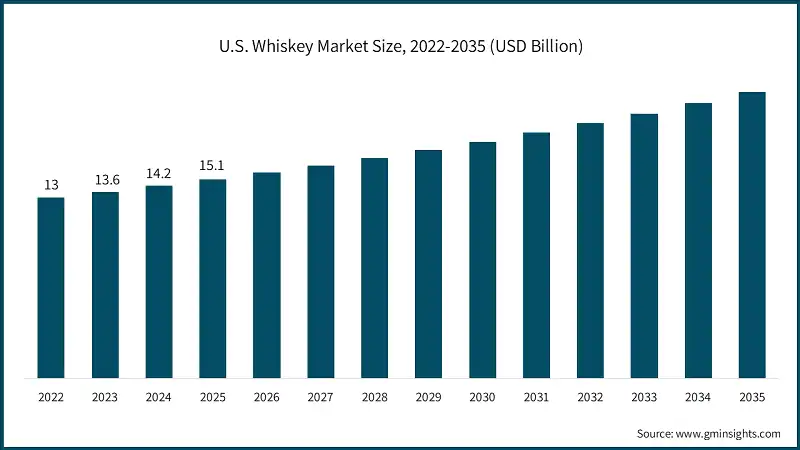
The North America whiskey market is expected to experience significant and promising growth from USD 3.6 billion in 2025 to USD 4.6 billion in 2035. The U.S. market shows a promising growth and accounted for USD 15.1 billion in 2025.
- In North America, the whiskey market is catered by demand in U.S. and Canada due to higher consumption and export of bourbon, rye, and Canadian whiskies. For U.S. consumers, bourbon leads domestically and internationally because of premiumization and craft distilleries. Interest in fine and easy-to-drink American whiskies continues to grow within Canada's borders, as does interest in smooth and diversified whiskies, which appeal to casual drinkers and cocktail enthusiasts. The area benefits from strong distribution networks and a culture of whiskey, further fostering innovation and expansion for the brand.
The whiskey market in Germany is projected to experience robust growth accounted for USD 17.3 billion in 2025 to USD 30.6 billion in 2035.
- Europe is a critical market for whiskey. Scotch whisky and Irish whiskey have truly set the standard worldwide. France, Germany, and Spain have also grown a high demand for premium, single-malt varieties. European consumers prefer historic brands, traditional methods of aging, and tasting experiences, while small, craft distilleries in countries like Sweden and Poland are experimenting with innovative flavors and cask finishes to reach out to the younger audience.
The whiskey market in Asia Pacific is expected to experience increasing growth from USD 33.2 billion in 2025 to USD 65.1 billion in 2035 with a CAGR of 6.9%.
- The growth in the Asia-Pacific region has been led by countries like Japan, India and China. Japanese whiskies are reputed for their precision and elegance around the globe. India, one of the major whiskey-consuming countries, is witnessing a transition towards premium brands and single malts. The emerging middle class in China creates demand for imported and high-end whiskeys while in South Korea is growth in market is catered by traditional and flavored whiskies in their urban nightlife and cocktail culture.
Middle East & Africa whiskey market is expected to experience significant and promising growth from USD 3 billion in 2025 to USD 5.2 billion in 2035.
- An increasing interest in premium whiskeys is due to high-income consumers and luxury lifestyle which is being witnessed in the Middle East. United Arab Emirates countries are growing the market, which is catered by tourism, high-end bars, and exclusive-tasting events that rises the demand for rare and aged whiskeys. On the other side, younger urban consumers are beginning to embrace whiskey, merging old appreciation with the modern cocktail culture, which is positioning the region as an emerging centre for premium spirits.
Latin America whiskey market is expected to experience significant and increasing growth from USD 6.8 billion in 2025 to USD 12.8 billion in 2035.
- Latin America is on the rise in terms of whiskey consumption with Mexico leading the whiskey trend. For now, urban bars and cocktail culture have introduced premium and imported brands while small distilleries experiment with unique aging processes and local grain varieties. This mix of traditional and innovative has created an evolving preference based on both the older and young consumers in the region.
Whiskey Market Share
- Whiskey industries are moderately consolidated with players like Diageo, Pernod Ricard, Suntory Holding Limited, Brown Foreman, William grant and Sons holding 49.7% market share and Diageo being the market leader holding the market share of 24.1% in 2025.
- Whiskey companies have held their position by emphasizing heritage and typically high quality in products. Most of the big brands have highlighted the history, traditional production methods, and their signature flavors to generate trust and loyalty among consumers. Authenticity with high standards would also create strong reputations to distinguish these companies from their competitors.
- Innovations in the products are important for companies to stay with the competition. New tastes, new ideas on barrel finishes, aging techniques, new experimental releases, and limited editions, will keep top brands a step ahead. These innovations help brands bring varying composition to appeal to traditional whiskey drinkers.
- Company structures engage with effective marketing approaches on personal levels through which companies connect to their consumers. Marketing about how they make it, and what is unique about it, will help in customer engagement and thus engaging them in social networks, virtual tastings, and events would help create loyalty around their products.
- Whiskey also maintains an alliance with the domestic market and ventures internationally into countries and strategic partnerships. Associating bars, restaurants, distributors, and luxury brands would prove to be a strong marketing value gain for the brands and ultimately leads to global expansion.
- Marketing and storytelling are increasingly important in the competition. Brands featuring the ingredients yet emphasizing the benefits and the method of preparation will gain more customers if they tell the stories behind the processing regarding the culture or origin of the plant.
- Adaptation to local tastes and trends creates an edge for the companies. Products that have been developed to meet local tastes, drinking habits, and health considerations will have enhanced chances of success. Being aware that what consumers want quickly changes, if brands can be flexible enough to theirs, they will always be ahead.
Whiskey Market Companies
Major players operating in the whiskey industry are:
- Diageo
- Pernod Ricard
- William Grant and Sons
- Suntory Holding Limited
- Brown Foreman
- Allied blenders and distilleries pvt. Ltd
- Angus Dundee Distillers Plc
- Bacardi Limited
- Constellation Brands Inc
- King Car Group (Kavalan Distillery)
- La Martiniquaise
- The Edrington Group
- Chivas Brothers
- Whyte & Mackay
Diageo belongs to the biggest drink companies holding internationally famous whiskey brands like Johnnie Walker and Crown Royal. The company is based in a number of countries, always bringing forward premium products, novelty, and opening up to new markets. It is through major investments in branding and efforts to improve sustainability that the company is trying to stimulate the interests of users and consumers.
Pernod Ricard is known as the world's second-largest spirits brand, famous for Jameson and its Chivas Regal whiskeys. The notion exists in Pernod Ricard to endeavour diligently in the premium and super-premium sphere by working the international stage in production thus keeping in view all the requisite features new trends, including blended recreation policies downtrend sustainability, and community engagement with consumers via on-the-ground projects and digital branding.
Suntory Holding Limited deals in production of international spirits, with a stellar lineup of whiskeys such as Jim Beam and Maker's Mark. It is a company with very high esteem for artisanry, quality, and innovation. It focuses on growing its business into a global scale of high incidence and premiumization and has its line on a mix of traditional and innovative preferences, meant to surpass a certain segment of what will be a new consumer representation for the company.
Brown-Forman is a much-renowned company based in the United States that holds one of the world's favourite whiskey brands Jack Daniel's and Woodford Reserve. It naturally has a strong footing in the global spirits market and is truly a model of top performance from a brand perspective. Following a stronger aspiration to produce premium value as justified before, it is really selling into the growth of world markets with more luck, with so many changing preferences on the consumer landscape.
William Grant & Sons is a family-owned firm that specializes in whiskey labels like Glenfiddich and The Balvenie. It places emphasis on full craftsmanship, traditional innovation, and environmental friendliness in its production. Ever since the company worked as a special focus on the premium and super-premium whiskeys, they have kept focusing more on its own substantial legacy and global interests on setting new challenges for the famous whiskey lovers of the world.
Whiskey Market Report Attributes
| Key Takeaway | Details |
|---|---|
| Market Size & Growth | |
| Base Year | 2025 |
| Market Size in 2025 | USD 77.2 Billion |
| Market Size in 2026 | USD 82.8 Billion |
| Forecast Period 2026-2035 CAGR | 6.4% |
| Market Size in 2035 | USD 145.1 Billion |
| Key Market Trends | |
| Drivers | Impact |
| Rising demand for premium whiskey | The popularity of premium and craft whiskey is increasing as consumers seek higher-quality and more distinctive flavor experiences. This trend is expanding the market and encouraging brands to elevate their product offerings. |
| Interest in aged and specialty spirits | People are showing greater interest in aged whiskeys and limited-edition varieties that offer unique tasting profiles. This demand motivates producers to experiment with aging techniques and specialty batches. |
| Expansion through e-commerce | Online retail platforms allow customers to explore and purchase whiskey from anywhere, increasing accessibility. This digital growth has boosted sales and opened global markets for both large and small distillers. |
| Pitfalls & Challenges | Impact |
| High production and aging costs | Producing whiskey requires significant investment in ingredients, equipment, and long aging periods. These costs can challenge smaller distilleries and limit their growth potential. |
| Increasing market competition | The growing number of craft distilleries and alternative spirits intensifies competition in the whiskey industry. Brands must work harder to maintain their market share and customer loyalty. |
| Opportunities: | Impact |
| Expansion into emerging markets | Countries in Asia, Africa, and Latin America are experiencing rising incomes and growing interest in premium spirits. These regions represent strong potential for long-term market expansion. |
| Innovation in flavors and techniques | Experimenting with new flavors, barrel finishes, and aging methods attracts younger and adventurous consumers. Innovation helps brands stand out in an increasingly competitive industry. |
| Adoption of sustainable practices | Environmentally responsible production methods, such as eco-friendly packaging and reduced waste, appeal to conscious consumers. Sustainability can enhance brand reputation and attract new market segments. |
| Market Leaders (2025) | |
| Market Leaders |
24.1% |
| Top Players |
|
| Competitive Edge |
|
| Regional Insights | |
| Largest Market | Europe |
| Fastest growing market | Asia Pacific |
| Emerging country | China, India, Japan, Australia, South Korea |
| Future outlook |
|
What are the growth opportunities in this market?
Whiskey Industry News
- On December 4, 2025, Tilaknagar Industries has acquired Imperial Blue whisky, business from Pernod Ricard India. This deal leads to entire control of Tilaknagar industries over Imperial Blue and associated brands. This acquisition strengthens Tilaknagar in India's whisky arena while expanding the portfolio of popular spirits.
- On January 4, 2025 — Artisanal Spirits Company (ASC) in US, has purchased Single Cask Nation (SCN), a whiskey bottling brand in America, transferring ownership of trade and assets to ASC. The acquisition will give ASC a greater hold in North America and give it greater opportunity to build an American whiskey portfolio in conjunction with its Scotch Malt Whisky Society operations. The founders of SCN will find continued support from industry veteran Steve Hawley in their efforts. The acquisition by ASC is meant to trial new products, beefing up its global whiskey offering and engaging with the US market much more directly.
The whiskey market research report includes an in-depth coverage of the industry with estimates and forecast in terms of revenue in USD Billion and volume in terms of million liters from 2022-2035 for the following segments:
Market, By Product
- Scotch whisky
- American whiskey
- Canadian whisky
- Irish whiskey
- Other whisky
Market, By Distribution Channel
- On-trade
- Off-trade
The above information is provided for the following regions and countries:
- North America
- U.S.
- Canada
- Europe
- Germany
- UK
- France
- Spain
- Italy
- Rest of Europe
- Asia Pacific
- China
- India
- Japan
- Australia
- South Korea
- Rest of Asia Pacific
- Latin America
- Brazil
- Mexico
- Argentina
- Rest of Latin America
- Middle East and Africa
- Saudi Arabia
- South Africa
- UAE
- Rest of Middle East & Africa
Frequently Asked Question(FAQ) :
What was the market size of the whiskey in 2025?
The market size was USD 77.2 billion in 2025, with a CAGR of 6.4% expected through 2035. Growth is driven by premiumization, innovative flavors, and sustainability trends.
What is the projected value of the whiskey market by 2035?
The market is poised to reach USD 145.1 billion by 2035, fueled by increasing demand for premium and aged whiskeys, sustainability initiatives, and digital marketing strategies.
What is the expected size of the whiskey industry in 2026?
The market size is projected to reach USD 82.8 billion in 2026.
What was the valuation of the Scotch whiskey segment in 2025?
The Scotch whiskey segment held the largest market value of USD 28.6 billion in 2025, led by steady demand and a preference for single malts among premium whiskey consumers.
How much revenue did the on-trade whiskey segment generate in 2025?
The on-trade whiskey segment generated USD 40.3 billion in 2025. The market Growth is propelled by premiumization and experiential drinking trends.
What is the growth outlook for the North American whiskey sector?
The North American market is expected to grow from USD 3.6 billion in 2025 to USD 4.6 billion by 2035.
What are the key trends shaping the whiskey market?
Premiumization, innovative flavored offerings, sustainability initiatives, and increased use of e-commerce and digital marketing such as virtual tastings.
Who are the key players in the whiskey industry?
The key players in the industry include Diego, Pernod Ricard, William Grant and Sons, Suntory Holding Limited, Brown Foreman, Bacardi Limited, Constellation Brands Inc, La Martiniquaise, and The Edrington Group.
Whiskey Market Scope
Related Reports