Summary
Table of Content

Whey Protein Hydrolysates Market
Get a free sample of this report
Form submitted successfully!
Error submitting form. Please try again.
Thank you!
Your inquiry has been received. Our team will reach out to you with the required details via email. To ensure that you don't miss their response, kindly remember to check your spam folder as well!
Request Sectional Data
Thank you!
Your inquiry has been received. Our team will reach out to you with the required details via email. To ensure that you don't miss their response, kindly remember to check your spam folder as well!
Form submitted successfully!
Error submitting form. Please try again.
Whey Protein Hydrolysates Market Size
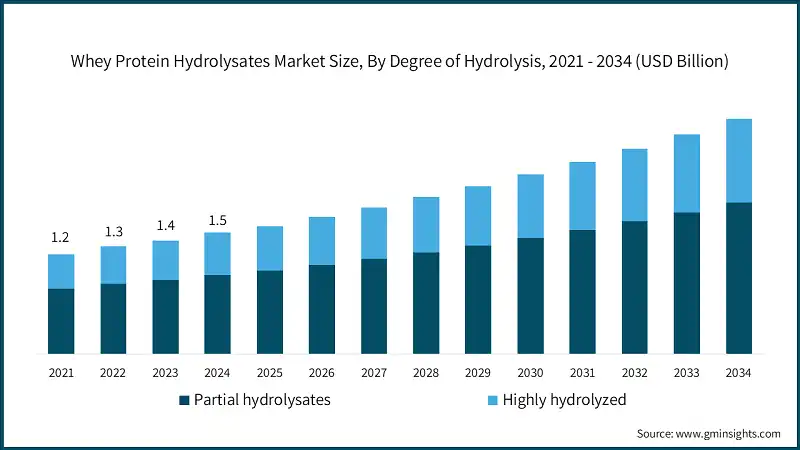
The global whey protein hydrolysates market size was valued at USD 1.5 billion in 2024. The market is expected to grow from USD 1.6 billion in 2025 to USD 2.9 billion in 2034, at a CAGR of 7% according to latest report published by Global Market Insights Inc.
Whey Protein Hydrolysates Market Key Takeaways
Market Size & Growth
- 2024 Market Size: USD 1.5 Billion
- 2025 Market Size: USD 1.6 Billion
- 2034 Forecast Market Size: USD 2.9 Billion
- CAGR (2025–2034): 7%
Key Market Drivers
- Growing sports nutrition market & protein supplementation.
- Increasing clinical nutrition demand.
- Consumer preference for clean label & functional ingredients.
Challenges
- High production costs & price sensitivity.
- Bitterness & sensory challenges limiting consumer acceptance.
Opportunity
- Bioactive peptide-enriched hydrolysates for cardiovascular health.
- MFGM-enriched hydrolysates for cognitive & muscle health.
Key Players
- Market Leader: Arla Foods Ingredients led with over 9.1% market share in 2024.
- Leading Players: Top 5 players in this market include Arla Foods Ingredients, Glanbia Nutritionals, Hilmar Ingredients, Fonterra Co-operative Group, Kerry Group, which collectively held a market share of 27.5% in 2024.
Get Market Insights & Growth Opportunities
- Whey protein hydrolysates are enzymatically pre-digested protein ingredients produced through controlled hydrolysis of whey protein concentrate or isolate, resulting in smaller peptides and free amino acids that offer superior digestibility, rapid absorption, and reduced allergenicity compared to intact whey proteins according to MDPI journal. These functional dairy ingredients have become essential components across infant nutrition, sports nutrition, clinical nutrition, and functional food applications, driven by growing consumer demand for easily digestible, hypoallergenic protein sources and the rising prevalence of lactose intolerance affecting approximately 65-68% of the global adult population.
- The whey protein hydrolysates industry represents a specialized segment within the broader dairy protein ingredients market, characterized by advanced enzymatic processing technologies and stringent quality standards. Production involves sophisticated hydrolysis processes using food-grade enzymes such as Alcalase, Flavourzyme, Neutrase, and Protamex under controlled pH, temperature, and time conditions to achieve specific degrees of hydrolysis ranging from partial (5-10%) to extensive (15-25%) according to American Chemical Society publications. The resulting peptide profiles and molecular weight distributions determine functional properties including solubility, heat stability, foaming capacity, emulsification, and most critically, digestibility and bioavailability for targeted nutritional applications.

To get key market trends
Whey Protein Hydrolysates Market Trends
- Shift toward clean-label hydrolysates: The market is witnessing accelerated demand for clean-label whey protein hydrolysates manufactured without chemical processing aids, artificial additives, or genetically modified organisms. Consumers and formulators increasingly prioritize transparent ingredient declarations, non-GMO Project Verified certifications, and organic options, particularly for infant formula and clinical nutrition applications according to Glanbia Nutritionals.
- This trend has prompted manufacturers to invest in enzymatic hydrolysis processes that deliver consistent peptide profiles while maintaining clean label status, with companies like Arla Foods Ingredients and Glanbia Nutritionals expanding their certified clean-label hydrolysate portfolios to meet regulatory requirements across North America, Europe, and Asia Pacific markets.
- Integration in clinical nutrition & medical foods: Whey protein hydrolysates are experiencing rapid adoption in clinical and medical nutrition applications, driven by their superior digestibility and suitability for patients with compromised gastrointestinal function, malabsorption disorders, and critical care needs. The enzymatically pre-digested peptides enable faster gastric emptying, enhanced amino acid bioavailability, and reduced metabolic stress compared to intact proteins, making them ideal for enteral formulas, oral nutritional supplements, and therapeutic foods for sarcopenia, cachexia, and post-surgical recovery according to Carbery Group.
- Recent product launches such as Arla Foods Ingredients' Lacprodan DI-3092 demonstrate industry focus on delivering high-protein-density hydrolysates (10 g protein per 100 ml versus typical 6-7 g/100 ml) with minimized bitterness and improved patient compliance for medical nutrition applications.
- Expansion of plant-whey hybrid formulations: The market is seeing innovative product development combining whey protein hydrolysates with plant-based proteins to create hybrid formulations that balance nutritional completeness, functional performance, and sustainability credentials. These blended systems leverage the superior amino acid profile and rapid absorption of whey hydrolysates while incorporating plant proteins such as pea, soy, or rice to appeal to flexitarian consumers and address environmental concerns associated with dairy production according to MDPI journal.
- Approximately 22% of new whey-based product launches in 2024 featured plant-blended hybrid protein formulations, reflecting growing market acceptance of combination approaches that optimize both nutritional quality and consumer appeal across sports nutrition, functional beverages, and mainstream food categories as per Industry Research.
Whey Protein Hydrolysates Market Analysis
Learn more about the key segments shaping this market
Based on degree of hydrolysis, the whey protein hydrolysates market is bifurcated into partial hydrolysates and highly hydrolyzed. Partial hydrolysates dominated the category with an approximate market share of 65.1% in 2024 and is expected to grow with a CAGR of 6.9% till 2034.
- Partial hydrolysis preserves significant intact protein structure while generating sufficient small peptides to enhance digestibility and reduce allergenicity compared to non-hydrolyzed whey proteins, creating optimal balance between functional performance and nutritional benefits. The segment benefits from lower bitterness intensity relative to extensively hydrolyzed products, enabling incorporation at higher levels in food and beverage formulations without requiring extensive flavor masking systems.
- Extensive enzymatic hydrolysis generates predominantly small peptides and free amino acids that require minimal digestive processing, enabling use in enteral nutrition formulas for patients with compromised gastrointestinal function, oral nutritional supplements for elderly populations with reduced digestive capacity, and therapeutic foods for malabsorption disorders. The segment commands premium pricing justified by specialized processing requirements, rigorous quality control, regulatory compliance costs, and targeted applications where functional benefits outweigh cost considerations.
Learn more about the key segments shaping this market
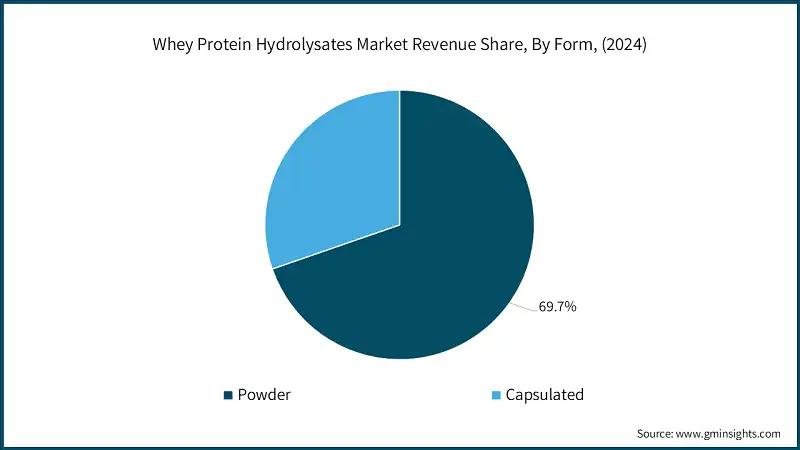
Based on form, the whey protein hydrolysates market is bifurcated into powder & capsulated. Powder holds the largest market share of 69.7% in 2024 and is expected to grow at a CAGR of 6.8% during 2025 to 2034.
- Spray drying represents the primary processing method for converting liquid hydrolysates to powder form, with process parameters including inlet temperature (160-190°C), outlet temperature (60-105°C), and feed concentration (10-30% w/v) optimized to preserve peptide integrity, maintain solubility, and achieve desired physical properties including bulk density, flowability, and dispersibility. Agglomeration and instantization processes further enhance powder functionality by improving wettability and dissolution speed, critical attributes for sports nutrition powders and clinical nutrition products requiring rapid reconstitution.
Based on application, the whey protein hydrolysates market is bifurcated into infant nutrition, sports nutrition, clinical nutrition, functional foods & beverages, animal nutrition. Sports nutrition segment dominated the market with an approximate market share of 42.3% in 2024 and is expected to grow with the CAGR of 7.3% up to 2034.
- Hydrolyzed whey proteins command premium positioning in sports nutrition based on scientific evidence demonstrating faster absorption kinetics (approximately 30% faster than intact whey protein), enhanced muscle protein synthesis stimulation, reduced muscle damage markers, and improved recovery outcomes compared to standard whey protein concentrates and isolates. The segment benefits from strong consumer awareness of protein quality importance, willingness to pay premium prices for functionally differentiated ingredients, and established distribution channels including specialty sports nutrition retailers, online platforms, and mass-market channels.
Looking for region specific data?
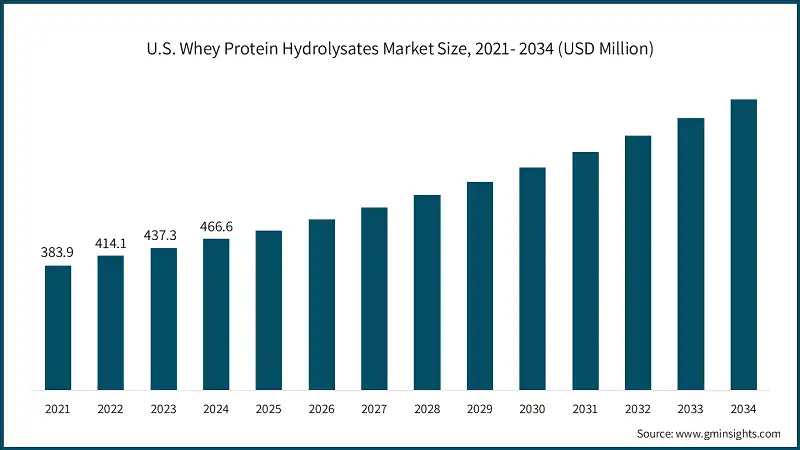
North America leads in the whey protein hydrolysates market with share of 36.9% in 2024.
- The region’s dominance is driven by mature sports nutrition and clinical nutrition industries, high consumer awareness of protein quality and functional benefits, presence of major ingredient manufacturers and processing capacity, and supportive regulatory frameworks.
U.S. dominates the North America whey protein hydrolysates market, showcasing strong growth potential.
- U.S. dry whey production totaled 853 million pounds in 2024 (down 9% versus 2023) while whey protein concentrate production reached 495 million pounds (down 1.9%), indicating tightening supply for commodity whey products while high-protein whey demand remained strong.
Europe is growing in the whey protein hydrolysates with market size of USD 449.7 million in 2024 and is anticipated to show lucrative growth over the forecast period.
- Growth is supported by sophisticated regulatory frameworks, strong infant nutrition and medical foods sectors, growing sports nutrition adoption, and emphasis on quality, safety, and sustainability. The region benefits from stringent regulatory standards including EFSA scientific opinions establishing safety and suitability criteria for protein hydrolysates in infant formula, Commission Delegated Regulation 2024/2684 defining specific compositional and processing requirements for formulas manufactured from protein hydrolysates, and comprehensive food safety and quality assurance systems supporting consumer confidence.
Germany dominates the European Whey Protein Hydrolysates market, showcasing strong growth potential.
- Growth drivers for Germany include aging demographics creating clinical nutrition demand, increasing sports nutrition and active lifestyle adoption particularly among younger demographics, growing demand for functional foods and beverages with health-promoting ingredients, and continued emphasis on sustainable and clean-label products aligning with consumer values.
The Asia Pacific whey protein hydrolysates market is anticipated to grow at a CAGR of 7.6% during the analysis timeframe.
- Asia Pacific represents the fastest-growing regional driven by rapidly expanding middle-class populations, increasing health and wellness awareness, growing sports participation and fitness culture, rising demand for infant formula and specialized nutrition products, and high lactose intolerance prevalence creating natural demand for digestible protein alternatives. The region's sports nutrition market reached USD 9.2 billion in 2024 to USD 11.6 billion by 2027, with protein powders representing USD 3.7 billion, directly supporting regional demand growth for premium protein ingredients including hydrolysates
China Whey Protein Hydrolysates Market is estimated to grow with a significant CAGR in the Asia Pacific market.
- Growth is supported by significant infant formula demand, regulatory framework for foods for special medical purposes approving 24 protein formulas including multiple products incorporating hydrolyzed whey protein and growing sports nutrition adoption among urban middle-class consumers.
Latin America Whey Protein Hydrolysates Market accounted for 3.9% market share in 2024 and is anticipated to show lucrative growth over the forecast period.
- Latin America, represents an emerging opportunity for whey protein hydrolysates driven by growing middle-class populations, increasing health and wellness awareness, expanding sports nutrition adoption, and rising demand for functional foods and beverages.
Brazil leads the Latin American Whey Protein Hydrolysates market, exhibiting remarkable growth during the analysis period.
- Brazil represents the largest country market with established sports nutrition industry and growing protein consumption. Recent industry initiatives include Arla Foods Ingredients launching an application toolbox specifically targeting Latin American manufacturers to inspire high-protein dessert innovation, demonstrating supplier focus on regional market development.
Middle East & Africa Whey Protein Hydrolysates accounted for 4% market share in 2024 and is anticipated to show lucrative growth over the forecast period.
- The Middle East and Africa growth is characterized by growing population, increasing urbanization, rising health awareness, and expanding modern retail infrastructure creating long-term growth potential for whey protein hydrolysates. The region demonstrates high lactose intolerance prevalence (Middle East 70%, Sub-Saharan Africa 63%) supporting demand for digestible protein alternatives, while growing sports nutrition adoption and increasing infant formula consumption create application opportunities.
Saudi Arabia Whey Protein Hydrolysates market to experience substantial growth in the Middle East and Africa Whey Protein Hydrolysates in 2024.
- Growth is fueled by demographic trends (large young populations entering prime sports nutrition consumption age, growing elderly populations requiring clinical nutrition support), economic development (expanding middle class with increasing purchasing power for premium nutritional products), urbanization and lifestyle changes (increasing gym memberships, sports participation, and health-conscious behaviors), and improving distribution infrastructure.
Whey Protein Hydrolysates Market Share
The top 5 companies in whey protein hydrolysates industry include Arla Food Ingredients, Glanbia Nutritionals, Hilmar Ingredients, Fonterra Co-operative, Kerry Group. These are prominent companies operating in their respective regions covering approximately 27.5% of the market share in 2024. These companies hold strong positions due to their extensive experience in whey protein hydrolysates market. Their diverse product portfolios, backed by robust production capabilities and distribution networks, enable them to meet the rising demand across various regions.
- Arla Foods Ingredients : Arla Foods Ingredients holds the leading market position with approximately 9.1% share in 2024, supported by its comprehensive portfolio of whey protein hydrolysate products marketed under the Peptigen and Lacprodan brands, extensive regulatory approvals including U.S. FDA clearance for infant formula applications and EFSA opinions supporting use in European markets, strong technical capabilities in enzymatic hydrolysis and peptide characterization, and global manufacturing footprint enhanced by the strategic acquisition of Volac's whey nutrition business in 2024.
- Glanbia Nutritionals : Glanbia Nutritionals represents a major competitive force in the whey protein hydrolysates market, leveraging its position as the world's number one supplier of whey protein isolate and leading sports nutrition company (Optimum Nutrition brand generating USD 1.2 billion revenue) to serve both business-to-business ingredient customers and direct-to-consumer sports nutrition markets.
- Hilmar Ingredients : Hilmar Ingredients maintains significant market presence as a major U.S.-based whey protein supplier with approximately 6% of global high-whey-ingredients supply, supported by integrated cheese and whey processing operations in Hilmar, California and Dalhart, Texas, plus a new sustainability-focused facility under construction in Dodge City, Kansas representing over USD 600 million investment and adding capacity for WPC80, functional proteins, WPI, and MFGM.
- Fonterra Co-operative Group : Fonterra Co-operative Group represents a major global dairy ingredients supplier with approximately 18% share of the broader whey protein ingredients market and over 350,000 tonnes annual production capacity, providing substantial scale and technical capabilities for whey protein hydrolysate manufacturing
- Kerry Group : Kerry Group maintains significant presence in the whey protein hydrolysates market through its ingredients and flavors division, offering specialized hydrolysate products for infant nutrition, clinical nutrition, sports nutrition, and functional food applications, supported by global manufacturing footprint, strong technical capabilities, and comprehensive flavor solutions that address taste challenges associated with hydrolyzed proteins
Whey Protein Hydrolysates Market Companies
Major players operating in the whey protein hydrolysates industry include:
- Arla Foods Ingredients
- Glanbia Nutritionals
- Hilmar Ingredients
- Fonterra Co-operative Group
- Kerry Group
- FrieslandCampina Ingredients
- Nestlé Health Science
- Carbery Group
- Agropur Ingredients
- Lactalis Ingredients
- Saputo Dairy Ingredients
- Ingredia
Whey Protein Hydrolysates Market Report Attributes
| Key Takeaway | Details |
|---|---|
| Market Size & Growth | |
| Base Year | 2024 |
| Market Size in 2024 | USD 1.5 Billion |
| Market Size in 2025 | USD 1.6 Billion |
| Forecast Period 2025 - 2034 CAGR | 7% |
| Market Size in 2034 | USD 2.9 Billion |
| Key Market Trends | |
| Drivers | Impact |
| Growing sports nutrition market & protein supplementation | The surge in fitness trends and demand for high-quality protein supplements is driving whey protein hydrolysates adoption due to their rapid absorption and muscle recovery benefits. |
| Increasing clinical nutrition demand | Rising prevalence of chronic diseases and aging populations is boosting clinical nutrition formulations, where whey hydrolysates are preferred for easy digestibility and high bioavailability |
| Consumer preference for clean label & functional ingredients | Consumers increasingly seek natural, minimally processed, and functional products, making whey hydrolysates attractive for their clean-label positioning and health benefits |
| Pitfalls & Challenges | Impact |
| High production costs & price sensitivity | Enzymatic hydrolysis and advanced processing raise production costs, limiting affordability and adoption in price-sensitive markets |
| Bitterness & sensory challenges limiting consumer acceptance | Hydrolysis often imparts bitterness, posing formulation challenges and requiring masking techniques to maintain taste appeal. |
| Opportunities: | Impact |
| Bioactive peptide-enriched hydrolysates for cardiovascular health | Targeted hydrolysates rich in bioactive peptides can support heart health, opening opportunities in functional foods and nutraceuticals |
| MFGM-enriched hydrolysates for cognitive & muscle health | Combining whey hydrolysates with milk fat globule membrane (MFGM) offers synergistic benefits for brain function and muscle performance |
| Market Leaders (2024) | |
| Market Leaders |
9.1% |
| Top Players |
Collective Market Share of 27.5% in 2024 |
| Competitive Edge | |
| Regional Insights | |
| Largest Market | North America |
| Fastest Growing Market | Asia Pacific |
| Emerging Country | China and Japan |
| Future Outlook |
|
What are the growth opportunities in this market?
Whey Protein Hydrolysates Industry News
- In November 2024, Arla Foods Ingredients launched a new whey protein hydrolysate with a better taste profile than comparable ingredients for peptide-based medical nutrition.
- In November 2024, Arla Foods Ingredients acquired Volac’s whey nutrition business. The acquisition gives Arla Foods Ingredients a significant additional quantity of whey, helping it meet a growing market need
- In July 2024, Arla Foods Ingredients secured US Food & Drug Administration approval for the use of whey protein hydrolysates that support allergy management and gut comfort in infant formula.
This whey protein hydrolysates market research report includes in-depth coverage of the industry, with estimates & forecasts in terms of revenue (USD Billion) and volume (Kilo Tons) from 2025 to 2034, for the following segments:
Market, By Degree of hydrolysis
- Partial hydrolysates
- Highly hydrolyzed
Market, By Form
- Powder
- Liquid
Market, By Application
- Infant nutrition
- Sports nutrition
- Protein Powders
- Ready to drink shakes
- Clinical nutrition
- Functional foods & beverages
- High-Protein Beverages
- Bakery & Confectionery
- Dairy Products
- Ready-to-Mix Powders
- Animal nutrition
- Livestock
- Pet food
Market, By Distribution Channel
- Retail channels
- Supermarkets and hypermarkets
- Specialty kosher stores
- Convenience stores
- Online and E-commerce
- Direct-to-consumer sales
- Brand website sales
- Subscription services
- E-commerce platforms
- Foodservice channels
The above information is provided for the following regions and countries:
- North America
- U.S.
- Canada
- Europe
- Germany
- UK
- France
- Spain
- Italy
- Rest of Europe
- Asia Pacific
- China
- India
- Japan
- Australia
- South Korea
- Rest of Asia Pacific
- Latin America
- Brazil
- Mexico
- Argentina
- Rest of Latin America
- Middle East and Africa
- Saudi Arabia
- South Africa
- UAE
- Rest of Middle East and Africa
Frequently Asked Question(FAQ) :
What was the market size of the whey protein hydrolysates in 2024?
The market size was valued at USD 1.5 billion in 2024, with a CAGR of 7% expected through 2034. Increasing demand for hypoallergenic, easily digestible protein sources and the rising prevalence of lactose intolerance are driving market growth.
What is the projected value of the whey protein hydrolysates market by 2034?
The market is poised to reach USD 2.9 billion by 2034, driven by advancements in enzymatic hydrolysis processes, clean-label trends, and expanding applications in clinical and sports nutrition.
What is the expected size of the whey protein hydrolysates industry in 2025?
The market size is projected to reach USD 1.6 billion in 2025.
What was the market share of partial hydrolysates in 2024?
Partial hydrolysates dominated the category with an approximate market share of 65.1% in 2024 and is expected to grow at a CAGR of 6.9% through 2034.
What was the market share of powder formulations in 2024?
Powder formulations held the largest market share of 69.7% in 2024 and is set to expand at a CAGR of 6.8% during the forecast period.
What is the growth outlook for the sports nutrition segment from 2025 to 2034?
The sports nutrition segment, which dominated the market with a 42.3% share in 2024, is anticipated to showcase around 7.3% CAGR till 2034.
Which region leads the whey protein hydrolysates sector?
North America leads the market with a 36.9% share in 2024. This dominance is attributed to mature sports, clinical nutrition industries and high consumer awareness.
What are the upcoming trends in the whey protein hydrolysates market?
Key trends include clean-label hydrolysates, expansion into clinical and medical nutrition, plant-whey hybrid formulations, and high-protein-density hydrolysate innovations for medical applications.
Who are the key players in the whey protein hydrolysates industry?
Key players include Arla Foods Ingredients, Glanbia Nutritionals, Hilmar Ingredients, Fonterra Co-operative Group, Kerry Group, Carbery Group, Agropur Ingredients, Lactalis Ingredients, Saputo Dairy Ingredients, and Ingredia.
Whey Protein Hydrolysates Market Scope
Related Reports