Summary
Table of Content

Water Quality Analyzer Market
Get a free sample of this report
Form submitted successfully!
Error submitting form. Please try again.
Thank you!
Your inquiry has been received. Our team will reach out to you with the required details via email. To ensure that you don't miss their response, kindly remember to check your spam folder as well!
Request Sectional Data
Thank you!
Your inquiry has been received. Our team will reach out to you with the required details via email. To ensure that you don't miss their response, kindly remember to check your spam folder as well!
Form submitted successfully!
Error submitting form. Please try again.
Water Quality Analyzer Market Size
The high-precision water quality analyzers is growing largely due to the rising focus on automation-supported environmental monitoring and the tightening of international safety standards for drinking water and wastewater treatment. The use of these analyzers is also driven by the rising number of strategic mergers and acquisitions among manufacturers of analytical instruments, who are looking to enhance their sensor offerings and optimize their efficiency in the municipal and industrial segments. This market trend is resulting in significant advances in sensor fusion, material science, and global expansion, particularly in the chemical processing, pharmaceutical, food & beverage, and utility industries.
Water Quality Analyzer Market Key Takeaways
Market Size & Growth
- 2025 Market Size: USD 4.5 Billion
- 2026 Market Size: USD 4.7 Billion
- 2035 Forecast Market Size: USD 7.3 Billion
- CAGR (2026–2035): 5%
Regional Dominance
- Largest Market: North America
- Fastest Growing Region: North America, Asia Pacific
Key Market Drivers
- Rising demand for fresh water.
- Rapid urbanization and industrialization.
- Increasing water pollution.
Challenges
- High integration complexity.
- Stringent regulatory standards.
Opportunity
- Technological advancements.
- Water scarcity and sustainability initiatives.
Key Players
- Market Leader: Hach (Veralto) led with over 8% market share in 2025.
- Leading Players: Top 5 players in this market include Hach (Veralto), ABB Ltd., Emerson, Horiba Ltd., Thermo Fisher Scientific, which collectively held a market share of 38% in 2025.
Get Market Insights & Growth Opportunities
The conventional basic monitoring kits, developed through manual sampling and insensitive chemical reagents, are increasingly being replaced by advanced high-performance digitally integrated water quality monitoring systems. The advanced analyzers, featuring smart sensors, IoT, and automated calibration capabilities, support more accurate real-time analysis of pH, dissolved oxygen, turbidity, and heavy metals. These advanced systems represent the global industrial community's need for highly efficient operations and strict adherence to emerging international environmental regulations (such as the EU's 2026 PFAS regulations), and thus represent a major driving force behind the water quality analyzer market growth.
The increasing growth of industrial expansion, combined with strict energy and water transition policies in North America and Europe, and growing infrastructure spending in the Asia-Pacific, are some of the most pressing considerations that are playing a pivotal role in making next-generation water analyzers commercially viable. Plant managers and municipal system integrators are increasingly adopting technologically advanced analyzers that provide greater durability, enhanced accuracy in harsh effluent conditions, and lower long-term maintenance costs.
Current sensors are self-calibrating and self-cleaning, minimizing manual input and lowering downtime. Smart diagnostics included in the analyzers identify sensor drift, deterioration, or failure so predictive maintenance can be done prior to the installation of a replacement. These functions lower maintenance time to equipment and increase longevity.
Water quality analyzers are becoming increasingly prevalent in emerging economies. This is a direct result of localized infrastructure investment, public health initiatives, and the influence of international funding agencies. Those decentralized water treatment technologies in rural and peri-urban communities rely heavily on analyzers that are cost-effective. Furthermore, they must be consistently reliable and accurate to be effective for non-expert users who do not regularly maintain their analyzers under unknown weather conditions.
In addition, design innovations centered on safety, such as advanced self-cleaning systems, anti-fouling materials, and cloud-based dashboard interfaces, are also improving the user experience and enabling more proactive water resource management. These factors are collectively contributing to positive financial outcomes in the market, fueled by steadily rising adoption rates, the global trend toward smart water networks, and the need for data-driven resource management solutions. The development of water quality analyzers—from bench-top laboratory analyzers to rugged, online smart-enabled analyzers—is being largely fueled by advances in materials such as corrosion-resistant titanium enclosures, high-resilience polymers, and nanotechnology-based sensors. These materials provide longer product life, enhanced chemical resistance, and stability in extreme salinity or temperature environments.
The water quality analyzer market was estimated at USD 4.5 billion in 2025. The market is expected to grow from USD 4.7 billion in 2026 to USD 7.3 billion in 2035, at a CAGR of 5% according to latest report published by Global Market Insights Inc.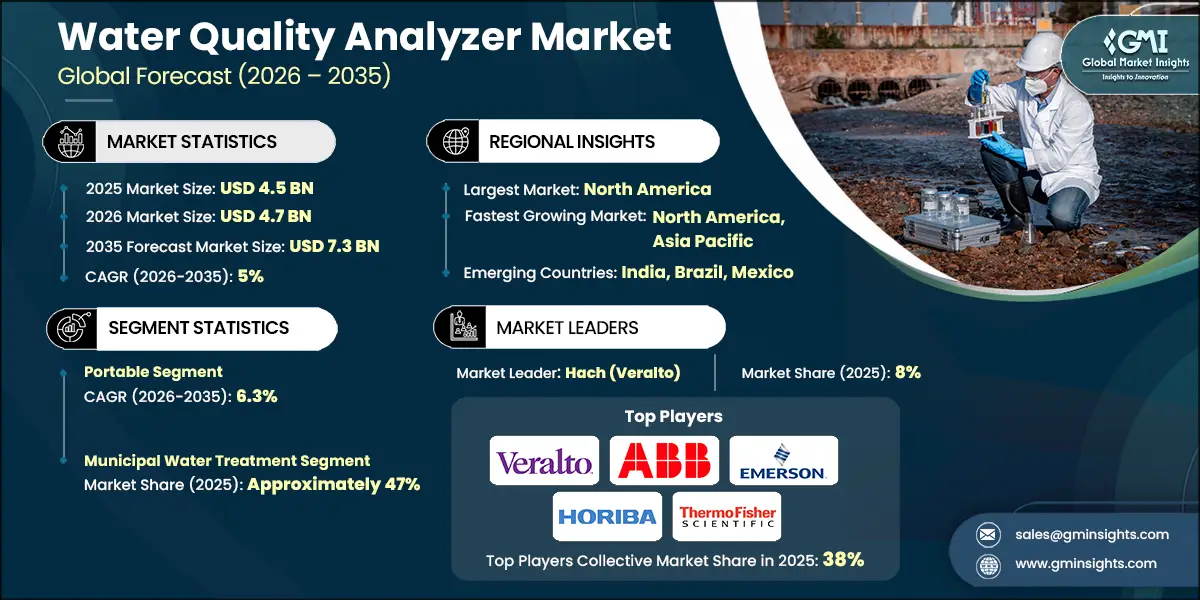
To get key market trends
Water Quality Analyzer Market Trends
The industry for water quality analyzers is experiencing a growing need for high-purity and specialty water analysis in high-stakes industries such as semiconductor electronics, pharmaceutical biotechnology, and green energy (especially green hydrogen technology). Such industries demand accurate and reliable measurement of ultra-low-level contaminants to guarantee product quality, patient safety, and process integrity. The industry is therefore experiencing the rapid emergence and adoption of advanced multi-parameter analyzers designed to withstand extreme sample temperatures, high pressures, and corrosive process fluids. These analyzers now incorporate highly sensitive optical and electrochemical sensors with digital control, remote access, and self-testing capabilities, greatly improving operational ease and accuracy.
The industry is also fuelled by the rising awareness and enforcement of environmental and occupational health and safety (OHS) regulations concerning wastewater discharge and drinking water safety. Hazardous water poses serious threats of ecological disaster and public health emergencies if not closely monitored with high accuracy. The industry is therefore experiencing a rapid rise in demand for analyzers capable of making real-time measurements of micropollutants, heavy metals, and TOC (Total Organic Carbon) to meet the most stringent standards
- Energy transition & hydrogen-ready analysis: With the growing need for green hydrogen in the global energy transition, there has been an increasing need for high-purity water analyzers. High-efficiency electrolyzers need high-purity water with conductivities close to the theoretical minimum. Companies such as Xylem and Hach are working on advanced monitoring solutions for these giga-scale energy projects, setting a new standard for robustness. This energy transition is compelling companies to speed up their R&D in anti-fouling coatings and ultra-high-precision conductivity solutions.
- Digitalization & smart water integration: Digitalization is a paradigm shift in the water industry. The industry is adopting smart analyzers with IoT connectivity, cloud-based data storage, and predictive maintenance capabilities. Industry leaders are at the forefront of this revolution, incorporating AI-powered diagnostic capabilities into their solutions. This enables the industry to move from a reactive maintenance approach to a proactive approach, minimizing non-revenue water (NRW) losses and ensuring 24/7 compliance.
- Product diversification into ultrapure & specialty markets: The increasing demand for ultra-clean water in the semiconductor and pharmaceutical markets has led to a rapid diversification of products. Companies are now diversifying their product lines to include ultra-high-purity products, medical-grade products, and lab-on-a-chip analyzers to cater to the specialized needs of the market. Such products may involve advanced filtration, the use of titanium parts for corrosion resistance, and ultra-stable calibration. Moreover, entering such high-spec markets also generates a continuous stream of revenue in the aftermarket through specialized sensor replacement, reagent refills, and calibration.
Water Quality Analyzer Market Analysis
Learn more about the key segments shaping this market
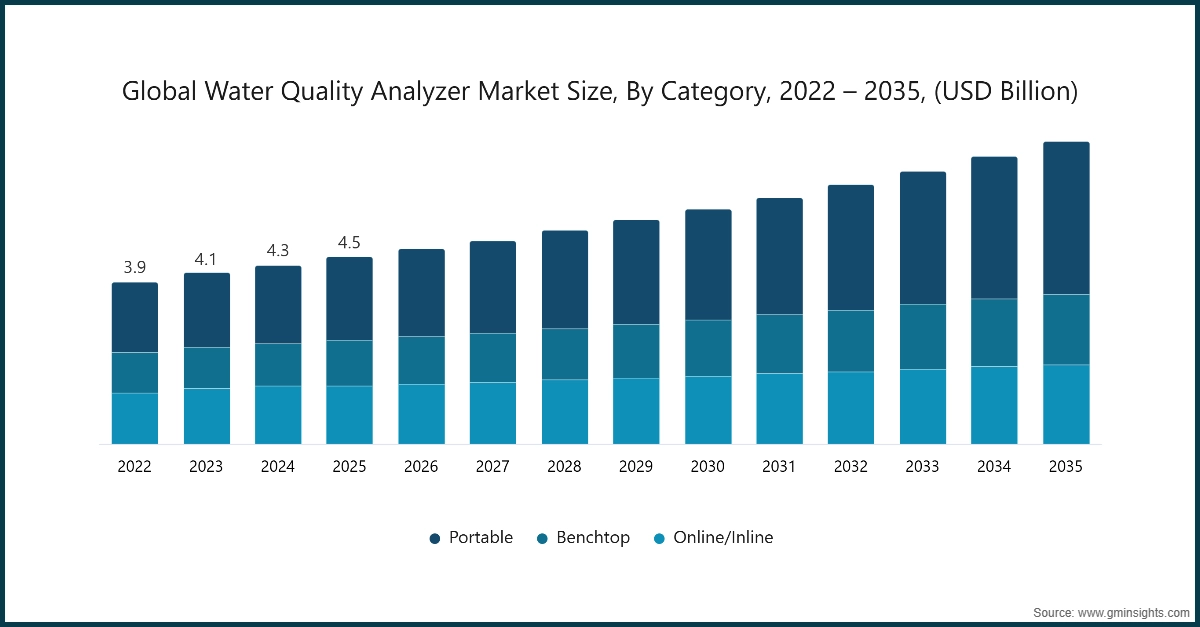
Based on category, the market is segmented into portable, benchtop, and online/inline analyzers. The portable segment reached USD 2 billion in 2025 and is expected to reach USD 3.68 billion by 2035, growing at the fastest CAGR of 6.3% during the forecast period.
- Portable analyzers allow for the assessment of water quality parameters directly in the field. These devices are compact, lightweight, and battery-operated, making them ideal for environmental surveys, emergency response, and spot-checks in remote locations. Their ability to deliver rapid, on-site results without transporting samples to a laboratory is a primary driver of their high growth rate.
- Benchtop analyzers provide a controlled laboratory environment for in-depth analysis. While less mobile, they offer superior precision and the ability to measure a wider array of complex parameters (such as trace metals and organic compounds).
- Online/Inline analyzers represent a significant portion of the market, particularly in municipal and industrial facilities where continuous, real-time data is required. These systems are integrated directly into the process stream, enabling automated monitoring and immediate response to quality deviations.
- The transition toward smart water networks is increasingly favouring online/inline systems in mature markets, while Portable units are seeing massive adoption in the Asia-Pacific and Latin American regions where field-based infrastructure development is a priority.
Learn more about the key segments shaping this market
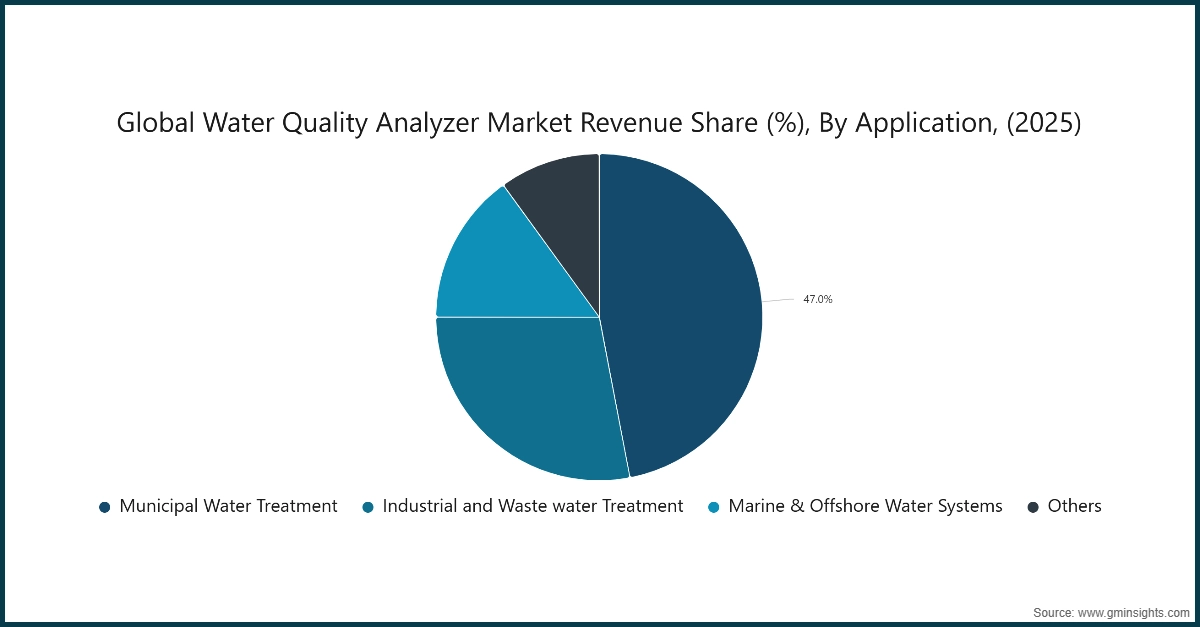
Based on application, the water quality analyzer market is categorized into municipal water treatment, industrial and wastewater treatment, marine & offshore, and others. In 2025, the municipal water treatment segment accounted for the largest market share of approximately 47% and is expected to maintain its dominance through 2035.
- Municipal systems rely heavily on analyzers to ensure potable water safety and compliance with public health standards. The segment's large share is driven by the consistent need for monitoring parameters like pH, chlorine, and turbidity in high-volume urban distribution networks.
- Industrial and wastewater treatment is the second-largest application, segment is essential for sectors such as pharmaceuticals, chemicals, and food & beverage, where effluent must meet strict environmental discharge limits.
- Marine & offshore water systems represent the most specialized segment, offering the second-highest growth rate. These analyzers are designed with corrosion-resistant materials to handle high-salinity environments and are essential for ballast water treatment and offshore platform operations.
- Safety and precision in these applications are driving a shift toward analyzers featuring advanced sealing mechanisms and corrosion-resistant alloys such as titanium or high-grade stainless steel to ensure durability in harsh industrial or marine conditions.
North America Water Quality Analyzer Market
Looking for region specific data?
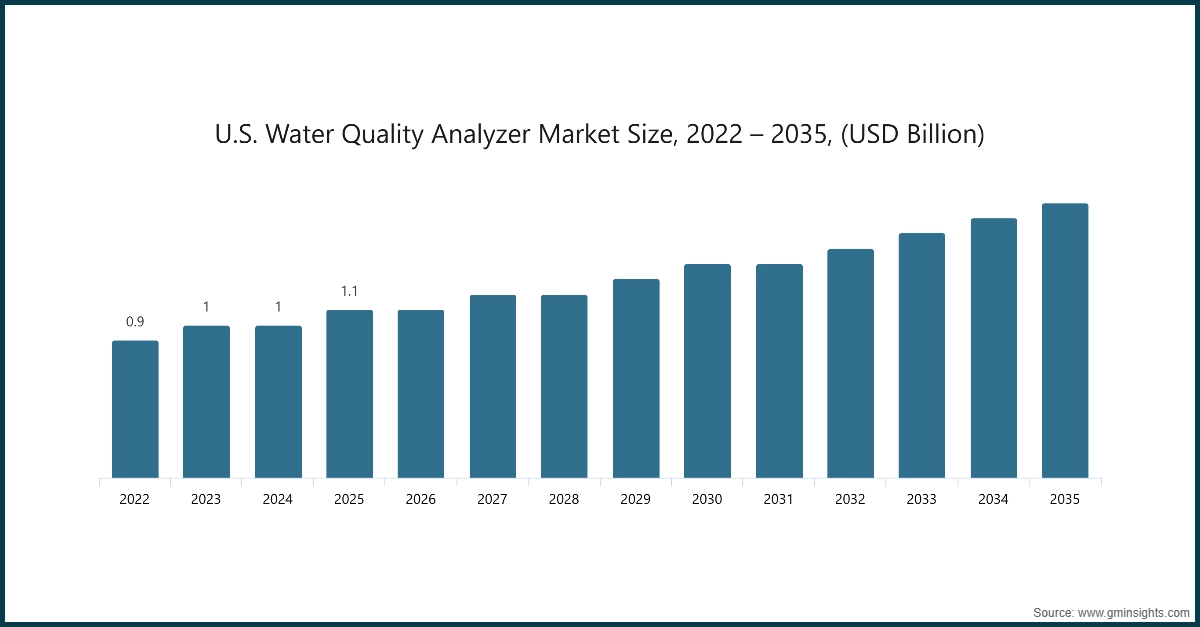
U.S. remains one of the strongest and most stable markets in North America, with the water quality analyser segment reaching USD 1.1 billion in 2025. This steady expansion is primarily driven by mature end-use industries such as municipal utilities, pharmaceutical manufacturing, and the burgeoning green hydrogen sector.
- The United States continues to dominate the regional market accounting for 74.3% of the share in 2025 due to stringent safety and environmental standards enforced by the EPA and FDA, which mandate the use of high-precision analyzers for potable water and industrial effluent.
- The rapid rise of semiconductor fabrication plants requiring ultrapure water and the modernization of aging municipal infrastructure.
- Additionally, heavy investments in AI-driven water monitoring and IoT-integrated systems support continuous demand for premium Online/Inline and Portable analyzers.
Europe Water Quality Analyzer Market
Europe demonstrates consistent growth, with market revenue reaching USD 1.25 billion in 2025, supported by strict regulatory frameworks and a major push toward the "Green Deal" and circular water economies.
- Countries such as Germany which holds a 24.3% share of the European market are investing heavily in advanced wastewater treatment, desalination, and chemical-neutral processing.
- The region’s strong pharmaceutical and food & beverage industries drive additional demand for high-purity analyzers capable of detecting micro-contaminants at the parts-per-billion (ppb) level.
- Furthermore, EU-wide standards emphasizing the reduction of PFAS and microplastics are pushing industries to upgrade outdated monitoring systems to high-performance digital platforms.
Asia Pacific Water Quality Analyzer Market
Asia-Pacific is a high-growth region, reaching USD 1.13 billion in 2025, driven by rapid urbanization and large-scale industrial water management expansion.
- China growing at a 5.7% CAGR and India are major contributors, with substantial growth in electronics manufacturing and municipal water filtration projects. APAC’s massive investment in new "smart cities" significantly increases the demand for both Portable and Online analyzers.
- The region’s focus on desalination to combat water scarcity and the expansion of the chemical manufacturing cluster are accelerating the adoption of corrosion-resistant, high-durability sensors.
- Availability of high-volume industrial activities and government-led water cleanup initiatives (like the "Clean Ganga" mission or China’s "Water Ten Plan") make Asia-Pacific a dynamic landscape for both volume-based and high-tech segments
Latin America Water Quality Analyzer Market
Latin America shows moderate but steady growth, reaching USD 0.31 billion in 2025. Key regional markets—Brazil, Mexico, and Chile—are witnessing gradual upgrades in water infrastructure, especially within mining, food processing, and municipal wastewater sectors.
- Brazil leads the region with a projected growth rate of 6.9% CAGR, the highest in the regional sub-segment, driven by expanding sanitation projects and industrial environmental compliance.
- Despite economic fluctuations, LATAM’s demand for reliable water quality analyzers is increasing due to new safety regulations and the modernization of industrial manufacturing facilities.
- While the market remains price-sensitive, the adoption of portable analyzers for field testing in remote mining and agricultural areas is rising rapidly.
Water Quality Analyzer Market Share
Hach (Veralto) is leading the market with approximately 8% market share. Top players including Hach (Veralto), ABB Ltd. and Thermo Fisher Scientific, Emerson, Horiba Ltd. are collectively held a substantial 38% market share. The market is highly fragmented. These industry leaders are actively engaged in strategic initiatives, such as mergers & acquisitions, facility expansions, and partnerships, to broaden their product portfolios, reach a wider customer base, and strengthen their market presence. These companies continuously invest in research & development to improve their products and incorporate new technologies, allowing them to stay ahead of the competition.
Horiba Limited is a company focused on spectroscopic technologies and water analysis solutions like ultraviolet-visible spectroscopic instruments, fluorescence, and inductively coupled plasma optical emission spectroscopy. Their analyzers and instruments provide indications of environmental, industrial, and OEM needs with accuracy, reliability, and the ability to remotely monitor real-time analysis and reporting.
Shimadzu Corporation has been producing instrumentation for over 50 years used to analyze water quality and total organic carbon. Their product line includes the TOC-4200 and e-TOC series in portable and online instrument options. Both product lines have excellent sensitivity, stability and high-performance analysis in any water type, including pure water to heavily polluted waters.
Water Quality Analyzer Market Companies
Major players operating in the water quality analyzer industry are:
- ABB Ltd.
- AppliTek (Hach)
- Christian Bürkert GmbH
- Emerson
- Endress+Hauser
- Hach (Veralto)
- Horiba Ltd.
- Martek Instruments
- Metrohm AG
- Mettler Toledo (Thornton)
- Shimadzu Corp.
- Thermo Fisher Scientific
- Veralto Corporation
- Xylem (Evoqua)
- Xylem (YSI)
ABB announced its UV tech optical water analyzers, advancing real-time water quality monitoring capabilities. This new sensor system replaces the realtek sensor offerings acquired by ABB in February 2024. UV tech integrates patented optical sensors, controllers, accessories, and analytics software to provide water and wastewater operations with immediate insights for improved performance, efficiency, and safety.
Water Quality Analyzer Market Report Attributes
| Key Takeaway | Details |
|---|---|
| Market Size & Growth | |
| Base Year | 2025 |
| Market Size in 2025 | USD 4.5 Billion |
| Market Size in 2026 | USD 4.7 Billion |
| Forecast Period 2026-2035 CAGR | 5% |
| Market Size in 2035 | USD 7.3 Billion |
| Key Market Trends | |
| Drivers | Impact |
| Rising demand for fresh water | The growing focus on public health and sustainable resource management drives investment in advanced water quality analyzers. |
| Rapid urbanization and industrialization | The increasing wastewater discharge and chemical run-off create a higher demand for high-performance analyzers to monitor and control environmental impact. |
| Increasing water pollution | It drives regulatory enforcement and accelerates the deployment of precision analyzers for early detection and remediation. |
| Pitfalls & Challenges | Impact |
| High integration complexity | Water monitoring applications in critical and remote locations face limitations in accuracy, maintenance requirements, and real-time monitoring capabilities, which restrict widespread adoption. |
| Stringent regulatory standards | The implementation of stringent global standards drives demand for high-performance analyzers while creating market entry barriers for manufacturers of low-cost monitoring solutions. |
| Opportunities: | Impact |
| Technological advancements | The advancements in portable, IoT-enabled, and cloud-integrated analyzers enable real-time monitoring, remote diagnostics, and predictive maintenance. |
| Water scarcity and sustainability initiatives | The global emphasis on water reuse, conservation, and sustainable management is increasing the implementation of analyzers at municipal and private levels. |
| Market Leaders (2025) | |
| Market Leader |
8% market share |
| Top Players |
Consolidate share of 38% |
| Competitive Edge |
|
| Regional Insights | |
| Largest Market | North America |
| Fastest growing market | North America, Asia Pacific |
| Emerging countries | India, Brazil, Mexico |
| Future outlook |
|
What are the growth opportunities in this market?
Water Quality Analyzer Industry News
- In November 2025, Veralto Corporation (parent company of Hach) announced a definitive agreement to acquire In-Situ, a pioneer in environmental water monitoring. This strategic acquisition is designed to significantly expand Veralto’s portfolio in high-growth surface water and groundwater analysis. The integration of In-Situ’s advanced sensors with Veralto’s existing Hach and OTT HydroMet brands will create a comprehensive suite of real-time analyzers for municipal, environmental, and industrial wastewater sectors.
- In January 2024, ABB Ltd. successfully completed the acquisition of Real Tech Inc., a leading provider of optical sensor technology for real-time water quality monitoring. This investment allows ABB to enhance its digital water portfolio with advanced spectrophotometric sensors that detect organic matter and suspended solids. The move reinforces ABB’s position in the smart water management market, providing utilities and industries with high-precision analytical tools for more sustainable water resource management.
- In May 2024, Xylem Inc. launched its new 2030 sustainability goals, significantly increasing its R&D investment in advanced analytics following its merger with Evoqua Water Technologies. A key part of this initiative involves the deployment of the water one digital management platform, which integrates real-time monitoring and 24/7 remote diagnostics. This service-led model ensures high-purity water consistency for the pharmaceutical and microelectronics industries, reducing operational downtime and improving water utilization efficiency.
- In July 2025, Veralto Corporation committed EUR 20 million to emerald technology ventures’ new fund to accelerate the development of next-generation water innovation solutions. This investment targets the advancement of digital water technologies and high-sensitivity sensing platforms. By supporting emerging tech in the water-energy nexus, Veralto is positioning its brands—including AppliTek and Hach—at the forefront of the global shift toward automated and energy-efficient water quality management.
- In January 2026, Thermo Fisher Scientific highlighted the success of its Aquanex ultrapure water purification system, which has set new industry benchmarks for laboratory-grade water analysis. The system features integrated smart-dispensing and standard leak-detection sensors designed for high-precision workflows in organic carbon analysis and spectroscopy. This product launch addresses the rising demand in the healthcare and life sciences sectors for ultra-clean water flow with high-pressure stability and minimal maintenance requirements.
- In March 2025, Endress Hauser announced a major expansion of its endress water challenge initiative, incorporating the installation of advanced sensor systems to monitor water levels and quality in disadvantaged regions like Togo and South Africa. This project utilizes the company's latest IoT-enabled sensors for real-time contaminant detection, supporting global public health initiatives while demonstrating the durability of its sensing equipment in extreme environmental conditions.
The water quality analyzer market research report includes in-depth coverage of the industry with estimates & forecasts in terms of revenue (USD Billion) and volume (Thousand Units) from 2022 to 2035, for the following segments:
Market, By Product Type
- pH meters
- Conductivity meters
- Turbidity meters
- Dissolved oxygen analyzers
- Total organic carbon analyzers
- Oxidation-reduction potential sensors
- Ammonia/nitrate/nitrite sensors
- Multi-parameter water quality analyzers
- Colorimeters and spectrometers
- Others
Market, By Category
- Portable
- Benchtop
- Online/Inline
Market, By Parameter Type
- Single parameter analyzers
- Multi-parameter analyzers
Market, By Application
- Municipal water treatment
- Industrial and wastewater treatment
- Marine & offshore water systems
- Others
Market, By Distribution Channel
Direct
- Indirect
The above information is provided for the following regions and countries:
- North America
- U.S.
- Canada
- Europe
- Germany
- UK
- France
- Italy
- Spain
- Asia Pacific
- China
- India
- Japan
- Australia
- South Korea
- Latin America
- Brazil
- Mexico
- Argentina
- Middle East and Africa
- South Africa
- Saudi Arabia
- UAE
Frequently Asked Question(FAQ) :
What is the market size of the water quality analyzer in 2025?
The market size was USD 4.5 billion in 2025, with a CAGR of 5% expected through 2035 driven by tightening international safety standards for drinking water and wastewater treatment, and growing adoption of IoT-enabled smart water management systems.
What is the projected value of the water quality analyzer market by 2035?
The water quality analyzer market is expected to reach USD 7.3 billion by 2035, propelled by expanding multi-parameter analyzer adoption, and rising water scarcity driving conservation-focused infrastructure investments.
What is the current water quality analyzer market size in 2026?
The market size is projected to reach USD 4.7 billion in 2026.
How much revenue did the portable analyzers segment generate in 2025?
The portable analyzers segment reached USD 2 billion in 2025, leading category growth at a CAGR of 6.3%, driven by their compact field-use design, rapid on-site results.
What was the market share of the municipal water treatment segment in 2025?
The municipal water treatment segment accounted for the largest share of approximately 47% in 2025, driven by the consistent need to monitor pH, chlorine, and turbidity parameters in high-volume urban distribution networks.
What is the growth outlook for Brazil's water quality analyzer market from 2026 to 2035?
Brazil leads Latin America with a projected CAGR of 6.9% till 2035, driven by industrial environmental compliance requirements, and rising adoption of portable analyzers for field testing in remote mining and agricultural areas.
Which region leads the water quality analyzer market?
North America leads the market, with the U.S. alone reaching USD 1.1 billion in 2025 and holding a 74.3% regional share, supported by rapid growth of semiconductor fabrication requiring ultrapure water, and heavy investment in AI-driven and IoT-integrated monitoring systems.
What are the upcoming trends in the water quality analyzer market?
Key trends include growing demand for high-purity analysis in semiconductor, pharmaceutical, and green hydrogen sectors, rapid digitalization through IoT-connected smart analyzers with AI-powered diagnostics, product diversification into ultrapure and specialty markets, and increasing energy transition requirements driving advanced conductivity monitoring solutions.
Who are the key players in the water quality analyzer market?
Key players include ABB Ltd., AppliTek (Hach), Christian Bürkert GmbH, Emerson, Endress+Hauser, Hach (Veralto), Horiba Ltd., Martek Instruments, Metrohm AG, Mettler Toledo (Thornton), Shimadzu Corp., Thermo Fisher Scientific, Veralto Corporation, Xylem (Evoqua), and Xylem (YSI).
Water Quality Analyzer Market Scope
Related Reports