Summary
Table of Content

Vehicle Conversion Market
Get a free sample of this report
Form submitted successfully!
Error submitting form. Please try again.
Thank you!
Your inquiry has been received. Our team will reach out to you with the required details via email. To ensure that you don't miss their response, kindly remember to check your spam folder as well!
Request Sectional Data
Thank you!
Your inquiry has been received. Our team will reach out to you with the required details via email. To ensure that you don't miss their response, kindly remember to check your spam folder as well!
Form submitted successfully!
Error submitting form. Please try again.
Vehicle Conversion Market Size
The vehicle conversion market volume was estimated at 257.3 thousand units in 2025. The market is projected to grow from 280.4 million units in 2026 to 535 million units by 2035.
Vehicle Conversion Market Key Takeaways
Market Size & Growth
- 2025 Market Size: USD 7.4 Billion
- 2026 Market Size: USD 8.1 Billion
- 2035 Forecast Market Size: USD 19.7 Billion
- CAGR (2026–2035): 10.3%
Regional Dominance
- Largest Market: North America
- Fastest Growing Region: Asia Pacific
Key Market Drivers
- Growing demand for electric vehicle conversions driven by environmental regulations.
- Rising adoption of accessible mobility solutions for aging populations.
- Expansion of last-mile delivery and e-commerce logistics requiring specialized fleets.
- Government incentives and subsidies for EV retrofitting programs.
- Increasing consumer preference for personalized and custom vehicles.
Challenges
- High upfront costs of conversion kits and retrofitting services.
- Complex regulatory and certification requirements across regions.
Opportunity
- Development of modular and plug-and-play conversion kits for the DIY market.
- Expansion into emerging markets with aging internal combustion engine vehicle fleet.
- Integration of advanced telematics and IoT technologies in converted vehicles.
- Growing recreational vehicle market driving camper van conversion demand.
Key Players
- Market Leader: BraunAbility led with over 7% market share in 2025.
- Leading Players: Top 5 players in this market include BraunAbility, Creative Mobile Interiors, ROUSH CleanTech, Sortimo, Syncro System, which collectively held a market share of 24% in 2025.
Get Market Insights & Growth Opportunities
The vehicle conversion market is an emerging segment supporting advanced mobility customization and safety enhancement across passenger, commercial, and specialty vehicles. Vehicle conversion solutions include structural, electronic, and functional modifications such as mobility accessibility upgrades, safety system integration, powertrain customization, and mission-specific vehicle transformation. The market primarily serves fleet operators, individual consumers, government agencies, and emergency service providers seeking enhanced operational efficiency and safety performance.
The vehicle conversion market includes hardware components, embedded software, AI-driven platforms, and after-sales services catering to OEMs, fleet operators, government agencies, and Tier 1 manufacturers. Solutions cover mobility upgrades, powertrain conversions, emergency vehicle transformations, and commercial fleet modifications.
Vehicle conversion technologies have advanced from basic mechanical modifications to integrated platforms featuring ECUs, telematics, ADAS, and AI-driven software. These solutions enable real-time monitoring, OTA updates, and connectivity, aligning retrofitted vehicles with future mobility and safety standards.
The vehicle conversion market is growing rapidly due to stringent safety and emissions regulations, fleet electrification mandates, and rising demand for mobility accessibility and mission-specific vehicles. Regulatory requirements and EV adoption incentives are driving fleet operators to opt for cost-effective powertrain conversions, especially for commercial and heavy-duty vehicles.
North America leads the vehicle conversion industry, driven by stringent regulatory enforcement, widespread adoption of advanced vehicle safety and electrification technologies, and a robust presence of major automotive OEMs, fleet operators, and specialized conversion technology providers. Agencies like the National Highway Traffic Safety Administration (NHTSA) and the Americans with Disabilities Act (ADA), along with state-level mandates for EV fleet transitions, have spurred the rapid standardization and adoption of conversion solutions across passenger, commercial, and government vehicles.
For instance, in March 2025, the National Highway Traffic Safety Administration (NHTSA) introduced updated safety guidelines promoting advanced vehicle safety systems like automatic emergency braking (AEB) and pedestrian detection. This initiative is driving AI-based multi-sensor platform adoption and boosting ADAS retrofit demand among North American fleet operators.
Asia Pacific, led by countries like China, Japan, South Korea, and India, is the fastest-growing region due to rising vehicle production, urbanization, and government-backed initiatives like China's carbon neutrality goals and India's FAME scheme, driving EV adoption and retrofitting solutions.
Global vehicle conversion market was estimated at USD 7.4 billion in 2025. The market is expected to grow from USD 8.1 billion in 2026 to USD 19.7 billion in 2035, at a CAGR of 10.3% according to latest report published by Global Market Insights Inc.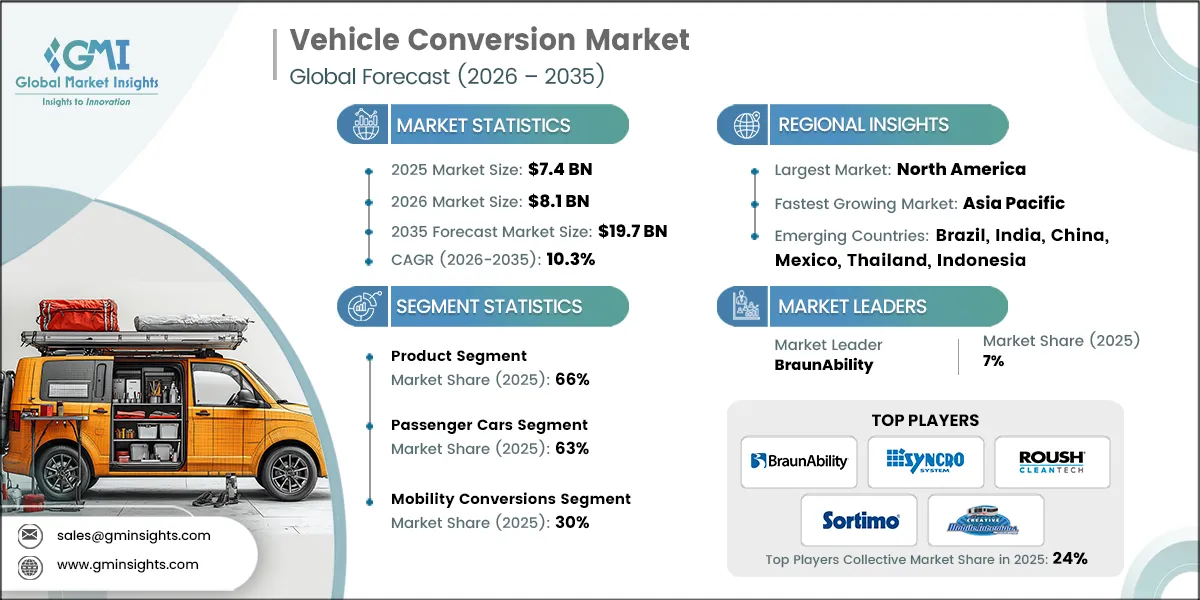
To get key market trends
Vehicle Conversion Market Trends
The vehicle conversion market is advancing rapidly due to tightening emissions and safety regulations, accelerating electrification mandates, continuous innovation in conversion technologies, and deepening integration within next-generation fleet management, smart mobility, and autonomous vehicle platforms, supporting the transition toward cleaner, safer, and more accessible mobility ecosystems.
Stringent global vehicle safety, emissions, and accessibility regulations remain the primary transformation driver, with regulatory authorities across major automotive regions mandating fleet electrification transitions, accessibility upgrades, and advanced safety system integration to meet updated environmental performance, vulnerable road user protection, and inclusive mobility standards. ICE phase-out timelines, zero-emission zone designations, and fleet carbon reduction targets are compelling fleet operators and government agencies to pursue vehicle conversion as a cost-effective and operationally efficient alternative to full fleet replacement.
The growing adoption of electric vehicles and advancements in EV powertrain retrofit technologies are driving demand for ICE-to-electric conversion solutions across various vehicle segments. Declining conversion kit costs, improved battery energy density, and expanding EV infrastructure are enabling fleet operators to electrify assets cost-effectively, supported by government incentives and sustainability mandates.
Growing awareness of inclusive mobility needs and stricter accessibility laws are driving demand for mobility conversion solutions in passenger and commercial vehicles. Aging populations in North America, Europe, and parts of Asia Pacific, along with government-backed programs and mandates, are fueling consistent demand for wheelchair-accessible vehicles, adaptive driving tools, and hand control systems.
AI-enabled vehicle management systems, telematics, and connected platforms are enhancing retrofitted vehicles with real-time health monitoring, predictive maintenance, and OTA updates. These advancements improve operational efficiency and enable integration with fleet management and smart mobility ecosystems for optimized performance.
The growing demand for mission-specific vehicle conversions in emergency services, defense, public safety, and utility sectors is driving market growth. Advanced systems integration in ambulances, fire trucks, police cars, and command vehicles is creating opportunities for upfitters in North America, Europe, and the Middle East.
For instance, in February 2025, XL Fleet expanded its commercial vehicle electrification and hybrid conversion platform to meet growing demand from municipal fleet operators and logistics firms aiming to reduce emissions through cost-effective powertrain conversions.
Learn more about the key segments shaping this market
Vehicle Conversion Market Analysis
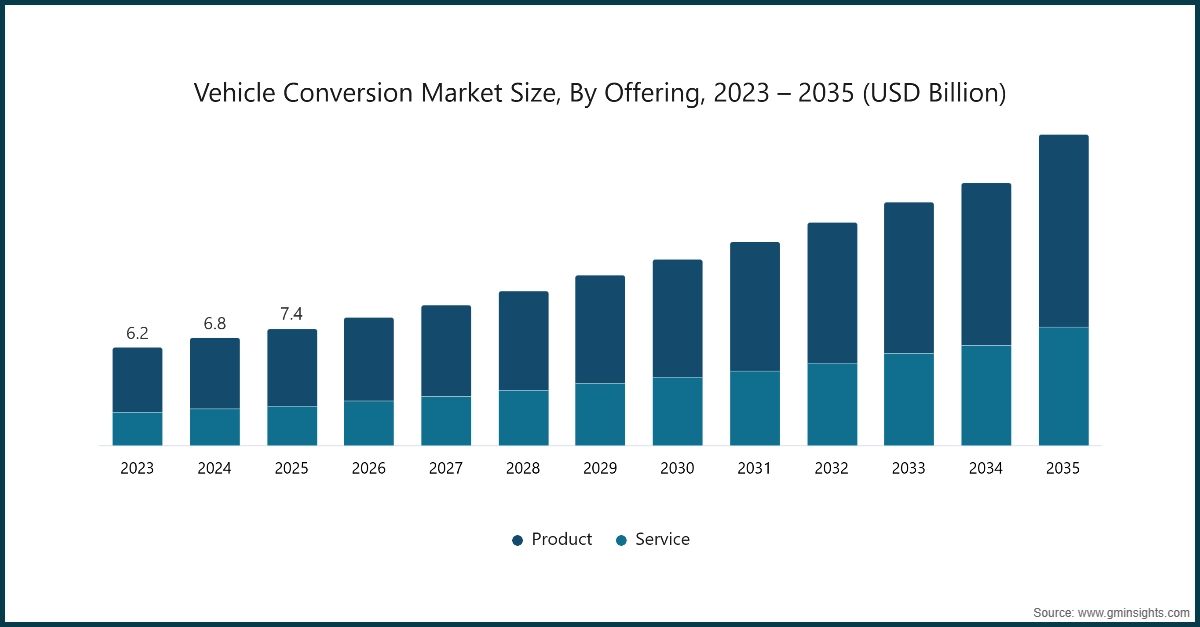
Based on offering, the market is segmented into product and service each play distinct but complementary roles in the conversion value chain. The product segment dominates the market with 66% share in 2025, and the segment is expected to grow at a CAGR of 9.7% from 2026 to 2035.
- The product segment encompasses physical components including conversion kits, electric motors, battery packs, controllers, Battery Management Systems, charging equipment, mechanical components, and installation hardware.
- Products represent the tangible conversion components with established supply chains spanning from specialized conversion kit manufacturers to major automotive OEMs entering the retrofit market.
- The product market has matured, offering standardized solutions across price tiers. Entry-level kits (USD 6,000-15,000) cater to DIY converters with DC motors and lead-acid batteries, while mid-range kits (USD 15,000-30,000) target enthusiasts and small fleets with AC motors and lithium batteries. Premium systems (USD 30,000+) provide high voltage 400V+ configurations and 50+ kWh battery packs for professional and commercial use.
- Increasing conversion volumes drive economies of scale by lowering component costs, streamlining procurement through mature supply chains, and reducing custom engineering needs via standardization.
- Innovations focus on higher energy density batteries, efficient motor designs, advanced thermal management systems, and integrated charging solutions compatible with emerging standards like Open Charge Point interoperability.
- In 2025, the service segment accounted for 33% of the market share. It is projected to grow at an 11.5% CAGR, reaching USD 7.4 billion by 2035.
- Services demonstrate higher growth rates due to increasing conversion complexity requiring specialized expertise, stringent regulatory certification requirements, high-voltage electrical system safety considerations, and growing consumer preference for professionally installed systems with warranty protection.
- Professional installation costs vary between USD 5,000 and USD 15,000 based on vehicle type and conversion complexity. Turnkey professional conversions start at around USD 30,000 and can exceed USD 500,000 for luxury or classic cars.
- Service providers deliver value through expertise in high-voltage electrical systems (48-400+ volts) requiring specialized knowledge and safety protocols, while efficiently managing regulatory compliance across varying state requirements.
Learn more about the key segments shaping this market
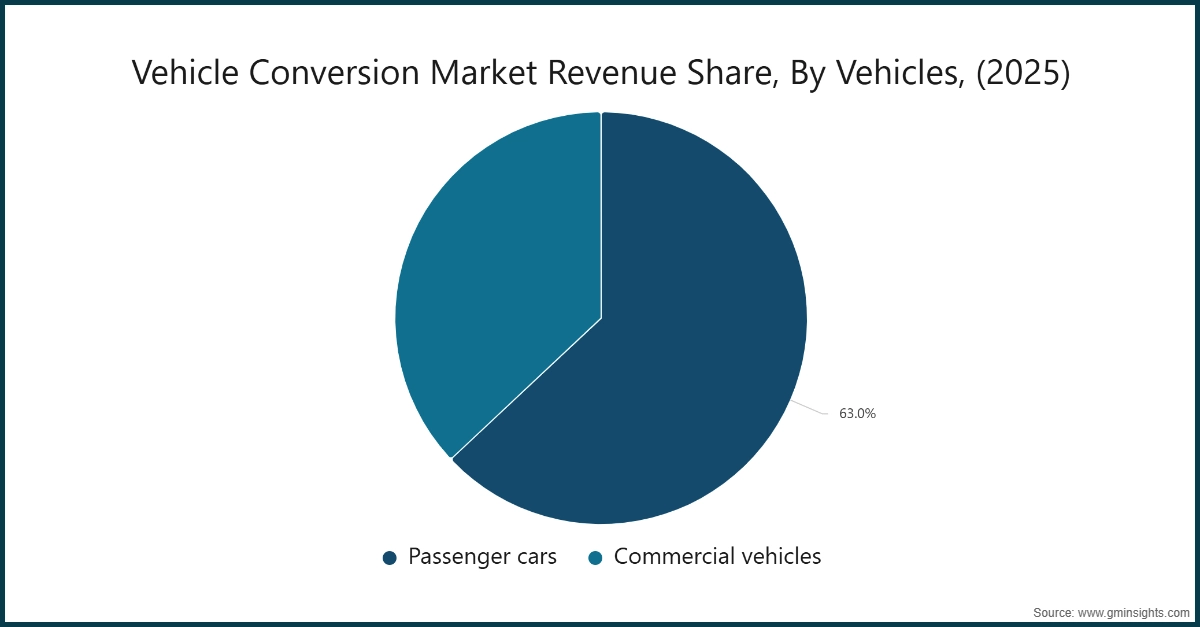
Based on vehicles, the market is divided into passenger cars and commercial vehicles with distinct adoption drivers, use cases, and value propositions characterizing each segment. The passenger cars segment dominates with 63% market share in 2025 and is growing at the rate of 9.9% CAGR.
- Vehicle conversion market demand is primarily driven by evolving mobility requirements, sustainability mandates, and the need for specialized vehicle functionality across passenger and commercial segments. Regulatory frameworks promoting electrification, accessibility, and emission reduction are accelerating structured conversion activities globally.
- For instance, in March 2025, regulatory tightening under the European Union’s Fit-for-55 framework and urban low-emission zone (LEZ) expansions across major cities such as London and Paris have accelerated electric vehicle (EV) retrofitting and powertrain conversion programs for light commercial and last-mile delivery fleets.
- Safety, accessibility, and inclusivity regulations are compelling automakers and certified upfitters to expand wheelchair-accessible vehicle (WAV) conversions and mobility adaptations across vans, MPVs, and SUVs, particularly in developed markets with strong disability mobility support policies.
- As electrification becomes a strategic priority, OEM-backed and independent converters are scaling internal combustion engine (ICE) to electric drivetrain conversions, particularly for high-utilization commercial fleets seeking lifecycle extension while meeting carbon reduction targets.
- Premium and performance vehicle segments continue to witness growing interest in heritage EV conversions, where specialized firms integrate modern electric powertrains into classic platforms, balancing sustainability with brand legacy preservation.
- Commercial vehicle conversion growth is strongly influenced by operational optimization and sector-specific customization needs, including refrigerated transport, ambulances, mobile workshops, and armored vehicles.
- Fleet operators report that purpose-built vehicle conversions improve asset utilization, payload efficiency, and route specialization, reducing total cost of ownership (TCO) compared to acquiring fully new specialized vehicles.
- For instance, in 2025, policy guidance and transport decarbonization roadmaps supported by organizations such as the International Energy Agency have emphasized vehicle retrofitting and electrified fleet transition as cost-effective pathways for reducing transport-sector emissions, further stimulating structured growth in the vehicle conversion ecosystem.
- Advancements in modular chassis platforms, battery packaging, telematics integration, and homologation frameworks are driving standardized, scalable conversion solutions. This development is formalizing the market for passenger and commercial vehicles.
Based on conversion type, the market is segmented into mobility conversions, commercial conversions, recreational conversions, propulsion conversion and others. The mobility conversions segment dominates with 30% market share in 2025 with 10.6% CAGR during 2026 to 2035.
- Mobility conversions represent one of the most socially impactful segments within the vehicle conversion market, encompassing modifications that enable safe and independent transportation for individuals with physical disabilities, elderly passengers, and those requiring medical-grade transport solutions.
- Mobility conversions hold a prominent position in the market, commanding share in 2025. This segment is driven by the growing global emphasis on accessibility and inclusivity, particularly the rising demand for wheelchair-accessible vehicles and adaptive transport solutions for individuals with physical disabilities.
- The integration of wheelchair ramps, lift installations, hand control systems, and other adaptive equipment in vehicles is growing. This growth is fueled by an aging population, increased disability awareness, and stronger accessibility-focused legislation.
- For instance, in March 2025, the U.S. Department of Transportation announced an expanded grant allocation under the Enhanced Mobility of Seniors and Individuals with Disabilities program, directing over $310 million toward accessible vehicle acquisition and conversion upgrades across rural and urban transit operators nationwide.
- Commercial conversions form the largest segment of the vehicle conversion market, covering a wide spectrum of modifications that adapt standard vehicles for specialized business and industrial operations.
- These include refrigerated van builds for cold-chain logistics, utility body installations for construction and telecom fleets, shelving and racking systems for trade vehicles, and emergency service outfitting for police, fire, and ambulance operators.
- The segment's dominance is a direct reflection of global economic activity, as virtually every industry that relies on field-based or mobile operations requires purpose-configured vehicles to maximize productivity and regulatory compliance.
- For instance, in January 2025, Amazon announced the expansion of its Rivian-built electric delivery van fleet in Europe. These vans are undergoing last-mile conversion fittings, including cargo partitioning and telematics integration, at fulfillment centers in Germany, France, and the United Kingdom.
- Recreational conversions capture the growing consumer appetite for customized leisure and adventure vehicles, encompassing camper van builds, overland expedition rigs, off-road upgrades, mobile office setups, and custom lifestyle vehicles.
- From converted Sprinter vans fitted with solar panels and fold-out kitchens to heavy-duty 4x4 trucks outfitted for remote wilderness expeditions, recreational conversions span a wide range of complexity and investment levels.
Based on end use, the market is divided between individual consumers, commercial fleet operators, government & emergency services, specialty service and providers. Commercial fleet operators dominate with 40% market share in 2025, and with a CAGR of 10.5% during forecast period.
- Commercial fleet operators dominate the vehicle conversion market, including logistics firms, courier services, utility and telecom providers, and rental fleet operators requiring customized configurations for operational efficiency.
- The scale of procurement in this segment often involving hundreds or thousands of vehicles at a time makes it the most commercially significant driver of conversion market revenues globally.
- Commercial fleet operators continue to dominate due to the global commerce shift, driven by e-commerce growth and urban last-mile delivery, requiring customized light commercial vehicles optimized for cargo, efficiency, and driver comfort.
- Individual consumers represent a significant and diverse end-use segment within the vehicle conversion market, encompassing private vehicle owners who seek personalized modifications for accessibility, lifestyle, recreational, or performance-related purposes.
- The segment held a 29% market share in 2025, as commercial and specialty end-users grow at a comparatively faster pace.
- This segment includes disability-related adaptive conversions for personal use, camper vans and overlanding builds, aesthetic and performance upgrades, and propulsion retrofits undertaken by environmentally conscious private buyers.
- The individual consumer segment is increasingly being served by a hybrid market of professional conversion specialists and DIY-friendly modular kit providers, giving buyers flexibility in how they approach their conversion projects.
- The government and emergency services segment is a key part of the vehicle conversion market, focusing on specialized modifications for police, fire and rescue, ambulance, military, and disaster response units.
- Vehicles in this segment require the most rigorous and technically demanding conversion work, as they must meet strict safety certifications, operational reliability standards, and often classified performance specifications.
- Specialty service providers represent the fastest-growing end-use segment in the market, with CAGR of 12.1% during forecast period.
- Purpose-converted vehicles are vital operational assets for businesses such as mobile healthcare clinics, veterinary units, food trucks, mobile salons, broadcast vehicles, event management units, and film production rigs.
- The segment's upward trajectory reflects the broader trend toward mobile service delivery models, driven by urbanization, consumer demand for convenience, and the cost advantages of mobile operations over fixed commercial premises.
Looking for region specific data?
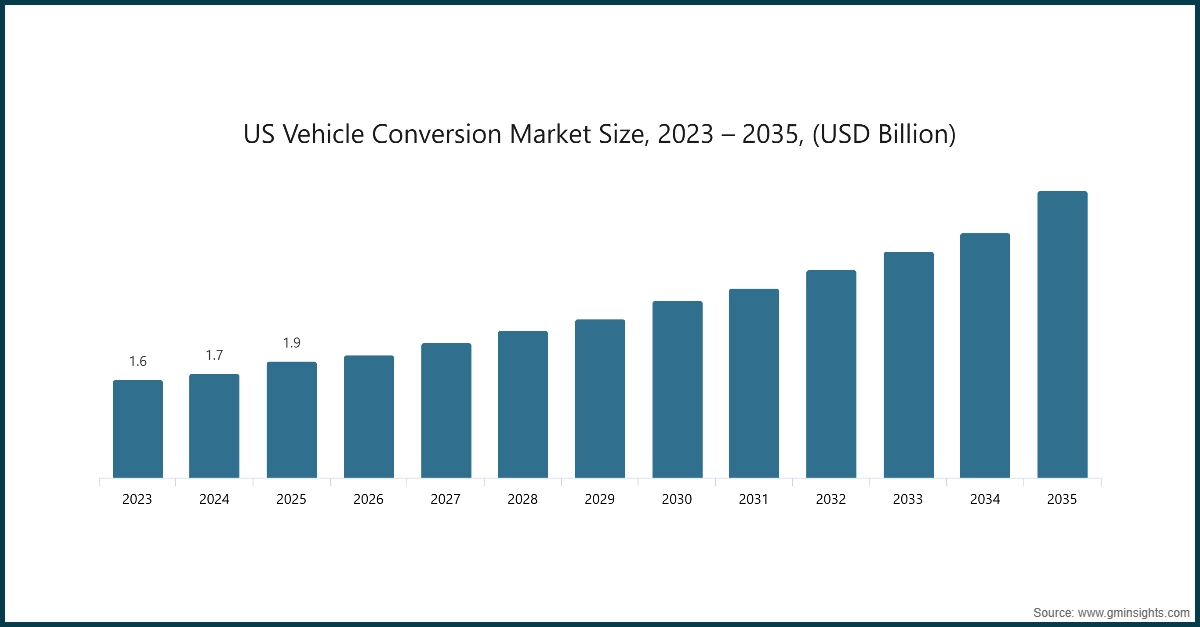
U.S. dominates the North America vehicle conversion market, showcasing strong growth potential, with a CAGR of 9.8% from 2026 to 2035.
- The United States leads the North American vehicle conversion industry due to strong aftermarket customization demand, advanced fleet mobility requirements, and widespread adoption of certified conversion services across commercial and passenger vehicle segments.
- Stringent automotive safety and emissions governance, along with federal and state transportation programs, are supporting the standardization of certified conversion solutions for electric mobility retrofitting, accessibility vehicles, and specialty commercial fleets.
- OEMs and fleet operators in the U.S. are increasingly investing in modular vehicle conversion platforms to support electrification, last-mile delivery operations, and customized utility vehicle applications across urban and highway transportation networks.
- Technology development and testing ecosystems are concentrated in states such as California, Michigan, Arizona, and Texas, which are emerging as major centers for mobility engineering, fleet conversion innovation, and specialty vehicle integration programs.
- By 2025, California continued to lead experimental programs involving electric fleet retrofitting, smart mobility vehicle customization, and advanced commercial vehicle conversion trials across multiple urban and highway mobility environments.
- Regions such as Texas and Arizona are gaining importance for commercial vehicle and specialty mobility conversion testing due to large-scale automotive proving grounds, supportive operational regulations, and the expanding presence of global mobility engineering centers.
North America dominated vehicle conversion market, which accounted for USD 2.4 billion in 2025 and is anticipated to show growth of 10.4% CAGR over the forecast period.
- The North America market is supported by strong aftermarket customization demand, growing electric mobility adoption, and well-established ecosystem participation from specialty conversion service providers and fleet operators.
- The United States dominates regional market demand due to high penetration of recreational vehicle customization, commercial fleet modification requirements, and advanced certified retrofitting services across passenger and utility vehicle segments.
- Canada is emerging as a promising market for mobility accessibility and electric vehicle conversion programs, supported by sustainable transportation policies, smart mobility initiatives, and government-backed clean mobility infrastructure development.
- Canadian transportation modernization programs emphasize accessibility vehicle deployment, last-mile logistics fleet electrification, and specialty public service vehicle conversion, encouraging technology integration in commercial and public mobility platforms.
- Pilot programs across provinces such as Ontario are accelerating demand for advanced vehicle conversion solutions supporting electric commercial fleets, accessible transit vehicles, and smart urban mobility operations.
- The North American vehicle conversion industry is increasingly adopting design simulation and digital engineering validation approaches, with conversion service providers investing in virtual configuration platforms to optimize structural modification, powertrain integration, and system compatibility before physical implementation.
- Growing collaboration between automotive OEMs, aftermarket solution developers, and clean energy technology companies is supporting next-generation conversion architecture development, particularly for electric propulsion retrofitting and smart vehicle system integration.
- Rising urban mobility demand, expanding e-commerce logistics networks, and increasing recreational vehicle usage across metropolitan regions are further driving adoption of customized vehicle conversion solutions in passenger, commercial, and specialty application segments.
The China market is expected to experience significant and promising growth with a CAGR of 10.8% from 2026 to 2035.
- The vehicle conversion market in China is expanding rapidly, supported by government-led smart mobility transformation programs, electric vehicle ecosystem growth, and increasing demand for customized commercial and accessibility mobility solutions. The Chinese mobility industry is shifting toward standardized certified conversion platforms to support new energy vehicle deployment and specialized fleet applications.
- For instance, in March 2025, transportation safety programs under the Ministry of Public Security of the People's Republic of China are promoting vehicle safety modernization and encouraging conversion technologies that support electric mobility retrofitting, commercial fleet efficiency, and vulnerable user accessibility transportation.
- China is targeting accelerated integration of intelligent conversion technologies across new mobility platforms, with development roadmaps focusing on modular electric vehicle architecture, smart fleet customization, and AI-assisted vehicle system enhancement by 2030.
- Leading domestic mobility and automotive technology companies such as BYD Company Limited, NIO, XPeng, and Li Auto are investing in vehicle conversion-compatible platform engineering to strengthen smart electric mobility offerings.
- During 2025, Chinese mobility manufacturers and aftermarket technology providers increased research investments in electric drivetrain retrofitting, smart sensor integration, and fleet conversion optimization technologies aligned with evolving safety and performance certification standards.
- China’s data governance and cybersecurity regulatory framework is influencing connected conversion platform development, encouraging localized software architecture deployment and supporting domestic mobility technology providers in smart vehicle system integration.
- Rising adoption of intelligent electric vehicles, urban logistics fleets, and shared mobility transportation programs is further driving demand for high-performance vehicle conversion solutions across commercial delivery vehicles, specialty service fleets, and urban passenger mobility platforms.
Asia Pacific market is anticipated to grow at a CAGR of 11.1% during the analysis timeframe.
- The Asia Pacific vehicle conversion market is expanding rapidly due to increasing vehicle ownership, accelerating urban mobility demand, and rising adoption of customized mobility and electric retrofit solutions across passenger, commercial, and specialty vehicle segments. Government initiatives supporting sustainable transportation and fleet modernization are further supporting market penetration.
- China remains the largest mobility production and technology deployment hub in the region, driving strong demand for electric vehicle conversion platforms, smart commercial fleet customization, and AI-enabled connected vehicle integration supporting intelligent transportation ecosystems.
- In Japan, the vehicle conversion industry is supported by advanced automotive engineering capabilities and high-quality customization standards, with manufacturers and aftermarket service providers focusing on precision mobility retrofitting, accessibility vehicle solutions, and specialty application conversions.
- South Korea is emerging as a technology-driven mobility conversion market, supported by strong investments from Hyundai Motor Group in electric vehicle platform engineering, smart fleet mobility integration, and advanced vehicle system customization.
- For instance, by 2025, Hyundai Motor Group expanded modular platform-based vehicle configuration capabilities across its electric mobility lineup, supporting enhanced system integration for commercial and utility conversion applications in the Korean mobility ecosystem.
- The India market is gaining traction due to increasing demand for electric commercial fleet retrofitting, accessibility mobility solutions, and customized utility vehicle platforms, driven by expanding urban transportation networks and growing logistics operations.
- Southeast Asian markets including Thailand, Indonesia, and Vietnam are gradually adopting certified vehicle conversion technologies, supported by growing automotive assembly activities, rising last-mile delivery fleet deployment, and strengthening transportation safety regulations.
Germany dominates Europe vehicle conversion market, generating revenue of USD 501.2 million in 2025 with CAGR of 10.1% during the forecasted timeframe from 2026 to 2035.
- Germany leads the European vehicle conversion industry, driven by its strong automotive manufacturing ecosystem, specialized upfitting and coachbuilding firms, and growing demand for customized vehicle solutions from various end-users.
- In February 2025, Mercedes-Benz Vans expanded its Van Conversion Partner program in Germany by onboarding over 35 certified upfitting specialists. These specialists will deliver factory-aligned conversions for the eSprinter electric van platform, targeting logistics operators, cold-chain providers, and utility fleet managers seeking emission-compliant last-mile delivery vehicles.
- Stringent EU emission regulations, including the Euro 7 standard and GSR 2022 framework, are driving German fleet operators and commercial vehicle owners to accelerate propulsion conversions. This is boosting demand for ICE-to-electric and alternative-fuel retrofit solutions across light commercial and heavy-duty vehicles.
- Germany's growing network of urban low-emission zones in cities like Berlin, Munich, and Hamburg is compelling commercial fleet operators and municipal transport authorities to adopt propulsion conversions to comply with stricter urban traffic regulations.
Europe vehicle conversion market accounted for USD 1.6 billion in 2025 and is anticipated to show growth of 10.2% CAGR over the forecast period.
- The European market is driven by stringent emission regulations, a strong commercial fleet infrastructure, a rich coachbuilding heritage, and growing demand for electric retrofits and customized commercial vehicle upfitting.
- For instance, in January 2025, the European Automobile Manufacturers Association reported that purpose-converted electric vans and specialty upfitted vehicles accounted for a growing share of light commercial vehicle registrations in EU member states, highlighting a shift toward integrated fleet procurement strategies.
- From mid-2024, the phased implementation of the Euro 7 emission standard and GSR 2022 General Safety Regulation is driving European fleet managers to certified propulsion conversion specialists to meet compliance without replacing entire fleets.
- European coachbuilding and vehicle conversion industry associations are enhancing certification frameworks and standardization protocols, requiring specialists to validate upfitted vehicles for safety, structural integrity, and emission compliance before commercial deployment.
- Adoption patterns for vehicle conversion technologies differ across major European markets, including Germany, France, Italy, Spain, the UK, and the Nordic region. These differences are influenced by automotive industry maturity, fleet electrification readiness, national accessibility policies, and local supplier ecosystems.
- Italy's vehicle conversion market, rooted in its strong coachbuilding tradition, is driven by manufacturers in Lombardy and Emilia-Romagna. They deliver high-value conversions for ambulances, motorhomes, armored vehicles, and luxury mobile services, catering to domestic and export markets in the Middle East, Africa, and Latin America.
- Sweden, Norway, and Finland lead the Nordic region in adopting electric propulsion and accessible mobility solutions, driven by ambitious decarbonization goals, high EV penetration rates, and strict accessibility laws for urban and rural transport.
Mexico leads the Latin American vehicle conversion market, exhibiting remarkable growth of 10.4% during the forecast period of 2026 to 2035.
- Mexico leads the Latin American vehicle conversion industry, driven by its strong automotive manufacturing base, growing aftermarket services, fleet modernization efforts, and rising demand for specialized vehicle modifications in key industrial areas.
- Commercial vehicle manufacturers and fleet operators in Mexico are adopting purpose-built conversion solutions, focusing on last-mile delivery, refrigerated transport, and accessibility-compliant passenger vehicles to meet growing urban mobility demands.
- Mexico's vehicle conversion technology and services are concentrated in hubs like Monterrey, Guadalajara, Puebla, and the Bajío region. OEMs, Tier-1 suppliers, and conversion specialists are adopting modular designs and EV-compatible retrofits to serve domestic and export fleet markets.
- Macroeconomic instability, peso volatility, and reliance on imported components, such as EV retrofit kits and compliance tools, have constrained conversion program budgets. Small and mid-sized fleet operators without government-backed financing or subsidies are particularly affected.
South Africa to experience substantial growth in the Middle East and Africa vehicle conversion industry in 2025.
- South Africa leads the Sub-Saharan Africa vehicle conversion market, driven by its advanced automotive manufacturing infrastructure, strong aftermarket services, growing fleet modernization needs, and increased government focus on road safety and compliance standards.
- The strong presence of OEMs like Toyota, Ford, Volkswagen, and BMW in South Africa is driving Tier-1 suppliers and local specialists to develop advanced vehicle modifications for domestic needs and regional exports across southern and eastern Africa.
- South African regulatory bodies, including the Bureau of Standards and the Department of Transport, are enforcing stricter roadworthiness, emissions, and accessibility standards while promoting certified conversion and validated upfitting methods for public transport, emergency services, and commercial fleets.
- Despite a mature domestic automotive ecosystem, South Africa's vehicle conversion market faces challenges such as high imported component costs, rand depreciation, and limited capital expenditure among fleet operators, slowing EV retrofits and advanced mobility conversions.
- Institutions like the University of Pretoria, Stellenbosch University, and the Council for Scientific and Industrial Research are driving advancements in South Africa's automotive technology by focusing on electric powertrain retrofitting, lightweight materials, and simulation-based vehicle modifications, aligned with evolving transport policies.
Vehicle Conversion Market Share
The top 7 companies in the vehicle conversion industry are BraunAbility, Sortimo, Creative Mobile Interiors, Syncro System, ROUSH CleanTech, Lightning eMotors, and Webasto contributed around 29% of the market in 2025.
- BraunAbility leads the accessible mobility conversion segment, specializing in wheelchair-accessible vehicles, adaptive driving controls, and specialized seating systems. The company serves the mobility conversions segment, driven by aging population demographics, with the U.S. population aged 65+ now representing roughly one in six people and projected to continue growing through 2060.
- Sortimo, a frontrunner in Europe's commercial vehicle upfitting and storage solutions, tailors its offerings to tradespeople, fleet operators, and service providers. Their expertise spans commercial van conversions, featuring modular storage systems, organized workspaces, vehicle tracking and shelving, ergonomic work surfaces, tool management systems, and fleet standardization programs.
- Creative Mobile Interiors competes through design expertise enabling highly customized solutions, craftsmanship quality differentiating premium conversions, comprehensive project management from concept through completion, and relationships with high-net-worth individuals and specialty vehicle enthusiasts.
- Syncro System specializes in commercial van upfitting and fleet conversion, with a strong foothold in European markets. Its standardized conversion platforms ensure vehicle consistency while allowing customization for operational needs.
- ROUSH CleanTech capitalizes on its strong relationships with school districts and fleet operators, offering turnkey solutions that include vehicles, fuel infrastructure, and maintenance support. The company’s focus on alternative fuels, alongside its EPA-certified propane systems, ensures diversification in the competitive conversion market.
- Lightning eMotors delivers solutions such as electric powertrains, battery systems, telematics, fleet management software, and charging infrastructure consultation, along with maintenance support. The company is well-positioned to benefit from the projected growth of the last-mile delivery sector through 2030.
- Webasto supplies electric heating systems, battery thermal management solutions, charging infrastructure, and climate control systems for converted vehicles. As a component supplier, it focuses on thermal management, which is increasingly vital for battery performance and longevity.
Vehicle Conversion Market Companies
Major players operating in vehicle conversion industry are:
- Adventure Van Conversions
- BraunAbility
- Creative Mobile Interiors
- DIYev
- El Kapitan Conversion Vans
- EV Source
- EV4U Custom Conversions
- Glampervan
- Kisae Technology
- Midwest Automotive Designs
- Key players in the vehicle conversion market, including Adventure Van Conversions, BraunAbility, Creative Mobile Interiors, DIYev, and others, offer solutions like mobility adaptations, recreational van builds, electric powertrain retrofits, and commercial upfitting. These services cater to individual consumers, fleet operators, and specialty service providers globally.
- These companies enhance their market position by integrating adaptive accessibility technologies, energy management systems, EV-compatible architectures, and custom interiors. Their solutions improve operational efficiency, accelerate conversion cycles, and help stakeholders meet evolving standards and performance requirements across various segments.
Vehicle Conversion Market Report Attributes
| Key Takeaway | Details |
|---|---|
| Market Size & Growth | |
| Base Year | 2025 |
| Market Size in 2025 | USD 7.4 Billion |
| Market Size in 2026 | USD 8.1 Billion |
| Forecast Period 2026-2035 CAGR | 10.3% |
| Market Size in 2035 | USD 19.7 Billion |
| Key Market Trends | |
| Drivers | Impact |
| Growing demand for electric vehicle conversions driven by environmental regulations | Accelerates transition toward sustainable mobility solutions and increases adoption of retrofit electric powertrain systems. |
| Rising adoption of accessible mobility solutions for aging populations | Expanded demand for wheelchair-accessible and assistive vehicle conversion technologies. |
| Expansion of last-mile delivery and e-commerce logistics requiring specialized fleets | Supports growth in commercial vehicle conversion for cargo optimization and operational efficiency. |
| Government incentives and subsidies for EV retrofitting programs | Improves affordability and stimulates adoption of converted electric mobility solutions. |
| Increasing consumer preference for personalized and custom vehicles | Drives aftermarket conversion services across passenger and recreational vehicle segments. |
| Pitfalls & Challenges | Impact |
| High upfront costs of conversion kits and retrofitting services | Restricts adoption in price-sensitive vehicle segments, particularly in developing economies. |
| Complex regulatory and certification requirements across regions | Slows commercialization and increases compliance burden for service providers. |
| Opportunities: | Impact |
| Development of modular and plug-and-play conversion kits for the DIY market | Expands consumer-driven customization and aftermarket revenue potential. |
| Expansion into emerging markets with aging internal combustion engine vehicle fleet | Provides long-term growth prospects for vehicle modernization programs. |
| Integration of advanced telematics and IoT technologies in converted vehicles | Enhance operational monitoring, fleet management, and vehicle performance optimization. |
| Growing recreational vehicle market driving camper van conversion demand | Supports diversification into lifestyle and tourism mobility segments |
| Market Leaders (2025) | |
| Market Leader |
7% Market Share |
| Top Players |
Collective Market Share is 24% |
| Competitive Edge |
|
| Regional Insights | |
| Largest Market | North America |
| Fastest growing market | Asia Pacific |
| Emerging countries | Brazil, India, China, Mexico, Thailand, Indonesia |
| Future outlook |
|
What are the growth opportunities in this market?
Vehicle Conversion Industry News
- In February 2026, BraunAbility launched its next-generation electric wheelchair-accessible vehicle conversion platform. It features an 800-pound capacity automated power ramp, smart tie-down sensors, and integration with EV battery management systems, targeting North American fleet operators by mid-2026.
- In October 2025, Stellantis rolled out its CustomFit program in various European markets, providing bespoke commercial vehicle conversion solutions to meet the rising demand for business-centric mobility configurations.
- In October 2025, Creative Mobile Interiors announced a $28 million expansion of its Indiana manufacturing campus to increase production capacity. The facility will include automated fabrication lines, EV-compatible wiring harness assembly systems, and a quality validation center to meet rising demand from last-mile delivery and utility fleet operators in the United States.
- In September 2025, DIYev partnered with three North American community colleges to launch an open-source EV conversion toolkit. It includes engineering documentation, component sourcing guides, and simulation-based training to promote EV retrofitting across the US and Canada.
The vehicle conversion market research report includes in-depth coverage of the industry with estimates & forecasts in terms of revenue (USD Bn) and shipments (Units) from 2022 to 2035, for the following segments:
Market, By Offering
- Product
- Service
Market, By Vehicle
- Passenger cars
- Hatchbacks
- SUV
- Sedan
- Commercial vehicles
- Light commercial vehicles (LCVs)
- Medium commercial vehicles (MCVs)
- Heavy commercial vehicles (HCVs)
Market, By Conversion Type
- Mobility conversions
- Commercial conversions
- Recreational conversions
- Propulsion conversion
- Others
Market, By Component Modified
- Powertrain & propulsion
- Body & exterior
- Interior & accessibility
- Wheels, suspension & performance
- Lighting & electronics
Market, By End Use
- Individual consumers
- Commercial fleet operators
- Government & emergency services
- Specialty service providers
The above information is provided for the following regions and countries:
- North America
- US
- Canada
- Europe
- Germany
- UK
- France
- Italy
- Spain
- Russia
- Netherlands
- Sweden
- Denmark
- Poland
- Asia Pacific
- China
- India
- Japan
- Australia
- South Korea
- Singapore
- Thailand
- Indonesia
- Vietnam
- Latin America
- Brazil
- Mexico
- Argentina
- Colombia
- MEA
- South Africa
- Saudi Arabia
- UAE
- Israel
Frequently Asked Question(FAQ) :
What is the market size of the vehicle conversion in 2025?
The market size was USD 7.4 billion in 2025, with a CAGR of 10.3% expected through 2035, driven by growing demand for electric vehicle conversions.
What is the projected value of the vehicle conversion industry by 2035?
The vehicle conversion market is expected to reach USD 19.7 billion by 2035, propelled by accelerating fleet electrification mandates, development of modular and plug-and-play conversion kits.
What is the current vehicle conversion industry size in 2026?
The market size is projected to reach USD 8.1 billion in 2026.
How much revenue did the commercial fleet operators end-use segment generate in 2025?
Commercial fleet operators dominated the end-use market with a 40% share in 2025, growing at a CAGR of 10.5% till 2035, driven by the global e-commerce shift requiring customized light commercial vehicles optimized for cargo, last-mile delivery efficiency, and driver comfort.
What was the market share of the product offering segment in 2025?
The product segment dominated the market with a 66% share in 2025, growing at a CAGR of 9.7% from 2026 to 2035.
What is the growth outlook for the specialty service providers end-use segment?
The specialty service providers segment is the fastest-growing end-use category with a CAGR of 12.1% expected through 2035, driven by rising demand for purpose-converted vehicles including mobile healthcare clinics.
Which region leads the vehicle conversion market?
North America leads the global vehicle conversion market, accounting for USD 2.4 billion in 2025 with a projected CAGR of 10.4% expected through 2035, supported by stringent NHTSA and ADA regulatory frameworks.
What are the key trends shaping the vehicle conversion market?
Key trends include stricter emissions and safety regulations driving ICE-to-electric conversions, AI-enabled telematics for real-time vehicle monitoring, rising mission-specific retrofits for emergency and defense use, and growing demand for accessibility mobility solutions.
Who are the key players in the vehicle conversion market?
Key players include BraunAbility, Creative Mobile Interiors, ROUSH CleanTech, Sortimo, Syncro System, Lightning eMotors, Webasto, Adventure Van Conversions, DIYev, Midwest Automotive Designs, and Kisae Technology.
Vehicle Conversion Market Scope
Related Reports