Summary
Table of Content

Vehicle-as-a-Platform Hardware Market
Get a free sample of this report
Form submitted successfully!
Error submitting form. Please try again.
Thank you!
Your inquiry has been received. Our team will reach out to you with the required details via email. To ensure that you don't miss their response, kindly remember to check your spam folder as well!
Request Sectional Data
Thank you!
Your inquiry has been received. Our team will reach out to you with the required details via email. To ensure that you don't miss their response, kindly remember to check your spam folder as well!
Form submitted successfully!
Error submitting form. Please try again.
Vehicle-as-a-Platform Hardware Market Size
The global vehicle-as-a-platform hardware market size was valued at USD 10.3 billion in 2024. The market is expected to grow from USD 12 billion in 2025 to USD 55.5 billion in 2034 at a CAGR of 18.6%, according to latest report published by Global Market Insights Inc.
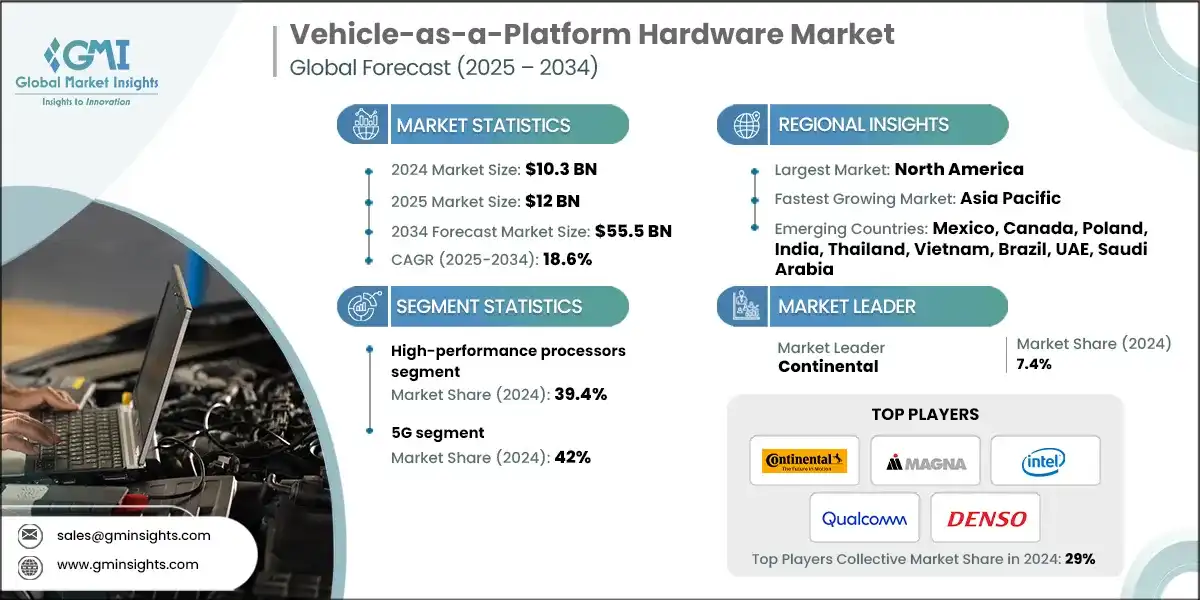
To get key market trends
With this evolutionary era, sectors such as automotive are expanding their technological aspects that solve the demand from the end users. Vehicle-as-a-platform hardware helps to ease driver and passenger experiences by offering features such as advanced driver assistant systems (ADAS), infotainment systems and vehicle connectivity, which become easily accessible.
As road safety is becoming a critical need to prevent any incidents, solutions such as ADAS that include lidar, radar, ultrasonic sensors and cameras are used in smooth driving experiences that provide lane detection, traffic signals, pedestrian and driver monitoring and measures of vehicle speed and distance. Combining these helpful features with rising interest among end users reflects OEMs and aftermarket players fulfilling this demand.
Meanwhile, the emerging autonomous vehicle ecosystem encourages the market players in the vehicle-as-a-platform hardware to invest in this domain, as it shows as an opportunity to them. For instance, the UK government expects to approve fully self-driving cars from 2026 to the second half of 2027. Overall, favourable government policies towards autonomous vehicle ecosystems create opportunities for players to enter into the vehicle-as-a-platform hardware market.
Additionally, infotainment systems nowadays have become must-have features in vehicles. Vehicle owners spend a lot to integrate the best in-control infotainment systems. For instance, in October 2025, Hyundai revealed that its upcoming Exter will debut the Korean brand’s next-generation infotainment system, which is scheduled to arrive early 2027. The new Exter will come with a new digital instrument cluster and a large infotainment screen that will run on the latest Android Auto Operating System (AAOS).
Connected vehicles is a concept that gives the vehicle-as-a-platform hardware market momentum. These connected features enable vehicles to communicate with other vehicles (V2V), infrastructure (V2I), and cloud services (V2C), forming a dynamic ecosystem that enhances safety, traffic efficiency, and user convenience. To make this possible, cars need robust hardware systems that enable high-speed data transfer, edge computing, and secure connectivity protocols. The embedding of IoT devices in cars, like telematics modules, intelligent sensors, and on-board diagnostics, further increases the demand for advanced hardware platforms.
The North America region is home to several pioneering OEMs like Tesla, GM and Ford, which are highly investing in vehicle technologies, mainly in software-defined vehicles (SDVs), autonomous driving, and electrification. These players are reshaping vehicle architecture by integrating advanced computing platforms that support real-time data processing, over-the-air updates, and feature-on-demand services.
Vehicle-as-a-Platform Hardware Market Report Attributes
| Key Takeaway | Details |
|---|---|
| Market Size & Growth | |
| Base Year | 2024 |
| Market Size in 2024 | USD 10.3 Billion |
| Market Size in 2025 | USD 12 Billion |
| Forecast Period 2025 - 2034 CAGR | 18.6% |
| Market Size in 2034 | USD 55.5 Billion |
| Key Market Trends | |
| Drivers | Impact |
| Growing adoption of Advanced Driver Assistance Systems (ADAS) | Boosts demand for high performance hardware such as sensors and processors. |
| Favorable Government Policies for Autonomous Vehicles | Accelerate R&D and deployment of autonomous technologies and promotes standardization of hardware components. |
| Increasing Consumer Interest in Advanced Infotainment Systems | Spurs demand for high-resolution displays and audio systems enhances user experience. |
| Connected Vehicle Ecosystem | Increases need for robust telematics and communication modules that drives adoption of V2X (Vehicle-to-Everything) hardware |
| Pitfalls & Challenges | Impact |
| Cybersecurity and Data Privacy Concerns | This raises barriers to consumer trust and adoption, which results in regulatory scrutiny and compliance costs. |
| High Cost of Advanced Hardware Components | Limits adoption in regions with cost-sensitive consumers, as it increases vehicle production costs. |
| Opportunities: | Impact |
| Growth of Electric Vehicles (EVs) | Drives demand for integrated hardware platforms such as ADAS and infotainment systems. |
| Expansion of Mobility-as-a-Service (MaaS) | Increases need for scalable and modular hardware to support real-time fleet monitoring and diagnostics. |
| Advancements in AI and Edge Computing | Enhances real-time decision-making capabilities and Reduces latency in autonomous and connected systems. |
| Emergence of 5G and V2X Communication | Facilitates ultra-fast data exchange between vehicles and infrastructure. |
| Market Leaders (2024) | |
| Market Leaders |
7.4% market share |
| Top Players |
Collective market share in 2024 is 29.0% |
| Competitive Edge |
|
| Regional Insights | |
| Largest Market | North America |
| Fastest growing market | Asia Pacific |
| Emerging countries | Mexico, Canada, Poland, India, Thailand, Vietnam, Brazil, UAE, Saudi Arabia |
| Future outlook |
|
What are the growth opportunities in this market?
Vehicle-as-a-Platform Hardware Market Trends
Software-defined vehicles (SDVs) is a concept which is trending within the automotive industry. There is a need for such hardware that helps vehicles become software-defined platforms. The reason for this change lies in the necessity for centralized computing architectures that enable dynamic software updates and feature enhancements over the lifespan of a vehicle. Automakers are increasingly embracing zonal E/E architectures and high-performance computing platforms to unbundle hardware from software, allowing flexible deployment of services. This trend enables cars to be upgraded continuously, increasing user satisfaction and operational effectiveness without physical changes.
The use of edge computing is becoming prevalent as a method of processing data locally. This edge computing is being integrated into car platforms and greatly omitting latency. For example, in September 2025, Sonatus, a company known for AI and software-defined vehicle (SDV) solutions, introduced a new solution, Sonatus AI Director. The new system allows original equipment manufacturers to utilize AI at the vehicle edge. Such functionalities are the basis of advanced driver monitoring, predictive vehicle maintenance, and adaptive user experiences.
The connected vehicles delivering robust networking and security constructions are the ones that allow easy communication indeed. This vivacious trend is affecting the hardware developments in connected vehicle ecosystems which are enhancing for secure over-the-air updates, multi-protocol networking, and real-time diagnostics to name a few. The combination of deterministic networking protocols and secure gateways is facilitating safe data exchange between vehicle domains.
Vehicle-as-a-Platform Hardware Market Analysis
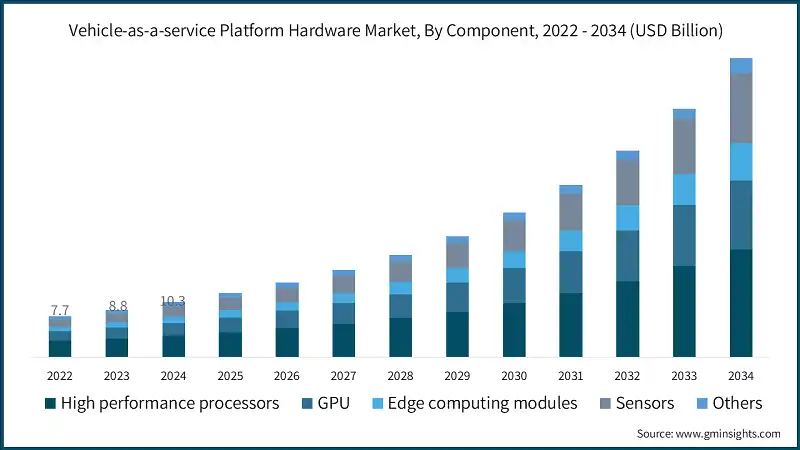
Learn more about the key segments shaping this market
Based on components, the vehicle-as-a-platform hardware market is divided into High performance processors, GPU, edge computing modules, sensors and others. The high-performance processors segment dominated the market with 39.4% share in 2024, due to its ability to support AI workloads, secure connectivity and centralized computing capabilities.
- High-performance processors are a necessity for the effective management of enormous data streams produced by sensors, cameras, and LiDAR in self-driving vehicles. These processors facilitate the prompt making of decisions, recognizing of objects, and designing of paths, all of which are the key components for driving autonomously in a safe and efficient manner. Their capability to perform complicated algorithms in real-time with small delays is what makes them vital in today's vehicle architecture, particularly as the shift in the industry is towards self-driving cars at higher levels (Level 3 and up).
- Presently cars are swapping out distributed ECUs for centralized computing platforms. The high-performance processors play a major role in this transition by merging the various functions, ADAS, infotainment, telematics, and body control, into a single domain controller. This change in hardware design not only simplifies the overall structure but also results in a decrease in costs and an increase in efficiency of operation. Their capacity to expand and adapt to different conditions makes them very suitable for the modular vehicle in this case, which consequently facilitates their widespread use.
- High-end processors have been developed with a view to the future and hence they support the wireless connectivity standards that are about to emerge like 5G, V2X (Vehicle-to-Everything), and OTA (over-the-air) updates. This will result in uninterrupted interaction between cars, roads, and cloud services. Their potential for high-speed data transfer and real-time analytics management positions them at the heart of connected car ecosystems thus reinforcing their superiority in the hardware market.
- For instance, in May 2025, the launch of new third-generation imaging radar processors for Level 2+ to 4 autonomous driving was announced by NXP. NXP’s highest performing radar processors are serving the autonomous vehicle industry by supporting Level 2+ to 4 autonomous driving with its highest performing radar processors.
- Cameras are used for many other ADAS applications, for example, parking assistance, driver monitoring, traffic sign recognition, and surround-view systems. They are very adaptable and able to provide safety as well as convenience features. It is because of this multifunctionality that camera sensors replace other sensor types, consequently simplifying the hardware architecture and making it easier for the OEMs who target efficient and integrated vehicle platforms.
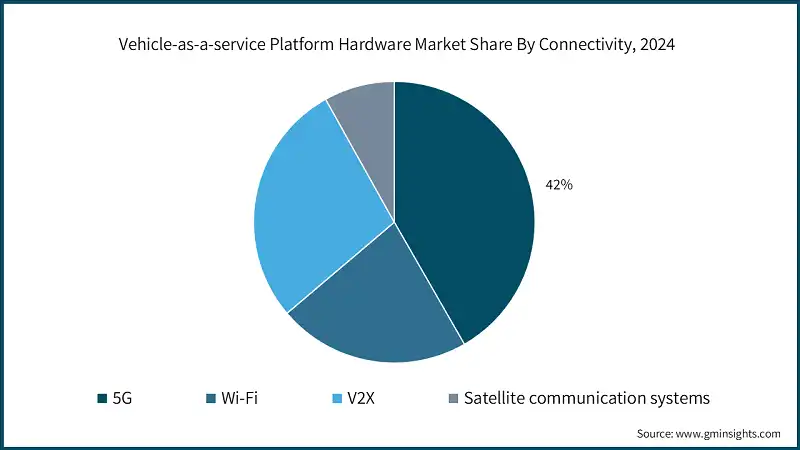
Learn more about the key segments shaping this market
Based on connectivity, the vehicle-as-a-platform hardware market is segmented into 5G, Wi-Fi, V2X and Satellite communication systems. The 5G segment dominates the vehicle-as-a-platform hardware market with 42% share in 2024 due to its widespread adoption across passenger and commercial vehicles.
- Vehicles are now being designed as mobile 5G edge devices embedding low-latency 5G modems into automotive compute platforms. This allows for real-time sensor fusion, over-the-air updates and cloud-assisted driving intelligence with minimal backhaul delays for autonomous and connected vehicles.
- Vehicles now have multi-node Wi-Fi mesh hardware that connects ECUs, sensors and infotainment modules. The distributed Wi-Fi backbone simplifies wiring and provides greater data transfer throughput from one module to another and scalability for electric and autonomous vehicle designs.
- V2X architecture features direct interfaces between perception sensors (including LiDAR, radar and cameras) and V2X modules. This hardware integration enables vehicles to share perception data with minimal processing delay (on the order of microseconds) improving cooperative perception and enhancing collective safety functions.
- In October 2025, the 5G Automotive Association and International Automobile City of Shanghai demonstrated live case studies in connected vehicles using 5G advanced networks powered by C-V2X protocols. Using sub-30 ms latency (30 milliseconds or less) in real-time safety scenarios, connected vehicles showcased advanced onboard units, multi-modal connectivity, and sensor-to-network hardware precursory for next-generation autonomous and cooperative driving applications.
Based on end use, the vehicle-as-a-platform hardware market is segmented passenger vehicle, commercial vehicle and electric vehicle. The passenger vehicle segment is expected to dominate the market, due to increasing demand for personal transportation.
- Urbanization, the rise of the middle-class population, and changes in lifestyles have all contributed to a higher demand for personal transportation. The characteristics of passenger vehicles have made them the leading option for daily work commutes and family trips. Hence, the increase in consumer demand will bring about higher production volumes and hardware integration, thereby positioning passenger vehicles as the largest player in the hardware market for the vehicle-as-a-platform segment.
- Passenger cars are being fitted more and more with first-rate technologies, for instance, ADAS, infotainment systems, and connectivity modules. Besides, manufacturers are making user experience and safety more appealing in mass-market models, which increases the use of hardware components such as sensors, processors, and connectivity systems. This overall integration in different price segments fortifies the market leadership of the passenger vehicle segment.
- The use of vehicle-as-a-platform technologies by commercial vehicles is to enhance the supply chain, reduce travel times, and control fleets. The integration of telematics, V2X communication, and predictive maintenance systems for the purpose of cost reduction and productivity improvement is becoming a more common practice. Accordingly, the commercial sector will continue to grow, with transportation, delivery, and construction being the main sectors benefited by this development.
- Electric vehicles (EVs) are the fastest-growing segment primarily because of global sustainability goals and support from governments. The hardware needs of EVs are there for battery management, autonomous driving, and connectivity. The hardware of EV is much more software-centric, thus it is the most suitable for the implementation of vehicle-as-a-platform solutions. The trend of rapid innovation, consumer interest, and government incentives will continue to dominate the EV market thereby, leading to exponential growth in this segment.
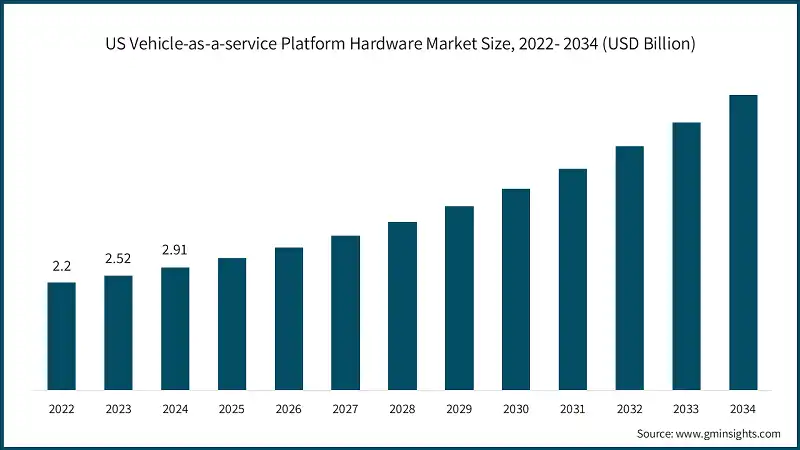
Looking for region specific data?
The US vehicle-as-a-platform hardware market reached USD 2.91 billion in 2024, growing from USD 2.52 billion in 2023.
- In North America, the US currently leads the way, as the US is home to players like Tesla, Waymo, NVIDIA, and Aptiv. These players are leading up to the perfect blending of automatic driving, sensor fusion and high-performance platforms. The presence of tech firms and OEMs in Silicon Valley and Detroit has made these places the key hubs for automotive R&D.
- The U.S. hardware market for vehicle-as-a-platform is underpinned by the continuous innovations in AI, sensor technologies as well as high-performance computing. Key players are bringing together domain controllers, zonal architectures, and chiplet-based SoCs for enabling real-time data processing and autonomous capabilities. The technological breakthroughs make vehicles function more safely and are hence, the U.S. is considered the leader for future generation mobility platforms.
- Additionally, the U.S. has its dominant position in the logistics market that is continuously creating a large space for key market players to invest in it. Vehicles which are used for logistics must be integrated with advanced connectivity for real time tracking and monitoring. Vehicle-as-a-platform hardware supports the country’s logistics industry by providing hardware that supports software-defined connectivity technologies.
North America dominated the vehicle-as-a-platform hardware market with a market share of 32.4% in 2024.
- The North America region is continuously maintaining its dominance in the vehicle-as-a-platform hardware industry, as the region is experiencing high demand for autonomous vehicle technologies and connected car ecosystems. As the region is home to major tech giants, this fulfils the domestic demand and R&D collaboration between OEMs and tech giants. Also, the rising demand from end use industries such as logistics and passenger transportation also supported the region’s dominating position in the market.
- Canada's hardware market for vehicle as a platform is gaining momentum through its focus on autonomous technologies, simulation platforms, and sensor integration. The automotive and tech industries are collaborating in the country to come up with hardware solutions that can easily be scaled and that will enable connected and intelligent mobility. The country is establishing itself as a strategic player in the development of platform-based vehicle architectures in North America by having strong research institutions and innovation hubs.
- The innovations in AI, edge computing, and 5G connectivity are the major forces behind the vehicle-as-a-platform hardware market in North America. These technologies facilitate real-time decision making, seamless sensor data integration, and improved vehicle-to-everything (V2X) communication. The industry players are working on extensible platforms that the company can use for different purposes such as autonomous operations, predictive maintenance, and immersive in-vehicle experiences making hardware innovation the main part of future mobility solutions.
Europe vehicle-as-a-platform hardware market accounted for USD 2.89 billion in 2024 and is anticipated to show lucrative growth over the forecast period.
- In 2024, Europe vehicle-as-a-platform hardware industry is expected to grow at a CAGR of 18.5%. The growing pace of market in the Europe region is mainly supported by the region's strong automotive background and engineering excellence. The transition to the software-defined vehicle is going to hardware requirements, with OEMs and suppliers pushing hard for modular platforms, centralized computer systems, and sensor-rich architectures.
- Germany, France, and the Nordics are at the forefront of vehicle-as-a-platform hardware technology. Germany’s auto companies are adding AI processors and zonal architectures while France and Sweden are making progress in simulation platforms and sensor fusion technologies. The countries are also supported by strong academic-industry partnerships and a skilled workforce that allows fast prototyping and deployment of next-gen vehicle platforms in both passenger and commercial segments.
- Central and Eastern Europe is a new and promising market with huge growth potential. Poland, Hungary, and the Czech Republic are among the countries that are investing in connected and autonomous vehicle infrastructures and fleet AI solutions. As a result, the market in these countries seems to be expanding in coming years.
Germany dominates the vehicle-as-a-platform hardware market, showcasing strong growth potential, with a CAGR of 19.2%.
- German’s automotive industry is characterized by precision engineering, advanced manufacturing, and a well-trained workforce, makes it a largest market for automobiles in Europe. Moreover, with OEMs like BMW, Mercedes-Benz, and Volkswagen who are recognized all over the world, the country is at the forefront of the integration of state-of-the-art hardware such as zonal architecture, sensor fusion systems, and centralized computer platforms into cars.
- German carmakers and suppliers are working together on technology platforms including open-source software ecosystems and modular hardware systems. Moreover, an initiative such as the joint EV software platform by BMW, VW, and Mercedes effectively opens the door for the deployment of vehicle-as-a-platform hardware across brands and models.
- Germany is always in the list of top global automotive R&D investors, with billions being spent every year on future mobility technologies. This is in the area of chiplet-based systems, self-driving cars, and electric components. The country’s dedication to innovation translates into the continuous upgrade of vehicle-as-a-platform capability and competitiveness.
The Asia Pacific vehicle-as-a-platform hardware market is anticipated to grow at the highest CAGR of 21.3% during the analysis timeframe.
- The Asia-Pacific region is experiencing a surge of electric and hybrid vehicle production with their main activities located in China, Japan and South Korea. This conversion is pushing the demand for vehicle-as-a-platform hardware such as centralized computing platforms, sensor modules, and domain controllers.
- The vehicle-as-a-platform hardware market in Japan is mainly propelled by the country's top-notch automotive ecosystem and growing autonomous mobility. The leading car manufacturers, namely Toyota, Nissan, and Honda, are embedding the latest technologies like AI, LiDAR, and V2X into their future cars. The government's focus on smart city integration and mobility solutions for older people has speeded up the installation of Level 3 and Level 4 autonomous systems in areas such as public transit and last-mile delivery, which are the most common applications of these technologies.
- India's vehicle-as-a-platform hardware market is anticipated to be the fastest growing among the different countries in the Asia Pacific region. This is mainly due to factors like the improved connectivity in vehicles, and the widespread use of telematics, and mobile-apps-based solutions. The trend of urbanization, the increasing number of smartphones, and the customer preference for features like real-time diagnostics and navigation are all contributing to the market growth.
China is estimated to reach a value of USD 1.23 billion, in 2024 due to increasing demand for electric vehicles (EVs) and autonomous vehicles (AVs) driveing the adoption of advanced hardware components.
- The Chinese government supports connected cars because they improve road safety, decrease traffic congestion, and transportation efficiency. China has built a strong innovation system at a fast pace to support autonomous driving and AI integration, and system-on-chip (SoC) technologies. The automotive industry sees BYD, NIO, and Geely as the top companies driving digital chassis development, and cockpit domain controllers, and ADAS platform creation.
- China possesses a wide automotive manufacturing network that enables quick prototyping and affordable manufacturing, and smooth vehicle-as-a-platform component assembly. The nation produces sensors, ECUs, and connectivity modules at high volumes through its complete supply chain system which starts with raw materials. It ends with final assembly. Chinese OEMs achieve market expansion through their large-scale production capabilities which allow them to distribute platform hardware across all affordable vehicle models.
- Chinese consumers show strong interest in vehicles that combine smart technology with connectivity and electric power. The market demands large infotainment displays, AI assistants, and autonomous features which has forced OEMs to focus on innovation instead of price reduction. China leads the vehicle-as-a-platform hardware market because its demand-driven approach resulted in fast implementation of software-defined vehicles and modular hardware platforms.
Latin America vehicle-as-a-platform hardware market accounted for USD 493.7 million in 2024 and is anticipated to show lucrative growth over the forecast period.
- OEMs and importers in Latin America are starting to incorporate centralized compute units for vehicle control and infotainment, which continues to allow OEMs to reduce reliance on multi-ECU architectures, increases the scalability of hardware, and allows the automakers in the region to grasp global Vehicle-as-a-Platform (Vehicle as-a-platform) architecture efforts implemented in conjunction with both cloud hosted processing and edge computer hardware ecosystems.
- Regional suppliers in Brazil and Mexico are investing in the domestic production of zonal controllers and gateway ECUs. This evolution not only facilitates hardware architectures based on a platforms concept by minimizing the complexity of wiring, but it also enables modular upgrades and the development of regional hardware ecosystems that align to global trends for vehicle platforms.
- The launch of 5G networks and V2X initiatives in Latin America and supporting hardware from telematics control units, antennas, and edge transmission processors, will also accelerate adoption in the creating a framework for Vehicle as-a-platform, which relies on the secure transmission of real-time data and over-the-air updates, as well as monetization of connected services and hardware platforms.
- Vehicle assemblers in Latin America as well as startups in the region are starting to adopt AI-capable SoCs and neural processing units into vehicle platforms. These chips are intended to enable vehicles to make localized decisions and process perception, key capabilities for creating vehicles that are intelligent, reconfigurable platforms for future autonomous and service-based capabilities.
The Middle East and Africa accounted for USD 812.5 million in 2024 and is anticipated to show lucrative growth over the forecast period.
- Automakers in the Middle East and Africa are increasingly embracing centralized and zonal computing architectures to modernize vehicle electronics. These compute architectures are characterized by less wiring complexity and greater scalability, preparing regional producers for future integration of Vehicle as-a-platform hardware layers capable of supporting connected, autonomous, and software defined features across vehicle model types and into vehicle market segments.
- With the strong deployment of 5G and smart city initiatives in the region, there is investment in advanced telematics control units, multi-antenna systems, and V2X modules. Upgrading connectivity hardware is also an important enable for Vehicle as-a-platform to embrace edge communication, data streaming, and platform-based services into connected vehicle ecosystems.
- Due to the region’s extreme climate and terrain, automakers and suppliers are designing ruggedized Vehicle as-a-platform hardware, specifically thermal-resistant compute modules, dust-proof sensors, and vibration-hardened controllers. These developments will assure the reliability for both zonal and centralized architectures that enable the deployment of platform-based vehicles that can endure sustained performance in harsh conditions found in the Middle East and Africa.
- In the Middle East and African regions, electric mobility initiatives are supporting demand for advanced power electronics, on-board chargers, and energy management units. Hardware systems are being conceptualized as an integrated part of the Vehicle as-a-platform ecosystem by utilizing vehicle-to-interface with renewable energy grids and charging systems in an intelligent way.
Vehicle-as-a-Platform Hardware Market Share
The top 7 companies in the vehicle as-a-platform hardware industry are Continental, Denso, Intel, Magna International, Qualcomm Technologies, Renesas Electronics, Texas Instruments contributing 36.8% of the market in 2024.
- Continental is estimated to hold a market share of 7.4% due to its strong relationships with automotive suppliers and its comprehensive portfolio of vehicle systems. This market position illustrates Continental's ability to integrate multiple hardware individual components into platform solutions that satisfy the sophisticated requirements of these VaaS applications. The company’s strength is in its capability as an integrator of sensor, processing unit and communications systems into single platform solutions wherein multiple business models can be operated simultaneously.
- Renesas Electronics serves the market with a 3.7% share, which positions the company as one of the largest suppliers of automotive semiconductors and automotive embedded processing solutions. Renesa's strength lies in its processor architectures for automotive applications that can integrate multiple processor functions while still adhering to rigorous safety and reliability standards. The company's position in the market exemplifies the critical role played by the automotive semiconductor that enables platform functionality.
- Magna International obtains 7.0% market share by benefiting from its position as a large automotive supplier with significant experience in vehicle integration and manufacturing. Magna's position reflects its capability to supply complete subsystem solutions that combine hardware components with durable mechanical systems and software applications.
- Intel holds 5.2% automotive market share and represents the entry of the technology industry into the automotive market. Intel's position reflects the higher importance of high-performance computing in automotive systems, while also capitalizing on its proven ability to convert data center and mobile computing technologies to the automotive industry. Intel's automotive platforms supply the computing power needed to enable AI inference, sensor fusion, and real-time decision making gained from VaaS applications.
- Qualcomm Technologies commands a 4.9% market share, with expertise in wireless communications and mobile computing applied to automotive environments. Qualcomm's market share signifies the critical importance of connectivity within a VaaS platform and delineates the company's leadership within cellular communication technologies. Qualcomm's automotive platforms are backed by high-performance processing capabilities with advanced communication technologies.
- Texas Instruments retains a 4.0% market share, taking advantage of its extensive portfolio of automotive semiconductors and embedded processing solutions. TI's market share speaks to the company's lengthy entry into automotive electronics and TI’s ability to offer differentiated components to satisfy automotive applications' specific needs. Texas Instrument’s strength is its extensive portfolio of analog and digital components that support all core functions of operating a VaaS platform.
Vehicle-as-a-Platform Hardware Market Companies
Major players operating in the vehicle-as-a-platform hardware industry are:
- Bosch
- Continental
- Denso
- Intel
- Magna International
- NVIDIA
- Qualcomm Technologies
- Renesas Electronics
- Texas Instruments
- Continental has positioned itself as a full-systems integrator, developing end-to-end VaaS platform solutions that integrate multiple hardware components, software applications, and vehicle integration capability. The company's approach is a focus on providing turnkey solutions to automotive manufacturers that can be integrated into their production vehicles with little to no additional development required. Continental's capabilities to integrate all components together range from sensor systems, processing platforms, communication platforms, and user interface capabilities, and as such, enables Continental to provide full VaaS hardware ecosystems.
- Renesas Electronics develops automotive-focused semiconductor solutions, enabling computational foundations for the VaaS platforms. The company's processor architectures combine multiple CPU cores, dedicated accelerators, and safety-critical functions into single silicon platforms, enabling advanced computational density and VaaS applications while meeting automotive reliability and safety.
- Magna's experience in manufacturing automotive products provides the expertise for scalable solutions that support high volume production along with the quality and reliability expected in automotive applications. The company's established global footprint and relationships with automotive manufacturers will be the basis for large-scale hardware deployment of VaaS.
- Intel leverages its data center and mobile computing capabilities and capacity in the automotive space, eliminating the limits of performance, to build high-performance processing platforms capable of supporting the computational requirements of advanced VaaS applications. Its platform emphasizes integration of multiple CPU cores, accelerators for AI and other specialized automotive functions on single silicon platforms.
- Qualcomm Technologies utilizes its experience in wireless communications and high-performance computing to develop integrated platforms that support both local processing and cloud connectivity functionality of VaaS applications. Its automotive platform integrates cellular communications, Wi-Fi, V2X communications, and high-performance processing capability on a single platform.
Vehicle-as-a-Platform Hardware Industry News
- In April 2025, Texas Instruments (TI) unveiled new automotive lidar, clock, and radar chips to support vehicle autonomy and safety. The LMH13000 lidar provides a 30% longer detection range, BAW-based clocks offer at least a 100× improvement in reliability vs quartz, while the AWR2944P radar sensor provides increased range and accuracy support in advanced, adaptive ADAS and automated driving systems that are safer.
- In January 2025, NVIDIA stated that its DRIVE AGX Hyperion automotive platform, powered by the DRIVE AGX SoC and DriveOS, has received important automotive safety and cybersecurity certification from TÜV SÜD and TÜV Rheinland, confirming the reliability and compliance of the platform for next-generation vehicle hardware to enhance safety and security, and enable software-defined mobility solutions at scale.
- In March 2025, NVIDIA and Magna International announced the partnership to integrate the NVIDIA DRIVE AGX Thor platform built on Blackwell, NVIDIA’s next generation computing architecture, into Magna’s next generation vehicle electronics and computing modules. The partnership will elevate vehicle hardware based on platforms with added processing power, scalability, and more intelligence for future software-defined and autonomous mobility solutions.
- In September 2025, Bosch is growing production of next-generation automotive hardware with its Mobility division - high-performance ECUs, sensors, and act-by-wire systems. The company landed its first large customer order in China for its next-generation high-performance cockpit computer, representing a key milestone in Bosch’s expansion into next-generation vehicle computing and mobility solutions.
- In September 2025, Vert, based in the UK, partnered with GRiDD Technologies with a view to providing rapid global scaling of Vehicle-as-a-Service platforms. To support this integration, GRiDD's GNet unified network connects more than 5,000 operators and distributors. For VaaS operators, the integration offers instant access to worldwide reservation systems, real-time data sharing, and workflow automation. This partnership highlights the growing ecosystem connectivity requirements for hardware integration within the VaaS platform. The article references Records4Minimal Facilities.
The vehicle as-a- platform hardware market research report includes in-depth coverage of the industry with estimates & forecasts in terms of revenue ($ Mn/Bn) and volume (Units) from 2021 to 2034, for the following segments:
Market, By Component
- High performance processors
- GPU
- Edge computing modules
- Sensors
- Cameras
- LiDAR
- RADAR
- Telematics devices
- Others
Market, By Connectivity
- 5G
- Wi-Fi
- V2X
- Satellite communication systems
Market, By Interface
- Electronic Control Units (ECU)
- Ports
Market, By End Use
- Passenger vehicle
- Sedan
- Hatchback
- SUV
- Commercial vehicle
- LCV
- MCV
- HCV
- Electric vehicle
- BEV
- PHEV
- FCEV
The above information is provided for the following regions and countries:
- North America
- US
- Canada
- Europe
- Germany
- UK
- France
- Italy
- Spain
- Russia
- Nordics
- Poland
- Asia Pacific
- China
- India
- Japan
- South Korea
- ANZ
- Vietnam
- Thailand
- Latin America
- Brazil
- Mexico
- Argentina
- MEA
- South Africa
- Saudi Arabia
- UAE
Frequently Asked Question(FAQ) :
What was the valuation of the 5G segment in 2024?
The 5G segment accounted for 42% of the market in 2024, owing to its widespread adoption in passenger and commercial vehicles.
Which region leads the vehicle-as-a-platform hardware sector?
North America leads the market, with the US generating USD 2.91 billion in 2024. The presence of key players like Tesla, Waymo, NVIDIA, and Aptiv, along with strong R&D hubs in Silicon Valley and Detroit, drives this dominance.
What are the upcoming trends in the vehicle-as-a-platform hardware market?
Trends include the rise of software-defined vehicles, integration of edge computing for reduced latency, secure over-the-air updates, multi-protocol networking, and real-time diagnostics.
Who are the key players in the vehicle-as-a-platform hardware industry?
Key players include Bosch, Continental, Denso, Intel, Magna International, NVIDIA, Qualcomm Technologies, Renesas Electronics, and Texas Instruments.
What was the market share of the high-performance processors segment in 2024?
The high-performance processors segment held a 39.4% market share in 2024, led by its ability to support AI workloads, secure connectivity, and centralized computing.
What is the market size of the vehicle-as-a-platform hardware in 2024?
The market size was USD 10.3 billion in 2024, with a CAGR of 18.6% expected through 2034. The growth is driven by advancements in ADAS, infotainment systems, and vehicle connectivity.
What is the expected size of the vehicle-as-a-platform hardware industry in 2025?
The market size is projected to reach USD 12 billion in 2025.
What is the projected value of the vehicle-as-a-platform hardware market by 2034?
The market is poised to reach USD 55.5 billion by 2034, fueled by the adoption of software-defined vehicles, edge computing, and 5G integration.
Vehicle-as-a-Platform Hardware Market Scope
Related Reports