Summary
Table of Content

Variable Rate Technology (VRT) Equipment Market
Get a free sample of this report
Form submitted successfully!
Error submitting form. Please try again.
Thank you!
Your inquiry has been received. Our team will reach out to you with the required details via email. To ensure that you don't miss their response, kindly remember to check your spam folder as well!
Request Sectional Data
Thank you!
Your inquiry has been received. Our team will reach out to you with the required details via email. To ensure that you don't miss their response, kindly remember to check your spam folder as well!
Form submitted successfully!
Error submitting form. Please try again.
Variable Rate Technology Equipment Market Size
The variable rate technology (VRT) equipment market has grown around the idea that every part of a field has different needs. Farmers are increasingly looking for ways to move away from uniform application methods and toward a more responsive approach to farming. VRT equipment supports this shift by allowing farm operations to adjust inputs as field conditions change. This approach helps farmers feel more in control of their work, as decisions are guided by field realities rather than fixed plans. As a result, VRT is often seen as a practical step toward more thoughtful and efficient farming practices.
From a business point of view, the market reflects a strong focus on usability and trust. Equipment manufacturers aim to design systems that fit easily with existing farm machinery so farmers can adopt new tools without disrupting daily operations. Clear displays, simple controls, and reliable performance are key selling points. Dealers and service partners also play an important role by offering on-ground support and helping farmers understand how to use the equipment effectively. This close connection between technology providers and end users shapes long-term relationships rather than one-time equipment sales.
Variable Rate Technology (VRT) Equipment Market Key Takeaways
Market Size & Growth
- 2025 Market Size: USD 11.9 Billion
- 2026 Market Size: USD 12.4 Billion
- 2035 Forecast Market Size: USD 20.9 Billion
- CAGR (2026–2035): 6%
Regional Dominance
- Largest Market: North America
- Fastest Growing Region: Asia Pacific
Key Market Drivers
- Accelerated adoption of precision agriculture practices.
- Rising need for input cost optimization and resource efficiency.
- Supportive government policies and digital farming incentives.
Challenges
- High initial investment and integration costs.
- Technical complexity and skill gaps among end users.
Opportunity
- Expansion in emerging and large-scale agricultural economies.
- Integration with ai, iot, and advanced farm management platforms.
Key Players
- Market Leader: John Deere led with over 15% market share in 2025.
- Leading Players: Top 5 players in this market include John Deere, AGCO Corporation, CNH Industrial, Trimble, Hexagon Agriculture, which collectively held a market share of 45% in 2025.
Get Market Insights & Growth Opportunities
The market is also influenced by changing attitudes toward resource management and environmental care. Farmers are increasingly aware of soil health, input waste, and the need to protect land for future use. VRT equipment supports this mindset by encouraging careful application rather than excess use. Over time, these tools are becoming part of routine farming decisions, not just advanced solutions for large-scale operations. This growing acceptance reflects a market that values balance, responsibility, and steady improvement over short-term gains.
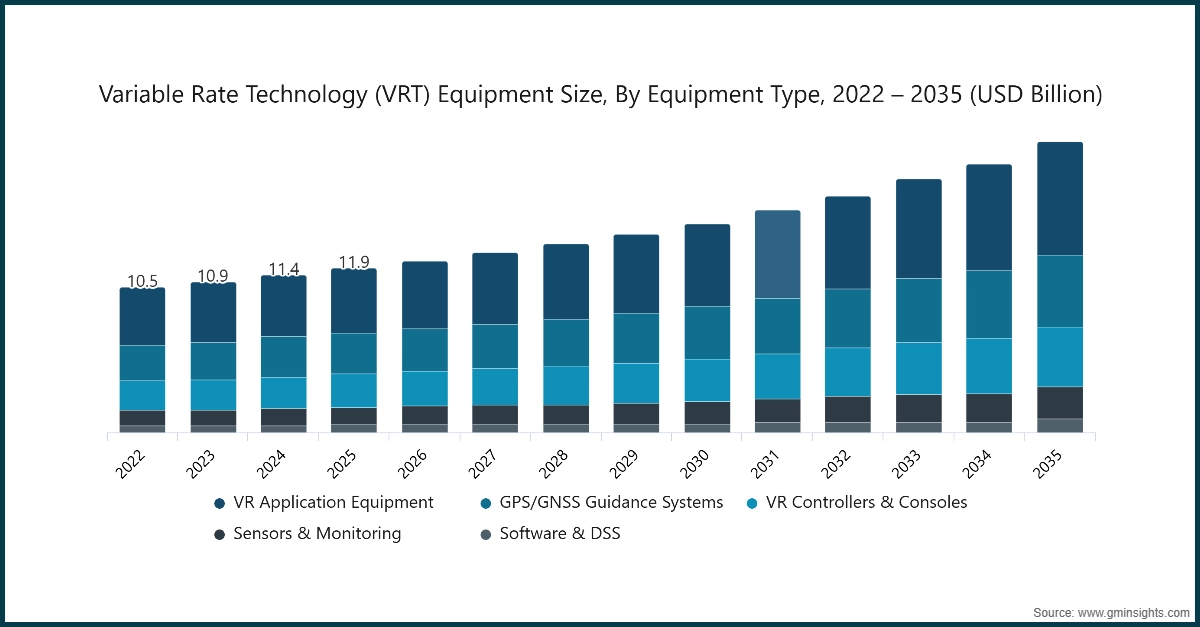
The global variable rate technology equipment market was estimated at USD 11.9 billion in 2025. The market is expected to grow from USD 12.4 billion in 2026 to USD 20.9 billion in 2035, at a CAGR of 6% according to latest report published by Global Market Insights Inc.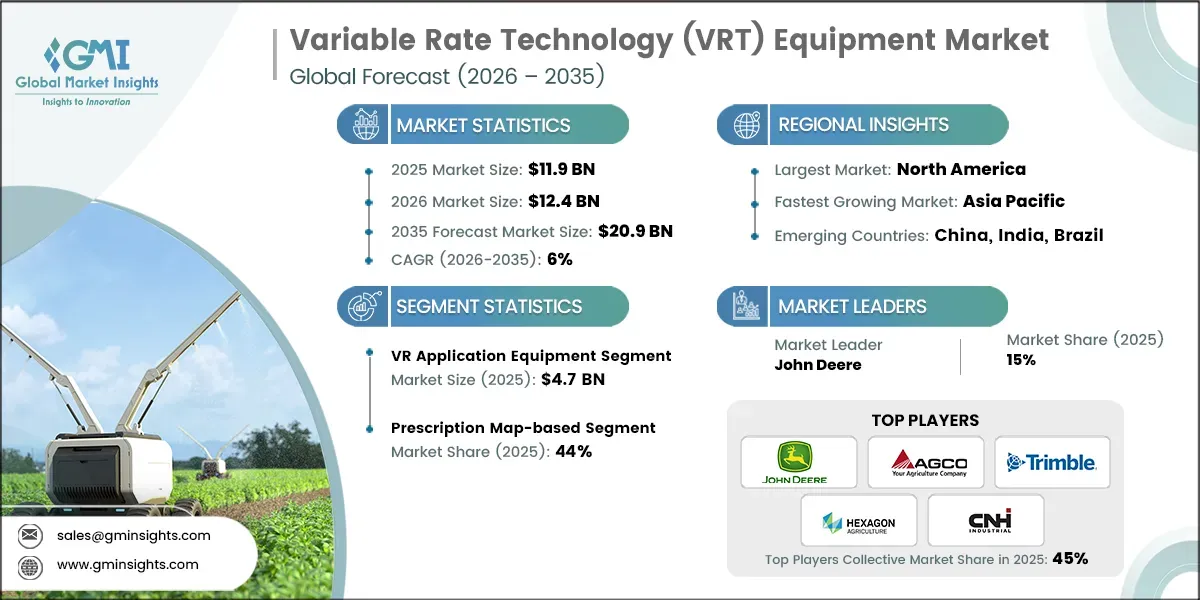
To get key market trends
Variable Rate Technology Equipment Market Trends
The global Variable rate technology (VRT) equipment Market is experiencing robust growth, driven by a confluence of economic, environmental, and technological factors.
- The Levelized Cost of Electricity (LCOE) associated with industrial solar systems within an organization is continuing to decline at a rapid pace, making it one of the most economically competitive sources of energy. As a result of improved Economic Viability and greater return on investment (ROI), organizations will ultimately lower their operational energy costs long-term. As a result, organizations across a wide variety of industrial sectors, all around the world, have begun to adopt the use of industrial solar systems faster than ever before.
- To mitigate the impact of increasing volatility in grid quotes as well as ensuring continuous operation during outages, industrial organizations are increasingly focusing on energy independence, which will foster greater energy independence and resilience throughout the world through onsite generating sources from solar power systems. By taking advantage of onsite generating sources of electricity, industrial organizations can eliminate their dependence on a central grid for the generation of electrical energy and ensure that they have an uninterrupted source of electrical energy for mission-critical industrial processes.
- Corporate Sustainability: As a result of increasing pressure from stakeholders, investors, and customers to meet increasing ESG (Environmental, Social, and Governance) Targets, corporate organizations are deploying industrial solar systems as a means of addressing the "E" component of the ESG Target and to enhance the corporate image, exhibit stewardship toward the environment, and to obtain a social license to continue to operate.
- Electric Storage Systems (BESS): With the increasing trend toward integrating Battery Energy Storage Systems (BESS) with industrial solar installations, many organizations are utilizing hybrid systems to mitigate the effects of solar energy intermittent behavior. Because of the integration of the two systems, organizations can store excess generation from solar systems for peak demand or during night-time hours to provide an uninterrupted source of power and, at the same time, to maximize solar energy self-capturing capacity of the installed solar energy systems.
- Government Incentives: In addition to the decreasing costs associated with industrial solar energy systems, the market is also experiencing strong support from, and from, various forms of Government initiatives and incentives.
Learn more about the key segments shaping this market
Variable Rate Technology Equipment Market Analysis
Based on equipment type, the variable rate technology (VRT) equipment market is divided into VR application equipment, GPS/GNSS guidance systems, VR controllers & consoles, sensors & monitoring, and software & DSS. In 2025, VR application equipment held the major market share, generating a revenue of USD 4.7 billion.
- Variable Rate Application (VRA) equipment dominates the Variable Rate Technology (VRT) equipment market primarily because it delivers immediate, measurable economic benefits to farmers. VRA systems enable precise, site‑specific application of high‑cost inputs such as fertilizers, pesticides, herbicides, and irrigation water based on real‑time field data and prescription maps.
- Input costs account for a significant portion of total farming expenses, the ability to directly reduce over‑application while maintaining or improving yields makes VRA equipment the most compelling investment within precision agriculture portfolios. This clear return on investment (ROI) has driven rapid adoption across both large commercial farms and increasingly among mid‑sized operators. In addition, VRA equipment benefits from ease of integration with existing farm machinery and digital ecosystems, further strengthening its market leadership. Many VRA systems can be retrofitted onto conventional sprayers, spreaders, and planters using GPS, sensors, and farm management software, lowering adoption barriers compared to more capital‑intensive precision technologies. Moreover, tightening environmental regulations and sustainability goals are encouraging farmers to adopt application‑focused precision tools that minimize nutrient runoff and chemical waste.
- As regulatory compliance, cost efficiency, and productivity improvement converge, VRA equipment continues to represent the most mature, scalable, and widely adopted segment within the VRT equipment market.
Learn more about the key segments shaping this market
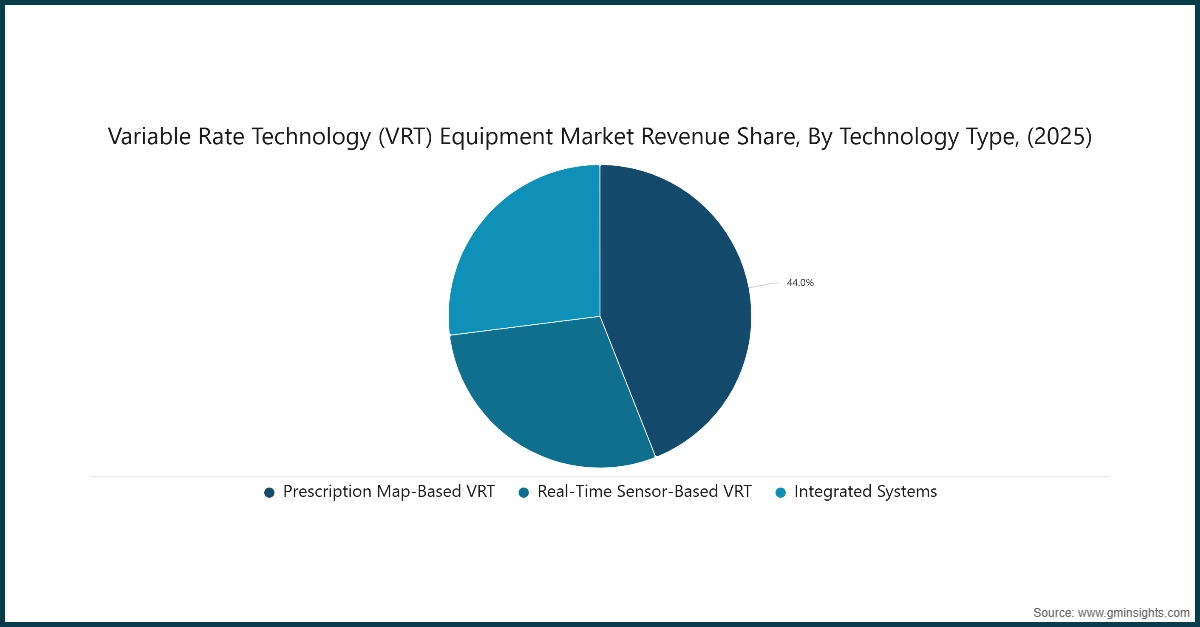
Based on technology type, the variable rate technology equipment market is segmented into prescription map-based, real-time sensor-based, and integrated. prescription map-based segment held the largest share, accounting for 44% of the global variable rate technology (VRT) equipment market in 2025.
- Prescription map‑based technology dominates the Variable Rate Technology (VRT) equipment market because it offers high agronomic accuracy and predictable application outcomes. These systems use pre‑generated prescription maps derived from soil sampling, yield maps, satellite imagery, and historical crop performance data to determine optimal input rates for different field zones.
- As a result, farmers gain precise control over where and how much fertilizer, seed, or crop protection chemical is applied. This structured, data‑intensive approach is especially valuable for large and complex fields where variability is well‑understood, making prescription map‑based VRT the preferred technology for planned, repeatable farming operations.
- Additionally, prescription map‑based systems benefit from broad compatibility with existing farm management software and machinery, reinforcing their commercial dominance. Most modern tractors, planters, sprayers, and spreaders from leading OEMs are designed to seamlessly execute prescription maps via GPS‑enabled controllers, reducing adoption risk.
- Compared to real‑time sensor‑based VRT, prescription map‑based technology involves lower system complexity, fewer calibration challenges, and greater reliability in varying environmental conditions. Furthermore, its strong alignment with regulatory reporting, nutrient management planning, and sustainability programs makes it attractive to both growers and agribusinesses. These advantages position prescription map‑based technology as the most scalable, cost‑effective, and widely implemented option within the VRT technology landscape.
Based on application, the variable rate technology equipment market is segmented into VR fertilizer/nutrient, VR seeding/planting, VR pesticide/chemical and VR irrigation (VRI). In 2025, VR fertilizer/nutrient dominate the market with highest market share.
- Variable Rate (VR) Fertilizer and Nutrient application dominate the VRT application landscape because it directly addresses one of the largest and most volatile cost components in crop production. Fertilizers and nutrients represent a significant share of farm input expenses, and their inefficient application leads to yield losses, nutrient runoff, and regulatory risk. VR nutrient systems allow farmers to adjust application rates based on soil fertility, crop demand, and yield potential across different field zones, delivering immediate cost savings and yield optimization. The strong and measurable return on investment (ROI) from reduced over‑application and improved nutrient use efficiency makes this application the most widely adopted entry point for VRT.
- In addition, increasing environmental regulations and sustainability requirements are accelerating adoption of VR fertilizer technologies. Governments and agri‑food companies are placing growing emphasis on nutrient management, carbon reduction, and water quality protection. VR nutrient application enables compliance with nutrient management plans while supporting sustainable farming certifications. Its compatibility with prescription maps, soil testing data, and existing spreaders and sprayers further reinforces its dominance across both developed and emerging agricultural markets.
Looking for region specific data?
North America Variable Rate Technology Equipment Market
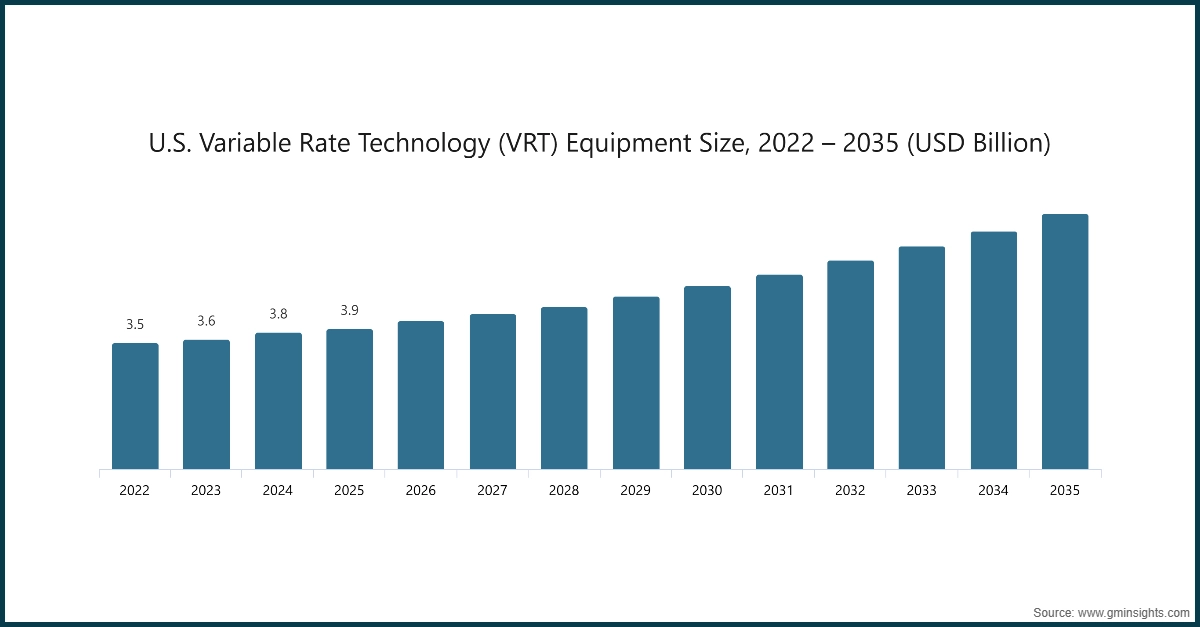
In 2025, the U.S. dominated the North America variable rate technology (VRT) equipment market, accounting for around 80% and generating around USD 3.9 billion revenue in the same year.
- North America represents the largest and most mature market for Variable Rate Technology (VRT) equipment, driven by early adoption of precision agriculture and the presence of large‑scale commercial farms. The U.S. and Canada have high penetration of GPS‑enabled machinery, advanced farm management software, and strong OEM ecosystems (e.g., precision‑ready tractors, planters, and sprayers), which support seamless VRT deployment.
- High input costs, particularly for fertilizers and seeds, further encourage adoption as farmers focus on ROI‑driven technologies. Additionally, supportive government programs, strong agronomic advisory networks, and increasing sustainability and nutrient‑management regulations continue to reinforce steady demand for VRT equipment across row crops such as corn, soybeans, and wheat.
Europe Variable Rate Technology Equipment Market
In Europe variable rate technology (VRT) equipment market, Germany leads the market 28% share in 2025 and is expected to grow at 5.2% during the forecast period.
- Europe is a technology‑driven and regulation‑led market for VRT equipment, with adoption strongly influenced by environmental sustainability goals and strict agricultural regulations. Countries such as Germany, France, the UK, and the Nordics are leading adopters, supported by high awareness of precision agriculture and strong integration of VRT with farm management and compliance systems.
- The European Union’s focus on reducing fertilizer usage, nutrient runoff, and greenhouse gas emissions under initiatives such as sustainable farming and climate action policies is accelerating demand for VR fertilizer and seeding technologies. Although farm sizes are generally smaller than in North America, high regulatory pressure and emphasis on efficient input use continue to drive consistent adoption across Western and Northern Europe.
Asia Pacific Variable Rate Technology Equipment Market
The Asia Pacific holds significant share in the variable rate technology (VRT) equipment market. China holds a market share of around 51% in 2025 and is anticipated to grow with a CAGR of around 6.4% from 2026 to 2035.
- Asia‑Pacific is the fastest‑growing regional market for VRT equipment, supported by rapid agricultural mechanization, expanding commercial farming, and rising food demand. Countries such as China, Australia, India, and Japan are increasingly adopting precision farming to improve productivity amid land constraints and labor shortages.
- While adoption is still uneven due to fragmented landholdings and cost sensitivity in parts of Southeast Asia and South Asia, government‑led digital agriculture initiatives and subsidies are improving accessibility. Growth is particularly strong in large‑scale farming regions such as Australia and China, where VRT is being used to optimize fertilizer and seeding rates for cereals, oilseeds, and horticultural crops, positioning APAC as a key long‑term growth engine.
Variable Rate Technology Equipment Market Share
John Deere is leading with 15% market share. John Deere, AGCO, CNH Industrial, Trimble, Hexagon Agriculture collectively hold around 45%, indicating moderately fragmented market concentration. These prominent players are proactively involved in strategic endeavors, such as mergers & acquisitions, facility expansions & collaborations, to expand their product portfolios, extend their reach to a broad customer base, and strengthen their market position.
- John Deere is a global manufacturer of agricultural, construction, and forestry machinery. They hold a significant position in VRT by deeply integrating precision agriculture capabilities into their planters, sprayers, and spreaders. Their advanced sensing technologies and MyJohnDeere platform enable precise input application, making them central to VRT adoption for optimized crop management and resource efficiency.
- AGCO manufactures and distributes agricultural equipment globally, including brands like Fendt and Massey Ferguson. They hold a significant VRT position through their Fuse Technologies platform, offering integrated variable rate solutions. Their equipment, with features like VarioGuide steering and Section Control, enables variable application of seeds, fertilizers, and chemicals, supporting improved yields and reduced waste.
Variable Rate Technology Equipment Market Companies
Major players operating in the variable rate technology (VRT) equipment market are:
- John Deere (Deere & Company)
- Trimble Inc.
- CNH Industrial
- AGCO Corporation
- Hexagon Agriculture
- Topcon Positioning Systems
- AMAZONE
- Kverneland Group
- Rauch
- Claas
- Lindsay Corporation
- Precision Planting
- Müller‑Elektronik
- Yara International
- Raven Industries
Trimble specializes in positioning technologies, including GPS, lasers, and optical, integrated with software and services. They are a critical VRT enabler, offering agnostic solutions compatible with diverse farm machinery. Their GPS receivers, displays, and FarmWorks software provide the precise mapping, guidance, and data management essential for variable rate application across various equipment brands.
CNH Industrial is a global leader in capital goods, manufacturing agricultural and construction equipment under brands like Case IH and New Holland. Their AFS and PLM platforms offer comprehensive VRT solutions. These platforms provide integrated hardware and software for variable rate seeding, fertilizing, and spraying, enhancing productivity and input efficiency for farmers worldwide.
Variable Rate Technology (VRT) Equipment Market Report Attributes
| Key Takeaway | Details |
|---|---|
| Market Size & Growth | |
| Base Year | 2025 |
| Market Size in 2025 | USD 11.9 Billion |
| Market Size in 2026 | USD 12.4 Billion |
| Forecast Period 2026-2035 CAGR | 6% |
| Market Size in 2035 | USD 20.9 Billion |
| Key Market Trends | |
| Drivers | Impact |
| Accelerated adoption of precision agriculture practices | Growing emphasis on precision agriculture is driving demand for VRT equipment as farmers aim to optimize input usage (seeds, fertilizers, water) based on field variability. VRT enables data‑driven decision‑making, improving crop yields while reducing waste and operational costs. |
| Rising need for input cost optimization and resource efficiency | Escalating prices of agricultural inputs and increasing pressure to improve farm profitability are pushing growers toward technologies that allow variable application rates. VRT helps minimize over‑application, leading to significant savings and better returns on investment. |
| Supportive government policies and digital farming incentives | Many governments are promoting smart farming through subsidies, grants, and digital agriculture initiatives. These programs encourage adoption of VRT systems by reducing capital barriers and promoting sustainable, technology‑enabled farming practices. |
| Pitfalls & Challenges | Impact |
| High initial investment and integration costs | VRT equipment requires substantial upfront capital, including hardware, software, and system integration with existing machinery. Small and medium‑sized farms often face financial constraints, limiting widespread adoption in cost‑sensitive regions. |
| Technical complexity and skill gaps among end users | Effective implementation of VRT requires technical knowledge in data interpretation, GPS systems, and farm management software. Limited digital literacy and lack of trained operators can hinder optimal utilization of VRT equipment. |
| Opportunities: | Impact |
| Expansion in emerging and large-scale agricultural economies | Rapid mechanization, increasing farm sizes, and growing awareness of precision farming in emerging economies create strong growth opportunities for VRT equipment manufacturers, particularly in Asia-Pacific, Latin America, and parts of Eastern Europe. |
| Integration with ai, iot, and advanced farm management platforms | The convergence of VRT equipment with artificial intelligence, IoT sensors, and advanced analytics platforms presents significant opportunities for product differentiation. Smart, connected VRT systems can deliver real‑time insights, predictive recommendations, and enhanced automation, increasing their value proposition. |
| Market Leaders (2025) | |
| Market Leader |
15% market share |
| Top Players |
Consolidate share of 45% |
| Competitive Edge |
|
| Regional Insights | |
| Largest market | North America |
| Fastest growing market | Asia Pacific |
| Emerging countries | China, India, Brazil |
| Future Outlook |
|
What are the growth opportunities in this market?
Variable Rate Technology Equipment Industry News
- In January 2025, John Deere launched Rate Controller 3, an advanced variable rate application controller for precision agriculture operations. This is going to help the company enhance farmer productivity and maintain competitive advantage in the precision agriculture equipment market.
- In April 2024, AGCO acquired 85% of Trimble's precision agriculture business for $2 billion, forming PTx Trimble joint venture. This is going to help the company strengthen its leadership position in precision agriculture and expand its variable rate technology portfolio globally.
- In 2024, AGCO PTx introduced SymphonyVision, a camera-based targeted spraying system enabling variable rate herbicide application. This is going to help the company reduce chemical usage costs and position itself as a leader in sustainable precision agriculture technology.
- In 2024, Raven Industries (CNH Industrial) launched Hawkeye individual nozzle control system for precision variable rate spraying applications. This is going to help the company improve application accuracy and strengthen its market position in precision agriculture technology solutions.
- In 2024, CNH Industrial integrated Raven autonomy platform with variable rate technology equipment for autonomous precision agriculture operations. This is going to help the company capture emerging autonomous farming market opportunities and differentiate its precision agriculture product offerings.
The variable rate technology equipment market research report includes in-depth coverage of the industry with estimates & forecasts in terms of revenue (USD Billion) and volume (Tons) from 2022 to 2035, for the following segments:
Market, By Product Type
- GPS/GNSS guidance and positioning systems
- Variable rate controllers and consoles
- Sensors and monitoring systems
- Variable rate application equipment
- Software and decision support systems
Market, By Technology
- Prescription map‑based VRT
- Real‑time sensor‑based VRT
- Integrated systems
Market, By Farm Size
- Small Family Farms (<600 acres)
- Midsize Family Farms (600–1,700 acres)
- Large‑Scale Family Farms (>1,700 acres)
Market, By Application
- Variable rate nutrient / fertilizer application (VRNT)
- Variable rate seeding / planting
- Variable rate pesticide / herbicide application
- Variable rate irrigation (VRI)
Market, By End Use
- Row crops (broadacre agriculture)
- Specialty crops (high‑value perennials)
- Forage & pasture
- Precision livestock farming
Market, By Distribution Channel
- Direct sales
- Indirect sales
The above information is provided for the following regions and countries:
- North America
- U.S.
- Canada
- Europe
- Germany
- UK
- France
- Italy
- Spain
- Asia Pacific
- China
- Japan
- India
- South Korea
- Australia
- Malaysia
- Indonesia
- Latin America
- Brazil
- Mexico
- Middle East and Africa
- South Africa
- Saudi Arabia
- UAE
Frequently Asked Question(FAQ) :
Who are the key players in the variable rate technology equipment market?
Key players in the VRT equipment market include John Deere (Deere & Company), Trimble Inc., CNH Industrial, AGCO Corporation, Hexagon Agriculture, Topcon Positioning Systems, AMAZONE, Kverneland Group, Rauch, Claas, Lindsay Corporation, and Precision Planting.
What are the upcoming trends in the VRT equipment industry?
Key trends include the integration of AI, IoT, and advanced analytics platforms with VRT systems, enabling real-time insights and predictive recommendations. The adoption of smart, connected systems and supportive government initiatives are also shaping the industry's future.
Which region leads the VRT equipment market in North America?
The U.S. dominated the North American variable rate technology equipment market in 2025, accounting for approximately 80% of the regional market share and generating around USD 3.9 billion in revenue. This leadership is supported by advanced farming practices and strong adoption of precision agriculture technologies.
What was the market share of the prescription map-based technology segment in 2025?
The prescription map-based technology segment accounted for 44% of the global VRT equipment market in 2025, driven by its ability to provide tailored solutions for field variability and enhance decision-making processes.
What is the variable rate technology (VRT) equipment market size in 2025?
The variable rate technology (VRT) equipment market is valued at USD 11.9 billion in 2025. The growing adoption of precision agriculture practices and supportive government policies are driving market growth.
What is the market size of the variable rate technology equipment market in 2026?
The market size for VRT equipment is projected to reach USD 12.4 billion in 2026, reflecting steady growth driven by increasing demand for resource efficiency and input cost optimization.
What is the projected value of the VRT equipment market by 2035?
The VRT equipment market is expected to reach USD 20.9 billion by 2035, growing at a CAGR of 6% during the forecast period. This growth is fueled by advancements in AI, IoT integration, and the expansion of precision farming practices globally.
How much revenue did the VR application equipment segment generate in 2025?
The VR application equipment segment generated USD 4.7 billion in revenue in 2025, making it the largest equipment type category. Its dominance is attributed to its widespread use in optimizing input application rates and improving farm productivity.
Variable Rate Technology (VRT) Equipment Market Scope
Related Reports