Summary
Table of Content

V2X Communication Chips Market
Get a free sample of this report
Form submitted successfully!
Error submitting form. Please try again.
Thank you!
Your inquiry has been received. Our team will reach out to you with the required details via email. To ensure that you don't miss their response, kindly remember to check your spam folder as well!
Request Sectional Data
Thank you!
Your inquiry has been received. Our team will reach out to you with the required details via email. To ensure that you don't miss their response, kindly remember to check your spam folder as well!
Form submitted successfully!
Error submitting form. Please try again.
V2X Communication Chips Market Size
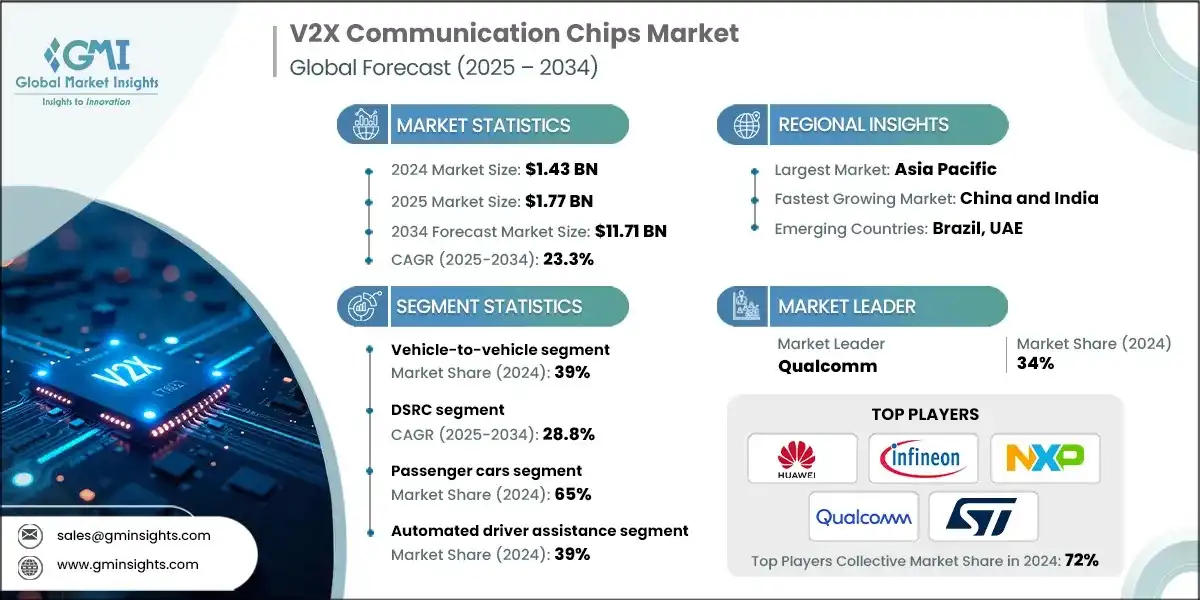
The global V2X communication chips market size was estimated at USD 1.43 billion in 2024. The market is expected to grow from USD 1.77 billion in 2025 to USD 11.71 billion in 2034, at a CAGR of 23.3%, according to latest report published by Global Market Insights Inc.
V2X Communication Chips Market Key Takeaways
Market Size & Growth
- 2024 Market Size: USD 1.43 Billion
- 2025 Market Size: USD 1.77 Billion
- 2034 Forecast Market Size: USD 11.71 Billion
- CAGR (2025–2034): 23.3%
Regional Dominance
- Largest Market: Asia-Pacific
- Fastest Growing Region: China and India
Key Market Drivers
- Increasing deployment of connected and autonomous vehicles.
- Government mandates on road safety and ITS infrastructure.
- Transition toward C-V2X with 5G compatibility.
- OEM–semiconductor partnerships for scalability.
Challenges
- High integration and testing costs.
- Fragmentation between DSRC and C-V2X standards.
Opportunity
- Expansion of smart city infrastructure and 5G rollout.
- Integration with ADAS and autonomous driving systems.
Key Players
- Market Leader: Qualcomm led with over 34% market share in 2024.
- Leading Players: Top 5 players in this market include Huawei Technologies, Infineon Technologies, NXP Semiconductors, Qualcomm, STMicroelectronics, which collectively held a market share of 72% in 2024.
Get Market Insights & Growth Opportunities
V2X communication chips are expanding rapidly in the market as motor vehicle OEMs, authorities and technology suppliers push connected dynamics and traffic safety. V2X communication chips are designed to enable direct communication between vehicles, infrastructure at the roadside, pedestrians and networks without relying only on cellular connection. These chips play an important role in supporting issues such as conflict prevention, traffic management, traffic warnings, emergency vehicles and cooperative driving.
The market has been shaped by regulatory initiatives, especially in areas such as North America, Europe, China and parts of the Middle East, compulsory V2X implementation. Governments encourage the adoption of V2X to reduce traffic accidents and overload. Work on standardization around DSRC (Dedicated Short-Range Communications) and C-V2X (Cellular V2X) affects the direction of the market, increasing the speed of the C-V2X due to the compatibility with the 5G network. China reported more than 29,000 kilometers of open intelligent connected vehicle test roads and over 6,800 test and demonstration licenses issued nationwide as of April 2024.
Demand is driven by integrating V2X chips into passenger cars, commercial vehicles and smart city infrastructure. OEMs collaborate with semiconductor companies to ensure low-latency, safe and scalable communication systems. It is also a partnership to accelerate readiness of the ecosystem between telecom operators, chipmakers and car manufacturers in the market.
From a competitive point of view, large semiconductor players are focused on chipsets that support both DSRC and C-V2X to meet different regional requirements. Companies also invest in low-power and high-performing designs to enable mass deployment. As adoption increases, cost reduction and supply chain stability are expected to be the most important factors affecting broad rollouts.
To get key market trends
V2X Communication Chips Market Trends
The V2X communication chip industry is shaped by increasing the placement of connected and autonomous vehicles. The demand is reinforced by the government's initiatives that promote Intelligent Transportation Systems (ITS) and provide a mandate to the use of V2X technologies to improve traffic safety and reduce congestion. In 2024, an estimated 17 million electric vehicles were sold globally, which took over 20% of total new car sales worldwide. EV production increases support using V2X as OEMs include advanced connection in the next generation vehicle.
Another important trend is a shift from DSRC-based systems to Cellular-V2X (C-V2X), which is driven by its compatibility with 5G networks. China leads as the largest manufacturer, producing around 31.3 million vehicles (passenger + commercial), which increased by 4% year-over-year. In comparison, the United States produced around 10.6 million vehicles, and Japan produced about 8.2 million, strengthening the strong role of the Asia-Pacific in the V2X adoption.
Strong cooperation between OEMs, telecom operators and semiconductor companies is also seen in the market to ensure that interoperability and distribution can accelerate. Partnership is aimed at scalable chip design that meets automotive industry standards with emphasis on cybersecurity and reliable data transfer. In addition, authorities and municipalities invest in smart city infrastructure that integrate V2X capabilities, which expand the addressable market.
The combination of V2X with Advanced Driver Assistance Systems (ADAS) and autonomous driving is a development driver. Integration enables vehicles to sense the surroundings not only through cameras and sensors but also receives future information from the surrounding infrastructure and vehicles. This convergence of V2X chips is expected to create an important component of the next generation mobility ecosystem.
V2X Communication Chips Market Analysis
Learn more about the key segments shaping this market
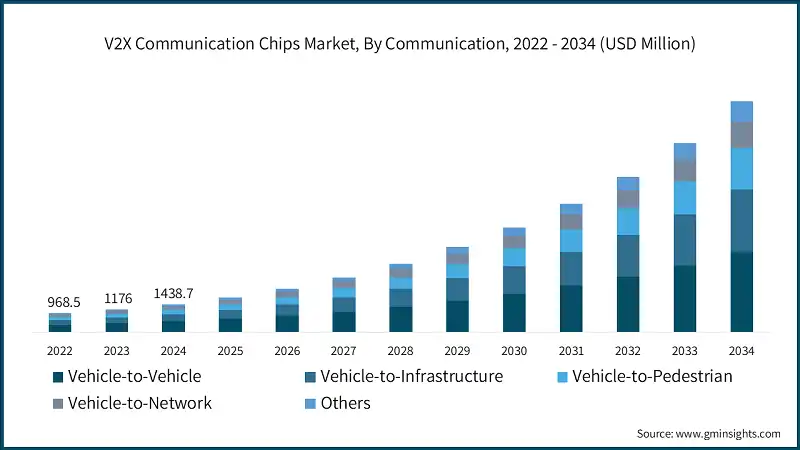
Based on communication, the V2X communication chips market is divided into vehicle-to-vehicle, vehicle-to-infrastructure, vehicle-to-pedestrian, vehicle-to-network, and others. Vehicle-to-vehicle segment dominated the market in 2024, accounting for 39% of total revenue.
- Vehicle-to-vehicle segment V2X creates the core application of communication chips, which enables direct data exchange between vehicles on the road. V2V communication supports such as collision prevention, lane assistance and blind spots. This section is expected to increase when OEMs integrate V2V functions into passenger and commercial vehicles to fulfill traffic safety rules and prepare for autonomous driving tasks.
- Vehicle-to-infrastructure segment gets traction with increasing investments in smart urban projects and Intelligent Transportation Systems. V2I allows vehicles to communicate with traffic signals, road sensors and toll systems to optimize traffic flows and reduce congestion. Governments support V2I deployment to improve urban mobility, making this part important in heavy investment areas in connected road infrastructure.
- Vehicle-to-pedestrian communication is designed to improve the safety of non-motorized road users such as pedestrians and cyclists. By using integrated V2X chips in smartphones or wearables, vehicles can detect pedestrian presence and give warnings to avoid accidents. Although adoption is still limited compared to V2V and V2I, this part is expected to expand as urban safety rules are strengthened, and smart mobility solutions include vulnerable road users.
- The vehicle-to-network segment focuses on connecting vehicles with cellular networks and cloud platforms for data exchange. V2N supports actions such as real-time navigation, traffic updates and remote diagnostics. With the increase of 5G connectivity, V2N adoption is accelerated, as it provides a backbone to integrate vehicles into the wider mobility ecosystem
Learn more about the key segments shaping this market
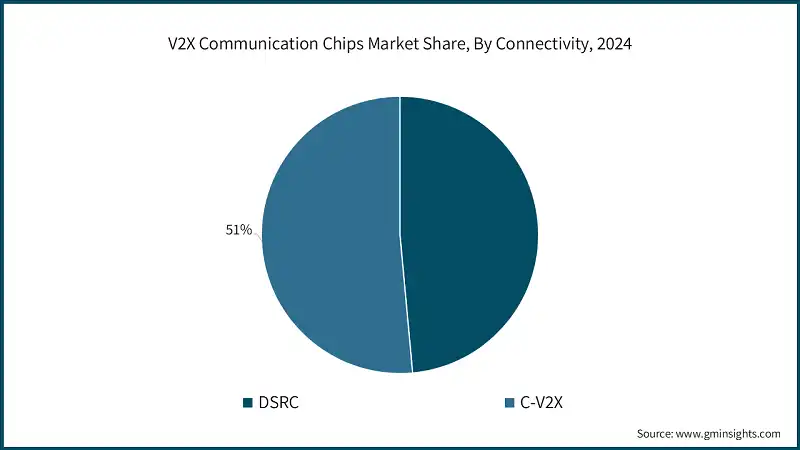
Based on connectivity, the V2X communication chips market is segmented into DSRC and C-V2X. The DSRC segment led the market in 2024 and is expected to grow at a CAGR of 28.8% from 2025 to 2034.
- The DSRC segment represents a traditional V2X communication technique and works with a 5.9 GHz band to enable short-distance between vehicles and infrastructure, short-distance data exchange. DSRC chips are mainly used for safety-oriented applications such as collision prevention, emergencies and roadside assistance. The segment has established adoption in areas with preliminary V2X deployment, including North America and parts of Europe, where regulatory structures support DSRC tests and pilot programs.
- The C-V2X segment is based on cellular networks and provides both direct communication (PC5 interface) and network-based communication (Uu interface). C-V2X enables long-distance communication, high scalability and better integration with 5G networks, suitable for both safety and non-safety applications, including real-time traffic updates, autonomous driving support and cloud-based vehicle management. The adoption increases rapidly due to the 5G deployment and increase in compatibility with the next generation connected vehicle.
- While DSRC has an early start in some areas with regulatory backing, C-V2X appears globally as a preferred technology due to its flexibility and support for future mobility trends. C-V2X also allows OEMs and telecom operators to use existing cellular infrastructure, reducing the cost of deployment and accelerating adoption. As a result, several automotive manufacturers now offer chipsets that support both DSRC and C-V2X to meet regional requirements and ensure interoperability.
Based on vehicle, the V2X communication chips market is segmented into passenger cars and commercial vehicles. The passenger cars segment dominated the market, accounting for share of 65% in 2024.
- Passenger car segment V2X Communication chips are responsible for an important part of the market. Passenger cars activate facilities such as V2X Collision avoidance, lane assistance, traffic signal communication and notifications. Integration of these chips helps to improve traffic safety and driving efficiency. Adoption in this segment is driven by regulatory mandates in many areas, in addition to increasing consumer demand for connected and semi-autonomous vehicles.
- The commercial vehicle segment includes trucks, buses and delivery vehicles, where V2X communication chips provide safety, efficiency and operational benefits. For commercial fleets, V2X vehicle-to-vehicle and vehicle-to-infrastructure enable communication to handle traffic, avoid collisions and optimize routing. This segment quickly adopts these chips to meet regulations, reduce operating costs and comply with regional rules that target traffic safety and emissions.
- While passenger cars dominate when it comes to volume, commercial vehicles are seeing rapid adoption due to strict safety rules and operational efficiency requirements. V2X chips in commercial vehicles also enable telematics integration, fleet management and connection with smart city infrastructure, which improves the overall value proposition. Manufacturers of both vehicle types collaborate with semiconductor companies to develop scalable, cost-effective solutions suitable for mass deployment.
Based on application, the V2X communication chips market is segmented into automated driver assistance, traffic management, emergency vehicle notification, and others. The automated driver assistance segment dominated the market, accounting for share of 39% in 2024.
- Automatic driver assistance segment V2X is an important use of communication chips. These chips enable vehicles to detect and respond to real-time traffic conditions, other vehicles and road barriers, supporting adaptive cruise control, lane keeping and collision avoidance. The ADAS application improves the vehicle's safety and driving efficiency, and adoption increases because OEMs integrate semi-autonomous and autonomous functions in passenger cars and commercial vehicles.
- V2X chips play an important role in traffic management applications by allowing vehicles to communicate with infrastructure and traffic control systems at the roadside. This connectivity enables real-time traffic monitoring, reduction of congestion and route optimization. Traffic management applications in urban areas are particularly important, where Smart City initiatives run a large-scale deployment of V2X infrastructure and connected vehicle technologies.
- The emergency vehicle notification segment enables vehicles and infrastructure to communicate alerts about ambulances, fire trucks or police vehicles. V2X chips provide quick response by improving the safety of both emergency responders and road users, by clearing traffic lanes and reducing delays. This segment grows as governments and municipalities prioritize traffic safety and emergency response efficiency, and such systems are increasingly mandated in vehicles under regulations.
The “others” segment includes new applications such as platooning, cooperative driving, pedestrian safety and vehicle-to-network communication. These applications benefit from V2X chips to enhance overall mobility, energy efficiency and safety beyond traditional use cases.
Looking for region specific data?
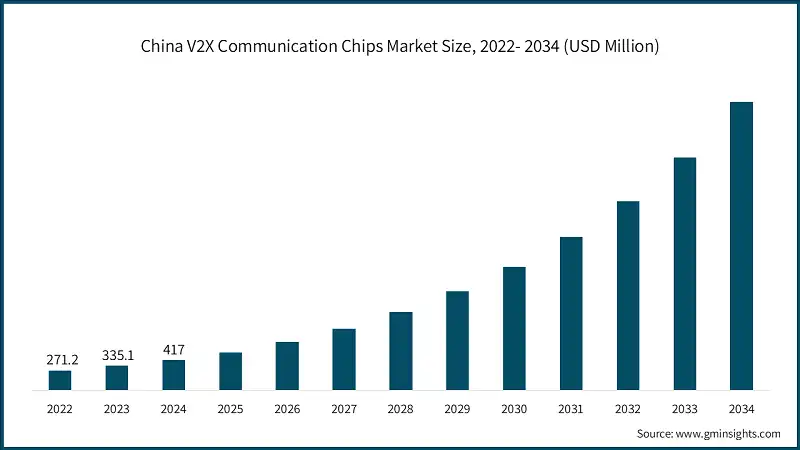
The China dominates the Asia Pacific V2X communication chips market, generating USD 417 million revenue in 2024.
- China is the largest and fastest growing market for V2X communications in Asia. The country's motor vehicle industry looks at rapid growth in both passenger and commercial vehicles, producing around 31.3 million vehicles in 2024, which is 4% from year to year. The government actively promotes active and autonomous vehicle technologies through national politics, pilot programs and smart city initiatives.
- Use V2X communication chips in China support the development of large -scale infrastructure, with more than 29,000 kilometers of open intelligent connected vehicle test roads and more than 6,800 tests and performance licenses were issued nations by April 2024.
- The C-V2X technology receives significant traction due to compatibility with 5G networks in China and scalability for future autonomous driving applications. While DSRC has been used in previous pilot projects, C-V2X is now a favorite technique to use a large scale in both passenger cars and commercial vehicles. OEM and semiconductor companies work together to develop automotive-grade chipsets that meet China's regulatory and technical needs.
- Combined with state support, increasing EV production and Smart City Initiative, China ranks as a hub for V2X Chip deployment. The country is expected to continue innovation and scale in the Asia-Pacific Market, affect regional standards and speed up using connected vehicle technologies.
The V2X communication chips market in the US is expected to experience robust growth from 2025 to 2034.
- The US is an important market for V2X communication chips in North America, driven by regulatory support, technological progress and growing connected vehicle initiatives. The US automotive industry produced around 10.6 million vehicles in 2024, including both passenger and commercial vehicles, and continuously observes the adoption of connected and semi-autonomous vehicles.
- US V2X communication chips are supported by federal and state policies, which promote Intelligent Transportation Systems (ITS), vehicle safety and deployment of connected infrastructure. Vehicle-to-vehicle (V2V), vehicle-to-infrastructure (V2I) and vehicle-to-network (V2N) communication systems are being tested and implemented through several pilot programs and smart city initiatives.
- The C-V2X technology is accelerating due to its compatibility with 5G networks, low-latency communication and support for autonomous driving applications. While DSRC is used in early pilot projects, automotive manufacturers and telecom operators are increasingly focusing on C-V2X for mass adoption in passenger cars and commercial vehicles. OEMs collaborate with semiconductor companies to develop chipsets that meet US safety standards and technical requirements.
- Government support, together with increasing EV production and investment in Smart City infrastructure, positions V2X as an important center for deployment in North America. The US market is expected to continue growing, influencing regional standards, promoting vehicle safety, and supporting the integration of connected and autonomous mobility solutions.
The V2X communication chips market in Germany is expected to experience strong growth from 2025 to 2034.
- Germany is leading markets for V2X communication chips in Europe, driven by its strong automotive industry, regulatory support and Smart Mobility initiatives. The country is home to large OEMs and automotive suppliers that are actively developing connected and autonomous vehicle technologies. Production of passenger cars and commercial vehicles in Germany is increasing, which provides a strong market for V2X chip integration.
- Use of V2X communication chips in Germany is supported by the government’s policies and EU directives, which promote vehicle safety, traffic efficiency and Intelligent Transportation Systems (ITS). Many pilot programs and city-level smart mobility projects have been launched to implement vehicle-to-vehicle (V2V), vehicle-to-infrastructure (V2I) and vehicle-to-network (V2N) communication systems.
- The C-V2X technology gains traction in Germany because of its low-latency communication, scalability and compatibility with 5G networks, and supports both safety and non-safety applications in connected vehicles. While DSRC has been used in early tests, automotive manufacturers are focusing on C-V2X for large-scale deployment in passenger cars and commercial vehicles. OEMs collaborate with semiconductor companies to produce chipsets that meet German and European Union safety and technical standards.
- Government support, combined with investment in smart city infrastructure and connected mobility initiatives, positions Germany as a center for V2X chip deployment in Europe. The market is expected to continue growing, influencing European standards, promoting road safety and accelerating the integration of autonomous vehicle technologies throughout the region.
The V2X communication chips market in UAE is expected to experience stable growth from 2025 to 2034.
- UAE is an emerging market for V2X communication chips in the Middle East and Africa, driven by government initiatives that promote smart urban development, Intelligent Transportation Systems (ITS) and connected mobility. The country is actively involved and invests in advanced road infrastructure and pilot programs to test and implement autonomous vehicle technologies.
- Use of V2X communication chips in UAE is supported by federal and municipal regulations that emphasize traffic safety, traffic management and vehicle-to-vehicle (V2V), vehicle-to-infrastructure (V2I) and vehicle-to-network (V2N) communication systems. The Smart City initiatives, especially in Abu Dhabi and Dubai, provide a favorable environment for large-scale deployment of these technologies.
- The C-V2X technology gains traction in the United Arab Emirates because of its low-latency communication, scalability and compatibility with 5G networks. While DSRC has been used in preliminary tests, automotive manufacturers and telecom operators are focusing on C-V2X for wide deployment in passenger cars and commercial vehicles. OEMs collaborate with semiconductor companies to develop chipsets that meet UAE safety standards and technical requirements.
- With government support combined with investments in smart urban infrastructure and connected vehicle programs, UAE ranks as an important hub for V2X chip deployment in the Middle East. The market is expected to continue growing, influencing regional standards, improving traffic safety and accelerating the adoption of autonomous mobility solutions across the country.
The V2X communication chips market in Brazil is expected to experience significant and promising growth from 2025 to 2034.
- Brazil is an emerging market for V2X communication chips in Latin America, which is inspired by the government's initiative that promotes the Intelligent Transportation System (ITS), traffic safety and connected mobility. The country's sector for motor vehicles, including both passengers and commercial vehicles, gradually adopted connected vehicle technologies to improve traffic safety and traffic management.
- Use of V2X communication chips in Brazil are supported by federal and state level programs that encourage vehicle-to-vehicle (V2V), vehicle-to- infrastructure (V2I) and network systems and vehicle-to- communication (V2N). The Smart Dynamics initiative and pilot projects in larger cities are intended to spread these techniques and show the benefits of vehicles that are involved in urban traffic management.
- The C-V2X technology receives traction in Brazil because of its communication, scalability and compatibility with low suppression with 5G networks. While DSRC has been used in early experiments, manufacturers of motor vehicles and telecommunications are focused on C-V2X for extensive distribution in passenger cars and commercial vehicles. OEM collaborates with semiconductor companies to develop tile sets for car quality that meets the safety and technical standards of Brazil.
- Joint government support with investments in smart city infrastructure and connected vehicle programs, V2X Chip in Latin America, rank to Brazil as an important market for V2X chips. The market is expected to continue to increase in the market, affect regional standards, improve traffic safety and accelerate across the country and use autonomous mobility solutions across the country.
V2X Communication Chips Market Share
- The top 7 companies in the V2X communication chips industry are Qualcomm, NXP semiconductors, Huawei technologies, Infineon technologies, STMicroelectronics, Continental, Robert Bosch, contributing around 79% of the market in 2024.
- Qualcomm focuses on developing high-performance C-V2X chipsets, which enable safe communication for low-latency, connected and autonomous vehicles. The solutions support both passenger and commercial vehicles, which are initially integrated with 5G networks and collaborate with OEMs to accelerate mass adoption globally.
- NXP Semiconductors provide V2X communication solutions including DSRC and C-V2X chips, which emphasize safety applications such as collision prevention and traffic control. The company works closely with OEMs and Tier-1 suppliers to provide scalable, automotive-grade chipsets for global markets.
- Huawei Technologies develops V2X communication modules and platforms focusing on connectivity. The solutions support Smart City Infrastructure integration, Fleet Management and Autonomous Driving applications, which strengthens partnerships with car manufacturers and telecom operators worldwide.
- Infineon Technologies supplies V2X chips adapted to automotive safety, low power consumption and reliability. The offerings are aimed at ADAS, traffic management and emergency vehicle notification systems, with strong cooperation with OEMs and Tier-1 suppliers in Europe, Asia-Pacific and North America.
- STMicroelectronics Automotive V2X provides solutions that support both DSRC and C-V2X standards. The chips are used in connected passenger cars and commercial vehicles, enabling integration with collision avoidance, vehicle-to-infrastructure communication and globally advanced driver assistance systems.
- Continental develops V2X communication modules and chipsets for commercial vehicles, supports traffic safety, smart mobility and autonomous driving. The company is collaborating with OEMs and city-level projects to implement C-V2X and DSRC deployment on a large scale in global markets.
- Robert Bosch offers integrated V2X communication solutions with ADAS and autonomous driving systems. The chipsets and modules support V2V, V2I and V2N applications, which emphasize safety, reliability and interoperability, while collaborating with OEMs and Tier-1 suppliers worldwide.
V2X Communication Chips Market Companies
Major players operating in the V2X communication chips industry are:
Continental
Denso
Harman
Huawei Technologies
Infineon Technologies
NXP Semiconductors
Qualcomm
Robert Bosch
STMicroelectronics
- The V2X communication chips market is poised for rapid growth driven by the convergence of global pressure for connected vehicle technologies, smart city initiatives and traffic safety. Increasing integrated passenger cars, commercial vehicles and electric vehicles with V2X functions creates a strong demand for reliable, low-latency and scalable chipsets.
- North America, Europe, China and parts of the Middle East accelerate regulatory mandate markets, as governments prefer Intelligent Transportation Systems (ITS) and autonomous driving infrastructure. Changes in C-V2X technology from DSRC supported by 5G networks, transformation of market dynamics and motivating semiconductor companies and OEMs to develop multi-standard solutions.
- The market has a mix of global semiconductor companies, OEMs and emerging technology suppliers. Companies such as Qualcomm, NXP Semiconductors, Huawei Technologies, Infineon Technologies, STMicroelectronics, Continental and Robert Bosch invest in R&D to offer high-performance, energy-efficient and cost-effective V2X solutions.
- Strategic partnerships between OEMs, telecom operators and chipmakers drive the development of the ecosystem, enabling real-world deployment and interoperability. Analysts estimate that as infrastructure investment increases and EV production rises, cost optimization, regulatory compliance and large-scale deployment will define the success of market participants in the next decade.
V2X Communication Chips Market Report Attributes
| Key Takeaway | Details |
|---|---|
| Market Size & Growth | |
| Base Year | 2024 |
| Market Size in 2024 | USD 1.43 Billion |
| Market Size in 2025 | USD 1.77 Billion |
| Forecast Period 2025 - 2034 CAGR | 23.3% |
| Market Size in 2034 | USD 11.71 Billion |
| Key Market Trends | |
| Drivers | Impact |
| Increasing deployment of connected and autonomous vehicles | Drives adoption of V2X chips for safety and cooperative mobility |
| Government mandates on road safety and ITS infrastructure | Boosts large-scale rollout of V2X solutions in passenger and commercial vehicles |
| Transition toward C-V2X with 5G compatibility | Strengthens integration into next-gen vehicles and smart cities |
| OEM–semiconductor partnerships for scalability | Accelerates ecosystem readiness and cost-effective production |
| Pitfalls & Challenges | Impact |
| High integration and testing costs | Slows adoption for mid- and low-tier vehicle segments |
| Fragmentation between DSRC and C-V2X standards | Creates uncertainty and slows global harmonization |
| Opportunities: | Impact |
| Expansion of smart city infrastructure and 5G rollout | Enhances demand for large-scale deployment of V2X chips |
| Integration with ADAS and autonomous driving systems | Creates growth potential for safety-critical communication |
| Market Leaders (2024) | |
| Market Leaders |
Market Share 34% |
| Top Players |
Collective market share in 2024 is 72% |
| Competitive Edge |
|
| Regional Insights | |
| Largest Market | Asia-Pacific |
| Fastest growing market | China and India |
| Emerging countries | Brazil, UAE |
| Future outlook |
|
What are the growth opportunities in this market?
V2X Communication Chips Industry News
- In August 2025, Qualcomm announced a strategic collaboration with a leading European automotive OEM to supply C-V2X chipsets for next-generation connected vehicles. The partnership aims to integrate low-latency, 5G-enabled V2X communication modules into both passenger and commercial vehicle platforms.
- In September 2025, NXP Semiconductors entered a multi-year agreement with a major North American fleet operator to provide DSRC and C-V2X chips. The contract focuses on deploying V2X-enabled traffic management and collision avoidance systems across urban and highway fleets.
- In October 2024, Huawei Technologies partnered with Dubai’s Roads and Transport Authority (RTA) to implement large-scale C-V2X infrastructure. The collaboration will support smart city initiatives, connected traffic signals, and real-time vehicle-to-infrastructure communication for safer urban mobility.
- In July 2024, Infineon Technologies launched a new series of automotive-grade V2X chipsets designed for ADAS, emergency vehicle notification, and autonomous driving applications. The modules are optimized for low power, high reliability, and integration with both DSRC and C-V2X standards.
- In June 2024, STMicroelectronics collaborated with a major German OEM to deploy V2X-enabled connected vehicles across Europe. The initiative focuses on integrating V2V, V2I, and V2N systems to enhance traffic safety, urban mobility, and autonomous driving capabilities.
The V2X communication chips market research report includes in-depth coverage of the industry with estimates & forecasts in terms of revenue ($ Mn/Bn) and volume (Units) from 2021 to 2034, for the following segments:
Market, By Communication
- Vehicle-to-Vehicle
- Vehicle-to-Infrastructure
- Vehicle-to-Pedestrian
- Vehicle-to-Network
- Others
Market, By Connectivity
- DSRC
- C-V2X
Market, By Vehicle
- Passenger Vehicles
- Hatchback
- Sedan
- SUV
- Commercial Vehicles
- Light Commercial Vehicles (LCV)
- Medium Commercial Vehicles (MCV)
- Heavy Commercial Vehicles (HCV)
Market, By Application
- Automated Driver Assistance
- Traffic Management
- Emergency Vehicle Notification
- Others
The above information is provided for the following regions and countries:
- North America
- US
- Canada
- Europe
- Germany
- UK
- France
- Italy
- Spain
- Russia
- Nordics
- Asia Pacific
- China
- India
- Japan
- Australia
- South Korea
- Southeast Asia
- Latin America
- Brazil
- Mexico
- Argentina
- MEA
- South Africa
- Saudi Arabia
- UAE
Frequently Asked Question(FAQ) :
What is the market size of the V2X communication chips in 2024?
The market size was estimated at USD 1.43 billion in 2024, with a CAGR of 23.3% expected through 2034. The growth is driven by the increasing adoption of connected and autonomous vehicles.
What is the projected value of the V2X communication chips market by 2034?
The market is poised to reach USD 11.71 billion by 2034, fueled by the integration of V2X with Advanced Driver Assistance Systems (ADAS), the shift to Cellular-V2X (C-V2X), and investments in smart city infrastructure.
What is the expected size of the V2X communication chips market in 2025?
The market size is projected to reach USD 1.77 billion in 2025.
How much revenue did the vehicle-to-vehicle segment generate in 2024?
The vehicle-to-vehicle segment accounted for 39% of the total revenue in 2024, led by its core application in collision prevention, lane assistance, and blind spot detection.
What was the valuation of the DSRC segment in 2024?
The DSRC segment is anticipated to expand at a CAGR of 28.8% from 2025 to 2034.
What is the growth outlook for the passenger cars segment?
The passenger cars segment dominated the market with a 65% share in 2024.
Which region leads the V2X communication chips sector?
China leads the Asia-Pacific market, generating USD 417 million in revenue in 2024, supported by government initiatives promoting autonomous and connected vehicle technologies.
What are the upcoming trends in the V2X communication chips market?
Key trends include the shift to C-V2X, integration with ADAS and autonomous driving, industry collaborations, and smart city investments.
Who are the key players in the V2X communication chips industry?
Major players include Continental, Denso, Harman, Huawei Technologies, Infineon Technologies, NXP Semiconductors, Qualcomm, Robert Bosch, and STMicroelectronics.
V2X Communication Chips Market Scope
Related Reports