Summary
Table of Content

U.S. Wearable Bioelectronic Skin Patches Market
Get a free sample of this report
Form submitted successfully!
Error submitting form. Please try again.
Thank you!
Your inquiry has been received. Our team will reach out to you with the required details via email. To ensure that you don't miss their response, kindly remember to check your spam folder as well!
Request Sectional Data
Thank you!
Your inquiry has been received. Our team will reach out to you with the required details via email. To ensure that you don't miss their response, kindly remember to check your spam folder as well!
Form submitted successfully!
Error submitting form. Please try again.
U.S. Wearable Bioelectronic Skin Patches Market Size
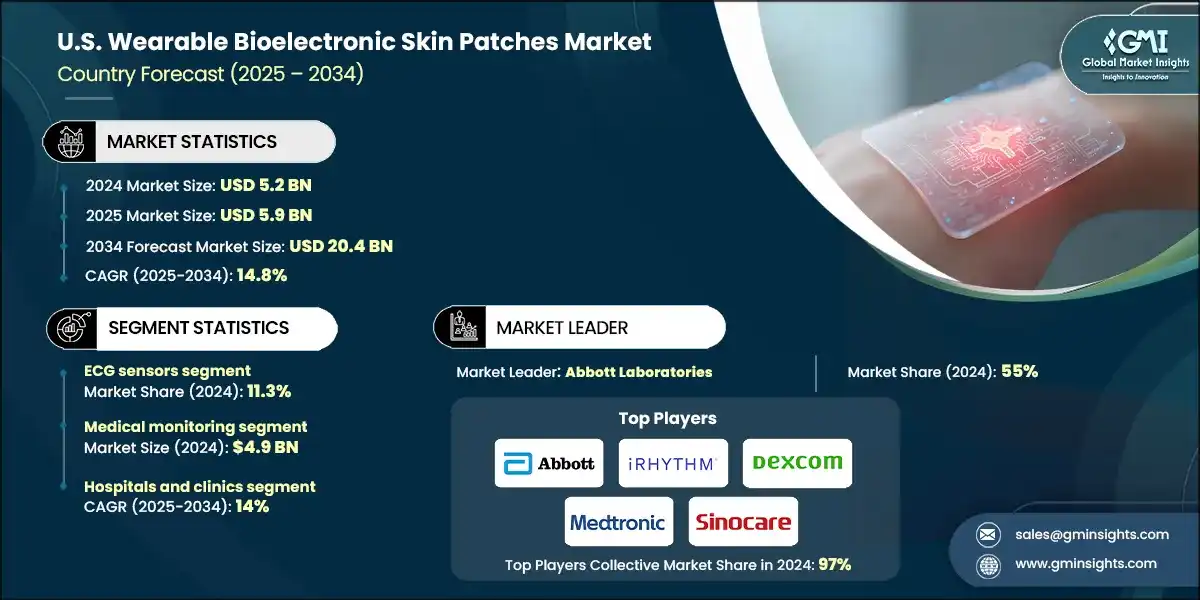
The U.S. wearable bioelectronic skin patches market was valued at USD 5.2 billion in 2024 and is projected to grow from USD 5.9 billion in 2025 to USD 20.4 billion by 2034, expanding at a CAGR of 14.8%, according to the latest report published by Global Market Insights Inc.
U.S. Wearable Bioelectronic Skin Patches Market Key Takeaways
Market Size & Growth
- 2024 Market Size: USD 5.2 Billion
- 2025 Market Size: USD 5.9 Billion
- 2034 Forecast Market Size: USD 20.4 Billion
- CAGR (2025–2034): 14.8%
Key Market Drivers
- Rising prevalence of chronic diseases in U.S..
- Increasing technological advancements in wearable bioelectronic skin patches.
- Growing fitness and wellness awareness.
- Rising demand for non-invasive health monitoring.
Challenges
- Data privacy and security concerns.
- Stringent regulatory scenario.
Opportunity
- Integration with telehealth and remote patient monitoring.
Key Players
- Market Leader: Abbott laboratories led with over 55% market share in 2024.
- Leading Players: Top 5 players in this market include Abbott laboratories, iRhythm Technologies, Dexcom, Medtronic, Sinocare, which collectively held a market share of 97% in 2024.
Get Market Insights & Growth Opportunities
The steady growth is driven by various factors, such as the rising prevalence of chronic diseases in the U.S., growing fitness and wellness awareness, technological advancements in wearable bioelectronic skin patches, and increasing demand for non-invasive health monitoring. Major companies in the industry include Abbott Laboratories, iRhythm Technologies, Dexcom, Medtronic, and Sinocare.
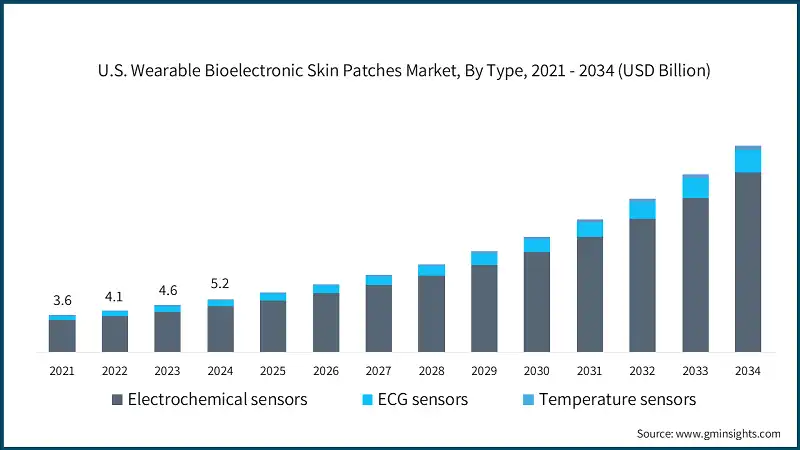
The U.S. wearable bioelectronic skin patches market has grown significantly, increasing from USD 3.6 billion in 2021 to USD 4.6 billion in 2023. This growth is primarily fueled by the rising prevalence of chronic conditions such as cardiovascular disorders, diabetes, and respiratory illnesses, which require continuous monitoring to prevent complications and improve patient outcomes. For instance, according to the Centers for Disease Control and Prevention (CDC), approximately 38.4 million people, or 11.6% of the population, are living with diabetes, with prevalence reaching 29.2% among adults aged 65 and older.
This escalating diabetes burden underscores the critical need for advanced monitoring solutions such as wearable bioelectronic skin patches. These devices enable real-time, non-invasive tracking of glucose levels and other vital parameters, facilitating early detection of fluctuations, reducing the risk of severe complications, and enhancing disease management.
Additionally, growing fitness and wellness awareness is a major driver of the U.S. wearable bioelectronic skin patches market. As consumers increasingly prioritize proactive health management, demand for advanced monitoring solutions is rising beyond traditional fitness trackers. For instance, according to the International Health, Racquet & Sportsclub Association (IHRSA), U.S. fitness facility memberships reached a record 68.9 million in 2022, up 3.7% from the previous year, while total facility users climbed to 82.7 million, reflecting a strong commitment to physical well-being.
Thus, bioelectronic skin patches deliver continuous, highly accurate physiological data through flexible, skin-adhering biosensors. This capability aligns seamlessly with the growing trend of personalized wellness, where individuals seek tailored insights for nutrition, exercise, and recovery.
Wearable bioelectronic skin patches include advanced, flexible electronic devices designed to monitor physiological signals, deliver therapies, or support diagnostics through direct skin contact. These patches integrate sensors and wireless communication for real-time health monitoring across medical, fitness, and wellness applications.
To get key market trends
U.S. Wearable Bioelectronic Skin Patches Market Trends
- Technological advancements are transforming the wearable bioelectronic skin patches market, making devices thinner, smarter, and more versatile than ever before. Modern patches now feature ultra-flexible, stretchable electronics that conform seamlessly to the skin, ensuring comfort and durability during extended use.
- These innovations are supported by advanced biosensor, which is estimated to reach USD 68.5 billion by 2034 technology, which enables real-time monitoring of multiple physiological parameters such as glucose, hydration, cardiac activity, and stress biomarkers with clinical-grade accuracy.
- Leading companies are driving commercialization through innovative products. For example, iRhythm Technologies offers Zio XT, a comprehensive ambulatory cardiac monitoring solution designed for patient comfort and supported by strong clinical evidence.
- Similarly, Abbott and Dexcom have introduced solutions such as FreeStyle Libre and Dexcom G7, which provide continuous glucose monitoring integrated with smartphone connectivity for real-time insights.
- Additionally, wireless connectivity and bluetooth enable seamless data transfer to smartphones and cloud platforms, supporting telehealth and remote patient monitoring. The incorporation of AI and machine learning algorithms adds predictive analytics capabilities, allowing early detection of health anomalies and personalized care recommendations.
- These advancements are not only improving patient outcomes but also driving the significant market growth by expanding applications across chronic disease management, fitness, and preventive healthcare.
U.S. Wearable Bioelectronic Skin Patches Market Analysis
Learn more about the key segments shaping this market
Based on type, the U.S. wearable bioelectronic skin patches market is segmented into electrochemical sensors, ECG sensors, temperature sensors, EMG sensors, and other types. The ECG sensors segment has revenue share of 11.3% in 2024 and is expected to grow at a CAGR of 14.4% over the forecast period.
- The rising prevalence of cardiovascular diseases (CVDs) is a major factor accelerating the adoption of ECG sensors in wearable bioelectronic skin patches.
- For instance, CVDs remain the leading cause of mortality worldwide, accounting for millions of deaths annually. In the U.S. alone, approximately 805,000 people experience a heart attack each year 605,000 of these are first-time events, while 200,000 occur in individuals with a prior history. Alarmingly, about 1 in 5 heart attacks are silent, causing damage without the patient’s awareness. This growing health burden underscores the urgent need for continuous cardiac monitoring solutions.
- Electrocardiogram (ECG) sensors embedded in wearable patches address this need by enabling real-time, non-invasive monitoring of cardiac activity. These sensors capture electrical signals from the heart and transmit them to integrated circuits for processing and analysis, providing accurate insights into heart rhythm and arrhythmia detection.
- Further, advancements in connectivity and AI have transformed ECG patches into powerful tools for preventive cardiology. Wireless and cloud integration enable real-time remote healthcare, while machine learning algorithms enhance diagnostic accuracy by predicting cardiac events early, thus further driving the market growth.
Based on application, the U.S. wearable bioelectronic skin patches market is classified into fitness and wellness, medical monitoring, and other applications. The medical monitoring segment accounted for the highest market revenue of USD 4.9 billion in 2024 and is projected to grow at a CAGR of 14.8% during the analysis period.
- Medical monitoring is the dominant application segment in the wearable bioelectronic skin patches market, enabling continuous evaluation of critical health metrics beyond conventional clinical environments.
- These patches provide uninterrupted, real-time tracking of vital signs and biochemical markers, such as glucose, ECG, hydration, and stress indicators. This capability allows for early detection of health anomalies and reduces the risk of severe complications.
- Advanced biosensors, combined with flexible electronics and wireless communication, make medical monitoring patches highly accurate, comfortable, and efficient. These patches monitor multiple parameters, including heart rate, glucose, and hydration, while transmitting data via Bluetooth or cloud platforms for remote monitoring and timely intervention.
- Additionally, this multi-parameter capability eliminates the need for multiple devices, improving efficiency and offering a holistic view of patient health. These advancements are driving market growth by enhancing patient outcomes, supporting telehealth adoption, and expanding applications across medical monitoring.
Learn more about the key segments shaping this market
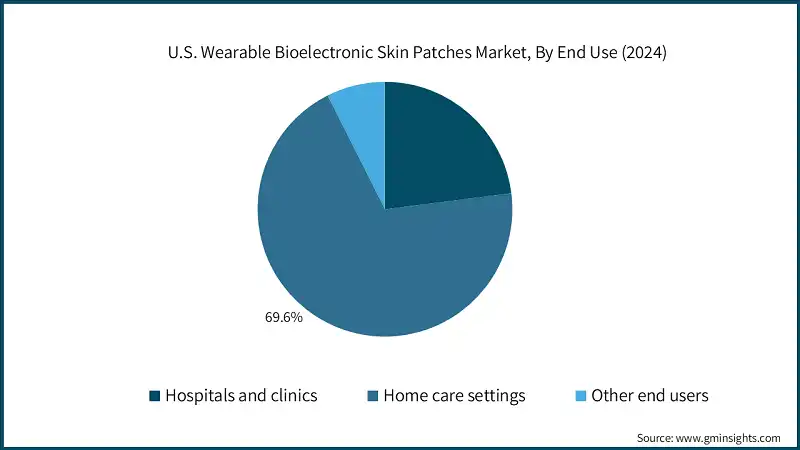
Based on end use, the U.S. wearable bioelectronic skin patches market is classified into hospitals and clinics, home care settings, and other end users. The hospitals and clinics segment is projected to grow at a CAGR of 14% during the analysis period.
- Hospitals and clinics play a pivotal role in the adoption and utilization of wearable bioelectronic skin patches. These healthcare facilities, equipped to manage high patient volumes and complex monitoring needs, provide an ideal environment for integrating advanced wearable technologies into routine and specialized care.
- Hospitals and clinics seamlessly incorporate wearable bioelectronic skin patches into both routine patient monitoring and emergency care settings. These patches enable continuous, real-time tracking of vital signs, supporting early disease detection, post-operative monitoring, and rapid response during critical situations. This integration ensures consistent demand and utilization across diverse clinical scenarios.
- Additionally, many hospitals and clinics collaborate with research institutions and technology companies to evaluate new wearable platforms and conduct clinical trials. These partnerships accelerate innovation, validate the effectiveness of bioelectronic skin patches, and position healthcare facilities as leaders in adopting cutting-edge diagnostic and monitoring solutions.
- Moreover, through their extensive patient care capabilities and advanced infrastructure, hospitals and clinics significantly contribute to the growth of the wearable bioelectronic skin patch market.
U.S. Wearable Bioelectronic Skin Patches Market Share
- Major players such as Abbott Laboratories, iRhythm Technologies, Dexcom, Medtronic, and Sinocare are actively expanding their global footprint through strategic initiatives. These include acquisitions, partnerships, and technology-driven collaborations aimed at strengthening their position in the rapidly growing wearable bioelectronic skin patches market. These leading top five companies collectively held 97% of the total market share.
- Abbott Laboratories stands out for its strong portfolio of advanced wearable health monitoring solutions, including bioelectronic skin patches, which are widely integrated across hospitals and clinics. By combining innovative sensor technology with robust data analytics, Abbott delivers reliable, real-time patient monitoring that enhances clinical workflows and improves outcomes. This comprehensive approach gives Abbott a competitive edge in the wearable healthcare market, positioning it as a leader in next-generation patient care solutions.
- Emerging players in the U.S. wearable bioelectronic skin patch market are implementing multi-pronged strategies to strengthen their presence. These strategies include leveraging advanced technologies such as AI-driven health analytics, flexible sensor designs, and integrated wireless platforms for real-time monitoring. Many companies are focusing on personalized healthcare applications, including chronic disease management and post-operative care, while forming strategic partnerships with hospitals, research institutions, and established healthcare firms.
U.S. Wearable Bioelectronic Skin Patches Market Companies
Few of the prominent players operating in the U.S. wearable bioelectronic skin patches industry include:
- 2M Engineering
- Abbott Laboratories
- Biolinq
- Baxter International
- Boston Scientific
- Dexcom
- Epicore Biosystems
- GE Healthcare Technologies
- GENTAG
- Insulet Corporation
- iRhythm Technologies
- Koninklijke Philips
- LifeSignals
- Medtronic
- Sinocare
- SmartCardia
- VitalConnect
- VivaLNK
- Abbott Laboratories
Abbott Laboratories leads the market in wearable bioelectronic skin patches with advanced sensor technology, real-time health monitoring, and seamless integration with data analytics. This enables personalized care and efficient remote patient management.
Sinocare focuses on providing affordable wearable bioelectronic skin patches for glucose monitoring. By combining biosensor innovation with mobile health apps, the company makes diabetes care accessible to emerging markets and underserved populations.
- iRhythm Technologies
iRhythm Technologies specializes in advanced cardiac monitoring through wearable bioelectronic skin patches. The company offers continuous, real-time ECG data collection supported by AI-driven analytics. Its flagship solutions, such as the Zio patch, enable early detection of arrhythmias and remote patient management, positioning iRhythm as a leader in digital cardiac care.
U.S. Wearable Bioelectronic Skin Patches Market Report Attributes
| Key Takeaway | Details |
|---|---|
| Market Size & Growth | |
| Base Year | 2024 |
| Market Size in 2024 | USD 5.2 Billion |
| Market Size in 2025 | USD 5.9 Billion |
| Forecast Period 2025 - 2034 CAGR | 14.8% |
| Market Size in 2034 | USD 20.4 Billion |
| Key Market Trends | |
| Drivers | Impact |
| Rising prevalence of chronic diseases in U.S. | Drives the adoption of patches for continuous monitoring of glucose, cardiac, and respiratory parameters, improving patient outcomes. |
| Increasing technological advancements in wearable bioelectronic skin patches | Enables the development of ultra-thin, flexible patches with real-time data transmission, enhancing comfort, accuracy, and integration with telehealth platforms. |
| Growing fitness and wellness awareness | Expands the market beyond clinical use into consumer wellness, fueling demand for patches that monitor hydration, stress, and muscle activity for personalized fitness insights. |
| Rising demand for non-invasive health monitoring | Accelerates adoption as patients and consumers prefer painless, skin-adhering solutions over invasive procedures, boosting compliance and usability. |
| Pitfalls & Challenges | Impact |
| Data privacy and security concerns | Limits user trust and adoption; requires robust encryption and compliance with HIPAA and GDPR to ensure safe data handling. |
| Stringent regulatory scenario | Slows product approvals and commercialization, increasing time-to-market and research and development costs for manufacturers. |
| Opportunities: | Impact |
| Integration with telehealth and remote patient monitoring | Enables real-time diagnostics and predictive analytics, improving chronic disease management and reducing healthcare costs through early intervention. |
| Market Leaders (2024) | |
| Market Leaders |
55% market share |
| Top Players |
Collective market share in 2024 is 97% |
| Competitive Edge |
|
| Regional Insights | |
| Future outlook |
|
What are the growth opportunities in this market?
U.S. Wearable Bioelectronic Skin Patches Industry News:
- In September 2023, iRhythm Technologies, Inc. launched its next-generation Zio monitor and enhanced Zio long-term continuous monitoring (LTCM) service in the U.S. The Zio monitor is the company’s smallest, lightest, and thinnest cardiac monitor, designed to improve patient comfort and provider efficiency with advanced service features. This innovation strengthens iRhythm’s market position, boosts adoption among healthcare providers, and creates new revenue opportunities through superior monitoring solutions.
The U.S. wearable bioelectronic skin patches market research report includes in-depth coverage of the industry with estimates and forecasts in terms of revenue in USD Million and from 2021 - 2034 for the following segments:
Market, By Type
- Electrochemical sensors
- ECG sensors
- Temperature sensors
- EMG sensors
- Other types
Market, By Application
- Fitness and wellness
- Medical monitoring
- Other applications
Market, By End Use
- Hospitals and clinics
- Home care settings
- Other end use
Frequently Asked Question(FAQ) :
What was the market size of the U.S. wearable bioelectronic skin patches market in 2024?
The market size was USD 5.2 billion in 2024, with a CAGR of 14.8% expected through 2034, driven by advancements in biosensor technology and increasing adoption of wearable health monitoring devices.
What is the projected value of the U.S. wearable bioelectronic skin patches market by 2034?
The market is expected to reach USD 20.4 billion by 2034, fueled by innovations in ultra-flexible electronics and the growing demand for real-time health monitoring solutions.
What is the projected size of the U.S. wearable bioelectronic skin patches market in 2025?
The market is projected to reach USD 5.9 billion in 2025.
What was the revenue share of the ECG sensors segment in 2024?
The ECG sensors segment accounted for 11.3% of the market revenue in 2024 and is expected to grow at a CAGR of 14.4% during the forecast period.
What was the valuation of the medical monitoring segment in 2024?
The medical monitoring segment generated USD 4.9 billion in 2024, making it the largest application segment, with a projected CAGR of 14.8% during the analysis period.
Which end-use segment is expected to grow significantly in the U.S. wearable bioelectronic skin patches market?
The hospitals and clinics segment is projected to grow at a CAGR of 14% during the analysis period, driven by the increasing adoption of wearable devices for patient monitoring.
What are the key trends in the U.S. wearable bioelectronic skin patches industry?
Key trends include advancements in ultra-flexible and stretchable electronics, real-time monitoring enabled by biosensor technology, and smartphone-integrated solutions for continuous health tracking.
Who are the key players in the U.S. wearable bioelectronic skin patches market?
Prominent players include 2M Engineering, Abbott Laboratories, Biolinq, Baxter International, Boston Scientific, Dexcom, Epicore Biosystems, GE Healthcare Technologies, GENTAG, and Insulet Corporation.
U.S. Wearable Bioelectronic Skin Patches Market Scope
Related Reports