Summary
Table of Content

U.S. Veterinary Assistive Reproduction Technology Market
Get a free sample of this report
Form submitted successfully!
Error submitting form. Please try again.
Thank you!
Your inquiry has been received. Our team will reach out to you with the required details via email. To ensure that you don't miss their response, kindly remember to check your spam folder as well!
Request Sectional Data
Thank you!
Your inquiry has been received. Our team will reach out to you with the required details via email. To ensure that you don't miss their response, kindly remember to check your spam folder as well!
Form submitted successfully!
Error submitting form. Please try again.
U.S. Veterinary Assistive Reproduction Technology Market Size
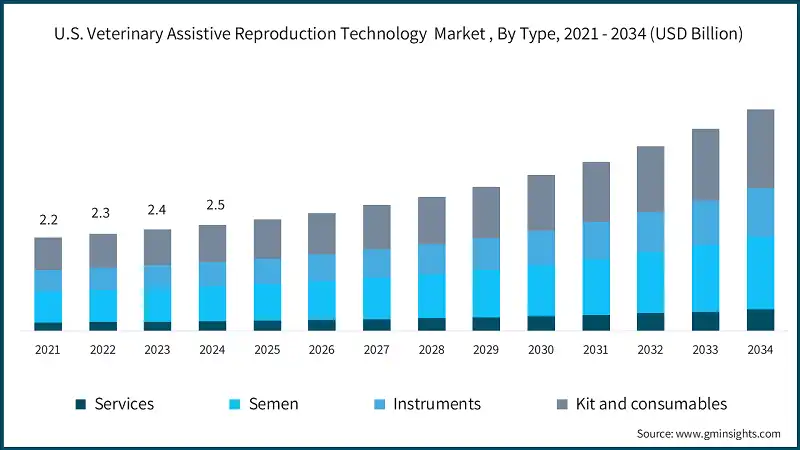
The U.S. veterinary assistive reproduction technology market was estimated at USD 2.5 billion in 2024. The market is expected to grow from USD 2.6 billion in 2025 to USD 5.2 billion in 2034, growing at a CAGR of 7.9% during the forecast period, according to the latest report published by Global Market Insights Inc. As per the U.S. Department of Agriculture (USDA) and National Agricultural Statistics Service (NASS), the livestock industry is expected to witness continuous growth in response to the rising demand for meat and dairy consumption in the U.S.

To get key market trends
For instance, as per Statista, per capita meat consumption in the U.S. in 2024 was 228.9 pounds and is expected to increase up to 236.6 pounds per capita by 2034. To meet this growing demand for animal-based food products, especially in the beef and dairy industries, the producers in the U.S. are mainly adopting ART to boost reproductive performance.
Veterinary assistive reproductive technology (ART) is an advanced breeding technology used to enhance the reproduction processes in animals by using reproduction techniques such as artificial insemination (AI), in vitro fertilization (IVF), embryo transfer (ET), and other technologies. Major players such as Genus, STgenetics, URUS Group, CRV Holdings, and Select Sires dominate the U.S. veterinary ART market. These players fuel market expansion by creating creative ART solutions, increasing access to specialized equipment, providing veterinarians with training and services, and making research and development investments to enhance efficiency and success rates.
In 2021, the U.S. veterinary assistive reproduction technology market was valued at USD 2.2 billion and witnessed growth to reach USD 2.3 billion and USD 2.4 billion in 2022 and 2023, respectively. A key factor behind this growth was the growing need for high-quality animal protein, which fueled the adoption of ART methods to improve livestock productivity and genetic merit. Additionally, a distinct shift of breeding practices towards more data-driven and precision-focused protocols is increasing their reliance on advanced veterinary assisted reproductive technologies such as AI, IVF, MOET, and other technologies. Further, supportive government policies created a favorable climate for the market during this period.
Veterinary assistive reproduction technology (ART) encompasses a range of medical procedures used to aid in the reproduction of animals. These technologies are essential in animal breeding, conservation of endangered species, and improving the genetics and health of livestock.
U.S. Veterinary Assistive Reproduction Technology Market Report Attributes
| Key Takeaway | Details |
|---|---|
| Market Size & Growth | |
| Base Year | 2024 |
| Market Size in 2024 | USD 2.5 Billion |
| Market Size in 2025 | USD 2.6 Billion |
| Forecast Period 2025 - 2034 CAGR | 7.9% |
| Market Size in 2034 | USD 5.2 Billion |
| Key Market Trends | |
| Drivers | Impact |
| Rising protein consumption in the region | Growing demand for milk, meat, and eggs is a key factor driving market growth. To meet this, farmers adopt ART to breed high-yield animals, boosting genetic gain and overall herd productivity. |
| Advancements in veterinary reproductive medicine | This has improved ART success rates and widened accessibility to services like IVF, ET, and semen sexing nationwide. |
| Increased focus on genetic preservation and quality | Drives long-term investments in ART to enhance genetic traits, disease resistance, and herd performance outcomes. |
| Rising veterinary healthcare expenditure | This enables clinics and breeders to adopt high-end reproductive technologies as part of broader healthcare services. |
| Pitfalls & Challenges | Impact |
| High costs of ART procedures | ART involves sophisticated equipment, laboratory facilities, and specialized veterinarians, making it costly. Small and medium-scale farmers often struggle to justify these expenses, slowing market penetration outside large-scale operations. |
| Inconsistent outcomes and risk of procedure failure | Undermines confidence in ART, especially for small-scale users without access to skilled personnel or labs. |
| Opportunities: | Impact |
| Expanding companion animal ART services | Growing demand for pet fertility services creates new revenue streams for specialized clinics and mobile vet units. |
| Development of cryobanks and genetic trade | Building regional semen and embryo banks allows access to superior genetics. This will open international trade opportunities and diversify revenue streams. |
| Market Leaders (2024) | |
| Market Leaders |
20.1% market share |
| Top Players |
Collective Market Share is 50% |
| Competitive Edge |
|
| Regional Insights | |
| Largest Market | South Atlantic |
| Fastest Growing Market | West South Central |
| Emerging Zones | North East, Pacific Central, East South Central, East North Central |
| Future outlook |
|
What are the growth opportunities in this market?
U.S. Veterinary Assistive Reproduction Technology Market Trends
- The growing livestock industry is one of the significant trends driving the growth of the market. The U.S. producers are increasingly adopting AI and embryo transfer to improve cattle and swine genetics.
- For instance, as per the USDA, more than 60% of dairy cows in the U.S. are bred by AI. Thus, this increasing utilization of AI in livestock reflects the major shift towards reproduction precision and efficiency in commercial livestock operations.
- Further, the rising use of sexed semen, which allows producers to select offspring sex, is driving the growth of the market.
- For instance, according to a 2022 Semen Sales Report from the National Association of Animal Breeders (NAAB), U.S. producers used 7.9 million units of sexed dairy semen, while 8.7 million units of sexed dairy semen were exported in 2022.
- This trend demonstrates the changing shift toward herd optimization, thereby driving the growth of this market.
- Additionally, technological advancements are significantly shaping the growth of the veterinary assistive reproduction technology market. Recent advances in cryopreservation techniques, ovum pick-up (OPU) procedures, and precision breeding technologies have enhanced both the efficiency and accessibility of ART services.
- Furthermore, the demand for meat and dairy products has increased dramatically in recent decades, owing to high population growth, increased lifespan, and improved economic prosperity in the developing world.
U.S. Veterinary Assistive Reproduction Technology Market Analysis
Learn more about the key segments shaping this market
Based on the type, the market is segmented into services, semen, instruments, and kits and consumables. The kits and consumables segment accounted for the highest market share and was valued at USD 879 million in 2024.
- This growth is primarily driven by the critical and recurring nature of these products across all reproduction procedures.
- Kits and consumables are essential components to perform procedures ranging from AI and MOET to cryopreservation and ovum pick-up, and are required at every stage, creating a consistent and high-volume demand.
- Unlike instruments, which represent a one-time investment, kits and consumables are used in every procedure, creating recurring demand, thus driving segmental growth.
- On the other hand, the semen segment accounted for second second-highest market share of 33.1% in 2024.
- The strong market position is driven by the increased use of sexed semen, particularly in the dairy sector. The producers are proactively using sexed semen that allows them to pre-select the sex of offspring, typically favoring females for milk production. Thus, this growing preference for genetic precision has fueled the growth of sexed semen segment in the market.
Based on the technology, the U.S. veterinary assistive reproduction technology market is categorized into artificial insemination (AI), in vitro fertilization (IVF), embryo transfer (MOET), and other technologies. The artificial insemination (AI) segment dominated the market and is anticipated to reach USD 3.8 billion by 2034.
- The primary factor driving the growth of this segment is its widespread applicability and ease of implementation. It requires minimal infrastructure and can be performed efficiently in both small veterinary clinics and large-scale commercial farms.
- Due to its relatively low price, easy process, and proven effectiveness, it is accessible to farmers across diverse economic settings.
- Additionally, government-backed breeding programs have further cemented AI’s dominance.
- Furthermore, the cost-effectiveness, reliability, and the low risk of injury or disease transmission compared to natural breeding are significant contributors to the AI segment’s market share.
- On the other hand, the in vitro fertilization segment is expected to witness significant growth at a CAGR of 9% during the analysis timeline.
- The significant growth is due to the ability of IVF to maximize the genetic potential of animals. IVF offers the ability to generate multiple embryos from high-value donor females, significantly enhancing reproductive efficiency compared to traditional artificial insemination. Thus, the demand for advanced breeding solutions that deliver faster genetic improvement is driving the adoption of this technique.
Learn more about the key segments shaping this market
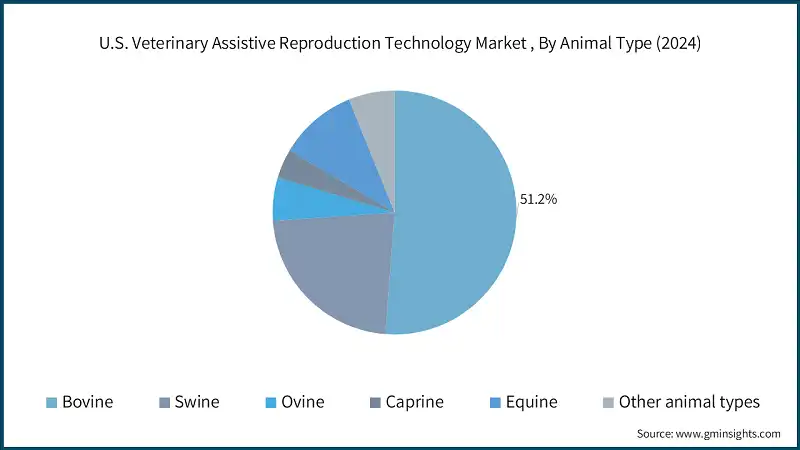
Based on the animal type, the U.S. veterinary assistive reproduction technology market is categorized into bovine, swine, ovine, caprine, equine, and other animal types. The bovine segment dominated the market with a 51.2% market share in 2024.
- The growing size and economic importance of the U.S. dairy and beef cattle industries is a major factor driving the growth of this segment.
- The rising number of cattle in the country supports the growth of this segment. For instance, as per the USDA, as of January 2025, there were 86.7 million head of cattle and calves on U.S. farms.
- Additionally, the strong institutional support from government entities, agricultural programs, breed associations, and research institutions in promoting the reproductive technologies for cattle further drives the segmental growth.
- The swine segment, on the other hand, held the second-largest market share of 22.7% in 2024 due to the increasing commercial pork production in the country.
- For instance, as per the USDA, the U.S. is the world's third-largest producer and consumer of pork and pork products. This high consumption drives the demand for efficient and scalable reproduction solutions. Thus, companies that manage operations from breeding to processing are adopting the ARTs for consistent performance and to reduce reproductive downtime.
Based on the end use, the U.S. veterinary assistive reproduction technology market is classified into veterinary clinics and hospitals, animal breeding centers, research institutes and universities, and other end users. In 2024, the veterinary clinics and hospitals segment held the highest market share and is expected to showcase growth at 7.6% CAGR over the analysis period, driven by their critical role in delivering accessible and specialized reproductive services.
- Veterinary clinics and hospitals are the primary point of contact for animal owners seeking breeding support or fertility evaluation, thus contributing to the growth of this segment.
- Additionally, the well-established veterinary infrastructure with availability of advanced portable ART equipment, diagnostic imaging, and in-house laboratory capabilities boosts the confidence of animal owners and producers.
- Further, their established infrastructure and ability to offer comprehensive care position them as key contributors to the market's dominance in this segment.
- On the other hand, the animal breeding centers segment is anticipated to grow at a considerable rate of 8.4% over the analysis period. To accelerate genetic gain and improve herd or flock performance, breeders are rapidly adopting advanced reproductive technologies, thereby driving the growth of this segment.
Looking for region specific data?
South Atlantic Veterinary Assistive Reproduction Technology Market.
The South Atlantic zone dominated the U.S. veterinary assistive reproduction technology market with a market share of 23.5% in 2024.
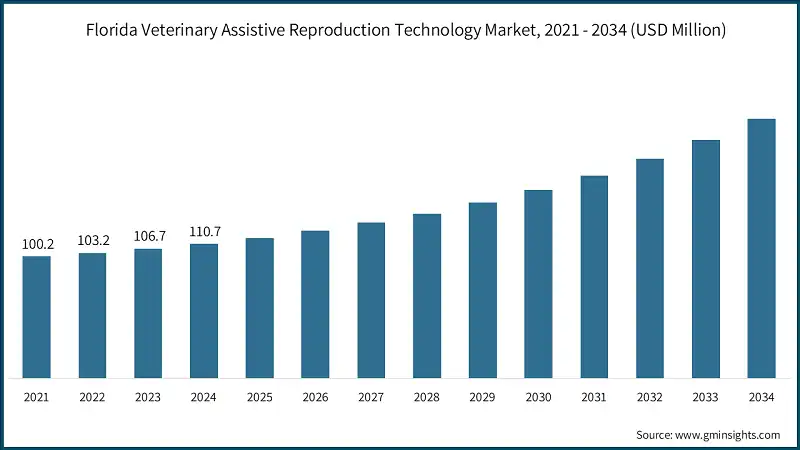
The Florida veterinary assistive reproduction technology market was valued at USD 100.2 million and USD 103.2 million in 2021 and 2022, respectively. The market size reached USD 110.7 million in 2024, growing from USD 106.7 million in 2023.
- Florida’s substantial livestock industry is a major factor driving the growth of the Florida veterinary assistive reproduction technology market. For instance, as per the Florida Beef Council, the state is home to more than 886,000 head of cattle and over 15,000 beef producers, ranking 13th in the U.S. for total cattle numbers.
- This strong agricultural base creates high demand for assistive reproduction technologies aiming to improve genetics and productivity.
- Additionally, Florida regions like Ocala, known for equine excellence, support the adoption of ARTs among the specialized horse breeding practices and high-value stallions.
The Georgia veterinary assistive reproduction technology market is anticipated to witness considerable growth over the analysis period.
- The Georgia veterinary assistive reproduction technology market is growing rapidly due to a strong and diverse agricultural and animal husbandry sector.
- Additionally, the significant presence of veterinary hospitals, research institutions, and specialty clinics across the state enhances the availability and accessibility of advanced veterinary ART services.
- Further, the increasing government initiatives supporting animal agriculture innovation and rural veterinary infrastructure further boost the growth of Georgia veterinary assistive reproduction technology market.
The veterinary assistive reproduction technology market in the Pacific Central zone of the U.S. was valued at USD 416.3 million in 2024 and is anticipated to witness significant growth over the analysis period.
- The growth of this market can be attributed to the region’s robust livestock industry, particularly in Texas, Oklahoma, and Kansas, which are major producers of beef and dairy cattle.
- Additionally, the increasing number of veterinary hospitals and clinics, as well as animal breeding centers is expected to propel the growth of this market.
U.S. Veterinary Assistive Reproduction Technology Market Share
The market is highly competitive, characterized by the strong presence of both global leaders and regional innovators that collectively drive technological advancement and industry growth. The market is led by prominent players such as Genus, STgenetics, URUS Group, CRV Holdings, and Select Sires, together accounting for approximately 50% share of the total market. These industry players are noted to have undertaken certain strategic initiatives, such as product launches and approvals, assisting them in sustaining the market competition.
Additionally, there are several local and regional players operating in the market who are boosting competition by providing affordable options at lower costs. These players are also involved in several strategies, such as mergers, acquisitions, and novel product launches, to expand their product offerings.
U.S. Veterinary Assistive Reproduction Technology Market Companies
Few of the prominent players operating in the U.S. veterinary assistive reproduction technology industry include:
- Bovine Elite
- CRV Holdings
- Geno
- Genus
- Hamilton Thorne
- IMV Technologies
- Minitube Group
- SEMEX
- Select Sires
- Swine Genetics International
- STgenetics
- URUS Group
- VikingGenetics
- Genus
Genus holds a leading position in the U.S. veterinary ART market with a market share of 20.1%, through its ABS Global and PIC business units. ABS provides bovine genetic solutions for dairy and beef producers, while PIC leads in porcine genetics, offering elite boar and sow lines, sexed semen, and fertility enhancement services. The company serves over 85 countries and is recognized for its innovative approach to breeding and reproductive technologies.
STgenetics is a major player in the U.S. veterinary ART space, widely recognized for its pioneering work in sexed semen technologies (SexedULTRA) and precision livestock breeding. The company offers a comprehensive range of services, including AI, IVF, ET, embryo sexing, and fertility consulting, with a strong customer base in both the dairy and beef cattle sectors. The company collaborates with research institutions and agricultural organizations to refine its technologies and enhance the effectiveness of assisted reproduction.
URUS Group comprises of leading animal genetics and reproductive technology brands such as Alta Genetics, GENEX, and Trans Ova Genetics. The group offers a wide array of services, including artificial insemination, embryo transfer, in vitro fertilization, and genetic preservation. The company collaborates with farmers and industry partners to optimize breeding programs.
U.S. Veterinary Assistive Reproduction Technology Industry News:
- In January 2024, Minitube, in collaboration with UNEX, launched an Equine Embryo Transfer Course to enhance expertise in assisted reproduction. The program provides hands-on training in embryo collection, evaluation, and transfer techniques for improved equine breeding outcomes.
- In February 2023, Genus’s bovine division, ABS and 605 Sires + Donors announced a strategic partnership to enhance beef embryo production. This collaboration includes constructing a new bovine IVF facility in South Dakota, dedicated to beef-only embryo production, aiming to provide advanced genetic solutions for beef producers nationwide.
- In December 2023, ABS Global, a division of Genus, partnered with Genes Diffusion in France to enhance bovine genetics and reproductive solutions. This collaboration aims to advance artificial insemination and genetic selection for improved herd productivity.
The U.S. veterinary assistive reproduction technology market research report includes an in-depth coverage of the industry with estimates and forecast in terms of revenue in USD Million and from 2021 - 2034 for the following segments:
Market, By Type
- Services
- Semen
- Normal semen
- Sexed semen
- Instruments
- Kit and consumables
Market, By Technology
- Artificial insemination (AI)
- In vitro fertilization (IVF)
- Embryo transfer (MOET)
- Other technologies
Market, By Animal Type
- Bovine
- Swine
- Ovine
- Caprine
- Equine
- Other animal types
Market, By End Use
- Veterinary clinics and hospitals
- Animal breeding centers
- Research institutes and universities
- Other end use
The above information is provided for the following zones and states:
- North East
- Connecticut
- Maine
- Massachusetts
- New Hampshire
- Rhode Island
- Vermont
- New Jersey
- New York
- Pennsylvania
- East North Central
- Wisconsin
- Michigan
- Illinois
- Indiana
- Ohio
- West North Central
- North Dakota
- South Dakota
- Nebraska
- Kansas
- Minnesota
- Iowa
- Missouri
- South Atlantic
- Delaware
- Maryland
- District of Columbia
- Virginia
- West Virginia
- North Carolina
- South Carolina
- Georgia
- Florida
- East South Central
- Kentucky
- Tennessee
- Mississippi
- Alabama
- West South Central
- Oklahoma
- Texas
- Arkansas
- Louisiana
- Mountain States
- Idaho
- Montana
- Wyoming
- Nevada
- Utah
- Colorado
- Arizona
- New Mexico
- Pacific Central
- California
- Alaska
- Hawaii
- Oregon
- Washington
Frequently Asked Question(FAQ) :
Which region leads the U.S. veterinary assistive reproduction technology industry?
The South Atlantic zone dominated the market with a 23.5% share in 2024, supported by a strong livestock industry presence.
Who are the key players in the U.S. veterinary assistive reproduction technology market?
Key players include Bovine Elite, CRV Holdings, Geno, Genus, Hamilton Thorne, IMV Technologies, Minitube Group, SEMEX, Select Sires, Swine Genetics International, and STgenetics.
What are the upcoming trends in the U.S. veterinary assistive reproduction technology industry?
Key trends include the increasing adoption of artificial insemination (AI), the rising use of sexed semen for offspring selection, and advancements in embryo transfer techniques to enhance livestock genetics.
Which animal type segment leads the U.S. veterinary assistive reproduction technology market?
The bovine segment led the market with a 51.2% share in 2024, driven by the high adoption of reproductive technologies in cattle.
How much revenue did the kits and consumables segment generate?
The kits and consumables segment generated USD 879 million in 2024, accounting for the highest market share.
What was the valuation of the artificial insemination (AI) segment?
The artificial insemination (AI) segment dominated the market and is projected to reach USD 3.8 billion by 2034.
What is the projected value of the U.S. veterinary assistive reproduction technology industry by 2034?
The market is expected to reach USD 5.2 billion by 2034, growing at a CAGR of 7.9% during the forecast period.
What is the projected size of the U.S. veterinary assistive reproduction technology market in 2025?
The market is expected to reach USD 2.6 billion in 2025.
What is the market size of the U.S. veterinary assistive reproduction technology in 2024?
The market size was estimated at USD 2.5 billion in 2024, driven by the growing livestock industry and advancements in reproductive technologies.
U.S. Veterinary Assistive Reproduction Technology Market Scope
Related Reports