Summary
Table of Content

U.S. Secondhand Camera and Lens Market
Get a free sample of this report
Form submitted successfully!
Error submitting form. Please try again.
Thank you!
Your inquiry has been received. Our team will reach out to you with the required details via email. To ensure that you don't miss their response, kindly remember to check your spam folder as well!
Request Sectional Data
Thank you!
Your inquiry has been received. Our team will reach out to you with the required details via email. To ensure that you don't miss their response, kindly remember to check your spam folder as well!
Form submitted successfully!
Error submitting form. Please try again.
U.S. Secondhand Camera and Lens Market Size
The U.S. market has witnessed significant growth, driven primarily by affordability and cost savings. These factors have become critical in reshaping purchasing behaviors across a diverse range of consumers, including beginners, hobbyists, students, and seasoned professionals. As the prices of new cameras and lenses continue to climb, an increasing number of buyers are gravitating toward the used market. This shift allows them to acquire high-quality, high-performance equipment at a fraction of the original retail price.
U.S. Secondhand Camera and Lens Market Key Takeaways
Market Size & Growth
- 2025 Market Size: USD 2.6 Billion
- 2026 Market Size: USD 2.8 Billion
- 2035 Forecast Market Size: USD 4.2 Billion
- CAGR (2026–2035): 4.7%
Regional Dominance
- Largest Market: U.S.
- Fastest Growing Country: U.S.
Key Market Drivers
- Affordability & Cost Savings.
- Upgrade Cycles & Increased Supply from DSLR → Mirrorless Shift.
- Rising Popularity of Photography & Content Creation.
Challenges
- Quality Variability and Lack of Warranty.
- Fraud Risks and Trust Issues on Peer‑to‑Peer Platforms.
Opportunity
- Rising Demand for Affordable, High‑Quality Gear.
- Increased Supply from the Shift to Mirrorless Systems.
Key Players
- Market Leader: KEH Camera led with over 2.3% market share in 2025.
- Leading Players: Top 5 players in this market include KEH Camera, B&H Photo, MPB, Adorama, Roberts Camera, which collectively held a market share of 7% in 2025.
Get Market Insights & Growth Opportunities
Secondhand gear, such as DSLR camera bodies, mirrorless systems, and premium lenses, continues to deliver exceptional functional value despite depreciation. This enables users to access professional-grade capabilities without the financial strain associated with purchasing brand-new models. Market research consistently highlights this trend, emphasizing that the appeal of secondhand equipment lies in its ability to combine premium performance with significantly reduced costs. This makes it an especially attractive option in today’s economic climate, where consumers are highly cost-conscious and actively seeking budget-friendly alternatives to meet their needs.
In addition to the cost advantages, the secondhand market benefits from the slowing pace of technological advancements in camera systems. Many of the latest camera releases offer only incremental improvements, such as slight enhancements in autofocus speed, minor increases in resolution, or marginally better low-light performance, rather than revolutionary breakthroughs. This trend reduces the urgency for photographers to invest in expensive upgrades. As a result, older camera bodies and lenses retain substantial practical value, making them a viable choice for many buyers.
For instance, a five-year-old DSLR or mirrorless camera may still offer excellent image quality, robust build quality, and reliable performance, comparable to newer models in many scenarios. This practical value encourages consumers to opt for used models that deliver nearly identical functionality to their newer counterparts but at a significantly lower cost. The widening gap between the price of new gear and the functional performance of used gear has further amplified demand for pre-owned options. This trend is particularly evident among content creators, photography enthusiasts, and professionals who require dependable equipment to meet their creative or commercial needs without overspending.
Industry insights reveal that the affordability of secondhand gear not only attracts a broader consumer base but also strengthens the long-term momentum of the market. As more consumers recognize the financial and practical benefits of purchasing pre-owned equipment, they increasingly view it as a strategic and cost-effective way to build or upgrade their camera systems. This shift in consumer behavior has also contributed to the growth of online platforms and marketplaces specializing in secondhand camera gear, offering buyers a wide range of options, from entry-level models to high-end professional equipment.
Additionally, the availability of certified pre-owned programs and warranties from reputable sellers has further enhanced consumer confidence in the secondhand market. These developments are expected to sustain the market’s growth trajectory, as affordability, practicality, and accessibility continue to drive demand for pre-owned cameras and lenses in 2024 and beyond.
The U.S. secondhand camera and lens market is experiencing a significant transformation, primarily driven by the widespread shift from DSLR to mirrorless systems. This transition is reshaping the market's supply and demand dynamics, influencing inventory flows, pricing trends, and buyer preferences. Photographers, ranging from casual enthusiasts to seasoned professionals, are increasingly adopting mirrorless camera bodies due to their advanced features, such as lighter and more compact designs, superior autofocus capabilities, enhanced video performance, and improved electronic viewfinders.
As these users upgrade to mirrorless systems, they release a substantial volume of DSLR cameras and compatible lenses into the resale ecosystem. This steady influx of pre-owned equipment enriches the variety and availability of secondhand inventory, ensuring a consistent supply of high-quality gear for resale platforms and retailers specializing in used photography equipment.
Market analyses reveal that this upgrade movement is a key factor driving the increased availability of used lenses. Photographers upgrading their kits often sell or trade in their older DSLR lenses, which are still valued for their optical quality and durability. The appeal of mirrorless systems, combined with evolving consumer preferences, has further accelerated this trend. Mirrorless cameras offer features such as in-body image stabilization, faster burst shooting, and advanced connectivity options, making them highly attractive to both amateur and professional photographers. These advantages incentivize users to transition from DSLR setups, thereby expanding the supply base of the secondhand market with a diverse range of cameras, lenses, and accessories.
On the demand side, the shift to mirrorless systems is significantly altering buyer behavior within the secondhand market. As mirrorless cameras gain dominance, buyers are increasingly seeking lenses and accessories compatible with mirrorless mounts. Popular mounts such as Sony's E-mount, Fujifilm's X-mount, and Canon's RF mount are in high demand, reflecting the growing adoption of these systems.
Additionally, the availability of lens adapters has created a unique opportunity for buyers to repurpose older DSLR lenses for use with mirrorless bodies. This dual compatibility has sustained interest in legacy DSLR lenses, which remain desirable for their exceptional optical performance and cost-effectiveness. As a result, the secondhand market caters to a broad spectrum of buyers, from those seeking modern mirrorless-compatible gear to those looking for affordable, high-quality DSLR lenses.
Technological advancements and changing mount preferences continue to influence this transition, with the migration to mirrorless systems acting as both a catalyst for increased supply and a structural disruption to the market. The introduction of features such as advanced autofocus tracking, higher-resolution sensors, and improved low-light performance in mirrorless cameras has further solidified their appeal. These innovations not only drive the adoption of mirrorless systems but also redefine the types of pre-owned gear that hold the greatest value for today's buyers.
Consequently, the DSLR-to-mirrorless migration remains one of the most significant growth accelerators in the U.S. secondhand camera and lens market. It continues to shape the market's inventory composition, pricing strategies, and buyer priorities, ensuring its relevance in an evolving technological landscape.
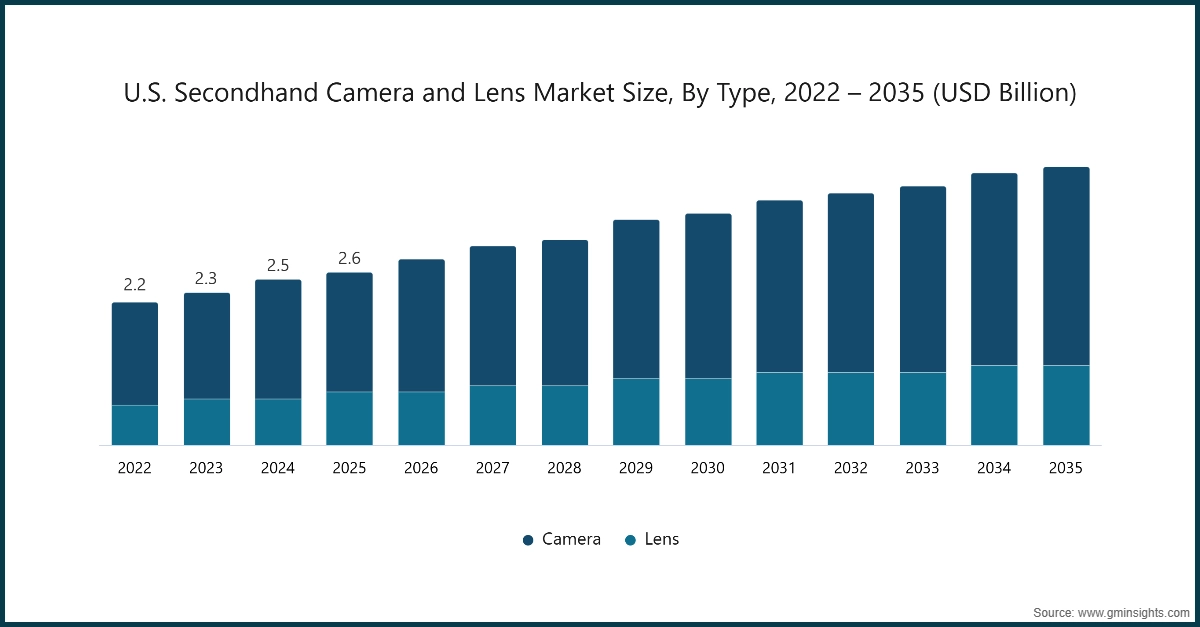
U.S. secondhand camera and lens market is estimated at USD 2.6 billion in 2025. The market is expected to grow from USD 2.8 billion in 2026 to USD 4.2 billion in 2035, at a CAGR of 4.7% according to latest report published by Global Market Insights Inc.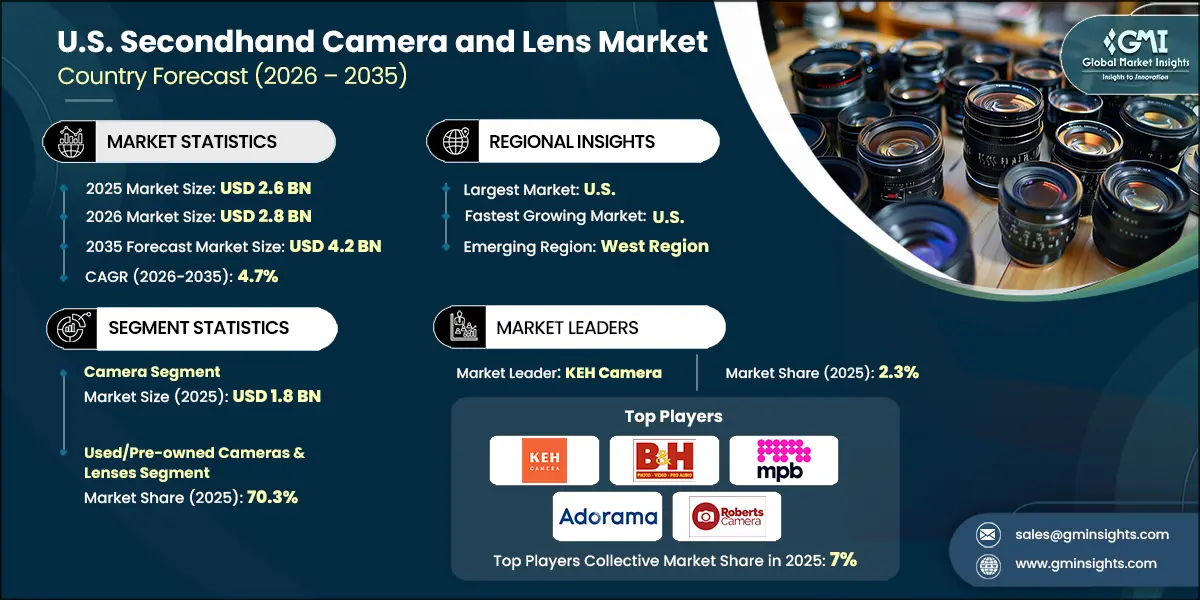
To get key market trends
U.S. Secondhand Camera and Lens Market Trends
- Shift from DSLR to Mirrorless Systems Reshaping Supply and Demand: The ongoing transition from DSLR to mirrorless camera systems is one of the most transformative trends impacting the secondhand camera market. As photographers increasingly adopt mirrorless technology, a substantial influx of DSLR bodies and lenses is entering the resale market. This surge in supply is driving down prices for legacy DSLR gear, making it more accessible to a wider range of buyers. Additionally, the shift is altering demand dynamics, with a growing preference for lenses that are either natively compatible with mirrorless platforms or adaptable through specialized mounts.
- Mirrorless systems offer advantages such as lighter weight, faster autofocus, and advanced features like in-body image stabilization, which are attracting both professionals and enthusiasts. Consequently, the demand for adapters that enable the use of older DSLR lenses on mirrorless bodies is also rising, further influencing purchasing decisions and reshaping the supply chain for camera equipment.
- Expansion of Online Marketplaces Driving Trusted Re-Commerce: The proliferation of trusted online resale platforms is revolutionizing how consumers buy and sell used camera gear. Marketplaces such as eBay, MPB, KEH, and B&H Used have introduced features like standardized grading systems, secure payment options, extended warranties, and item authentication services. These enhancements have significantly reduced the risks associated with purchasing secondhand equipment, thereby increasing buyer confidence and encouraging more consumers to explore the used market.
- The availability of detailed product descriptions, high-resolution images, and transparent condition assessments has further streamlined the buying process. By addressing common concerns such as product authenticity and quality, these platforms are not only expanding the market but also fostering a culture of trust and reliability. This trust infrastructure has become a critical factor in driving the growth of the secondhand camera market, making it a viable option for both amateur and professional photographers.
- Affordability-Driven Market Growth Amid Rising New Gear Prices: The escalating costs of new cameras and lenses are making secondhand gear an increasingly attractive alternative for cost-conscious consumers. Buyers are actively seeking high-performance equipment at more affordable prices, and the secondhand market is meeting this demand by offering a wide range of options. The growing price disparity between new and used gear is particularly appealing to students, hobbyists, and professionals operating on tight budgets.
- Additionally, the slowdown in groundbreaking advancements in imaging technology has led to a market environment where older models remain highly competitive in terms of performance. For instance, many used DSLR and mirrorless cameras still offer features like 4K video recording, high-resolution sensors, and robust build quality, making them a practical choice for buyers who prioritize value over the latest innovations. This trend is broadening market participation and reinforcing the secondhand market as a key segment within the broader camera industry.
- Sustainability and Circular Economy Influencing Consumer Behavior: The increasing emphasis on sustainability is driving a cultural shift toward re-commerce and environmentally conscious purchasing decisions. Consumers, particularly younger demographics, are gravitating toward secondhand gear as a way to reduce electronic waste and extend the lifecycle of products. Purchasing used equipment aligns with eco-friendly values, as it minimizes the environmental impact associated with manufacturing new products. This shift is not only accelerating the adoption of secondhand gear but also reshaping brand perceptions.
- The term "used" is evolving to signify responsible consumption rather than a compromise in quality. Many buyers now view secondhand purchases as a way to contribute to the circular economy, where resources are reused and repurposed rather than discarded. This growing segment of eco-conscious consumers is becoming a significant driver of growth in the U.S. secondhand camera market, influencing both supply and demand dynamics.
- Explosion of Content Creation Fueling Camera and Lens Demand: The rapid expansion of the creator economy, fueled by platforms such as YouTube, TikTok, Instagram, and livestreaming services, is generating a surge in demand for high-quality imaging equipment. Content creators, particularly those just starting out, often turn to secondhand gear to achieve professional-grade results without exceeding their budgets.
- The affordability of used cameras and lenses allows creators to invest in equipment that meets their specific needs, whether it's for vlogging, photography, or video production. Additionally, the rise of niche content creation trends has spurred interest in unique and specialized gear. For example, vintage lenses that produce distinctive aesthetic effects, lenses with shallow depth-of-field capabilities, and other specialty equipment have seen a significant increase in demand. Some of these items have even experienced dramatic price spikes in the used market due to their rarity and appeal among creators. This trend underscores the evolving preferences of content creators and highlights the critical role of the secondhand market in meeting their diverse requirements.
U.S. Secondhand Camera and Lens Market Analysis
Learn more about the key segments shaping this market
Based on type, the U.S. secondhand camera and lens market is divided into camera and lens. In 2025, camera held the major market share, generating revenue of USD 1.8 billion.
- In the U.S. market, cameras have solidified their position as the leading segment, driven by their exceptional functional lifespan and the gradual evolution of their core technology. Despite the frequent release of new models, many camera bodies, particularly digital single-lens reflex (DSLR) cameras and earlier-generation mirrorless models, continue to deliver outstanding performance over extended periods. This longevity makes them highly desirable in the used market.
- Their robust build quality, ease of repair, and compatibility with an extensive range of existing lenses ensure that older models remain relevant and functional. These attributes allow buyers to achieve professional-grade results at significantly reduced costs, making secondhand cameras an attractive option for photography enthusiasts, students, and emerging creators who seek high-quality equipment without the financial burden of purchasing new devices. Additionally, experienced photographers often upgrade their camera bodies to access incremental technological improvements, which contributes to a steady supply of well-maintained and high-performing units entering the resale ecosystem.
- The dominance of cameras in this market segment is further reinforced by their critical role in shaping creative identity and supporting diverse workflow preferences. Many users prefer owning dedicated camera bodies over relying solely on smartphones, as cameras offer superior ergonomics, advanced manual controls, and consistent performance across a wide range of shooting environments. These features are particularly valued by professionals and hobbyists who require precision and reliability in their equipment.
- The expanding creator economy has also played a significant role in driving this trend. Aspiring photographers, vloggers, and content creators increasingly seek dependable interchangeable-lens systems that enable them to produce professional-quality content without the financial barrier of high upfront investments. Retailers and resellers actively support the growth of this segment by offering trade-in programs, implementing rigorous certification processes, and providing warranties that reduce consumer risk and enhance confidence in purchasing secondhand products. Together, these factors establish cameras as the most sought-after and fastest-moving product category within the secondhand market, catering to a diverse audience ranging from casual users to professional creators.
Learn more about the key segments shaping this market
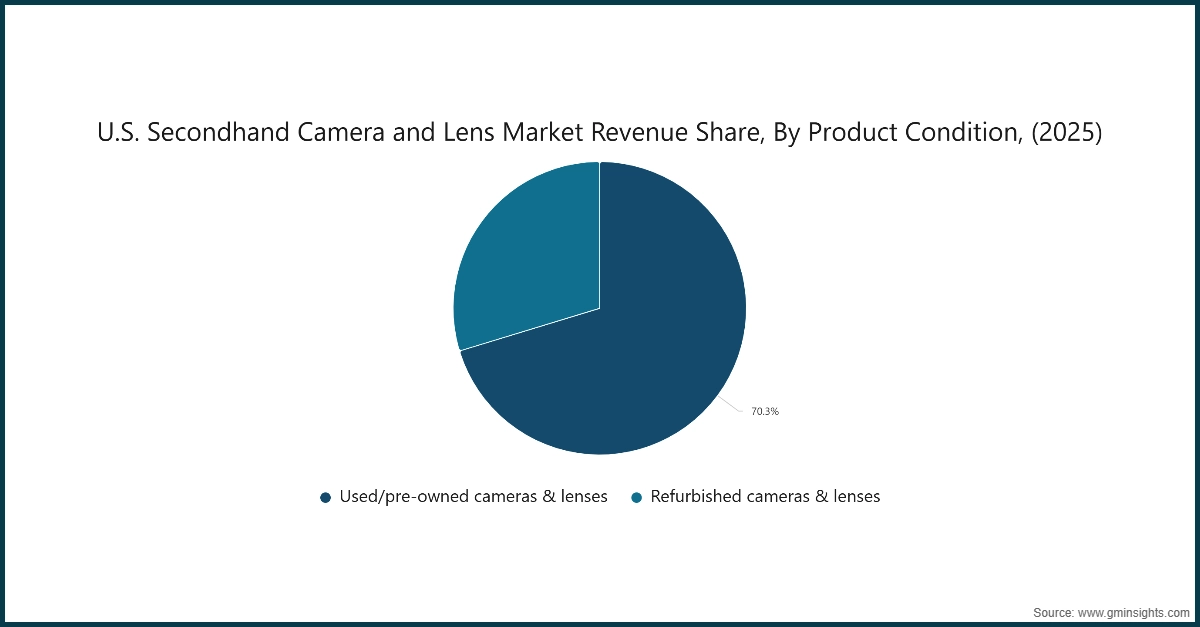
Based on product condition, the U.S. secondhand camera and lens market is segmented into used/pre-owned cameras & lenses and refurbished cameras & lenses. The used/pre-owned cameras & lenses segment held the largest share, accounting for 70.3% of the global U.S. market in 2025.
- The used/pre-owned segment dominates the U.S. secondhand camera and lens industry, offering buyers an optimal combination of affordability, quality, and reliability. Photographic equipment, known for its robust construction and extended lifespan, ensures that most used cameras and lenses continue to deliver exceptional performance even after years of use. This durability, paired with access to detailed grading systems, thorough refurbishment checks, and flexible return policies, significantly boosts consumer confidence in purchasing pre-owned gear.
- Additionally, the segment benefits from the frequent upgrade cycles of photographers, which consistently introduce a steady supply of well-maintained, high-quality items into the resale market. The availability of a diverse range of models, spanning various brands, formats, and price points, further enhances the appeal of used gear. This variety allows both amateur photographers and seasoned professionals to find equipment tailored to their specific needs, all while avoiding the financial strain associated with purchasing new products.
- The segment's growth is also driven by the increasing emphasis on sustainability and the adoption of circular-economy principles. Consumers are becoming more conscious of the environmental impact of their purchases, recognizing that reusing existing camera bodies and lenses significantly reduces electronic waste and minimizes the carbon footprint associated with manufacturing new devices.
- Resale platforms and retailers have responded to this demand by refining their inspection and certification processes, ensuring that used products meet high standards of quality and reliability. Enhanced customer service offerings, including extended warranties, transparent grading systems, and comprehensive after-sales support, further strengthen consumer trust in the Used/Pre-Owned segment. These advancements empower buyers to make informed, value-driven decisions while aligning with environmentally responsible practices. Collectively, these factors position used/pre-owned gear as the most practical, accessible, and sustainable choice in the secondhand camera and lens market, solidifying its leadership and appeal across a broad spectrum of consumers.
U.S. Secondhand Camera and Lens Market Share
Major players in the U.S. secondhand camera and lens industry are KEH Camera, B&H Photo (Used Dept), MPB (USA Operations), Adorama (Used Dept), and Roberts Camera collectively focus on innovation, sustainability, and global expansion to strengthen their positions. Their strategies emphasize advanced automation, IoT integration, and predictive maintenance to enhance efficiency and reduce downtime.
KEH Camera has strengthened its market position by building deep credibility around grading accuracy and refurbishment standards. Its transparent, conservative condition-rating system reduces buyer uncertainty, a critical factor in the used-equipment segment. KEH also emphasizes supply-side strength by offering competitive trade-in programs, ensuring consistent inventory flow. Operationally, the company invests in in-house inspection and testing, enabling quality control at scale. By positioning itself as a trusted lifecycle partner rather than merely a reseller, KEH sustains long-term customer relationships and repeat purchases, particularly among professionals seeking reliability over price-driven alternatives.
B&H’s used department benefits from strong integration with its dominant new-equipment business. The company leverages high web traffic, brand trust, and cross-selling between new and used categories to maintain volume leadership. Its liberal return policies and customer support infrastructure reduce perceived risk for used purchases. Strategically, B&H uses used gear as a retention tool, capturing price-sensitive customers without diluting its premium brand. Efficient logistics, fast fulfillment, and consistent pricing discipline allow B&H to compete effectively while maintaining margins in a highly transparent online marketplace.
MPB differentiates itself through a platform-driven, circular-economy model focused on speed, convenience, and transparency. Its instant online quoting and streamlined buy-sell process reduces friction for both suppliers and buyers. MPB’s standardized pricing algorithms and centralized refurbishment operations support scalability across geographies. In the U.S., the company has invested in localized operations to improve turnaround times and customer trust. By framing used gear as a sustainable alternative rather than a compromise, MPB appeals strongly to younger and value-conscious photographers, reinforcing brand relevance and long-term growth potential.
U.S. Secondhand Camera and Lens Market Companies
Major players operating in the U.S. secondhand camera and lens industry are:
- Adorama Used
- B&H Photo Used Department
- Canon U.S.A., Inc.
- Central Camera Company
- Competitive Camera
- eBay Certified Refurbished
- KEH Camera
- Lens Rentals
- Mike's Camera
- MPB
- National Camera Exchange
- Nikon Inc.
- Precision Camera
- Roberts Camera
- Samy's Camera
Adorama’s used department operates as a strategic extension of its broader retail ecosystem. The company integrates used inventory into its loyalty programs, educational content, and financing options, increasing customer lifetime value. Adorama emphasizes quality assurance through professional inspection while maintaining competitive pricing aligned with market trends. Its strength lies in omnichannel execution, combining online reach with physical store credibility. Used gear is positioned as an entry point for new customers, who can later be upgraded to new equipment, making the used segment a deliberate funnel within Adorama’s growth strategy.
Roberts Camera leverages its long-standing reputation and regional retail presence to differentiate in the used-camera market. The company emphasizes personalized service, expert staff evaluation, and in-store trust, which appeals to enthusiasts and collectors. Its strategy focuses on curated inventory rather than volume, allowing tighter quality control and niche specialization. Roberts also benefits from strong community engagement, trade-in programs, and estate acquisitions, ensuring access to unique stock. By balancing e-commerce with human expertise, Roberts sustains relevance against larger national and platform-based competitors.
U.S. Secondhand Camera and Lens Market Report Attributes
| Key Takeaway | Details |
|---|---|
| Market Size & Growth | |
| Base Year | 2025 |
| Market Size in 2025 | USD 2.6 Billion |
| Market Size in 2026 | USD 2.8 Billion |
| Forecast Period 2026-2035 CAGR | 4.7% |
| Market Size in 2035 | USD 4.2 Billion |
| Key Market Trends | |
| Drivers | Impact |
| Affordability & Cost Savings | Lower prices compared to new equipment expand access, stimulate first‑time buyers, and boost replacement purchases, driving higher transaction volumes and faster market circulation across enthusiast and semi‑professional segments globally sustainably. |
| Upgrade Cycles & Increased Supply from DSLR → Mirrorless Shift | Migration to mirrorless systems releases used DSLR gear into secondary markets, improving availability, compressing prices, increasing choice, and sustaining resale ecosystems during accelerated upgrade cycles across global photography communities worldwide. |
| Rising Popularity of Photography & Content Creation | Social media, e‑commerce, and creator economies motivate broader camera adoption, increasing demand for affordable equipment, shortening replacement cycles, and supporting sustained growth in pre‑owned gear transactions across consumer professional segments. |
| Pitfalls & Challenges | Impact |
| Quality Variability and Lack of Warranty | Inconsistent product condition and limited post‑sale support reduce buyer confidence, elevate return disputes, pressure platforms to invest in inspection services, and constrain repeat purchases within organized resale channels over time. |
| Fraud Risks and Trust Issues on Peer‑to‑Peer Platforms | Fraud, misrepresentation, and payment risks deter cautious buyers, increase platform monitoring costs, slow transaction velocity, and push demand toward verified intermediaries and professionally managed resale marketplaces for used imaging equipment. |
| Opportunities: | Impact |
| Rising Demand for Affordable, High‑Quality Gear | Value‑seeking consumers create opportunities for certified pre‑owned programs, refurbishment services, and branded resale channels, enabling manufacturers and retailers to capture incremental revenue and loyalty while extending product lifecycles sustainably globally. |
| Increased Supply from the Shift to Mirrorless Systems | Growing volumes of legacy DSLR equipment improve assortment depth, support competitive pricing, and help platforms scale inventories, accelerating market liquidity and enabling standardized grading and certification models across regions worldwide. |
| Market Leaders (2025) | |
| Market Leader |
2.3% market share |
| Top Players |
The collective market share in 2025 is 7% |
| Competitive Edge |
|
| Regional Insights | |
| Largest market | U.S. |
| Fastest growing market | U.S. |
| Emerging region | West Region |
| Future Outlook |
|
What are the growth opportunities in this market?
U.S. Secondhand Camera and Lens Industry News
- In January 2026, Canon brought back refurbished units of its sought-after RF 70 200mm f/2.8L IS USM Z lens, giving photographers another chance to purchase a premium telephoto zoom in like new condition at a meaningful savings. The renewed availability drew quick attention from buyers, and the lenses moved fast, reflecting both the strong reputation of Canon’s L series optics and the consistently high demand for refurbished RF glass within Canon’s official store.
- The expanded "magical bulk listing" tool is now available across all U.S. categories, utilizing AI to optimize product descriptions, pricing, and photography for sellers. This initiative lowers entry barriers for sellers, accelerates inventory turnover, and ensures consistent listing quality, which is crucial for scaling the Certified Refurbished camera inventory beyond the current 191 items. It aims to address the demand from 89% of consumers who plan to maintain or increase their spending on pre-loved items in 2025. Consequently, a 15-20% increase in refurbished camera listings is projected by 2026.
- In September 2025, KEH Camera partnered with the Atlanta Falcons, recognizing the team’s photography department as a KEH Circular Economy Partner and supporting its gear refresh through trade ins of more than 200 cameras and lenses (part of an ongoing relationship that positions KEH as the Falcons’ camera gear provider). Earlier, in May 2024, KEH partnered with PetaPixel by expanding its role to become PetaPixel’s Official Preferred Pre-Owned Camera Gear Partner across the website and YouTube with affiliate integration and co-branded promotions an arrangement that further deepened in July 2025 via a KEH discount perk for PetaPixel Members.
- LensRentals sets itself apart in the secondhand camera and lens market by offering a highly structured and trustworthy buying process, reinforced by responsive customer support that helps buyers feel confident in their purchases. Instead of the uncertainty often associated with peer-to-peer marketplaces, LensRentals provides clear product condition standards, professional handling of equipment, and reliable communication, creating a smoother, more secure, and more transparent experience for customers seeking high quality used gear.
- In November 2025, Mike’s Camera held its fall in store event featuring manufacturer representatives, exclusive savings, “SAVE THE TAX” promotions, trade in bonus weekends, free firmware updates, and live workshops. In March–April 2026, the spring event followed with the same high engagement format, continuing to drive strong customer turnout and significant trade in activity. Throughout these periods and in ongoing cycles, these biannual events remained among the company’s highest performing revenue weekends, creating urgency through limited time offers and direct manufacturer interaction while also replenishing used gear inventory.
The U.S. secondhand camera and lens market research report includes in-depth coverage of the industry with estimates & forecasts in terms of revenue (USD Billion) & volume (Thousand Units) from 2022 to 2035, for the following segments:
Market, By Type
- Camera
- DSLR cameras
- Mirrorless cameras
- Point-and-shoot cameras
- Film cameras
- Others (medium format camera, etc.)
- Lens
- Standard lens
- Wide angle lens
- Telephoto lens
- Others (fisheye, etc.)
Market, By Product Condition
- Used/pre-owned cameras & lenses
- Refurbished cameras & lenses
Market, By Price Range
- Entry-level
- Mid-range
- Professional
- Premium
Market, By End Use
- Amateur/hobbyist photographers
- Semi-professional photographers
- Content creators/vloggers
- Institutional/educational
- Others (collectors, rental companies, travel enthusiasts)
Market, by Application
- Online channels
- Offline channels
The above information is provided for the following regions:
- Northeast
- Midwest
- South
- West
- Southwest
Frequently Asked Question(FAQ) :
What is the market size of the U.S. secondhand camera and lens in 2025?
The market size is estimated at USD 2.6 billion in 2025, driven by affordability and cost-saving factors influencing consumer behavior.
What is the projected value of the U.S. secondhand camera and lens market by 2035?
The market is poised to reach USD 4.2 billion by 2035, growing at a CAGR of 4.7% during the forecast period.
What is the expected size of the U.S. secondhand camera and lens industry in 2026?
The market size is projected to grow to USD 2.8 billion in 2026.
How much revenue did the camera segment generate in 2025?
The camera segment generated USD 1.8 billion in revenue in 2025.
What was the market share of the used/pre-owned cameras and lenses segment in 2025?
The used/pre-owned cameras and lenses segment accounted for 70.3% of the market share in 2025, driven by affordability and reliability.
What are the key trends shaping the U.S. secondhand camera and lens sector?
Key trends include the shift from DSLR to mirrorless systems, the expansion of online marketplaces, affordability-driven growth, sustainability influencing consumer behavior, and the rise of content creation fueling demand for specialized gear.
Who are the major players in the U.S. secondhand camera and lens industry?
Major players include Adorama Used, B&H Photo Used Department, Canon U.S.A., Inc., Central Camera Company, Competitive Camera, eBay Certified Refurbished, KEH Camera, Lens Rentals, and Mike's Camera.
U.S. Secondhand Camera and Lens Market Scope
Related Reports