Summary
Table of Content

U.S. Residential Heat Pump Market
Get a free sample of this report
Form submitted successfully!
Error submitting form. Please try again.
Thank you!
Your inquiry has been received. Our team will reach out to you with the required details via email. To ensure that you don't miss their response, kindly remember to check your spam folder as well!
Request Sectional Data
Thank you!
Your inquiry has been received. Our team will reach out to you with the required details via email. To ensure that you don't miss their response, kindly remember to check your spam folder as well!
Form submitted successfully!
Error submitting form. Please try again.
U.S. Residential Heat Pump Market Size
Paradigm shift toward renewable energy integration with HVAC systems and the gradual replacement of conventional technologies with greener alternatives further accelerates this trend. Growing emphasis on reducing carbon emissions and energy consumption, rising new home construction and retrofitting projects shifting consumer preferences toward ambient indoor comfort will positively influence industry dynamics.
U.S. Residential Heat Pump Market Key Takeaways
Market Size & Growth
- 2025 Market Size: USD 5.8 Billion
- 2026 Market Size: USD 6.3 Billion
- 2035 Forecast Market Size: USD 14.4 Billion
- CAGR (2026–2035): 9.6%
Key Market Drivers
- Increasing demand for energy efficient systems.
- Stringent measures to reduce carbon footprints.
- Rising electrification of homes.
Challenges
- Availability of substitutes.
Opportunity
- Growing demand for energy-efficient home solutions.
- Supportive government policies and incentives.
- Rising focus on sustainability and decarbonization.
Key Players
- Market Leader: Daikin led with over market share of: 15% in 2025.
- Leading Players: Top 5 players in this market include Carrier, Daikin, Lennox International, Trane, Johnson Controls, which collectively held a market share of 45% in 2025.
Get Market Insights & Growth OpportunitiesFor instance, in November 2025, five New England states Connecticut, Maine, Massachusetts, New Hampshire, and Rhode Island launched a USD 450 million Heat Pump Accelerator programme to expand adoption of energy‑efficient, low‑emission heating systems. The initiative is funded through federal Climate Pollution Reduction Grants, targets a region heavily reliant on oil and gas, aiming to cut emissions, reduce heating costs, and accelerate deployment of cleaner home‑heating technologies.
Rising demand for reliable and efficient heating, cooling and hot water systems along with stringent regulatory and policy frameworks toward phasing out of emission generating technologies accelerated the widespread of the residential heat pumps. Manufacturers expanding their residential heat pump offerings driven by shifting consumer inclination to reduce long-term utility expenses and improving overall household energy performance further contributing to industry growth.
For instance, in September 2025, NESCAUM released its Multistate Action Plan addressing strategies to accelerate the transition to zero‑emission residential heating, including high‑efficiency heat pumps. The organization also confirmed that Washington, joined the 2024 multistate agreement targeting heat pumps deployment and their superior efficiency, zero emissions, and cost‑stability benefits will drive widespread adoption.
Growing retrofitting of prevailing residential establishments, ongoing replacement of conventional heating systems and adoption of advanced heat pump technologies along with growing awareness pertaining to sustainability are further augmenting industry outlook. Continuous technological improvements to enhance performance and affordability along with beneficial government incentives for energy-efficient home upgrades will further accelerate product deployment.
For instance, in May 2025, Samsung Electronics honoured for its leadership in sustainable climate solutions with a prestigious industry award. The company’s Hylex heat pump system named after Green Builder’s Sustainable Products of the Year for 2025, reflecting its commitment to energy-efficient HVAC innovation.
Ongoing technological advancements designed to operate efficiently across a wide range of temperatures, will accelerate product deployment for diverse U.S. climate zones. Enhanced controls, quieter operation and improved system integration have made these products more attractive to homeowners, supporting industry growth and reinforcing their presence in residential applications.
For instance, in August 2025, Carrier introduced a new heat pump designed for residential and light commercial applications, reinforcing its commitment to energy-efficient climate solutions. The system delivers advanced performance with optimized heating and cooling capabilities, offering homeowners and businesses a reliable, sustainable alternative to traditional HVAC systems.
Heat pumps are increasing long-term solution for residential comfort, offers both heating and cooling in a single system, driven by homeowners seeking reliable technologies that can adapt to varying climate conditions across different regions. Rising awareness toward energy efficiency and shifting consumer focus toward adopting advanced technology and reducing electricity bills has played a pivotal role in shaping the industry outlook.
U.S. residential heat pump market was valued at USD 5.8 billion in 2025 and is estimated to grow from USD 6.3 billion in 2026 to USD 14.4 billion by 2035, at a CAGR of 9.6%, according to a recent study by Global Market Insights Inc.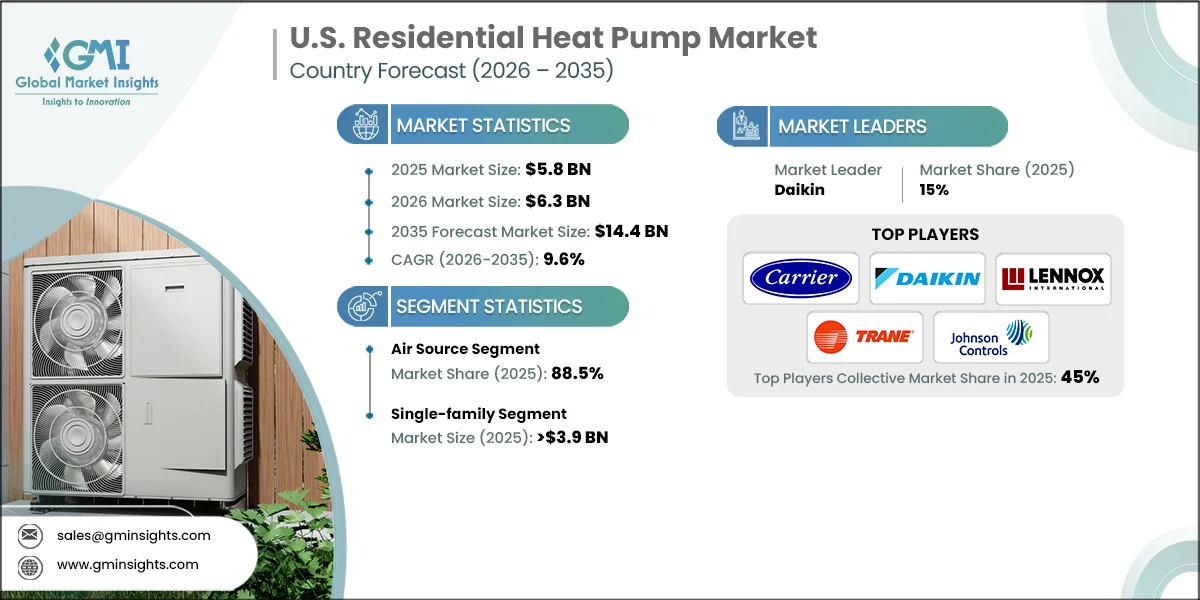
To get key market trends
U.S. Residential Heat Pump Market Trends
The U.S. residential heat pump market is gaining momentum driven by rising demand for cooling, heating and hot water for domestic applications along with growing retrofitting and development of residential establishments. Favorable policies propelling energy efficient HVAC technologies, mandates toward electrification of building infrastructure, aligning with long-term cost savings and sustainability objectives will further augment industry outlook.
For instance, in December 2024, nine U.S. states committed to accelerate heat‑pump deployment through an agreement targeting 65% market penetration by 2030 and 90% by 2040 and promotes regional alignment to cut building‑sector emissions. The agreement was endorsed by California, Maine, Colorado, Maryland, New Jersey, Massachusetts, New York, Rhode Island and Oregon aiming to boost heat pump deployment over the coming years.
Supportive policy measures and regulatory frameworks toward removing emissions from infrastructure along with building codes and efficiency standards favoring systems that lower households’ energy consumption, is accelerating product deployment. Heat pumps are emerging as a preferred option that meet regulatory compliance while offering homeowners a future-ready solution for heating & cooling for all climatic conditions, will stimulate product penetration.
Continuous technological advancements, increasing consumer purchase decisions with modern residential heat pumps designed to perform reliably in colder climates, addressing earlier concerns about performance limitations, further augmenting product demand. Improvements in compressor technology, utilization of natural refrigerants and advanced system controls ensuring enhanced comfort levels and operational stability will further stimulate product penetration.
For instance, in May 2025, Viessmann US introduced out two new air-to-air heat pump lines Vitocal 100-S and Vitocal 200-S for residential applications, designed to deliver high energy efficiency and enhanced comfort, supporting the growing trend toward electrification and low-emission HVAC solutions.
Rising heat pump adoption supports greenhouse gas reduction goals, aligning with sustainability initiatives and energy-saving regulations further shaping business dynamics. Favorable government programs at federal, state, and local levels through tax credits, rebates and grants along with supportive policies aimed at replacing less efficient HVAC systems have accelerated deployment of heat pumps across residential establishments.
For instance, from January 2025, ENERGY STAR Most Efficient air‑source heat pumps qualify for the federal tax credit through two eligibility pathways: cold‑climate systems or models suited for cooling‑focused or dual‑fuel installations. Contractors can reference ENERGY STAR’s approved product list. Annual credit limits apply, including a USD 3,200 overall cap, with heat‑pump‑related incentives limited to USD 2,000 per year.
Ongoing digitalization has enhanced the efficiency and reliability of heat pumps, with the growing integration of smart home features, enabling remote monitoring and control, enhancing energy optimization will stimulate product penetration. Rising energy costs and heightened environmental awareness are driving demand for these systems, which offer superior heating and cooling efficiency compared to traditional HVAC units further influence business outlook.
For instance, in January 2024, Bosch introduced the IDS Ultra Heat Pump for North America, delivering full heating output at 5°F and operating down to –13°F, offering a strong alternative to fossil‑fuel systems in colder regions. The company also unveiled its most efficient hybrid heat‑pump water heater, three to four times more efficient than conventional units, supporting broader household electrification and energy‑cost reduction.
U.S. Residential Heat Pump Market Analysis
Learn more about the key segments shaping this market
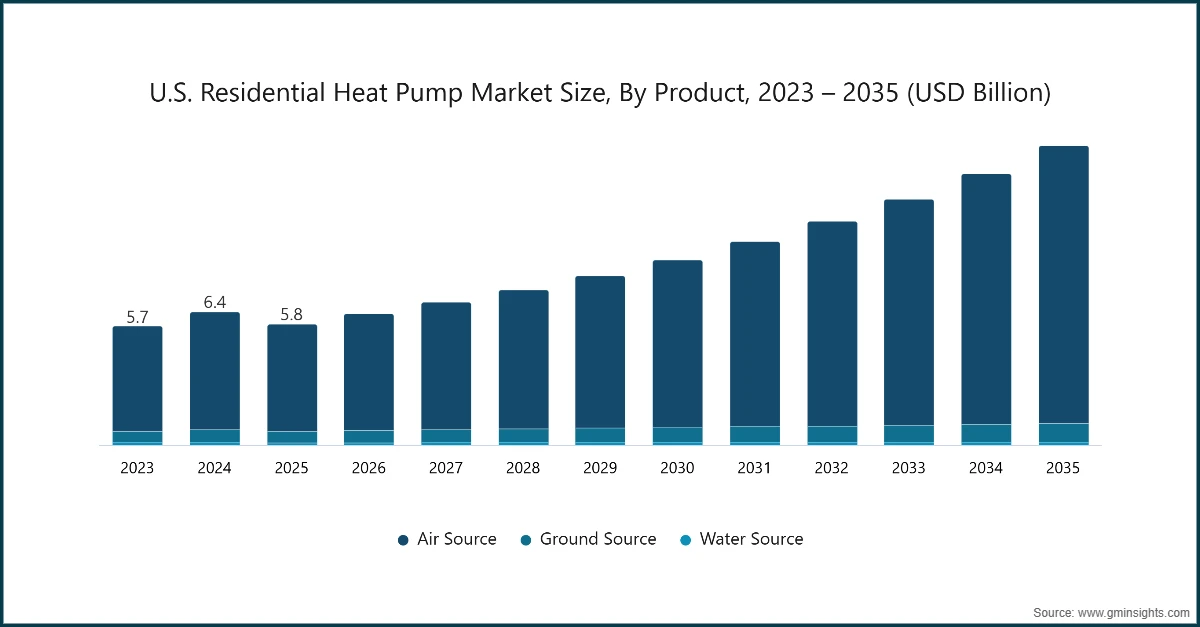
Based on the product, the industry is categorized into air source, ground source and water source. The air source segment dominated U.S. residential heat pump industry accounting for about 88.5% market share in 2025 and is set to grow at a CAGR of 10.1% through 2035.
Rising demand for heating cooling and hot water across residential establishments and the ability of air source heat pump to deliver exceptional efficiency with minimal energy use, lower carbon emissions will augment product demand. Introduction of advanced eco-friendly design aligns with shifting consumer preferences for sustainable home solutions and supports government initiatives aimed at achieving climate goals will contribute to industry growth.
For instance, in September 2025, Bosch Home Comfort Group introduced a new line of Hitachi airHome ductless heat pumps for single‑ and multi‑room applications, offering energy‑efficient, environmentally friendly heating and cooling with improved indoor air quality. Designed for colder climates and requiring no ductwork, systems simplify adoption of high‑efficiency heat pumps while enhancing comfort, lowering utility costs, and ensuring reliable year‑round performance.
Supportive government policies and shifting consumer preferences toward electrification and energy efficiency have contributed to favorable industry momentum for air source heat pumps, further augmenting industry outlook. Furthermore, technological advancements in compressor design, heat exchanger efficiency, and system controls have improved performance across a wide range of outdoor temperatures.
For instance, in December 2024, Mitsubishi Electric planned to start U.S. production of variable‑speed heat pump compressors in October 2027 after a USD 143.5 million retrofit of its Kentucky plant. The upgraded facility will produce up to one million units annually and mark the first U.S. manufacturing of twin‑rotary variable‑speed compressors. The project includes USD 50 million in U.S. DOE funding and additional support from Kentucky’s economic programs.
The ground source segment is anticipated to grow at a CAGR of over 4.4% by 2035. Growing demand for heating and cooling systems owing to long-term energy savings, low maintenance requirements, energy efficiency, supporting demand across residential applications. Rising adoption of systems capable of maintaining accurate indoor temperatures across varied applications, supported by the introduction of advanced, high‑performance technologies, will complement U.S. geothermal heat pump industry outlook.
For instance, in October 2025, Dandelion Energy announced the launch of the nation’s first residential geothermal leasing program, aimed at making geothermal heating and cooling more accessible to homeowners. This initiative allows customers to adopt efficient, reliable geothermal technology without the upfront cost, supporting broader efforts to promote sustainable home energy solutions across the U.S.
Rising integration of ground source heat pumps in new residential construction and retrofit developments driven by enhanced energy performance, optimization of space utilization and system efficiency will stimulate product penetration. These systems are widely recognized for their ability to deliver consistent heating and cooling by leveraging stable underground temperatures further augmenting the industry outlook.
The water source segment was valued at above USD 113.9 million in 2025. Paradigm shift toward retrofitting of building infrastructure along with implementation of electrification programs will accelerate product deployment into centralized infrastructure designs. These units are suitable for new housing projects that emphasize sustainability and efficient resource use and have augmented their demand in modern residential planning further shaping water source heat pump industry dynamics.
For instance, in June 2024, Bosch Home Comfort Group introduced a new line of water‑source heat pumps designed for both new construction and retrofit applications. Offered in vertical and horizontal configurations, these units use R‑454B refrigerant and include freeze‑protection technologies and the CL Series ranges from 0.5 to 6 tons, delivering COPs between 4.45 and 4.90.
Learn more about the key segments shaping this market
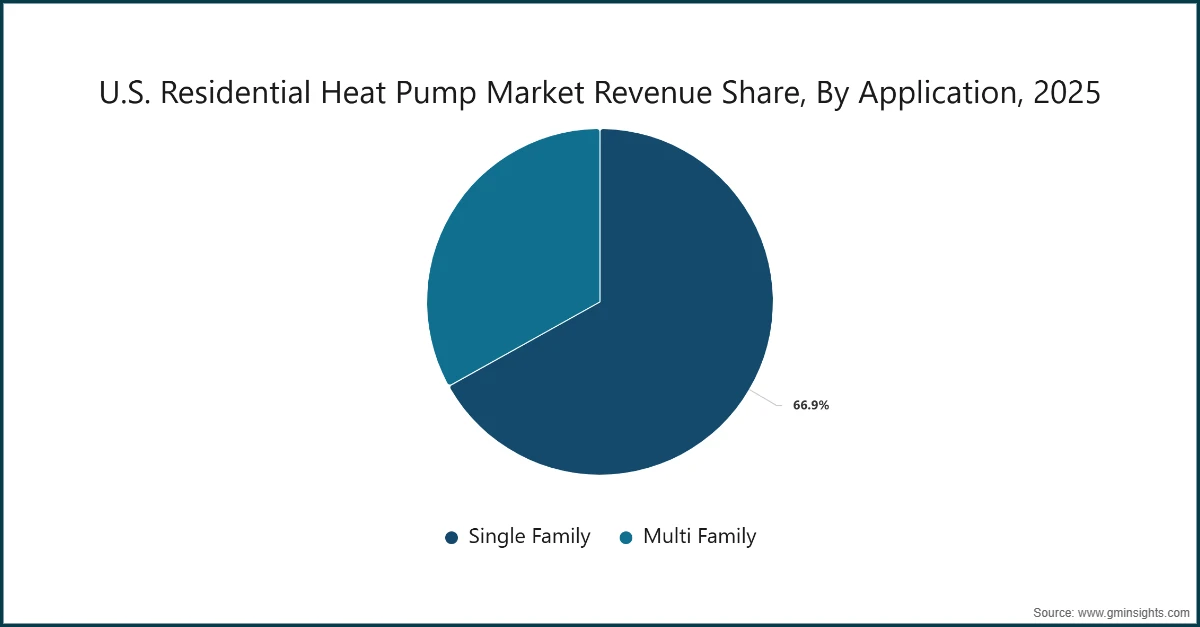
Based on application, the U.S. residential heat pump market is classified into single family and multi family. The single-family segment was evaluated at over USD 3.9 billion in 2025.
The single‑family application is set to grow supported by rapid urbanization, increasing housing development, and government‑backed incentives and rebates toward heat pump adoption is further complementing industry landscape. Increasing advancements in product design and system performance, offer improved temperature control, quieter operation and enhanced reliability across varying weather conditions have further increased product deployment in single-family homes.
For instance, in September 2025, according to the U.S. Census Bureau’s latest Survey of Construction and published by the National Association of Home Builders Economic research, nearly all new single-family homes built in 2024 featured either air-source or ground-source heat pumps paired with forced-air systems as the primary heating solution. Heat pumps dominated installations in warmer regions, accounting for 82% in the South Atlantic and 77% in the East South Central, while colder areas such as the East and West North Central saw only 7%.
The multi-family segment is anticipated to grow at a CAGR of 6.4% by 2035. Heat pumps enable building owners to optimize energy usage across shared infrastructure, which aligns well with the large residential properties, with modern building management systems enhances operational control, suitable for an attractive choice for both new construction and large-scale retrofit projects in urban and suburban settings gaining momentum in the heat pump industry.
For instance, in July 2025, a recent ACEEE (American Council for an Energy-Efficient Economy) study indicates that large multifamily buildings using central fossil‑fuel heating face major decarbonization challenges, yet window‑mounted heat pumps now offer the most cost‑effective solution. Over a 24‑year period, window units average roughly USD 14,500 per apartment, compared with nearly USD 22,000 for central air‑to‑water systems and just over USD 25,000 for mini‑splits.
Stringent government regulatory compliance and sustainability objectives influencing adoption trends across multi-family segment. Building developers meet stricter building energy standards in densely populated regions for multi-family projects owing to their ability to deliver consistent heating and cooling across multiple units while supporting centralized or semi-centralized system designs.
For instance, in March 2024, the U.S. Department of Energy’s Zero Energy Ready Home (ZERH) program has expanded its scope to include multifamily buildings of any height, marking a major step toward energy-efficient housing. Under the Inflation Reduction Act, ZERH-certified multifamily units qualify for a tax credit of USD 1,000 per dwelling, if wage standards met which can increase to USD 5,000.
The U.S. residential heat pump market was estimated at USD 5.7 billion, USD 6.4 billion & USD 5.8 billion in 2023, 2024 and 2025 respectively. Increasing efficiency of heat pump systems among homeowners driven by their ability to deliver year-round comfort while aligning with environmental mandates and regulatory measures for efficiency further complementing business landscape.
Paradigm shift toward electrification of building infrastructure in residential energy reduces reliance on traditional fuel-based heating systems and integrate smoothly with electric infrastructure, encouraged both homeowners and builders to consider heat pumps as a long-term solution, in new housing developments and planned community projects.
For instance, in December 2025, California regulators approved flourishing investment of USD 115 million aimed at accelerating home electrification, reducing carbon emissions and promoting sustainable living through innovative, cost-effective solutions. The program focuses on boosting the adoption of plug-in heat pumps and induction stoves, making energy-efficient technologies more accessible and affordable for homeowners.
Growing replacement of aging HVAC systems in existing homes are opting for heat pump installations that offer improved performance and lower operational complexity. For instance, in November 2025, New York government authority committed USD 38.4 million to install high‑efficiency heat pumps at the NYCHA’s Beach 41st Street houses in Queens, replacing outdated gas‑boiler system. The project will provide 712 homes with reliable heating, efficient cooling, and individual controls, supporting the city’s Clean Heat for All initiative, which aims to equip over 10,000 NYCHA apartments with modern electric systems by 2030.
U.S. Residential Heat Pump Market Share
The top five companies in the market are Carrier, Daikin, Trane, Johnson Controls and Lennox International contribute around 45% of the market share in 2025.
Key manufacturers operating across the U.S. residential heat pump market are expanding their product portfolios driven by rising demand for energy-efficient systems. These manufacturers prioritize research and development initiatives to deliver advanced systems that meet stringent efficiency standards with robust customer support and after-sales services to enhance reliability further contributing to industry growth.
Leading manufacturers are making initiatives including strategic collaborations, partnerships, joint ventures, mergers and acquisitions to hold a strong position and to strengthen their competitive edge over the others. Ongoing major approaches include product innovation to deliver high-efficiency, low-emission systems aligned with sustainability goals, including smart and connected solutions to meet rising consumer demand for energy optimization. Leading manufacturers leverage partnerships and distribution networks to expand market reach, flourishing investing in advanced refrigerant technologies to comply with evolving regulatory standards.
Daikin offers a comprehensive range of heat pump solutions engineered to meet diverse residential requirements, ensuring sustainable and reliable comfort throughout the year. Its ductless single‑zone heat pump systems are specifically designed to condition individual spaces, offering an efficient alternative where ducted systems or conventional furnaces may be impractical. These units enable targeted heating or cooling for studios, or isolated rooms while maintaining high performance and operational flexibility.
Carrier provides an extensive portfolio of heat pump solutions suitable for a wide range of households and budgets. Its Infinity, Performance, and Comfort series offer varying levels of efficiency and features, including numerous ENERGY STAR certified models. The advanced Infinity system delivers enhanced temperature control, minimized fluctuations, and optimized energy performance, offering homeowners a highly intelligent and refined comfort experience.
Trane, offers advanced HVAC solutions supported by reliable and prompt service to ensure consistent home comfort. The company’s heat pump systems combine proven efficiency with hybrid technology to reduce energy costs and support sustainability. Trane’s electric heat pumps are designed and engineered for reliable, quiet performance across diverse climates and provide reliable heating even during extreme temperatures.
U.S. Residential Heat Pump Market Companies
Some of the key market players operating across the U.S. residential heat pump industry are:
American Standard Heating and Air Conditioning
Bard HVAC
Baxi
Blue Star
Bosch Thermotechnology
Bryant Heating and Cooling
Carrier
Daikin
EarthLinked Technologies
Fujitsu General
Goodman
Johnson Controls
Lennox International
LG Electronics
Miami Heat Pump
Midea
Mitsubishi Electric Trane HVAC US
Panasonic North America
Rheem Manufacturing
SpacePak
Trane Technologies
Trane headquartered in Ireland, reported revenues of USD 16.1 billion in first nine months of 2025 and USD 19.8 billion revenue for the year 2024. The company’s electric heat pumps are designed and rigorously evaluated to ensure dependable, quiet operation for both heating and cooling needs. It also provides fully electric packaged heat pump solutions aimed at lowering energy consumption and emissions. These systems serve as an efficient option for regions with moderate winter conditions, offering consistent performance and enhanced sustainability.
Lennox International reported revenues of USD 5.1 billion for 2025 and a revenue of USD 5.3 billion in 2024. The company’s heat pumps are designed to deliver dependable, precise, and quiet performance, making them well‑suited for regions with moderate temperature conditions. The product lineup includes Low‑Ambient heat pumps for improved cold‑weather capability, Variable‑Capacity models for optimized efficiency, advanced Cold‑Climate variable‑capacity units for harsher environments, and Single‑Stage systems that provide consistent, cost‑effective heating and cooling for residential needs.
Johnson Controls offers residential heat pumps through its brand YORK to meet including YORK split‑system heat pumps provide year‑round comfort by operating like air conditioners in warm weather while delivering reverse‑cycle heating during colder periods, reducing reliance on natural gas and improving efficiency. The company’s ductless mini‑split systems eliminate duct‑related losses and offer a solution for adding heating & cooling capacity without extensive renovation. Johnson Controls reported sales revenues of USD 23.5 billion for the year 2025 and USD 22.9 billion for the year 2024.
Carrier reported sales revenues of USD 21.7 billion for the year 2025 and USD 22.4 billion as sales for 2024. The company’s heat pump portfolio includes the high‑efficiency Infinity System, which uses adaptable‑speed technology for optimized comfort and humidity control, the Performance Series offering reliable mid‑tier efficiency with optional two‑stage operation and remote diagnostics and the Comfort Series cost‑effective range providing essential heating and cooling with single‑stage compressors and ENERGY STAR options for select models.
U.S. Residential Heat Pump Market Report Attributes
| Key Takeaway | Details |
|---|---|
| Market Size & Growth | |
| Base Year | 2025 |
| Market Size in 2025 | USD 5.8 Billion |
| Market Size in 2026 | USD 6.3 Billion |
| Forecast Period 2026-2035 CAGR | 9.6% |
| Market Size in 2035 | USD 14.4 Billion |
| Key Market Trends | |
| Drivers | Impact |
| Increasing demand for energy efficient systems | Homeowners prioritizing energy efficiency to reduce utility costs and enhance comfort, offer a dual advantage by providing heating and cooling with minimal energy consumption compared to conventional systems. Growing preference for sustainable and cost-effective solutions, driving strong adoption across residential markets. |
| Stringent measures to reduce carbon footprints | Government regulations and environmental policies aimed at lowering greenhouse gas emissions are accelerating the shift toward electrified heating solutions. Manufacturers and installers benefit from this trend as compliance requirements push consumers toward cleaner technologies. |
| Rising electrification of homes | Paradigm shifts toward home electrification replace gas-based systems with electric alternatives; heat pumps emerge as a natural transition is supported by infrastructure upgrades and incentives that make electrification more accessible. |
| Pitfalls & Challenges | Impact |
| Availability of substitutes | The availability of conventional substitutes including high efficiency gas furnaces, traditional HVAC systems, and emerging electric technologies intensifies competition, pressures pricing, and impact industry growth potential. |
| Opportunities: | Impact |
| Growing demand for energy-efficient home solutions | Paradigm shift toward energy efficiency in residential establishments and focus on reducing energy consumption and maintaining comfort will increase product adoption. |
| Supportive government policies and incentives | Federal and state-level initiatives supporting electrification and low-carbon technologies create favorable environment for heat pump installations. Incentives including tax credits and rebates encourage homeowners to upgrade from traditional heating systems to advanced heat pumps. |
| Rising focus on sustainability and decarbonization | Residential heat pumps stand out as a sustainable solution, which operate and utilize renewable electricity makes them central to decarbonization strategies. Manufacturers leverage environmental benefits and align products with green building standards. |
| Market Leaders (2025) | |
| Market Leader |
Market Share of: 15% |
| Top Players |
Collective Market Share of: 45% |
| Competitive Edge |
|
| Regional Insights | |
| Future outlook |
|
What are the growth opportunities in this market?
U.S. Residential Heat Pump Industry News
In November 2025, LG Electronics introduced advanced technological heat pump further helps in driving modernization of aging U.S. homes with its advanced range of unitary (ducted) residential HVAC solutions. LG’s advanced ducted heat pump portfolio offers high‑performance heating and cooling solutions suitable for all climate zones across the U.S. These systems enable contractors to provide homeowners with energy‑efficient alternatives that can help reduce utility consumption, lower environmental impact, and enhance overall indoor comfort.
In June 2025, Lennox international introduced the EL18KSLV Side Discharge heat pump, a compact solution designed for residential applications. The new model features a space-saving design and utilizes R-454B refrigerant, aligning with sustainability goals. Available in capacities ranging from 2 to 5 tons, the system offers flexibility for various home sizes while delivering efficient heating and cooling performance.
In June 2025, Enertech Global launched its next-generation WV Geothermal Heat Pump, designed to deliver comprehensive home comfort with enhanced efficiency. The new system leverages advanced geothermal technology to provide reliable heating and cooling while promoting sustainability. With its innovative design, the WV series aims to meet growing consumer demand for eco-friendly solutions that combine performance, durability, and energy savings.
In April 2025, Mitsubishi Electric Trane HVAC US LLC (METUS) introduced a new series of heat pump systems that utilize low global warming potential (GWP) refrigerant, underscoring its focus on sustainable technology. The latest all-climate lineup features upgraded indoor and outdoor units from popular series like FX and GX, along with SMART MULTI systems tailored for larger homes, multi-zone setups and light commercial spaces.
The U.S. residential heat pump market research report includes in-depth coverage of the industry with estimates & forecast in terms of “USD Million” and volume in “’000 Units” from 2022 to 2035 for the following segments:
Market, By Product
Air Source
Ground Source
Water Source
Market, By Application
Single Family
Multi Family
Frequently Asked Question(FAQ) :
What is the U.S. residential heat pump market size in 2025?
The U.S. market for residential heat pump is valued at USD 5.8 billion in 2025. Increasing demand for energy-efficient systems and government incentives are driving market growth.
What is the market size of the U.S. residential heat pump industry in 2026?
The market size for U.S. residential heat pumps is projected to reach USD 6.3 billion in 2026, reflecting steady growth driven by electrification trends and sustainability initiatives.
What is the projected value of the U.S. residential heat pump market by 2035?
The market size for U.S. residential heat pumps is expected to reach USD 14.4 billion by 2035, growing at a CAGR of 9.6%. This growth is fueled by rising adoption of energy-efficient technologies and supportive government policies.
What was the market share of the air source segment in 2025?
The air source segment dominated the U.S. residential heat pump market in 2025, accounting for 88.5% of the market share. Its leadership is attributed to cost-effectiveness, ease of installation, and technological advancements.
What is the growth outlook for the multi-family segment from 2025 to 2035?
The multi-family segment is projected to grow at a CAGR of 6.4% through 2035. Heat pumps' ability to optimize energy use across shared infrastructures makes them an attractive choice for large-scale retrofits and new constructions.
Which segment led the U.S. residential heat pump market by application in 2025?
The single-family segment led the market by application in 2025, with a valuation exceeding USD 3.9 billion. Rising consumer preference for energy-efficient solutions in standalone homes supports its dominance.
What are the key trends in the U.S. residential heat pump industry?
Key trends include increasing electrification of homes, adoption of sustainable heating solutions, and alignment with green building standards. Government incentives and advancements in heat pump technology are further driving market momentum.
Who are the key players in the U.S. residential heat pump market?
Key players include Daikin, Carrier, Lennox International, Trane, Johnson Controls, American Standard Heating and Air Conditioning, Bard HVAC, Baxi, Blue Star, Bosch Thermotechnology, Bryant Heating and Cooling, EarthLinked Technologies, and Fujitsu General.
U.S. Residential Heat Pump Market Scope
Related Reports