Summary
Table of Content

U.S. Protective Eyewear Market
Get a free sample of this report
Form submitted successfully!
Error submitting form. Please try again.
Thank you!
Your inquiry has been received. Our team will reach out to you with the required details via email. To ensure that you don't miss their response, kindly remember to check your spam folder as well!
Request Sectional Data
Thank you!
Your inquiry has been received. Our team will reach out to you with the required details via email. To ensure that you don't miss their response, kindly remember to check your spam folder as well!
Form submitted successfully!
Error submitting form. Please try again.
U.S. Protective Eyewear Market Size
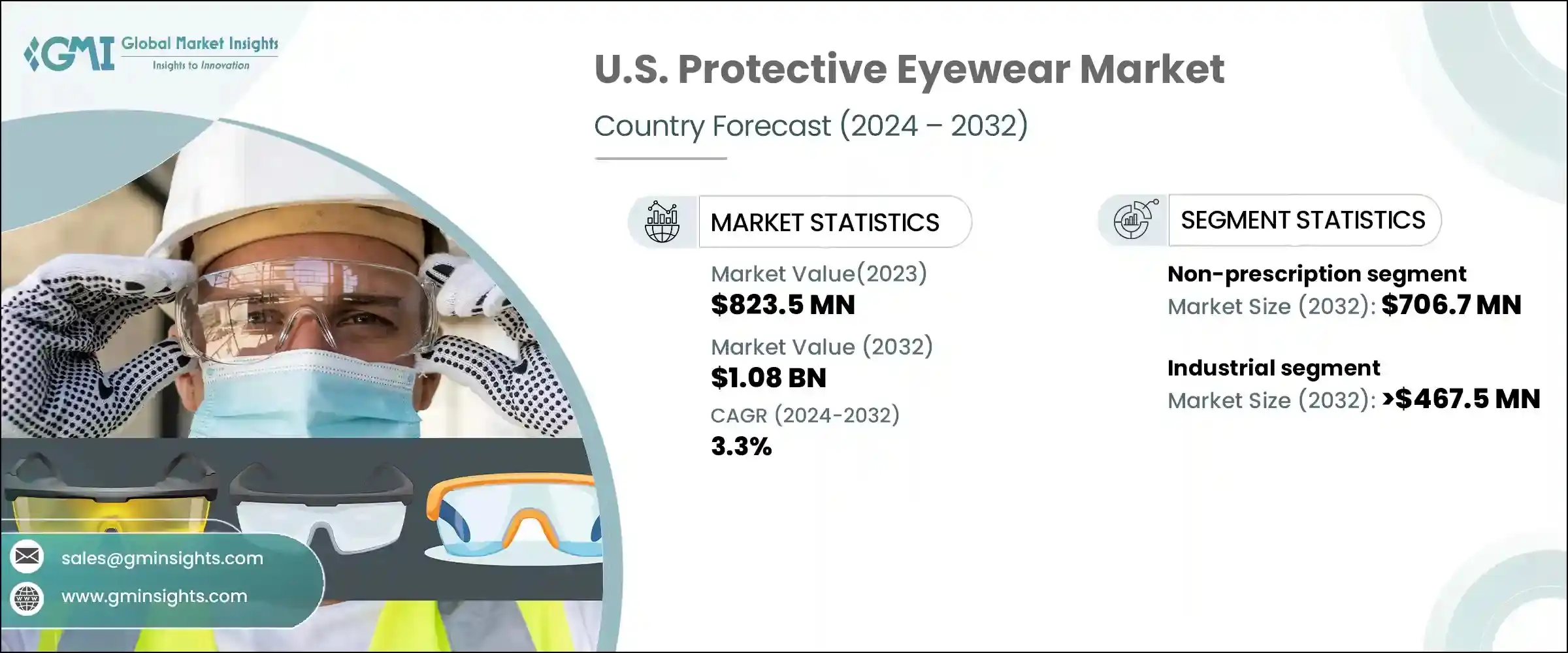
U.S. Protective Eyewear Market was valued at USD 823.5 million in 2023 and is anticipated to register a CAGR of 3.3% between 2024 and 2032. The growth can be attributed to the rising awareness of eye safety, increasing safety regulations, and the expanding industrial sector. The U.S. has implemented several workplace safety laws through organizations, such as the Occupational Safety and Health Administration, seeking to protect workers from injuries and fatalities in hazardous environments. By imposing legal penalties on violators, safety laws have significantly lowered the probability of fatalities in many occupations.
To get key market trends
Furthermore, the growing awareness about eye safety among U.S. workers and corporation’s results in a standardized market that adheres to industry rules. The emergence of novel materials, such as Tri vex, is modernizing the business; these materials are made from urethane polymers and are easier to mold into prescription eyeglasses than polycarbonates, which are normally injection molded.
U.S. Protective Eyewear Market Report Attributes
| Key Takeaway | Details |
|---|---|
| Market Size & Growth | |
| Base Year | 2023 |
| Market Size in 2023 | USD 823.5 Million |
| Forecast Period 2024 - 2032 CAGR | 3.3% |
| Market Size in 2032 | USD 1.08 Billion |
| Key Market Trends | |
| Growth Drivers |
|
| Pitfalls & Challenges |
|
What are the growth opportunities in this market?
The protective eyewear market in the U.S. is saturated with numerous players ranging from multinational corporations to small-scale manufacturers and distributors. This intense competition often leads to price wars and erodes profit margins, especially for companies with limited resources or brand recognition.
U.S. Protective Eyewear Market Trends
Eye injuries are common in workplaces. The National Institute for Occupational Safety and Health (NIOSH) claims that around 2,000 workers in the U.S. suffer job-related eye injuries that require medical care every day. These injuries can be caused by a variety of circumstances including improper handling and exposure to hazardous substances. Scrapping, building, chemical laboratories, and electrical work are industries with a high risk of eye injuries.
U.S. Protective Eyewear Market Analysis

Learn more about the key segments shaping this market
Based on product type, the market is classified into prescription and non-prescription. The non-prescription segment was crossed USD 551.1 million in 2023 and is expected to reach USD 706.7 million in 2032. Non-prescription safety glasses, commonly known as "Plano" lenses, are designed for people who do not have vision problems but require glasses to prevent injuries on the job. In cases where visual safety is an issue, prescription safety glasses are worn instead of the user's usual glasses. Non-prescription safety glasses can be worn over the wearer's usual corrective lenses instead of prescription safety eyewear. This safety eyewear is mostly used by laborers, city facilities management (civic) workers, police and military personnel, and heavy machinery operators. As the number of people who need corrective lenses is less, the market for non-prescription safety eyewear is likely to rise rapidly.

Learn more about the key segments shaping this market
Based on application, the U.S. protective eyewear market is segmented into sports, defense, and industrial. In 2023, the industrial segment dominated the market with a share of 45% and is likely to exceed USD 467.5 million by 2032. Industrial manufacturing includes a variety of procedures that expose workers to hazardous chemicals, dust particles, and light radiation. This is increasing the demand for protective gear in the industrial production sector. Industrial manufacturing operations, such as chiseling, drilling, hammering, sanding, chipping, spraying, grinding, smelting, cutting, and welding, involve a high risk of eye injury, leading to increased product demand.
U.S. Protective Eyewear Market Share

Looking for region specific data?
The global U.S. protective eyewear industry is moderately fragmented with prominent players such as 3M Company, Honeywell International, Bollé Safety, and Kimberly-Clark Corporation. They are adopting strategic steps, such as mergers, acquisitions, partnerships, and collaborations, to consolidate their market position and meet the growing consumer demand.
U.S. Protective Eyewear Market Companies
Major players operating in the U.S. protective eyewear industry include:
- 3M Company
- ArmouRX Inc.
- Art-Craft Optical Co. Inc
- Bollé Safety
- Gateway Safety Inc.
- Guardian Industries Holdings
- Honeywell International
- Hudson Optical
- JSP Safety
- Kimberly-Clark Corporation
- MCR Safety
- Pyramex Safety Products LLC
- Radians, Inc.
- Uvex Winter Holding GmbH & Co. KG
- Wiley X
U.S. Protective Eyewear Industry News
- In February 2024, Bollé Safety, a safety eyewear manufacturer, introduced the SWIFT industrial collection. This comprehensive line includes safety glasses and over-the-glasses goggles designed to exceed essential safety standards while maintaining an eco-friendly approach and providing cost-effective solutions suitable for the dynamic industrial workforce.
- In March 2023, 3M and Guardhat collaborated with a focus on connected safety. Guardhat integrated 3M's Safety Inspection Manager (SIM) into its Industrial Internet of People (IIoP) platform, aimed at expediting product development. This partnership accelerated SIM advancements and explored novel connected safety Personal Protection Equipment (PPE) to enhance the safety of frontline workers.
This U.S. protective eyewear market research report includes in-depth coverage of the industry, with estimates & forecast in terms of revenue (USD Million) and volume (Million Units) from 2021 to 2032, for the following segments:
Market, By Type
- Prescription
- Non-prescription
Market, By Product
- Safety glasses
- Safety goggles
- Others
Market, By Frame Material
- Metal
- Plastic
- Polycarbonate
- Rubbers
- Others
Market, By Shape
- Oval & aviator
- Rectangular
- Round
- Square
- Others
Market, By Price
- Low
- Medium
- High
Market, By Application
- Sports
- Defense
- Industrial
Market, By Distribution Channel
- Direct sales
- Indirect sales
Frequently Asked Question(FAQ) :
Who are the major U.S. protective eyewear industry players?
Hudson Optical, JSP Safety, Kimberly-Clark Corporation, MCR Safety, Pyramex Safety Products LLC, Radians, Inc, and Uvex Winter Holding GmbH & Co. KG among others.
Why is the demand for protective eyewear booming in industries across the U.S.?
The industrial segment of the U.S. protective eyewear market recorded 45% share in 2023 and is expected to reach USD 467.5 million by 2032, owing to its utility in chiseling, drilling, hammering, sanding, chipping, spraying, grinding, smelting, cutting, and welding.
How much is the U.S. protective eyewear market worth?
The market of U.S. protective eyewear was reached USD 823.5 million in 2023 and is anticipated to register 3.3% CAGR between 2024 and 2032, attributed to the rising awareness of eye safety, and increasing safety regulations.
Why is the demand for non-prescription protective eyewear rising in the U.S.?
U.S. non-prescription protective eyewear industry recorded USD 551.1 million in 2023 and is expected to reach USD 706.7 million in 2032, owing to their applicability in cases where visual safety is an issue, prescription safety glasses are worn instead of the user's usual glasses.
U.S. Protective Eyewear Market Scope
Related Reports