Summary
Table of Content

U.S. Nursing Education Market
Get a free sample of this report
Form submitted successfully!
Error submitting form. Please try again.
Thank you!
Your inquiry has been received. Our team will reach out to you with the required details via email. To ensure that you don't miss their response, kindly remember to check your spam folder as well!
Request Sectional Data
Thank you!
Your inquiry has been received. Our team will reach out to you with the required details via email. To ensure that you don't miss their response, kindly remember to check your spam folder as well!
Form submitted successfully!
Error submitting form. Please try again.
U.S. Nursing Education Market Size
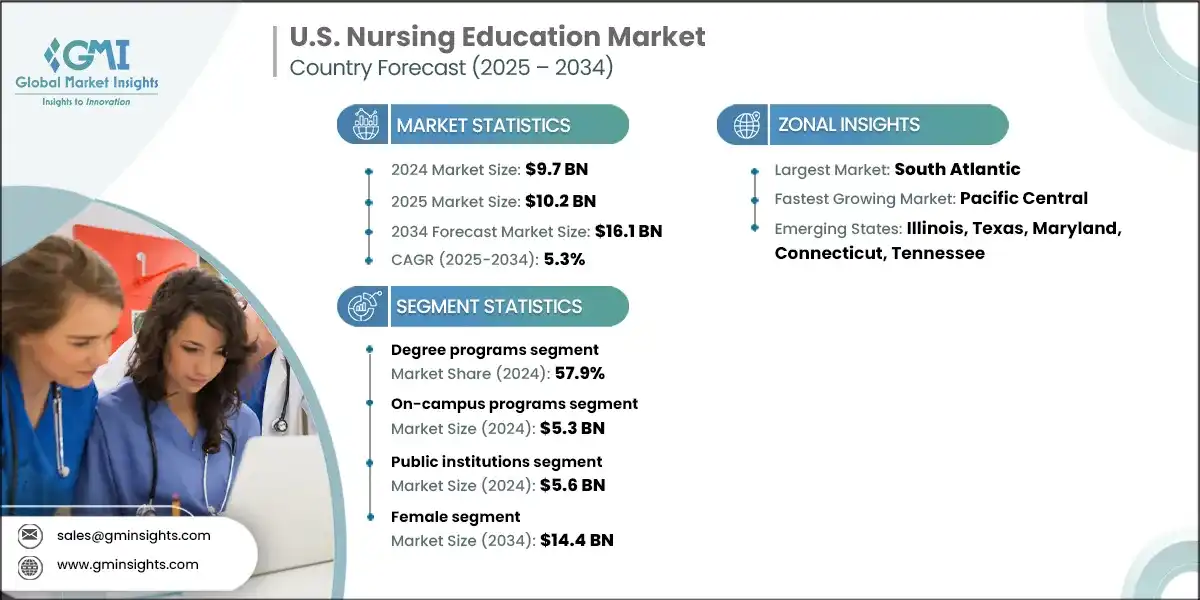
The U.S. nursing education market size was valued at USD 9.7 billion in 2024. The market is expected to grow from USD 10.2 billion in 2025 to USD 16.1 billion in 2034, growing at a CAGR of 5.3% during the forecast period, according to the latest report published by Global Market Insights Inc. The high market growth is attributed to the rising nursing shortage, growing healthcare demand, rising government and institutional support, and shift toward advanced practice roles, among other contributing factors.
U.S. Nursing Education Market Key Takeaways
Market Size & Growth
- 2024 Market Size: USD 9.7 Billion
- 2025 Market Size: USD 10.2 Billion
- 2034 Forecast Market Size: USD 16.1 Billion
- CAGR (2025–2034): 5.3%
Regional Dominance
- Largest Market: South Atlantic
- Fastest Growing Country: Pacific Central
Key Market Drivers
- Rising demand for healthcare services.
- Shortage of registered nursing staff.
- Globalization and collaboration with international institutes.
Challenges
- Regulatory and accreditation requirements.
Opportunity
- Rural state market entry strategies.
- High-opportunity states for online nursing education.
- Competitive Edge.
Get Market Insights & Growth Opportunities
Nursing education is the structured process of training individuals to become competent nursing professionals. It encompasses theoretical instruction, practical clinical experience, and skill development across various healthcare settings. Programs range from diploma and certificate courses to undergraduate and graduate degrees, preparing students for patient care, advanced practice, and leadership roles.
Leading players in the U.S. nursing education market include top institutions such as the University of Pennsylvania, Johns Hopkins, Duke University, and New York University (NYU). They sustain their edge through curriculum innovation, online/hybrid program expansion, and strong clinical partnerships. Significant investments in research, faculty development, and global visibility further enhance their competitiveness.
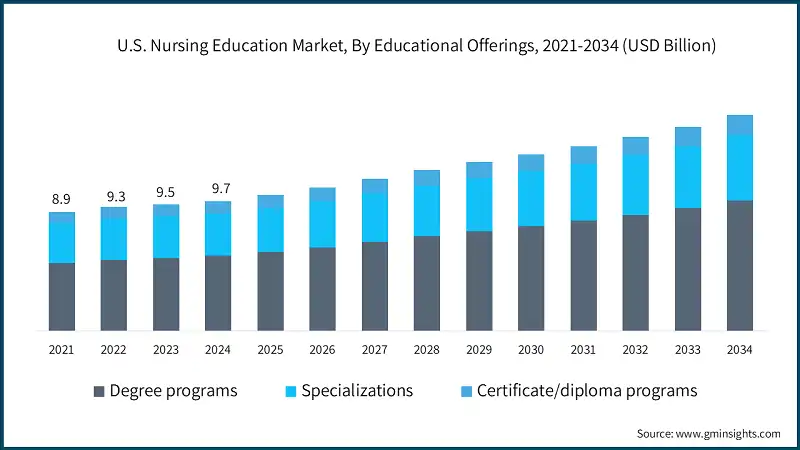
The market has increased from USD 8.9 billion in 2021 and reached USD 9.5 billion in 2023, with the historic growth rate of 3.2%. Market expansion was supported by the rising demand for skilled nurses amid nationwide workforce shortages and increasing enrollment supported by expanding online and hybrid learning models. Additionally, favorable government initiatives, scholarships, and the push for advanced practice roles (DNP, MSN) further fuel market growth.
The U.S. nursing education market is being shaped by several factors illustrating the larger need for trained healthcare professionals and the changes occurring within the healthcare system. Perhaps the most significant is the enduring nursing shortage across the nation, which is being driven by an aging population, an increase in chronic illnesses, and a greater emphasis on patient-centered care.
As the number of nursing graduates increases, the current healthcare systems and patient volume are predicted to increase, which will in turn increase the demand for more highly trained nurses. The other phenomenon is the retirement of a considerable segment of the nursing population.
Federal and state initiatives aimed at funding nursing education and supporting academic-practice partnerships are also propelling growth by making training more accessible and aligned with workforce demands.
Moreover, the rise in advanced practice roles, including nurse practitioners and nurse anesthetists, has created demand for higher-level nursing education programs. Together, these factors are fostering a strong, sustained demand for nursing education in the U.S. over the next decade.
To get key market trends
U.S. Nursing Education Market Trends
The U.S. nursing education industry is experiencing several notable trends that are shaping its growth and development. Factors such as growing emphasis on advanced degrees, expansion of online & hybrid programs, surging need for integrated simulation-based training, and rising industry-academia collaborations, among other factors, are collectively driving industry growth.
- Nursing schools are implementing online and hybrid learning models to accommodate working nurses and non-traditional students. According to the American Association of Colleges of Nursing (AACN), the number of nursing programs offering online education increased by 42% between 2021 and 2023.
- The U.S. Department of Education reported that 68% of nursing schools incorporated virtual simulations and e-learning platforms in 2022, up from 35% in 2021.
- Additionally, the National League for Nursing indicated that remote laboratory adoption in nursing education grew by 56% in 2023, with 72% of institutions planning further expansion by 2024.
- Further, there is a strong trend toward higher nursing qualifications, such as master’s, DNP, and PhD programs. This shift is driven by the demand for advanced practice nurses and academic faculty to fill gaps left by retiring educators.
- Moreover, healthcare systems and academic institutions are increasingly forming partnerships. According to the American Hospital Association (AHA), in 2023, over 75% of teaching hospitals maintained active partnerships with academic institutions, up from 62% in 2021.
- The Association of American Medical Colleges (AAMC) reported that clinical training partnerships increased by 28% between 2022 and 2024. These collaborations focus on developing curricula, providing clinical training, and creating workforce programs that prepare graduates for immediate practice.
- The U.S. Department of Health and Human Services noted that healthcare-academic partnerships contributed to a 15% increase in practice-ready nursing graduates in 2023 compared to 2021.
U.S. Nursing Education Market Analysis
Learn more about the key segments shaping this market
The U.S. market was valued at USD 8.9 billion in 2021. The market size reached USD 9.5 billion in 2023, from USD 9.3 billion in 2022.
Based on the educational offerings, the U.S. market is segmented into degree programs, specializations, and certificate/diploma programs. The degree programs segment has asserted its dominance in the market by securing a majority market share of 57.9% in 2024 owing to the high demand for BSN and RN-to-BSN pathways due to workforce shortages and the growing preference for advanced qualifications as entry-level standards rise. The segment is expected to exceed USD 9.7 billion by 2034, growing at a CAGR of 5.7% during the forecast period.
On the other hand, the specializations segment is expected to grow with a CAGR of 4.5%. The growth of this segment is driven by the rising need for advanced practice roles (NPs, DNPs, PhDs) and the increasing demand for nurse leaders, educators, and researchers to address workforce and academic gaps.
- The degree programs segment leads the market, with the BSN-in-10 initiative playing a key role. This initiative requires nurses to earn their Bachelor of Science in Nursing within ten years after getting their license, which has led to more nurses enrolling in bachelor's degree programs across the country.
- Healthcare organizations now place more value on nurses with degrees, as research shows that higher education levels help nurses provide better patient care, reduce death rates, and make better decisions during treatment. As more positions open up for advanced roles like nurse practitioners, nurse anesthetists, and nurse educators, more nurses are pursuing master's and doctoral degrees to qualify for these positions.
- The specializations segment held a revenue of USD 3.2 billion in 2024, with projections indicating a steady expansion at 4.5% CAGR from 2025 to 2034. This growth comes from the increasing need for nurses who understand complex patient care, especially in areas like critical care, cancer treatment, and children's health. As healthcare becomes more technology-driven, nurses need both digital skills and clinical expertise. Many nurses choose these specialized programs because they offer better career opportunities and higher salaries.
- The certificate/diploma programs segment held a revenue of USD 923.7 million in 2024, with projections indicating a steady expansion at 5% CAGR from 2025 to 2034. These programs are growing because they offer a quick and affordable way to become a nurse when hospitals need staff. Many hospitals and community colleges help by offering short training programs that quickly prepare nurses to work in specific healthcare settings.
Based on educational delivery mode, the U.S. nursing education market is segmented into on-campus programs, hybrid programs, and online programs. The on-campus programs segment dominated the market in 2024, accounting for USD 5.3 billion and is anticipated to grow at a CAGR of 4.6% during the forecast period.
- Students continue to choose on-campus programs, which hold the highest revenue share in the U.S. market. These programs excel in providing essential hands-on training and face-to-face instruction that nursing students need. Students develop their practical skills through real patient interactions, hospital rotations, and hands-on laboratory practice, which work best in a physical campus environment.
- Nursing schools and universities across the U.S. offer students a blend of classroom learning and practical experience at partner hospitals, where they experience real healthcare situations firsthand. Students prefer these established on-campus institutions because they offer better job prospects, valuable networking opportunities, and access to extensive learning resources.
- The hybrid programs segment accounted for significant revenue in 2024 and is anticipated to grow at a CAGR of 6.3% over the forecast period. More students are choosing these programs because they offer the flexibility to balance clinical training with online learning. Universities have embraced this mixed approach to reach more students while maintaining the quality of practical training.
- The online programs segment accounted for significant revenue in 2024 and is anticipated to grow at a CAGR of 5.4% over the forecast period. Working nurses particularly value these programs as they can advance their careers without quitting their jobs. Better technology and trusted online learning platforms are making nursing education more accessible to students everywhere in the country.
Based on institution type, the U.S. nursing education market is segmented into public institutions and private institutions. The public institutions segment dominated the market in 2024, accounting for USD 5.6 billion and is anticipated to grow at a CAGR of 5% during the forecast period.
- Public universities and community colleges welcome students by offering lower tuition fees compared to private institutions, opening opportunities for students from diverse economic backgrounds. Students can further ease their financial burden through government funding, grants, and scholarships.
- Students at these institutions benefit from well-developed facilities, including spacious campuses, modern simulation laboratories, and connections with teaching hospitals that ensure hands-on clinical training. Understanding the need for healthcare professionals, state governments continue to support nursing programs at public institutions, especially to help communities in rural and underserved areas.
- The private institutions segment accounted for significant revenue in 2024 and is anticipated to grow at a CAGR of 5.6% over the forecast period. These schools create unique learning environments through smaller class sizes and individualized attention to each student.
- Students at private institutions connect with strong alumni networks and benefit from industry partnerships that help in getting a better start to their careers. These schools can quickly update their teaching approaches and introduce new learning methods, giving their students unique advantages in their education journey.
Learn more about the key segments shaping this market
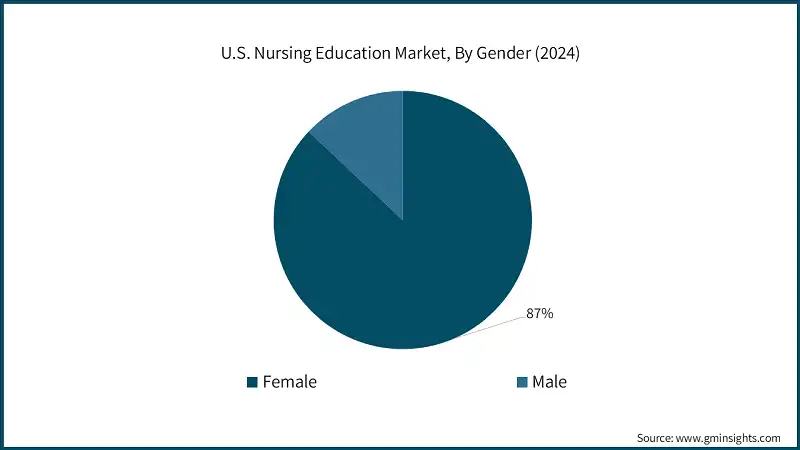
Based on gender, the U.S. nursing education market is classified into female and male. The female segment dominated the market with a revenue share of 87% in 2024 and is expected to reach USD 14.4 billion in 2034.
- Women continue to shape the nursing profession, influenced by deep-rooted historical, cultural, social, and economic factors. The traditional view of nursing as a female-oriented profession stems from long-established cultural connections between women and caregiving roles, making it a natural career path for many female students.
- Women are drawn to nursing by its promise of stable and fulfilling career opportunities. The field rewards practitioners with competitive salaries, reliable job security, and diverse career advancement options from registered nursing to specialized advanced practice roles. Nursing's flexible work arrangements, including part-time positions across various healthcare settings, allow women to successfully manage both family commitments and professional aspirations.
- Support networks play a crucial role, with organizations such as the American Nurses Association (ANA) and National League for Nursing (NLN) actively fostering female participation through dedicated scholarship programs, mentorship opportunities, and diversity initiatives that strengthen women's pathways in nursing education.
- The male segment held a revenue of USD 1.3 billion in 2024, with projections indicating a steady expansion at 3.3% CAGR from 2025 to 2034. This expansion reflects society's growing acceptance of gender diversity in healthcare, while attractive salaries and leadership prospects encourage more men to choose nursing as their profession.
Looking for region specific data?
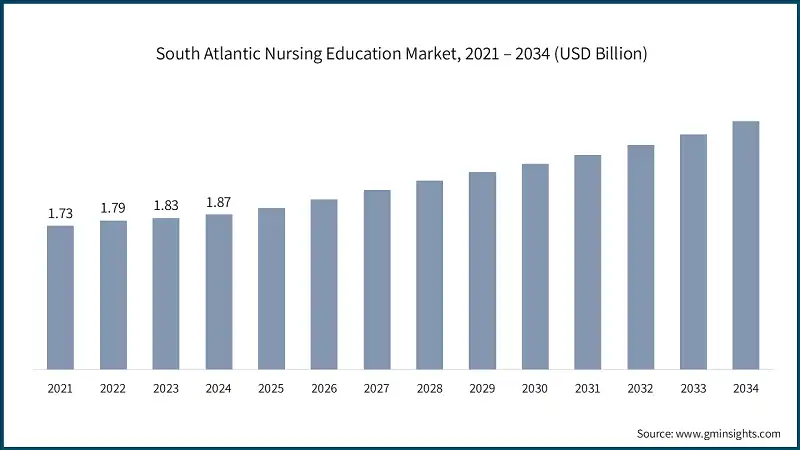
South Atlantic zone dominated the U.S. nursing education market with the highest market share of 19.2% in 2024.
- The South Atlantic region plays a vital role in shaping the nursing education market by addressing diverse healthcare needs, supporting educational growth, and responding to population changes. States such as Florida, North Carolina, and Virginia host many nursing schools and universities, welcoming more students each year through their comprehensive educational programs.
- Florida has a considerable percentage of an aging population, and there is a growing need for nurses who specialize in caring for older adults. Healthcare systems across Georgia and Maryland work closely with educational institutions, allowing students to gain hands-on experience in hospitals and research centers. Washington, D.C., serves as the policy hub, helping secure funding and shape regulations that benefit nursing education. Smaller states like Delaware, South Carolina, and West Virginia are building more nursing programs in schools and community colleges to help fill the shortage of healthcare workers.
- With both the urban and rural areas to serve, the region needs nurses across categories, from advanced practitioners to registered nurses. This need has led to more master's and doctoral programs. State governments help by providing grants and creating programs to train more nurses and make education more accessible. Local nursing organizations work to improve nurses' ability to practice and continue their education.
- By bringing together the needs of an aging population, healthcare demands, government support, and strong educational institutions, the South Atlantic region helps advance nursing education across the country.
North East nursing education market accounted for USD 1.8 billion in 2024 and is anticipated to show lucrative growth over the forecast period.
- The Northeast zone of the U.S. nursing education market brings together an impressive network of top-ranked nursing schools, teaching hospitals, and academic medical centers throughout Massachusetts, New York, Pennsylvania, and New Jersey. Students from across the country and around the world come to study at renowned institutions like Columbia University, the University of Pennsylvania, and Yale University, drawn by their exceptional advanced nursing programs.
- As the region's population ages and healthcare needs grow, there is an increasing need for nurses with specialized education in elder care, critical care, and primary care. States such as New York and Massachusetts have taken progressive steps by implementing healthcare policies that give nurse practitioners more independence in their practice. Such supportive policies by state government have encouraged more students to enroll in advanced degrees, such as the Doctor of Nursing Practice (DNP).
- The key pointer supporting the Northeast region's growth is the strong partnership between state nursing boards, academic institutions, and healthcare providers, working together to maintain high educational standards and provide valuable clinical experience opportunities. In Pennsylvania and New Jersey, substantial research funding helps nurture the next generation of nursing scholars through Ph.D. and research-focused doctorate programs.
- Students find support through various financial aid options, scholarships, and state-level grants, making education more accessible. The vibrant urban environments of Boston, New York City, and Philadelphia welcome students from all backgrounds. Such elements, from well-established institutions and strong healthcare systems to supportive policies and growing demand for advanced practice nurses, make the region a key force in U.S. nursing education and help address the nationwide need for qualified nurses.
The Pacific Central nursing education market is anticipated to grow at the highest CAGR of 6.6% during the analysis timeframe.
- The Pacific Central zone, comprising Alaska, California, Hawaii, Oregon, and Washington, is highly active and shifting within the U.S. nursing education market due to complex and varied health care needs, immigration, and policy changes. California nurse practitioners are in constant demand, reflecting the state’s large and diverse population and its extensive network of nursing schools. The state is also recognized for its strong focus on advanced practice and its rapidly aging population.
- The demand for the region in Washington and Oregon is also enhanced due to the integration of advanced nursing practices and improvement in health care systems, which results in the construction of Doctor of Nursing Practice (DNP) and Master’s programs. Hawaii and Alaska are in a contrasting position due to geography, which limits their access to adequate health care in the community, which results in a need for specialized trained nurses in telehealth, culture, and community health.
- Additionally, the region is also experiencing rising adoption of technology in education, such as simulation labs and online learning platforms, which bridge gaps in training and expand access to rural students. Also, the reason for the aid is the strong policies on the state level, which aim to balance the lacking nursing workforce and the partnerships with universities to fund the needed healthcare institutions.
- Professional organizations and advocacy groups in this zone actively support educational advancement and promote continuous development of nursing faculty, further enriching the academic ecosystem. Additionally, the region’s focus on equity, diversity, and inclusion aligns with national calls for a more representative nursing workforce, attracting students from varied backgrounds.
- Collectively, these drivers position the Pacific Central zone as a hub for innovation, specialization, and growth in the U.S. market.
U.S. Nursing Education Market Share
The U.S. market is characterized by the dominance of leading academic institutions such as Johns Hopkins University, University of Pennsylvania, Duke University, University of Washington, and NYU Rory Meyers College of Nursing.
These universities leverage their strong reputations, research excellence, and affiliations with top healthcare systems to attract a large pool of domestic and international students. Their competitive edge is further strengthened by consistent investments in faculty development, curriculum innovation, and expansion of online and hybrid learning models, which allow them to cater to evolving student preferences and workforce demands.
Alongside these universities, community colleges, private nursing schools, and online education providers are expanding their presence by offering cost-effective, flexible, and career-oriented programs. Increasing collaborations with healthcare organizations and technology platforms are also reshaping the market by integrating simulation-based learning, telehealth training, and interdisciplinary education.
As the nursing shortage intensifies, competition among institutions is expected to focus on expanding program capacity, enhancing accessibility, and developing specialized tracks, positioning both top-tier universities and emerging players to capture growth opportunities in the coming years.
U.S. Nursing Education Market Educational Institutes
Few of the prominent players operating in the U.S. nursing education industry include:
- Duke University
- Emory University
- Indiana University
- Johns Hopkins University
- MidAmerica Nazarene University
- New York University
- University of California
- University of Florida
- University of Maryland
- University of Pennsylvania
- Villanova University
- Yale University
- Duke University
Recognized for its innovative curriculum and leadership in nursing informatics, Duke offers a strong emphasis on research and global health, preparing nurses for advanced practice and policy-making roles.
Its integration with the Johns Hopkins Hospital system provides unmatched clinical training, while its global health initiatives and top-ranked research output make it a leader in advancing nursing science.
Known for being consistently ranked among the top nursing schools, Penn Nursing combines rigorous academic programs with strong research funding and partnerships, creating a hub for nurse leaders and scholars.
U.S. Nursing Education Market Report Attributes
| Key Takeaway | Details |
|---|---|
| Market Size & Growth | |
| Base Year | 2024 |
| Market Size in 2024 | USD 9.7 Billion |
| Market Size in 2025 | USD 10.2 Billion |
| Forecast Period 2025 - 2034 CAGR | 5.3% |
| Market Size in 2034 | USD 16.1 Billion |
| Key Market Trends | |
| Drivers | Impact |
| Rising demand for healthcare services | The aging population and higher chronic disease burden are pushing universities to expand nursing program capacity and accelerate graduate output. |
| Shortage of registered nursing staff | Workforce gaps have increased enrollment demand, making nursing one of the fastest-growing fields of study in U.S. higher education. |
| Globalization and collaboration with international institutes | Partnerships with global nursing schools are enhancing curriculum standards and attracting international students, boosting overall market revenues. |
| Pitfalls & Challenges | Impact |
| Regulatory and accreditation requirements | Stringent standards from accrediting bodies like CCNE and ACEN increase compliance costs and limit rapid program expansion, restraining market scalability. |
| Opportunities: | Impact |
| Rural state market entry strategies | Expanding nursing programs in underserved rural states will help address regional workforce shortages and open new revenue streams for universities. |
| High-opportunity states for online nursing education | Growth in states with strong demand for flexible learning will accelerate adoption of online and hybrid programs, broadening access and boosting enrollments. |
| Competitive Edge | Johns Hopkins University School of Nursing has strong global reputation and integration with a leading healthcare system provide unmatched clinical training opportunities and research excellence. |
| Regional Insights | |
| Largest Market | South Atlantic |
| Fastest growing market | Pacific Central |
| Emerging states | Illinois, Texas, Maryland, Connecticut, Tennessee |
| Future outlook |
|
What are the growth opportunities in this market?
U.S. Nursing Education Industry News:
- In September 2024, Duke University School of Nursing and Pratt School of Engineering launched a joint research program to tackle health inequities through nursing-engineering integration. The program funded projects such as ALS communication wearables, nurse-guided telerobotics, rural mental health predictive models, and dementia-focused sensor systems. This initiative boosted Duke’s presence in the U.S. market by highlighting its leadership in interdisciplinary innovation, research excellence, and advanced learning opportunities.
- In June 2023, Emory’s Nell Hodgson Woodruff School of Nursing launched a Data Science Certificate program to train nurses in analytics, informatics, and digital health. By integrating data science into nursing practice, it prepared professionals for leadership roles in research and patient care. This initiative enriched the market by aligning education with digital healthcare transformation and building a tech-savvy nursing workforce.
- In August 2024, NYU Rory Meyers College of Nursing, in collaboration with Rutgers University, secured National Institute on Aging funding to establish a joint resource center for Alzheimer’s and dementia care. The center supported nurse-led research, training, and clinical studies, fostering cross-sector collaboration. This initiative is expected to strengthen the U.S. market by expanding geriatric specialization, advancing dementia-focused curricula, and enhancing nurse leadership in aging care innovation.
The U.S. nursing education market research report includes an in-depth coverage of the industry with estimates and forecast in terms of revenue in USD Million from 2021 – 2034 for the following segments:
Market, By Educational Offerings
- Degree programs
- Specializations
- Certificate/diploma programs
Market, By Educational Delivery Mode
- On-campus programs
- Hybrid programs
- Online programs
Market, By Institution Type
- Public institutions
- Private institutions
Market, By Gender
- Female
- Male
The above information is provided for the following zones and states:
- East North Central
- Illinois
- Indiana
- Michigan
- Ohio
- Wisconsin
- West South Central
- Arkansas
- Louisiana
- Oklahoma
- Texas
- South Atlantic
- Delaware
- Florida
- Georgia
- Maryland
- North Carolina
- South Carolina
- Virginia
- West Virginia
- Washington, D.C.
- Northeast
- Connecticut
- Maine
- Massachusetts
- New Hampshire
- Rhode Island
- Vermont
- New Jersey
- New York
- Pennsylvania
- East South Central
- Alabama
- Kentucky
- Mississippi
- Tennessee
- West North Central
- Iowa
- Kansas
- Minnesota
- Missouri
- Nebraska
- North Dakota
- South Dakota
- Pacific Central
- Alaska
- California
- Hawaii
- Oregon
- Washington
- Mountain States
- Arizona
- Colorado
- Utah
- Nevada
- New Mexico
- Idaho
- Montana
- Wyoming
Frequently Asked Question(FAQ) :
What is the market size of the U.S. nursing education in 2024?
The U.S. nursing education market was valued at USD 9.7 billion in 2024, supported by rising demand for healthcare services and workforce shortages.
How much revenue did the degree programs segment generate in 2024?
Degree programs dominated with USD 5.6 billion in 2024, accounting for 57.9% of total market share.
What is the projected value of the U.S. nursing education market by 2034?
The market is expected to reach USD 16.1 billion by 2034, growing at a CAGR of 5.3% from 2025–2034.
What was the valuation of the public institutions segment in 2024?
Public institutions generated USD 5.6 billion in 2024, benefiting from lower tuition costs and state government support.
What is the growth outlook for hybrid programs from 2025 to 2034?
Hybrid programs are projected to grow at a 6.3% CAGR through 2034, driven by demand for flexible yet practical nursing education.
Which region leads the U.S. nursing education industry?
The South Atlantic region led with 19.2% market share in 2024, supported by a concentration of nursing schools and aging population needs.
Who are the key players in the U.S. nursing education market?
Leading players include Johns Hopkins University, University of Pennsylvania, Duke University, New York University, Yale University, University of California, University of Florida, University of Maryland, Villanova University, Emory University, and Indiana University.
What is the market size of the U.S. nursing education market in 2025?
The market size is projected to reach USD 10.2 billion in 2025, reflecting strong enrollment growth and government support.
U.S. Nursing Education Market Scope
Related Reports