Summary
Table of Content

US Motorcycles and Scooters Market
Get a free sample of this report
Form submitted successfully!
Error submitting form. Please try again.
Thank you!
Your inquiry has been received. Our team will reach out to you with the required details via email. To ensure that you don't miss their response, kindly remember to check your spam folder as well!
Request Sectional Data
Thank you!
Your inquiry has been received. Our team will reach out to you with the required details via email. To ensure that you don't miss their response, kindly remember to check your spam folder as well!
Form submitted successfully!
Error submitting form. Please try again.
US Motorcycles and Scooters Market Size
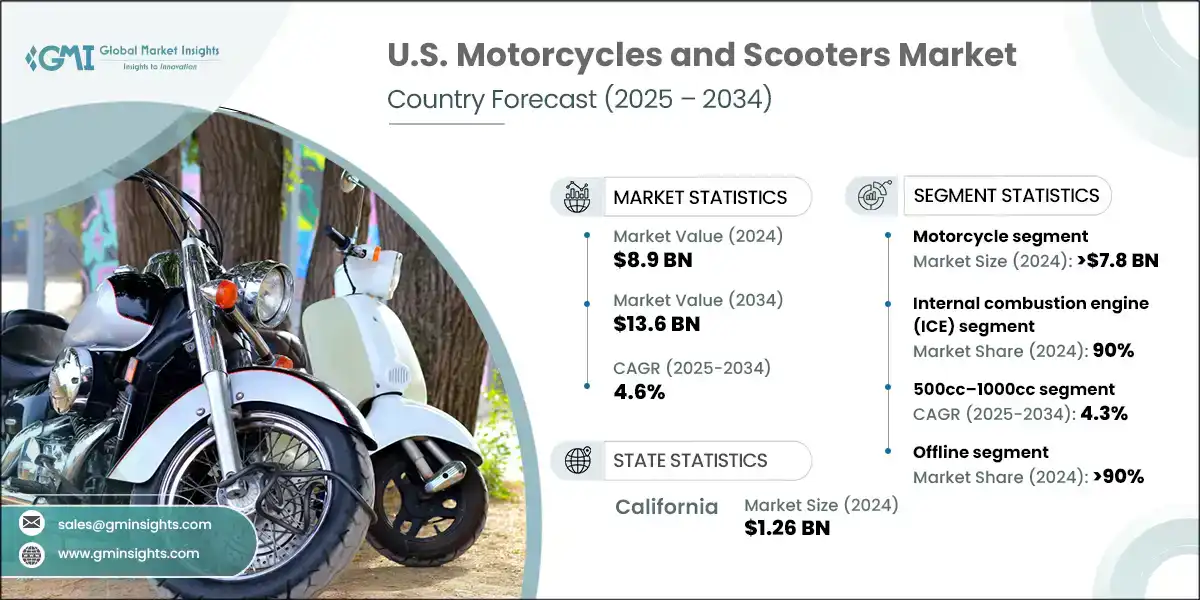
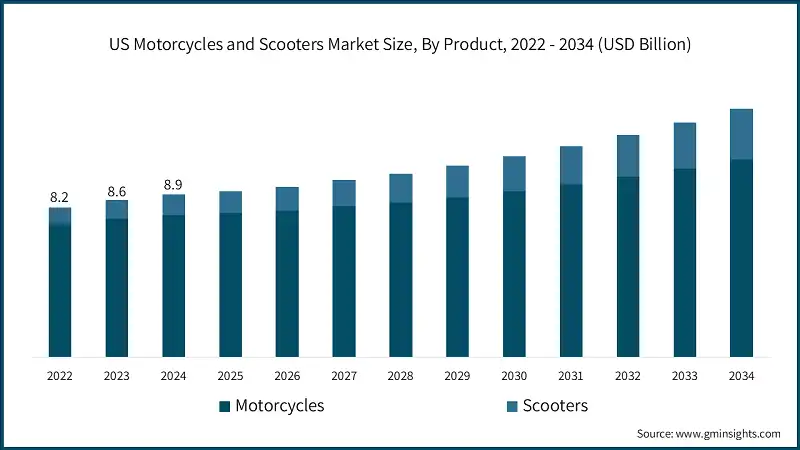
According to a recent study by Global Market Insights Inc., the US motorcycles and scooters market size was estimated at USD 8.9 billion in 2024. The market is expected to grow from USD 9.1 billion in 2025 to USD 13.6 billion in 2034, at a CAGR of 4.6%.
US Motorcycles and Scooters Market Key Takeaways
Market Size & Growth
- 2024 Market Size: USD 8.9 Billion
- 2034 Forecast Market Size: USD 13.6 Billion
- CAGR (2025–2034): 4.6%
Regional Dominance
- Largest Market: South
- Fastest Growing Country: West
Key Market Drivers
- Increasing demand for fuel-efficient urban mobility.
- Rise in electric two-wheeler adoption.
- Recreational motorcycle culture and touring demand.
- Expanding e-commerce and last-mile delivery.
Challenges
- Lack of nationwide EV charging infrastructure.
Opportunity
- Growing youth preference for personal mobility.
- Technological innovation in two-wheeler design.
- Fleet electrification initiatives.
- Retrofitting aging Off-Shore platforms.
Key Players
- Market Leader: Honda led with over 38% market share in 2024.
- Leading Players: Top 5 players in this market include Harley-Davidson, Honda, Kawasaki, Suzuki, Yamaha, which collectively held a market share of 79% in 2024.
Get Market Insights & Growth Opportunities
- Motorcycles and scooters constitute a vital component of the US transportation infrastructure, fulfilling a diverse array of functions ranging from routine urban transit to leisure excursions and commercial last-mile distribution. The US motorcycles and scooters market encompasses a spectrum of vehicle classifications, including cruisers, sport and touring motorcycles, standard motorcycles, and with increasing prevalence, electric scooters and motorcycles engineered for streamlined urban mobility.
- In 2022, the US saw approximately 9.6 million registered motorcycles, a testament to the substantial size and established nature of this vehicle sector. California leads the nation with over 800,000 registered motorcycles, a figure attributable to its favorable weather conditions, enthusiasm for leisure activities, and progressive transportation policies. Within the southern states, cruiser and touring motorcycles are especially prevalent, reflecting the region's suitability for long-distance travel and year-round utilization.
- Metropolitan congestion and the escalating demand for efficient, short-range transport have propelled the amplification of scooter utilization in major urban centers. According to the US Department of Energy, the shared micromobility journeys reached 133 million in 2023, apportioned as 65 million trips via scooters and 68 million via motorcycles. This trend highlights the augmenting reliance on compact, two-wheeled alternatives for navigating the urban landscape.
- Bolstered by federal and state incentives, mandates for fleet electrification, and shifting consumer tastes, the US motorcycles and scooters market is anticipated to maintain robust growth. Increased adoption of electric vehicles, integration of micromobility solutions, and the cultural popularity of motorcycles in southern and western states will continue to shape the industry through 2034.
To get key market trends
US Motorcycles and Scooters Market Trends
- The motorcycle retail and maintenance sector underpin a substantial labor force, comprising approximately 91,738 individuals nationally as of 2024, which includes 14,330 motorcycle technicians earning an average yearly remuneration of $47,960, as indicated by the Bureau of Labor Statistics. This employment foundation supports aftermarket services and customer assistance vital to market expansion.
- The integration of "micromobility" options into city transportation plans is really taking off. Local governments are incorporating motorcycles and scooters into public transit systems. Tackles like shared scooter programs and designated parking spots are making it easier to get to and from transit hubs, especially in crowded cities. The goal is to reduce traffic congestion and pollution, while also providing affordable ways for people to get around.
- Electric motorcycles and scooters are becoming increasingly popular in many states, owing to government support for environmentally friendly transportation. A variety of federal and state programs, including tax breaks and rebates, are encouraging individuals and businesses alike to switch to electric two-wheelers as part of a broader commitment to environmental responsibility. This governmental drive is spurring innovation in the vehicles themselves and leading to an expansion of charging infrastructure.
- The expansion observed within the distribution and logistics industries is amplifying the need for scooters and motorcycles specifically engineered for commercial purposes. The burgeoning of electronic commerce and culinary conveyance services necessitates dependable, fuel-conservative vehicles capable of maneuvering through congested urban landscapes, thereby generating prospects for customized two-wheeler designs tailored for organizational vehicle fleets.
- The increasing prevalence of subscription-based and vehicle-as-a-service (VaaS) models is transforming conventional ownership attributes. Urban consumers are progressively demonstrating a preference for flexible access to motorcycles and scooters, thereby obviating the need for protracted commitments. This ongoing shift is inspiring established manufacturers (OEMs) and emergent ventures to conceive innovative mobility solutions, seamlessly integrating technological and financial innovation to cater to the evolving preferences of the contemporary user base.
US Motorcycles and Scooters Market Analysis
Learn more about the key segments shaping this market
Based on product, the US motorcycles and scooters market is divided into motorcycles and scooters. The motorcycle segment held over 87% of the market share and generated revenue of over USD 7.8 billion in 2024.
- Motorcycles are a diverse class of motorized two-wheeled vehicles, encompassing a range of styles such as cruisers, sport bikes, touring motorcycles, and standard models. They are commonly utilized for extended journeys, leisure activities, and as a reflection of personal identity. Compared to scooters, motorcycles generally feature larger engines and enhanced power output, rendering them appropriate for highway travel and prolonged excursions.
- The motorcycle market benefits considerable customer allegiance and a robust network of passionate enthusiasts, particularly in areas with pleasant climates, such as the southern and western regions. These vehicles demand a greater level of proficiency and licensing compared to scooters, often attracting seasoned riders and those in search of high-end or performance-focused machines.
- Scooters are mainly intended for urban environments and shorter commutes, providing a compact design, simplified handling, and improved fuel economy. They typically incorporate smaller engines, automatic transmissions, and reduced maximum speeds, thereby making them accessible to a wider range of users, including younger individuals and novice riders.
- Scooters perform exceptionally well in densely populated urban areas and are becoming increasingly prevalent among delivery services and micromobility providers due to their maneuverability and low running expenses. Electric scooters are experiencing rapid growth within this market segment, bolstered by advancements in urban infrastructure and sustainability efforts. Their affordability and ease of operation make scooters a viable solution for daily travel and last-mile transportation.
Learn more about the key segments shaping this market
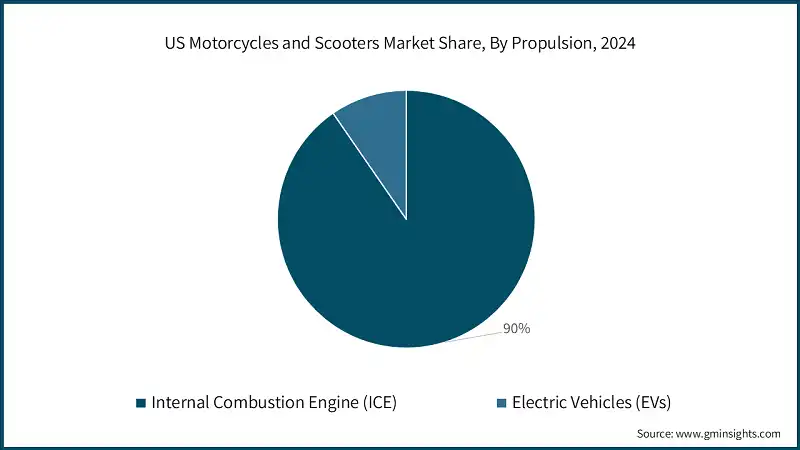
Based on propulsion, the US motorcycles and scooters market is segmented into internal combustion engine (ICE) and electric vehicles (EVs). The internal combustion engine (ICE) segment held a market share of 90% in 2024 and it is expected to grow at CAGR of 1.8% from 2025 to 2034.
- Vehicles powered by internal combustion engines remain prevalent, notably in motorcycles and scooters, owing to an existing fuel distribution network and widespread user understanding. Governmental and regulatory organizations in the US have established evolving pollution control measures for ICE motorcycles to mitigate environmental impact.
- For instance, the California Air Resources Board (CARB) has suggested revisions to these measures, encompassing more demanding requirements for exhaust and evaporation emissions, aligned with European Union standards. These revisions also introduce novel diagnostic systems to minimize environmental contamination. The aim of these is to significantly cut smog-producing emissions and greenhouse gases from ICE motorcycles by 2035.
- The US motorcycles and scooters market is expanding, bolstered by a variety of federal and state initiatives intended to expedite EV adoption. The US government has implemented policies targeting that half of all new vehicle sales by 2030 be zero-emission vehicles, sustained by infrastructural investments such as the creation of a nationwide network comprising 500,000 EV charging stations. Programs such as Electrify America have allocated significant funds to community organizations to improve EV education and accessibility, particularly within underserved communities, while workforce development programs are cultivating expertise for the expanding EV sector.
Based on engine displacement, the US motorcycles and scooters market is segmented into under 250cc, 250cc–500cc, 500cc–1000cc and above 1000cc. The 500cc–1000cc segment held a market share of 50% in 2024 and this segment is expected to grow at CAGR of 4.3% from 2025 to 2034.
- 500cc–1000cc a medium-to-large displacement motorcycles are favored by practiced riders for their elevated performance, comfort, and capacity to manage extended touring or sporty riding styles. This segment encompasses cruisers, sport motorcycles, and adventure models suitable for varied landscapes and riding environments. The 500cc–1000cc range remains a central interest for prominent manufacturers and contributes substantially to motorcycle retailer income within the US.
- Under 250cc vehicles are largely composed of lightweight scooters and introductory-level motorcycles. These are particularly attractive for urban transit and novice riders due to their relatively low initial expense, simple handling, and commendable fuel efficiency. Younger individuals and urban residents often find this segment appealing. However, their restricted capabilities on highways and overall performance may diminish their attractiveness to experienced riders or those undertaking extended journeys. Growth in this segment is supported by the burgeoning micromobility movement and the increasing necessity for efficient last-mile transport solutions.
- 250cc-500cc motorcycles offer a compromise between urban practicality and adequate power for intermediate touring. This classification is popular among individuals upgrading from smaller displacement bikes and commuters requiring greater versatility than offered by the sub-250cc segment. These vehicles present enhanced highway performance while preserving acceptable weight and cost. This class also functions as an intermediate stage to the mid-size motorcycle market, commonly targeted by manufacturers introducing introductory sport or adventure-style models.
- Above 1000cc high-displacement motorcycles are designed for aficionados pursuing top-tier performance, luxurious touring capabilities, or premium cruiser experiences. Models within this category are frequently outfitted with cutting-edge electronics, comfort amenities, and potent engines, making them well-suited for long-distance voyages and performance devotees. While representing a comparatively smaller volume of sales, these vehicles account for a substantial portion of market value due to their elevated price points.
Based on distribution channel, the US motorcycles and scooters market is segmented into offline and online. The offline segment held a market share of over 90% in 2024 and the segment is expected to grow at a CAGR of 3.3% from 2025 to 2034.
- In the US, the sale of motorcycles and scooters is primarily conducted through traditional brick-and-mortar establishments, including authorized dealerships, showrooms, and independent retailers. These venues provide customers with the opportunity for hands-on interaction, including test rides, personalized consultations, maintenance services, and financing opportunities.
- Established and robust dealer networks, maintained by original equipment manufacturers (OEMs) of the stature of Harley-Davidson, Honda, and Yamaha, exert a considerable influence on brand allegiance and consumer confidence. Extended maintenance plans and trade-in incentives further bolster the perceived worth proposition of conventional retail routes, particularly concerning high-capacity and premium-tier motorbikes.
- However, the offline marketplace is demonstrating increasing prevalence, propelled by ongoing technological advancements, the proliferation of electronic commerce platforms, and a shifting consumer inclination towards ease of access. Internet-based channels present heightened price visibility, options for residential conveyance, and an evolving integration of virtual presentation spaces and digitized funding instruments. This avenue holds particular allure for younger, technologically adept demographics and for lower-capacity, urban-oriented models, such as scooters or electric motorcycles.

Looking for region specific data?
California dominated the motorcycles and scooters market in West US with around 50% of the market share and generated around USD 1.26 billion revenue in 2024.
- The Western US persists as the most rapidly expanding region in the market for motorcycles and scooters, primarily due to its advantageous topography, robust recreational lifestyle, and the strategic implementation of environmentally conscious transportation alternatives. Within this Western expanse, California maintains a preeminent position, boasting the most substantial volume of motorcycle registrations nationwide totaling 936,809 vehicles in 2023. This figure, while representing a marginal contraction from the 953,652 units recorded in 2021, underscores the state's sustained significance.
- California's ongoing supremacy is underpinned by its picturesque roadways, amenable climate that permits year-round riding, and a significant concentration of motorcycle enthusiasts residing in both urban and suburban locales. Furthermore, the state's progressive electric vehicle policies and incentivized infrastructure have stimulated growth in the acquisition of electric scooters and motorcycles, particularly within municipalities prioritizing the alleviation of urban traffic congestion and the diminution of emissions.
- Notably, states such as Arizona, Nevada, and Colorado are exhibiting accelerated market penetration, underpinned by demographic expansion, a comparatively youthful population, and the progressive development of EV charging infrastructure. The region also profits from a vibrant aftermarket and dealership network, ensuring expedient product access and maintenance services. This enhanced accessibility bolsters consumer assurance and further galvanizes regional advancement.
New York dominated the Northeast US motorcycles and scooters market and is expected to experience significant and promising growth from 2025-2034.
- The Northeastern US represents a mature but relatively small market for motorcycles and scooters. Its growth is tempered by abbreviated riding seasons and the complexities of densely populated urban environments. Nevertheless, major metropolitan centers such as New York City, Boston, and Philadelphia are experiencing heightened interest in electric scooters and compact two-wheeled vehicles, spurred by persistent traffic bottlenecks and the demand for efficient last-mile transportation solutions.
- States like New York and Pennsylvania consistently demonstrate substantial vehicle registration numbers, underpinned by a robust network of dedicated motorcycle aficionados and individuals who utilize motorcycles for commuting purposes. Even so, the rate of market penetration in the Northeast lags behind that of the Western and Southern regions, primarily due to inclement weather conditions and limitations on parking availability within densely populated urban environments.
- Expansion is evident in the area of micromobility solutions, particularly within university towns and urban districts where shared electric scooters emerge as a viable substitute for conventional transportation. Escalating fuel costs, coupled with a growing emphasis on carbon-neutral transit options, are progressively inclining consumers within the region toward electric alternatives.
Illinois dominated the motorcycles and scooters market in Midwest US and is expected to experience strong growth from 2025 to 2034.
- Motorcycle ownership in the Midwestern US constitutes a significant portion of the market, propelled by a robust community of dedicated riders and the prevalence of extensive, uncongested roadways. Within the region, Ohio, Illinois, Michigan, and Wisconsin demonstrate the highest volumes of motorcycle registrations. To illustrate, data published by the Federal Highway Administration indicates that Ohio maintained a registry exceeding 400,000 motorcycles in 2023, placing it among the top five states in the nation in this regard.
- While electric motorcycles are still a relatively new phenomenon, cities like Chicago and Minneapolis are starting to see more electric scooters and smaller electric bikes on the streets. This growth is being encouraged by micromobility programs and a growing concern for the environment.
Texas dominated the South US motorcycles and scooters market and is expected to experience high growth from 2025 to 2034.
- The South US continues to be the dominant regional market for motorcycles and scooters within the nation, an advantage attributable to its amenable weather conditions, expansive road infrastructure, and a deeply ingrained motorcycle enthusiast community. Data from the Federal Highway Administration indicates that Florida possessed 668,046 registered motorcycles in 2023, placing it second only to California in this metric. Texas, with 394,351 registered, occupies a pivotal position within the Southern market.
- This geographic area exhibits substantial demand for motorcycles with medium to large engine displacements (500cc–1000cc and exceeding), particularly within the touring and cruiser categories, which are favored by recreational riders. While internal combustion engine (ICE) models currently hold a commanding market share, the adoption of electric scooters and motorcycles is increasing, particularly in metropolitan centers such as Austin, Miami, and Atlanta. This trend is further supported by electric vehicle (EV) incentives and investments in charging infrastructure.
- Moreover, Southern states maintain a robust network of dealerships and service centers, thereby facilitating greater accessibility and aftermarket commerce. Developing markets, including Georgia, North Carolina, and Tennessee, are experiencing heightened adoption rates owing to urban sprawl, demographic expansion, and an escalating interest in economical urban transportation solutions.
US Motorcycles and Scooters Market Share
- The top 7 companies in the US motorcycles and scooters industry are Honda, Harley-Davidson, Yamaha, Kawasaki, Suzuki, KTM, and Indian Motorcycle contributing over 89.3% of the market in 2024.
- Honda maintains the foremost position in terms of market dominance. This prominent standing is attributable to their adaptable selection of vehicles, encompassing economical scooters, adventure-oriented machines, and mid-sized motorcycles. Recognized for both dependability and economical fuel consumption, Honda benefits from an extensive network of dealerships strategically positioned throughout both metropolitan and suburban locales.
- Harley-Davidson maintains a considerable market presence with its cruiser and touring motorcycle models. The company exerts a dominant influence in the heavyweight motorcycle sector (exceeding 1000cc), specifically throughout the southern and western regions of the US, where motorcycle enthusiast culture is particularly prevalent. Furthermore, the organization remains committed to technological advancement, demonstrated by their electric motorcycle introductions, such as LiveWire.
- Yamaha occupies a significant market position, presenting a diverse array of products ranging from introductory models to high-performance sport bikes. The marque is especially esteemed by novice riders and daily commuters and is building substantial participation in conventional and emerging electric scooter sectors.
- Kawasaki sustains a competitive presence, concentrating on high-performance motorcycles that encompass sport, dual-sport, and off-road applications. The company's Ninja series enjoys considerable favor among younger riders and dedicated enthusiasts.
- Suzuki capitalizes on its expertise in sport and standard motorcycles, coupled with a competitive pricing strategy, rendering its products appealing in regions with high price sensitivity. Its presence is particularly noteworthy in both rural areas and urban commuter markets.
- KTM an Austrian manufacturer, possesses a specialized, albeit expanding, portion of the market focusing on off-road, motocross, and adventure touring categories. The brand's assertive aesthetic and performance-oriented market strategy generates substantial appeal amongst devotees, notably in the western states.
- Indian Motorcycle a division of Polaris, has cultivated a devoted customer base within the cruiser and heavyweight motorcycle segments. Strategically positioned as a direct rival to Harley-Davidson, the brand is gaining momentum by merging classic styling with modern technological features.
US Motorcycles and Scooters Market Companies
Major players operating in the US motorcycles and scooters industry are:
- BMW
- Ducati
- Harley-Davidson
- Honda
- Indian Motorcycle
- Kawasaki
- KTM
- Suzuki
- Triumph
- Yamaha
- Honda distinguishes itself as the market's volume progenitor, owing to its robust position in both the motorcycle and scooter market. This success is largely attributable to its reliable, economical, and competitively priced offerings, which appeal to both novice and seasoned riders. In contradistinction, Harley-Davidson occupies a leading position in the heavyweight cruiser sector and benefits from considerable brand value among riders who prioritize lifestyle and long-distance touring, particularly within the southern and western regions of the country.
- Yamaha, Kawasaki, and Suzuki maintain considerable influence in the intermediate and high-performance segments, areas favored by enthusiasts of sport bikes and dual-purpose motorcycles. Conversely, KTM and Indian Motorcycle cater to specialized market segments: KTM with its focus on off-road and motocross applications, and Indian as an upscale alternative to Harley-Davidson in the heritage cruiser arena.
- These organizations, working in concerts, exert considerable influence upon the trajectory of the US market. They navigate a complex landscape, balancing advancements in electric and hybrid powertrains with a long-standing tradition of internal combustion engine motorcycles. Their strategies incorporate omnichannel sales approaches, strategically placed regional dealerships, and sophisticated product differentiation.
US Motorcycles and Scooters Market Report Attributes
| Key Takeaway | Details |
|---|---|
| Market Size & Growth | |
| Base Year | 2024 |
| Market Size in 2024 | USD 8.9 Billion |
| Forecast Period 2025 – 2034 CAGR | 4.6% |
| Market Size in 2034 | USD 13.6 Billion |
| Key Market Trends | |
| Drivers | Impact |
| Increasing demand for fuel-efficient urban mobility | Rising fuel prices and traffic congestion are driving preference for two-wheelers, especially scooters, in US metro cities |
| Rise in electric two-wheeler adoption | Growing EV state incentives, and rising eco-consciousness are accelerating e-motorcycle and e-scooter adoption |
| Recreational motorcycle culture and touring demand | Strong consumer base for cruisers and touring motorcycles, especially in southern and western states, fuels premium segment sales |
| Expanding e-commerce and last-mile delivery | Commercial demand for scooters and lightweight motorcycles is increasing due to growth in delivery services |
| Pitfalls & Challenges | Impact |
| Lack of nationwide EV charging infrastructure | Insufficient coverage of public charging networks in semi-urban and rural regions restricts electric scooter/motorcycle uptake |
| Regulatory inconsistencies across states | Varying helmet laws, licensing requirements, and vehicle regulations create fragmented compliance for manufacturers and users |
| Opportunities: | Impact |
| Growing youth preference for personal mobility | Gen Z and Millennials are showing increased interest in affordable, tech-enabled scooters for city travel |
| Technological innovation in two-wheeler design | Connected vehicle platforms, smart helmets, and anti-lock braking systems are enhancing rider experience and safety |
| Fleet electrification initiatives | Logistics and ride-share companies are increasingly investing in electric scooters to meet ESG targets |
| Retrofitting aging Off-Shore platforms | Platform modernization initiatives, especially in Canadian fields and older US sites (e.g., West Coast), offer long term revenue potential for crane retrofits and lifecycle services |
| Market Leaders (2024) | |
| Market Leaders |
38% market share |
| Top Players |
Collective market share in 2024 is 79% |
| Competitive Edge |
|
| Regional Insights | |
| Largest Market | South |
| Fastest Growing Market | West |
| Emerging Market | Arizona, Nevada, Georgia, Colorado, North Carolina |
| Future outlook |
|
What are the growth opportunities in this market?
US Motorcycles and Scooters Industry News
- In March 2025, Honda announced the US debut of three new motorcycle models for the 2025 model year CB750 Hornet, CB1000 Hornet SP, and NT1100 DCT. The launch strengthens Honda’s presence in the naked-bike and sport-touring segments, aiming to cater to performance-focused and touring enthusiasts in the US market.
- In May 2025, KTM announced its renewed commitment to the US market with the launch of the ORANGE BOARD rider community initiative, engaging passionate riders to help shape the brand’s future. Alongside this, KTM is set to introduce new models for 2025, including the 390 SMC R, 390 Enduro R, 390 Adventure X, and 390 Adventure R, expanding its street and adventure lineup with enhanced performance and fresh design.
- In January 2025, Harley-Davidson unveiled its 2025 motorcycle lineup, featuring the new Street Glide Ultra for enhanced long-distance touring and the Pan America 1250 ST, a versatile adventure sport model. The refreshed Cruiser collection includes six models with upgraded Milwaukee-Eight 117 engines and technology enhancements. Sportster S also received a suspension upgrade, improving comfort and ride quality for both new and experienced riders.
- In December 2024, Honda highlights its $19 billion investment in US production. With nearly 23,000 US associates and 12 manufacturing plants, Honda’s American operations support over 200,000 powersports products annually. The Technical Development Center plays a key role in advancing manufacturing capabilities through education and training.
The US motorcycles and scooters market research report includes in depth coverage of the industry with estimates & forecasts in terms of revenue (USD Mn/Bn) and Volume (Units) from 2021 to 2034, for the following segments:
Market, By Product
- Motorcycles
- Cruiser motorcycles
- Sport motorcycles
- Touring motorcycles
- Standard/naked motorcycles
- Adventure/dual-sport motorcycles
- Off-road/dirt motorcycles
- Scooters
- Traditional gasoline scooters
- Electric scooters
- Maxi scooters
- Moped-style scooters
Market, By Propulsion
- Internal combustion engine (ICE)
- Electric vehicles (EVs)
Market, By Engine Displacement
- Under 250cc
- 250cc–500cc
- 500cc–1000cc
- Above 1000cc
Market, By Distribution Channel
- Offline
- Online
Market, By End Use
- Personal
- Commercial users
The above information is provided for the following regions and countries:
- Northeast US
- Connecticut
- Maine
- Massachusetts
- New Hampshire
- New Jersey
- New York
- Pennsylvania
- Rhode Island
- Vermont
- Midwest US
- Illinois
- Indiana
- Iowa
- Kansas
- Michigan
- Minnesota
- Missouri
- Nebraska
- North Dakota
- Ohio
- South Dakota
- Wisconsin
- South US
- Alabama
- Arkansas
- Delaware
- Florida
- Georgia
- Kentucky
- Louisiana
- Maryland
- Mississippi
- North Carolina
- Oklahoma
- South Carolina
- Tennessee
- Texas
- Virginia
- West Virginia
- Washington D.C.
- West US
- Alaska
- Arizona
- California
- Colorado
- Hawaii
- Idaho
- Montana
- Nevada
- New Mexico
- Oregon
- Utah
- Washington
- Wyoming
Frequently Asked Question(FAQ) :
What is the market size of the US motorcycles and scooters in 2024?
The market size was estimated at USD 8.9 billion in 2024, with a CAGR of 4.6% expected through 2034. The market's growth is driven by increasing demand for urban mobility solutions, electric vehicles, and commercial applications.
What is the projected value of the US motorcycles and scooters market by 2034?
The market is poised to reach USD 13.6 billion by 2034, fueled by advancements in electric vehicle technology, government incentives, and the expansion of micromobility solutions.
How much revenue did the motorcycle segment generate in 2024?
The motorcycle segment generated over USD 7.8 billion in revenue in 2024, accounting for more than 87% of the market share.
What was the market share of the internal combustion engine (ICE) segment in 2024?
The ICE segment held a 90% market share in 2024 and is expected to witness over 1.8% CAGR till 2034.
What is the growth outlook for the offline segment from 2025 to 2034?
The offline segment, which held over 90% of the market share in 2024, is set to expand at a CAGR of 3.3% up to 2034.
Which region leads the US motorcycles and scooters sector?
California leads the West US market, holding approximately 50% of the market share and generating around USD 1.26 billion in revenue in 2024.
What are the upcoming trends in the US motorcycles and scooters market?
Key trends include micromobility integration, rising electric two-wheeler adoption, growing logistics demand, and increasing VaaS popularity.
Who are the key players in the US motorcycles and scooters industry?
Key players include BMW, Ducati, Harley-Davidson, Honda, Indian Motorcycle, Kawasaki, KTM, Suzuki, Triumph, and Yamaha.
US Motorcycles and Scooters Market Scope
Related Reports