Summary
Table of Content

U.S. Memory Care Products Market
Get a free sample of this report
Form submitted successfully!
Error submitting form. Please try again.
Thank you!
Your inquiry has been received. Our team will reach out to you with the required details via email. To ensure that you don't miss their response, kindly remember to check your spam folder as well!
Request Sectional Data
Thank you!
Your inquiry has been received. Our team will reach out to you with the required details via email. To ensure that you don't miss their response, kindly remember to check your spam folder as well!
Form submitted successfully!
Error submitting form. Please try again.
U.S. Memory Care Products Market Size
The high market growth is attributed to the increasing awareness among general and patient population, supportive government initiatives including favorable reimbursment policies, developed healthcare infrastructure and increasing healthcare expenditure in the country. The demand for memory care products is further augmented by factors such as aging population, rising prevalence of dementia/Alzheimer’s disease, along with technological advancements in care products.
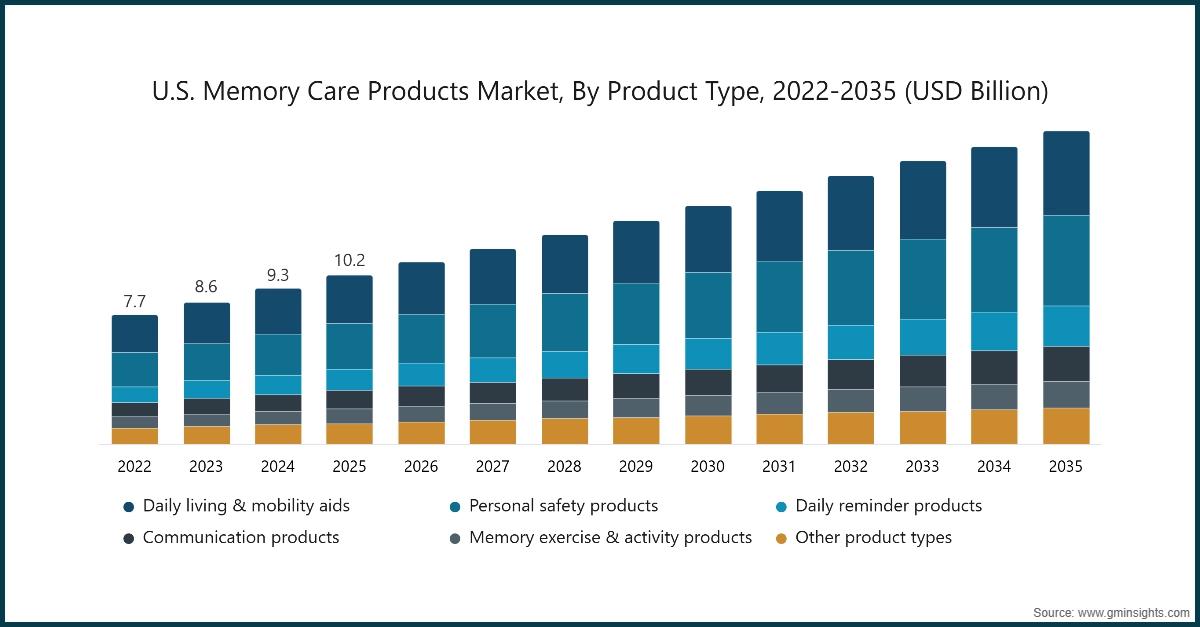
The market has increased from USD 7.8 billion in 2022 and reached USD 9.3 billion in 2024, with the historic growth rate of 9.6%. The market growth was driven by increasing awareness of early cognitive health monitoring, growing demand for home‑based and assisted living memory care solutions, expansion of remote monitoring and telehealth coupled with product innovation focused on caregiver support.
U.S. Memory Care Products Market Key Takeaways
Market Size & Growth
- 2025 Market Size: USD 10.2 Billion
- 2026 Market Size: USD 10.9 Billion
- 2035 Forecast Market Size: USD 18.9 Billion
- CAGR (2026–2035): 6.2%
Regional Dominance
- Largest Market: South Atlantic
- Fastest Growing Country: Mountain States
Key Market Drivers
- Aging population and rising prevalence of dementia/Alzheimer’s disease.
- Advanced infrastructure and high healthcare spending.
- Technological advancements in care products.
- Increasing awareness and supportive government initiatives/programs.
Challenges
- High cost of memory care products.
Opportunity
- Integration of advanced technologies.
- Expansion of personalized and smart memory care solutions.
Key Players
- Market Leader: Medline led with over 6% market share in 2025.
- Leading Players: Top 5 players in this market include Tobii Dynavox, Lifeline, Buddi, Medline, Jabbla, which collectively held a market share of 20% in 2025.
Get Market Insights & Growth Opportunities
Due to the increasing number of elderly people, there is growing demand for memory care products since age continues to be a major factor, which puts geriatric populaion at risk of deterioration of the cognitive functions, with indications such as dementia/Alzheimer’s disease. For instance, according to the statistics published in the Alzheimer's Association 2025 report, around 7.2 million Americans aged over 65 are living with Alzheimer’s dementia in 2025. The increase in the diagnostic rates highlights the growing number of potential individuals who may need long-term support in areas of daily living as well as safety, communication, and cognitive activities.
Additionally, advanced healthcare infrastructure has enabled effective integration of memory care devices into the clinical workflow of healthcare providers, long-term care facilities, and home care settings. This combined with increasing healthcare spending has made basic assistive devices as well as sophisticated technology-enabled alternatives more affordable for both providers and consumers. Healthcare providers associated with various healthcare settings such as hospitals, assisted living facilities, and community rehabilitation facilities, are well positioned financially to implement monitoring systems, safety devices, and adaptive products that improve patient outcomes and operational efficiencies.
Further, as technology continues to evolve, memory care devices and products are moving from being just passive devices that help caregivers assist people with dementia, towards becoming 'smart and connected' solutions that work in conjunction with each other. Innovations such as AI-enabled monitoring systems, sensor technology, and voice recognition capabilities, along with wearable devices, provide more accurate information, enhanced flexible usability, and immediate responses to an individual’s needs. Furthermore, as technology is now more widely available through smart homes and telehealth platforms, many more caregivers and healthcare providers are adopting the new technologies.
Memory care products are specialized devices and tools designed to support individuals with memory impairments or cognitive decline. They enhance daily communication, safety, independence, and engagement, enabling seniors and patients to maintain functional abilities in home or care settings.
The U.S. memory care products market was valued at USD 10.2 billion in 2025. The market is expected to reach from USD 10.9 billion in 2026 to USD 18.9 billion in 2035, growing at a CAGR of 6.2% during the forecast period, according to the latest report published by Global Market Insights Inc.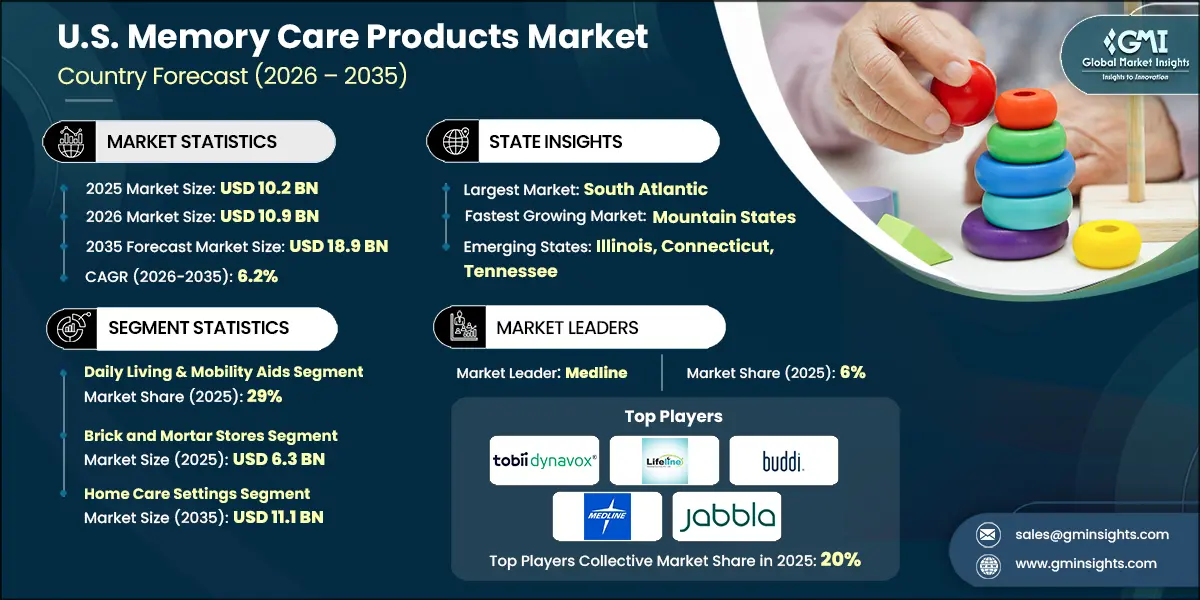
To get key market trends
U.S. Memory Care Products Market Trends
The market is witnessing a shift toward home-based care, along with increasing role of caregivers in purchase decisions, and the rise of connected and smart memory care products. Market players are focusing on the expansion of digital distribution channels, with an aim to offer diversified solutions.
- The preference of patients towards home-care settings for receiving memory care is driving the growth of a variety of products enabling individuals to maintain their independence and safety in their homes as well as receive assistance with daily living tasks. Families are placing greater value on non-institutionalized forms of care, leading to a growing preference for the use of products that provide monitoring, reminders, and support for mobility.
- Additionally, caregivers are becoming key decision‑makers, influencing product design and marketing strategies. The importance of certain features in terms of ease of use, caregiver alerts, interoperability, and reducing stress continues to influence the way products are developed and accepted by consumers.
- Further, advancements in sensor, wearable, and smart home technology have allowed the development of connected, integration-based memory care products, enabling the caregiver to monitor and obtain alerts in real time, improving the likelihood of using a product and upgrading the product.
- Furthermore, the new avenues of e-commerce are providing greater visibility and access to products while reducing their cost through available discounts. Digital channels provide companies with the ability to distribute a product to a wider audience, as well as offer subscription models to interface directly with consumers, benefiting especially those products that are technology-based and in a niche category.
U.S. Memory Care Products Market Analysis
Learn more about the key segments shaping this market
Based on the product type, the U.S. memory care products market is segmented into daily living & mobility aids, personal safety products, daily reminder products, communication products, memory exercise & activity products, and other product types. The daily living & mobility aids segment held leading market share of 29% in 2025 owing to expansion of specialized memory care facilities. The segment is expected to exceed USD 5.1 billion by 2035, growing at a CAGR of 5.5% during the forecast period.
On the other hand, the personal safety products segment is expected to grow with a CAGR of 7%. The growth of this segment is driven by rising adoption of wearable cognitive health devices and integration of memory care products into smart home ecosystems.
- Memory care products that assist with day-to-day living and movement comprise the primary portion of the overall memory care market. Daily living & mobility aids are vital for people with a memory disorder because they help them continue to perform the everyday tasks required for a healthy life (e.g., bathing, walking, dressing, eating). In addition, the use of these types of products has increased dramatically in the home care and long-term care sectors.
- There has been significant progress in the design and manufacture of these products, focusing on ergonomic design, ease of use, and durability instead of using advanced technologies that might make them cost-prohibitive for many.
- The personal safety products segment held a revenue of USD 2.7 billion in 2025. Solutions addressing personal safety regarding cognitive impairment, including fall detection systems, emergency response devices, and location tracking tools, are available to help reduce the potential for an accident or injury before it happens and allow caregivers to intervene quickly.
- The growing need to enhance both caregiver safety and decrease their concern about liability and patient safety has led to increased adoption of these solutions across home, assisted living, and community care environments. Integration of wearable technology and monitoring tools has improved usability and provided real-time alerts to caregivers, thereby making this segment a significant driver of growth for the overall market.
- The daily reminder products segment accounted for significant revenue in 2025 and is anticipated to grow at a CAGR of 6.7% over the forecast period. Daily reminder products help people with memory loss keep their routines and daily tasks in order through reminders. Examples of these products include electronic reminder systems, clocks and timers, and systems that remind users when to take their medications to help decrease dependence on caregivers.
Based on distribution channel, the U.S. memory care products market is segmented into brick and mortar stores, and ecommerce. The brick and mortar stores segment dominated the market in 2025, accounting for USD 6.3 billion and is anticipated to grow at a CAGR of 5.9% during the forecast period.
- Brick-and-mortar stores remain a major distribution channel for memory care products due to the consultative nature of purchases. Caregivers and institutions often prefer in‑person evaluation to assess product usability, comfort, and safety, particularly for mobility aids and personal safety devices.
- Physical stores also enable professional guidance from pharmacists, medical supply specialists, or trained staff, which builds trust among buyers.
- Additionally, long‑term care facilities frequently rely on established offline procurement networks for bulk purchasing. Immediate product availability and after‑sales support continue to reinforce this channel’s importance.
- Further, the eCommerce segment accounted for significant revenue in 2025 and is anticipated to grow at a CAGR of 6.8% over the forecast period. Ecommerce is rapidly reshaping memory care product distribution by improving accessibility, convenience, and product variety. Online platforms allow caregivers to easily compare features, prices, and reviews, simplifying purchasing decisions.
- Moreover, ecommerce is particularly effective for daily reminder products, communication tools, and smart safety devices. Subscription models, direct‑to‑consumer offerings, and home delivery further enhance appeal, especially for home care users.
Learn more about the key segments shaping this market
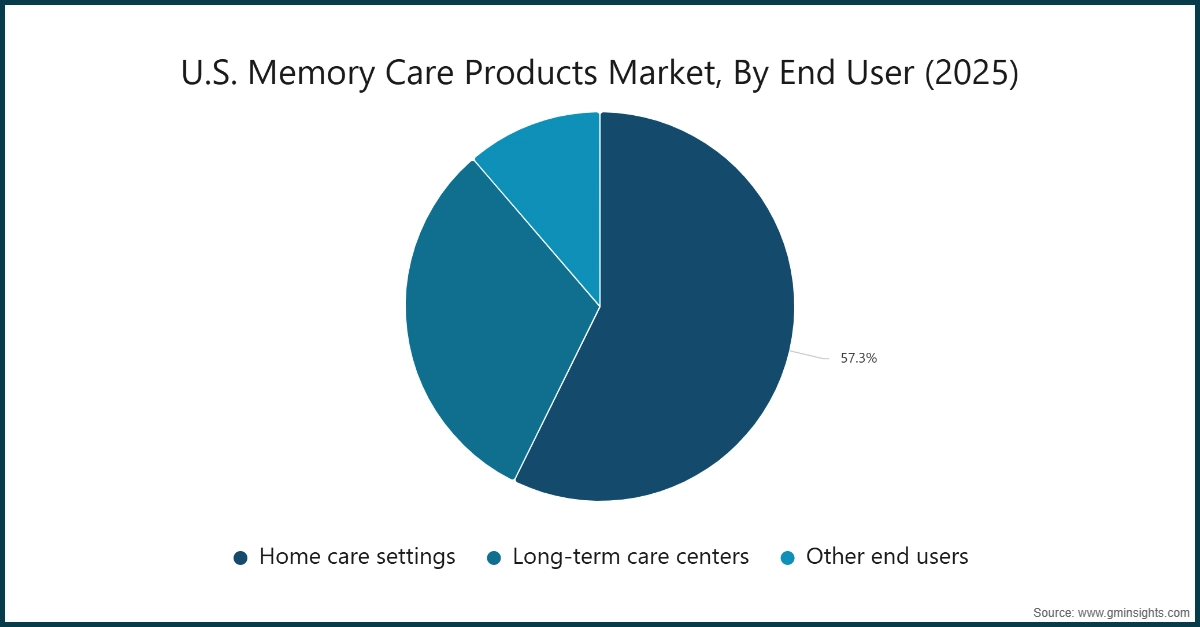
Based on end user, the U.S. memory care products market is classified into home care settings, long-term care centers, and other end users. The home care settings segment dominated the market with a revenue share of 57.3% in 2025 and is expected to reach USD 11.1 billion by 2035.
- Home care settings represent the largest and fastest‑growing end‑user segment, driven by strong preferences for aging-in-place. Families are increasingly relying on memory care products at homecare setting to ensure safety, independence, and daily functioning without institutional support. Demand spans across mobility aids, reminder systems, personal safety devices, and communication products. Caregiver‑friendly features, ease of use, and affordability are some key factors that are strongly influencing the adoption of memory care products in home care settings.
- Additionally, a growing trend of caregivers providing preventative care and support at the initial stages of a person's cognitive decline has resulted in growing demand from this group of customers and continues to drive growth in the market long-term.
- The long-term care centers segment accounted for significant revenue in 2025 and is anticipated to grow at a CAGR of 5.9% over the forecast period. Facilities providing long-term care have a consistent customer base that is primarily concerned with memory care products that are compatible with their existing infrastructure, have a long service life, and are designed to be safe.
- Further, growing focus on preventing resident falls, managing patient wandering, enabling timely communication with residents, family members, and staff, and providing mobility solutions are the key factors leading to lower risk and improved quality of care in these settings.
- Moreover, purchasing decisions are often driven by regulatory compliance, liability management, and operational efficiency rather than personalization. Therefore, while the long-term care segment is experiencing slower growth than the home-care segment, these facilities are purchasing large quantities of monitoring systems, safety systems, and related products at predictable replacement intervals.
Looking for region specific data?
South Atlantic Memory Care Products Market
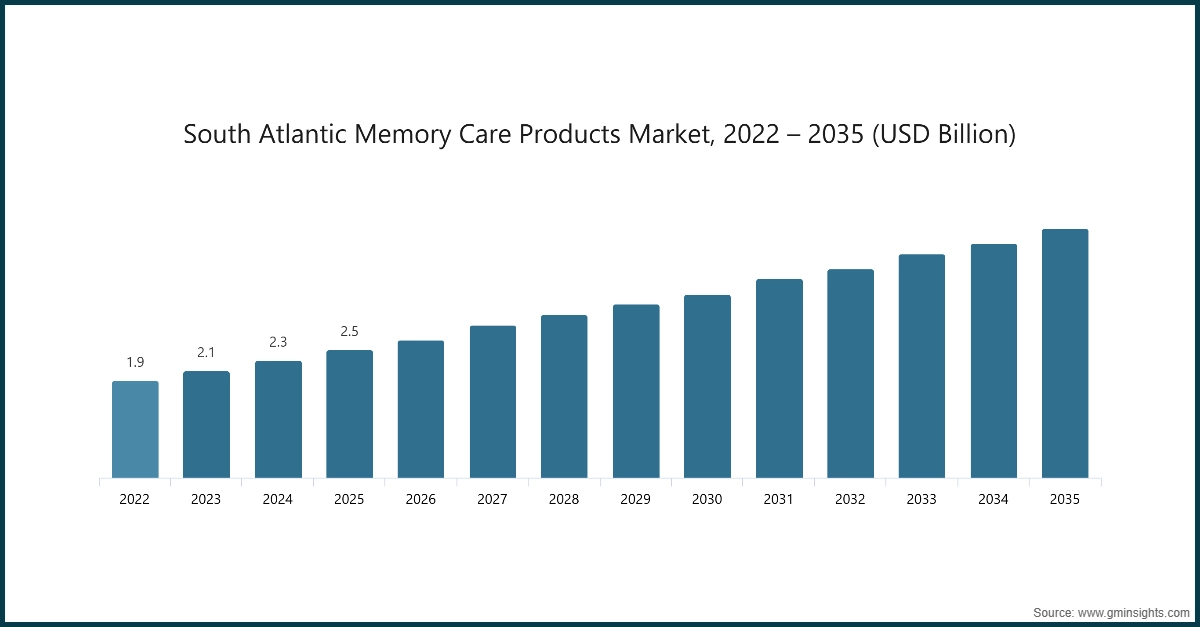
South Atlantic held leading share of 25.1% in the U.S. memory care products market in 2025.
- The South Atlantic region is experiencing strong growth in the memory care products market driven by its rapidly expanding elderly population and higher prevalence of age‑related cognitive conditions. States within this region attract retirees due to favorable climate and cost of living, increasing demand for home‑based memory care solutions.
- Additionally, home care settings dominate product adoption, particularly mobility aids, personal safety products, and reminder systems. The region also shows expanding assisted living and memory care facilities, supporting steady institutional demand.
- Further, caregiver‑led purchasing plays a major role, favoring easy‑to‑use, affordable products. Growing acceptance of wearable safety devices and simplified communication tools further supports market expansion.
Pacific Central Memory Care Products Market
Pacific Central memory care products market accounted for USD 2 billion in 2025 and is anticipated to show lucrative growth over the forecast period.
- The Pacific Central region demonstrated robust market growth supported by high healthcare spending, technological openness, and strong innovation ecosystems. Consumers in this region show high acceptance of technologically advanced memory care products, including smart safety systems, digital reminders, and connected communication tools.
- Additionally, home care adoption in the region is particularly strong as families are investing in solutions that support independence and aging-in-place. The presence of technology‑driven caregivers and service providers accelerates demand for integrated and premium products. Overall, market growth is shaped by early adoption behavior, higher disposable income, and preference for connected, personalized memory care solutions.
Northeast Memory Care Products Market
The Northeast memory care products market accounted for USD 1.4 billion in 2025 and is anticipated to show lucrative growth over the forecast period.
- The Northeast is characterized by a substantially larger percentage of people aged 65 and over, in comparison with other U.S. regions. This age group is more likely to have chronic diseases, cognitive condition, and have limited mobility. Demand is balanced between home care and institutional settings, with strong adoption of safety, mobility, and communication products.
- Hospitals, nursing homes, and community care centers contribute through consistent procurement of standardized memory care aids. Although population growth is slower than other regions, higher healthcare engagement, greater emphasis on quality of care, and structured caregiving environments sustain stable and predictable market expansion.
U.S. Memory Care Products Market Share
The U.S. memory care products industry is moderately fragmented, characterized by the presence of large healthcare suppliers, technologydriven solution providers, and numerous specialized niche players. The major players within the space compete based on their overall product portfolios, strong distribution systems, and their relationships with home health care agencies and long-term care facilities. Within the commercial space, the major suppliers are focused primarily on the important product categories of mobility aids, personal safety devices, and emergency alert systems, and each of these categories has a potential to distinguish themselves, primarily by having a significant presence and a source in areas of expertise.
Additionally, at the same time, specialized and emerging companies are gaining traction by offering targeted solutions such as GPS‑enabled wander management, advanced communication aids, and cognitive support technologies. Competition in this market is primarily based on product advancement, ease of use, and product features that enhance the caregiver experience, rather than price alone. Accordingly, product differentiation amongst all firms tends toward increasing their ease of use, ability to connect with existing digital platforms, and ability to adapt to the various stages of cognitive decline experienced by those they serve.
Further, competition is also intensifying across distribution channels, with established brands expanding e-commerce presence. Many of these companies form strategic partnerships with care facilities, healthcare providers, and community organizations to access markets that have traditionally been difficult for them to penetrate successfully. The competitive landscape as a whole is moving toward integrated care ecosystems that leverage technology to facilitate connections between facilities and their patients, while at the same time, there continues to be a strong demand for traditional high-volume memory care products.
U.S. Memory Care Products Market Companies
Few of the prominent players operating in the U.S. memory care products industry include:
- AbleNet
- Amazon
- Buddi
- EasierLiving
- Find Memory Care
- Jabbla
- Lifeline
- Lingraphica
- Medical Guardian
- Medline
- MindCare
- PRC-Saltillo
- Tobii Dynavox
Emphasizes wearable GPS and location‑based safety solutions, partnering with care providers and public agencies to strengthen adoption of wander management and emergency response technologies.
Leverages brand trust in personal emergency response systems by enhancing fall detection accuracy, integrating digital monitoring features, and expanding services across home‑based aging populations.
Drives growth through advanced assistive communication technologies, focusing on eye‑tracking innovation, AI‑enabled interaction, and deeper penetration into clinical, home care, and rehabilitation settings.
U.S. Memory Care Products Market Report Attributes
| Key Takeaway | Details |
|---|---|
| Market Size & Growth | |
| Base Year | 2025 |
| Market Size in 2025 | USD 10.2 Billion |
| Market Size in 2026 | USD 10.9 Billion |
| Forecast Period 2026-2035 CAGR | 6.2% |
| Market Size in 2035 | USD 18.9 Billion |
| Key Market Trends | |
| Drivers | Impact |
| Aging population and rising prevalence of dementia/Alzheimer’s disease | Currently drives sustained demand for memory care products, increasing adoption across home care and long-term care settings |
| Advanced infrastructure and high healthcare spending | Enables faster adoption of innovative memory care products through better access, reimbursement pathways, and institutional purchasing power. |
| Technological advancements in care products | Improves product effectiveness and usability, accelerating replacement cycles and supporting wider acceptance among caregivers and patients. |
| Increasing awareness and supportive government initiatives/programs | Enhances early diagnosis and caregiving readiness, indirectly boosting demand for memory aids, safety devices, and cognitive support products. |
| Pitfalls & Challenges | Impact |
| High cost of memory care products | Limits adoption among middle and low income households, slowing penetration of advanced devices despite recognized clinical and caregiving benefits. |
| Opportunities: | Impact |
| Integration of advanced technologies | Will enable real‑time monitoring, predictive insights, and automation, significantly improving outcomes while expanding product value beyond basic assistive functionality. |
| Expansion of personalized and smart memory care solutions | Expected to drive premiumization, improve patient engagement, and support aging‑in‑place preferences through adaptive, data‑driven, and user‑specific product ecosystems. |
| Market Leaders (2025) | |
| Market Leader |
Market Share 6% |
| Top Players |
collective 5 companies share is 20% |
| Competitive Edge |
|
| Regional Insights | |
| Largest Market | South Atlantic |
| Fastest growing market | Mountain States |
| Emerging markets | Illinois, Connecticut, Tennessee |
| Future outlook |
|
What are the growth opportunities in this market?
U.S. Memory Care Products Industry News:
- In December 2025, Medline announced that it had entered into a new prime vendor agreement with Tender Loving Care Management, a healthcare consulting organization supporting skilled nursing, memory care, and independent living facilities. Its services span 33 facilities across Indiana, Ohio, and Florida. Through this agreement, TLC will gain access to Medline’s extensive portfolio of medical products and solutions designed to help improve clinical outcomes and build operational efficiencies.
- In May 2023, Tobii Dynavox announced the launch of the TD I-Series, a fast, light, and durable communication aid that is controlled with the eyes. The device is built for individuals with conditions such as ALS, cerebral palsy, or Rett syndrome. This development enabled the company to improve its product range as well as its industry presence in the country.
The U.S. memory care products market research report includes an in-depth coverage of the industry with estimates and forecast in terms of revenue in USD Million from 2022 – 2035 for the following segments:
Market, By Product Type
- Daily living & mobility aids
- Bathroom safety
- Dining aids
- Walking aids
- Other mobility products
- Personal safety products
- Wanderer control
- Fall detection and prevention
- Daily reminder products
- Communication products
- Voice-optimized communication systems
- Visual & multi-modal communication tools
- Memory exercise & activity products
- Other product types
Market, By Distribution Channel
- Brick and mortar stores
- Ecommerce
Market, By End User
- Home care settings
- Long-term care centers
- Other end users
The above information is provided for the following zones and states:
- East North Central
- Illinois
- Indiana
- Michigan
- Ohio
- Wisconsin
- West South Central
- Arkansas
- Louisiana
- Oklahoma
- Texas
- South Atlantic
- Delaware
- Florida
- Georgia
- Maryland
- North Carolina
- South Carolina
- Virginia
- West Virginia
- Washington, D.C.
- Northeast
- Connecticut
- Maine
- Massachusetts
- New Hampshire
- Rhode Island
- Vermont
- New Jersey
- New York
- Pennsylvania
- East South Central
- Alabama
- Kentucky
- Mississippi
- Tennessee
- West North Centra
- Iowa
- Kansas
- Minnesota
- Missouri
- Nebraska
- North Dakota
- South Dakota
- Pacific Central
- Alaska
- California
- Hawaii
- Oregon
- Washington
- Mountain States
- Arizona
- Colorado
- Utah
- Nevada
- New Mexico
- Idaho
- Montana
- Wyoming
Frequently Asked Question(FAQ) :
What is the market size of the U.S. memory care products market in 2025?
The market was valued at USD 10.2 billion in 2025, driven by rising prevalence of dementia and Alzheimer’s disease, growing aging population, and supportive reimbursement policies across the market.
What is the current U.S. memory care products market size in 2026?
The market is projected to reach USD 10.9 billion in 2026, supported by expanding home-based care adoption and increasing demand for technology-enabled memory support solutions in the market.
What is the projected value of the U.S. memory care products market by 2035?
The market is expected to reach USD 18.9 billion by 2035, growing at a CAGR of 6.2% during 2026–2035, driven by integration of AI-enabled monitoring systems, wearable safety devices, and smart communication tools across the market.
How much revenue did the daily living & mobility aids segment generate in the U.S. memory care products industry in 2025?
The daily living & mobility aids segment held a leading 29% share in 2025 in the market and is expected to exceed USD 5.1 billion by 2035, growing at a CAGR of 5.5%, supported by expansion of specialized memory care facilities and strong demand across home care settings within the market.
What was the valuation of the personal safety products segment in the U.S. memory care products market in 2025?
The personal safety products segment generated USD 2.7 billion in 2025 in the market, driven by increasing adoption of wearable cognitive health devices, fall detection systems, and GPS-enabled safety solutions.
What was the revenue of the brick and mortar stores segment in the U.S. memory care products industry in 2025?
The brick and mortar stores segment accounted for USD 6.3 billion in 2025 in the market and is anticipated to grow at a CAGR of 5.9%, supported by consultative purchasing behavior, in-person product evaluation, and established institutional procurement networks.
Which region leads the U.S. memory care products industry?
The South Atlantic region held a leading 25.1% share of the market in 2025. Growth in the market within this region is driven by its expanding elderly population, higher prevalence of age-related cognitive conditions, and strong demand for home-based memory care solutions.
Who are the key players in the U.S. memory care products industry?
Key players operating in the market include Tobii Dynavox, Lifeline, Buddi, Medline, and Jabbla, focusing on wearable safety devices, advanced communication aids, and integrated memory care ecosystems within the market.
U.S. Memory Care Products Market Scope
Related Reports