Summary
Table of Content

U.S. Equestrian Apparel Market
Get a free sample of this report
Form submitted successfully!
Error submitting form. Please try again.
Thank you!
Your inquiry has been received. Our team will reach out to you with the required details via email. To ensure that you don't miss their response, kindly remember to check your spam folder as well!
Request Sectional Data
Thank you!
Your inquiry has been received. Our team will reach out to you with the required details via email. To ensure that you don't miss their response, kindly remember to check your spam folder as well!
Form submitted successfully!
Error submitting form. Please try again.
U.S. Equestrian Apparel Market Size
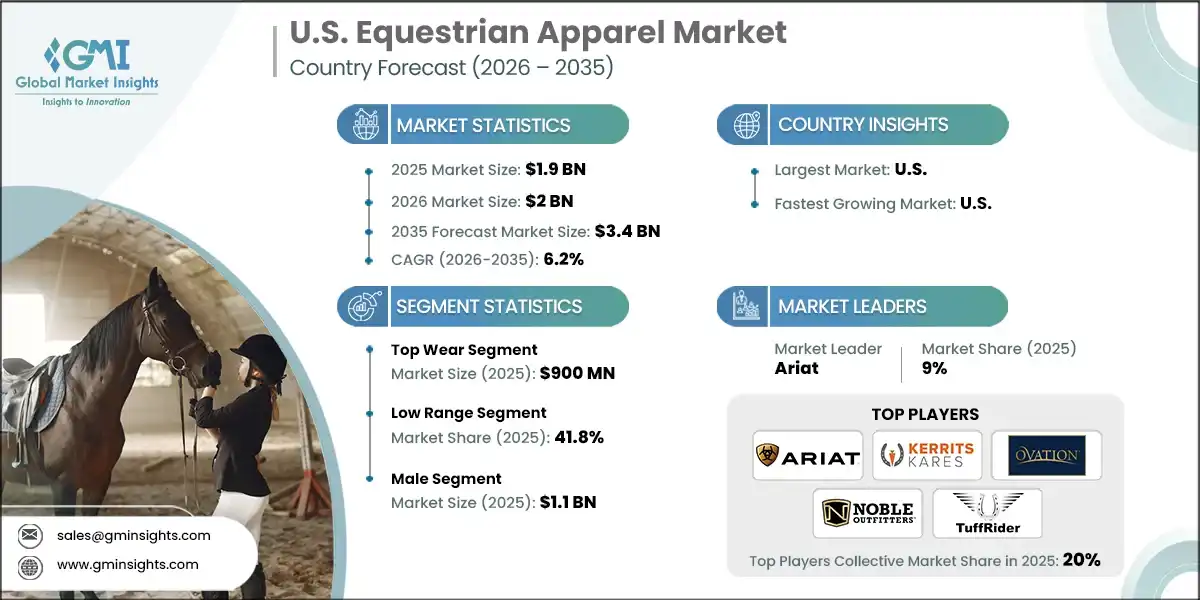
The U.S. equestrian apparel market was estimated at USD 1.9 billion in 2025. The market is expected to grow from USD 2 billion in 2026 to USD 3.4 billion in 2035, at a CAGR of 6.2%, according to latest report published by Global Market Insights Inc.
U.S. Equestrian Apparel Market Key Takeaways
Market Size & Growth
- 2025 Market Size: USD 1.9 Billion
- 2026 Market Size: USD 2 Billion
- 2035 Forecast Market Size: USD 3.4 Billion
- CAGR (2026–2035): 6.2%
Regional Dominance
- Largest Market: U.S.
- Fastest Growing Region: U.S.
Key Market Drivers
- Rising participation equestrian sports.
- Innovation in performance fabrics.
- Increase in disposable income.
Challenges
- High cost of production and materials..
- Seasonal nature of the equestrian sport.
Opportunity
- Expansion through sustainable and eco-friendly products.
- Leveraging digital platforms and customization.
Key Players
- Market Leader: Ariat led with over 9% market share in 2025.
- Leading Players: Top 5 players in this market include Ariat, Kerrits, Ovation Riding, Noble Outfitter, TuffRider, which collectively held a market share of 20% in 2025.
Get Market Insights & Growth Opportunities
According to the U.S. Equestrian Federation, there has been a major increase in the number of individuals involved with horses in recent years. Particularly, this increase appears to be mainly due to more women participating in equestrian sports and those who are younger than 30 years old showing a larger interest in competitive riding such as dressage, show jumping, etc. and recreational riding. As interest has increased the need for fashionable, fitting clothing for equestrians, consequently, manufacturers are now manufacturing additional products such as safety apparel, competition attire and everyday clothing for use during equestrian events.
Many factors are contributing to the expansion of this marketplace, however one of the largest contributors has been the widespread use of cutting-edge technologies used to produce technical performance fabrics utilized in the creation of equestrian apparel. The use of these advanced technologies allows the creation of technical performance fabrics with unique characteristics that provide enhanced levels of comfort, breathability and effective heat dissipation and moisture removal from the rider. This ultimately leads to enhanced comfort and performance experience for riders while participating in their equestrian activities. As a result, manufacturers are now focusing their efforts on producing equestrian apparel that meets the functional requirements of equestrians as well as appealing to the tastes of today's consumers.
Apart from performance, sustainability has become a key motivator of consumer choice in the equestrian apparel market. For consumers, environmental awareness is increasingly translating from rising demand for products made from sustainable and eco-friendly materials. Accordingly, the rise in conscious consumer behavior has catalyzed innovation through manufacturers seeking to embed environmentally responsible manufacturing practices.
To get key market trends
U.S. Equestrian Apparel Market Trends
The U.S. equestrian apparel industry is experiencing dynamic trends fueled by innovative product launches and technological advancements from leading brands. Companies are introducing cutting-edge apparel lines featuring advanced performance fabrics, ergonomic designs, and smart features such as moisture-wicking technology and temperature regulation.
- The U.S. equestrian apparel industry is rapidly changing, influenced by the evolution of customer preference and technology. Probably the most flagrant feature is the increasing trend toward sustainability. With increased awareness among customers about ecological imbalance, demand for eco-friendly equestrian clothing has also increased. These clothes are made from green materials such as organic cotton, recycled fabrics, and biodegradable fibers. Consequently, brands introduce collections with a controlled supply chain, ensuring compliance with environmental standards of production. This attention to sustainability appeals to the ecologically sensitive consumer and plays into the broader industry movements that allow differentiation within a highly competitive market.
- Another notable trend is the integration of technology into equestrian apparel. Innovations such as smart fabrics that regulate temperature, provide UV protection, or incorporate wearable technology are becoming more prevalent. These advanced materials enhance both comfort and performance, making them highly desirable for riders engaged in competitive and recreational activities. Wearable technology, such as sensors embedded in clothing, is also gaining traction, offering riders insights into their posture, movement, and overall performance. This technological evolution is reshaping the market and catering to the needs of modern equestrians who value functionality and innovation.
- Customization has become an important trend in the equestrian apparel industry. More riders want garments to showcase their personal style, and they want their garments to have functional aspects that address their individual needs. More equestrian apparel brands are providing custom options to accommodate rider preference, such as the option to choose from different colors, add a monogram, or be fitted. This has created stronger connections between equestrian apparel brands and riders based on each rider’s preferences, creating greater brand loyalty.
- The equestrian apparel industry has also experienced a transition towards athleisure. Athleisure-inspired equestrian apparel is no longer confined to conventional equestrian wear but is melding characteristics of casual or athletic apparel into the mainstream. Riders are looking for more ways to wear their equestrian apparel and want clothing that can be worn in many situations, not just at the stable. The combination of fashion and function makes equestrian apparel more attractive to a broader audience beyond the core equestrian community.
- Equestrian apparel brands are increasingly focusing on diversity and inclusiveness in their designs. Many companies have started offering expanded size options, as well as designs tailored for a broader audience. This change represents an acknowledgement of the need for equestrian sports to be available to more riders, regardless of their body type or background.
- A new trend in the equestrian apparel market is the focus on durability and performance. Riders want to be able to take part in all aspects of equestrian life without compromising their comfort or fashion.
U.S. Equestrian Apparel Market Analysis

Learn more about the key segments shaping this market
Based on product type, the market is divided into top wear, bottom wear, and others (socks, etc.). In 2025, top wear held the major market share, generating a revenue of USD 900 million.
- Top wear maintains a dominant position in the U.S. equestrian apparel industry, primarily due to its essential role in combining functionality and style for riders. Riding tops, including jackets, shirts, and vests, are indispensable for ensuring comfort, protection, and freedom of movement during various equestrian activities. These garments are specifically designed to meet the unique needs of riders, offering features such as moisture-wicking fabrics, UV protection, and stretchable materials. These technical attributes not only enhance the overall riding experience but also ensure that riders remain comfortable and agile in diverse conditions.
- The versatility of top wear further solidifies its leading position in the market. These garments cater to a wide range of riding disciplines, from dressage and show jumping to casual trail riding. Additionally, they are suitable for varying weather conditions, providing warmth during colder months and breathability in warmer climates. This adaptability makes top wear a preferred choice for equestrian enthusiasts, regardless of their specific riding preferences or environmental challenges.
- One of the emerging trends shaping the top-wear segment is the increasing demand for sustainable and eco-friendly materials. Consumers are becoming more conscious of their environmental impact and are seeking apparel made from organic or recycled fabrics. Many manufacturers are responding to this shift by adopting sustainable practices, such as using biodegradable materials or reducing water consumption during production. This focus on sustainability not only aligns with consumer values but also enhances brand loyalty and market competitiveness.
- Technological advancements in fabric innovation are also influencing the top wear market. Smart textiles, which integrate technology into clothing, are gaining popularity among riders. For example, some riding tops now feature temperature-regulating fabrics or built-in sensors that monitor body metrics, providing riders with real-time feedback to optimize their performance. These innovations are particularly appealing to professional riders and competitive equestrians who prioritize precision and efficiency in their activities.
- Fashion trends are another significant factor driving the growth of the top wear segment. Riders are increasingly seeking apparel that combines technical performance with modern aesthetics. As a result, manufacturers are focusing on creating designs that are not only functional but also stylish, incorporating contemporary patterns, colors, and cuts. This trend has expanded the appeal of equestrian apparel beyond the riding community, attracting a broader audience interested in athleisure and outdoor fashion.
Learn more about the key segments shaping this market
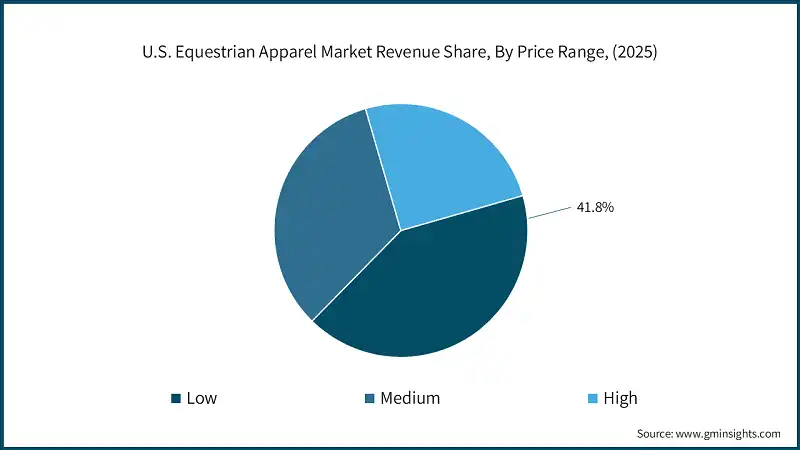
Based on price range, the market is segmented into low, medium, high. The low range segment held the largest share, accounting for 41.8% of the U.S. equestrian apparel market in 2025.
- The low-priced segment in the market primarily targets entry-level riders and casual enthusiasts who prioritize affordability over premium features. Products in this category include basic riding shirts, breeches, and helmets made from standard materials, offering functional performance without advanced technologies.
- This segment accounts for the largest share of the market, driven by high accessibility and widespread participation in recreational riding. Brands competing in this range focus on cost efficiency, simplified designs, and mass production to maintain competitive pricing. While margins are lower, the volume of sales ensures steady revenue, making this segment a critical foundation for overall market growth.
Based on the consumer group, the market is segmented into male, female and children. In 2025, male segment held a major market share, generating a revenue of USD 1.1 billion.
- Men's dominance as a leading consumer group in the equestrian apparel market is primarily driven by their active participation in traditional equestrian sports. These sports demand specialized and tailored apparel, which has historically been designed to cater more robustly to male riders compared to women’s or unisex lines. Male equestrians often require specific types of gear, such as tailored breeches, competition jackets, and protective equipment, which are essential for both performance and safety. This demand for specialized products has positioned men as a significant influence in the market.
- One of the key trends shaping this dominance is the preference for high-quality, durable, and performance-oriented apparel. Male riders tend to prioritize functionality and longevity in their gear, which has encouraged manufacturers to focus on premium materials and advanced technologies.
- For instance, innovations in fabric technology, such as moisture-wicking and stretchable materials, have gained traction among male consumers, as these features enhance comfort and performance during rigorous activities.
U.S. Equestrian Apparel Market Share
Ariat International, Inc. is leading with 9% market share. Ariat, Kerrits, Ovation Riding, Noble Outfitter, and TuffRider collectively hold around 20% in 2025, indicating moderately fragmented market concentration. These prominent players are proactively involved in strategic endeavors, such as mergers & acquisitions, facility expansions & collaborations, to expand their product portfolios, extend their reach to a broad customer base, and strengthen their market position.
Ariat is recognized for its advanced performance technology and durability in equestrian apparel. Its competitive edge lies in combining athletic footwear innovation with traditional riding gear, offering superior comfort, shock absorption, and moisture-wicking fabrics. Ariat appeals strongly to professional riders and those seeking premium, high-performance products.
Kerrits stands out for its focus on lightweight, breathable fabrics and ergonomic designs tailored for comfort during long rides. Its competitive advantage is affordability combined with functional performance, making it popular among everyday riders.
U.S. Equestrian Apparel Market Companies
Major players operating in the U.S. equestrian apparel industry are:
- Ariat International, Inc.
- Asmar Equestrian
- Devon-Aire
- Equine Couture
- Essex Classics
- FITS Riding
- Goode Rider
- Irideon (Toklat)
- Kerrits
- Noble Outfitters
- Ovation Riding
- RJ Classics
- Romfh Equestrian Apparel
- Tailored Sportsman
- TuffRider
Ovation Riding competitive advantage lies in offering affordable, yet high-quality equestrian apparel and footwear designed for comfort and practicality. The brand focuses on ergonomic designs, breathable fabrics, and durable construction, making it a popular choice among riders seeking value without sacrificing performance.
Noble Outfitter differentiates itself through practical, rugged designs and affordability without compromising quality. Its strength lies in creating versatile apparel and accessories that cater to both riding and barn work. The brand appeals to riders seeking durability, comfort, and value, making it a strong choice for everyday equestrian need.
TuffRider’s competitive edge is affordability and accessibility. It offers a wide range of riding apparel and gear at budget-friendly prices, making it ideal for beginners and casual riders. While not positioned as a luxury brand, TuffRider focuses on functional designs and reliable quality, ensuring strong penetration in entry-level segments.
U.S. Equestrian Apparel Market Report Attributes
| Key Takeaway | Details |
|---|---|
| Market Size & Growth | |
| Base Year | 2025 |
| Market Size in 2025 | USD 1.9 Billion |
| Market Size in 2026 | USD 2 Billion |
| Forecast Period 2026 - 2035 CAGR | 6.2% |
| Market Size in 2035 | USD 3.4 Billion |
| Key Market Trends | |
| Drivers | Impact |
| Rising participation equestrian sports | Increased involvement in riding and competitive events is driving demand for specialized apparel, creating growth opportunities across all price segments. |
| Innovation in performance fabrics | Advancements in breathable, moisture-wicking, and durable materials are enhancing rider comfort and safety, fueling premium product adoption. |
| Increase in disposable income | Higher spending power among consumers supports the purchase of mid-range and luxury equestrian apparel, boosting overall market value. |
| Pitfalls & Challenges | Impact |
| High cost of production and materials. | Premium fabrics and tailored designs raise manufacturing costs, which can limit affordability and pose challenges for market expansion. |
| Seasonal nature of the equestrian sport | Demand fluctuates with riding seasons and event schedules, leading to inventory and revenue management challenges for apparel brands. |
| Opportunities: | Impact |
| Expansion through sustainable and eco-friendly products | Growing consumer awareness about environmental impact creates an opportunity for brands to introduce apparel made from organic, recycled, or biodegradable materials |
| Leveraging digital platforms and customization | The rise of e-commerce and digital engagement offers a chance to provide personalized shopping experiences, including custom-fit apparel and virtual try-on tools. |
| Market Leaders (2025) | |
| Market Leaders |
Market share of 9% |
| Top Players |
Collective market share in 2024 is 20% |
| Competitive Edge |
|
| Regional Insights | |
| Largest Market | U.S. |
| Fastest growing market | U.S. |
| Future outlook |
|
What are the growth opportunities in this market?
U.S. Equestrian Apparel Industry News
- In April 2025, Ariat renewed its multi-year partnership with US Equestrian as the official apparel and performance footwear sponsor for U.S. teams.
- In January 2025, Ariat announced a $63.7M investment to expand operations in Fort Worth, Texas.
- In August 2025, Goode Rider, introduced Fall 2025 collection featuring equestrian jeans with cell phone pockets and bi-stretch denim for versatility.
The U.S. equestrian apparel market research report includes in-depth coverage of the industry with estimates & forecasts in terms of revenue (USD Billion) and volume (Thousand Units) from 2022 to 2035, for the following segments:
Market, By Product Type
- Top wear
- Show shirts
- Polo shirts & tops
- Show jackets
- Other (outwear, etc.)
- Bottom wear
- Breeches/riding pants
- Tights
- Others (thermal, etc.)
- Others (socks, etc.)
Market, By Apparel Type
- Sustainable
- Unsustainable
Market, By Category
- Professional rider
- Recreational rider
Market, By Price Range
- Low
- Medium
- High
Market, By Consumer Group
- Male
- Female
- Children
Market, By Distribution Channel
- Online
- E-commerce websites
- Company websites
- Offline
- Specialty stores
- Hypermarkets & supermarkets
- Others (departmental stores, etc.)
Frequently Asked Question(FAQ) :
What is the market size of the U.S. equestrian apparel industry in 2025?
The market size was USD 1.9 billion in 2025. Growth is supported by rising participation in equestrian sports and increasing demand for functional, stylish riding apparel.
What is the current U.S. equestrian apparel market size in 2026?
The market size is projected to reach USD 2 billion in 2026. This growth is driven by innovation in performance fabrics and greater adoption of technical sportswear.
What is the projected value of the U.S. equestrian apparel industry by 2035?
The industry is expected to reach USD 3.4 billion by 2035. Long-term growth is fueled by sustainability trends, advanced fabric technologies, and rising recreational riding participation.
How much revenue did the top-wear segment generate in 2025?
Top wear generated USD 900 million in 2025. Its dominance comes from the essential role of performance shirts, jackets, and tops that combine comfort, safety, and style.
What was the valuation of the low-price range segment in 2025?
The low-price range accounted for 41.8% market share in 2025. Growth is driven by affordability and high participation among entry-level and casual riders seeking cost-effective apparel.
What is the growth outlook for the U.S. equestrian apparel market from 2026 to 2035?
The market is projected to grow at a CAGR of 6.2% through 2035. Key drivers include rising disposable income, social media influence, and increasing adoption of eco-friendly materials.
Which region leads the equestrian apparel market?
The U.S. leads the equestrian apparel market with USD 1.9 billion in 2025. This leadership is driven by strong sports participation, innovation in performance fabrics, and premium customer spending.
What are the upcoming trends in the U.S. equestrian apparel industry?
Key trends include sustainable materials, smart fabrics, wearable technology integration, and athleisure-inspired designs. Customization and expanded size inclusivity are also shaping the evolving consumer demand.
Who are the key players in the U.S. equestrian apparel market?
Key players include Ariat International, Kerrits, Ovation Riding, Noble Outfitters, TuffRider, Asmar Equestrian, FITS Riding, Essex Classics, RJ Classics, and Goode Rider. These companies lead through performance-driven innovations, sustainability initiatives, and strong brand reputation.
U.S. Equestrian Apparel Market Scope
Related Reports