Summary
Table of Content

US Cranial Implant Market
Get a free sample of this report
Form submitted successfully!
Error submitting form. Please try again.
Thank you!
Your inquiry has been received. Our team will reach out to you with the required details via email. To ensure that you don't miss their response, kindly remember to check your spam folder as well!
Request Sectional Data
Thank you!
Your inquiry has been received. Our team will reach out to you with the required details via email. To ensure that you don't miss their response, kindly remember to check your spam folder as well!
Form submitted successfully!
Error submitting form. Please try again.
U.S. Cranial Implant Market Size
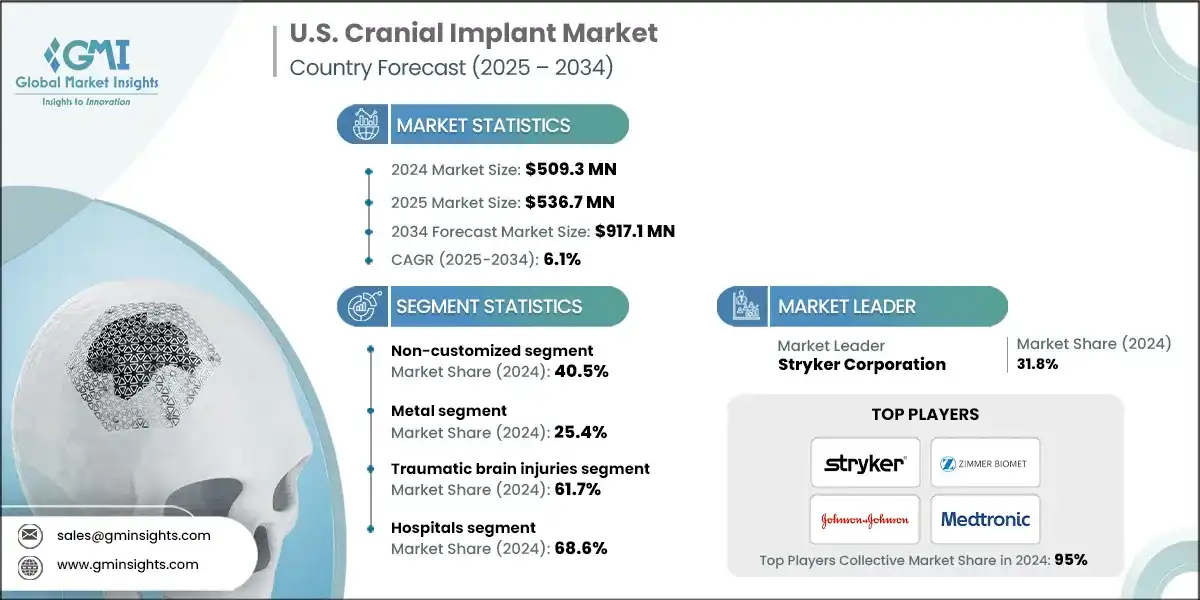
The U.S. cranial implant market was valued at USD 509.3 million in 2024. The market is expected to grow from USD 536.7 million in 2025 to USD 917.1 million in 2034, at a CAGR of 6.1% during the forecast period, according to the latest report published by Global Market Insights Inc. The U.S. cranial implant market is growing, driven by the increasing cases of traumatic brain injuries (TBI). A cranial implant is a type of medical device which is used to repair or replace a section of the skull due to trauma, congenital defects, tumors, or neurosurgical procedures.
US Cranial Implant Market Key Takeaways
Market Size & Growth
- 2024 Market Size: USD 509.3 Million
- 2025 Market Size: USD 536.7 million
- 2034 Forecast Market Size: USD 917.1 million
- CAGR (2025–2034): 6.1%
Key Market Drivers
- Increasing cases of traumatic brain injuries (TBI).
- Growing prevalence of neurological disorders and skull deformities.
- Advancements in 3D printing and custom implant technologies.
- Increasing adoption of biocompatible and smart materials.
Challenges
- High cost of cranial implants and surgical procedures.
- Stringent regulatory approvals and compliance requirements.
Opportunity
- Expansion of personalized cranial reconstruction.
Key Players
- Leading Players: Top 5 players in this market include Stryker Corporation, Zimmer Biomet Holdings, Inc, Johnson & Johnson, Medtronic plc, which collectively held a market share of 95% in 2024.
Get Market Insights & Growth Opportunities
This market segment plays a pivotal role in advancing neurosurgical and craniofacial reconstruction by offering innovative implant solutions tailored to individual patient needs. Leading companies in the cranial implant market, including Stryker Corporation, Zimmer Biomet Holdings, Inc., Johnson & Johnson, and Medtronic, are actively shaping the future of the field through strategic innovation and global expansion. These players maintain their competitive edge by investing in next-generation materials, 3D printing technologies, and digital surgical planning tools, while also pursuing strategic partnerships and acquisitions to broaden their product portfolios and geographic reach.
The U.S. represents the largest and most technologically advanced market for cranial implants, underpinned by a robust regulatory framework, widespread surgical infrastructure, and a strong emphasis on patient-specific solutions. The market is driven by the high incidence of traumatic brain injuries, cranial deformities, and post-surgical reconstruction needs.
A cranial implant is a specialized medical device used in cranioplasty, a surgical procedure aimed at repairing or reconstructing defects or deformities in the skull. These implants serve multiple purposes, they protect the brain from external injury or infection in areas where the skull is missing or damaged, restore the natural shape and appearance of the head, and in some cases, contribute to improved neurological function. Cranial implants can be either standard, pre-manufactured devices or patient-specific implants that are custom-designed using advanced 3D imaging and additive manufacturing techniques to precisely match the individual’s skull anatomy.
To get key market trends
U.S. Cranial Implant Market Trends
- The U.S. cranial implant industry is experiencing robust growth, supported by a convergence of clinical demand, technological innovation, and regulatory advancement. Cranial implants are increasingly used in neurosurgical procedures for trauma, congenital anomalies, tumor resection, and reconstructive surgeries. The country’s extensive healthcare infrastructure facilitates high neurosurgical volumes and supports widespread access to advanced imaging, surgical planning, and implant customization.
- The market benefits from broad adoption of biocompatible materials such as titanium, PEEK, and PEKK, which offer durability, imaging compatibility, and reduced infection risk. The integration of 3D printing and robotic-assisted surgery enables the production and precise placement of patient-specific implants, improving surgical outcomes and reducing operative time.
- Technological innovations such as AI-driven surgical planning, sensor-enabled implants, and digital surgical platforms are reshaping the treatment landscape. These tools enhance preoperative visualization, enable real-time intraoperative guidance, and support post-operative monitoring ushering in a new era of personalized cranial reconstruction.
- The number of Americans ages 65 and older is projected to increase from 58 million in 2022 to 82 million by 2050, significantly increase the demand for cranial implants, particularly for fall-related TBIs. This demographic shift is anticipated to drive both the volume and complexity of neurosurgical interventions.
- Regulatory support from the FDA, including pathways such as 510(k), PMA, IDE, and the Pre-Submission Program, enabling faster development and approval of novel implant technologies. These frameworks are especially critical for custom-designed or high-risk implants used in pediatric and geriatric populations.
- Combined with strong payer support, active collaboration among device manufacturers, research institutions, and clinical networks, and a growing emphasis on outcome-based care, the U.S. continues to lead in cranial implant innovation, adoption, and commercialization.
U.S. Cranial Implant Market Analysis
Learn more about the key segments shaping this market
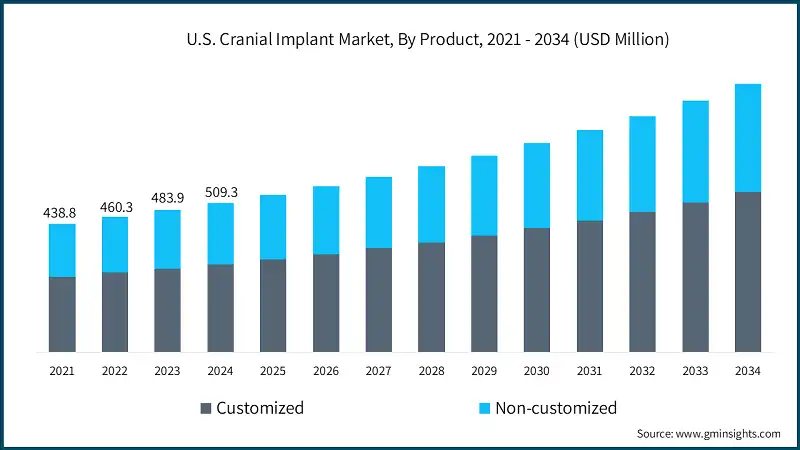
In 2021, the U.S. cranial implant industry was valued at USD 438.4 million. The following year, it saw a slight rise to USD 460.3 million, and by 2023 the market further climbed to USD 483.9 million.
Based on product, the cranial implant market is segmented into customized and non-customized. The non-customized segment held a significant market share of 40.5% in 2024.
- In the U.S., non-customized cranial implants continue to play a vital role in neurosurgical procedures, particularly in emergency care and high-volume trauma settings. These implants are typically available in standardized shapes and sizes, allowing for rapid surgical deployment without the need for preoperative customization.
- Unlike patient-specific implants, non-customized solutions do not rely on imaging-based design or advanced manufacturing, making them ideal for urgent interventions where time and cost-efficiency are critical. Their off-the-shelf availability ensures that neurosurgeons can act swiftly, especially in resource-constrained environments or during intraoperative decision-making.
- Materials such as titanium meshes and preformed PEEK implants are commonly used in these applications due to their mechanical reliability, biocompatibility, and ease of intraoperative modification. Surgeons can adapt these implants in real time to fit the patient’s cranial defect, ensuring functional and aesthetic restoration.
- Overall, the speed, affordability, and versatility of non-customized cranial implants make them indispensable in trauma care, emergency neurosurgery, and settings where personalized solutions may not be feasible.
Based on material, the cranial implant market is segmented into metal, polymer, and ceramic. The metal segment held a significant market share of 25.4% in 2024.
- In the U.S., metal cranial implants particularly those made from titanium and its alloys are widely utilized due to their superior mechanical strength, durability, and long-term reliability. These implants are especially favored in trauma cases where robust structural support is essential to protect the brain and maintain cranial integrity.
- Titanium’s high biocompatibility and corrosion resistance make it ideal for long-term implantation, especially in environments exposed to cerebrospinal fluid. Its ability to form a stable oxide layer helps prevent degradation, ensuring consistent performance over time.
- Recent advancements in additive manufacturing have enabled companies like KLS Martin Group, which operates in the U.S. market, to develop patient-specific 3D-printed titanium implants. These implants offer precise anatomical fit, improved load distribution, and porous structures that promote tissue integration and healing.
- Such innovations are accelerating the adoption of metal implants in complex cranial reconstructions, particularly in oncology, trauma, and congenital defect cases. The combination of material strength, customization capabilities, and biocompatibility positions titanium-based implants as a key growth driver in the U.S. cranial implant market.
Based on the application, the U.S. cranial implant market is segmented into traumatic brain injuries, tumor resection cases, neurosurgical reconstructive procedures, and other applications. The traumatic brain injuries segment held a significant market share of 61.7% in 2024.
- Cranial implants are essential in neurosurgical procedures following brain tumor resection, especially when portions of the skull must be removed to access and excise the tumor. In many cases, the original bone flap cannot be replaced due to tumor infiltration, infection, or structural damage, making synthetic implants necessary for reconstruction.
- The U.S. healthcare system with over 6,000 hospitals and a high volume of emergency neurosurgical procedures supports rapid deployment of both customized and non-customized implants. The aging population, which reached 57.8 million aged 65+ in 2022 and is projected to grow to 106.3 million by 2100, further amplifies demand, as older adults are more prone to fall-related TBIs.
- Technological advancements in AI-assisted surgical planning, 3D printing, and regulatory support through FDA pathways like 510(k), IDE, and Pre-Submission Programs are accelerating innovation and adoption in this segment. These developments are enabling more personalized, outcome-driven care and reinforcing the TBI segment’s central role in the market.
Learn more about the key segments shaping this market
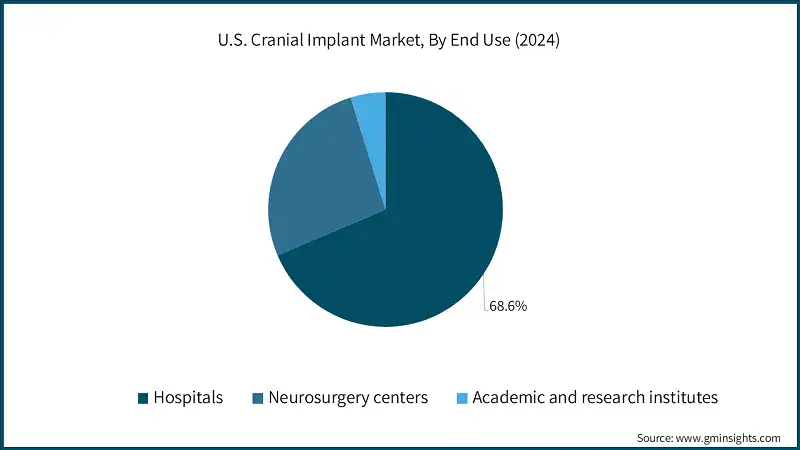
Based on end use, the U.S. cranial implant market is categorized into hospitals, neurosurgery centers, and academic and research institutes. Among these, the neurosurgery center’s segment accounts for 26.6% of the total market share.
- In the U.S., neurosurgery centers are emerging as a critical end-user segment in the cranial implant market due to their specialization in complex neurological procedures such as cranioplasty, tumor resections, and trauma-related reconstructions. These centers are equipped to manage high-acuity cases with precision, contributing significantly to the growing volume of cranial implant surgeries.
- Their strength lies in dedicated infrastructure, including advanced operating rooms, neuro-intensive care units, and real-time imaging systems that support rapid diagnosis and intervention particularly vital in time-sensitive conditions like TBIs.
- Neurosurgery centers also benefit from multidisciplinary teams comprising neurosurgeons, neuro-anesthesiologists, neuroradiologists, and specialized nursing staff. This concentration of expertise ensures comprehensive care from preoperative planning through post-operative recovery. Their role in evidence-based practice and innovation positions them as key stakeholders in shaping the future of cranial reconstruction in the U.S.
U.S. Cranial Implant Market Share
The U.S. cranial implant industry is shaped by a mix of established medtech leaders and emerging innovators, creating a dynamic and rapidly evolving competitive environment. Leading companies such as Stryker Corporation, Zimmer Biomet Holdings, Inc., and Johnson & Johnson (DePuy Synthes) hold 95% share of the global market, driven by their advanced implant portfolios, global surgical reach, and sustained investment in digital surgery and personalized care.
Beyond the dominant players, a growing number of specialized manufacturers and technology-driven startups are contributing to innovation in space. These firms are particularly active in expanding access in emerging markets and improving affordability through localized production. Overall, the cranial implant market is witnessing intensified competition, deeper technological diversification, and a stronger focus on patient-centric surgical solutions.
U.S. Cranial Implant Market Companies
Prominent players operating in the U.S. cranial implant industry are as mentioned below:
- 3di
- 3d Systems
- Acumed LLC
- B. Braun SE
- Integra LifeSciences Holdings Corporation
- Johnson & Johnson
- Kelyniam Global
- KLS Martin Group
- Matrix Surgical USA
- Medtronic
- Renishaw
- Stryker Corporation
- Zimmer Biomet Holdings
- Stryker Corporation
Stryker Corporation stands as a leading force in the U.S. cranial implant market, recognized for its Cranial iD platform that delivers patient-specific solutions for cranial reconstruction. Utilizing advanced materials such as PEEK, these implants are designed to ensure anatomical accuracy, biocompatibility, and long-term performance. Backed by decades of neurosurgical expertise, Stryker has established itself as a benchmark provider in personalized cranial reconstruction, combining innovation with precision to meet the evolving needs of U.S. healthcare providers.
Medtronic is a prominent player in the U.S. cranial implant market, leveraging its leadership in medical technology and neurosurgical solutions. Focused on clinical innovation and precision engineering, Medtronic delivers a portfolio of biocompatible implant systems designed to support complex cranial procedures and enhance long-term patient outcomes. Through its commitment to advancing neurosurgical care, the company continues to strengthen its position in personalized cranial reconstruction across the U.S. healthcare landscape.
KLS Martin Group is a key innovator in the U.S. cranial implant market, recognized for its expertise in patient-specific, 3D-printed titanium implants tailored for complex cranial reconstructions. By integrating precision engineering with advanced biomaterials, the company delivers implants that provide exceptional structural integrity, biocompatibility, and long-term reliability. KLS Martin continues to set a high standard for customized cranial solutions within the U.S. healthcare sector.
US Cranial Implant Market Report Attributes
| Key Takeaway | Details |
|---|---|
| Market Size & Growth | |
| Base Year | 2024 |
| Market Size in 2024 | USD 509.3 Million |
| Market Size in 2025 | USD 536.7 million |
| Forecast Period 2025 - 2034 CAGR | 6.1% |
| Market Size in 2034 | USD 917.1 million |
| Key Market Trends | |
| Drivers | Impact |
| Increasing cases of traumatic brain injuries (TBI) | The U.S. sees a high incidence of TBIs, especially among older adults due to falls and younger populations due to accidents and sports injuries. |
| Growing prevalence of neurological disorders and skull deformities | Rising cases of congenital anomalies, post-surgical defects, and neurological conditions requiring cranioplasty are expanding the clinical use of cranial implants across pediatric and adult populations. |
| Advancements in 3D printing and custom implant technologies | The integration of 3D printing enables the production of patient-specific implants with precise anatomical fit, reducing surgical time and improving outcomes. |
| Increasing adoption of biocompatible and smart materials | Materials like PEEK, PEKK, and titanium offer superior biocompatibility, durability, and imaging compatibility. Emerging smart materials with antimicrobial or sensor capabilities are enhancing post-operative monitoring and long-term safety. |
| Pitfalls & Challenges | Impact |
| High cost of cranial implants and surgical procedures | Advanced implants and neurosurgical interventions are expensive, limiting access for uninsured or underinsured populations and posing reimbursement challenges. |
| Stringent regulatory approvals and compliance requirements | FDA mandates rigorous testing for safety, biocompatibility, and long-term performance. Custom-designed or high-risk implants often require IDEs and PMAs, which can delay market entry and increase development costs. |
| Opportunities: | Impact |
| Expansion of personalized cranial reconstruction | The growing use of AI-driven surgical planning and 3D printing enables highly customized implants tailored to individual anatomy. |
| Market Leaders (2024) | |
| Market Leaders |
31.8 % market share |
| Top Players |
Collective market share in 2024 is 95% |
| Competitive Edge |
|
| Future outlook |
|
What are the growth opportunities in this market?
U.S. Cranial Implant Industry News
- In March 2024, KLS Martin Group completed its new company building in the U.S. and inaugurated a state-of-the-art facility in Jacksonville, Florida, dedicated to the planning and production of custom-made implants. This expansion significantly enhanced the company’s U.S. manufacturing capabilities, reinforcing its commitment to delivering innovative, patient-specific surgical solutions with greater efficiency and precision.
- In July 2024, Matrix Surgical USA, announced the establishment of its first international wholly owned subsidiary in Brazil under Matrix Surgical Holdings, LLC. The launch of the Brazil subsidiary helped Matrix Surgical USA enhance its international footprint and improve direct access to Latin American markets.
The U.S. cranial implant market research report includes in-depth coverage of the industry with estimates and forecast in terms of revenue in USD million from 2021 - 2034 for the following segments:
Market, By Product
- Customized
- Non-customized
Market, By Material
- Metal
- Polymer
- Polyetheretherketone (PEEK)
- Polymethylmethacrylate (PMMA)
- Other polymers
- Ceramic
Market, By Application
- Traumatic brain injuries
- Tumor resection cases
- Neurosurgical reconstructive procedures
- Biomimetic cranial reconstructive procedures
- Post-traumatic reconstructions
- Other neurosurgical reconstructive procedures
- Other applications
Market, By End Use
- Hospitals
- Neurosurgery centers
- Academic and research institutes
Frequently Asked Question(FAQ) :
What is the market size of the U.S. cranial implant industry in 2024?
The market size for U.S. cranial implant was valued at USD 509.3 million in 2024, supported by strong demand in trauma, oncology, and reconstructive neurosurgery.
What is the current U.S. cranial implant market size in 2025?
The market is projected to reach USD 536.7 million in 2025, driven by higher neurosurgical procedure volumes and increased adoption of advanced implant materials.
What is the projected value of the U.S. cranial implant market by 2034?
The U.S. cranial implant industry is expected to reach USD 917.1 million by 2034, growing at a 6.1% CAGR as personalized and 3D-printed implants gain wider clinical adoption.
How much revenue did the non-customized cranial implant segment generate in 2024?
The non-customized cranial implant segment held 40.5% market share in 2024, reflecting its critical role in emergency trauma care and high-volume neurosurgical settings.
What was the valuation of the metal material segment in 2024?
The metal materials segment accounted for 25.4% market share in 2024, driven by strong usage of titanium implants due to their mechanical strength, biocompatibility, and durability.
What is the growth outlook for the traumatic brain injuries (TBI) segment through 2034?
The traumatic brain injuries application segment held 61.7% share in 2024 and is expected to maintain strong growth as TBI cases rise across aging and active populations.
What are the upcoming trends in the U.S. cranial implant market?
Key trends include the rise of patient-specific 3D-printed implants, adoption of smart and antimicrobial materials, integration of AI-driven surgical planning, and rapid expansion of digital cranial reconstruction platforms.
Who are the key players in the U.S. cranial implant market?
Major companies include Stryker Corporation, Zimmer Biomet Holdings, Johnson & Johnson (DePuy Synthes), Medtronic, KLS Martin Group, Integra LifeSciences, Matrix Surgical USA, B. Braun SE, Renishaw, Kelyniam Global, Acumed LLC, 3d Systems, and 3di.
US Cranial Implant Market Scope
Related Reports