Summary
Table of Content

Urodynamic Equipment and Consumables Market
Get a free sample of this report
Form submitted successfully!
Error submitting form. Please try again.
Thank you!
Your inquiry has been received. Our team will reach out to you with the required details via email. To ensure that you don't miss their response, kindly remember to check your spam folder as well!
Request Sectional Data
Thank you!
Your inquiry has been received. Our team will reach out to you with the required details via email. To ensure that you don't miss their response, kindly remember to check your spam folder as well!
Form submitted successfully!
Error submitting form. Please try again.
Urodynamic Equipment and Consumables Market Size
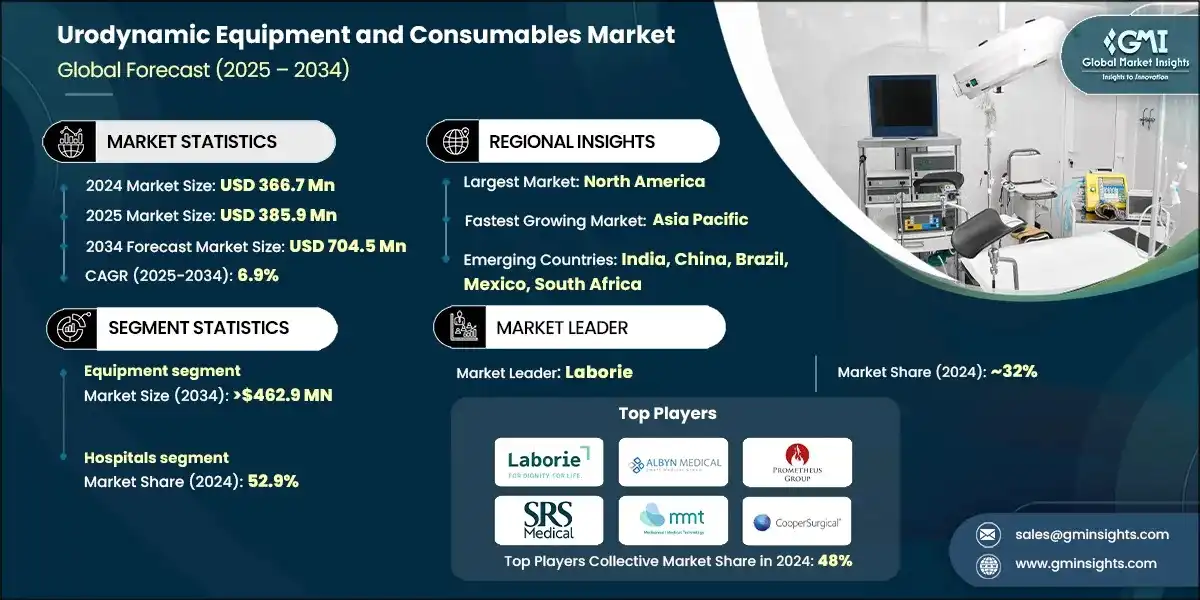
The global urodynamic equipment and consumables market was valued at USD 366.7 million in 2024. The market is expected to reach from USD 385.9 million in 2025 to USD 704.5 million in 2034, growing at a CAGR of 6.9% during the forecast period, according to the latest report published by Global Market Insights Inc. The high market growth is attributed to the technological advancements in urodynamic devices, rising prevalence of urological disorders, rising awareness and early diagnosis, and expansion of outpatient and ambulatory care centers, among other contributing factors.
Urodynamic Equipment and Consumables Market Key Takeaways
Market Size & Growth
- 2024 Market Size: USD 366.7 Million
- 2025 Market Size: USD 385.9 Million
- 2034 Forecast Market Size: USD 704.5 Million
- CAGR (2025–2034): 6.9%
Regional Dominance
- Largest Market: North America
- Fastest Growing Region: Asia Pacific
Key Market Drivers
- Increase in prevalence of lower urinary tract symptoms (LUTS) and urological disorders.
- Growing awareness coupled with facilitative government initiatives for incontinence treatment.
- Technological advancements in urodynamic equipment.
Challenges
- High cost of equipment and strict regulatory policies.
Opportunity
- Growing demand for portable and wireless urodynamic devices.
- Expansion in emerging markets with improving healthcare access.
Key Players
- Market Leader: Laborie led with over 32% market share in 2024.
- Leading Players: Top 5 players in this market include Laborie, Albyn Medical (CREO MEDICAL), The Prometheus Group, SRS Medical, MEDKONSULT medical technology, CooperSurgical, which collectively held a market share of 48% in 2024.
Get Market Insights & Growth Opportunities
Urodynamic equipment and consumables are medical devices and associated materials used to assess the function of the lower urinary tract. These devices allow measuring bladder pressure, urine flow, and sphincter activity, etc. in order to find the cause of urinary disorders. Consumables are such items as catheters, sensors, and tubing necessary for performing urodynamic tests.
Leading players in the urodynamic equipment and consumables market include Laborie, Albyn Medical (CREO MEDICAL), The Prometheus Group, SRS Medical, MEDKONSULT medical technology, and CooperSurgical. These companies maintain their competitive edge through continuous product innovation, global market presence, and significant investments in research and development.
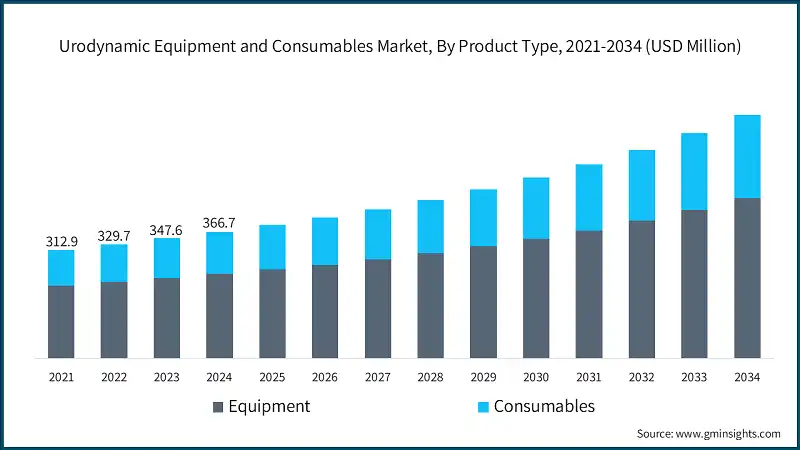
The market has increased from USD 312.9 million in 2021 and reached USD 347.6 million in 2023, with the historic growth rate of 5.4%. The market growth was driven by the rising prevalence of urological disorders such as urinary incontinence and neurogenic bladder, growing awareness regarding urodynamic diagnostics, technological advancements in diagnostic equipment, and increasing adoption of minimally invasive and precise diagnostic procedures across hospitals and diagnostic centers.
Moreover, the rising prevalence of urinary incontinence, overactive bladder, prostate enlargement, and neurogenic bladder drives the demand for urodynamic testing. For instance, according to the National Institutes of Health (NIH), urinary incontinence affects approximately 25 million adults in the U.S. in 2023, with nearly 33% of people aged 65 and above experiencing this condition.
The World Health Organization (WHO) reported that benign prostatic hyperplasia affects about 40% of men in their 50s and 80% of men in their 70s in 2022. The accurate diagnosis provided by urodynamic equipment enables physicians to develop specific treatment plans, increasing market adoption. The growing elderly population in developed regions, which the United Nations estimates will reach 1.6 billion by 2024, further strengthens this demand.
Furthermore, innovations such as wireless catheters, multi-channel pressure systems, portable urodynamic devices, and software-based diagnostic solutions enhance accuracy, ease of use, and patient comfort. These improvements encourage healthcare providers to upgrade existing systems, contributing to market growth.
To get key market trends
Urodynamic Equipment and Consumables Market Trends
The urodynamic equipment and consumables industry is growing considerably with the shift towards minimally invasive and wireless devices, integration with digital health and software solutions, rising adoption in emerging markets, and growth in home-based and ambulatory testing, among other factors collectively driving industry growth.
- Manufacturers are developing portable, wireless, and catheter-free urodynamic systems that reduce patient discomfort. These devices enable real-time data collection, improve workflow efficiency, and are increasingly preferred in outpatient and home-care settings.
- Advanced urodynamic equipment now includes software for data analysis, cloud storage, and remote monitoring. Integration with electronic health records (EHRs) and AI-driven analytics enhances diagnostic accuracy and supports personalized treatment planning.
- Healthcare infrastructure improvements, rising awareness of urinary disorders, and growing affordability of diagnostic equipment are driving adoption in regions such as Asia Pacific and Latin America. Companies are strategically targeting these markets with cost-effective and portable solutions.
- Additionally, portable urodynamic systems suitable for home or ambulatory care are becoming more popular. This trend aligns with the rise of telemedicine and outpatient services, allowing patients to undergo testing without hospital admission and, thereby supporting sustained market growth.
Urodynamic Equipment and Consumables Market Analysis
Learn more about the key segments shaping this market
The global market was valued at USD 312.9 million in 2021. The market size reached USD 347.6 million in 2023, from USD 329.7 million in 2022.
Based on the product type, the urodynamic equipment and consumables market is segmented into equipment and consumables. The equipment segment has asserted its dominance in the market by securing a significant market share of 66.9% in 2024 owing to the rising prevalence of urological disorders, increasing adoption of advanced diagnostic technologies, and the growing demand for accurate and comprehensive urodynamic assessments in hospitals and specialized clinics. The segment is expected to exceed USD 462.9 million by 2034, growing at a CAGR of 6.7% during the forecast period.
On the other hand, the consumables segment is expected to grow with a CAGR of 7.3%. The growth of this segment is driven by the recurring demand for single-use catheters, transducer sets, and other disposable accessories, rising adoption of minimally invasive urodynamic procedures, and increasing awareness of infection - control protocols in hospitals and outpatient settings.
- The equipment segment continues to dominate the market. The increasing elderly population, who are more susceptible to urinary dysfunctions, drives the demand for advanced diagnostic equipment. According to the World Health Organization (WHO), the global population aged 60 years and above was reached 1.4 billion by 2023, up from 1 billion in 2021.
- In addition, the United Nations estimates that by 2024, approximately 28.9% of Europe's population will be aged 60 or older. These diagnostic tools enable detailed assessments for improved patient management, particularly in geriatric care facilities, where urinary dysfunction affects 15-30% of people aged 65 and above, as reported by the National Institutes of Health in 2023.
- Moreover, portable and easy-to-use urodynamic equipment is highly preferred in outpatient clinics and ambulatory surgical centers. This trend allows efficient diagnostics without hospital admission, driving the demand for compact and advanced devices.
- The consumables segment held a revenue of USD 121.4 million in 2024, with projections indicating a steady expansion at 7.3% CAGR from 2025 to 2034. The segment is driven by the recurring need for disposable items such as catheters, transducer sets, and tubing, which are essential for each urodynamic test. Increasing adoption of minimally invasive and outpatient procedures has further boosted demand for single-use consumables.
- Additionally, stringent infection-control protocols in hospitals and clinics are encouraging the use of disposable equipment to prevent cross-contamination. Rising awareness of urological disorders and the expansion of diagnostic services in emerging markets are also supporting sustained growth in this segment.
Learn more about the key segments shaping this market
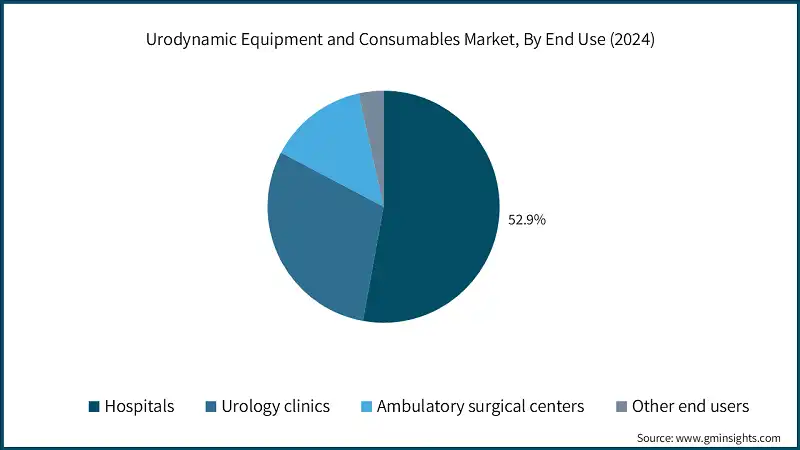
Based on end use, the urodynamic equipment and consumables market is classified into hospitals, urology clinics, ambulatory surgical centers, and other end users. The hospitals segment dominated the market with a revenue share of 52.9% in 2024 and is expected to reach USD 364.9 million within the forecast period.
- Hospitals are increasing urology departments to satisfy growing patient demands for diagnosis and treatment of urinary disorders. The provision of comprehensive urodynamic testing not only attracts more patients but also broadens the hospital’s service portfolio, thus promoting the use of equipment and consumables.
- Moreover, hospitals are focusing on precise diagnosis and tailored treatment to obtain positive patient outcomes. A decision to purchase sophisticated urodynamic systems will be instrumental in achieving early detection of disorders, lowering the risk of complications, and improves overall care quality.
- The urology clinics segment accounted for significant revenue in 2024, with projections indicating a steady expansion at 7.1% CAGR from 2025 to 2034. The segment's expansion is mainly due to the increased adoption of diagnostic procedures for urinary disorders, supported by the presence of trained staff and state-of-the-art equipment. The patient influx for outpatient and minimally invasive urodynamic testing is on the rise, which is boosting the demand for equipment and consumables in these settings.
- The ambulatory surgical centers segment held a revenue of USD 50.7 million in 2024, with projections indicating a steady expansion at 7.5% CAGR from 2025 to 2034. The segmental growth is driven by adopting portable and efficient urodynamic systems that enable quick and accurate diagnostics in outpatient settings. The rising preference for minimally invasive procedures and same-day treatments increases the demand for both equipment and disposable consumables in ASCs.
Looking for region specific data?
North America Urodynamic Equipment and Consumables Market
North America dominated the global urodynamic equipment and consumables industry with the highest market share of 45.4% in 2024.
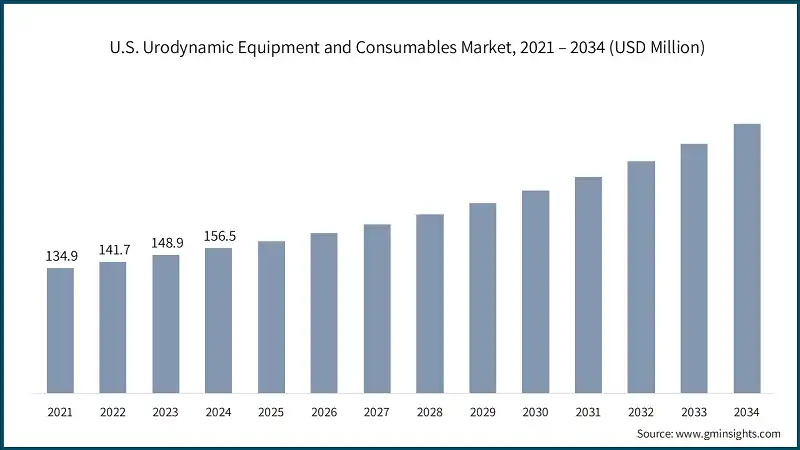
- The U.S. market was valued at USD 134.9 million and USD 141.7 million in 2021 and 2022, respectively. The market size reached USD 156.5 million in 2024, growing from USD 148.9 million in 2023, and is anticipated to grow at a CAGR of 6.5% between 2025 to 2034.
- North America has a significant patient population affected by urinary incontinence, overactive bladder, and prostate-related disorders. The growing awareness for accurate diagnosis has become a major factor in hospitals and clinics installing advanced urodynamic systems and consumables.
- In the U.S. and Canada, the insurance coverage and the support from Medicare/Medicaid for urodynamic tests make the cost for patients relatively low. Thus, the patients are encouraged to undergo frequent testing which, in turn, motivates healthcare providers to obtain modern diagnostic equipment and consumables.
- Further, the region’s advanced healthcare infrastructure, including specialized urology centers and tertiary hospitals, supports the adoption of sophisticated urodynamic equipment. High-quality facilities are more likely to invest in cutting-edge technology to maintain clinical excellence.
Europe Urodynamic Equipment and Consumables Market
Europe market accounted for USD 93.3 million in 2024 and is anticipated to show lucrative growth over the forecast period.
- Europe experiences a growth of chronic urinary diseases, which include benign prostatic hyperplasia, urinary incontinence, and neurogenic bladder, most notably among the elderly population. The demand of accurate diagnosis and the continuous monitoring is leading to the use of sophisticated urodynamic instruments and consumables in hospitals and speciality clinics to improve the level of patient care.
- Furthermore, there is an increasing preference for minimally invasive procedures in European healthcare, driven by patient comfort and reduced recovery times. Urodynamic devices with wireless, catheter-free, or portable features are being increasingly adopted in hospitals and outpatient settings, aligning with this trend.
Asia Pacific Urodynamic Equipment and Consumables Market
The Asia Pacific market is anticipated to grow at the highest CAGR of 7.8% during the analysis timeframe.
- Several countries in Asia Pacific, including China, India, and South Korea, are investing heavily in healthcare infrastructure. The expansion of hospitals, specialized urology centers, and diagnostic facilities has increased accessibility to advanced urodynamic equipment, driving market growth across the region.
- Governments and private healthcare providers are promoting awareness campaigns and early diagnostic screening programs for urinary disorders. Rising patient knowledge about the benefits of timely diagnosis encourages hospitals to invest in urodynamic equipment and consumables.
Latin America Urodynamic Equipment and Consumables Market
The Latin America urodynamic equipment and consumables industry is experiencing robust growth over the analysis timeframe.
- In Latin America, the market is being driven by expanding healthcare infrastructure and modernization of diagnostic facilities across major countries like Brazil and Mexico. Rising awareness of urological disorders among the population, coupled with increasing government initiatives for urinary incontinence management, is boosting market adoption. The growing number of specialized urology clinics and outpatient centers is further fuelling demand for both equipment and consumables.
- Additionally, improving affordability of advanced diagnostic devices and the gradual increase in health insurance coverage are encouraging more patients to seek urodynamic testing. The region is also witnessing interest from international manufacturers, who are introducing cost-effective and portable solutions tailored to local needs.
Middle East & Africa Urodynamic Equipment and Consumables Market
The Middle East & Africa (MEA) market is experiencing robust growth over the analysis timeframe.
- The regional growth is driven by rapid development of healthcare infrastructure and investment in speciality urology centers. Increasing government initiatives to improve diagnostic capabilities and rising awareness of urinary disorders among patients are boosting market adoption.
- The growing prevalence of lifestyle-related urological conditions is creating additional demand for advanced diagnostic solutions. Furthermore, the entry of international manufacturers offering region-specific, cost-effective, and portable systems is supporting market growth across both urban and semi-urban areas.
Urodynamic Equipment and Consumables Market Share
The global urodynamic equipment and consumables industry is highly competitive, characterized by the presence of both global and regional players focusing on innovation, product differentiation, and strategic collaborations. Companies are continuously investing in research and development to introduce advanced, portable, and wireless urodynamic systems, along with improved consumables, to enhance diagnostic accuracy and patient comfort.
Key players include Laborie, Albyn Medical (CREO MEDICAL), The Prometheus Group, SRS Medical, MEDKONSULT medical technology, and CooperSurgical, collectively accounting for 48% of the total market share.
Market competition is further intensified by factors such as pricing strategies, after-sales service, and regional expansion efforts. Firms are targeting emerging markets with cost-effective and user-friendly solutions to capture growing demand, while also strengthening their position in developed regions through technological advancements and comprehensive service networks.
Strategic partnerships, acquisitions, and product portfolio expansions remain critical approaches for players aiming to maintain and increase their market presence in this rapidly evolving landscape.
Urodynamic Equipment and Consumables Market Companies
A few of the prominent players operating in the urodynamic equipment and consumables industry include:
- Advin
- Albyn Medical (CREO MEDICAL)
- Ashlar Medical
- COOK MEDICAL
- CooperSurgical
- Digitimer
- HC Italia
- Laborie
- Medica
- MEDKONSULT medical technology
- Neomedix Systems
- Santron Meditronic
- SRS Medical
- The Prometheus Group
- Tic Medizintechnik
- Laborie
Laborie leads the urodynamic equipment and consumables market with an estimated ~32% market share in 2024, driven by its comprehensive portfolio of advanced urodynamic systems featuring integrated software, wireless technology, and intuitive interfaces for precise diagnostics. The company’s strong global footprint, continuous innovation, and commitment to clinical education further reinforce its leadership in urological diagnostic solutions.
Albyn Medical stands out for its high-quality, customizable urodynamic systems and consumables designed to meet varied clinical needs. Its European manufacturing excellence and integration with CREO Medical’s technology strengthen its position in precision diagnostics.
The Prometheus Group differentiates itself through robust, user-friendly urodynamic and pelvic health diagnostic systems tailored for clinical efficiency. The company’s focus on modular designs and interoperability with electronic health systems (EHRs) enhances workflow and patient data management.
Urodynamic Equipment and Consumables Market Report Attributes
| Key Takeaway | Details |
|---|---|
| Market Size & Growth | |
| Base Year | 2024 |
| Market Size in 2024 | USD 366.7 Million |
| Market Size in 2025 | USD 385.9 Million |
| Forecast Period 2025 - 2034 CAGR | 6.9% |
| Market Size in 2034 | USD 704.5 Million |
| Key Market Trends | |
| Drivers | Impact |
| Increase in prevalence of lower urinary tract symptoms (LUTS) and urological disorders | Rising incidence of conditions like urinary incontinence and bladder dysfunction has boosted the demand for urodynamic testing to ensure accurate diagnosis and effective treatment planning. |
| Growing awareness coupled with facilitative government initiatives for incontinence treatment | Public health campaigns and reimbursement support have encouraged early diagnosis and adoption of urodynamic assessments, strengthening market penetration across clinical settings. |
| Technological advancements in urodynamic equipment | The introduction of digital, wireless, and portable systems has enhanced test accuracy and patient comfort, driving wider adoption in hospitals and diagnostic centers. |
| Pitfalls & Challenges | Impact |
| High cost of equipment and strict regulatory policies | The significant capital investment required for advanced systems and time-consuming regulatory approvals continue to limit adoption, especially among small clinics and in developing regions. |
| Opportunities: | Impact |
| Growing demand for portable and wireless urodynamic devices | The shift toward compact, wireless, and patient-friendly systems is expected to expand the market by enabling point-of-care testing and increasing accessibility in outpatient and homecare settings. |
| Expansion in emerging markets with improving healthcare access | Rapid healthcare infrastructure development and rising awareness of urological care in emerging economies will create significant growth potential for both equipment and consumables in the coming years. |
| Market Leaders (2024) | |
| Market Leaders |
~32% |
| Top Players |
Collective market share in 2024 is 48% |
| Competitive Edge |
|
| Regional Insights | |
| Largest Market | North America |
| Fastest growing market | Asia Pacific |
| Emerging countries | India, China, Brazil, Mexico, South Africa |
| Future outlook |
|
What are the growth opportunities in this market?
Urodynamic Equipment and Consumables Industry News
- In April 2025, Bright Uro announced that the FDA granted 510(k) clearance for the Glean Urodynamics System, enabling wireless, catheter-free ambulatory urodynamics. This approval is expected to enhance the company’s presence in the U.S. market and showcased innovation in patient-friendly diagnostics. It also supports growth in the urodynamic equipment and consumables market by promoting adoption of advanced, minimally invasive technologies.
- In November 2023, Laborie Medical Technologies Corp. (Laborie) announced a strategic equity investment in Bright Uro. This investment strengthened Laborie’s portfolio in innovative urodynamic solutions and expanded its technological capabilities. It also supports growth in the market by accelerating the development and adoption of advanced, patient-friendly diagnostic systems.
The urodynamic equipment and consumables market research report includes an in-depth coverage of the industry with estimates and forecast in terms of revenue in USD Million from 2021 – 2034 for the following segments:
Market, By Product Type
- Equipment
- Urodynamic system
- Standard urodynamic systems
- Video urodynamic systems
- Uroflowmetry equipment
- Cystometer
- Electromyographs
- Urodynamic system
- Consumables
- Urodynamic catheters
- Transducer sets
- Urodynamic pumps
- Other consumables
Market, By End Use
- Hospitals
- Urology clinics
- Ambulatory surgical centers
- Other end users
The above information is provided for the following regions and countries:
- North America
- U.S.
- Canada
- Europe
- Germany
- UK
- France
- Spain
- Italy
- Netherlands
- Asia Pacific
- China
- Japan
- India
- Australia
- South Korea
- Latin America
- Brazil
- Mexico
- Argentina
- Middle East and Africa
- South Africa
- Saudi Arabia
- UAE
Frequently Asked Question(FAQ) :
What is the market size of the urodynamic equipment and consumables industry in 2024?
The market size was USD 366.7 million in 2024, with a CAGR of 6.9% expected through 2034, driven by technological advancements in diagnostic equipment and the rising prevalence of urological disorders.
What is the current urodynamic equipment and consumables market size in 2025?
The market size is projected to reach USD 385.9 million in 2025.
What is the projected value of the urodynamic equipment and consumables market by 2034?
The market size for urodynamic equipment and consumables is expected to reach USD 704.5 million by 2034, fueled by increasing adoption of portable and wireless diagnostic systems and the expansion of outpatient and ambulatory care centers.
How much revenue did the equipment segment generate in 2024?
The equipment segment accounted for 66.9% share in 2024, driven by the growing use of advanced diagnostic systems in hospitals and specialized urology centers.
What is the expected valuation of the consumables segment by 2034?
The consumables segment expanding at a 7.3% CAGR due to recurring demand for disposable items like catheters, transducer sets, and tubing.
Which end-use segment led the urodynamic equipment and consumables industry in 2024?
Hospitals dominated the market with 52.9% share in 2024, supported by higher patient inflow, advanced diagnostic capabilities, and increasing investments in urology departments.
What is the growth outlook for ambulatory surgical centers from 2025 to 2034?
The ambulatory surgical centers segment is projected to grow at a CAGR of 7.5%, driven by the adoption of portable, minimally invasive systems that enable same-day testing and faster diagnostics.
How much revenue did the U.S. urodynamic equipment and consumables market generate in 2024?
The U.S. market generated USD 156.5 million in 2024, supported by advanced healthcare infrastructure, insurance coverage for diagnostic procedures, and widespread adoption of wireless urodynamic systems.
What are the upcoming trends in the urodynamic equipment and consumables industry?
Key trends include the integration of digital health and software analytics, development of wireless and catheter-free diagnostic systems, and the expansion of portable testing in outpatient and home-care settings.
Who are the key players in the urodynamic equipment and consumables market?
Major players include Laborie, Albyn Medical (CREO MEDICAL), The Prometheus Group, SRS Medical, MEDKONSULT medical technology, and CooperSurgical, collectively accounting for 48% of global market share in 2024.
Urodynamic Equipment and Consumables Market Scope
Related Reports