Summary
Table of Content

Upcycled Snacks Market
Get a free sample of this report
Form submitted successfully!
Error submitting form. Please try again.
Thank you!
Your inquiry has been received. Our team will reach out to you with the required details via email. To ensure that you don't miss their response, kindly remember to check your spam folder as well!
Request Sectional Data
Thank you!
Your inquiry has been received. Our team will reach out to you with the required details via email. To ensure that you don't miss their response, kindly remember to check your spam folder as well!
Form submitted successfully!
Error submitting form. Please try again.
Upcycled Snacks Market Size
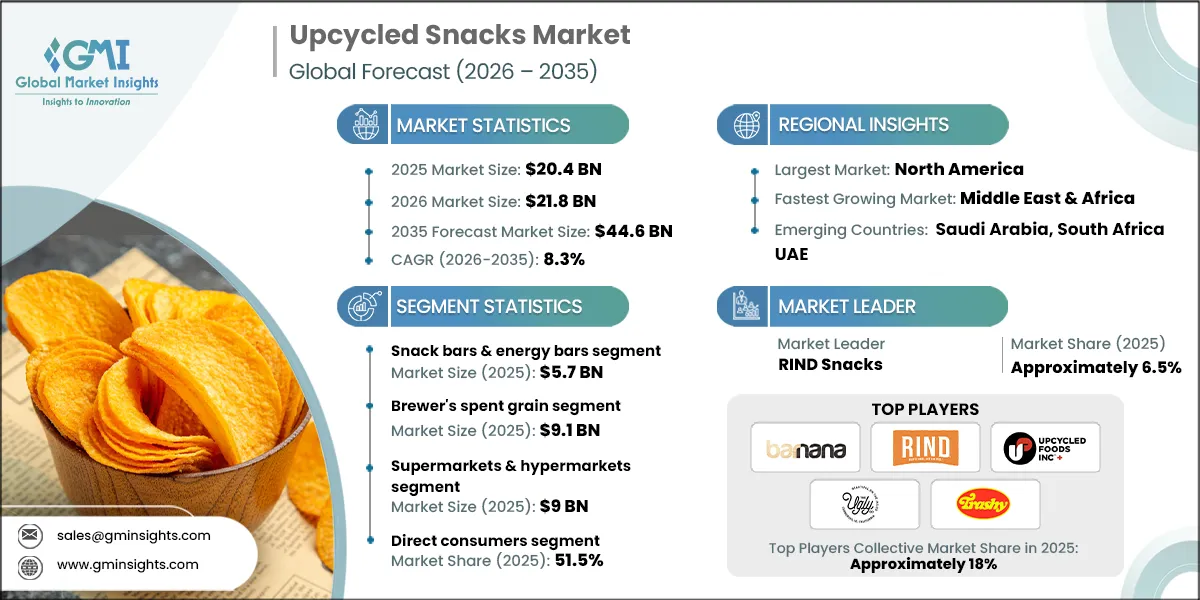
The global upcycled snacks market was valued at USD 20.4 billion in 2025. It is projected to grow from USD 21.8 billion in 2026 to USD 44.6 billion by 2035, representing 8.3% CAGR from 2026 to 2035, according to latest report published by Global Market Insights Inc.
Upcycled Snacks Market Key Takeaways
Market Size & Growth
- 2025 Market Size: USD 20.4 Billion
- 2026 Market Size: USD 21.8 Billion
- 2035 Forecast Market Size: USD 44.6 Billion
- CAGR (2026–2035): 8.3%
Regional Dominance
- Largest Market: North America
- Fastest Growing Region: Middle East & Africa
Key Market Drivers
- Rising food waste reduction awareness among consumers.
- Growing preference for sustainable and ethical food products.
- Brand adoption of circular economy food production models.
- Supportive sustainability positioning by retailers and foodservice chains.
Challenges
- Limited consumer understanding of upcycled food concepts.
- Inconsistent supply quality of food byproducts.
- Higher processing and certification compliance costs.
Opportunity
- Product innovation using byproducts from fruits and grains.
- Private label entry into eco‑focused snack categories.
- Rising demand for clean‑label and plant‑based snacks.
- Expansion in online and direct‑to‑consumer retail channels.
Key Players
- Market Leader: RIND Snacks led with over market share approximately 6.5% in 2025.
- Leading Players: Top 5 players in this market include Barnana, RIND Snacks, Upcycled Foods, Inc., The Ugly Company, Trashy Chips, which collectively held a market share of 18% in 2025.
Get Market Insights & Growth Opportunities
- The market of snacks that are recycled is experiencing high growth rates due to the increased environmental awareness of the consumers. Growing awareness of the problem of food waste and sustainable development has changed the buyer’s preferences in favor of a product that minimizes ecological footprint. Consumers are also demanding brands that are willing to show a desire to work towards the principles of the circular economy, a shift that has attracted manufacturers to invest in upcycled ingredients. This congruence of consumer ethics and buying behavior is broadening the market presence in the world.
- The upcycled snacks segment is also driven by the health and wellness trends. The current generation of consumers is already putting value on healthy and clean label foods and upcycled foods can use byproducts of different foods that are rich in nutrients like fruit pulp or spent grain. The placement enables such products to match conventional health snacks to attract knowledgeable consumers. As wellness keeps shaping the consumption trends of snacks, upcycled products are taking shelf space in both retail and online stores.
- Another important growth drive is that of retail channel expansion. Specialty stores, supermarkets, and e-commerce outlets are beginning to dedicate space to sustainable food items, which are increasing the exposure and the availability of upcycled snacks. Collaborations with big stores and wholesalers increase market penetration and consumer experimentation. Besides, the niche upcycled snack manufacturers are scaling fast due to the digital marketing and direct-to-consumer models.
- The food sector is also an industry where investment and innovation act to enhance growth in the market. Companies and established food industries are investing in the creation of new upcycled snacks that have good taste and texture profiles. The competitive environment is becoming fiercer because of additional funding, partnerships, and product introductions. The market will experience long-term growth, as the cost efficiency and scalability of production are enhanced due to technological progress.
To get key market trends
Upcycled Snacks Market Trends
- Upcycled snacks are undergoing a major trend towards clean label positioning and open storytelling. Brands are concentrating on more straightforward ingredient statements, and they are stating where upcycled inputs come from and the reason why they are needed. This story-based strategy is useful in making consumers realize the sustainability value that is not based on price and taste. Due to this, brand trust and emotional involvement are emerging as important factors in the buying decision-making process.
- The implementation of sustainable packaging solutions that are supportive of the idea of upcycled products is also another trend that has been adopted. The manufacturers are also shifting towards recyclable, compostable or minimal packaging to strengthen the environmental credence. Packaging ceases to be a functional behavior but a clue as to the sustainability of the retail shelves. Such congruence of product and packaging is changing the perception of consumers on upcycled snacks.
- The development of the market of upcycled snacks is also being impacted by the digital-first go-to-market strategies. The brands use e-commerce platforms and social media, and direct-to-consumer to educate buyers and build niche communities. The channels enable more in-depth storytelling, consumer feedback, and quicker product iteration. Consequently, access to market is growing beyond the traditional growth models in which growth is driven by retail.
- Another trend that can be observed is product innovation by diversifying the format and ingredients. The companies are also trying out new upcycled raw materials and snack packages to expand consumer tastes. This covers functional, high quality, and plant-based snack variants that are in line with current consumption trends. This kind of diversification is slowly transforming the market out of a low-volume niche sustainability area, to a mainstream snack product.
Upcycled Snacks Market Analysis
Learn more about the key segments shaping this market
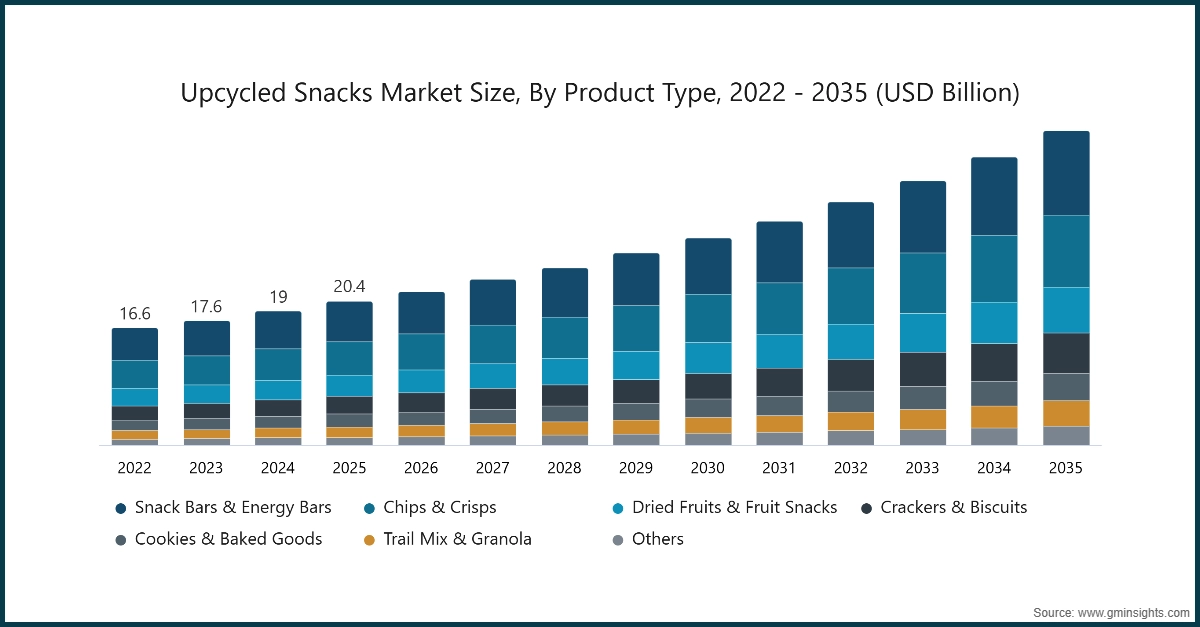
Upcycled snacks market based on product type is segmented into snack bars & energy bars, chips & crisps, dried fruits & fruit snacks, crackers & biscuits, cookies & baked goods, trail mix & granola, and others. The snack bars & energy bars segment was valued at USD 5.7 Billion in 2025, and it is anticipated to expand to 8% of CAGR during 2026 to 2035.
- The snack bars, energy bars, and granola-based products fulfill market growth with the help of regular consumption habits and the ability to integrate with fibers and protein-rich upcycled inputs. These formats allow the use of higher frequencies and inclusion in daily habits like breakfast and on-the-go snacking. The chips, crisps and crackers facilitate the volume approach as they deal with mainstream consumption of savory snacks. Upcycled ingredients can be implemented on a large scale owing to their high consumption base.
- Baked goods, cookies, and dried fruit snacks will help enter the indulgent and naturally positioned snack markets. Fruit snacks are associated with pulp- and residue-based feedstuff and allow the effective utilization of by-products. Snacks of trail mixes and mixed formats can incorporate various upcycled elements. The range of formats decreases category dependence and offers even spread of demand between a variety of snack occasions.
Upcycled snacks market based on ingredient source is segmented into brewer's spent grain (BSG), fruit & vegetable waste, juicing & cold-press pulp, and other by-products. The brewer's spent grain segment was valued at USD 9.1 billion in 2025, and it is anticipated to expand to 8.1% of CAGR during 2026 to 2035.
- The spent grain used by brewer helps in providing stability and cost-effectiveness because of stable output of the brewing process. It has a nutritional profile that allows its use in baked and extruded snacks with increased inclusion levels. Fruit and vegetable waste promotes growth in sweet and savory formulations in terms of natural flavor, color and fiber content. These resources enhance the use of raw materials and empower circular sourcing models.
- Juicing and cold-press pulp are used to facilitate the development of products in the fruit-based and functional snack markets. Fiber and micronutrients are retained allowing positioning into wellness-based applications. Other by-products like cereal residues and oilseed meals will increase the formulation choices in a variety of snacks. Such variety of sources enhances flexibility of sourcing and minimizes reliance on waste streams.
Upcycled snacks market based on distribution channel is segmented into supermarkets & hypermarkets, specialty & health food stores, online retail, foodservice & HoReCa, and wholesale & B2B. The supermarkets & hypermarkets segment was valued at USD 9 billion in 2025, and it is anticipated to expand to 7.9% of CAGR during 2026 to 2035.
- Supermarkets and hypermarkets have a positive effect on sale as they have a wide range of consumers, and they become the part of the shopping regularity. Normalization and repeat buying is facilitated by shelf placement and traditional snacks. Health and specialty food stores facilitate high end positioning and consumer targeting. These stores augment product worth and promote higher-margin products.
- Online shopping helps in geographical growth and direct brand-consumer interaction. This is a channel through which product rollout is quick and efficient consumer targeting. HoReCa and foodservice channels complement institutional consumption and menu integration. The wholesale and B2B allows mass distribution and ingredient-level provision to facilitate scale in manufacturing and foodservice use.
Learn more about the key segments shaping this market
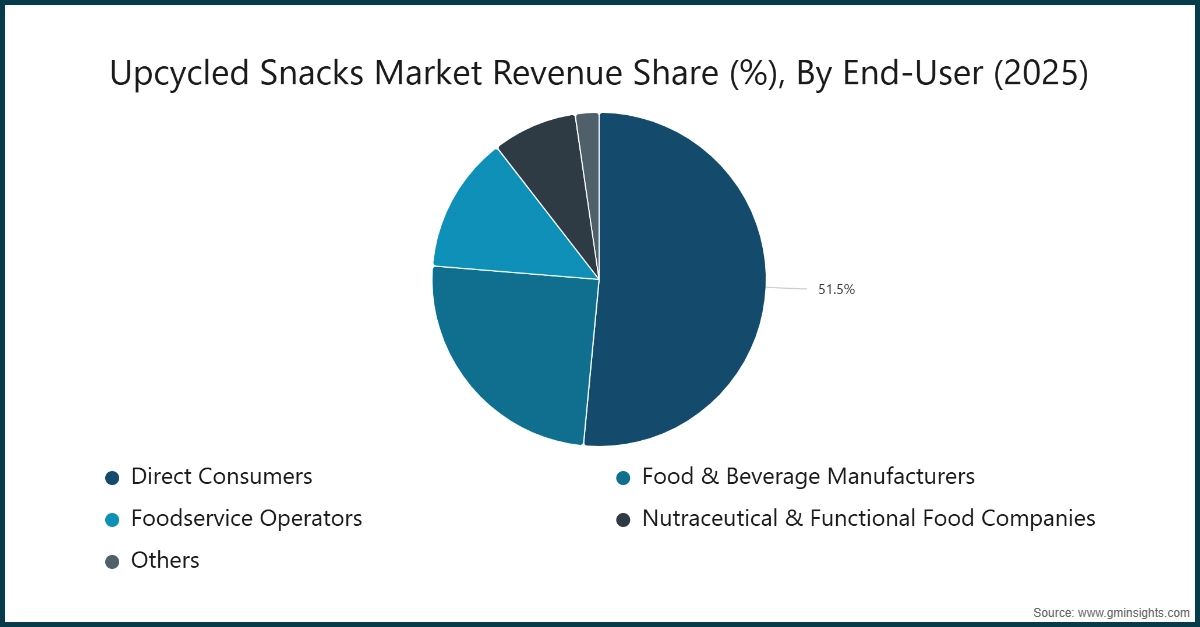
Upcycled snacks market based on end-user is segmented into direct consumers, food & beverage manufacturers, foodservice operators, nutraceutical & functional food companies, and others. The direct consumers segment was valued at USD 10.5 billion with a market share of with a market share of 51.5% in 2025, and it is anticipated to expand to 7.9% of CAGR during 2026 to 2035.
- Direct consumers promote stable demand by consumption at the household level and by buying repeatedly. Additional integration into the routine snacking behavior normalizes the volume flow. This segment enjoys product diversity and product availability in various retailing formats. Regular retail adoption helps in the predictable demand trends.
- Manufacturers in the food and beverage industry can expand the range of the application by developing upcycled ingredients into larger lines of products. Foodservice operators aid demand by catering, institutional and commercial food service. The companies that use upcycled inputs are nutraceutical and functional foods that develop fiber-enriched or protein-enriched formulations. Other end-users such as institutional and private-label purchasers push demand outside of conventional retail outlets.
Looking for region specific data?
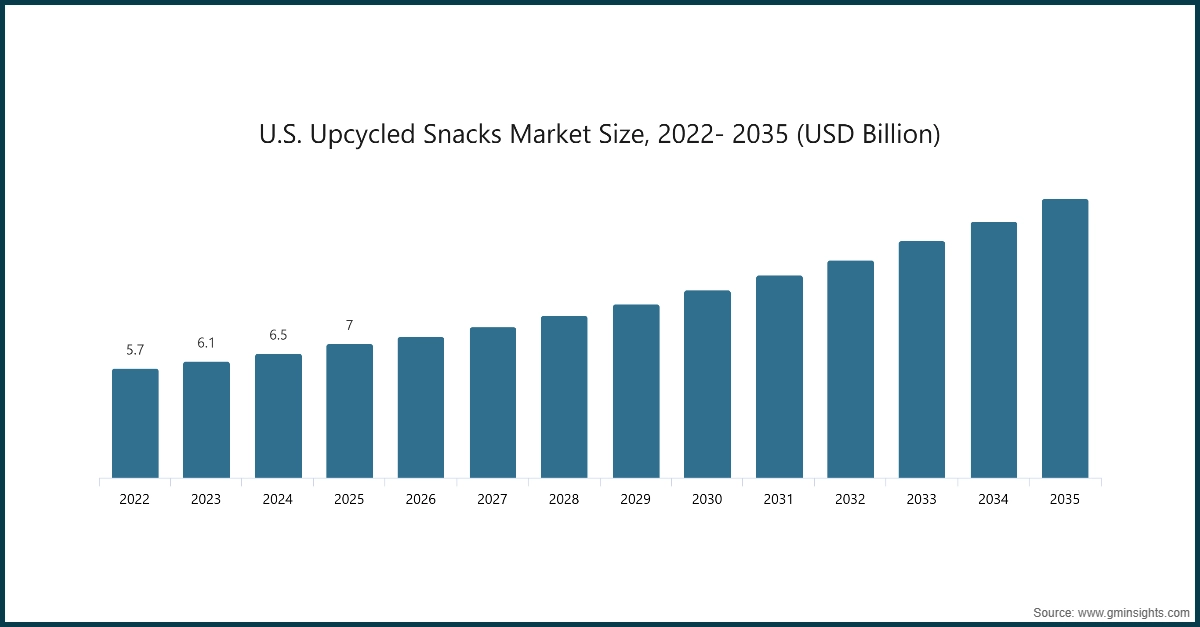
The North America upcycled snacks market accounted for USD 7.9 billion in 2025 and is anticipated to show lucrative growth over the forecast period.
The market of upcycled snacks is experiencing consistent growth in North America, which is backed by the stable sustainability knowledge and robust innovation cultures. Food brands are adopting recycled ingredients in the mainstream snack products to keep up with the objectives of waste-reduction and clean-label demands. The U.S. is in the center stage because consumer reception of the idea of sustainable food is high, and several suppliers of upcycled ingredients exist. Volume scaling is supported by strong retail penetration, vigorous startup involvement, and experimentation in its own label. The area is also characterized by developed food waste recovery infrastructure, which allows obtaining a regular supply of by-products and produces at the scale of commercial-level production of snack types.
The Europe upcycled snacks market accounted for USD 6.1 billion in 2025 and is anticipated to show lucrative growth over the forecast period.
The market of upcycled snacks in Europe is developing due to its high regulatory compliance with the principles of the circular economy and food waste minimization. Germany is unique in terms of the developed infrastructure of food processing and sustainable consumption. Producers are introducing bakery snacks, bars and crisps that are made using upcycled grains, fruit residues and pulp. Such products are being accepted by high transparency standards and environmentally friendly purchase behavior. Retailers are eager to advertise sustainable food selections enhancing visibility and normalization. Policy support, consumer drive and industrial efficiency can combine to ensure the development of the regional market on a steady basis as the central innovation and consumption center can be found in Germany.
Asia Pacific upcycled snacks market accounted for 20.2% market share in 2025 and is anticipated to show lucrative growth over the forecast period.
Asia Pacific is a fast-changing market of upcycled snacks, which is caused by urbanization and increased attention to resource efficiency. China is at the center of expansion of the region because of its vast food processing foundation and growing interest in waste valorization. Manufacturers of snacks are also using by-products of fruit, vegetables and grains to achieve both cost savings and sustainability objectives. The increasing consumption and growth of modern retail formats in the middle-income population facilitate the market penetration. Making upcycled inputs to recognizable snack products, domestic brands are progressively implementing it in their domestic brands that do not entail drastic dietary adjustments. This scale effect coupled with processing capacity and dynamic consumer preferences enhance momentum in the region.
Latin America upcycled snacks market is anticipated to grow at a CAGR of 9.4% during the analysis timeframe.
Latin America is moving in the direction of the upcycled snacks industry by using more of the by-products of agriculture. Brazil is a strategic country as it has significant fruit processing and agribusiness industries, which can produce a considerable amount of raw materials that can be upcycled. Fruit peel, pulp, and cereal residue are some of the items that snack manufacturers are using to create low-cost or value addition products. The increasing sensitivity to the issue of food waste and food sustainability is enhancing market receptivity. The capability of local production and increased retail access facilitate gradual integration of the market. The high agricultural foundation and the rise of the processed food industry in Brazil provide good opportunities to the further growth of the region.
Middle East & Africa upcycled snacks market is expected to grow at a CAGR of 10% during the analysis timeframe.
The Middle East & Africa region is building upcycled snacks industry along with the wider sustainability and food security campaigns. There is a growing interest in Saudi Arabia, which is being invested in food processing, waste management, and domestic production. Manufacturers of snacks are considering using upcycled ingredients as a way to better utilize the resources and decrease the reliance on imports. There are demand drivers in modern retail development and lost consumer taste of packaged snacks. The sustainability programs supported by the government also promote circular food practices. All these are pointers of a slow market growth with a systematic way of adoption and regional impact by Saudi Arabia.
Upcycled Snacks Market Share
- Barnana, RIND Snacks, Upcycled Foods, Inc., The Ugly Company, and Trashy Chips are a significant part of the global upcycled snacks industry and with further standing of being highly consolidated with the top five players steadily holding 18% market share in the year 2025.
- Organizations are busy with the innovation of products and using upcycled ingredients to create new snacks versions in the same format, where the taste, texture, and convenience will stay consistent with the expectations of consumers. This lowers the barrier to adoption and enhances repeat buying. The constant redefining is effective in ensuring that they remain relevant to changes in preferences.
- There is a great focus on supply chain integration with the food processors in ensuring the constant number of by-products. The partnerships in sourcing help in enhancing the reliability of the raw materials and containing of costs in the long term. This enhances scalability and cushioning margins in a market that is sensitive to resources.
- The brands pay a lot of attention to open communication regarding sourcing, impact specifications, and ingredient tracking. Credibility and confidence of the consumers are strengthened through clear labeling and storytelling. This has informed manner in which sustainability value is communicated in the market of upcycled snacks.
- The certifications and industry partnership are also invested in to improve market positioning and setting standards. A claim can be justified by being members of upcycled food associations and sustainability programs. Such activities have impacts on perceptions and acceptance of the market and category.
- Omnichannel distribution strategy is the focus of the companies to achieve scale and brand building. Existence in retail, e-commerce and foodservice means increasing visibility and demand stability. Such a diversified channel mix eliminates reliance on any particular sales channel.
- The marketing approaches focus on value which goes beyond sustainability, such as nutrition, functionality and lifestyle fit. This changes the perception of the market of niche eco-products to snacks. This kind of position increases the number of consumers targeted.
- Processing technologies that enhance the usability of ingredients and shelf life are part of operational efficiency. Investment in manufacturing capacity facilitates increased rates of upcycling of inputs. This improves commercial sustainability and competitiveness.
- Partnerships with retailers, ingredient suppliers, and foodservice operators are strategic approaches to market penetration. Co-development and own brand businesses raise volume flow. Such collaborations will determine the speed at which upcycled snacks become part of the mainstream collections.
Upcycled Snacks Market Companies
The major players operating in upcycled snacks industry include:
- Barnana
- RIND Snacks
- Upcycled Foods, Inc.
- The Ugly Company
- Trashy Chips
- Others
- Barnana has been able to maintain its role in the market of upgraded snacks by repurposing excessive bananas into common snacks like chips and bites. The company also concentrated on powerful sourcing relationships and brand-led storytelling to support sustainability and simultaneously ensuring the consistency of the taste. Simple products and extensive retailing can contribute to maintaining consumer interest.
- RIND Snacks retain its market position since it uses whole-fruit upcycling, such as peels and rinds, to cut down on waste and bring in nutritional value. This firm focuses on transparency and clean formulations in order to establish trust. Its emphasis on snacking made out of fruits helps to correlate with health-conscious consumption trends.
- Upcycled Foods, Inc. reinforce its position by creating multi-use upcycled products that can be incorporated into the snack products with ease. Working with food manufacturers, the company can guarantee good and scaled supply. This ingredient-first strategy gives it the ability to affect the entire ecosystem of the upcycled snacks.
- The Ugly Company has contributed significantly as it obtains flawed produce and converts them into snack food products accessible to everyone. Its model enables it to be cost competitive as well as efficiency in its supply. Minimal formulas and direct sustainability communication serve as a way of maintaining consumer acceptance and repeat purchase.
- Trashy Chips maintains its practice by targeting waste streams of vegetables to make snack products that are crunchy and familiar to the consumers. The company plays the sustainability-indulgence game to attract mainstream shoppers. The ability to source ingredients in control, and unique branding assists in strengthening its identity in the market.
Upcycled Snacks Market Report Attributes
| Key Takeaway | Details |
|---|---|
| Market Size & Growth | |
| Base Year | 2025 |
| Market Size in 2025 | USD 20.4 Billion |
| Market Size in 2026 | USD 21.8 Billion |
| Forecast Period 2026-2035 CAGR | 8.3% |
| Market Size in 2035 | USD 44.6 Billion |
| Key Market Trends | |
| Drivers | Impact |
| Rising food waste reduction awareness among consumers | Expands consumer acceptance for snacks made from surplus ingredients |
| Growing preference for sustainable and ethical food products | Strengthens demand for environmentally responsible snack alternatives |
| Brand adoption of circular economy food production models | Increases commercial availability of upcycled snack offerings |
| Supportive sustainability positioning by retailers and foodservice chains | Improves shelf presence and visibility of upcycled snack products |
| Pitfalls & Challenges | Impact |
| Limited consumer understanding of upcycled food concepts | Slows purchase decisions in price-sensitive consumer groups |
| Inconsistent supply quality of food byproducts | Creates challenges in maintaining uniform taste and texture |
| Higher processing and certification compliance costs | Compresses margins for small and emerging snack brands |
| Opportunities: | Impact |
| Product innovation using byproducts from fruits and grains | Enables differentiated snack formats with sustainability positioning |
| Private label entry into eco‑focused snack categories | Accelerates volume growth through cost‑competitive offerings |
| Rising demand for clean‑label and plant‑based snacks | Aligns upcycled snacks with broader healthy eating trends |
| Expansion in online and direct‑to‑consumer retail channels | Enhances reach among sustainability‑driven consumer segments |
| Market Leaders (2025) | |
| Market Leader |
Market Share Approximately 6.5% |
| Top Players |
Collective Market Share Approximately 18% |
| Competitive Edge |
|
| Regional Insights | |
| Largest Market | North America |
| Fastest growing market | Middle East & Africa |
| Emerging countries | Saudi Arabia, South Africa, UAE |
| Future outlook |
|
What are the growth opportunities in this market?
Upcycled Snacks Industry News
- In June 2025, The Ugly Company is increasing its retail penetration in June 2025 by listing its retail stores in large box stores (e.g., getting shelf space at Walmart stores), meaning that it upcycled fruit and vegetable snacks were much more widely available to consumers. This move into mainstream retail showed greater demand on the part of buyers and confidence in upcycled formats by retailers and moved category awareness and acceptance further.
- In March 2025, In March 2025, Upcycled Foods, Inc. collaborated with Misfits Market to introduce the retailer to its initial brand of upcycled grains in everyday bakery goods, Odds and Ends, and it combined upcycled grains into the brand. This introduction expanded the use of upcycled ingredients beyond snack foods alone and the power of ingredient-level enterprises to impact product lines in the neighboring food categories in the upcycled market.
- In August 2024, Confetti Snacks was accepted to an estimated 900 Walmart outlets in the U.S and it upcycled vegetable and fruit chips were accessible to a broader audience. This distribution achievement was an important step to demonstrate how snack brands based on upcycling can become part of the mainstream retail business and thus help them occupy a larger market share and presence on shelves.
- In February 2024, RIND Snacks has acquired Vermont-based Small Batch Organics; manufacturing and fulfillment is brought in house and new snacks of granola and fruit blend are added to the product line. This acquisition strengthened research and development and operational control.
The upcycled snacks market research report includes in-depth coverage of the industry with estimates & forecasts in terms of revenue (USD Billion) & (Kilo Tons) from 2022 to 2035, for the following segments:
Market, By Product Type
- Snack Bars & Energy Bars
- Chips & Crisps
- Vegetable Chips
- Tortilla Chips
- Puffed Snacks
- Fruit Crisps
- Dried Fruits & Fruit Snacks
- Crackers & Biscuits
- Cookies & Baked Goods
- Trail Mix & Granola
- Others
Market, By Ingredient Source
- Brewer's Spent Grain (BSG)
- Fruit & Vegetable Waste
- Juicing & Cold-Press Pulp
- Other by-products
- Soy Processing
- Coffee
- Oat & Nut Milk Processing
- Agricultural & Processing
Market, By Distribution Channel
- Supermarkets & Hypermarkets
- Specialty & Health Food Stores
- Online Retail
- Foodservice & HoReCa
- Wholesale & B2B
Market, By End-User
- Direct Consumers
- Food & Beverage Manufacturers
- Foodservice Operators
- Nutraceutical & Functional Food Companies
- Others
The above information is provided for the following regions and countries:
- North America
- U.S.
- Canada
- Europe
- UK
- Germany
- France
- Italy
- Spain
- Rest of Europe
- Asia Pacific
- China
- India
- Japan
- South Korea
- Australia
- Rest of Asia Pacific
- Latin America
- Brazil
- Mexico
- Argentina
- Rest of Latin America
- MEA
- UAE
- Saudi Arabia
- South Africa
- Rest of Middle East and Africa
Frequently Asked Question(FAQ) :
What was the market size of the upcycled snacks in 2025?
The market size was valued at USD 20.4 billion in 2025, growing at a CAGR of 8.3% from 2026 to 2035. The market is driven by increasing consumer awareness of environmental sustainability and food waste reduction.
What is the projected value of the upcycled snacks market by 2035?
The market is poised to reach USD 44.6 billion by 2035, fueled by consumer demand for sustainable and circular economy-based products.
What is the expected size of the upcycled snacks industry in 2026?
The market size is projected to reach USD 21.8 billion in 2026.
How much revenue did the snack bars & energy bars segment generate in 2025?
The snack bars & energy bars segment generated USD 5.7 billion in 2025 and is expected to grow at a CAGR of 8% till 2035.
What was the valuation of the brewer's spent grain segment in 2025?
The brewer's spent grain segment was valued at USD 9.1 billion in 2025 and is anticipated to grow at a CAGR of 8.1% from 2026 to 2035.
What is the growth outlook for the direct consumers segment from 2026 to 2035?
The direct consumers segment, valued at USD 10.5 billion with a 51.5% market share in 2025, is set to expand at a CAGR of 7.9% up to 2035.
Which region leads the upcycled snacks sector?
North America leads the market, accounting for USD 7.9 billion in 2025. The region's growth is supported by strong sustainability awareness, innovation, and a developed food waste recovery infrastructure, with the U.S. playing a central role.
What are the upcoming trends in the upcycled snacks market?
Key trends include clean label positioning, sustainable packaging adoption, digital-first go-to-market strategies, expansion into functional and plant-based variants, and stronger consumer engagement through transparency and storytelling.
Who are the key players in the upcycled snacks industry?
Key players include Barnana, RIND Snacks, Upcycled Foods, Inc., The Ugly Company, and Trashy Chips.
Upcycled Snacks Market Scope
Related Reports