Summary
Table of Content

Upcycled Ingredients in Cosmetics Market
Get a free sample of this report
Form submitted successfully!
Error submitting form. Please try again.
Thank you!
Your inquiry has been received. Our team will reach out to you with the required details via email. To ensure that you don't miss their response, kindly remember to check your spam folder as well!
Request Sectional Data
Thank you!
Your inquiry has been received. Our team will reach out to you with the required details via email. To ensure that you don't miss their response, kindly remember to check your spam folder as well!
Form submitted successfully!
Error submitting form. Please try again.
Upcycled Ingredients in Cosmetics Market Size
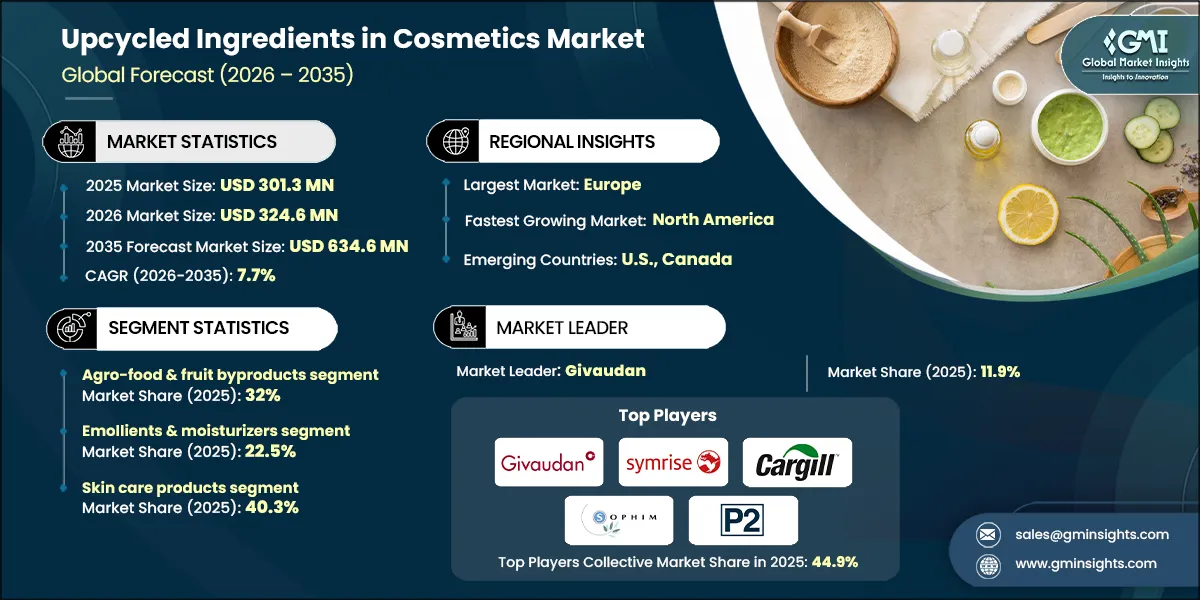
The global upcycled ingredients in cosmetics market was valued at USD 301.3 million in 2025. The market is expected to grow from USD 324.6 million in 2026 to USD 634.6 million in 2035, at a CAGR of 7.7% according to latest report published by Global Market Insights Inc.
Upcycled Ingredients in Cosmetics Market Key Takeaways
Market Size & Growth
- 2025 Market Size: USD 301.3 Million
- 2026 Market Size: USD 324.6 Million
- 2035 Forecast Market Size: USD 634.6 Million
- CAGR (2026–2035): 7.7%
Regional Dominance
- Largest Market: Europe
- Fastest Growing Region: North America
Key Market Drivers
- Increasing consumer demand for sustainability.
- Regulatory support and environmental policies.
- Innovation and product differentiation.
Challenges
- Supply chain challenges.
- Higher production costs.
Opportunity
- Expansion into new markets.
- Partnerships and collaborations.
Key Players
- Market Leader: Givaudan led with over 11.9% market share in 2025.
- Leading Players: Top 5 players in this market include Givaudan, Symrise, Cargill, SOPHIM IBERIA S.L., P2 Science, Inc, which collectively held a market share of 44.9% in 2025.
Get Market Insights & Growth Opportunities
The cosmetics industry is currently experiencing a major growth in upcycled ingredients because consumers now understand the need for sustainable and environmentally friendly products. The cosmetic industry uses upcycled ingredients which come from food and beverage industry by-products and waste materials to create premium cosmetic components. The current trend supports the overall movement which aims to achieve sustainability and circular economic goals by decreasing waste and environmental damage.
Cosmetic products need upcycled ingredients for important functions. The functional components of products provide their special abilities which include antioxidants and moisturizers and anti-aging agents. The products also meet consumer demand for products which contain clean and natural materials that come from ethical sources. Environmental responsibility emerges from companies which use upcycled materials because this practice generates brand loyalty among customers who care about sustainable products. Companies which produce upcycled ingredients benefit from lower costs because they use materials which would have become waste and this approach establishes a more environmentally friendly supply chain.
Upcycled ingredients bring numerous positive outcomes for businesses. The materials help reduce waste from food and industrial processes which results in decreased carbon emissions during cosmetic production. Upcycled ingredients contain bioactive compounds which deliver skin health benefits through their antioxidant and anti-inflammatory and nourishing effects. Brands use these ingredients to build their market image because they provide evidence of their sustainable practices. Businesses develop innovative products which meet the needs of contemporary consumers who prefer eco-friendly circular economy products through their use of upcycled ingredients.
To get key market trends
Upcycled Ingredients in Cosmetics Market Trends
The market trend for upcycled ingredients in cosmetics experiences rapid growth because consumers now understand environmental issues better and businesses focus on sustainable practices. Consumers who become more aware of environmental problems force brands to use eco-friendly ingredients which come from waste materials and by-products for their products which support circular economy concepts. The demand for natural organic and ethically sourced cosmetic products has grown which makes upcycled ingredients an important factor that companies use to stand out from their competitors.
The market trend depends on technological developments which establish its essential foundation. The introduction of new extraction and processing and stabilization methods creates a pathway to extract bioactive compounds from waste materials through safe and effective methods used in cosmetic products. The introduction of green extraction technologies which include supercritical fluid extraction and enzymatic processes enables producers to manufacture high-quality upcycled ingredients in an environmentally sustainable yet economical manner. The introduction of new formulation technologies enables manufacturers to create products which can use these materials without harming their product stability or sensory qualities for use in skincare and haircare and color cosmetics.
Sustainable practices receive greater support from regulatory systems which maintain their complicated nature. Upcycled ingredient safety requirements and transparency standards and labeling requirements are being developed into guidelines and standards by governments and industry organizations. Some regions now implement certification programs to validate sustainable and ethical sourcing of specific ingredients which help to build consumer trust. Companies now use upcycled ingredients in their products because regulatory bodies provide them with incentives which promote sustainable innovation.
Product innovation drives this trend forward as brands introduce new formulations which showcase their sustainability advantages. This includes using upcycled fruit peels for antioxidants coffee grounds for exfoliation and brewery waste for nourishing oils. The market now offers sustainable products which meet consumer needs while allowing companies to create distinctive brand identities through storytelling which boosts customer loyalty in a competitive industry. The upcycled ingredients market in cosmetics now experiences strong growth because of technological advancements and supportive regulations and innovative product development.
Upcycled Ingredients in Cosmetics Market Analysis
Learn more about the key segments shaping this market
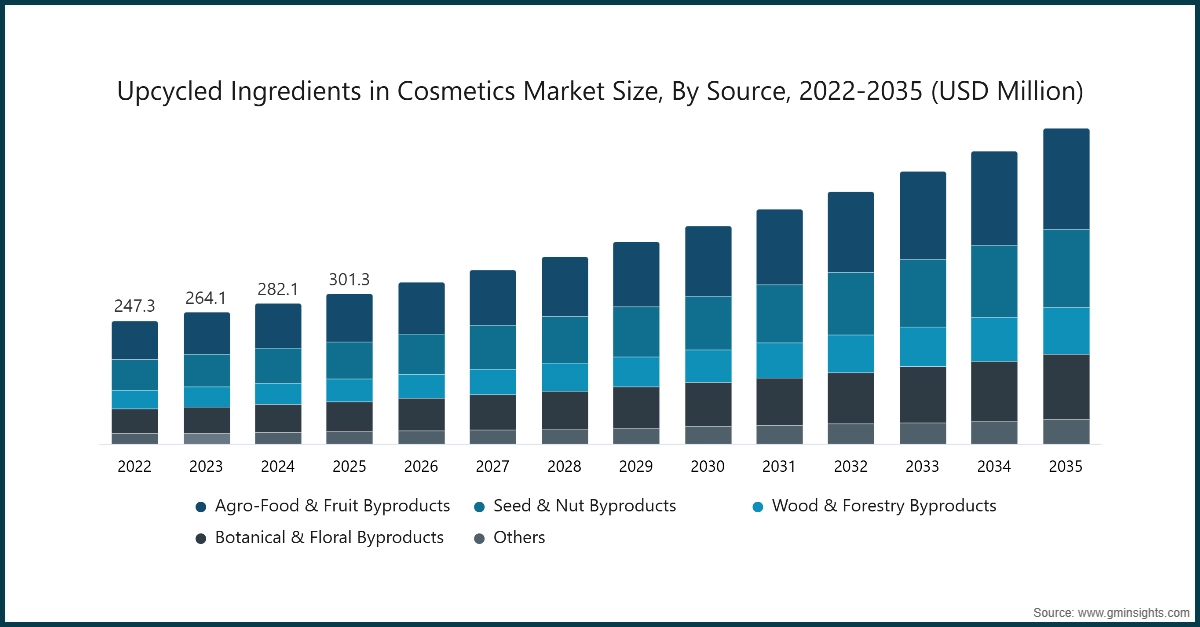
Based on source, the market is segmented into agro-food & fruit byproducts, seed & nut byproducts, wood & forestry byproducts, botanical & floral byproducts, and others. Agro-food & fruit byproducts dominated the market with an approximate market share of 32% in 2025 and is expected to grow with a CAGR of 7.8% by 2035.
The upcycled ingredients market is experiencing a growing demand for agro-food & fruit byproducts because of the worldwide movement towards sustainable practices & clean beauty products. The components of fruit peels & pulp and seeds possess valuable antioxidants and vitamins and bioactive compounds which make them essential components of skincare products. Companies are investing in innovative extraction techniques to harness these byproducts which help them decrease waste while creating additional value for the fruit processing industry. Brands highlight their sustainability commitments because consumers prefer products that contain natural ingredients which come from environmentally friendly sources and ethically sourced components.
The cosmetic industry is increasingly using seed and nut byproducts as sources of both oils and proteins and bioactive compounds. Companies now use skin-nourishing properties from these byproducts which oil extraction processes typically discard to create products with anti-aging and moisturizing effects. Wood and forestry byproducts, which include lignin and cellulose now serve as sustainable bio-based materials for creating formulations that need film-forming properties or thickening agents or antioxidant capabilities. Essential oils and phytochemicals which exist in botanical and floral byproducts have high market demand because of their sensory properties and therapeutic benefits. The cosmetics industry uses these sources to create a circular economy which focuses on waste reduction and environmentally friendly production methods.
Learn more about the key segments shaping this market
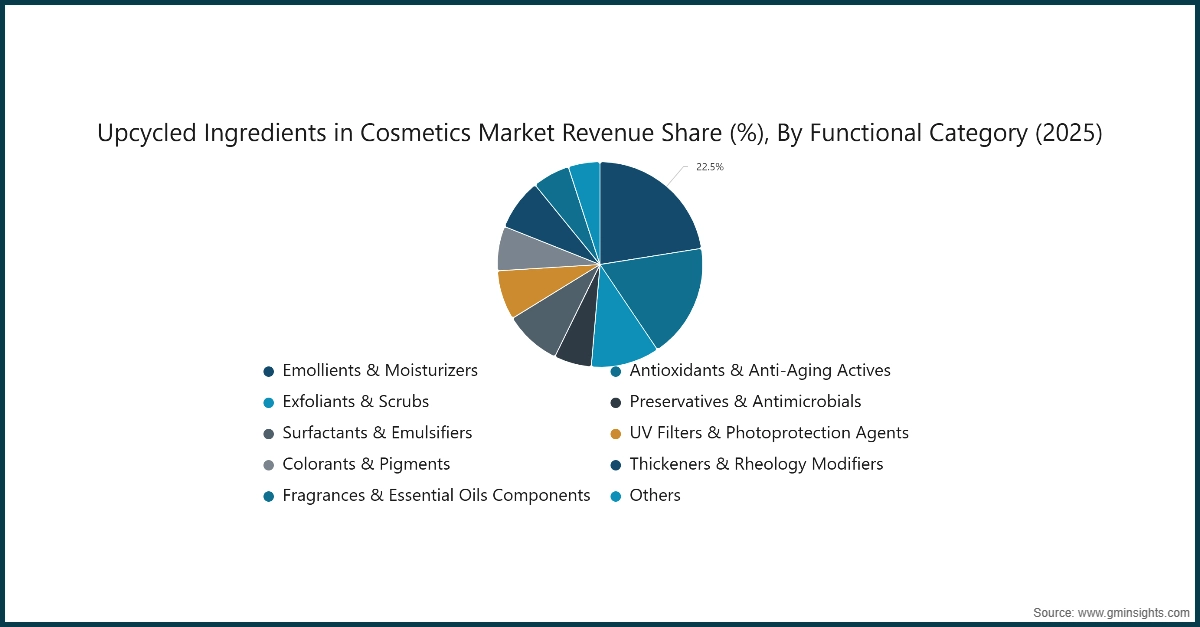
Based on functional category, the upcycled ingredients in cosmetics market is segmented into emollients & moisturizers, antioxidants & anti-aging actives, exfoliants & scrubs, preservatives & antimicrobials, surfactants & emulsifiers, UV filters & photoprotection agents, colorants & pigments, thickeners & rheology modifiers, fragrances & essential oils components, and others. Emollients & moisturizers held the largest market share of 22.5% in 2025 and is expected to grow at a CAGR of 8.4% during 2026-2035.
The market for upcycled ingredients has attained substantial growth because consumers want natural and sustainable skincare products. Upcycled seed oils & botanical extracts together with plant-based emollients deliver effective hydration and skin barrier protection while creating less waste. Manufacturers implement upcycled materials in their products because they want to meet industry sustainability standards and customer demand for clean beauty items.
Anti-aging products use fruit and vegetables plus botanical byproducts because they contain high levels of polyphenols and flavonoids and vitamins. The ingredients increase product performance while making the product attractive to consumers who care about environmentSal protection. The industry now embraces natural preservation together with active ingredients which use waste streams to create sustainable skincare solutions.
The industry uses upcycled materials across multiple product categories which include exfoliants and scrubs and preservatives and surfactants and UV filters and colorants and thickeners and fragrances and essential oils to achieve environmental goals and drive product development. Bio-based exfoliants from fruit seeds or sugarcane bagasse provide eco-friendly alternatives to synthetic abrasives. The market shows a growing demand for natural preservatives and antimicrobial agents which people derive from botanical waste products because these products reduce the need for artificial chemical substances.
Based on application, the upcycled ingredients in cosmetics market is segmented into skin care products, hair care products, makeup & color cosmetics, body care products, oral care products, personal hygiene products, and others. Skin care products segments dominated the market with an approximate market share of 40.3% in 2025 and is expected to grow with a CAGR of 8% by 2035.
The global skincare market continues to expand rapidly, with consumers increasingly seeking natural, sustainable, and multifunctional ingredients. The popularity of upcycled ingredients from fruit and seed and botanical byproducts is rising due to their ability to provide anti-aging and moisturizing and antioxidant advantages. Brands create environmentally friendly products through their development of eco-friendly formulations which decrease waste while improving product performance. Consumers choose clean and sustainable ingredients which promote skin health and environmental sustainability as their primary requirement for facial serums and creams and masks. The increasing sustainability awareness among people drives companies to create new product packaging materials and develop their ingredient sourcing methods which leads to increased demand for environmentally friendly skincare products.
The application of upcycled ingredients is becoming more common in the hair care and body care and oral care and personal hygiene product categories. Shampoos and conditioners and body lotions and soaps use upcycled seed oils and botanical extracts to deliver nourishing antioxidant and restorative benefits. Manufacturers of oral and personal hygiene products use waste streams to develop natural preservatives and antimicrobial agents which serve customers who want chemical-free and environmentally friendly products. The entire personal care industry shows an upward shift toward using upcycled and sustainable ingredients because environmentally conscious customers prefer these products while the industry works to reduce waste and support green beauty initiatives.
Looking for region specific data?
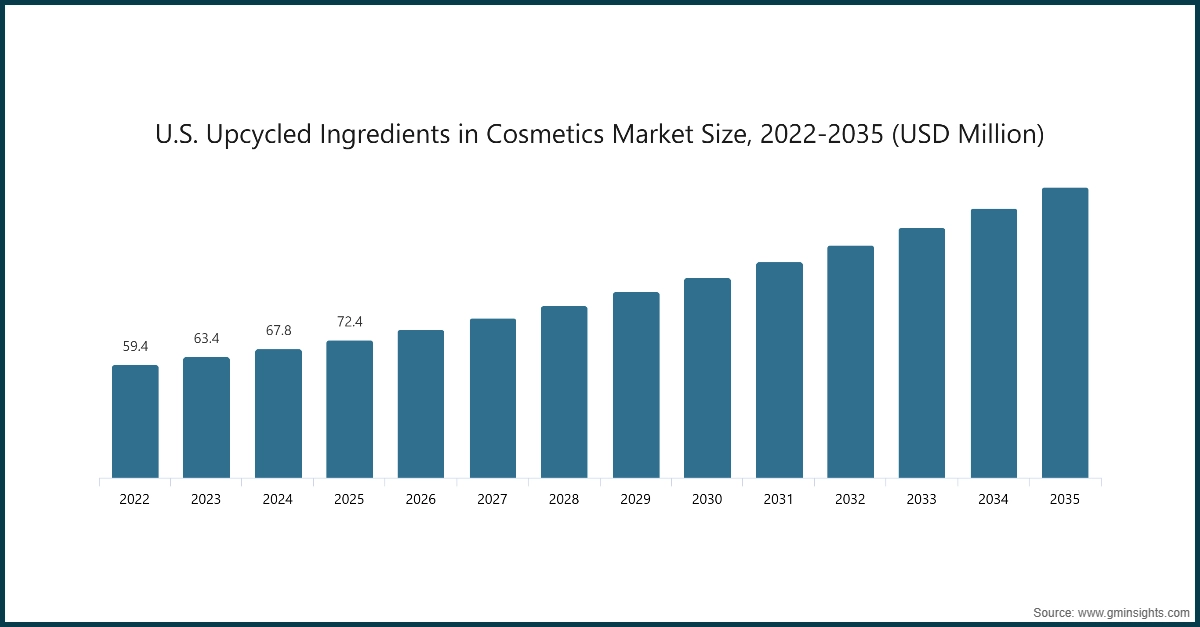
The North America upcycled ingredients in cosmetics industry is growing rapidly on the global level with a market share of 30% in 2025.
North America remains the strong personal care market due to its high consumer awareness and preference for natural sustainable products. The region's dedication to clean beauty products and eco-friendly products has led to the widespread use of upcycled ingredients in skincare products and hair care products and cosmetics. Both established brands and new companies create sustainable products which demonstrate their environmental commitment through transparent packaging and sustainable production methods. North American markets experience rapid eco-friendly product expansion because of their established distribution systems and their large base of environmentally conscious consumers.
Europe upcycled ingredients in cosmetics market leads the industry with revenue of USD 121.1 million in 2025 and is anticipated to show lucrative growth over the forecast period.
European consumers show strong preference for sustainable products which use natural ingredients, thus making Europe a leading market for products containing upcycled materials. European consumers prefer products which are both environmentally safe and cruelty free therefore brands need to implement circular economy methods. The combination of regulatory frameworks plus eco certifications function as a dual system which drives manufacturers to develop new products that reduce waste through their use of sustainable materials. The countries like France and Germany and the UK demonstrate strong preference for organic and vegan and sustainable products. The region's strict environmental regulations together with its environmentally friendly consumer behavior drive demand for both green beauty products and upcycled ingredient products.
The Asia Pacific upcycled ingredients in cosmetics market is anticipated to grow at a CAGR of 7.7% during the analysis timeframe.
The Asia Pacific region shows strong demand for personal care products because the beauty industry is expanding. Consumers want sustainable products which disclose their ingredient information thus creating a market for products made from eco-friendly materials and upcycled resources. The countries like China, India, South Korea and Japan experience growing demand for innovative products which use natural materials and environmentally friendly practices based on local botanical materials.
Latin America upcycled ingredients in cosmetics accounted for 4.9% market share in 2025 and is anticipated to show steady growth over the forecast period.
Latin America shows a rising interest in natural and sustainable personal care products with consumers increasingly favoring environmentally responsible brands. The Brazilian and Mexican markets serve as important areas which are adopting local botanical extracts and upcycled ingredients because of their strong cultural heritage of natural beauty and herbal medicine. The market shows increasing environmental awareness which drives consumers to seek products that provide both affordability and environmental safety while delivering effective results. Companies are developing new products which combine upcycled materials in their products to meet the needs of environmentally aware customers and to establish sustainable manufacturing methods.
Middle East & Africa upcycled ingredients in cosmetics market accounted for 2.9% market share in 2025 and is anticipated to show lucrative growth over the forecast period.
The shift towards sustainable personal care in the Middle East and Africa region is progressing because people become more aware of environmental problems. The market still needs time to mature but urban areas are seeing higher demand for natural products which do not contain chemical substances and which have eco-friendly properties. Brands are beginning to introduce upcycled ingredients that align with the region’s cultural preferences for herbal and botanical products. The region shows potential for market growth because its residents become more aware of environmental issues while they pursue sustainable products and innovative solutions which meet the needs of their young environmentally minded population.
Upcycled Ingredients in Cosmetics Market Share
The top 5 companies in upcycled ingredients in cosmetics industry include Givaudan, Symrise, Cargill, SOPHIM IBERIA S.L., and P2 Science, Inc. These are prominent companies operating in their respective regions covering approximately 44.9% of the market share in 2025. These companies hold strong positions due to their extensive experience in upcycled ingredients in cosmetics market. Their diverse product portfolios, backed by robust production capabilities and distribution networks, enable them to meet the rising demand across various regions.
Givaudan operates as a worldwide flavor and fragrance company which expands its operations into environmentally sustainable natural product development that includes upcycled materials used in cosmetic products. The company utilizes its extensive research and development capabilities together with its commitment to innovation to create environmentally friendly products which fulfill the increasing demand from consumers who prefer sustainable products. Givaudan strengthens its market position through its strategic partnerships which enable the company to create environmentally sustainably upcycled ingredients while it increases its presence in the market.
Symrise operates as a leading force in the cosmetics and personal care industry because the company prioritizes sustainable practices and development of natural products. The company allocates substantial resources to create upcycled materials which serve as its primary strategy for implementing circular economy principles. Symrise maintains a leading position in the upcycled cosmetic ingredient industry because its extensive product range, and dedication to clean beauty enable the company to deliver innovative sustainable solutions which match consumer preferences.
Cargill operates as a worldwide agribusiness company which distributes natural ingredients that include plant-based materials and upcycled cosmetics ingredients. The company excels at transforming agricultural by-products and waste materials into sustainable ingredients which minimize their negative effects on the environment. Cargill provides budget-friendly solutions by implementing supply chain sustainability practices which enable the company to deliver cost-effective upcycled solutions for mass-market cosmetics products.
Sophim which develops natural cosmetic ingredients together with sustainable formulation solutions. The company builds its competitive edge in the regional cosmetic industry through its natural ingredient sourcing and development capabilities which enable it to create innovative products from both natural materials and upcycled resources. SOPHIM delivers personalized upcycled ingredient solutions which meet European sustainability standards through its ability to adapt to regional consumer demands.
P2 Science Inc. operates as a specialty ingredient company which creates sustainable cosmetic solutions through its core principle of green chemistry. The company produces high-quality ingredients through its commitment to upcycled and bio-based materials and its exclusive technological capabilities which result in less environmental damage. P2 Science develops state-of-the-art upcycled ingredients for premium cosmetic brands which demand eco-friendly products because of the company’s dedication to pioneering new products while fulfilling sustainable development goals.
Upcycled Ingredients in Cosmetics Market Companies
Major players operating in the Upcycled ingredients in cosmetics industry include:
- Cargill
- Givaudan
- Innomost Oy
- Lignopure
- Mibelle Ltd.
- OLVEA Group
- P2 Science, Inc
- SOPHIM IBERIA S.L.
- Symrise
- Upcycled Beauty Ltd
Upcycled Ingredients in Cosmetics Market Report Attributes
| Key Takeaway | Details |
|---|---|
| Market Size & Growth | |
| Base Year | 2025 |
| Market Size in 2025 | USD 301.3 Million |
| Market Size in 2026 | USD 324.6 Million |
| Forecast Period 2026-2035 CAGR | 7.7% |
| Market Size in 2035 | USD 634.6 Million |
| Key Market Trends | |
| Drivers | Impact |
| Increasing consumer demand for sustainability | Consumers are actively seeking eco-friendly and ethically sourced products, driving brands to incorporate upcycled ingredients to meet these preferences. |
| Regulatory support and environmental policies | Governments and industry bodies are promoting sustainability initiatives, encouraging companies to adopt circular economy practices, including the use of upcycled ingredients. |
| Innovation and product differentiation | Cosmetic brands leverage upcycled ingredients to develop innovative formulations that stand out in a crowded market, offering unique benefits and storytelling around sustainability. |
| Pitfalls & Challenges | Impact |
| Supply chain challenges | Sourcing consistent, high-quality upcycled raw materials can be complex, leading to potential supply shortages or variability in ingredient quality. |
| Higher production costs | Incorporating upcycled ingredients may involve additional processing or certification, increasing manufacturing costs and potentially impacting profit margins. |
| Opportunities: | Impact |
| Expansion into new markets | Growing awareness and acceptance of sustainable beauty open avenues for expanding upcycled ingredient-based products across diverse geographic regions. |
| Partnerships and collaborations | Collaborating with food and beverage industries or waste management companies can create innovative supply chains and new ingredient sources. |
| Market Leaders (2025) | |
| Market Leader |
11.9% |
| Top Players |
Collective Market Share of 44.9% in 2025 |
| Competitive Edge |
|
| Regional Insights | |
| Largest Market | Europe |
| Fastest growing market | North America |
| Emerging countries | U.S., Canada |
| Future outlook |
|
| Companies covered: | 10 |
| Tables, Charts & Figures: | 205 |
| Countries covered: | 18 |
| No of Pages: | 190 |
What are the growth opportunities in this market?
Upcycled Ingredients in Cosmetics Industry News
- In April 2024, Kaffe Bueno announced the launch of "KLEANSTANT," an upcycled anionic surfactant made from coffee oil, providing a natural alternative to sulfates with a fully bio-based carbon footprint.
- In April 2024, Mibelle Biochemistry introduced RejuveNAD, a novel active ingredient sourced from organic sunflower sprouts that naturally boosts NAD+ levels to promote skin longevity.
- In March 2022, Givaudan Active Beauty launched Patchoul’Up, a 100% upcycled active ingredient designed to balance sebum production, reduce dry flakes, and restore the scalp microbiome for overall wellness.
This upcycled ingredients in cosmetics market research report includes in-depth coverage of the industry, with estimates & forecasts in terms of revenue (USD Billion) and volume (Kilo Tons) from 2026 to 2035, for the following segments:
Market, By Source
- Agro-food & fruit byproducts
- Seed & nut byproducts
- Wood & forestry byproducts
- Botanical & floral byproducts
- Others
Market, By Functional Category
- Emollients & moisturizers
- Antioxidants & anti-aging actives
- Exfoliants & scrubs
- Preservatives & antimicrobials
- Surfactants & emulsifiers
- UV filters & photoprotection agents
- Colorants & pigments
- Thickeners & rheology modifiers
- Fragrances & essential oils components
- Others
Market, By Application
- Skin care products
- Moisturizers & creams
- Serums & anti-aging products
- Sunscreens
- Facial cleansers & toners
- Others (masks & exfoliators, etc.)
- Hair care products
- Shampoos & conditioners
- Hair treatments & masks
- Styling products
- Others
- Makeup & color cosmetics
- Foundations & BB/CC creams
- Lipsticks & lip care
- Eye makeup products
- Blush & bronzers
- Others
- Body care products
- Body lotions & butters
- Body washes & scrubs
- Others
- Oral care products
- Personal hygiene products
- Others
The above information is provided for the following regions and countries:
- North America
- U.S.
- Canada
- Europe
- Germany
- UK
- France
- Spain
- Italy
- Rest of Europe
- Asia Pacific
- China
- India
- Japan
- Australia
- South Korea
- Rest of Asia Pacific
- Latin America
- Brazil
- Mexico
- Argentina
- Rest of Latin America
- Middle East and Africa
- Saudi Arabia
- South Africa
- UAE
- Rest of Middle East and Africa
Frequently Asked Question(FAQ) :
What is the market size of the upcycled ingredients in cosmetics industry in 2025?
The market size for upcycled ingredients in cosmetics was valued at USD 301.3 million in 2025. Increasing consumer demand for sustainable and eco-friendly products has been a key driver of market growth.
What is the market size of the upcycled ingredients in cosmetics industry in 2026?
The market size for upcycled ingredients in cosmetics reached USD 324.6 million in 2026, reflecting steady growth driven by regulatory support and innovation in product formulations.
What is the projected value of the upcycled ingredients in cosmetics market by 2035?
The market size for upcycled ingredients in cosmetics is expected to reach USD 634.6 million by 2035, growing at a CAGR of 7.7%. This growth is fueled by advancements in extraction technologies, increasing consumer awareness, and supportive environmental policies.
What was the market share of agro-food & fruit byproducts in 2025?
Agro-food & fruit byproducts dominated the market with a 32% share in 2025. Their leadership is attributed to the abundance of raw materials and their versatility in cosmetic formulations.
What was the valuation of the emollients & moisturizers segment in 2025?
The emollients & moisturizers segment held the largest market share of 22.5% in 2025. Its dominance is driven by the rising demand for hydrating and skin-nourishing products.
What is the growth outlook for the skin care products segment from 2025 to 2035?
The skin care products segment is projected to grow at a CAGR of 8% from 2025 to 2035. Increasing consumer focus on natural and sustainable skin care solutions is driving this growth.
What is North America’s market share in the global upcycled ingredients in cosmetics industry?
North America accounts for around 30% of the global market in 2025, driven by strong sustainability awareness, rising demand for clean beauty products, and active adoption of circular economy practices by cosmetic manufacturers.
What are the upcoming trends in the upcycled ingredients in cosmetics industry?
Key trends include the adoption of circular economy practices, advancements in sustainable sourcing, and the development of innovative formulations using upcycled ingredients. Increasing collaborations with food and beverage industries and the rise of lignin-based solutions are also shaping the market.
Who are the key players in the upcycled ingredients in cosmetics market?
Key players include Givaudan, Symrise, Cargill, SOPHIM IBERIA S.L., P2 Science, Inc, Lignopure, Innomost Oy, Mibelle Ltd., OLVEA Group, and Upcycled Beauty Ltd. These companies are focusing on innovation, sustainable sourcing, and advanced extraction technologies to strengthen their market positions.
Upcycled Ingredients in Cosmetics Market Scope
Related Reports