Summary
Table of Content

Upcycled Food Products Market
Get a free sample of this report
Form submitted successfully!
Error submitting form. Please try again.
Thank you!
Your inquiry has been received. Our team will reach out to you with the required details via email. To ensure that you don't miss their response, kindly remember to check your spam folder as well!
Request Sectional Data
Thank you!
Your inquiry has been received. Our team will reach out to you with the required details via email. To ensure that you don't miss their response, kindly remember to check your spam folder as well!
Form submitted successfully!
Error submitting form. Please try again.
Upcycled Food Products Market Size
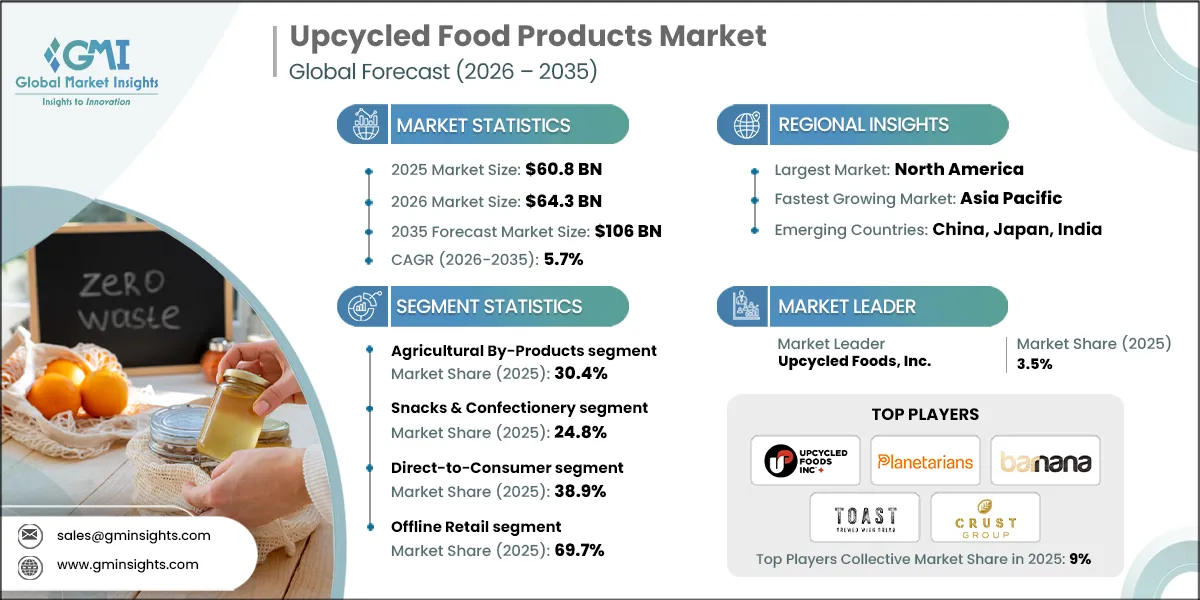
The global upcycled food products market was valued at USD 60.8 billion in 2025. The market is expected to grow from USD 64.3 billion in 2026 to USD 106 billion in 2035, at a CAGR of 5.7% according to latest report published by Global Market Insights Inc.
Upcycled Food Products Market Key Takeaways
Market Size & Growth
- 2025 Market Size: USD 60.8 Billion
- 2026 Market Size: USD 64.3 Billion
- 2035 Forecast Market Size: USD 106 Billion
- CAGR (2026–2035): 5.7%
Regional Dominance
- Largest Market: North America
- Fastest Growing Region: Asia Pacific
Key Market Drivers
- Rapid Growth in Consumer Demand for Sustainable and Ethical Food Consumption.
- Global Food Waste Reduction Mandates Supporting Circular Economy Business Models.
- Corporate ESG Commitments Increasing Use of Sustainable Ingredients in Product Formulations.
Challenges
- Consumer Skepticism Around Safety, Quality, and Taste of Upcycled Products.
- Inconsistent Availability and Quality of Food Processing By-Product Feedstocks.
Opportunity
- Expansion of High-Margin B2B Ingredients for Food and Beverage Manufacturers.
- Development of Functional Foods and Nutraceuticals from Bioactive Waste Compounds.
Key Players
- Market Leader: Upcycled Foods, Inc. led with over 3.5% market share in 2025.
- Leading Players: Top 5 players in this market include Upcycled Foods, Inc., Planetarians, Barnana, PBC, Toast Ale Ltd., CRUST Group Pte. Ltd., which collectively held a market share of 9% in 2025.
Get Market Insights & Growth Opportunities
- The upcycled food products is experiencing rapid growth, driven by sustainability trends, increasing consumer awareness, and technological innovations. Companies are transforming food waste, agricultural by-products, brewery residues, and processing by-products into functional ingredients, enabling higher nutritional value, longer shelf lives, and diversified product offerings.
- Agricultural by-products make up the largest share of the market, 30.3%, in 2025. It is anticipated that market share will increase at a compound annual growth rate of 6% per year from 2025 through 2035. Brewery and distillation waste in the recycled food industry is growing at an average annual growth rate of 6.2%; this growth has been fueled by the high protein content of this material, as it is often used as a source of protein in many products that are functional in how they perform.
- Snack and confectionary segment has the largest market share at 24.8% in 2025. This segment is experiencing fast growth due to strong consumer acceptance of this product type, opportunity for impulse purchase, and the opportunity to create a positive sustainable brand image. Bakery/cereal, prepared meals, dairy, and ingredient and supplement products are also growing and see increased integration of upcycled agricultural food products into the mainstream market.
- The direct-to-consumer market continues to be the largest end-user market with a share of 38.9% and B2B ingredient producers are the fastest-growing segment at a CAGR of 6.3% due to increased Supply Chain Security (IED) through the development of functional and stable long-term supply agreements.
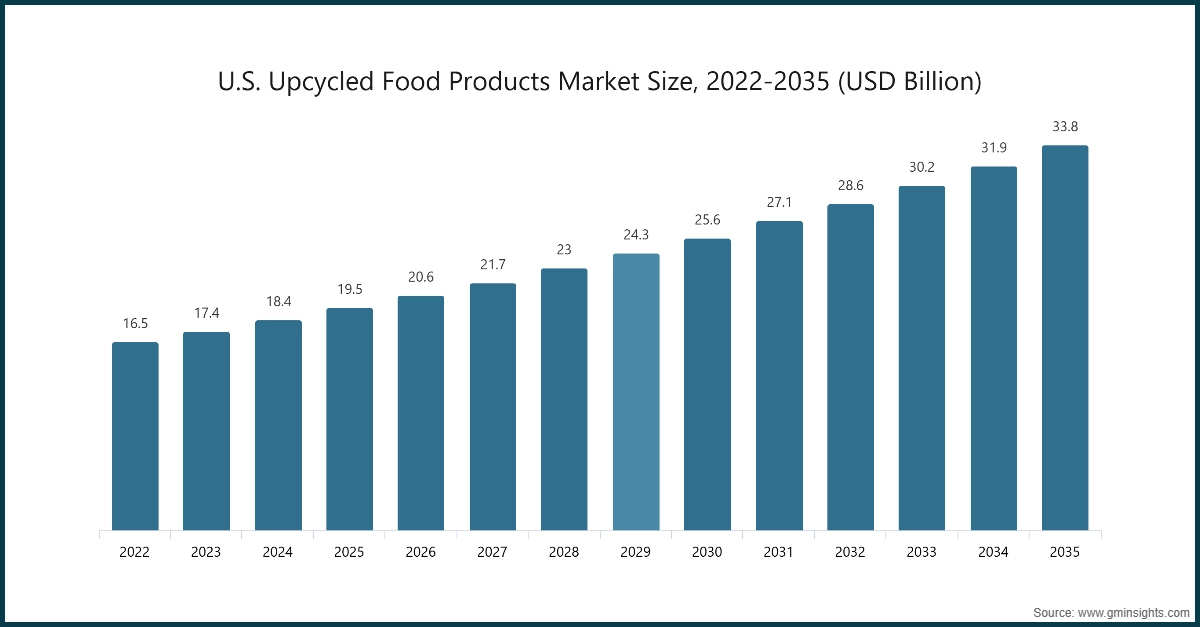
- North America market is projected to have revenue of USD 24.3 billion. In Europe, 30% of the market was driven by Circular Economy Programs and Consumer Awareness of Sustainability. The Asia Pacific region will see a CAGR of 6.4% driven by Urbanization, Expansion of the Middle Class and Adoption of Plant-Based Products.
- Latin America and MEA are emerging as a major growth area with the Growth of the Regulatory Frameworks, urbanization and Government Backed Circular Economy Initiatives. Overall, the continued Expansion and Innovation of the Industry will lead to the Continued Mainstream Adoption of new products and methods of distribution until 2035.
To get key market trends
Upcycled Food Products Market Trends
- Food products made from recyclables and surplus food materials are growing in popularity as businesses by making larger, more mass produced items that use recycled materials. Businesses are already starting to add food by-products into their final products. Their reasons for doing so include the fact that there is a large market for these types of food products.
- Using advanced processing methods has allowed companies to take traditional, low-value finished food product waste and turn it into a functional food ingredient. These technological advancements will ultimately improve shelf lives and provide higher nutritional values for some of these wasted food products. Differentiation through new technologies is becoming an important factor for companies to succeed in the recycled food industry; therefore, these companies are investing in new technology, forming joint ventures, and filing patents with respect to the recycled food industry.
Upcycled Food Products Market Analysis

Learn more about the key segments shaping this market
Based on source type, the upcycled food products market is segmented into Food Waste, Agricultural By-Products, Brewery & Distillery Waste, Food Processing By-Products, and Others. Agricultural By-Products dominated the market with an approximate market share of 30.4% in 2025 and is expected to grow with a CAGR of 6% through 2035.
- Agriculture-based by-products dominate the marketplace, with the largest share occurring in 2025, which will continue to be driven by the predictability of supply chains and the scalability of the industrial process. Between 2025 and 2034, the total market for agriculture-based by-products will continue to increase annually through compound annual growth rates of approximately 6%.
- Food waste generated from retail and the home will play a major role in increasing overall demand in 2025, with a combined value of USD 15.8 billion, due to sustainability efforts, as well as from urban recycling programs. However, logistical complexity and variability will limit the future expansion of this area relative to agricultural inputs.
- Brewery and distillery by-products have the fastest growth potential at 6.2% CAGR, stemming from high-protein areas, as well as many other functional uses of by-products produced during the brewing process, including spent grains and yeast. While the market for these by-products in 2025 will still be much smaller, demand and market share will become increasingly competitive due to Continued technology innovations.
- By-products associated with food processing have historically occupied a steady mid-range position, primarily due to manufacturer-finished product traceability and long-term supply agreements. By-products from other sources such as fruit peel or pulp residues are niche products that represent incremental growth in specialized applications.
- Food processing by-products maintain a stable mid-tier position, favored for traceability and long-term supply contracts. Other sources, including fruit peels and pulp residues, remain niche but contribute incremental growth in specialty applications.

Learn more about the key segments shaping this market
Based on product type, the upcycled food products market is segmented into Snacks & Confectionery, Bakery & Cereal Products, Dairy Alternatives & Frozen, Ingredients & Supplements, Prepared Foods & Meals, Personal Care Products, Pet Food, and Household Products. Snacks & Confectionery held the largest market share of 24.8% in 2025 and is expected to grow at a CAGR of 5.5% during 2025 to 2034.
- The snack and confectionery products accounted for the largest portion of overall sales in 2025 due to consumer familiarity, impulse purchase behaviour and strong sustainability branding. Their expansion and continuing growth is expected to parallel overall market growth through to 2034.
- Bakery and cereal products represent one of the strongest / fastest growing segments of the market at a CAGR of 5.5%, having increased share by successfully integrating "upcycled" (recycled) flours and fibres with grains into everyday food products.
- Ingredient and supplement products are also a strategic importance to the marketplace since they account for a large percentage of what will be sold in 2025 and continue to grow as Food Manufacturers (B2B) look for cost effective and sustainable formulation inputs.
- The prepared foods and meal products segment is expected to reach USD 9.1billion by 2026. The segment has increased its consumer appeal, particularly to foodservice and institutional channels.
- Dairy Alternative and Frozen Products will continue to see steady growth as a result of innovation regarding plant based foods. While Personal Care and Household Care product segments remain smaller revenue streams, these segments produce high margins based on bioactive compounds that can be derived from the use of food waste. Pet Food continues to maintain a consistent market share as a result of regulatory limitations, yet gaining strength due to the popularity of functional nutrition trends.
Based on end user, the upcycled food products market is segmented into Direct-to-Consumer, Food Service & Hospitality, Ingredient Manufacturers (B2B), Institutional & Government, Pet Care Industry, and Beauty & Personal Care. Direct-to-Consumer segment dominated the market with an approximate market share of 38.9% in 2025 and is expected to grow with the CAGR of 5.6% till 2035.
- Direct-to-consumer is projected to capture the largest market share due to consumer's increased awareness of sustainability and brand transparency.B2B Ingredient manufacturers are projected to be the fastest-growing end-user segment at 6.3%.
- The B2B ingredient market will grow rapidly over the next 10 years primarily due to the large-scale integration of upcycled ingredients into mainstream food production, and its growth will be driven by the demand for stability, functionality, and long-term supply agreements resulting from B2B ingredient suppliers needing to be established.
- In 2025, food service and hospitality, valued at USD 12.1 billion, form a substantial mid-tier segment, supported by corporate sustainability commitments and waste-reduction targets.
- Institutional and government adoption accelerates from a smaller base, benefiting from public procurement mandates and circular economy policies. Pet care remains stable, while beauty and personal care expands selectively, using upcycled compounds for functional and sensory benefits.
Based on distribution channel, the upcycled food products market is segmented into Online / E-Commerce, and Offline Retail. Offline Retail segment dominated the market with an approximate market share of 69.7% in 2025 and is expected to grow with the CAGR of 5.6% up to 2035.
- Offline retail is predicted to dominate the overall market in 2025 with product support through grocery, specialty, foodservice. While it has moderate growth relative to online/ecommerce through 2034, its size, trustworthiness and institutional purchasing relationships provide it with continued strength in the marketplace.
- Online/ecommerce is anticipated to see the highest growth rate at 6% and will increase significantly from 2025 to 2034 and gain incremental market share. The ability to engage directly with consumers, tell stories about sustainability, and offer subscription models supports emerging brands on digital platforms.
- Logistics cost, perishability and complexity of Fulfillment will limit the complete substitution of offline channels for the B2B/institutional channels. It is important to note that offline procurement channels still play a vital role in B2B, institutional purchasing due to the large purchase quantities required, and contracts established with those vendors.
Looking for region specific data?
North America upcycled food products market leads the industry with revenue of USD 24.3 billion in 2025 and is anticipated to show lucrative growth over the forecast period.
- North America is an important region in developing and producing upcycled food products, with increased awareness of sustainability, large consumer demand, and strong regulations promoting the reduction of waste.
- Both the U.S. and Canada lead innovation in food products, especially in snacks and food ingredients and plant-based food supplies, due to their established supply chain networks and advancements in food processing technologies.
- Corporate and institutional sustainability commitments underpin the growing demand for upcycled food products, and growing digital and off-line channels allow for wide distribution of these products across the North America region. North America is a key player in innovating food technology and has become a global center for Business to Business (B2B) integration of upcycled food products.
The Europe upcycled food products industry is growing rapidly on the global level with a market share of 29.9% in 2025.
- Europe's stringent environmental regulations, circular economy policies, and increasing consumer awareness of sustainability are driving the adoption of upcycling in food categories such as snacks, drinks and condiments; Germany, the UK and France lead the way with certification programs for upcycling.
- Collaboration between food manufacturers, governmental authorities and non-profit organisations (NGOs) to create awareness and generate demand for waste valorisation; the e-commerce and specialty retail businesses have improved distribution and created a demand-driven environment for upcycling, while the institutional and hospitality industries are providing a more stable demand for upcycled food products. Europe is viewed as an innovative and regulated marketplace that supports both direct-to-consumer and business-to-business applications of upcycled food products.
The Asia Pacific upcycled food products market is anticipated to grow at a CAGR of 6.4% during the analysis timeframe.
- The Asia-Pacific region is emerging as a high-growth area due to its large population base, increased rate of urbanisation and increased environmental consciousness. Countries such as China, India, Japan and South Korea are taking the lead in the adoption of plant-based and functional products.
- Foodservice, retail modernisation and the growth of the middle class have created greater opportunities for the widespread integration of upcycled ingredients into the global food supply. Supply chain impediments remain; however, investment in technology and government incentives within circular economy programs are facilitating the commercialisation of upcycled food in both consumer and industrial segments.
Latin America upcycled food products accounted for 5.8% market share in 2025 and is anticipated to show highest growth over the forecast period.
- The continued growth of Latin America is supported by the abundance of agricultural byproducts and the increasing awareness of sustainability in South America, particularly in Brazil, Mexico, and Argentina. The Food Service, Snack, and Ingredient Segments continue to expand due to increased urbanization and consumer demand for environmentally friendly products.
- There is a rapid evolution of regulatory frameworks in the region. The ability to partner with large multinational players in the food industry will continue to improve supply chain efficiencies and create avenues for the growth of the upcycled foods market in the region. Although the current upcycled foods market remains in its infancy, the market presents significant opportunities for technology adoption, enhanced B2B integration, and localized innovation in the creation of plant-based and functional upcycled products.
Middle East & Africa upcycled food products accounted for 2.7% market share in 2025 and is anticipated to show lucrative growth over the forecast period.
- The emerging MEA market is rapidly developing into an area for upcycled food products and is primarily supported by the growth of urban populations and an increase in government-led sustainability initiatives in the region. The lead regional hubs are currently UAE, Saudi Arabia, and South Africa and are leveraging foodservice, hospitality, and retail sectors.
- Supply chain and cold chain infrastructures are still developing in this region; however, government-backed circular economy policies are encouraging food waste valorization through initiatives promoting upcycled food products. High-value ingredient, plant-based food product, and functional applications are all niche opportunities within the MEA region. Additionally, digital channels and institutional procurements are expected to be utilized to promote and support initial adoption and subsequent expansion of the upcycled food market in this region.
Upcycled Food Products Market Share
The top 5 companies in upcycled food products industry include Upcycled Foods, Inc., Planetarians, Barnana, Toast Ale Ltd., and CRUST Group Pte. Ltd. These are prominent companies operating in their respective regions covering approximately 9% of the market share in 2025. These companies hold strong positions due to their extensive experience in upcycled food products market. Their diverse product portfolios, backed by robust production capabilities and distribution networks, enable them to meet the rising demand across various regions.
Upcycled Foods, Inc. based out of San Francisco utilizes a unique ingredient called SuperGrain + which is made from upcycled grains to create a variety of products. The company also provides an innovation lab to further develop sustainable ingredient solutions for their partners, as well as being a strong supporter of environmental responsibility through its B Corp Certification and 1% for the Planet initiative. The intent is to create more opportunities for upcycled foods in both B2B and consumer applications on a large scale.
Planetarians is a startup out of Hayward, California that is developing plant-based meat products with the use of brewer's spent yeast from the brewery. The company has partnered with Anheuser-Busch InBev and has developed patented processing technology that takes brewery waste and converts it into high-protein, sustainable foods. Planetarians is an active, profitable company and is known as an innovator for both B2B and consumer markets in the area of upcycled protein products based on a circular economy approach.
Barnana is a brand based in Santa Monica, California and creates organic snacks from rescued plantains and bananas. Barnana is an actively certified B Corp that emphasizes sustainability and waste reduction, as well as ethical sourcing. Barnana is focused primarily on selling its products through direct-to-consumer channels as well as retail-based channels, with an emphasis on storytelling and functional, plant-based snacking to create visibility for its products globally among consumers.
Toast Ale Ltd. Creates Craft Beers with Waste Bread; The Company focused on Sustainable Circular Economic Practice; Through Partnerships with Heineken; Toast Ale Ltd.'s Goals of Reducing Waste and When Appropriate; An Innovative Approach to Craft Beer Produce from Waste; The Company Teaches Environmental Responsibility and Supports the Authenticity of Beer Brands via Its Innovative Brew Process; The Company Taught Environmental Responsibility Support Brand Authenticity Through Its Innovative Brew Process.
CRUST Group Pte. Ltd. was founded in Singapore and operates throughout Asia developing Craft Beer using upcycled Fruits; it is having a measurable effect on environmentally responsible waste reduction and lower the price per unit of production. The company has utilized circular economies to build a strong reputation as an organization that utilizes waste for something beneficial; it offers a substantial variety of innovative circular economy solutions to food and drink both B2C and B2B product offerings that utilize upcycled crops.
Upcycled Food Products Market Companies
Major players operating in the upcycled food products industry include:
- Barnana
- CRUST Group Pte. Ltd.
- Green Bowl Foods
- I Am Grounded
- Matriark Foods
- Planetarians
- Rootly ApS
- Rubies in the Rubble Ltd.
- Toast Ale Ltd.
- Upcycled Foods, Inc.
Upcycled Food Products Market Report Attributes
| Key Takeaway | Details |
|---|---|
| Market Size & Growth | |
| Base Year | 2025 |
| Market Size in 2025 | USD 60.8 Billion |
| Market Size in 2026 | USD 64.3 Billion |
| Forecast Period 2026-2035 CAGR | 5.7% |
| Market Size in 2035 | USD 106 Billion |
| Key Market Trends | |
| Drivers | Impact |
| Rapid Growth in Consumer Demand for Sustainable and Ethical Food Consumption | Accelerates adoption of upcycled products, driving premium pricing, brand loyalty, and faster retail shelf penetration. |
| Global Food Waste Reduction Mandates Supporting Circular Economy Business Models | Encourages food manufacturers to monetize waste streams, expanding supply and legitimizing upcycled food commercialization. |
| Corporate ESG Commitments Increasing Use of Sustainable Ingredients in Product Formulations | Drives B2B ingredient demand as brands integrate upcycled inputs to meet sustainability targets. |
| Pitfalls & Challenges | Impact |
| Consumer Skepticism Around Safety, Quality, and Taste of Upcycled Products | Slows mass adoption, increases marketing and education costs, and limits penetration beyond sustainability-focused consumers. |
| Inconsistent Availability and Quality of Food Processing By-Product Feedstocks | Creates supply volatility, complicates scale-up, and raises production costs for manufacturers. |
| Opportunities: | Impact |
| Expansion of High-Margin B2B Ingredients for Food and Beverage Manufacturers | Improves profitability through bulk sales, long-term contracts, and integration into mainstream food formulations. |
| Development of Functional Foods and Nutraceuticals from Bioactive Waste Compounds | Enables premium positioning and entry into health-focused categories with higher margins. |
| Market Leaders (2025) | |
| Market Leader |
3.5% market share |
| Top Players |
Collective market share in 2025 is 9% |
| Competitive Edge |
|
| Regional Insights | |
| Largest Market | North America |
| Fastest growing market | Asia Pacific |
| Emerging countries | China, Japan, India |
| Future outlook |
|
What are the growth opportunities in this market?
Upcycled Food Products Industry News
- In June 2025, Foodvalley launched the Upcycled4Food Initiative at the “Towards Halving Food Waste in Europe” conference, aiming to make upcycled foods and ingredients the new normal. Nearly 50 stakeholders collaborated on a Position Paper outlining strategies for side-stream utilization, creating innovative products, and fostering partnerships across producers, retailers, and foodservice companies to advance circular agrifood systems.
- In May 2025, Del Monte Foods’ JOYBA Bubble Teas received Upcycled Certified status, reclaiming 265 tons of sweetened syrup and promoting food waste reduction. Building on previous certifications for green beans, this initiative strengthens sustainable practices, enhances consumer awareness, and demonstrates leadership in the upcycled food industry while delivering functional and enjoyable beverages.
This upcycled food products market research report includes in-depth coverage of the industry, with estimates & forecasts in terms of revenue (USD Billion) and volume (Kilo Tons) from 2022 to 2035, for the following segments:
Market, By Source Type
- Food Waste
- Agricultural By-Products
- Brewery & Distillery Waste
- Food Processing By-Products
- Others
Market, By Product Type
- Snacks & Confectionery
- Bakery & Cereal Products
- Dairy Alternatives & Frozen
- Ingredients & Supplements
- Prepared Foods & Meals
- Personal Care Products
- Pet Food
- Household Products
Market, By End user
- Direct-to-Consumer
- Food Service & Hospitality
- Ingredient Manufacturers (B2B)
- Institutional & Government
- Pet Care Industry
- Beauty & Personal Care
Market, By Distribution Channel
- Online / E-Commerce
- Offline Retail
The above information is provided for the following regions and countries:
North America
- U.S.
- Canada
Europe
- Germany
- UK
- France
- Spain
- Italy
- Rest of Europe
Asia Pacific
- China
- India
- Japan
- Australia
- South Korea
- Rest of Asia Pacific
Latin America
- Brazil
- Mexico
- Argentina
- Rest of Latin America
Middle East and Africa
- Saudi Arabia
- South Africa
- UAE
- Rest of Middle East and Africa
Frequently Asked Question(FAQ) :
What was the market size of the upcycled food products in 2025?
The market size was USD 60.8 billion in 2025, with a CAGR of 5.7% expected through 2035. Growth is driven by sustainability trends, increasing consumer awareness, and technological advancements.
What is the projected value of the upcycled food products market by 2035?
The market is poised to reach USD 106 billion by 2035, fueled by innovations in processing technologies, rising demand for sustainable products, and the integration of food by-products into final offerings.
What is the expected size of the upcycled food products industry in 2026?
The market size is projected to reach USD 64.3 billion in 2026.
What was the market share of the agricultural by-products segment in 2025?
The agricultural by-products segment held a market share of approximately 30.4% in 2025 and is expected to grow at a CAGR of 6% through 2035.
What was the valuation of the snacks & confectionery segment in 2025?
The snacks & confectionery segment accounted for 24.8% of the market share in 2025 and is set to expand at a CAGR of 5.5% from 2025 to 2034.
What is the growth outlook for the direct-to-consumer segment through 2035?
The direct-to-consumer segment dominated the market with a 38.9% share in 2025 and is anticipated to observe around 5.6% CAGR till 2035.
Which region leads the upcycled food products sector?
North America leads the market, generating USD 24.3 billion in revenue in 2025. The region benefits from increased sustainability awareness, strong consumer demand, and stringent waste reduction regulations.
What are the upcoming trends in the upcycled food products market?
Use of advanced technologies to turn food waste into functional ingredients, strong focus on innovation and patents/joint ventures, integration of by-products into finished foods, and rising demand for sustainable snacks and confectionery.
Who are the key players in the upcycled food products industry?
Key players include Barnana, CRUST Group Pte. Ltd., Green Bowl Foods, I Am Grounded, Matriark Foods, Planetarians, Rootly ApS, Rubies in the Rubble Ltd., Toast Ale Ltd., and Upcycled Foods, Inc.
Upcycled Food Products Market Scope
Related Reports