Summary
Table of Content

Ulcerative Colitis Market
Get a free sample of this report
Form submitted successfully!
Error submitting form. Please try again.
Thank you!
Your inquiry has been received. Our team will reach out to you with the required details via email. To ensure that you don't miss their response, kindly remember to check your spam folder as well!
Request Sectional Data
Thank you!
Your inquiry has been received. Our team will reach out to you with the required details via email. To ensure that you don't miss their response, kindly remember to check your spam folder as well!
Form submitted successfully!
Error submitting form. Please try again.
Ulcerative Colitis Market Size
One of the major factors contributing to the growth of this market is the rising prevalence of the disease. Urbanization, changes in diet, and environmental factors are leading to a higher incidence of inflammatory bowel diseases (IBD), such as ulcerative colitis. Along with this increase in prevalence, there is also better awareness of the disease, encouraging earlier diagnosis and treatment, which in turn boosts demand for medical therapies. For instance, according to an article in Lancet, globally about 5 million people suffered from ulcerative colitis in 2023, indicating that the chronic inflammatory bowel disease has been an increasing burden in the world. The rising prevalence of ulcerative colitis has expanded the global patient pool, driving higher demand for effective treatments.
Another factor behind the ulcerative colitis market is the development of treatment options. The introduction of biologics (such as anti-TNF agents like infliximab and adalimumab, integrin inhibitors like vedolizumab, and IL-12/23 inhibitors like ustekinumab) has significantly increased the treatment options for moderate to severe ulcerative colitis. Additionally, advances in imaging, endoscopy, and biomarkers have improved early diagnosis and treatment initiation, leading to better management of ulcerative colitis and increased use of both conventional and newer therapies. Moreover, the increasing healthcare budgets in the developed as well as the emerging markets are leading to the uptake of advanced treatments for ulcerative colitis, thus contributing to market expansion.
Ulcerative Colitis Market Key Takeaways
Market Size & Growth
- 2025 Market Size: USD 8.3 Billion
- 2026 Market Size: USD 8.7 Billion
- 2035 Forecast Market Size: USD 14.5 Billion
- CAGR (2026–2035): 5.8%
Regional Dominance
- Largest Market: North America
- Fastest Growing Region: Asia Pacific
Key Market Drivers
- Increasing prevalence of ulcerative colitis.
- Expanding treatment options.
- Increasing awareness and diagnosis.
Challenges
- High treatment costs.
- Side effects and safety concerns.
Opportunity
- Growing demand and utilization of combination therapies.
- Development of pediatric ulcerative colitis treatment.
Key Players
- Market Leader: AbbVie led with over 21.3% market share in 2025.
- Leading Players: Top 5 players in this market include AbbVie, Johnson & Johnson, Takeda Pharmaceutical Company, Pfizer, Bristol-Myers Squibb, which collectively held a market share of 58.2% in 2025.
Get Market Insights & Growth Opportunities
Ulcerative colitis is a form of inflammatory bowel disease that causes long-lasting inflammation and ulcers (sores) in the innermost part of the colon and rectum. The condition disrupts normal digestive processes and hence results in symptoms such as diarrhea, abdominal pain, tiredness, and weight loss. Key players operating in the global market including AbbVie, Johnson & Johnson, Takeda Pharmaceutical Company, Pfizer, and Bristol Myers Squibb collectively accounted for approximately 58.2% of the global ulcerative colitis industry. This significant market concentration indicates that there is a strong presence of advanced biologics and small-molecule therapies by these companies. Innovations in targeted immunotherapies, enhanced drug delivery systems, and extended regulatory approvals are continuously driving their competitive position. Ongoing clinical pipeline developments are set to increase the competition and shape the future landscape of the market.
This growth was driven not only by the rising prevalence of the disease but also by the increasing adoption of advanced biologics and targeted therapies, which offer improved efficacy and safety over conventional treatments. Expanding clinical research and the introduction of new therapies such as oral small-molecule drugs and combination treatments, further contributed to market expansion. Additionally, increasing urbanization, lifestyle changes, and the growing demand for patient-centric care, supported by improved healthcare infrastructure and reimbursement policies, played a significant role in enhancing treatment access and uptake during this period.
The global ulcerative colitis market was valued at USD 8.3 billion in 2025. The market size is estimated to grow from USD 8.7 billion in 2026 to USD 14.5 billion in 2035, growing at a CAGR of 5.8% from 2026 - 2035, according to the latest report published by Global Market Insights Inc.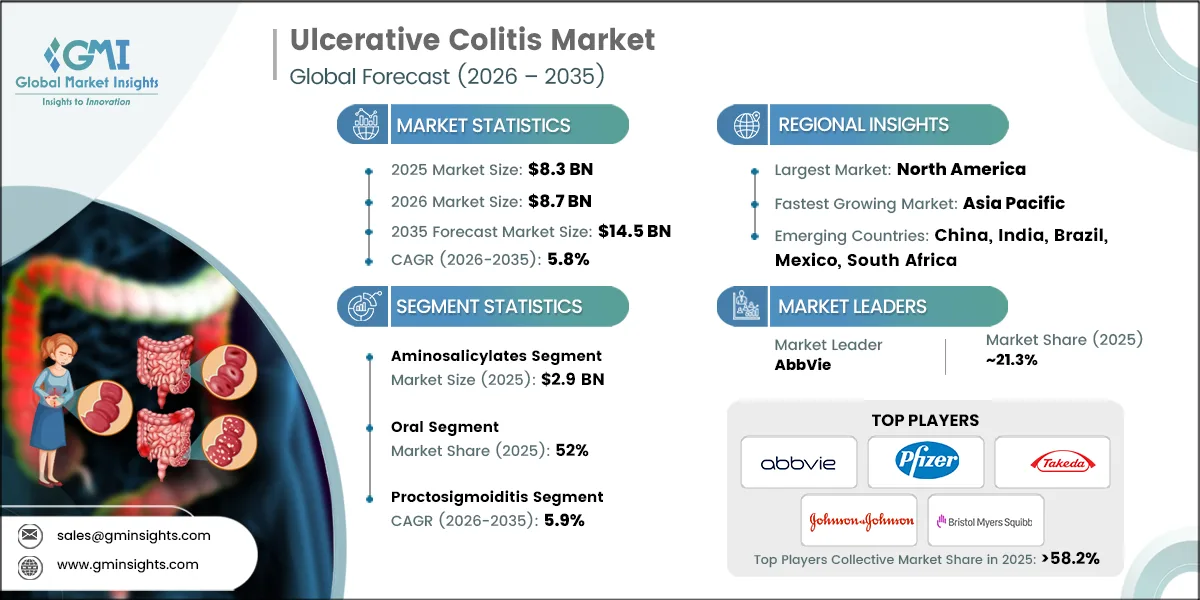
To get key market trends
Ulcerative Colitis Market Trends
The ulcerative colitis industry is witnessing steady growth driven by several key trends shaping the competitive landscape and opening new opportunities.
- The rising incidence of diseases together with the growing awareness among patients and healthcare professionals have resulted in earlier diagnosis and intervention, which in turn is driving the demand for treatment.
- For instance, as per Gastroenterology Advisor, the annual incidence of ulcerative colitis is about 15 new cases per 1000,000 people. This increasing number of patients has encouraged the development and expansion of treatment options, including advanced biologics, targeted small-molecule inhibitors, and combination therapies, providing clinicians with a broader spectrum of tools to manage moderate-to-severe cases.
- The adoption of biologics and novel therapies is one of the main trends influencing market dynamics. For instance, following its FDA approval in 2024, Skyrizi, the first IL, 23 inhibitors approved for both ulcerative colitis and Crohn's disease, has been gaining popularity. At the same time, selective S1P receptor modulators such as Velsipity have been rolled out in key regions, expanding oral treatment options.
- Besides therapeutic innovation, the introduction and use of biosimilars are making high-cost biologic therapies more affordable, especially in emerging markets, thereby expanding patient access and increasing overall market penetration.
- Additionally, there is an increasing emphasis on combination therapies that improve remission rates and reduce relapses, which is shaping prescribing patterns and creating new market opportunities.
- Collectively, these trends highlight a rapidly advancing market, driven by innovation, broader treatment access, and personalized patient care, setting the stage for sustained growth in the years ahead.
Ulcerative Colitis Market Analysis

Learn more about the key segments shaping this market
Based on drug type, the ulcerative colitis market is segmented into aminosalicylates, biologics, corticosteroids, Janus kinase (JAK) inhibitors, immunosuppressants, and other drug types. The aminosalicylates segment accounted for USD 2.9 billion in 2025.
- Aminosalicylates, such as mesalamine and sulfasalazine, are widely prescribed as first-line treatments for mild to moderate ulcerative colitis. Their ability to effectively reduce inflammation and maintain remission makes them a go-to option for early-stage management of the disease.
- This drug class is suitable for a large proportion of ulcerative colitis patients, including those with localized forms like ulcerative proctitis or left-sided colitis. This versatility in addressing different disease severities contributes to its strong market performance.
- Additionally, aminosalicylates are cost-effective compared to advanced therapies like biologics and JAK inhibitors, making them an accessible option for a broad range of patients, especially in regions with limited healthcare budgets.
- On the other hand, the biologics segment is anticipated to witness growth at a CAGR of 6.1% over the analysis period due to their higher efficacy and safety compared to conventional therapies.
- Additionally, the growing focus on personalized medicine, where biologic therapy is tailored based on biomarkers or disease severity, is further boosting the segment’s growth potential and shaping future market dynamics.
Based on the disease type, the ulcerative colitis market is categorized into proctosigmoiditis, ulcerative proctitis, left-sided colitis, pancolitis or universal colitis, and fulminant colitis. The proctosigmoiditis segment dominated the market and is anticipated to witness growth at 5.9% CAGR over the analysis period.
- This growth is largely driven by the high prevalence of proctosigmoiditis, a common form of ulcerative colitis affecting the rectum and sigmoid colon, which represents a significant share of ulcerative colitis cases.
- Additionally, the availability of targeted therapies, such aminosalicylates and corticosteroids, has proven highly effective in managing this localized disease, contributing to the segment's robust market performance.
- Improved diagnostic tools and greater awareness of ulcerative colitis have facilitated earlier detection and management of proctosigmoiditis, further boosting demand for treatment options.
- On the other hand, ulcerative proctitis segment is expected to grow at 6.2% during the forecast period, driven by the rising prevalence of this localized form of ulcerative colitis and increased awareness among patients and healthcare providers.
- Further, expanding healthcare infrastructure and reimbursement support in key regions are further contributing to the segment’s growth.

Learn more about the key segments shaping this market
Based on the route of administration, the ulcerative colitis market is divided into oral and injectable. The oral segment accounted for 52% market share in 2025.
- The growth is driven by its convenience, broad applicability, and cost-effectiveness. Oral medications, including aminosalicylates, JAK inhibitors, and immunosuppressants, are widely preferred by patients for their ease of administration and non-invasive nature.
- Advancements in oral formulations, such as delayed-release and targeted delivery systems, have enhanced the efficacy and tolerability of these treatments, increasing their adoption.
- Additionally, they are more accessible and affordable compared to biologics and injectables. Thus, these factors are expected to drive the growth of this segment.
- The injectable segment is predicted to grow at 6.1% CAGR over the coming years due to the high efficacy and safety of biologic therapies, including anti-TNF agents, integrin receptor antagonists, and IL-23 inhibitors, which are preferred for moderate-to-severe ulcerative colitis.
- Advancements in delivery systems, such as auto-injectors and self-administration options, are improving patient convenience and adherence, thereby driving the market growth.
Based on the distribution channel, the ulcerative colitis market is classified into hospital pharmacies, retail pharmacies and online pharmacies. In 2025, the hospital pharmacies segment held highest market share and expected to grow at 5.6% CAGR over the analysis period.
- Hospital pharmacies are critical for dispensing these complex treatments, as they offer expert drug administration and closely monitor patients for potential side effects, ensuring optimal outcomes.
- Additionally, the rising number of hospital admissions due to ulcerative colitis complications further boosts the demand for hospital pharmacy services. The integration of hospital pharmacies with healthcare providers enhances coordinated care and improves patient outcomes.
- With better access to insurance coverage and reimbursement, hospital pharmacies also make high-cost treatments more accessible to patients. These factors collectively contribute to the dominant role of hospital pharmacies in the market and its expected growth in the future.

Looking for region specific data?
North America Ulcerative Colitis Market
The North America market held the largest market share of 41.2% in 2025 in the global ulcerative colitis industry, and it is anticipated to expand at 5.6% CAGR over the forecast period.
- Well-established healthcare infrastructure, widespread access to advanced therapies, and strong reimbursement support make biologics and novel therapies more accessible to patients. The region also benefits from early diagnosis and growing awareness among patients and healthcare providers, which increases treatment adoption.
- Additionally, North America is a hub for pharmaceutical innovation, with frequent approvals of new biologics, small-molecule inhibitors, and combination therapies, further strengthening the market.
- The presence of key industry players investing heavily in research, clinical trials, and patient support programs also contributes to sustained growth in this region.
The U.S. ulcerative colitis market reached USD 3.2 billion in 2025, growing from USD 3 billion in 2024.
- As per National Institute of Diabetes and Digestive and Kidney Disease, around 600,000 to 900,000 people in the U.S. have ulcerative colitis. This large patient population naturally drives the demand for ulcerative colitis treatments, contributing significantly to the market's growth in the country.
- Another driving factor is the increasing diagnosis and awareness rates of ulcerative colitis. As awareness improves and diagnostic methods advance, more individuals seek medical attention for ulcerative colitis symptoms, leading to higher diagnosis rates and treatment uptake.
Europe Ulcerative Colitis Market
The Europe market was valued at USD 2.3 billion in 2025 and is anticipated to witness strong growth over the forecast period.
- The growth is driven by the increasing prevalence of the disease across key countries such as Germany, France, and the U.K. Robust healthcare infrastructure, increasing patient awareness, and timely diagnosis are contributing to greater adoption of treatments.
- Additionally, the availability of advanced therapies, including biologics, small-molecule inhibitors, and combination treatments, along with supportive reimbursement policies, is facilitating market expansion.
Germany ulcerative colitis market is predicted to grow remarkably in coming years.
- Germany has a large and growing population of individuals diagnosed with ulcerative colitis, with a high prevalence of inflammatory bowel diseases in Western Europe. As awareness of ulcerative colitis increases and more people seek medical attention for their symptoms, the demand for effective treatments is expected to rise, contributing to the overall market growth.
- Further, with a robust healthcare system that supports the use of advanced therapies, patients in Germany have access to the latest treatments, boosting the demand for high-cost, high-efficacy options like biologics, further driving market expansion.
Asia Pacific Ulcerative Colitis Market
The Asia Pacific market is expected to witness strong growth, growing at a CAGR of 6.2% between 2026 – 2035, driven by increasing urbanization, lifestyle changes, and adoption of Western diets, which are linked to higher incidence of the disease.
- Government initiatives aimed at improving access to advanced therapies, promoting early diagnosis, and supporting research and awareness campaigns are strengthening the market and driving sustained growth.
- Additionally, improvements in diagnostic technologies and the availability of patient support programs are facilitating better disease management, thereby contributing to the market growth.
India ulcerative colitis market is anticipated to experience lucrative growth over the forecast period.
- As awareness about ulcerative colitis rises, more people are seeking medical attention, leading to earlier diagnoses and higher treatment demand. Additionally, advancements in biologic therapies and immunosuppressants are becoming more accessible in India, boosting the market for advanced treatments.
- Moreover, the country’s growing aging population and increasing urbanization further contribute to the market expansion, as these factors are associated with a higher incidence of chronic diseases like ulcerative colitis.
Latin America Ulcerative Colitis Market
Brazil's market is projected to showcase significant growth over the analysis period in the Latin America ulcerative colitis industry.
- Brazil's market is expected to grow due to increased investment in research and development, expanding clinical trials, and the introduction of innovative therapies.
- Additionally, improved healthcare access through the Sistema Único de Saúde (SUS) and private insurance, along with government support for biologic therapies, will boost treatment availability.
- Moreover, public health campaigns raising awareness contribute to early diagnosis, further driving market growth and competition for ulcerative colitis treatments.
Middle East and Africa Ulcerative Colitis Market
Saudi Arabia ulcerative colitis industry is poised to grow in coming years in the Middle East and Africa market.
- As part of Vision 2030, Saudi Arabia is improving healthcare access and quality, focusing on reducing chronic diseases like ulcerative colitis. The government is increasing access to biologic therapies through public health programs and insurance coverage. Rising awareness about ulcerative colitis is leading to earlier diagnoses and better disease management.
- Significant investments in healthcare infrastructure and specialized care ensure patients have access to advanced treatments, including biologics and immunosuppressants, driving market growth.
Ulcerative Colitis Market Share
The market is characterized by a competitive landscape comprising both pharmaceutical giants and biotechnology companies. These players are actively investing in research and development to introduce innovative drugs and therapies that address unmet medical needs, including advanced biologics, small-molecule inhibitors, and combination therapies. With a growing emphasis on precision medicine, companies are increasingly targeting specific patient subgroups to enhance treatment efficacy and safety, thereby improving overall clinical outcomes. Market dynamics are also shaped by factors such as drug pricing, access to healthcare, and regulatory approvals, which influence the speed of product launches and adoption.
Among the key players, AbbVie, Johnson & Johnson, Takeda Pharmaceutical Company, Pfizer, and Bristol Myers Squibb collectively account for approximately 58.2% of the global market, highlighting the dominance of established companies in driving innovation, shaping treatment standards, and capturing significant market share. This concentration underscores the importance of strategic R&D, pipeline expansion, and patient-centric approaches as companies compete to address the evolving needs of the ulcerative colitis patient population.
Ulcerative Colitis Market Companies
Prominent players operating in the ulcerative colitis industry are as mentioned below:
- AbbVie
- Bausch Health Companies
- Bristol Myers Squibb
- Eli Lilly and Company
- Johnson & Johnson
- Merck
- Mitsubishi Tanabe Pharma Corporation
- Novartis
- Pfizer
- Sun Pharmaceutical Industries
- Takeda Pharmaceutical Company Limited
- Teva Pharmaceutical Industries
AbbVie is a key player in the market, holding a significant share of 21.3%, due to its strong biologics portfolio, including established TNF inhibitors and targeted therapies. The company leverages extensive clinical research, a global distribution network, and strong physician relationships to drive adoption and maintain market leadership.
Johnson & Johnson plays a pivotal role in the ulcerative colitis market through its diversified immunology pipeline and long-term efficacy data for therapies like TREMFYA. The company’s strong brand recognition, global commercialization capabilities, and focus on innovative treatment options enhance patient access and adoption.
Takeda contributes to market growth with its advanced therapies for inflammatory bowel diseases, emphasizing targeted treatments and personalized medicine approaches. Strong R&D capabilities, strategic collaborations, and global presence enable Takeda to expand its ulcerative colitis portfolio and reach diverse patient populations.
Ulcerative Colitis Market Report Attributes
| Key Takeaway | Details |
|---|---|
| Market Size & Growth | |
| Base Year | 2025 |
| Market Size in 2025 | USD 8.3 Billion |
| Market Size in 2026 | USD 8.7 Billion |
| Forecast Period 2026-2035 CAGR | 5.8% |
| Market Size in 2035 | USD 14.5 Billion |
| Key Market Trends | |
| Drivers | Impact |
| Increasing prevalence of ulcerative colitis | Rising patient numbers boost demand for therapies, expanding treatment adoption and driving overall market growth. |
| Expanding treatment options | Introduction of new drugs and biologics enhances therapeutic choices, improving patient outcomes and stimulating market competitiveness. |
| Increasing awareness and diagnosis | Improved awareness and early diagnosis lead to more treated patients, increasing therapy utilization and market penetration. |
| Pitfalls & Challenges | Impact |
| High treatment costs | Expensive therapies restrict patient access and insurance coverage, limiting overall adoption and slowing market expansion. |
| Side effects and safety concerns | Potential adverse events reduce patient adherence and clinician preference, negatively impacting therapy uptake and market growth. |
| Opportunities: | Impact |
| Growing demand and utilization of combination therapies | Combining therapies improves efficacy, attracts new patient segments, and drives innovation in treatment protocols. |
| Development of pediatric ulcerative colitis treatment | Addressing pediatric needs expands target populations, creates new market segments, and increases long-term revenue potential. |
| Market Leaders (2025) | |
| Market Leader |
Market share is ~21.3% |
| Top Players |
Collective market share is more than 58.2% |
| Competitive Edge |
|
| Regional Insights | |
| Largest Market | North America |
| Fastest-growing market | Asia Pacific |
| Emerging countries | China, India, Brazil, Mexico, South Africa |
| Future outlook |
|
What are the growth opportunities in this market?
Ulcerative Colitis Industry News
- In February 2026, Johnson & Johnson announced updated long-term results from the QUASAR long-term extension (LTE) study demonstrating that TREMFYA (guselkumab) maintained sustained clinical, endoscopic, and histological remission outcomes through Week 140 in adults with moderately to severely active ulcerative colitis (UC). These positive long-term efficacy and durability data strengthened the company’s immunology portfolio and reinforced its competitive position in the inflammatory bowel disease treatment market.
- In February 2026, Sanofi and Teva announced that Phase 2b maintenance study results for duvakitug demonstrated clinically meaningful and durable efficacy in patients with ulcerative colitis and Crohn’s disease. These positive findings strengthened the companies’ immunology pipelines and supported the potential advancement of duvakitug into later-stage development, enhancing their competitive positioning in the market.
- In June 2024, AbbVie announced that the U.S. Food and Drug Administration (FDA) approved SKYRIZI for adults with moderately to severely active ulcerative colitis. This approval enhances AbbVie’s position in this market, enabling the company to tap into a broader patient base and strengthen its portfolio in treating ulcerative colitis.
- In October 2023, Pfizer announced that the U.S. Food and Drug Administration (FDA) approved VELSIPITY (etrasimod), an oral, once-daily selective sphingosine-1-phosphate (S1P) receptor modulator for adults with moderately to severely active ulcerative colitis. This approval helped the company to expand its portfolio in the market and boost revenue growth.
The ulcerative colitis market research report includes in-depth coverage of the industry with estimates and forecast in terms of revenue in USD Million from 2022 – 2035 for the following segments:
Market, By Drug Type
- Aminosalicylates
- Biologics
- Corticosteroids
- Janus kinase (JAK) inhibitors
- Immunosuppressants
- Other drug types
Market, By Disease Type
- Proctosigmoiditis
- Ulcerative proctitis
- Left-sided colitis
- Pancolitis or universal colitis
- Fulminant colitis
Market, By Route of Administration
- Oral
- Injectable
Market, By Distribution Channel
- Hospital pharmacies
- Retail pharmacies
- Online pharmacies
The above information is provided for the following regions and countries:
- North America
- U.S.
- Canada
- Europe
- Germany
- UK
- France
- Spain
- Italy
- Netherlands
- Asia Pacific
- China
- Japan
- India
- Australia
- South Korea
- Latin America
- Brazil
- Mexico
- Argentina
- Middle East and Africa
- Saudi Arabia
- South Africa
- UAE
Frequently Asked Question(FAQ) :
What is the market size of the ulcerative colitis market in 2025?
The ulcerative colitis market was valued at USD 8.3 billion in 2025, driven by the increasing prevalence of inflammatory bowel diseases, rising awareness, and growing adoption of advanced biologic and targeted therapies for disease management.
What is the projected size of the ulcerative colitis market in 2026?
The ulcerative colitis industry is projected to reach approximately USD 8.7 billion in 2026, supported by increasing diagnosis rates, expanding access to biologics and small-molecule therapies, and continuous advancements in treatment options for moderate to severe disease.
What is the expected value of the ulcerative colitis market by 2035?
The ulcerative colitis market is expected to reach around USD 14.5 billion by 2035, growing at a CAGR of about 5.8% during the forecast period, driven by increasing global disease prevalence, expanding biologic drug pipelines, and improved healthcare access.
Which drug type dominates the ulcerative colitis market?
The aminosalicylates segment dominated the ulcerative colitis market, generating around USD 2.9 billion in revenue in 2025, due to its widespread use as a first-line treatment for mild to moderate ulcerative colitis and its cost-effectiveness compared to advanced biologics.
Which route of administration leads the ulcerative colitis industry?
The oral route of administration held the largest share of the ulcerative colitis market with about 52% in 2025, as oral medications offer convenience, improved patient adherence, and broad applicability across different stages of the disease.
Which region leads the ulcerative colitis market?
North America dominated the ulcerative colitis market with 41.2% share in 2025, supported by advanced healthcare infrastructure, early diagnosis, strong reimbursement policies, and widespread adoption of biologic therapies.
Who are the key companies operating in the ulcerative colitis market?
Major companies in the ulcerative colitis industry include AbbVie, Johnson & Johnson, Takeda Pharmaceutical Company Limited, Pfizer, Bristol Myers Squibb, Eli Lilly and Company, Novartis, Mitsubishi Tanabe Pharma Corporation, Teva Pharmaceutical Industries, Bausch Health Companies, and Sun Pharmaceutical Industries, focusing on biologics, targeted therapies, and innovative immunology treatments.
Ulcerative Colitis Market Scope
Related Reports