Summary
Table of Content

Two-Wheeler Safety Solutions Market
Get a free sample of this report
Form submitted successfully!
Error submitting form. Please try again.
Thank you!
Your inquiry has been received. Our team will reach out to you with the required details via email. To ensure that you don't miss their response, kindly remember to check your spam folder as well!
Request Sectional Data
Thank you!
Your inquiry has been received. Our team will reach out to you with the required details via email. To ensure that you don't miss their response, kindly remember to check your spam folder as well!
Form submitted successfully!
Error submitting form. Please try again.
Two-Wheeler Safety Solutions Market Size
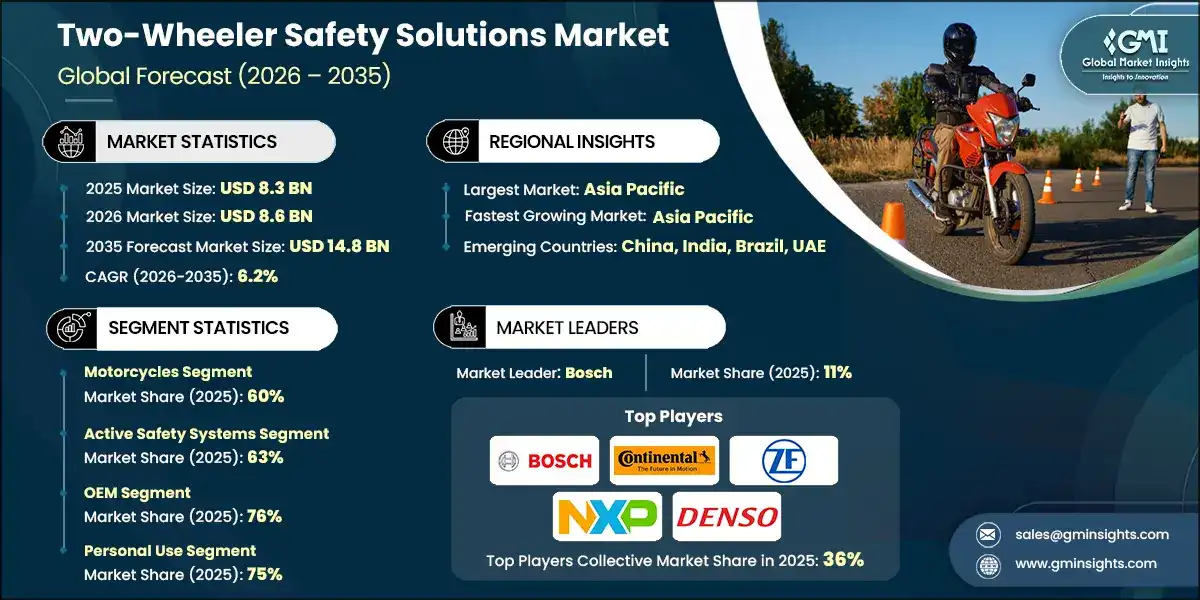
The global two-wheeler safety solutions market size was estimated at USD 8.3 billion in 2025. The market is expected to grow from USD 8.6 billion in 2026 to USD 14.8 billion in 2035, at a CAGR of 6.2% according to latest report published by Global Market Insights Inc.
Two-Wheeler Safety Solutions Market Key Takeaways
Market Size & Growth
- 2025 Market Size: USD 8.3 Billion
- 2026 Market Size: USD 8.6 Billion
- 2035 Forecast Market Size: USD 14.8 Billion
- CAGR (2026–2035): 6.2%
Regional Dominance
- Largest Market: Asia Pacific
- Fastest Growing Region: Asia Pacific
Key Market Drivers
- Rising urbanization and increasing traffic congestion.
- Integration of AI, IoT, and sensors to develop advanced safety features.
- Stringent safety regulations.
- Growing awareness among consumers about rider safety.
- Increasing road accident rates & safety awareness.
Challenges
- High cost of advanced safety systems.
- Limited adoption in low-cost vehicles.
Opportunity
- Adoption of smart and connected safety devices.
- Growing demand for aftermarket and retrofit solutions.
- Integration of safety technology in electric two-wheelers.
- Expansion of fleet and commercial safety solutions.
Key Players
- Market Leader: Bosch led with over 11% market share in 2025.
- Leading Players: Top 5 players in this market include Bosch, Continental, ZF, NXP, Denso, which collectively held a market share of 36% in 2025.
Get Market Insights & Growth Opportunities
Two-wheeler safety solutions integrate a variety of technologies and systems aimed at safeguarding riders and lessening the impact of accidents. These encompass active safety systems that work to avert accidents and passive systems that aim to reduce injuries in the event of a collision.
Technological advancements, regulatory mandates, and heightened safety awareness among global riders have significantly transformed the market. The two-wheeler segment has seen a revolution in safety offerings, thanks to the integration of advanced electronics, sensors, artificial intelligence, and connectivity features. These enhancements have made safety features more sophisticated and accessible across various vehicle price points.
ADAS technologies, such as anti-lock braking systems (ABS), traction control systems (TCS), cornering ABS, adaptive headlights, and collision warning systems, are increasingly being integrated into premium motorcycles and scooters. This trend highlights the growing emphasis on safety and advanced features in the segment.
Connected safety devices, powered by IoT, GPS, emergency SOS, crash detection, and real-time rider behavior monitoring, are witnessing rapid growth. Smartphone integration, 5G connectivity, and cloud-based analytics are driving innovations like predictive maintenance, route safety recommendations, and emergency response coordination, particularly in urban mobility and commercial fleets.
The aftermarket segment for two-wheeler safety solutions is growing rapidly as vehicle owners upgrade their rides with modern safety features. Products such as smart helmets, airbag vests, advanced lighting systems, blind-spot detection devices, and tire pressure monitoring systems are in high demand, particularly in mature markets with older vehicle fleets lacking these enhancements.
Regional market dynamics vary significantly in maturity, regulations, and adoption trends. Asia Pacific dominates due to its large two-wheeler population, while Europe and North America exhibit higher per-vehicle safety content driven by strict regulations and premium product preferences. The EU mandates, such as compulsory ABS, and North America's focus on safety-equipped vehicles and aftermarket upgrades further strengthen their markets.
To get key market trends
Two-Wheeler Safety Solutions Market Trends
Transformative trends are reshaping the two-wheeler safety solutions industry, influencing product development, consumer expectations, and global regulatory frameworks. Collectively, these trends are steering the market towards more intelligent, connected, and comprehensive safety ecosystems for motorcycle and scooter riders.
Advanced Driver Assistance Systems (ADAS), initially developed for the automotive sector, are now being adapted for two-wheelers to address unique motorcycle dynamics and rider behavior. Key features include anti-lock braking systems with lean-angle compensation, adaptive cruise control, blind-spot monitoring, forward collision warnings, and rear-end alerts.
Modern systems have advanced significantly, utilizing sensor fusion with radar, cameras, inertial measurement units, and GPS for comprehensive environmental awareness. Bosch's Motorcycle Stability Control (MSC) system, featuring nine-axis inertial sensors processing data 100 times per second, optimizes ABS intervention based on lean angle, preventing wheel lock and instability during cornering.
Connected safety transitions from standalone vehicle systems to integrated networks linking vehicles, riders, emergency services, and infrastructure. Modern platforms use crash detection algorithms to analyze deceleration, impact forces, and vehicle orientation, ensuring emergency services receive precise location alerts promptly.
IoT-enabled safety devices go beyond emergency responses by monitoring rider behaviors in real-time, such as acceleration, braking, cornering speeds, and fatigue. Fleet telematics in commercial applications help operators enforce safety protocols, schedule maintenance, and optimize routes to avoid high-risk areas or conditions.
Driven by a vast number of older vehicles without modern safety features, heightened awareness among riders about their vulnerabilities and available protective technologies, and insurance incentives for adopting safety equipment, the aftermarket safety solutions segment is witnessing unprecedented growth.
Aftermarket channels are addressing the lack of modern safety features in hundreds of millions of active two-wheelers by offering retrofit solutions. These cost-effective upgrades are particularly beneficial in price-sensitive markets and for riders with out-of-warranty vehicles, avoiding expensive replacements or dealer services.
AI and machine learning are transforming two-wheeler safety, offering predictive insights that traditional rule-based systems can't match. These AI-driven systems sift through extensive datasets, including riding habits, environmental factors, vehicle data, and past accident records, to foresee and mitigate potential dangers.
Two-Wheeler Safety Solutions Market Analysis
Learn more about the key segments shaping this market
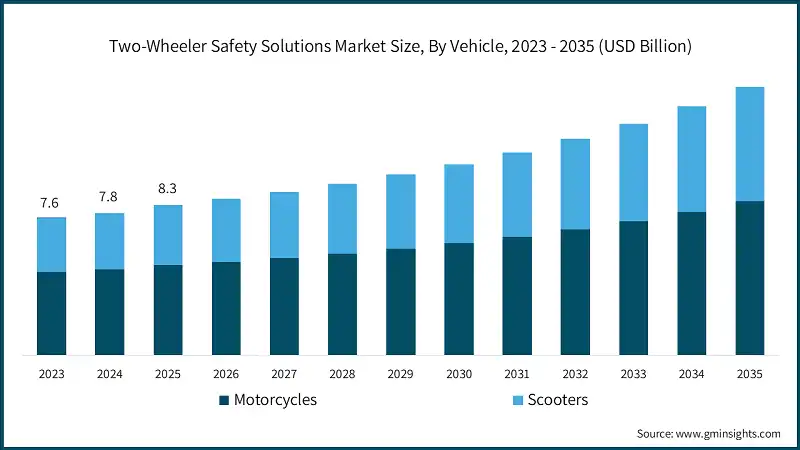
Based on vehicle, two-wheeler safety solutions market is segmented into motorcycles and scooters each presenting distinct characteristics, use cases, safety requirements, and adoption patterns. The motorcycles segment dominates the market with 60% share in 2025, and the segment is expected to grow at a CAGR of 5.7% from 2026 to 2035.
- Motorcycles encompass a broad spectrum from entry-level commuter bikes to premium touring motorcycles, sport bikes, adventure bikes, and cruisers, each with specific safety solution requirements.
- The segment's market dominance is driven by a larger global installed base, higher transaction values enabling advanced safety systems, and stricter regulations addressing motorcycle safety due to higher speeds and accident risks.
- In the premium motorcycle segment (>500cc), 65-75% of new units feature advanced safety systems like ABS, traction control, and adaptive riding modes tailored to conditions and rider preferences.
- Leading manufacturers like BMW, Honda, Ducati, and KTM are integrating advanced safety technologies, such as cornering ABS, wheelie control, slide control, and hill start assistance, into their sport touring and adventure motorcycles.
- Mid-range motorcycles (250-500cc) represent a substantial growth opportunity as safety technologies cascade from premium segments with cost reductions through scale and component maturity.
- Entry-level motorcycles (<250cc) face significant market penetration challenges in price-sensitive regions like India, Southeast Asia, and Africa, where they are essential for lower-income transportation.
- In 2025, scooters held a 40% market share. Key factors driving this segment include rising urbanization, accelerated electrification, and increased regulatory focus on scooter safety.
- Scooter safety requirements differ from motorcycles due to their urban commuting focus, lower average speeds, higher traffic density exposure, and rider demographics, including more female and novice riders seeking convenience.
- The electric scooter segment within this category is experiencing explosive growth, particularly in China, India, and European urban centers, with electric variants now exceeding 40% of scooter sales in leading markets.
- Electric scooter manufacturers like Ather, Ola Electric, NIU, and Gogoro leverage advanced electronic architectures to integrate connected safety features, predictive maintenance alerts, and navigation systems as key differentiators.
Learn more about the key segments shaping this market
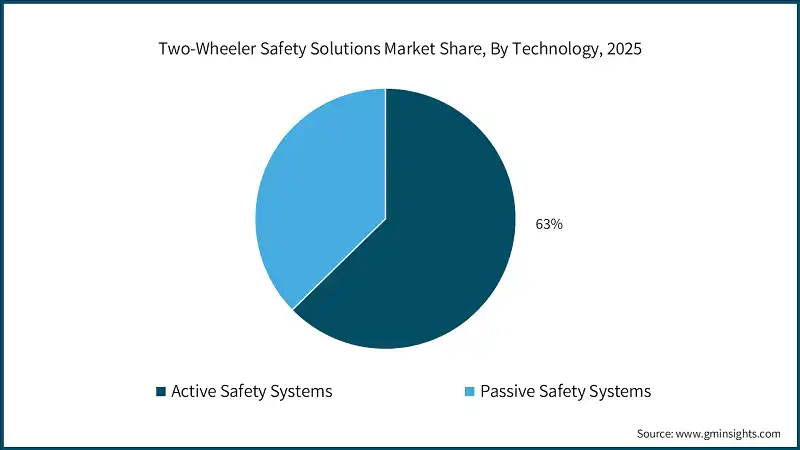
Based on technology, two-wheeler safety solutions market is divided into active safety systems and passive safety systems. The active safety systems segment dominates with 63% market share in 2025 and is growing at the fastest rate of 6.6% CAGR between 2026 and 2035.
- Active Safety Systems dominate the market due to regulatory mandates enforcing specific technologies, cost-effective deployment enabled by technological maturity, and their proven role in accident prevention.
- Anti-lock Braking Systems (ABS) are the most widely used active safety technology, mandated by regulations in Europe, India, Japan, and other major markets for motorcycles with specific engine capacities.
- Modern ABS systems now incorporate lean angles, surface conditions, and rider inputs for advanced functionality. Mandated combined braking systems (CBS) for smaller displacement vehicles enhance safety by optimizing braking force distribution at lower costs.
- With declining component costs and growing consumer awareness, Traction Control Systems (TCS), which prevent rear wheel spin during acceleration, have expanded from premium sport bikes to a broader range of motorcycles.
- Modern TCS implementations enable riders to adjust aggressiveness based on preferences and conditions. Off-road motorcycles offer modes allowing controlled wheel spin for specific terrains and techniques.
- Electronic Stability Control (ESC) systems use gyroscopes and accelerometers to monitor vehicle dynamics. They enhance control during extreme maneuvers by applying selective braking and reducing power.
- In 2025, Passive Safety Systems held a 37% market share, driven by the recognition that accident prevention technologies cannot fully eliminate accidents. Innovations in airbag systems and advanced materials further enhanced passive protection capabilities.
- Manufacturers are focusing on passive safety measures, including impact-absorbing frame designs, deformation zones to manage crash energy, and reinforced mounting points for safety equipment.
- Integrated airbag systems, first introduced by Honda Gold Wing in 2006, represent advanced passive safety technology. However, challenges like rider position variability, system weight, packaging constraints, and high costs limit their adoption to ultra-premium segments.
- Rider protective equipment now includes advanced helmet technologies with impact-absorbing liners, communication systems, and emergency beacons. Protective clothing features armor, abrasion-resistant materials, and visibility enhancements, while boots and gloves offer impact protection, making them key market components.
- Globally mandated regulations prioritize passive safety features, such as fuel cutoff systems, reinforced tanks, and protected fuel lines, to prevent fires during accidents. In electric vehicles, battery isolation and fire suppression measures are critical to ensuring battery integrity during crashes.
Based on sales channel, the two-wheeler safety solutions market is segmented into original equipment manufacturer (OEM) and aftermarket. The OEM segment dominates with 76% market share in 2025 driven by regulatory mandates requiring specific safety features on new vehicles, manufacturer competition emphasizing safety as key differentiator, and cost advantages of integration during manufacturing versus retrofit.
- The OEM channel reflects direct integration of safety technologies during vehicle manufacturing, enabling optimal system integration, calibration, and validation.
- Manufacturers are bundling multiple technologies into safety packages to enhance value perception and differentiation. Premium brands like BMW Motorrad offer advanced electronics packages, while mass-market players such as Honda, Yamaha, Hero, and Bajaj are expanding safety features in mainstream models.
- Regulatory compliance represents a significant OEM channel driver, with mandates for ABS, CBS, daytime running lights, and other features creating baseline demand regardless of consumer preference.
- The regulatory trajectory globally indicates expanding requirements, with discussions of potential mandates for additional technologies including traction control, electronic stability control, and connected emergency calling systems.
- These evolving standards will sustain OEM channel growth as manufacturers implement progressively sophisticated safety suites to meet regulatory baselines and maintain competitive positioning.
- European and North American markets lead in average safety content per vehicle, outpacing their Asian, Latin American, and African counterparts by a notable margin.
- Regulatory differences, price point variations, and diverse consumer preferences shape the landscape. Yet, as safety awareness becomes global, regulations are aligned, and technology costs drop, a convergence is taking shape.
- In 2025, the aftermarket channel accounted for 24%, growing at a 5.3% CAGR during forecast period. Growth was driven by older vehicles lacking modern safety features, consumer demand for safety upgrades, and advancements in retrofit-friendly safety products.
- Aftermarket safety solutions include retrofit ABS kits for vehicles without such systems, auxiliary lighting for improved visibility, and wearable airbag systems from brands like Dainese and Alpinestars for advanced crash protection.
- Other offerings include smart helmets with integrated features, tire pressure monitoring systems, blind spot detection devices, and dash cameras with collision detection and emergency alerts.
- Aftermarket safety products are distributed through specialized motorcycle accessory retailers, automotive chains expanding into two-wheeler offerings, online marketplaces enabling global access and comparison shopping, and direct-to-consumer sales by manufacturers.
- Some insurers are offering premium reductions for vehicles equipped with specific safety devices or for riders using protective equipment, highlighting the potential of insurance incentives as a key driver for adopting aftermarket safety measures.
- Professional installation and calibration challenges limit some aftermarket safety technologies, particularly sophisticated electronic systems requiring vehicle integration and precise setup.
Based on application, the two-wheeler safety solutions market is divided between personal use and commercial/fleet. Personal use dominates with 75% market share in 2025.
- Personal use leads the market, driven by growing consumer awareness of safety technology benefits, rising disposable incomes enabling safety-related spending, and the normalization of safety consciousness in society.
- Personal use includes daily commuters seeking reliable transportation, recreational riders enjoying leisure activities, touring riders traveling long distances, and sport riders engaging in high-performance riding on roads or tracks.
- Commuter riders, the largest personal use segment, focus on safety features such as effective lighting for traffic visibility, reliable braking for congestion, and weather protection to enhance control in adverse conditions.
- Connected safety features are increasingly popular, offering navigation to reduce smartphone distractions, crash detection with emergency alerts, and theft prevention through GPS tracking.
- Recreational and touring riders are more inclined to invest in safety. Their discretionary spending on hobbies, coupled with extended ride durations, underscores their commitment to comfort and safety upgrades.
- This segment promotes premium safety product adoption, including advanced suspension systems for better control, electronics packages with traction management, and emergency assistance features for remote travel safety.
- Sport and performance riders focus on technologies that enhance control and support aggressive riding within safety limits, though they sometimes prioritize performance over specific safety features.
- In 2025, commercial/fleet segment held 24% market share and is expected to grow at 6.3% CAGR between 2026 and 2035. This growth was driven by the expansion of delivery services, fleet safety investments due to liability concerns, and stricter insurance and regulatory requirements.
- Food delivery platforms like Uber Eats, DoorDash, Deliveroo, Swiggy, and Zomato operate extensive two-wheeler fleets globally, where riders face time pressures, urban traffic, and long hours, increasing accident risks.
- Leading platforms are mandating safety equipment, offering training, and using telematics to monitor rider behavior for high-risk patterns. Some also subsidize or provide helmets, protective gear, and vehicle safety features to enhance rider safety and reduce liability.
- Companies such as Amazon, FedEx, UPS, and regional logistics providers increasingly use two-wheelers for last-mile delivery in congested urban areas and emerging markets, where they outperform vans in efficiency.
- These applications, with longer service lives and higher daily mileage than personal use, warrant higher safety investments, reducing accident costs, insurance premiums, and operational disruptions.
- Police, emergency services, security patrols, and other institutional users require specialized commercial applications with strict safety standards due to high-speed pursuits, extended hours, and challenging environments.
Looking for region specific data?
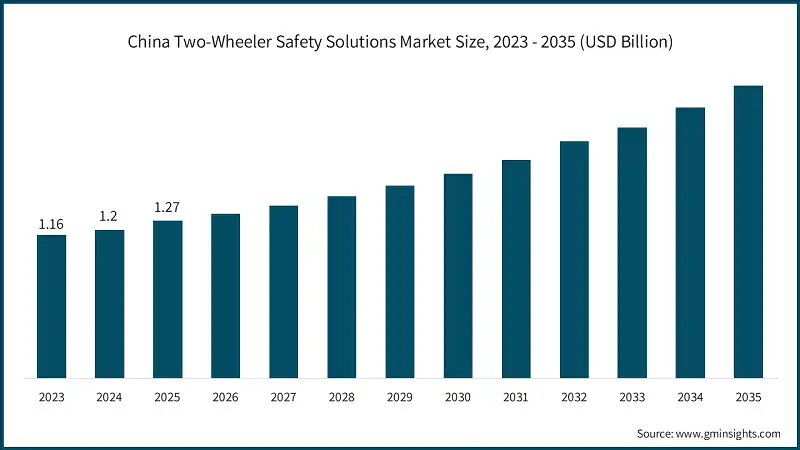
The China two-wheeler safety solutions market is expected to experience significant and promising growth with a CAGR of 6.6% from 2026 to 2035.
- China dominates the electric vehicle market, with electric two-wheelers comprising over 90% of new sales in various categories. This trend drives demand for advanced safety solutions utilizing sophisticated electronic architectures.
- Government initiatives including new energy vehicle subsidies, urban restriction exemptions for electric two-wheelers, and emerging safety regulations are driving market evolution.
- Leading domestic manufacturers like NIU, Yadea, and Ola Electric are focusing on safety features to gain a competitive edge. Simultaneously, global players such as Bosch and Continental are partnering with Chinese manufacturers as key suppliers.
- The urban delivery surge in tier-1 cities like Beijing, Shanghai, and Shenzhen is driving demand for commercial safety. Platforms such as Meituan and Ele.me, managing large delivery fleets, require effective safety management systems.
- However, price sensitivity remains acute, particularly in tier-3 and rural markets where cost constraints limit advanced safety adoption.
- Future growth will be influenced by regulatory trajectory, with discussions of potential ABS mandates and electric vehicle safety standards likely to accelerate adoption.
Asia Pacific dominated the two-wheeler safety solutions market with a market share of 41%, which is anticipated to grow at a CAGR of 7% during the analysis timeframe.
- Asia Pacific dominated the market due to the large two-wheeler populations in countries like India, China, and Indonesia, coupled with rapid urbanization, rising safety demands, increasing middle-class incomes, and stricter government safety regulations.
- China represented USD 1.3 billion market size within Asia Pacific in 2025, growing at 6.6% CAGR to reach USD 2.4 billion by 2035.
- In 2025, the rest of Asia Pacific held a significant market share, driven by rapid growth in emerging economies like India, Indonesia, Vietnam, Thailand, and the Philippines. These countries are witnessing swift two-wheeler market expansion with a growing focus on safety due to urbanization, traffic density, and regulatory measures.
- India stands as the largest single market, producing over 20 million units annually, primarily motorcycles and scooters, catering to diverse transportation needs across various income levels. Regulatory mandates in India, including
- The 2019 implementation of ABS requirements for motorcycles over 125cc drove significant baseline demand. Discussions on expanding safety mandates, including CBS for all vehicles, indicate potential regulatory developments ahead.
- Domestic manufacturers like Hero MotoCorp, Bajaj Auto, TVS Motor, and Honda Motorcycle & Scooter India are striving to enhance safety features while addressing the price sensitivity of a market where many vehicles cost less than USD 1,000.
- Indonesia, Vietnam, and Thailand each feature two-wheeler populations exceeding 30 million units, with scooters dominating given traffic conditions and climate factors.
- Urban middle-class consumers are increasingly prioritizing safety, leading to a surge in the premium segment and a rise in the adoption of aftermarket safety products.
- Thailand and Indonesia are emerging as cost-competitive hubs for manufacturing safety components for domestic and export markets. Additionally, e-commerce growth has improved access to aftermarket safety products in non-urban areas.
- The rapid growth of Southeast Asia's delivery market, led by platforms like Grab, Gojek, and Foodpanda, has significantly increased the demand for commercial safety measures. These platforms manage hundreds of thousands of riders across the region.
US dominated the North America two-wheeler safety solutions market with share of 81% in 2025.
- The US market is dominated by cruiser and touring categories from Harley-Davidson, Indian Motorcycle, and Japanese manufacturers. Riders in this market are typically older than global averages and often travel long distances on well-maintained highways.
- Safety priorities focus on visibility with extensive lighting, improved comfort to reduce fatigue, and features like cruise control and integrated navigation systems for long-distance travel.
- Riders are extensively customizing their vehicles, leading to significant aftermarket spending and creating opportunities for safety-enhancing accessories.
- The regulatory environment remains fragmented, with federal standards for new vehicles but varying state-level requirements, including helmet laws, inspections, and licensing standards.
- Programs like the motorcycle safety foundation emphasize rider education and safety. Insurance incentives, such as premium reductions, further encourage safety adoption for riders completing courses or using vehicles with advanced safety features.
- Adventure and dual-sport segments are growing, driven by younger riders seeking versatile vehicles and off-road recreation opportunities.
- These segments particularly value sophisticated electronics including riding modes, traction management, and navigation integration.
North America two-wheeler safety solutions market accounted for USD 1.7 billion in 2025 and is anticipated to show growth of 5.3% CAGR over the forecast period.
- In 2025, North America held 20% of the market share, driven by stable unit sales, rising vehicle value, a focus on premium cruisers and touring bikes, and a strong aftermarket culture. The aging rider demographic further emphasized safety awareness.
- The region leads due to a developed two-wheeler ecosystem, higher disposable incomes, and a strong emphasis on rider safety and regulatory compliance.
- The U.S. leads in adopting advanced two-wheeler safety solutions, driven by rising motorcycle ownership, a growing premium bike segment, and increased rider safety awareness.
- Canada's market, while smaller than the U.S., features strong touring and adventure segments driven by its geography and outdoor culture.
- Seasonal riding constraints limit activity, but urbanization is boosting scooter and small motorcycle adoption in cities like Toronto, Vancouver, and Montreal.
- Canadian riders show strong safety consciousness with high helmet compliance and interest in protective equipment.
- Electric motorcycle adoption is emerging particularly in British Columbia with environmental emphasis and charging infrastructure support.
Germany dominates the Europe two-wheeler safety solutions market, showcasing strong growth potential, with a CAGR of 6.3% from 2026 to 2035.
- Germany leads the European market for two-wheeler safety solutions, driven by its strong automotive engineering base, high safety standards, and early adoption of advanced vehicle technologies.
- The mature two-wheeler market in the country prioritizes quality, reliability, and compliance, driving demand for advanced braking systems, rider assistance technologies, and certified protective gear.
- Germany's market is characterized by a strong presence of premium motorcycles from BMW Motorrad and KTM, a well-established safety culture across transportation, and strict type approval regulations within its comprehensive framework.
- German riders are among the world's top spenders on safety equipment and technology, showcasing their commitment to safety.
- Riding at high speeds on the Autobahn underscores the importance of advanced safety systems. Features like ABS, traction control, and sophisticated suspension management play a crucial role in maintaining control at elevated velocities.
- Commercial applications, including police and emergency services, feature highly specified vehicles with comprehensive safety configurations.
Europe two-wheeler safety solutions market accounted for USD 2.6 billion in 2025 and is anticipated to show growth of 6% CAGR over the forecast period.
- In 2025, Europe held a 31% market share, driven by stringent EU safety mandates, high aftermarket penetration, and a premium product mix focused on quality and safety, supported by a strong motorcycle enthusiast culture.
- While Italy, France, Spain, and the United Kingdom sustain baseline demand with large motorcycle populations, Eastern Europe is growing rapidly due to improved safety awareness, vehicle parc expansion, and regulatory alignment.
- Despite facing challenging weather conditions that shorten their riding seasons, Nordic countries uphold robust safety cultures and adopt high-quality equipment.
- European Union regulations mandating ABS for higher-capacity motorcycles and combined braking systems for lighter vehicles are driving safety technology. Additionally, the potential mandatory implementation of eCall systems for automatic crash notifications could further accelerate market growth in the region.
- European aftermarket is particularly developed with extensive retail networks, strong online sales channels, and sophisticated consumer base seeking performance and safety enhancements.
- Tourism and recreational riding are prominent in Europe, with riders undertaking Alpine tours, Mediterranean routes, and trans-European trips. They emphasize safety equipment, emergency services, and group communication systems.
Brazil leads the Latin American two-wheeler safety solutions market, exhibiting remarkable growth of 5.3% during the forecast period of 2026 to 2035.
- The Latin American two-wheeler market is driven by essential transportation needs, urbanization boosting demand for scooters and small motorcycles, and evolving regulations mandating basic safety requirements. However, price sensitivity limits the adoption of advanced safety features.
- Brazil's two-wheeler ecosystem features global OEMs, strong regional manufacturers, and a significant aftermarket primarily serving commuter and delivery riders.
- Commercial fleet operators, food delivery platforms, and ride-for-work users are increasingly adopting safety solutions such as ABS-equipped motorcycles, protective gear, telematics, and rider monitoring systems to reduce accidents and insurance costs.
- Brazil features the largest Latin American motorcycle market with fleet exceeding 25 million, predominantly serving transportation needs for middle and lower-income populations.
- Regulatory requirements include mandatory ABS on motorcycles >300cc implemented in recent years, with discussions of expanding to lower displacements.
- Urban delivery boom drives commercial safety interest, with platforms like iFood and Rappi managing large rider fleets facing safety challenges in congested traffic conditions.
- Domestic manufacturing from companies including Honda, Yamaha, and Dafra enables cost-optimized vehicles and safety solutions appropriate for market economics.
South Africa to experience substantial growth in the Middle East and Africa two-wheeler safety solutions market in 2025.
- South Africa, the most developed market in the region, boasts a strong motorcycle culture, tourism applications like safari and scenic riding, and a regulatory framework with basic safety standards.
- Safety awareness is relatively high among South African riders, with aftermarket spending on protective equipment and accessories comparable to emerging European markets.
- South Africa leads the two-wheeler safety market in Sub-Saharan Africa, driven by advanced road infrastructure, established vehicle regulations, and rising safety awareness among riders.
- Two-wheelers in South Africa are widely used for commuting, leisure, touring, and commercial purposes. Their increasing adoption in urban delivery and courier services has amplified road safety concerns.
- High accidents and fatality rates in the country are driving a focus on protective gear, ABS-equipped motorcycles, visibility solutions, and rider training-based safety technologies.
Two-Wheeler Safety Solutions Market Share
- The top 7 companies in the two-wheeler safety solutions industry are Bosch, Continental, ZF, NXP, Denso, Autoliv, and Valeo contributed around 39% of the market in 2025.
- Bosch leads the market by leveraging its advanced automotive safety technology for two-wheelers, including innovations like lean-sensitive ABS and motorcycle stability control systems. Its dominance is further supported by global OEM partnerships and cost-efficient manufacturing at scale.
- Continental competes directly with Bosch in safety categories but differentiates itself through integrated solutions combining safety, connectivity, and user interface elements. Its strengths include a comprehensive sensor portfolio, expertise in brake systems, and software capabilities that integrate safety with broader vehicle systems.
- ZF Friedrichshafen utilizes its expertise in driveline and chassis technology to provide integrated safety solutions, emphasizing active suspension systems and advanced braking technologies.
- NXP Semiconductors specializes in semiconductor and electronic components supporting safety systems. Its expertise includes secure connectivity solutions, radar sensor chips for ADAS, and automotive-grade processors for safety-critical control algorithms.
- Denso leverages its expertise in powertrains, thermal management, and electronics to provide integrated safety solutions. Its strengths include a diverse sensor portfolio, compact component design for two-wheelers, and a strong presence in Asian markets, particularly Japan.
- Autoliv, a global leader in automotive safety, focuses on airbag systems and impact protection technologies. In the two-wheeler segment, it offers integrated airbag systems for premium motorcycles, wearable airbag systems in rider apparel, and passive safety consulting services for manufacturers.
- Valeo operates in safety-focused product categories, including lighting systems, driver assistance sensors, and connectivity solutions. Its key strengths include advanced lighting technologies, parking assistance systems, and thermal management solutions critical for electric vehicle battery safety.
Two-Wheeler Safety Solutions Market Companies
Major players operating in the two-wheeler safety solutions industry are:
- Autoliv
- Bosch
- Continental
- Delphi
- Denso
- Harman
- Magneti Marelli
- NXP
- Valeo
- ZF
- Autoliv, Bosch, Continental, Denso, Valeo, and ZF dominate the two-wheeler safety solutions market by leveraging expertise in safety systems, electronics, and sensor technologies. Their focus on advanced braking, traction control, airbags, and rider assistance, combined with innovation and OEM partnerships, strengthens their global presence.
- Magneti Marelli, Delphi, Harman, and NXP are key players in electronic and connected safety architecture. They specialize in vehicle control units, semiconductors, connectivity, and software-defined platforms, enabling advanced rider assistance and connected safety ecosystems for motorcycles and scooters.
- Companies are leveraging stricter regulations, rising safety awareness, and growing adoption of electronic safety features to expand their presence in the two-wheeler safety solutions market. By offering scalable and cost-effective solutions, they are driving innovation across OEM and aftermarket channels.
Two-Wheeler Safety Solutions Market Report Attributes
| Key Takeaway | Details |
|---|---|
| Market Size & Growth | |
| Base Year | 2025 |
| Market Size in 2025 | USD 8.3 Billion |
| Market Size in 2026 | USD 8.6 Billion |
| Forecast Period 2026 - 2035 CAGR | 6.2% |
| Market Size in 2035 | USD 14.8 Billion |
| Key Market Trends | |
| Drivers | Impact |
| Rising urbanization and increasing traffic congestion | Boosts demand for advanced safety solutions to manage higher traffic risks and prevent accidents. |
| Integration of AI, IoT, and sensors to develop advanced safety features | Enables smarter, real-time safety interventions, improving rider protection and reducing crash severity. |
| Stringent safety regulations | Forces manufacturers to adopt safety technologies, driving market growth and compliance-focused innovations. |
| Growing awareness among consumers about rider safety | Increase adoption of safety solutions as riders prioritize protection over cost or convenience. |
| Increasing road accident rates & safety awareness | Encourages uptake of safety systems to mitigate risks, reduce fatalities, and enhance rider confidence. |
| Pitfalls & Challenges | Impact |
| High cost of advanced safety systems | Increases vehicle price, limiting adoption among budget-conscious buyers and slowing overall market growth. |
| Limited adoption in low-cost vehicles | Reduces market penetration in emerging economies and entry-level segments, restricting the overall effectiveness of safety initiatives. |
| Opportunities: | Impact |
| Adoption of smart and connected safety devices | Improves real-time hazard detection and rider assistance, enhancing overall two-wheeler safety. |
| Growing demand for aftermarket and retrofit solutions | Enables upgrading older models with advanced safety features, increasing market penetration. |
| Integration of safety technology in electric two-wheelers | Supports safer EV operations, reducing accident risks and boosting consumer confidence. |
| Expansion of fleet and commercial safety solutions | Enhance monitoring, compliance, and accident prevention for commercial two-wheeler operations. |
| Market Leaders (2025) | |
| Market Leaders |
11% Market Share |
| Top Players |
|
| Competitive Edge |
|
| Regional Insights | |
| Largest Market | Asia Pacific |
| Fastest growing market | Asia Pacific |
| Emerging countries | China, India, Brazil, UAE |
| Future outlook |
|
What are the growth opportunities in this market?
Two-Wheeler Safety Solutions Industry News
- In December 2025, Bosch introduced a cloud-connected motorcycle safety platform. It features over-the-air software updates, predictive maintenance alerts, and a community-based hazard warning system for sharing road condition information.
- In November 2025, The Indian government announced that by April 2027, all motorcycles above 125cc engine capacity must have anti-lock braking systems, impacting millions of vehicles in the world’s largest two-wheeler market.
- In October 2025, Dainese introduced its fourth-generation D-Air airbag system with 40% faster deployment, advanced crash detection algorithms to reduce false positives, and a modular design for easy maintenance.
- In September 2025, ZF Friedrichshafen partnered with a leading Chinese electric motorcycle manufacturer to develop integrated safety and vehicle dynamics systems for electric powertrains.
The two-wheeler safety solutions market research report includes in-depth coverage of the industry with estimates & forecasts in terms of revenue (USD Bn) and volume (Units) from 2022 to 2035, for the following segments:
Market, By Technology
- Active safety systems
- Anti-lock braking systems (ABS)
- Traction control systems (TCS)
- Adaptive cruise control (ACC)
- Advanced rider assistance systems (ARAS)
- Passive safety systems
- Airbags
- Smart helmets
- Protective clothing
Market, By Vehicles
- Motorcycles
- Scooters
Market, By Sales Channel
- OEM
- Aftermarket
Market, By Application
- Personal use
- Commercial / fleet
The above information is provided for the following regions and countries:
- North America
- US
- Canada
- Europe
- Germany
- UK
- France
- Italy
- Spain
- Russia
- Nordics
- Benelux
- Asia Pacific
- China
- India
- Japan
- Australia
- South Korea
- Singapore
- Thailand
- Indonesia
- Vietnam
- Latin America
- Brazil
- Mexico
- Argentina
- Colombia
- MEA
- South Africa
- Saudi Arabia
- UAE
Frequently Asked Question(FAQ) :
What is the market size of the two-wheeler safety solutions in 2025?
The market size was USD 8.3 billion in 2025, with a CAGR of 6.2% expected through 2035. The growth is driven by advancements in safety technologies, increasing rider awareness, and regulatory mandates.
What is the projected value of the two-wheeler safety solutions market by 2035?
The market is poised to reach USD 14.8 billion by 2035, fueled by the adoption of advanced safety systems, IoT-enabled devices, and AI-driven solutions.
What is the expected size of the two-wheeler safety solutions industry in 2026?
The market size is projected to reach USD 8.6 billion in 2026.
How much revenue did the motorcycles segment generate in 2025?
The motorcycles segment generated approximately 60% of the market revenue in 2025 and is expected to grow at a CAGR of 5.7% till 2035.
What was the market share of the active safety systems segment in 2025?
The active safety systems segment held a 63% market share in 2025 and is set to expand at the fastest rate, with a CAGR of 6.6% up to 2035.
What is the growth outlook for the OEM segment from 2026 to 2035?
The OEM segment, which dominated with a 76% market share in 2025, due to regulatory mandates, competitive differentiation, and cost advantages of integrating safety features during manufacturing.
Which region leads the two-wheeler safety solutions sector?
China leads the market with a projected CAGR of 6.6% through 2035. The dominance is led by the widespread adoption of electric two-wheelers.
What are the upcoming trends in the two-wheeler safety solutions market?
Integration of ADAS, connected safety networks, IoT-enabled devices, AI-driven predictive systems, and growth of aftermarket retrofit solutions.
Who are the key players in the two-wheeler safety solutions industry?
Key players include Autoliv, Bosch, Continental, Delphi, Denso, Harman, Magneti Marelli, NXP, Valeo, and ZF.
Two-Wheeler Safety Solutions Market Scope
Related Reports