Summary
Table of Content

Two Wheeler Market
Get a free sample of this report
Form submitted successfully!
Error submitting form. Please try again.
Thank you!
Your inquiry has been received. Our team will reach out to you with the required details via email. To ensure that you don't miss their response, kindly remember to check your spam folder as well!
Request Sectional Data
Thank you!
Your inquiry has been received. Our team will reach out to you with the required details via email. To ensure that you don't miss their response, kindly remember to check your spam folder as well!
Form submitted successfully!
Error submitting form. Please try again.
Two Wheeler Market Size
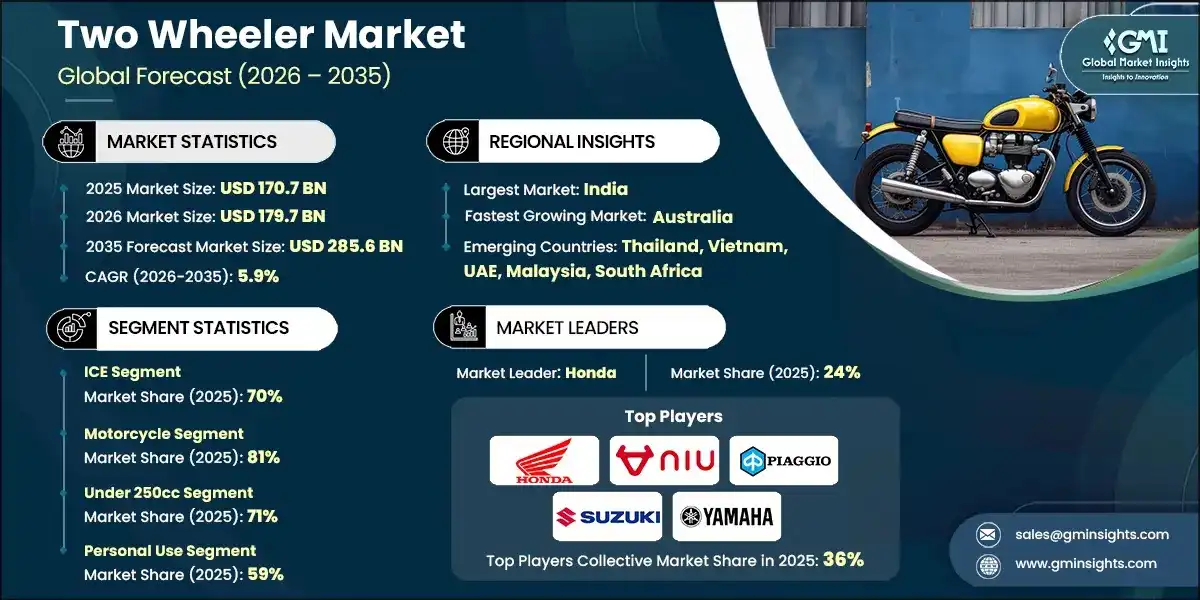
The global two wheeler market size was estimated at USD 170.7 billion in 2025. The market is expected to grow from USD 179.7 billion in 2026 to USD 285.6 billion in 2035, at a CAGR of 5.9% according to latest report published by Global Market Insights Inc.
To get key market trends
The two-wheeler market is growing due to increased amount of EV manufacturers worldwide. Concentrated attention towards sustainability and environmental safety is slowly raising production and sales of electric motorcycles which, in its turn, contribute to development of the motorcycle industry.
Major players are investing a lot in order to remain competitive in the business. As an example, in 2024, Honda introduced the first electric vehicle in India and had allocated USD 3.4 billion to enable the company to meet its 2030 electric mobility goals.
Innovative entrants in the sector are also reacting to the increased demand of sustainable mobility by introducing motorcycles that are environmentally friendly. The industry is being transformed by their entry. Mantis was introduced by Orxa in November 2023. An electrically propelled motorcycle, which is an ecologically friendly one. It will fulfill the increased interest in eco-friendly electric motorcycles, as well as help in the transition towards the more renewable methods of using conventional combustion engines.
The two-wheeler market is experiencing continuous advancement and innovation of technology that does not only enhance the expansion of the market but also the perspective of personal mobility. Because of the issue of international concern of minimizing carbon footprints, it is evident that the world is becoming positively oriented towards the acceptance of EVs everywhere.
One of them is the small, light, and transformational electric motors and energy drives, which are combined with large capacity and high performance batteries. This has been enhanced by improvements in battery technology through higher energy densities, increased range and shorter charging periods leading to development of the industry. In November 2023, Farasis Energy announced its Super Pouch Solution (SPS) which uses eVTOL battery technology with electric motorcycle batteries.
The two wheeler industry is undergoing remarkable transformation due to shifting consumer patterns, issues of urban mobility, and adoption of new technology. The electric motorcycle and scooters are gaining momentum due to factors that include rising environmental awareness and favorable government policies, which facilitate green mobility. The need for urban centers and traffic jams is further contributing to flaunting compact, maneuverable and economical cars, as the motorcycle and scooters are finding favor as a means of everyday transportation.
North American two wheeler market is growing quickly. This growth is due to more consumers choosing eco-friendly transportation, especially in cities. Rising fuel prices and traffic congestion, along with government incentives for electric vehicles, are increasing demand for two-wheelers. Also, improvements in battery technology and the popularity of shared mobility solutions are important factors in this growth.
Asia Pacific leads the two-wheeler market because of its high population density and urbanization, particularly in India and China. Affordable and fuel-efficient two-wheelers meet the needs of a large workforce. Furthermore, government support for manufacturing and sales, along with low labor costs, helps boost the market's growth and share.
Two Wheeler Market Report Attributes
| Key Takeaway | Details |
|---|---|
| Market Size & Growth | |
| Base Year | 2025 |
| Market Size in 2025 | USD 170.7 Billion |
| Market Size in 2026 | USD 179.7 Billion |
| Forecast Period 2026-2035 CAGR | 5.9% |
| Market Size in 2035 | USD 285.6 Billion |
| Key Market Trends | |
| Drivers | Impact |
| Rise in demand for electric two-wheelers | Increasing environmental awareness and government incentives for electric vehicles are driving the demand for electric two-wheelers. |
| Technological advancements in battery and motor systems | Enhanced battery efficiency, improved charging infrastructure, and more powerful motors are making electric two-wheelers more reliable and cost-effective. |
| Expansion of urbanization and traffic congestion | Growing urbanization, combined with increased traffic congestion, is leading consumers to choose two-wheelers as a quick and affordable commuting option. |
| High fuel prices and environmental concerns | The rise in fuel prices and the need for eco-friendly transportation solutions are pushing consumers toward fuel-efficient and electric two-wheelers. |
| Pitfalls & Challenges | Impact |
| High initial cost of electric vehicles | Despite lower running costs, the initial purchase price of electric two-wheelers can deter price-sensitive consumers, especially in developing markets. |
| Infrastructure limitations for electric vehicles | The slow rollout of charging infrastructure, especially in rural and less developed regions, can hinder the adoption of electric two-wheelers. |
| Opportunities: | Impact |
| Expansion of electric vehicle adoption | The push towards sustainability and stricter environmental regulations present opportunities for electric two-wheeler manufacturers. |
| Growth in emerging markets | Rising disposable incomes in emerging markets like India, Southeast Asia, and Africa are expanding the market for affordable two-wheelers. |
| Integration of smart technology | The integration of smart features like GPS, ride-hailing apps, and connectivity in two-wheelers is attracting tech-savvy consumers. |
| Government-backed infrastructure development | Increasing government focus on developing electric vehicle charging infrastructure in urban and rural areas presents opportunities for EV two-wheeler sales. |
| Market Leaders (2025) | |
| Market Leaders |
24% Market Share |
| Top Players |
|
| Competitive Edge |
|
| Regional Insights | |
| Largest Market | India |
| Fastest Growing Market | Australia |
| Emerging Country | Thailand, Vietnam, UAE, Malaysia, South Africa |
| Future Outlook |
|
What are the growth opportunities in this market?
Two Wheeler Market Trends
- As the cities are becoming urbanized, traffic congestion is becoming an issue of concern. Two wheelers, which are flexible and fast moving, are becoming the choice of vehicles in congested cities. The demand for cost-effective, efficient and fuel-efficient two-wheelers, especially in the emerging economies, is a response to daily commute problems as this trend is the solution to the issue.
- Increase in environmental concerns increases the demand of eco-friendly transportation. Two-wheelers that are electric with zero emissions are becoming popular in markets that have high environmental standards. People are choosing the less polluting options to traditional gasoline-powered vehicles, which is why the electric two-wheeler market is growing fast and the market transition to the green transportation solutions occurs.
- Governments in the world have been putting favorable policies, subsidies and tax incentives to encourage the adoption of electric vehicles including two wheelers. These efforts are very crucial in lowering the cost of buying electric two-wheelers in the first place to make them more appealing to consumers. The latter are especially effective in developing countries, where the incentives can hasten the shift to the use of electric two-wheelers, instead of the traditional ones.
- The electric two-wheelers are being boosted by the continuous development of battery technology, such as longer-run time and higher charging speed batteries, the more efficient motor system. These inventions contribute to the improvement of the performance, cost-effectiveness, and the distance to the electric motorcycles and scooters, which become more competitive in comparison with the traditional cars. With the advancement in technology, consumer confidence of using electric two-wheelers is increasing and it is increasing market demand even more.
- The fact that two-wheelers are cheap in nature compared to cars makes them a very common option among cost-conscious consumers whether in the urban or rural setting. They also consume less fuel and maintain less and have long-term savings. This low cost, coupled with the increased fuel costs and the need to seek more cost-effective means of transport, is the reason why the two-wheeler market is steadily gaining significant size worldwide.
- The great challenges of urban mobility result in significant demand of two-wheelers solutions, especially in the face of rapid urbanization of most parts of the world and increasing traffic congestion in cities and the major metropolitan regions. As more than 60 percent of Europeans reside in cities, urban cogs can be greatly reduced by two-wheel-driven propulsion, which generates 40 percent of the total CO2 emissions produced during road transport. Research has shown that two-wheeler vehicles are 26% faster than cars at peak times, which saves much time of the urbanites and lowers the traffic congestion and environmental degradation.
Two Wheeler Market Analysis
Learn more about the key segments shaping this market
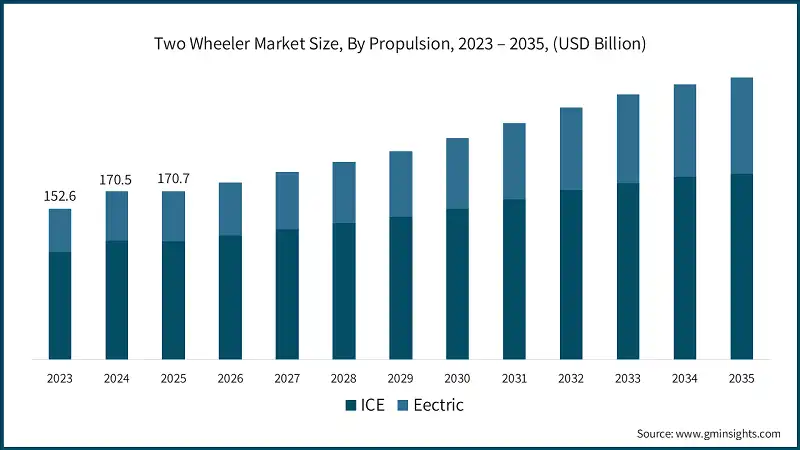
Based on propulsion, the two wheelers market is divided into ICE and Electric. The ICE segment dominated the market accounting for around 70% in 2025 and is expected to grow at a CAGR of over 5% from 2026 to 2035.
- In the emerging markets, the ICE two-wheelers remain less expensive than their electric counterparts. Having low initial expenditure, they are still the favorite among price-conscious customers. Also, the wide variety of models with reduced prices in large quantity and accessibility make ICE two-wheelers a household choice of personal transport.
- The presence of well-established fueling infrastructure is one of the driving forces for ICE two wheelers. ICE motorcycles and scooters are convenient because consumers can refuel their vehicles with a global network of petrol stations. Conversely, the scarcity of charging networks of electric vehicles (EVs) in most places negatively affects the popularity of EV two wheelers.
- The ICE two wheelers have better range than electric models and this makes them good in long distance commuting, more so in areas that cover a large geographical location. Electric two-wheelers need to be charged, which makes refueling an ICE vehicle faster and more convenient than charging them, which contributes to the convenience of riders who do not want to spend a lot of time waiting in a queue at a charging station.
- Though electric vehicles (EVs) are indeed expensive to purchase initially, the service of internal combustion two-wheelers is not so high. ICE engines and the associated technology are highly developed, and the parts are readily available. Moreover, the infrastructure of the ICE vehicles is well advanced hence affordability in terms of repair and long-term functionality, which makes it an appealing decision among those with a limited budget.
- ICE two wheelers still are popular in terms of performance, especially power and speed. ICE motorcycles have a higher level of torque, acceleration, and power demanded by those that are enthusiasts and may need high performance like in sports or heavy-duty usage; electric models may not be able to compete with these. This competitive advantage pushes the demand in the high-end of the market.
Learn more about the key segments shaping this market
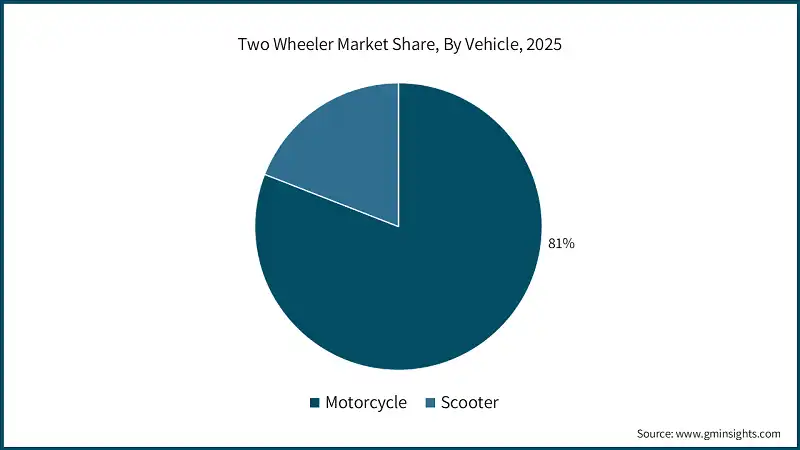
Based on vehicle, the two wheelers market is segmented into motorcycles and scooter. The motorcycle segment dominate the market with 81% share in 2025, and the segment is expected to grow at a CAGR of 5.9% from 2026 to 2035.
- With the increase in the urban populations and congestion in the public transport systems, the use of motorcycles offers an efficient and low cost means of moving about. Motorcycles are increasingly becoming a popular means of transport among the consumers who want cheaper and more convenient means of transportation. They are easy to park; traffic is easily navigated making them an option in daily urban transport particularly in overcrowded cities.
- Increase in popularity of high-performance motorcycles has been brought about by improvement in engine technology, design, and innovation. The manufacturers of motorcycles are currently providing models that are characterized by superior speed, power and handling which appeal to the performance enthusiasts. The attractability of this segment is particularly high in other parts of the world such as Europe and North America where the sporting and touring motorcycles demand is growing.
- Governments of most countries are investing in road networks and offering incentives to the motorcycle segment particularly in emerging markets. The attractive environment to motorcycle buyers is given by programs aimed at improving road quality, establishing friendly motorcycle lanes, and reducing the cost of registering the vehicle. These efforts are making the adoption of motorcycles gain ground, especially in developing countries where the middle class is growing at a high rate.
- Motorcycles are well known in terms of their high fuel efficiency, and this makes them the best choice when a consumer wants to have cheap and affordable transportation. Motorcycles are still cheaper than cars with increased fuel prices throughout the world. This makes them popular in areas that do not have access to cheap cars due to their ability to travel long distances using less fuel as well as low cost of maintenance.
- Motorcycle tourism and adventure riding are taking off at a high rate because people are in search of unique off-the-beaten-path travel experiences. Most consumers are buying motorcycles to travel even when they want to take recreational trips or to tour remote areas. Touring motorcycles and other related accessories are in demand due to the increased popularity of motorcycle touring and adventure riding as a result of social media and influencer culture.
Based on displacement, the two wheelers market is segmented into under 250cc, 250cc–500cc, 500cc–1000cc, and Above 1000cc. The under 250cc segment dominated the market, accounting for share of 71% in 2025.
- Motorcycles of less than 250cc are also generally cheaper than those having above 250cc, and this makes them appealing to first-time buyers and younger motorcycle riders. Their reduced price of purchase, and low prices of insurance, and maintenance make them affordable and available to more population, such as students and professionals seeking to have a low-cost means of transport.
- Motorcycles under 250cc are characterized by high fuel efficiency and thus are perfect among low-end consumers. These motorcycles are also a cheap substitute for a long-distance commute, particularly in areas where the cost of fuel is increasing. Their fuel efficiency, in addition to the latest engine technology, makes them a good alternative to an urban commuter, as well as for a user in the rural area.
- In cities that have high population and the problem of traffic jams and lack of parking space is normal, the 250cc and below motorcycles are very convenient and agile in commuting to the office daily. They are also small and can easily cut through traffic, besides being capable of parking in smaller areas, so they can be used by city residents who require a very fast and efficient means of transportation.
- Bikes below 250cc are trendy with the youthful drivers and the first-time users of motorcycles. Being able to produce less power and being easier to handle, the bikes are a less intimidating and more manageable ride experience for a beginner. Manufacturers are capitalizing on this group by releasing some of the stylish but affordable models which have been found to be effective in performance and safety.
- Under 250cc motorcycles are becoming safer as the introduction of new safety features like the anti-lock braking systems (ABS) and the traction control features. These motorcycles have a balance of performance and safety, due to better handling and increased stability, and this is what is acceptable to both new and experienced riders who are mindful of the rider’s safety, particularly in the urban traffic conditions.
Based on end use, the two wheeler market is divided into personal use and commercial. Personal use dominates with 59% market share in 2025.
- Two-wheelers are unrivaled in terms of convenience in personal use and enable riders to move faster in the traffic and get to their destinations within a shorter time. As the increasing population of people in cities and towns require flexibility in their means of commuting, motorcycles and scooters are becoming the choice of people who require an effective mode of transportation without considering the timetable of the transport system. They are small in size and hence convenient to travel with.
- Two-wheelers that are used personally, and particularly motorcycles and scooters are a cheaper mode of transportation when compared to automobiles. Having cheaper purchase prices, lower fuel costs, and lower maintenance, they are a low cost to consumers who want to find a low-cost travel mode. This affordability has resulted in two-wheelers being the preferred choice of personal mobility to middle-income and the youthful consumers in the developing markets.
- As the fuel prices continue to increase, the number of consumers opting to use the two-wheelers has been on the increase, as the fuel-efficiency of the two-wheelers is high. Scooters and motorcycles, particularly those that have a capacity of less than 250cc, are much more economical in fuel consumption than cars, and thus they make an appealing alternative source of daily commuting. This movement of the cost-efficient individual transport is a key driver of growth.
- Traffic congestion is becoming a major issue in most urban centers due to the increase in the number of people in the cities. The solution to this is two wheelers, especially motorcycles and scooters, that are ideal to be used personally in congested cities. Their car handling ability in traffic, easy parking and speedy traveling times has helped them gain popularity among urban dwellers who want to have a fast means of transport.
- The innovations in the safety measures of the personal use two-wheelers like anti-lock braking devices (ABS), traction control and improved suspension are drawing more users. These safety technologies render motorcycles and scooters safer to use in daily commute and this motivates more people to use them personally. Better safety increases the confidence of the rider and is a major growth factor.
Looking for region specific data?
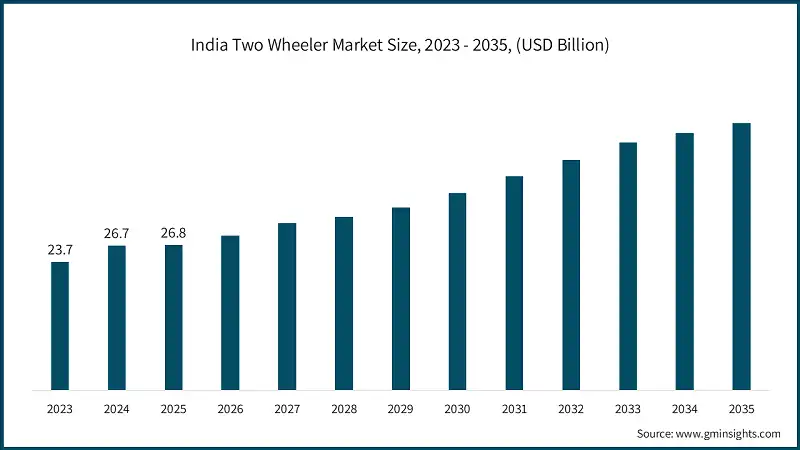
India dominated the two wheeler market in Asia Pacific with around 21% share and generated USD 26.9 billion in revenue in 2025.
- India is the largest motorcycle manufacturer in the world and the second-largest motorcycle market among the global markets, producing 15-20 percent of the world motorcycle population with an annual production rate of around 28 million motorcycles in FY 2024. Indian market can be described as having large scale and fast rate of growth with production reaching 21.47 million units (up by 10.3%) in 2023 and 17.97 million units (up by 13.3%) are sold including one million electric motorcycles.
- The market characteristics of India are completely contrast to those of the developed markets where two wheelers are not as recreational products, but rather as main means of transportation and thus affordability, fuel efficiency, and reliability are the factors that matter to an Indian customer in deciding to buy a particular two-wheeler. There are local manufacturers who have dominated their market such as Hero MotoCorp, Honda, and Bajaj who have designed products that are intrinsically made, suited within the Indian consumer pocket and needs.
- Electric mobility is facing a paradigm shift in the Indian market where sales of electric two-wheelers recorded a phenomenal 33 percent growth in 2024, amounting to 59 percent in the total electric vehicle market. Distinct brands such as Ola Electric have already secured high market share and Ola, in particular, has managed to sell more than 400,000 units and get a 35 percent market share within the electric segment.
- Its economics, as operating costs of the electric two-wheelers are about 55 percent lower than the petrol ones with the increasing costs of fuels and constant costs of electricity, is becoming the driving force behind the transformation. Ongoing governmental support in the form of initiatives such as FAME-II scheme along with a rising number of charging stations and a lower cost of the batteries is accelerating the pace of adoption. Industry estimates indicate that by 2030, the idea of two-wheelers without engines may lead to the rise of a quarter of all two-wheeler sales selling electric models which is a paradigm shift in the world largest motorcycles market.
The US two wheeler market reached over USD 6 billion in 2025, driven by increased environmental awareness, government subsidies, and battery technology improvements.
- US consumers are shifting to two-wheelers to use in their daily commute as the cost of fuel increases. Scooters and motorcycles are very efficient in fuel consumption, and this makes them a good alternative to coping with the increasing cost of oil. This is more evident in the cities where two-wheelers offer a cheaper and viable alternative to cars as a mode of personal transportation.
- The U.S. is experiencing environmental enlightenment, which is increasing the need to have eco-friendly means of transport. Electric motorcycles and scooters are becoming a trend in sustainable vehicles that can replace gasoline-powered vehicles. With the government coming up with stricter government emissions policies and consumers shifting their focus towards greener lifestyles, the U.S two-wheeler market is experiencing a boom in the electric and hybrid two-wheelers demand.
- Two-wheelers can provide an effective way of urban transportation in American cities characterized by heavy traffic congestion. The ease with which they move in the traffic and the tight areas they can fit makes scooters and motorcycles an appealing choice when it comes to commuting. Due to rising urbanization, there is an increment in the number of consumers using two-wheelers so as to save time and eliminate the burden of traffic jams and parking problems.
- The consumer tastes in the U.S. have changed significantly, as a considerable number of people use two-wheelers as more versatile means of transportation which is quite economical. The convenience and affordability of motorcycles and scooters attract younger generations who are mostly attracted by convenience and affordability. This is a trend that is helping the U.S. two-wheeler market to grow particularly among the urban inhabitants.
- The U.S. government is also providing more incentives and subsidies to encourage people to start using electric vehicles (EVs) such as the electric motorcycles and scooters. Tax credits and rebates are some of these incentives that will make electric two-wheelers cheaper and more appealing to the U.S. consumers. This support policy will boost the demand of electric two-wheelers as the EV uptake rises.
The two wheeler market in France is projected to grow at a strong CAGR of 4.6% from 2026 to 2035, driven by accelerating adoption of electric two-wheelers, stringent safety regulations for vehicles under EU standards, rapid expansion of charging infrastructure, and increasing demand for advanced diagnostic technologies in motorcycles and scooters.
- There is a very big movement towards electric two-wheelers in France as people give preference to transport that is environmentally friendly. This move is being fueled by government incentives as well as increased environmental awareness. Electric motorcycles and scooters become affordable and more viable with the advancement of battery technology, and it can be assumed that they will gain popularity as a means of commuting to work, particularly in cities with heavy traffic and parking as central concerns.
- The congestion in cities such as Paris is increasing with the increase in the urban population. To escape commuting time, two-wheelers will be convenient. Motorcycles and scooters are a desirable mode of transport since they are able to move well in the traffic and fit in the narrow areas. This trend is compelling the French cities to demand smaller and efficient two-wheelers.
- French government is encouraging the use of two-wheelers by subsidizing the purchase of electric cars, as well as infrastructure developments. The increase in charging points of the electric motorcycles and scooters and enhanced road network is motivating more buyers to adopt the two-wheelers. These actions lead to the development of the market and make France one of the leaders in green urban mobility.
The two wheeler market in Brazil reached significant scale in 2025, driven by rising safety regulations, growing consumer demand for advanced safety features, increased adoption of anti-lock braking systems (ABS) and traction control, and expanding domestic production of motorcycles.
- Motorcycles and scooter transportation is also cheap and accessible to the rising middle classes in Brazil. Two-wheelers provide an affordable alternative as fuel prices increase and cost of owning a car goes high. Being cheap at the start and with superb fuel efficiency, they are the most preferred due to their convenience in providing personal mobility, particularly in urban and rural areas.
- The delivery services and the emergence of e-commerce in Brazil are increasing the demand of motorcycles in a great way. As the delivery companies depend on the motorcycles to deliver goods quickly and efficiently, the two wheelers are becoming more and more widespread in the sphere of commerce. Combined with the fact that food delivery applications have become popular, this trend is causing the motorcycle segment to grow steadily.
- Two wheelers are also becoming cheaper to the Brazilian population through government programs and financing options. These programs such as tax exemptions and low interest loans to buy motorcycles assist in clearing barriers to finance among the consumers. With the growth of these programs, it prompts on the individual and fleet purchases, which in turn will help in the growth of the two-wheeler market in Brazil.
The two wheeler market in UAE is projected to grow at a CAGR of 5.8% from 2026 to 2035, driven by the country's expanding automotive sector, rising demand for advanced rider safety systems, increasing integration of anti-lock braking systems (ABS) and traction control, and government initiatives promoting vehicle safety standards and fleet modernization across public and private transport segments.
- Traffic congestion is one of the issues in cities such as Dubai and Abu Dhabi with the UAE being a city that is still evolving into urbanization. Two-wheelers are the most practical and efficient way of commuting daily as they avoid most of the traffic jams by navigating faster. This is because they offer convenience in that they can get to all places without any congestion and also their size is a factor because they can fit in any small area which is a market driver among urban residents.
- Electric vehicles are rapidly spreading in the UAE, and the electric two-wheelers are becoming more popular. Electric motorcycles and scooters are increasingly attractive to the environmentally conscious consumer with government programs to encourage sustainability and minimize carbon footprints. This change in the motor mobility towards electric is being influenced by the increasing number of charging infrastructure and the accessibility of electric-friendly models.
- The two-wheeler market in the UAE is propelled by tourism as motorcycles and scooters are popular among tourists as vehicles that they use to have a good time. This is due to the rise in the number of tourists, recreational services such as desert safaris and coastal tours, which is increasing market demand for rental and recreational two-wheelers. The trend enhances local and tourist-based markets of personal and recreational use.
Two Wheeler Market Share
- Top 7 companies of the two-wheeler industry are Harley Davidson, Honda, Yamaha, Suzuki, Niu Technologies, Piaggio and Kawasaki collectively holding market share of around 36% in 2024.
- Harley-Davidson competes through high-performance and heritage as well as adopting electric mobility with the LiveWire brand. The brand is also increasing its presence in the world market, particularly in the developing markets, and is introducing technologically advanced integration in its motorcycles. In addition to customized experiences and lifestyle products and a robust brand community, the company is also increasing engagement with customers.
- Honda has been in the market since it continually releases a variety of motorcycles in the market since they have entry level models to the high-performance models. The company is making a massive investment in electric mobility, and it intends to increase its EV two-wheeler offerings. Honda has also focused on innovation and has incorporated more high-tech safety systems, fuel-saving engines and a strong network of distribution all over the world, a factor that makes it dominate several of its segments.
- Yamaha also remains competitive by being innovative both in traditional internal combustion engine motorcycles and in the electric vehicles. The company focuses on high performance, reliability and ease of use in its product range and also on smart integration of technology. Yamaha is also improving on its post-sales services, partnering with other companies worldwide, and entering the market with electric two-wheelers, securing and sustaining growth and customer base.
- In its two-wheeler, Suzuki still persists with its business strategy of providing affordable, reliable and fuel-efficient products. The firm has been increasing its presence in the developing economies at affordable models. Having an influential presence in the sport and off-road motorcycle divisions, Suzuki is focusing on hybrid and electric technology with the same effort that it is maintaining the growing needs of sustainability and new-level safety in its motorcycles.
- Niu Technologies is a company that has a niche in producing electric scooters and provides smart, connected vehicles to use in cities as a mode of commuting. The company uses the latest technology of the IoT to combine real-time tracking, diagnostics, and rider analytics into its products. Niu is also growing business in the international market, especially in Europe and Asia, and focusing on sustainability and affordable urban mobility products as more people demand delivery of more eco-friendly transportation.
- Piaggio keeps its competitive edge by providing a variety of scooters and motorcycles that highlight style, comfort, and performance. The company has invested heavily in electric mobility with its Vespa and other eco-friendly projects, focusing on sustainability. Piaggio is also increasing its presence in emerging markets and using its strong brand identity to attract younger, environmentally conscious customers.
- Kawasaki remains competitive by concentrating on high-performance motorcycles and broadening its product line with new technology like supercharged engines and smart safety features. The company is entering the electric two-wheeler market with its upcoming EV models while maintaining its positions in the sport and touring segments. Kawasaki’s global brand recognition and ongoing innovation help it stay at the top of the market.
Two Wheeler Market Companies
Major players operating in the two-wheeler industry include:
- Honda
- Hero
- Yamaha
- Bajaj
- Yadea
- Suzuki
- Kawasaki
- Harley-Davidson
- Piaggio
- Royal Enfield
- BMW Motorrad
- Businesses that are developed alongside new technological innovations modernize an industry and compete within it. An example is the continuous competition for supremacy between Hero, Honda, and Yamaha motorcycle manufacturing companies. As these companies are well established, they already have a strong presence in the markets and have a diverse portfolio serving various components of the motorcycle industry. For instance, Honda has everything within its reach, starting from commuter bikes to superbikes, thus ensuring his capture in this market.
- The rivalry of niche manufacturers has increased from the introduction of KTM and Ducati to performance and premium motorcycles. For instance, this is clear when KTM launched the 790 Adventure for the North American 2024 model year after the Super Adventure family of motorcycles was released. This new version is an improvement, but it is better in terms of updated electronics and more mechanical changes than his predecessor. The introduction of electric motorcycle manufacturers also increases the competition, this includes Zero Motorcycles and Energica which illustrate the industry is going in the direction of greener options.
Two Wheeler Industry News
- In May 2025, BMW Motorrad unveiled the Concept RR at the Concorso d'Eleganza Villa d'Este in May 2025. This concept bike showcases the brand's vision for future superbike performance, blending cutting-edge technology with striking design.
- In March 2025, Niu launched the NX Pro Electric Motorcycle, featuring advanced technologies like millimeter-wave radar and AI connectivity, catering to premium riders seeking high-performance electric mobility solutions.
- In November 2023, at EICMA 2023, Royal Enfield electric motorcycle brand- The Himalayan 450 was revealed for the very first time at international markets. The Himalayan 450 is a fusion of nature and technology as it incorporates Royal Enfield’s adventure essence into an eco friendly electric motorcycle, giving the society what they want in a sustainable & multifaceted electric bike.
- In November 2023, Pure EV has launched the “Pure EcoDryft 350” electric scooter. This electric scooter is considered, at least one of the most functional eco-friendly electric scooters available, traveling a distance of 171 kilometres on a single charge. It also helps to support the trend of eco responsible mobility by sustaining the need for electric motorcycles that are green and efficiently usable.
The two-wheeler market research report includes in-depth coverage of the industry with estimates & forecasts in terms of revenue ($ Mn/Bn) and shipment (Units) from 2022 to 2035, for the following segments:
Market, By Vehicle
- Motorcycle
- Cruiser motorcycles
- Sport motorcycles
- Touring motorcycles
- Standard/naked motorcycles
- Adventure/dual-sport motorcycles
- Off-road/dirt motorcycles
- Scooter
- Maxi scooters
- Moped-style scooters
Market, By Propulsion
- ICE
- Electric
Market, By Displacement
- Under 250cc
- 250cc–500cc
- 500cc–1000cc
- Above 1000cc
Market, By Distribution Channel
- Offline
- Online
Market, By End Use
- Personal Use
- Commercial
The above information is provided for the following regions and countries:
- North America
- US
- Canada
- Europe
- UK
- Germany
- France
- Italy
- Spain
- Poland
- Netherlands
- Belgium
- Asia Pacific
- China
- India
- Japan
- South Korea
- Taiwan
- Myanmar
- Thailand
- Vietnam
- Singapore
- Indonesia
- ANZ
- Latin America
- Brazil
- Mexico
- Argentina
- MEA
- UAE
- South Africa
- Saudi Arabia
Frequently Asked Question(FAQ) :
What was the market share of two-wheelers for personal use in 2025?
Two-wheelers for personal use held a 59% market share in 2025, led by their convenience and efficiency in urban and rural commuting.
Who are the major players in the two-wheeler industry?
Major players in the two-wheeler market include Honda, Hero, Yamaha, Bajaj, Yadea, Suzuki, Kawasaki, Harley-Davidson, Piaggio, Royal Enfield, and BMW Motorrad.
Which region dominated the two-wheeler industry in Asia Pacific in 2025?
India dominated the Asia Pacific market with a 21% share, generating USD 26.9 billion in revenue in 2025.
What are the key trends driving the two-wheeler market?
Key trends include growing demand for electric two-wheelers, supportive government EV incentives, advancements in battery technology, and the need for affordable, fuel-efficient urban transportation solutions.
What was the market share of the motorcycle segment in 2025?
The motorcycle segment accounted for 81% of the market share in 2025 and is set to grow at a CAGR of 5.9% from 2026 to 2035.
What was the market share of the ICE segment in 2025?
The ICE segment dominated the market with a 70% share in 2025 and is expected to grow at a CAGR of over 5% from 2026 to 2035.
What is the expected size of the two-wheeler industry in 2026?
The market size is projected to reach USD 179.7 billion in 2026.
What is the projected value of the two-wheeler market by 2035?
The market is expected to reach USD 285.6 billion by 2035, fueled by advancements in battery technology and government incentives for electric vehicles.
What was the market size of the two-wheeler in 2025?
The market size was estimated at USD 170.7 billion in 2025, growing at a CAGR of 5.9% from 2026 to 2035. The market is driven by the increasing adoption of electric vehicles and a focus on sustainability.
Two Wheeler Market Scope
Related Reports