Summary
Table of Content

Truck Refrigeration Unit Market
Get a free sample of this report
Form submitted successfully!
Error submitting form. Please try again.
Thank you!
Your inquiry has been received. Our team will reach out to you with the required details via email. To ensure that you don't miss their response, kindly remember to check your spam folder as well!
Request Sectional Data
Thank you!
Your inquiry has been received. Our team will reach out to you with the required details via email. To ensure that you don't miss their response, kindly remember to check your spam folder as well!
Form submitted successfully!
Error submitting form. Please try again.
Truck Refrigeration Unit Market Size
Cold chain capabilities are being added to logistics networks around the world to protect the integrity of perishable goods and maintain the quality of items from point of origin through to the final point of delivery across the globe. As food and pharmaceutical supply chains continue to grow, the demand for refrigerated logistics continues to increase, producing a rise in global support for refrigerated transport as well as for cold chain logistics. In April 2025, UPS reported a significant acquisition of cold chain logistics capabilities to assist in supporting the increased demand for temperature-sensitive transportation in Canada (cold chain expansion).
Truck Refrigeration Unit Market Key Takeaways
Market Size & Growth
- 2025 Market Size: USD 13.8 Billion
- 2026 Market Size: USD 14.6 Billion
- 2035 Forecast Market Size: USD 23.1 Billion
- CAGR (2026–2035): 5.3%
Regional Dominance
- Largest Market: North America
- Fastest Growing Region: Asia Pacific
Key Market Drivers
- Rising demand for cold chain logistics.
- Increasing perishable food consumption.
- Stringent food safety regulations.
- Growth in pharmaceutical transportation.
Challenges
- High initial investment cost.
- Maintenance and operational complexity.
Opportunity
- Electric and hybrid refrigeration units.
- Expansion in emerging markets.
- IoT-enabled smart monitoring systems.
- Renewable energy-powered cooling solutions.
Key Players
- Market Leader: Thermo King led with over 35% market share in 2025.
- Leading Players: Top 5 players in this market include Carrier Transicold, Daikin Industries, MHI Thermal Systems, Thermo King, Zanotti, which collectively held a market share of 82% in 2025.
Get Market Insights & Growth Opportunities
Fresh and frozen food consumption around the globe continues to increase, resulting in an increased demand for refrigeration units in trucks to avoid spoilage and support perishable product volume. Refrigerated transport investment followed the trends of increased consumption of fresh and frozen products, as many fleets added refrigerated transport/increased refrigerated transport capacity due to the dramatic increase in volume associated with the delivery of perishable products.
As the food industry has grown, governments and food safety regulatory agencies have begun to impose more stringent controls on the transportation of perishable products. As a result, logistics companies will be required to implement precise temperature monitoring and record-keeping systems to comply with government regulations regarding the transportation of perishable goods; therefore, there is a significant demand for advanced refrigerated units that adhere to current standards of traceability and safety.
The market demand for logistics firms to provide temperature-controlled transportation services for pharmaceuticals is growing very rapidly. Over 40% of pharmaceutical distributors rely on refrigerated transport vehicles for transporting pharmaceuticals and therefore, in 2025 there will be a major demand for advanced refrigeration units for the use in the transportation of pharmaceuticals, to maintain drug integrity.
The global truck refrigeration unit market was valued at USD 13.8 billion in 2025. The market is expected to grow from USD 14.6 billion in 2026 to USD 23.1 billion in 2035 at a CAGR of 5.3%, according to latest report published by Global Market Insights Inc.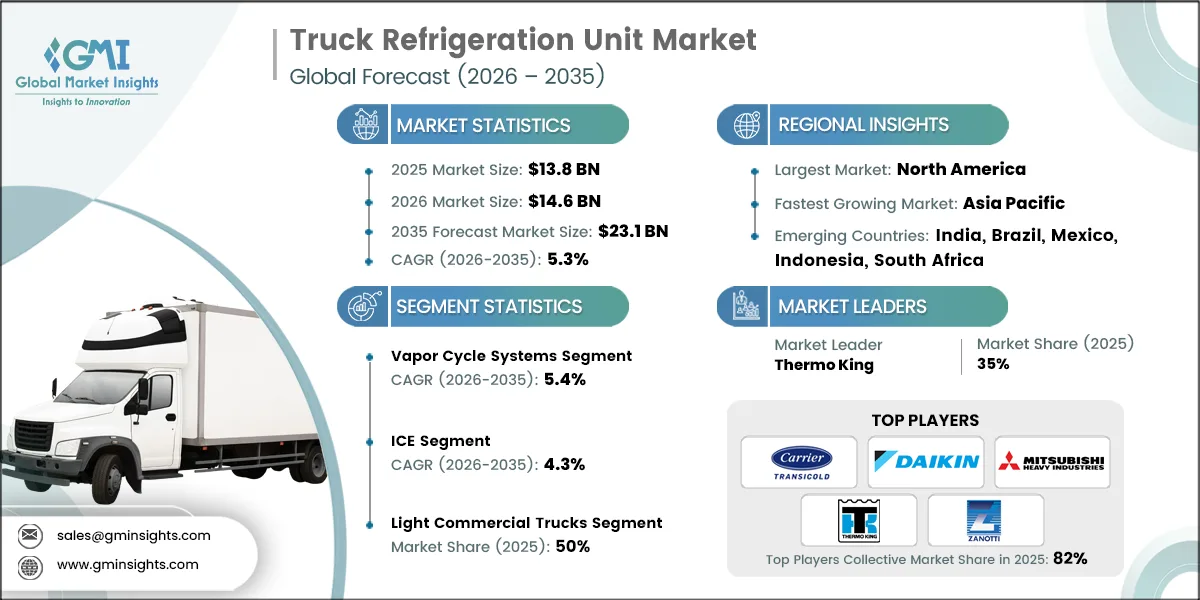
To get key market trends
Truck Refrigeration Unit Market Trends
There is an increasing trend of electric and hybrid temperature-controlled transport refrigeration units (TRUs) taking the place of diesel-only systems, as fleets strive for zero-emission logistics while also adhering to decarbonization policies. These systems reduce fuel consumption and emissions while also meeting the needs of urban goods delivery, especially in developed markets where regulations regarding environmental impact from goods movement are becoming more stringent. In March of 2025, Carrier Transicold announced a partnership to collaboratively develop hybrid-electric TRUs; their goal being to create more sustainable cold chain solutions.
There is an integration of the Internet of Things (IoT) sensors, telematics and cloud-based platforms into refrigeration systems that provide an ongoing ability to monitor temperature, preventative maintenance alerts and performance insights, all of which help to lessen spoilage and ensure compliance. Therefore, this type of digital technology is shifting from being an optional feature to an expected feature on all refrigerated transport units. Advanced telematics platforms, like Carrier Transicold’s remote enhanced monitoring system, will be standard on all TRUs by fleet operators.
There are now breakthrough innovative applications through the integration of solar panels and hybrid electrical systems into TRUs so as to provide supplemental power; to increase run time; and to reduce any additional use of energy on those routes that will experience a high degree of either daylight or idle operation between deliveries. Results of grocery delivery and urban delivery pilot programs have shown substantial improvements in fuel efficiencies and reductions in emissions; there are numerous retail logistics pilot programs currently being conducted with fleet operators using rooftop solar hybrid TRUs.
Due to their innovations in the use of lighter weight materials, improved insulation and thermal optimization, manufacturers are able to manufacture TRUs that have better overall efficiencies (additional payload capacity), and overall lower operating costs. With the development of new design and engineering technologies, manufacturers will be able to provide TRUs that will perform economically.
Truck Refrigeration Unit Market Analysis
Learn more about the key segments shaping this market
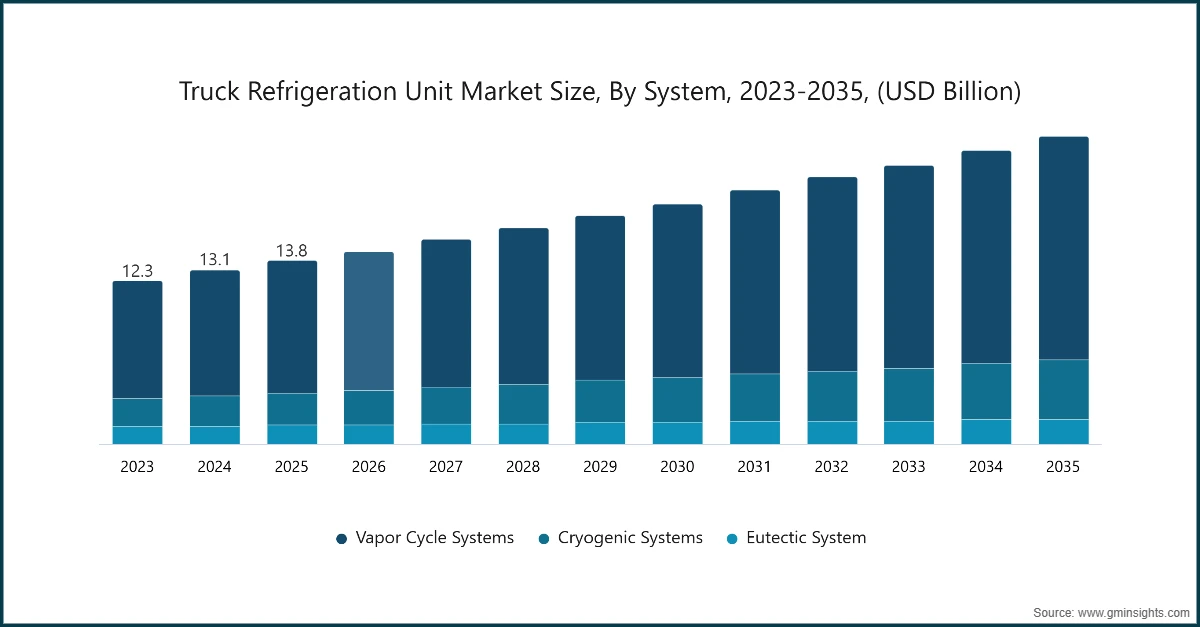
Based on system, the truck refrigeration unit market is divided into vapor cycle systems, cryogenic systems and eutectic system. Vapor cycle systems dominated the market, accounting for 72% in 2025 and are expected to grow at a CAGR of 5.4% through 2026 to 2035.
- Vapor cycle systems remain the dominant technology for truck refrigeration due to high reliability, efficiency, and broad temperature range suitability. Innovations focus on energy‑efficient compressors, low‑GWP refrigerants, and integration with telematics for remote monitoring and predictive maintenance, improving performance while reducing emissions and operational costs across long‑haul and urban delivery fleets.
- Cryogenic refrigeration using liquid nitrogen or CO₂ is a perfect solution for cooling goods such as sensitive pharmaceuticals and high-value cargo with no vibration and very little noise.
- There is an increase in demand for specialized cold chain segments that require precise temperature control and minimal mechanical complexity. This trend has resulted in improvements to the design of cryogenic equipment to improve the efficiency and safety of storage as cryogenic equipment supports both long-haul and warehouse to truck transitions.
- Eutectic-style systems, utilizing phase change material, can sustain stable temperatures without running the engine continuously, therefore, conserving fuel and reducing emissions while idling or during a stop/urban delivery.
- Adoption of eutectic systems is increasing in the short-haul and last-mile distribution market, particularly in situations where eco-friendly and silent cooling are at a premium.
Learn more about the key segments shaping this market
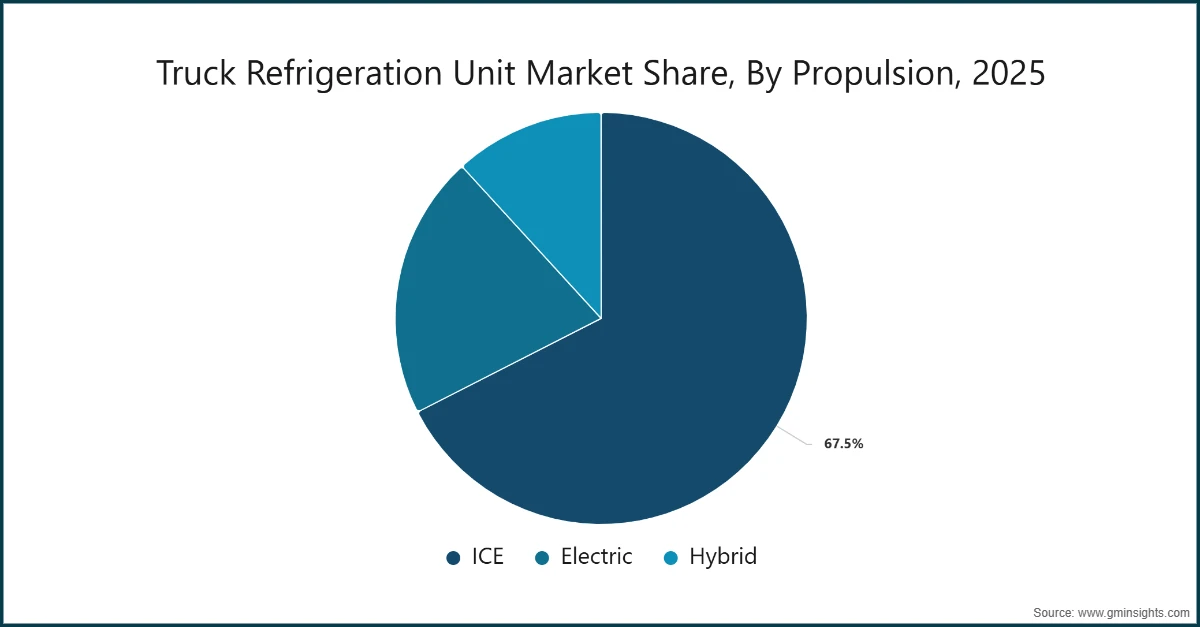
Based on propulsion, the truck refrigeration unit market is segmented into ICE, electric and hybrid. ICE segment dominates the market with 67.5% share in 2025, and the segment is expected to grow at a CAGR of 4.3% from 2026 to 2035.
- Refrigeration systems run by internal combustion engines (ICE) have strong market presence due to their extensive existing infrastructure, reliability, durability, and high volume of heat transfer/cooling capability along with their usage over long distances.
- In addition, electric refrigeration systems have become more common for last mile delivery in urban areas with zero emissions and on shorter distance routes. Trends for these units include the improved efficiency and use of batteries, connection to fleet telematics, and development of renewable energy sources.
- When used in urban areas, transport refrigeration units (TRU) that operate with electric power are able to support noise reduction, lower operating costs and reduce greenhouse gas emissions by replacing traditional fossil fuels with alternative clean energy, thus aligning with current city goals for sustainability.
- Hybrid TRUs, which utilize both ICE and electric power, allow for optimization of fuel consumption and emission reduction while providing the operating flexibility necessary for both long haul and short haul operations.
- Home trends for hybrid TRUs include greater sophistication of power management, use of regenerative power and vehicle telematics for predictive maintenance, making hybrid TRUs an excellent transitional option for markets that are transitioning to full electrification.
Based on vehicle, the truck refrigeration unit market is segmented into light commercial trucks, medium commercial trucks and heavy commercial trucks. Light commercial trucks segment dominates the market with 50% share in 2025, and the segment is expected to grow at a CAGR of 4.1% from 2026 to 2035.
- There has been a significant increase in the use of light commercial trucks to transport perishable products to their destination, particularly in urban environments. The trend is evolving towards compact, energy-efficient, and battery/electric refrigeration systems that operate quietly and produce minimal emissions, allowing operators to make repeated stops while maintaining a precise temperature for fresh food, medical products, etc.
- Medium-duty trucks are used to transport temperature-controlled products over short distances (regional) and have a balance between the maximum permitted payload and operating efficiency.
- Some of the latest techniques being used include the hybridization of TRUs, the use of the Internet of Things (IoT) for remote temperature monitoring, and the use of energy-efficient vapor cycle/traditional refrigeration systems.
- Long-haul (heavy duty) refrigerated trucks are primarily used to transport bulk volume temperature-controlled products. The focus of the continued expansion of this segment includes improvements to the efficiency of the refrigeration methods to improve operational performance.
- Long haul truck support both medium-to-large, commercial logistics operators moving fresh and frozen and temperature-sensitive medications/products over long distances.
Based on temperature, the truck refrigeration unit market is segmented into frozen, chilled and dual. Chilled segment is expected to dominate the market with a share of 53% in 2025.
- Chilled refrigeration systems keep perishable items such as dairy, fruits, and vegetables above 32°F but less than ambient temperature. The smaller and lighter systems for urban environments; using eutectic or low emission vapor cycle refrigeration systems; and utilizing real-time monitoring technologies to provide consistent temperature maintenance, improved energy efficiency, and increased opportunity for last mile delivery growth.
- Refrigeration systems for frozen food, ice, and seafood delivered long overland have refrigeration units with vapor cycle systems that can keep products frozen during transportation.
- Current industry trends show a focus on energy-efficient systems; using hybrid or electric power; and IoT-enabled temperature monitoring to maintain temperature integrity, minimize spoilage, and meet stringent cold chain regulations.
- Dual-temperature refrigeration systems allow you to transport frozen food and chilled perishables simultaneously in separate compartments. These include higher levels of insulating materials, more energy-efficient multi-zone vapor cycle or cryogenic technology, and enhanced digital controls.
- Dual-temperature systems are increasingly preferred in flexible supply chain operations, e-commerce, retail, and pharmaceutical delivery where multiple temperature sensitive goods are delivered in the same refrigerated truck.
Looking for region specific data?
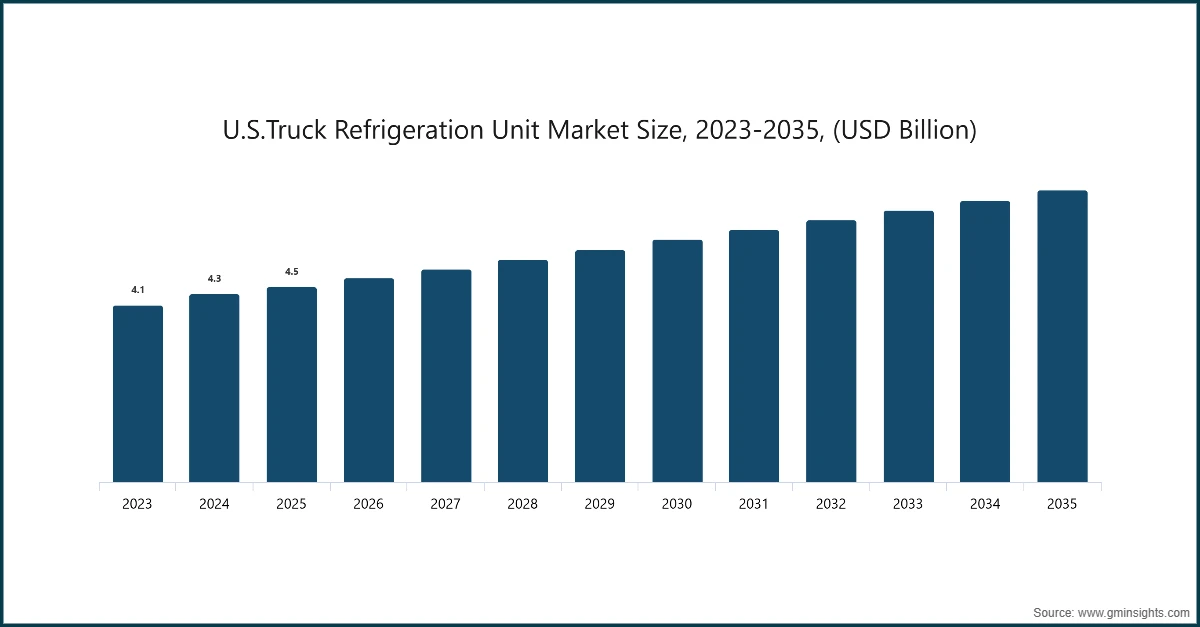
U.S. truck refrigeration unit market reached USD 4.5 billion in 2025, growing from USD 4.3 billion in 2024.
- In U.S., rising consumption levels of temperature-sensitive food and pharmaceuticals are helping to drive growth in the cold chain logistics industry and increasing the number of refrigerated fleets.
- The adoption of electric and hybrid refrigerated carrier fleets is occurring as U.S. carriers comply with environmental regulations and decrease their carbon emissions.
- In 2024 and 2025, there were over 15,316 electric medium and heavy-duty vehicles, including refrigerated trucks, deployed through all North America, with large distributors (reported in 2025) planning to expand their fleets of electric vehicles.
- Advanced telematics, IoT, and digital control systems are increasingly embedded in TRUs to enable remote temperature monitoring, predictive maintenance, and route optimization. As of 2025, over 65% of refrigerated fleets installed telematics systems, improving delivery compliance and operational efficiency in core cold chain logistics.
North America dominated the truck refrigeration unit market with a market size of USD 5.4 billion in 2025.
- In North America, electrifying Fleets and reducing emissions are becoming popular as the industry transforms toward electric and hybrid refrigeration units to conform to stricter emission laws, reduce diesel usage for greater urban delivery sustainability, and drive OEMs toward developing lower-emission TRU technology.
- More fleets are utilizing telematics and IOT Sensors in their truck refrigeration units to maximize cold chain visibility through remote temperature monitoring, predictive maintenance, and compliance documentation.
- With increased purchases and deliveries of perishable products and groceries, the demand for efficient temperature-controlled transportation solutions for last-mile distribution is driving fleets to invest in flexibility with TRUs.
Europe truck refrigeration unit market accounted for a share of 28.3% and generated revenue of USD 3.9 billion in 2025.
- Europe is trying to establish a standardized system for refrigeration so that all parties will share the same equipment specifications to promote efficiencies, leading to manufacturers producing products that can be operated and serviced easily.
- Increased trade in fruits, dairy products, and seafood between European countries places an emphasis on reliable methods of transport using refrigeration.
- The growing number of elderly people in Europe has resulted in an increase in the need for transport of medicine requiring temperature control; this has resulted in high-strength pharmaceutical cold-chain units becoming more popular.
Germany dominates the truck refrigeration unit market, showcasing strong growth potential, with a CAGR of 6.8% from 2026 to 2035.
- Germany's mature logistics sector has rendered it a global leader in temperature-controlled logistics and is leading to the rapid adoption of high-efficiency refrigerated transport units utilizing digital control systems and developing and implementing energy optimization practices to enhance the quality and reliability of cold chains.
- Germany is focused on reducing carbon emissions and that effort is creating opportunities for investment in electric and hybrid refrigeration solutions that can be utilized in quick and cold cross-border shipments, along with local deliveries.
- Logistics and automotive sectors in Germany are integrating refrigerated transport units with fleet telematics and Industry 4.0 to improve routing, monitoring and anticipatory servicing of vehicles.
The Asia Pacific truck refrigeration unit market is anticipated to grow at the highest CAGR of 7.8% from 2026 to 2035 and generated revenue of USD 3.3 billion in 2025.
- In APAC, cold storage and refrigerated logistics are being heavily invested in the markets, increasing the demand for refrigerated units for trucks to reduce food waste.
- The demand for cost-effective and fuel-efficient refrigerated units is growing from the emerging fleet owners in the APAC region, resulting in manufacturers creating solutions tailored to consumers with limited budgets.
- The rapid increase in the online delivery of food and groceries has created a significant requirement for flexible, mass-market refrigerated transportation solutions throughout the region.
China truck refrigeration unit market is estimated to grow with a CAGR of 8.7% from 2026 to 2035.
- The internal growth of China's cold chain infrastructure is causing a corresponding addition to the demand for advanced refrigerated transportation solutions to accommodate the vast domestic market for perishable goods.
- There is an increase in the number of TRUs in China becoming equipped with integrated telematics, remote-controlled, and digital compliance tools to help facilitate the optimization of logistics on a large scale.
- National policies aimed at reducing emissions and increasing clean energy sources are creating a rapid increase in the utilization of electric and hybrid refrigerated vehicles within commercial fleets.
Latin America truck refrigeration unit market shows lucrative growth over the forecast period.
- LATAM nations are enhancing cold chain logistics to reduce post‑harvest losses, encouraging wider TRU adoption for domestic and export routes.
- Growing urban populations drive demand for refrigerated delivery services, increasing investment in last‑mile TRUs.
- Infrastructure funds and logistics PPPs accelerate refrigerated transport capacity expansion, fostering regional market growth.
Mexico truck refrigeration unit market is estimated to grow with a CAGR of 6.2% from 2026 to 2035 and reach USD 561.3 million in 2035.
- Mexico’s position within North American supply chains fuels investment in reliable TRUs capable of long‑haul, temperature‑controlled transport to U.S. and Canadian markets.
- Growing exports of perishables like fresh produce and meat increases need for efficient refrigerated transport throughout the country.
- Mexican transport operators upgrade to more fuel‑efficient, low‑maintenance TRU models to manage operational costs while meeting quality expectations.
Middle East and Africa truck refrigeration unit market accounted for USD 368.9 million in 2025 and is anticipated to show lucrative growth over the forecast period.
- In MEA, increased awareness of cold chain logistics enhances cold chain facilities across the region. This promotes food safety and will reduce food waste while also providing new opportunities for refrigerated transport companies to expand their services.
- High fuel prices, along with the long distances associated with transporting perishable products, have resulted in an increased demand for refrigeration units that provide greater fuel efficiency and consume less energy.
- The growing healthcare industry and increase in vaccine distribution across MEA countries is creating increased demand for temperature-controlled transportation of pharmaceutical products.
UAE market is expected to experience substantial growth in the Middle East and Africa truck refrigeration unit market, with a CAGR of 5.2% from 2026 to 2035.
- As the UAE continues to grow as a strategic trade hub for the Middle East and Africa, there will be an increased need for advanced refrigerated transport options to move perishables throughout the region via import, export, and re-export.
- Sustainability and the promotion of smart cities are driving the integration of electric powered and digitally connected refrigerated truck systems within the UAE's clean energy initiatives and smart logistics.
- As more large-scale events are held in the UAE and the need for high-end food and beverage services grows, the reliance on reliable refrigerated logistics options in urban and desert environments will continue to rise.
Truck Refrigeration Unit Market Share
- The top 7 companies in the truck refrigeration unit industry are Thermo King, Carrier Transicold, MHI Thermal Systems, Daikin Industries, Zanotti, Hubbard Products and Schmitz Cargobull, contributing 87% of the market in 2025.
- Thermo King is one of the leading manufacturers of refrigerated trucks with an extensive portfolio of products for trucks, trailer and bus applications. It is able to harness its capabilities through advanced telematics, a significant service network and innovative electric/hybrid refrigeration technology which facilitates sustainable cold chain logistics on a global scale.
- Carrier Transicold has established itself as a leader in the development of transport refrigeration technologies. Carrier Transicold concentrates on developing energy-efficient systems, electric/hybrid transport refrigeration units (TRUs) and digital fleet management systems, such as the Lynx platform which provides real-time data monitoring and provides improved operational efficiencies. The company has a strong global presence in serviced refrigerated transport markets.
- MHI Thermal Systems delivers advanced technology in truck refrigeration products using the engineering strengths of Mitsubishi Heavy Industries. The company places emphasis on high-efficiency compressors, durable systems and building cold chain infrastructure throughout the Asia-Pacific region, while building their presence in North American and European transport refrigeration markets.
- Daikin Industries puts an emphasis on sustainable, environmentally friendly refrigerants and expertise in refrigeration technologies to position its products against competitors. The company's truck refrigeration solutions are designed with energy efficiency, sustainability and advanced climate control systems in mind, and benefit from having considerable support from Daikin's international R&D capabilities and strong presence in Asia, Europe and North America.
- Zanotti provides compact and modular truck refrigeration units for light and medium commercial vehicles. The company has developed a reputation for providing reliable, energy-efficient and highly adaptable products in Europe.
- Hubbard Products focuses on direct-drive refrigeration units for medium and heavy-duty trucks. The company’s competitive edge comes from durable designs, cost-efficient systems, and strong relationships with North American fleet operators, making it a prominent regional player in refrigerated truck transport.
- Schmitz Cargobull is a leading European trailer manufacturer integrating advanced refrigeration solutions within refrigerated trailers. Its competitive advantage lies in combining trailer manufacturing with cooling technology, digital fleet management systems, and strong logistics partnerships across Europe’s temperature-controlled transport sector.
Truck Refrigeration Unit Market Companies
Major players operating in the truck refrigeration unit industry are:
- Carrier Transicold
- Daikin Industries
- Frigoblock
- Guchen Industry
- Hubbard Products
- Kingtec
- MHI Thermal Systems
- Schmitz Cargobull
- Thermo King
- Zanotti
- The truck refrigeration unit market demonstrates significant concentration with leading manufacturers leveraging technological capabilities, extensive distribution networks, established relationships with commercial vehicle manufacturers, and comprehensive service infrastructure to maintain competitive positions. The market structure reflects substantial barriers to entry including technology complexity, capital requirements, regulatory compliance obligations, service network necessities, and established customer relationships that favor incumbent manufacturers.
- Merger and acquisition activity remains limited due to market concentration, regulatory scrutiny of further consolidation, and substantial capital requirements. Recent strategic partnerships focus on technology collaboration rather than ownership consolidation, such as joint development agreements for electric refrigeration systems, partnerships with telematics and IoT platform providers, and collaborations on sustainable refrigerant development. The market structure is expected to remain concentrated while experiencing gradual share shifts based on technological leadership, service excellence, and successful navigation of the industry's electric transformation.
- Regulatory frameworks and sustainability mandates significantly influence competition. Environmental policies targeting diesel emissions, refrigerant phase-down regulations, and urban low-emission zones are pushing manufacturers to develop electric and hybrid TRUs. Companies capable of delivering compliant, energy-efficient solutions with strong service support gain a competitive advantage in fleet adoption and long-term contracts.
Truck Refrigeration Unit Market Report Attributes
| Key Takeaway | Details |
|---|---|
| Market Size & Growth | |
| Base Year | 2025 |
| Market Size in 2025 | USD 13.8 Billion |
| Market Size in 2026 | USD 14.6 Billion |
| Forecast Period 2026-2035 CAGR | 5.3% |
| Market Size in 2035 | USD 23.1 Billion |
| Key Market Trends | |
| Drivers | Impact |
| Rising demand for cold chain logistics | Expands market size by increasing the volume of refrigerated transport services. |
| Increasing perishable food consumption | Boosts adoption of advanced truck refrigeration units to reduce spoilage. |
| Stringent food safety regulations | Forces upgrades to technologically compliant refrigeration systems, driving sales. |
| Growth in pharmaceutical transportation | Creates high-value, specialized demand for reliable temperature-controlled logistics. |
| Pitfalls & Challenges | Impact |
| High initial investment cost | Limits adoption among small and mid-sized transport operators. |
| Maintenance and operational complexity | Increases downtime and operational expenses, reducing overall efficiency. |
| Opportunities: | Impact |
| Electric and hybrid refrigeration units | Reduces fuel costs and emissions, attracting eco-conscious fleets. |
| Expansion in emerging markets | Opens new revenue streams as cold chain infrastructure develops. |
| IoT-enabled smart monitoring systems | Enhances real-time temperature control and predictive maintenance, improving reliability. |
| Renewable energy-powered cooling solutions | Offers sustainable alternatives, aligning with green logistics initiatives. |
| Market Leaders (2025) | |
| Market Leader |
35% market share |
| Top Players |
Collective market share in 2025 is 82% |
| Competitive Edge |
|
| Regional Insights | |
| Largest Market | North America |
| Fastest growing market | Asia Pacific |
| Emerging countries | India, Brazil, Mexico, Indonesia, South Africa |
| Future outlook |
|
What are the growth opportunities in this market?
Truck Refrigeration Unit Industry News
- In March 2025, Carrier Transicold partnered to co-develop hybrid-electric truck refrigeration units for urban and regional deliveries. The collaboration integrates advanced battery management with refrigeration expertise, targeting zero-emission operation, operational flexibility, and compliance with growing sustainability and emission regulations.
- In February 2025, Thermo King launched an AI-powered telematics platform for predictive maintenance, fleet optimization, and performance monitoring. By analysing connected refrigeration unit data, it enables proactive maintenance, reduces downtime, prevents temperature excursions, and lowers operational costs.
- In January 2025, Wabash National introduced lightweight composite refrigerated trailers, reducing weight by ~15% and improving thermal efficiency. Payload capacity increases 500–700 kg, while insulation cuts cooling loads 20–25%, enabling smaller or longer-lasting refrigeration units.
- In December 2024, The EU expanded zero-emission urban delivery requirements to cities like Paris, Madrid, Amsterdam, and Milan. Regulations accelerate adoption of electric and hydrogen TRUs and phase out diesel systems, creating market opportunities for sustainable refrigeration technologies.
The truck refrigeration unit market research report includes in-depth coverage of the industry with estimates & forecasts in terms of revenue ($ Mn/Bn) and shipments (thousand units) from 2022 to 2035, for the following segments:
Market, By System
- Vapor cycle systems
- Cryogenic systems
- Eutectic system
Market, By Propulsion
- ICE
- Electric
- Hybrid
Market, By Vehicle
- Light commercial trucks
- Medium-duty trucks
- Heavy-duty trucks
Market, By Temperature
- Frozen
- Chilled
- Dual
Market, By End Use Industry
- Food & beverage
- Pharmaceuticals & healthcare
- Chemicals
- Others
The above information is provided for the following regions and countries:
- North America
- U.S.
- Canada
- Europe
- Germany
- UK
- France
- Italy
- Spain
- Russia
- Nordics
- Poland
- Romania
- Asia Pacific
- China
- India
- Japan
- South Korea
- ANZ
- Vietnam
- Indonesia
- Thailand
- Latin America
- Brazil
- Mexico
- Argentina
- MEA
- South Africa
- Saudi Arabia
- UAE
Frequently Asked Question(FAQ) :
What was the market size of the truck refrigeration unit in 2025?
The market size was USD 13.8 billion in 2025, with a CAGR of 5.3% expected through 2035. The growth is driven by increasing demand for cold chain logistics and temperature-sensitive transportation.
What is the projected value of the truck refrigeration unit market by 2035?
The market is poised to reach USD 23.1 billion by 2035, supported by advancements in refrigeration technologies and the expansion of cold chain networks.
What is the expected size of the truck refrigeration unit industry in 2026?
The market size is projected to reach USD 14.6 billion in 2026.
What was the market share of vapor cycle systems in 2025?
Vapor cycle systems accounted for 72% of the market share in 2025 and are expected to grow at a CAGR of 5.4% through 2035.
What was the market share of the ICE segment in 2025?
The ICE segment held a 67.5% market share in 2025 and is projected to grow at a CAGR of 4.3% till 2035.
What was the market share of the light commercial trucks segment in 2025?
The light commercial trucks segment dominated the market with a 50% share in 2025 and is set to expand at a CAGR of 4.1% up to 2035.
What was the valuation of the U.S. truck refrigeration unit sector in 2025?
The U.S. market was valued at USD 4.5 billion in 2025, led by rising consumption of temperature-sensitive food and pharmaceuticals and the growth of refrigerated fleets.
What are the upcoming trends in the truck refrigeration unit market?
Trends include electric and hybrid TRUs, IoT-based monitoring, solar-assisted power, and efficiency-focused design innovations.
Who are the key players in the truck refrigeration unit industry?
Key players include Carrier Transicold, Daikin Industries, Frigoblock, Guchen Industry, Hubbard Products, Kingtec, MHI Thermal Systems, Schmitz Cargobull, Thermo King, and Zanotti.
Truck Refrigeration Unit Market Scope
Related Reports