Summary
Table of Content

Topical Drugs Packaging Market
Get a free sample of this report
Form submitted successfully!
Error submitting form. Please try again.
Thank you!
Your inquiry has been received. Our team will reach out to you with the required details via email. To ensure that you don't miss their response, kindly remember to check your spam folder as well!
Request Sectional Data
Thank you!
Your inquiry has been received. Our team will reach out to you with the required details via email. To ensure that you don't miss their response, kindly remember to check your spam folder as well!
Form submitted successfully!
Error submitting form. Please try again.
Topical Drugs Packaging Market Size
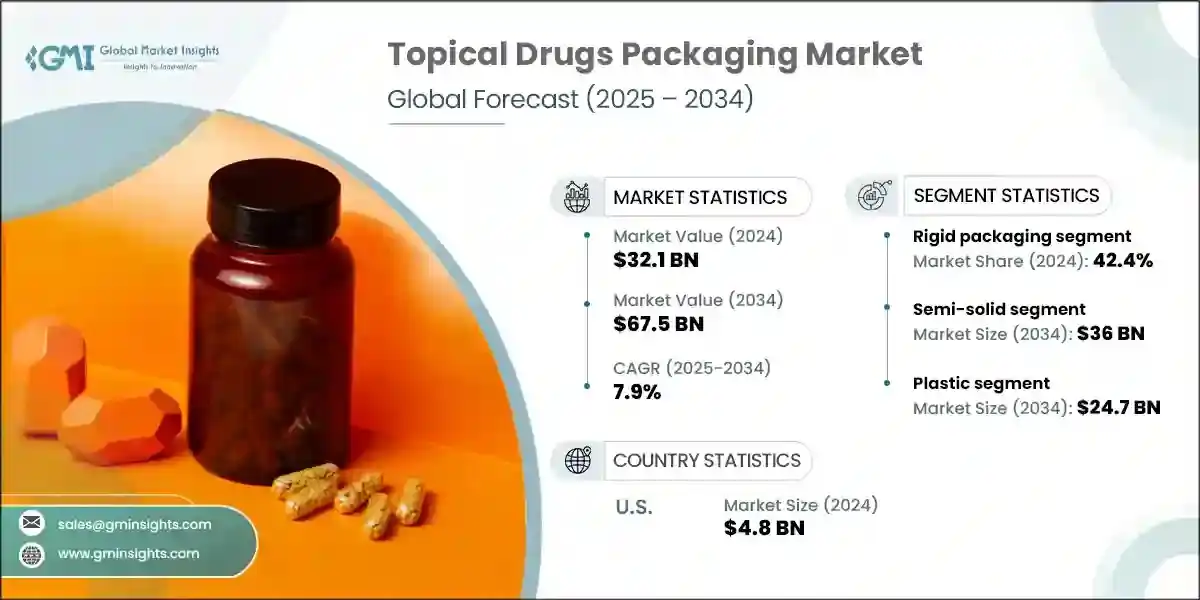
The global topical drugs packaging market was valued at USD 32.1 billion in 2024 with a volume of 32.5 kilo tons. The market is expected to grow from USD 34.2 billion in 2025 to USD 48.3 billion by 2030 and USD 67.5 billion by 2034 with a volume of 71.8 kilo tons, growing at a value CAGR of 7.9% and volume CAGR of 8.4% during the forecast period of 2025-2034.
Topical Drugs Packaging Market Key Takeaways
Market Size & Growth
- 2024 Market Size: USD 32.1 Billion
- 2034 Forecast Market Size: USD 67.5 Billion
- CAGR (2025–2034): 7.9%
Key Market Drivers
- Rising prevalence of skin diseases and dermatological disorders.
- Growing demand for convenient and user-friendly packaging formats.
- Expansion of over-the-counter (OTC) topical drug products.
- Growth of e-commerce and direct-to-consumer pharmaceutical sales.
- Innovation in unit dose and controlled-dispensing systems.
Challenges
- Stringent regulatory compliance and approval processes.
- Complexities in designing child-resistant yet senior-friendly packaging.
Opportunity
- Expansion into emerging markets with underserved dermatological needs..
- Integration of smart packaging technologies for authentication and patient engagement..
- Rising investment in sustainable and biodegradable packaging solutions..
- Growth of private-label topical product lines by retail pharmacy chains..
Key Players
- Market Leader: Amcor led with over 42.6% market share in 2024.
- Leading Players: Top 5 players in this market include Amcor, Gerresheimer, AptarGroup, West Pharmaceutical Services, Schott, which collectively held a market share of 65.1% in 2024.
Get Market Insights & Growth Opportunities
- The market growth is attributed to factors such as the increased incidence of skin diseases and disorders, expansion of e-commerce and direct-to-consumer pharmaceutical sales.
- The rapid expansion of e-commerce offers substantial opportunities for the pharmaceutical industry, including the subsector of topical drug products. According to the ITA report, B2C e-commerce revenue is expected to reach USD 5.5 trillion by 2027, growing at a CAGR of 14.4%. This comprehensive growth is anticipated to result in an increase in the online sales of OTC and topical drugs, leading to the adoption of e-commerce compatible packaging by manufacturers. This entails innovations in unit-dose packaging, tamper-evidence, and robust, eco-friendly, and sustainable packaging designed for direct shipment and home use, strengthening market momentum for topical drug packaging.
- The growing prevalence of skin diseases is driving the rising demand for topical drug products and their packaging. The growing incidence of acne, eczema, psoriasis, and other infections are propelling pharmaceutical companies to improve the accessibility and availability of topical treatments for consumers. According to the American Academy of Dermatology Association acne impacts nearly 50 million people annually, making it the most prevalent skin condition in the United States. Such high prevalence of dermatological disorders increases the demand for effective, safe, and simple-to-use packaging solutions that preserve the product's quality and facilitate consumer-driven administration.
- In 2024, North America accounted for 37.6% share of the topical drugs packaging market, mainly due to the growing adoption of widespread over-the-counter (OTC) topical medications. The Consumer Healthcare Products Association (CHPA) reported that 93% of American adults prefer to self-treat using OTC medications, rather than consulting a healthcare professional for minor ailments. Such strong preferences highlight the need for safe, seamless, and self-administered topical drug delivery systems packaged in tubes, sachets, sprays, or unit-dose packs.
To get key market trends
Topical Drugs Packaging Market Trends
- One of the most significant trends shaping the market is the shift towards adoption of single-use and unit-dose packaging. These formats are ideal for OTC and consumer health products as they offer hygiene, precise dosing, and portability. This shift is in line with the growing popularity of self-medication and the trend toward decentralized healthcare systems. Overall market adoption is expected to grow steadily by the end of 2025, peaking between 2027 and 2028 as manufacturers transition to topical delivery systems that are more portable and resistant to contamination.
- Incorporation of digital technologies such as QR codes, authentication indicators, and tracking and tracing features into topical pharmaceutical packaging is becoming increasingly popular, particularly in premium over-the-counter and prescription dermatology markets. Even though the adoption of smart packaging is at an early stage, the acceleration is expected post 2026, with widespread commercial adoption anticipated by 2028 as reliance on digitally connected healthcare systems rises and the acceptance of regulatory frameworks on connected packaging matures.
- Sustainability is becoming a defining trend in the market for topical drug packaging for packaging suppliers as well as pharmaceutical brands. Companies are now adopting recyclable plastics, compostable laminates, and refillable systems as a competitive requirement. This trend is anticipated to peak significantly between 2027 and 2029, as sustainable packaging becomes a key differentiator in the market.
- The increase in biologic-based topical formulations is also creating a significant trend toward high performance packaging solutions. These formulations include peptide creams, nanocarrier-based ointments, and bioactive gels, which are particularly vulnerable to damage from heat, oxygen, and ultraviolet radiation. Thus, barrier-enhanced materials such as foil-laminated structures, multilayer tubes, and amber glass are being used in packaging design. The clinical development of topical biologics is driving this packaging trend, which is anticipated to intensify from 2026 with peak innovation and adoption between 2028 and 2029.
Topical Drugs Packaging Market Analysis
Learn more about the key segments shaping this market
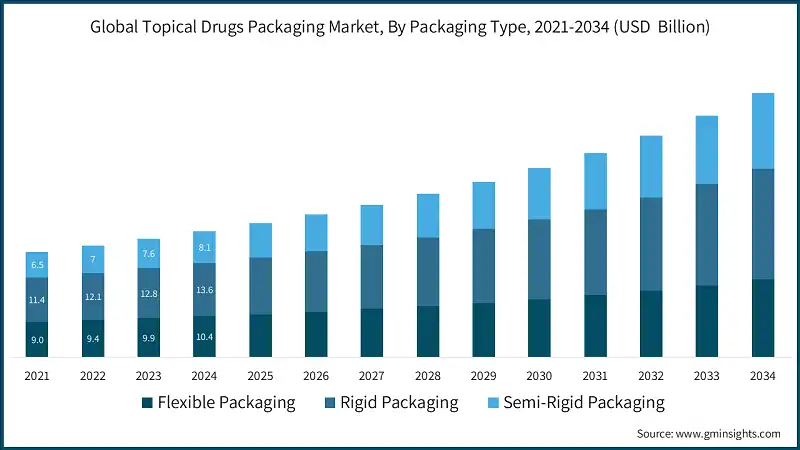
On the basis of packaging type, the market is divided into flexible packaging, rigid packaging, and semi-rigid packaging.
- The rigid packaging segment dominated the market with a market share of 42.4% in 2024. Rigid packaging formats such as jars, bottles, and glass containers are preferred for prescription-based and premium dermatological products due to their structural integrity and product protection. These formats are suitable for maintaining bulk quantities and maintaining a product’s viscosity, as well as for items with tight storage requirements or those meant for high-end display.
- To meet regulatory standards and ensure product integrity, manufacturers should provide rigid packaging that includes tamper-evident closures and barrier-enhancing coatings. Use of glass and plastics that are recyclable and compliant will help meet environmental standards without compromising on safety and regulatory requirements.
- The semi-rigid packaging segment is anticipated to grow at a CAGR of 9.2% during the forecast period 2025 - 2034. Semi-rigid formats like tubes, squeeze bottles, and dispensers dominate the topical drug segment for both OTC and prescription categories. These formats are preferred due to ease of use and controlled dispensing and are also suitable for semi-solid formulations, especially in unit-dose or travel-size variants.
- Packaging suppliers should adopt multilayer laminate technology and user-friendly dispensing systems. Packaging suppliers should provide high hygiene and dosing control to consumers of all ages and backgrounds through airless pumps and precision nozzles, which improve usability and dosing control.
Learn more about the key segments shaping this market
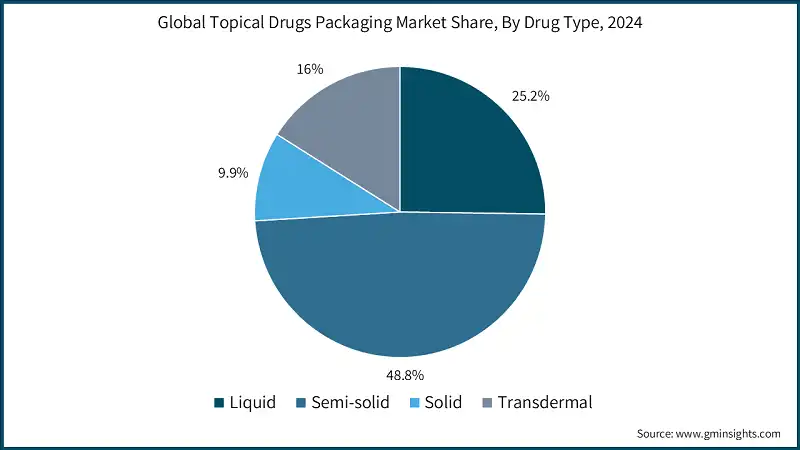
On the basis of drug type, the topical drugs packaging market is divided into liquid, semi-solid, solid, and transdermal.
- The semi-solid segment is anticipated to reach USD 36 billion by 2034. Semi-solid formulations, including creams, ointments, and gels, form the core of the topical drug market. These products require moisture and air-tight seals to ensure protection against degradation or contamination while also ensuring stability and easy dispensing.
- Packaging manufacturers should design tubes with oxygen-blocking seals, collapsible laminates, or barrier-resistant tubes. Compatibility with viscous textures and ease of use will be important factors for both retail and therapeutic appeal.
- The liquid segment is anticipated to grow at a CAGR of 7.9% during the forecast period 2025 - 2034. Packaging for topical liquids, such as medicated sprays, antiseptic solutions, and serums, must ensure accurate, spill-free dispensing while maintaining sterility and avoiding contamination. These products frequently require packaging suitable for sensitive ingredients and varying viscosities.
- Manufacturers should prioritize spray pumps, dropper bottles, or flip-top closures that have leak-proof features. The use of amber or other UV protective materials is beneficial for formulation containing sensitive active ingredients as it protects from light exposure.
On the basis of packaging material, the topical drugs packaging market is segmented into plastic, glass, metal, paper, aluminium, and others.
- The plastic market is anticipated to reach USD 24.7 billion by 2034. Plastic remains the dominant material in topical drug packaging due to its cost efficiency, versatility, and adaptability to various shapes and closures. Moreover, plastic aids in the high-volume production of OTC and mass-market products like squeezable tubes, bottles, and blister packs.
- To resolve sustainability issues, packaging developers should consider using recyclable or bio-based plastics, including PCR (post-consumer resin). Emphasizing lightweighting and mono-material design may further improve circularity without compromising functionality.
- The paper market is projected to register a CAGR of 9.2% during the forecast period 2025 - 2034. Paper-based packaging materials are gaining popularity as a secondary packaging option, and as a more sustainable primary packaging alternative for low-viscosity topical products. Its renewability and biodegradability are appealing to environmentally concerned customers and regulatory authorities.
- Manufacturers should innovate coated or laminated paper formats that provide barrier protection for moisture-sensitive topicals. Emphasis should be placed on carton design optimization for branding, tamper-evidence, and compliance labeling in e-commerce-ready formats.
Looking for region specific data?
North America held a market share of 37.6% in 2024 and is anticipated to grow at a CAGR of 6.9% during the forecast period. The topical drug packaging market in North America is advancing steadily due to high consumer reliance on over-the-counter (OTC) products and robust pharmaceutical infrastructure. The rising inclination toward self-diagnosis and self-treatment, coupled with the expansion of e-commerce platforms, is propelling the need for convenient, tamper-proof, and compliance-focused packaging in the United States and Canada.
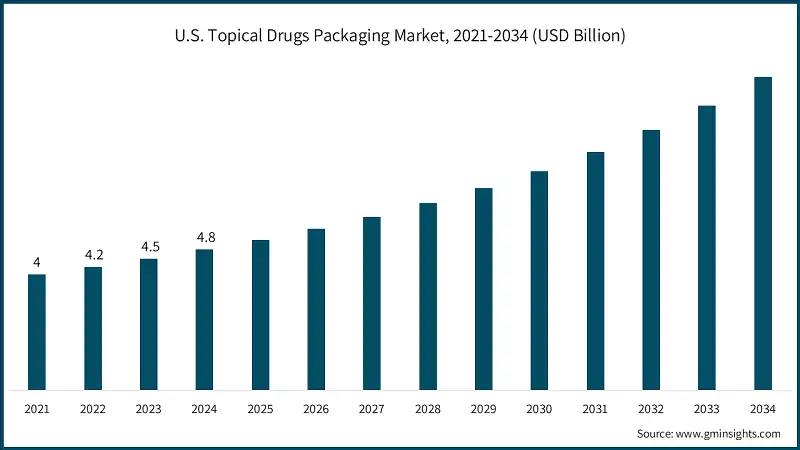
- U.S. dominated the topical drugs packaging market, accounting for USD 4.8 billion in the year 2024. The U.S. has a well-established market in the topical drug packaging segment, supported by robust consumption of OTC drugs. As reported by the Consumer Healthcare Products Association, 93% of adults and 85% of parents in the U.S. favor relying on OTC medications prior to seeking professional advice, further increasing the need for well-designed and user-friendly packaging.
- Manufacturers must emphasize clear labeling, tamper-evident packaging, and user-friendly formats like squeezable tubes and metered dispensers. With a continued rise in online order fulfillment, packaging must be functional while also meeting durability standards for shipping.
- Canada is anticipated to grow at a 9.1% CAGR during the forecast period 2025 - 2034. Canada reflects similar consumer behaviors to the U.S. in the topical drug segment, with widespread usage of creams and gels via both pharmacies and online platforms. Regulatory standards and bilingual packaging requirements influence the structure and material selection for topical drug packaging across provinces.
- Developing bilingual, regulation-compliant packaging in recyclable or refillable formats is critical. Tamper-evident pump tubes and portable unit-dose packaging will help brands enhance product safety and appeal across Canada's retail and digital distribution networks.
Europe accounted for 19.9% of the global topical drugs packaging market in 2024 and is anticipated to grow with a CAGR of 8.7% during the forecast period. The increasing demand for dermatological treatments and for cosmetic topicals is stimulating innovation in topical drug packaging in Europe, where sustainability and compliance are two key differentiating factors. As cited by the CTPA, Europe remains the largest cosmetics market as of 2023 with a Retail Sales Price (RSP) of USD 104 billion.
- Germany is anticipated to grow at a 10.2% CAGR during the forecast period 2025 - 2034. Rising consumption of dermatological treatments is a core driver for topical drug packaging in Germany. According to Statista, the revenue in the dermatological drugs market is estimated to reach USD 806.46 million in 2025, reflecting stable growth and sustained pharmaceutical demand.
- Manufacturers should concentrate on high-barrier packaging formats such as multilayer tubes, pump dispensers, and sealed containers that offer high barrier packaging and protect formulation integrity. Compliance with regulations and alignment with distribution models used by pharmacies will be essential for market entry.
- UK's topical drugs packaging market is anticipated to grow at a 8.1% CAGR during the forecast period. Increasing consumer engagement with both therapeutic and cosmetic topical products is a key driver for the UK topical drug packaging market. Demand for packaging that balances functionality, safety, and shelf appeal is growing steadily across pharmacy and retail channels.
- Suppliers should provide aesthetically pleasing, legally compliant packaging formats, like airless pumps and recyclable polymer containers. Customers that are health-conscious and the environmentally aware will be drawn to designs that are high-quality and incorporate sustainable materials.
Asia-Pacific held a share of 26.2% in the global topical drugs packaging market and is the fastest-growing region with a 9.2% CAGR during the forecast period. Rapid urbanization, growing awareness of skincare, and expansion of pharmaceutical manufacturing are major drivers of the topical drug packaging market across Asia-Pacific. The region shows rising demand for both medical and cosmetic topical formulations, especially in India, China, and Japan, backed by growing OTC consumption and online pharmacy adoption.
- The topical drugs packaging market in China is anticipated to reach USD 6.7 billion by the year 2034. Expanding dermatological product usage, aging demographics, and the rise of e-pharmacies are accelerating demand for topical drug packaging in China. There is a growing emphasis on safety, traceability, and high-quality delivery systems aligned with increasingly strict pharmaceutical regulations.
- Manufacturers should invest in high-barrier laminated tubes and airless containers along with anti-counterfeit features like serialized labels and QR codes. Long-term packaging scalability will be supported by compliance with China's regulatory framework and compatibility with cold-chain logistics.
- Japan's topical drugs packaging market was valued at USD 726.6 million in 2024. In Japan, customer's preference for high-precision, hygienic, and minimal-waste formats is driving innovation in topical drug packaging market. With the country's aging population and the demand for high-quality dermatological products, user-friendly, high-end packaging is growing in popularity.
- Suppliers should focus on airless dispensers, recyclable components, and precision applicators tailored to sensitive skin formulations. Packaging must provide sustainability and convenience while adhering to Japan's stringent quality and safety regulations.
- India's topical drugs packaging market is anticipated to grow at a CAGR of over 10% during the forecast period. Growing demand for affordable dermatological treatments and increasing access to healthcare are accelerating the topical drug packaging market in India. The Indian Pharmaceutical industry is anticipated to attain a market value of USD 130 billion by 2030 and USD 450 billion by 2047, as reported by IBEF. In the longer term, the forecast underscores India’s strategic advantage as a prospective market not only for the pharmaceutical manufacturing sector but also for auxiliary industries such as drug packaging.
- To address this opportunity, packaging manufacturers need to concentrate on economical, scalable formats that sustain barrier properties through various climatic conditions. To serve the rural and urban demand and foster support towards self-sustaining and export driven pharmaceutical development, packaging formats such as laminated sachets, protective, tamper-evident tubes and small volume dispensers will be essential.
Latin America held 6.1% market share in 2024 and is anticipated to grow with a 5.9% CAGR during the forecast period. Increasing access to OTC topicals and expanding healthcare awareness are pushing the topical drug packaging market forward in Latin America. Growth is supported by expanding pharmacy chains, digitization, and rising demand for affordable dermatological products.
In 2024, the Middle East and Africa held a share of 10.2% and is anticipated to grow at a 7.1% CAGR during the forecast period. In the MEA region, the topical drug packaging market is expanding due to rising awareness of skin health, improved healthcare access, and regionally focused governmental healthcare expansions. Increased need for both therapeutic and cosmetic topical products is observed in primary markets like Saudi Arabia, the UAE, and South Africa.
- Saudi Arabia accounted for a 26% topical drugs packaging market share in 2024. Rising incidence of climate-induced skin conditions and the expansion of localized pharmaceutical production are driving demand for topical drug packaging in Saudi Arabia. This trend is being further bolstered by heightened government focus toward the healthcare infrastructure.
- Manufacturers should provide UV-resistant, high-barrier packaging formats with tamper-proof closures. Compliance with SFDA requirements and suitability for both OTC and prescription formulations will be key to successful market penetration.
- The South Africa market is anticipated to grow at a CAGR of 6.3% during the forecast period. The growing need for skin treatments related to infections, sun exposure, and general dermatological care is supporting the expansion of topical drug packaging in South Africa. Ongoing refinement in the accessibility of public health services as well as the distribution of pharmaceuticals is supporting this trend.
- Manufacturers should introduce tamper-resistant, climate-resilient packaging such as collapsible tubes and sachets. Emphasis on affordability, clear labeling, and localized supply chain partnerships will strengthen market presence.
- The UAE accounted for a share of 28.1% in the market in 2024. Medical tourism, premium personal care demand, and evolving pharmaceutical standards are advancing the topical drug packaging market in the UAE. Consumers are increasingly seeking high-quality products with reliable and safe packaging.
- Packaging providers should offer airless dispensers, recyclable premium tubes, and serialized packaging to meet both local consumer expectations and global export compliance. Aesthetic appeal combined with performance will be essential for competitive differentiation.
Topical Drugs Packaging Market Share
The key players in the market are Amcor, Gerresheimer, AptarGroup, West Pharmaceutical Services, and Schott. As of 2024, these companies together accounted for over 65% of the market share.
- Amcor led the topical drug packaging market with a 23.5% share in 2024. Amcor stands out as a top competitor in the topical drug packaging market as it offers products like flexible tubes, blister packs, sachets, and barrier films. The company's position in the market is strong as they focus on competing products such as recyclable laminates, heat-seal coatings, and packaging designed specifically for e-commerce. Moreover, Amcor provides mounting proprietary and OTC dermatological products in North America, Europe, and Asia Pacific with strong, sustainable packaging.
- Gerresheimer held 19% market share in 2024. Gerresheimer is distinguished by its proprietary and high-quality plastic and glass containers meant for semi-solid and liquid topical formulations. The company is often preferred by brands offering premium skincare and prescription dermatology products due to their sterile pharmaceutical packaging and compliance to regulatory requirements. The company's global manufacturing footprint provides supply chain resilience and bespoke technical support.
- AptarGroup accounted for 10.7% of the market in 2024. AptarGroup is recognized for airless pumps and other dispensing systems like metered applicators and unit dose packaging. The company’s emphasis on safety features, patient-centric design, and preservative-free delivery methods are in alignment with the most recent developments in direct-to-consumer healthcare and the self-care industry. AptarGroup's packaging designs are utilized in both the generic and precision medical-grade topical formulations.
- West Pharmaceutical Services captured 7.5% market share in 2024. West Pharmaceutical brings strong capabilities in barrier-enhanced components and closures used in dermatological and sterile topical drug applications. West is a reliable supplier for pharmaceutical companies creating cutting-edge topical therapies, with a portfolio that meets the packaging requirements of biologic-based and moisture-sensitive products. High dependability across therapeutic segments is provided by the company's depth of engineering and material science expertise.
- Schott secured 4.4% share in 2024, driven by its specialized glass packaging solutions including amber containers, tubes, and vials designed to protect light-sensitive topical formulations. With manufacturing strength in Europe and Asia, Schott’s focus on pharmaceutical-grade borosilicate glass, coupled with sustainability in material sourcing, supports its niche leadership in high-performance topical drug delivery.
Topical Drugs Packaging Market Companies
Major players operating in the topical drugs packaging industry are:
- Amcor
- AptarGroup
- Bormioli Pharma
- Catalent
- CCL Industries
- Constantia Flexibles
- Gerresheimer
- Huhtamaki
- LOG Pharma Primary Packaging
- Mondi
- Nelipak
- Nipro
- ProAmpac
- Amcor, Gerresheimer, AptarGroup, West Pharmaceutical Services, and Schott are considered leaders in the market. These companies have a comprehensive global presence, diverse portfolios in topical formulation packaging, as well as topical packaging. These companies play a significant role in defining the sustainable packaging and innovation landscape, which covers sustainable films, airless dispensing technologies.
- Constantia Flexibles, ProAmpac, Mondi, Sonoco Products, and Silgan Holdings fall under the challengers category. These companies possess competitive expertise in laminate structures, flexible packaging, and container design. These companies innovations in customization, recyclable packaging, and focus on growth in targeted geographies make them major players in the topical and OTC pharmaceutical packaging market.
- WestRock, Huhtamaki, Nipro, CCL Industries, and Catalent are considered as followers. Their involvement in the topical pharmaceutical packaging market is either peripheral in nature or limited to secondary packaging and select contract manufacturing. These companies focus on strategic innovation and cooperation in the consumer health and dermatology sectors.
- Bormioli Pharma, LOG Pharma Primary Packaging, Nelipak, and SGD Pharma are classified as niche players. These companies focus on small-batch manufacturing, regional topical formulation compliance, or precisely engineered packaging. These companies also emphasize partnerships with pharmaceutical companies that require specialized or clinical-grade topical delivery systems.
Topical Drugs Packaging Market Report Attributes
| Key Takeaway | Details |
|---|---|
| Market Size & Growth | |
| Base Year | 2024 |
| Market Size in 2024 | USD 32.1 Billion |
| Forecast Period 2025 - 2034 CAGR | 7.9% |
| Market Size in 2034 | USD 67.5 Billion |
| Key Market Trends | |
| Drivers | Impact |
| Rising prevalence of skin diseases and dermatological disorders | Drives topical drug packaging demand by over 25% as chronic skin conditions continue to rise globally, particularly in urban populations. |
| Growing demand for convenient and user-friendly packaging formats | Accelerates adoption of ergonomic packaging by approximately 20%, especially among aging consumers and self-administering patients. |
| Expansion of over-the-counter (OTC) topical drug products | Boosts market volume by nearly 35% due to increased consumer preference for self-treatment and pharmacist-recommended solutions. |
| Growth of e-commerce and direct-to-consumer pharmaceutical sales | Elevates demand for e-commerce-ready packaging by around 28% as digital pharmacy channels reshape delivery models. |
| Innovation in unit dose and controlled-dispensing systems | Enhances adoption of advanced dispensing formats by 22%, driven by the need for accurate dosing, hygiene, and waste reduction. |
| Pitfalls & Challenges | Impact |
| Stringent regulatory compliance and approval processes | Slows time-to-market for new packaging solutions as manufacturers navigate evolving global and regional pharmaceutical standards. |
| Complexities in designing child-resistant yet senior-friendly packaging | Creates engineering and usability trade-offs that hinder rapid adoption of packaging innovations across diverse age groups. |
| Opportunities: | Impact |
| Expansion into emerging markets with underserved dermatological needs. | Opens new revenue streams as rising healthcare access fuels demand for localized, cost-effective topical packaging formats. |
| Integration of smart packaging technologies for authentication and patient engagement. | Enables value-added services and brand differentiation through features like QR codes, NFC tags, and digital adherence tools. |
| Rising investment in sustainable and biodegradable packaging solutions. | Drives innovation in material science as regulatory and consumer pressure shifts focus toward eco-friendly topical packaging. |
| Growth of private-label topical product lines by retail pharmacy chains. | Creates packaging volume opportunities through high-turnover SKUs requiring rapid customization, cost efficiency, and compliant branding. |
| Market Leaders (2024) | |
| Market Leaders |
Top 2 players held 42.6% market share |
| Top Players |
Collective market share in 2024 is 65.1% |
| Competitive Edge |
|
| Regional Insights | |
| Largest Market | North America |
| Fastest Growing Market | Asia Pacific |
| Emerging Country | Mexico, India, Brazil, Indonesia, South Africa |
| Future Outlook |
|
What are the growth opportunities in this market?
Topical Drugs Packaging Industry News
- In October 2023, At CPHI Barcelona, Aptar Pharma launched a wide range of cutting-edge drug delivery and packaging options, including dermal dosage forms, emphasizing patient compliance, product safety, and sustainability.
- In June 2021, Neopac launched the small Polyfoil tube with a patented closure with a nozzle. The tube is designed for topical disinfectants, eye ointments, gels, and oral hygiene products.
The topical drugs packaging market research report includes in-depth coverage of the industry with estimates & forecasts in terms of revenue (USD Million) and Volume (Kilo Tons) from 2021 to 2034, for the following segments:
Market, By Packaging Type
- Flexible packaging
- Rigid packaging
- Semi rigid packaging
Market, By Packaging Material
- Plastic
- Glass
- Metal
- Paper
- Aluminium
- Others
Market, By Product Types
- Bottles
- Caps & closures
- Inhalers
- Tubes
- Jars
- Others
Market, By Drug Type
- Liquid
- Semi-solid
- Solid
- Transdermal
Market, By Closure Type
- Screw cap
- Flip-top cap
- Pump dispenser
- Dropper
- Nozzle
Market, By Mode of Administration
- Ophthalmic usage
- Nasal usage
- Dermal usage
Market, By Application
- Dermatology
- Ophthalmology
- Others
The above information is provided for the following regions and countries:
- North America
- U.S.
- Canada
- Europe
- Germany
- Uk
- France
- Spain
- Italy
- Netherlands
- Asia Pacific
- China
- India
- Japan
- Australia
- South Korea
- Latin America
- Brazil
- Mexico
- Argentina
- Middle East and Africa
- Saudi Arabia
- South Africa
- UAE
Frequently Asked Question(FAQ) :
What is the market size of the topical drugs packaging in 2024?
The market size was USD 32.1 billion in 2024, with a volume of 32.5 kilo tons.
What is the projected value of the topical drugs packaging market by 2034?
The market is expected to reach USD 67.5 billion by 2034, with a volume of 71.8 kilo tons, growing at a value CAGR of 7.9% and a volume CAGR of 8.4% during the forecast period of 2025-2034.
What is the projected size of the topical drugs packaging market in 2025?
The market is expected to reach USD 34.2 billion in 2025.
What is the valuation of the semi-solid segment by 2034?
The semi-solid segment is anticipated to reach USD 36 billion by 2034, driven by demand for creams, ointments, and gels requiring moisture and air-tight seals for stability and protection.
What is the projected value of the plastic segment in the topical drugs packaging industry?
The plastic segment is expected to reach USD 24.7 billion by 2034, maintaining dominance due to its cost efficiency, versatility, and adaptability for high-volume production of OTC products.
Which region leads the topical drugs packaging market?
North America held a 37.6% market share in 2024 and is projected to grow at a CAGR of 6.9% during the forecast period. The region's growth is driven by reliance on OTC products, robust pharmaceutical infrastructure, and the expansion of e-commerce platforms.
What are the upcoming trends in the topical drugs packaging industry?
Key trends include the adoption of single-use and unit-dose packaging for hygiene and portability, the shift toward decentralized healthcare systems, and the development of packaging solutions with oxygen-blocking seals and barrier-resistant materials.
Who are the key players in the topical drugs packaging market?
Key players include Amcor, AptarGroup, Bormioli Pharma, Catalent, CCL Industries, Constantia Flexibles, Gerresheimer, Huhtamaki, and LOG Pharma Primary Packaging.
Topical Drugs Packaging Market Scope
Related Reports