Summary
Table of Content

Tobacco Products Market
Get a free sample of this report
Form submitted successfully!
Error submitting form. Please try again.
Thank you!
Your inquiry has been received. Our team will reach out to you with the required details via email. To ensure that you don't miss their response, kindly remember to check your spam folder as well!
Request Sectional Data
Thank you!
Your inquiry has been received. Our team will reach out to you with the required details via email. To ensure that you don't miss their response, kindly remember to check your spam folder as well!
Form submitted successfully!
Error submitting form. Please try again.
Tobacco Products Market Size
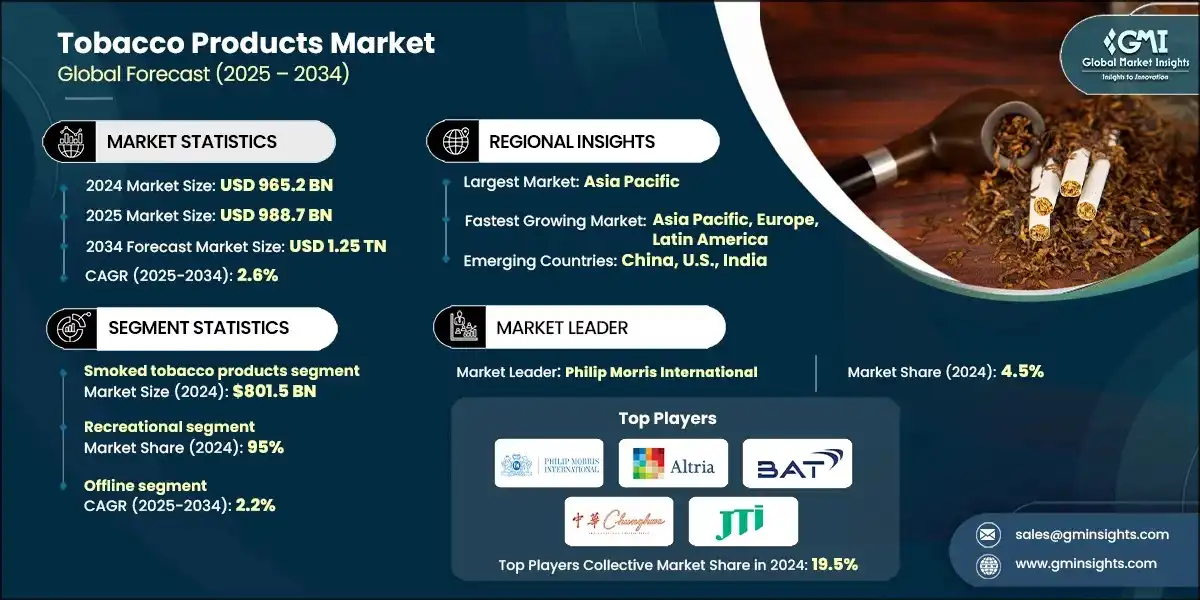
The global tobacco products market was estimated at USD 965.2 billion in 2024. The market is expected to grow from USD 988.7 billion in 2025 to USD 1.25 trillion in 2034, at a CAGR of 2.6%, according to latest report published by Global Market Insights Inc.
Tobacco Products Market Key Takeaways
Market Size & Growth
- 2024 Market Size: USD 965.2 Billion
- 2025 Market Size: USD 988.7 Billion
- 2034 Forecast Market Size: USD 1.25 Trillion
- CAGR (2025–2034): 2.6%
Key Market Drivers
- Increasing consumer demand for premium tobacco products.
- Popularity of smokeless tobacco and e-cigarettes.
Challenges
- Stringent government regulations and taxation policies.
- Rising health awareness among consumers.
Opportunity
- Innovation in product offerings.
- Expansion into emerging markets.
Key Players
- Market Leader: Philip Morris International led with over 4.5% market share in 2024.
- Leading Players: Top 5 players in this market include Philip Morris International, Altria Group, British American Tobacco, Chunghwa, Japan Tobacco International, which collectively held a market share of 19.5% in 2024.
Get Market Insights & Growth Opportunities
The market for tobacco products is expanding due to the increasing consumer demand for premium and innovative tobacco products, such as flavored cigarettes and cigars, is significantly contributing to market expansion.
With 253 million tobacco users, India has some of the highest rates of tobacco use in the world. In 2022, an estimated 62.9 million people (38.4 million males and 24.3 million females) aged 15 years and older were tobacco product users in the United States of America.
In 2022, India produced about 772.2 thousand tons of unmanufactured tobacco, accounting for about 13.4% of the global production of 5.8 million tons, thus positioning the country as the world's 2nd largest tobacco producer.
The increasing legalization of tobacco related products for recreational and medical purposes across countries is driving the market growth. Europe, major portion of Latin America, and North America have legalized marijuana, enhancing the user market for vaporizers. Legalization also boosts investment in the quality of the product and innovation, which enables vaporizers as a healthier preference over smoking.
In 2013, Uruguay was the first nation to legalize the manufacturing, sale, and use of cannabis for recreational purposes. In 2024, Germany joined Malta and Luxembourg as the third country in the European Union to make cannabis use legal, for personal consumption.
In December 2021, Malta became the first EU member state to legalize the use of recreational cannabis, under which adults may possess up to seven grams and cultivate up to four plants at home. Canada in 2018 was the second country globally following Uruguay and the first G7 big economy to permit the use of cannabis recreationally.
Despite stringent regulations and increasing health awareness, the market continues to grow due to the persistent demand for tobacco products in emerging economies, where cultural and social factors influence consumption patterns.
To get key market trends
Tobacco Products Market Trends
- The market for tobacco products sees tremendous changes prompted by changing consumer preferences, shifting regulatory policies, and new product innovations. Increased health risk awareness from the traditional consumption of tobacco has led to tumbling sales of cigarettes globally.
- However, reputedly less-harmful alternative products are consistently growing, such as e-cigarettes, heated tobacco products, and nicotine pouches. The existing regulatory frameworks are getting tighter; therefore, governments are acting by increasing taxes on tobacco products, limiting its advertising, and even banning smoking at public places, further influencing the market.
- Organic and herbal tobacco products would be more widely adopted in coming years as health-conscious consumers will see these product categories as healthier.
- Moreover, manufacturers are in a place where they can develop innovative products according to evolving consumer demand, including flavored and customizable products.
- The dominant market remains the Asia-Pacific region due to a huge population base and the cultural tradition of tobacco consumption, while slow change is recorded in North American and European markets due to increased adoption of reduced-risk products.
- Another emerging trend is the belief in sustainability wherein companies create focus on using eco-friendly packaging and sustainable sources of raw materials. Product portfolio diversification and strategic partnerships to overcome regulatory hurdles would likely continue through the forecast period, thereby considering new opportunities arising in the global market.
Tobacco Products Market Analysis

Learn more about the key segments shaping this market
Based on the product type, the market is divided into smoked tobacco products, smokeless tobacco products and nicotine products. The smoked tobacco products generated around USD 801.5 billion revenue in 2024 and is expected to grow at a CAGR of 2.6% during 2025 to 2034.
- The segment will see steady growth through the forecast period owing to continuous demand for cigarettes and cigars across different regions. While regulatory bans and increased health awareness related to smoking are on the rise, this segment still sees significant returns with its strong consumer base and brand loyalty.
- The segment of smokeless tobacco products is expected to show a moderate growth rate during the forecast period, driven by rising consumer preference for less harmful alternatives to smoked tobacco. Product types like chewing tobacco, snuff, and dissolvable tobacco are attracting consumers in regions such as South Asia and parts of Africa, where cultural acceptance is high.
Learn more about the key segments shaping this market
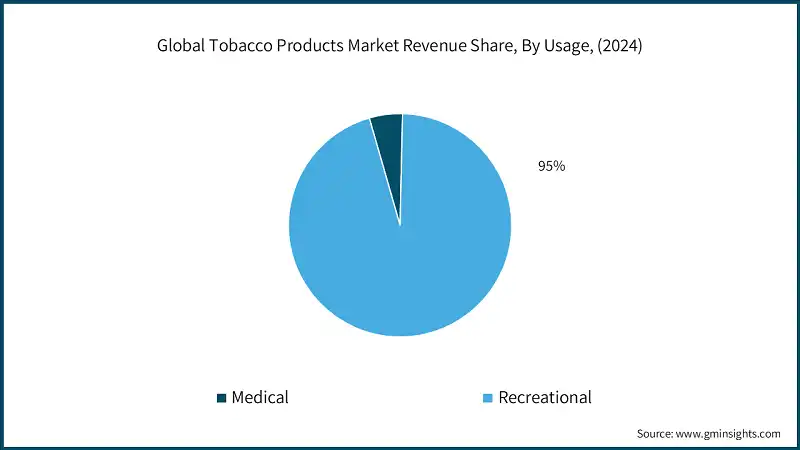
Based on usage, the market is segmented into medical and recreational. The recreational segment dominates the market with 95% share in 2024 and is expected to grow at a CAGR of 2.7% from 2025 to 2034.
- The medical segment is growing steadily in the tobacco products market, with increasing research into the therapeutic applications of nicotine and other tobacco-derived compounds. These products have applications in neurological disorders such as Alzheimer's and Parkinson's disease, and smoking cessation therapies.
- Within the recreational category, the increasing demand for e-cigarettes and vaping devices imparts additional impetus, especially among youth.
- The development of various flavor profiles and product designs has increased their desirability among consumers, and marketing campaigns featuring lifestyle preferences have broadened the customer base. There are, however, regulatory hurdles and growing awareness regarding health issues associated with smoking.
Based on distribution channel, the tobacco products market is segmented into online and offline. The offline segment dominates the market and is expected to grow at a CAGR of 2.2% from 2025 to 2034.
- The online segment of the tobacco products market is growing rapidly, owing to the rising internet penetration and convenience provided by e-commerce platforms. Consumers find online channels convenient due to an assortment of choices available at competitive prices besides providing discretion to buyers. Furthermore, it integrates advanced technologies, which enhance the online shopping experience, such as AI-driven recommendations for increasing conversions and secure payment gateways.
- Offline channels remain strong in the tobacco products market, owing to the large distribution networks at retail stores, convenience stores, and specialty tobacco shops.
Looking for region specific data?
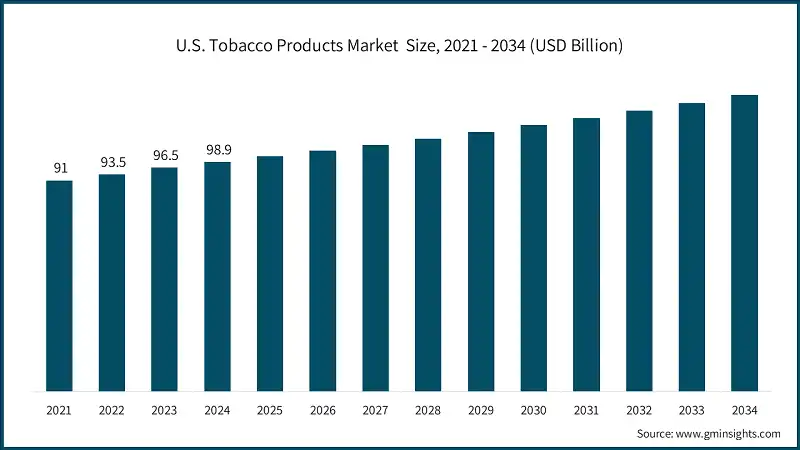
The United States led the tobacco products market with 80% share with USD 98.9 billion in revenue in 2024, primarily driven by the increasing demand for innovative and alternative tobacco products, such as e-cigarettes and heated tobacco devices, has significantly contributed to market expansion.
- The strong presence of established players in the market, coupled with their continuous efforts in product innovation and marketing strategies, has further fueled growth. Moreover, the availability of flavored tobacco products has played a crucial role in attracting a diverse consumer base.
- As per the National Health Interview Survey, in 2023, 11.0 percent of adults aged 18 years and over were current cigarette smokers. In 2023, non-Hispanic American Indian or Alaska Native adults had the highest group rate of current cigarette smoking (15.4 percent). Non-Hispanic Asian adults (reference group) had the lowest group rate (5.3 percent).
The Europe tobacco products market was valued at USD 275.4 billion in 2024 and is projected to grow at a CAGR of 2.5% between 2025 and 2034.
- In the European Union, 24% of the population aged 15+ smoked in 2023. There was a clear divergence on the basis of gender, with 28% of men smoking compared to 21% of women.
- In Germany, 24% of the population smoked, according to EU statistics office Eurostat. The highest smoking rates in the EU were in Bulgaria (37%) and Greece (36%), and the lowest in Sweden (8%) and the Netherlands (11%).
The Asia Pacific tobacco products market was valued at USD 446.8 billion in 2024 and is projected to grow at a CAGR of 3% between 2025 and 2034.
- China’s tobacco market is expanding rapidly, despite the ongoing global push to reduce tobacco consumption. The country is home to more than 300 million smokers, making up nearly 30% of the global smoking population.
- In 2023, China produced a staggering 2.4 trillion cigarettes, continuing a five-year upward trend, as reported by the National Bureau of Statistics. According to Euromonitor, China’s share of global tobacco sales grew to approximately 47% in 2022.
The Middle East and Africa tobacco products market was valued at USD 86.3 billion in 2024 and is projected to grow at a CAGR of 2% between 2025 and 2034.
- Saudi Arabia is ranked fourth in the world in terms of tobacco sales and importation. In 2022, 17.8% of Saudi Arabia's population used tobacco, with a stark gender difference as 28.4% of males and only 2.1% of females were users. Both heated tobacco products and e-cigarettes are allowed and marketed, with a high tax rate of 100% on e-liquids and devices.
Tobacco Products Market Share
- The top 5 companies in the tobacco products industry are Altria Group, British American Tobacco, Chunghwa, Japan Tobacco International, Philip Morris International collectively hold a share of 19.5% in the market.
- These companies continue to acquire and merge with others, expand facilities, and make various collaborations to increase their product offerings, access customer bases, and secure their market positions.
- Altria Group invests in product innovation and diversification to respond to market changes. While the company invests heavily in smokeless tobacco products and e-cigarettes, it enables several shifts in consumer trends. Its leading distribution network and strategic partnerships have helped it to sustain a competitive edge in the sector. The marketing strategies of Altria also point toward brand loyalty and consumer engagement as vital factors for growth.
- British American Tobacco develops and executes its strategy of market share acquisition through firm dedication to next-generation products, heated tobacco, and vaping devices. Sustainability and innovation have been emphasized in the area of launching products that would be attractive to health-conscious consumers. With its global presence and robust supply chain, BAT has earned a great advantage in such emerging markets.
- The commitment of Philip Morris International to a smoke-free future secures it more market share. The company has heavily invested in its flagship product, IQOS-heated tobacco, which has gained phenomenal traction worldwide. As sustainability and innovation continue to take center stage for consumers and regulators, PMI is well-positioned.
Tobacco Products Market Companies
Major players operating in the tobacco products industry are:
- Altria Group
- British American Tobacco
- Chunghwa
- Imperial Brands
- ITC
- Japan Tobacco International
- KT&G Corp
- Philip Morris International
- Pyxus International
- Reynolds Tobacco
- Scandinavian Tobacco Group
- Smoore International
- U.S. Smokeless Tobacco
- Universal Corp
- Vector Group
To improve the product and market share key players are constantly investing in technological activities and are also entering into partnerships to provide improved and better solutions for the customers. These investments are benefiting both companies and customers as they help develop and offer solutions as per the changing technological trends and thus the customer requirements.
British American Tobacco is a global player in the tobacco product marketplace, operating in more than 180 countries worldwide. Its product portfolio includes combustible cigarettes, oral tobacco, and next-generation products like vaping devices and heated tobacco. The flagship brands of British American Tobacco comprise Dunhill, Lucky Strike, and Pall Mall, which have strong consumer loyalty across the world.
Imperial Brands is one of the leading companies in the global tobacco market, headquartered in the United Kingdom. The company is mainly engaged in the manufacture and distribution of a variety of tobacco and next-generation products. Its brand portfolio includes well-known brands such as Davidoff, Gauloises Blondes, and blu, serving varied consumer needs. Imperial Brands has lately been investing in developing reduced-risk products involving e-cigarettes and heated tobacco.
Based in India, ITC Limited is a leading diversified conglomerate with considerable participation in the tobacco products market. The company holds a leading position in the Indian cigarette segment with popular brands like Gold Flake, Classic, and Wills Navy Cut. ITC leverages its extensive distribution network and strong brand equity to maintain its dominance in the domestic market.
Philip Morris International is one of the leading worldwide tobacco products companies that has been very committed to its progress toward a smoke-free future. The company is famous for its flagship brand, Marlboro, which is one of the most recognizable cigarette brands across the globe. Philip Morris has been at the forefront of developing reduced-risk products, with its innovative IQOS heated tobacco system gaining significant traction in various markets.
Tobacco Products Market Report Attributes
| Key Takeaway | Details |
|---|---|
| Market Size & Growth | |
| Base Year | 2024 |
| Market Size in 2024 | USD 965.2 Billion |
| Market Size in 2025 | USD 988.7 Billion |
| Forecast Period 2025 - 2034 CAGR | 2.6% |
| Market Size in 2034 | USD 1.25 Trillion |
| Key Market Trends | |
| Drivers | Impact |
| Increasing consumer demand for premium tobacco products | Rising disposable incomes have led to a growing preference for premium products, driving market growth. |
| Popularity of smokeless tobacco and e-cigarettes | These alternatives to traditional smoking are gaining traction, contributing to market expansion. |
| Pitfalls & Challenges | Impact |
| Stringent government regulations and taxation policies | These measures increase operational costs and limit market growth potential. |
| Rising health awareness among consumers | Growing awareness about the health risks of tobacco consumption is reducing demand for traditional tobacco products. |
| Opportunities: | Impact |
| Innovation in product offerings | The introduction of flavored tobacco and heat-not-burn products attracts a broader consumer base, driving market growth. |
| Expansion into emerging markets | Markets with a growing population of adult smokers present significant growth opportunities for industry players. |
| Market Leaders (2024) | |
| Market Leaders |
4.5% market share |
| Top Players |
Collective market share in 2024 is 19.5% |
| Competitive Edge |
|
| Regional Insights | |
| Largest Market | Asia Pacific |
| Fastest Growing Market | Asia Pacific, Europe, Latin America |
| Emerging Country | China, U.S., India |
| Future Outlook |
|
What are the growth opportunities in this market?
Tobacco Products Industry News
- In November 2025, Imperial Brands launched its Zone nicotine pouch brand in the UK. The range is launched in five varieties: Sweet Mint, Cool Mint, Watermelon Ice, Juicy Peach and Berry Blast. Each pack contains 20 pouches.
- In September 2025, Reynolds is planning to launch Vuse One, a new disposable synthetic nicotine e-cigarette product in Florida, Georgia, and South Carolina. The latest national data indicate that disposable e-cigarettes have become the most popular e-cigarettes among U.S. youth by a large margin.
- In May 2025, Japan Tobacco launches Ploom AURA, its next generation heated tobacco device in Japan, primarily in its Ploom stores and CLUB JT online shop. In parallel, JT Group will roll out EVO, its exclusive and premium heated tobacco sticks (HTS), to complement Ploom AURA and provide adult consumers with the latest and most technologically advanced propositions in the heated tobacco segment.
- In March 2025, Philip Morris International (PMI) began selling its IQOS heated tobacco device in Austin, Texas. The launch comes after PMI reported that it saw quarterly shipments of HTU and oral smoke-free products exceeding 40 billion units for the first time last quarter, with full-year net revenues increasing by 14.2%.
The tobacco products market research report includes in-depth coverage of the industry with estimates & forecasts in terms of revenue (USD Billion) and volume (Million Units) from 2021 to 2034, for the following segments:
Market, By Product Type
- Smoked tobacco products
- Cigarettes
- Cigars and pipes
- Hookah
- E-cigarettes
- Others (bidis etc.)
- Smokeless tobacco products
- Chewing tobacco
- Snuff
- Dry snuff
- Moist snuff
- Dissolvable tobacco
- Others (snus etc.)
- Nicotine products
- Electronic cigarette
- Disposable
- Rechargeable
- Nicotine pouches
- Electronic cigarette
Market, By Usage
- Medical
- Recreational
Market, By Consumer Group
- Men
- Women
Market, By Age Group
- Youth (13-17 years)
- Young Adults (18-24 years)
- Adults (25-44 years)
- Older Adults (45+ years)
Market, By Price
- Low
- Medium
- High
Market, By Distribution Channel
- Online
- E-commerce
- Company websites
- Offline
- Supermarkets/hypermarket
- Specialty vape/tobacco shops
- Convenience stores and gas stations
- Others (duty-free shops etc.)
The above information is provided for the following regions and countries:
- North America
- U.S.
- Canada
- Europe
- Germany
- UK
- France
- Spain
- Italy
- Netherlands
- Asia Pacific
- China
- Japan
- India
- Australia
- South Korea
- Latin America
- Brazil
- Mexico
- Argentina
- MEA
- South Africa
- Saudi Arabia
- UAE
Frequently Asked Question(FAQ) :
What is the market size of the tobacco products in 2024?
The market size was USD 965.2 billion in 2024, with a CAGR of 2.6% expected through 2034 driven by rising demand for premium and innovative products like flavored cigarettes and cigars.
What is the projected value of the tobacco products market by 2034?
The tobacco products market is expected to reach USD 1.25 trillion by 2034, propelled by increasing legalization of cannabis, consumer demand for alternative tobacco products, and expansion into emerging markets.
What is the current tobacco products market size in 2025?
The market size is projected to reach USD 988.7 billion in 2025.
How much revenue did the smoked tobacco products segment generate in 2024?
Smoked tobacco products generated around USD 801.5 billion in 2024 and is expected to grow at a CAGR of 2.6% during 2025 to 2034.
What was the market share of recreational usage segment in 2024?
The recreational segment dominates the market with 95% share in 2024 and is expected to grow at a CAGR of 2.7% from 2025 to 2034.
What is the growth outlook for offline distribution channel from 2025 to 2034?
The offline segment dominates the market and is expected to grow at a CAGR of 2.2% from 2025 to 2034, driven by large distribution networks at retail stores, convenience stores, and specialty tobacco shops.
Which region leads the tobacco products market?
The U.S. dominated the tobacco products market with an 80% share with USD 98.9 billion in revenue in 2024, supported by strong growth in innovative alternatives such as e-cigarettes and heated tobacco devices.
What are the upcoming trends in the tobacco products market?
Key trends include increased adoption of e-cigarettes and heated tobacco products, growing demand for organic and herbal tobacco, focus on sustainability with eco-friendly packaging, and innovation in flavored and customizable products to cater to evolving consumer preferences.
Who are the key players in the tobacco products market?
Key players include Altria Group, British American Tobacco, Chunghwa, Imperial Brands, ITC, Japan Tobacco International, KT&G Corp, Philip Morris International, Pyxus International, Reynolds Tobacco, Scandinavian Tobacco Group, Smoore International, U.S. Smokeless Tobacco, Universal Corp, and Vector Group.
Tobacco Products Market Scope
Related Reports