Summary
Table of Content

Titanium Dioxide Nanomaterials Market
Get a free sample of this report
Form submitted successfully!
Error submitting form. Please try again.
Thank you!
Your inquiry has been received. Our team will reach out to you with the required details via email. To ensure that you don't miss their response, kindly remember to check your spam folder as well!
Request Sectional Data
Thank you!
Your inquiry has been received. Our team will reach out to you with the required details via email. To ensure that you don't miss their response, kindly remember to check your spam folder as well!
Form submitted successfully!
Error submitting form. Please try again.
Titanium Dioxide Nanomaterials Market Size
- The market is growing because of increasing demand from the electronics and optoelectronics industries. The photocatalytic properties and high surface area of Nano-TiO₂ make it an essential component for sensors and semiconductors and display technologies and photovoltaic devices. Manufacturers use nanomaterials in electronic devices because these materials improve both performance and energy efficiency which leads to sustained market expansion in high-technology sectors.
- Titanium dioxide nanomaterials are increasingly used in healthcare and biotechnology which creates major growth opportunities for the market. The materials show their chemical stability and biocompatibility through their application in medical implants and drug delivery research and diagnostic technologies and antimicrobial coatings. The increasing investment in biomedical research and nanotechnology-based healthcare solutions drives the creation of new applications which increases the demand for high-purity nano-TiO₂ materials in specialized medical and laboratory environments.
- Industries now use titanium dioxide nanomaterials because environmental sustainability requirements together with more rigorous pollution control standards make these materials necessary for their operations. The materials possess strong photocatalytic abilities which allow their application in air purification systems and wastewater treatment processes and self-cleaning surfaces to reduce environmental pollution. Governments and industries establish advanced materials research programs which lead to the increased use of nano-TiO₂ in environmental technologies and green technology solutions that support sustainable infrastructure development and pollution control efforts.
The global titanium dioxide nanomaterials market was estimated at USD 23.2 billion in 2025. It is expected to grow from USD 24.5 billion in 2026 to USD 40 billion by 2035, at a CAGR of 5.6%, according to latest report published by Global Market Insights Inc.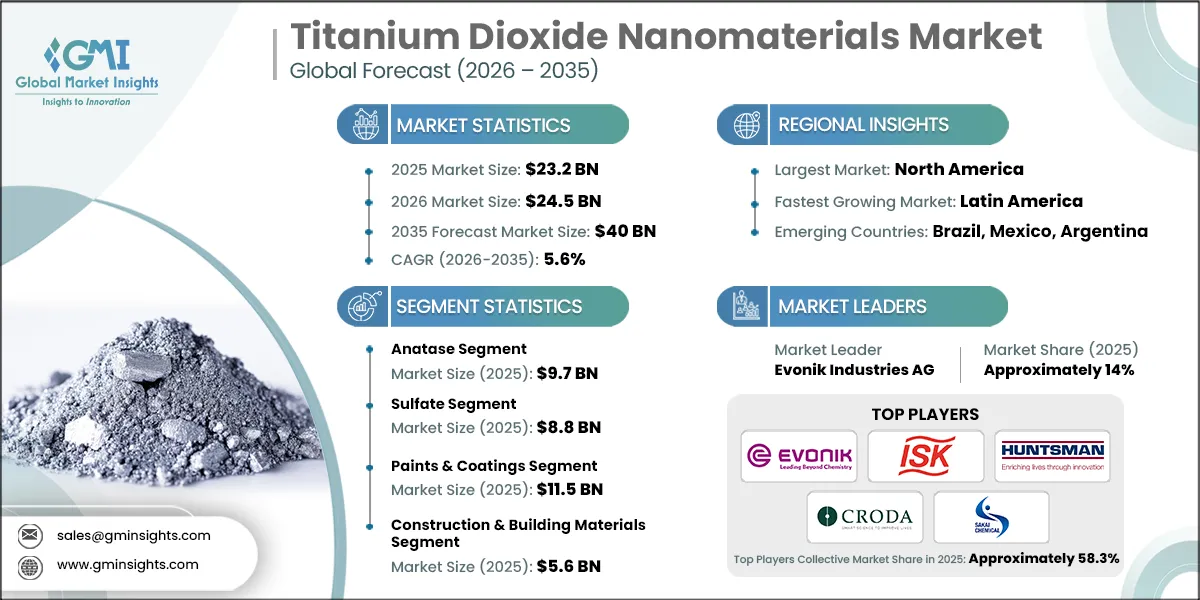
Titanium Dioxide Nanomaterials Market Key Takeaways
Market Size & Growth
- 2025 Market Size: USD 23.2 Billion
- 2026 Market Size: USD 24.5 Billion
- 2035 Forecast Market Size: USD 40 Billion
- CAGR (2026–2035): 5.6%
Regional Dominance
- Largest Market: North America
- Fastest Growing Region: Latin America
Key Market Drivers
- Increasing demand in electronics and optoelectronics..
- Growing applications in healthcare and biotechnology..
- Environmental sustainability and stringent regulations..
Challenges
- Health and environmental concerns regarding nanoparticle exposure..
- High Production Costs and Scale-Up Challenges.
Opportunity
- Expanding Photocatalytic and Environmental Applications.
- Rising Penetration in Energy Storage and Solar Technologies.
Key Players
- Market Leader: Evonik Industries AG led with over 14% market share in 2025.
- Leading Players: Top 5 players in this market include Evonik Industries AG, ISHIHARA SANGYO KAISHA, LTD, Huntsman International LLC, Croda International Plc, Sakai Chemical Industry Co., Ltd, which collectively held a market share of 58.3% in 2025.
Get Market Insights & Growth Opportunities
To get key market trends
Titanium Dioxide Nanomaterials Market Trends
- The exceptional photocatalytic performance of titanium dioxide nanomaterials makes them increasingly popular for environmental cleanup applications. The technology gets utilized in three main ways which include air purification systems and wastewater treatment and self-cleaning surfaces for pollutant and organic material removal. The recent installation of TiO₂ nanowires and coatings shows an increasing trend for their deployment in water treatment facilities and urban infrastructure projects which aim to enhance environmental sustainability.
- The strong UV-blocking capability of nano-scale titanium dioxide drives its increasing application in sunscreens and personal care products. The rising consumer demand for effective UV protection products which maintain skin safety has led to worldwide adoption of nano-TiO₂ as a primary component in cosmetic and dermatological products.
- The market is experiencing growing adoption of nano-TiO₂ in solar energy systems which specifically include dye-sensitized solar cells and photovoltaic coatings. The materials enable better light absorption which results in higher energy conversion efficiency to create advanced solar technologies. The expansion of nano-TiO₂ coatings on solar modules and energy devices supports the increasing use of nanomaterials in renewable energy systems.
Titanium Dioxide Nanomaterials Market Analysis

Learn more about the key segments shaping this market
Based on grade, the market is segmented into rutile, anatase, and mixed phase. Anatase holds a significant share at a valuation of USD 9.7 billion in 2025.
- The titanium dioxide nanomaterials market divides its grades according to the specific functional abilities and application requirements of each crystalline type. Anatase grade holds significant adoption because its superior photocatalytic activity enables environmental purification and self-cleaning coatings and energy-related applications. The rutile grade serves various industries because it provides high stability and strong UV-blocking capabilities and durable performance for protective surfaces and plastic materials and coating solutions.
- Mixed phase titanium dioxide is gaining interest for its dual anatase and rutile structure which provides optical and catalytic performance balanced characteristics. The advanced material of this grade offers superior charge separation capabilities plus higher photocatalytic performance when compared to single-phase materials, which makes it suitable for advanced applications in coatings and sensors and environmental technologies. The rising demand for high-performance nanomaterials in research and industry has led manufacturers to optimize their crystal phase compositions to achieve better functionality and wider application potential.
Based on process, the market is segmented into chloride, sulfate, sol-gel process, and hydrothermal process. Sulfate holds a significant share at a valuation of USD 8.8 billion in 2025.
- The titanium dioxide nanomaterials market divides its production process into different segments because of its varying production efficiency and material purity and suitability for specific applications. The titanium dioxide production process uses chloride and sulfate processes as its primary method because these processes have industrial infrastructures that enable stable production throughout the entire production process. The industry employs these methods predominantly for applications in coatings and plastics and pigments because these methods provide cost-effective solutions for high-volume production needs.
- The advanced synthesis techniques of sol-gel and hydrothermal processes are becoming more popular for producing titanium dioxide nanomaterials that possess both high purity and controlled structural properties. The methods enable scientists to achieve exact control over three particle characteristics which determine essential properties for photocatalysis and electronics and biomedical applications. The growing market demand for high-performance nanomaterials leads manufacturers to allocate more funds toward advanced processes which help their operations in specialized industrial and technological fields.
Based on application, the market is segmented into paints & coatings, plastic, paper and pulp, printing inks, and other. Paints & coatings holds a significant share at a valuation of USD 11.5 billion in 2025.
- The titanium dioxide nanomaterials market shows comprehensive application through its various industrial uses which utilize its optical properties and UV resistance and chemical durability. The major application area for paints and coatings exists because nano-TiO₂ helps architectural and industrial coatings achieve better durability and opacity and weather protection. The plastics segment shows consistent market demand because titanium dioxide nanomaterials provide UV protection and color stability and product durability to polymer formulations.
- The paper and pulp sector uses titanium dioxide nanomaterials to enhance specialty papers through improved brightness and opacity together with better print quality. Nano-TiO₂ gets used in printing inks to improve pigment distribution and color stability and to protect against external damage. The material's multifunctional properties and expanding industrial relevance support emerging applications which include electronics and environmental purification and advanced materials.
Learn more about the key segments shaping this market
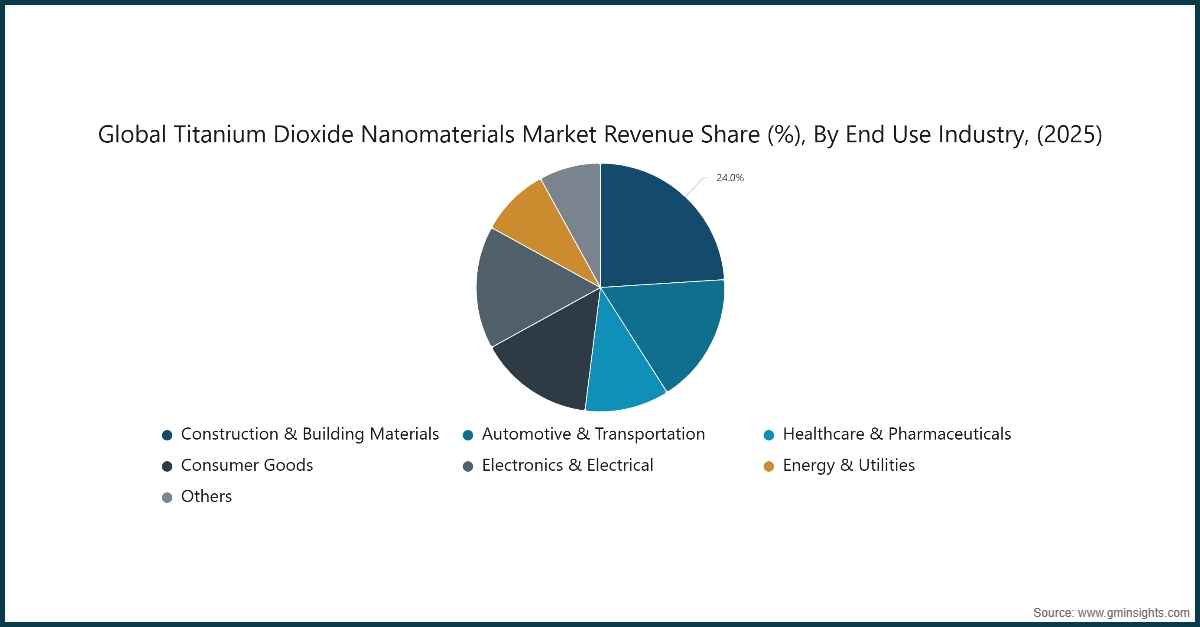
Based on end use industry, the market is segmented into construction & building materials, automotive & transportation, healthcare & pharmaceuticals, consumer goods electronics & electrical, energy & utilities, and others. Construction & building materials is estimated to grasp a value of USD 5.6 billion in 2025.
- The titanium dioxide nanomaterials market shows its broad range of applications through its end-use industry segments which cover all sectors that need high-performance functional materials. Construction and building materials account for significant utilization due to the integration of nano-TiO₂ in coatings, cement additives, and self-cleaning surfaces that enhance durability and environmental resistance. The automotive and transportation sector maintains continuous demand because these nanomaterials boost coating performance while providing UV protection and extending surface lifespan.
- The healthcare and pharmaceuticals sector along with consumer goods and electronics and electrical industries have begun to use titanium dioxide nanomaterials for their special functions which include antimicrobial coatings and UV protection and advanced electronic components. The energy and utilities sector is currently testing nano-TiO₂ to develop renewable energy technologies and environmental purification systems. The broad range of applications in both emerging and established industries continues to drive commercial growth for titanium dioxide nanomaterials.
Looking for region specific data?
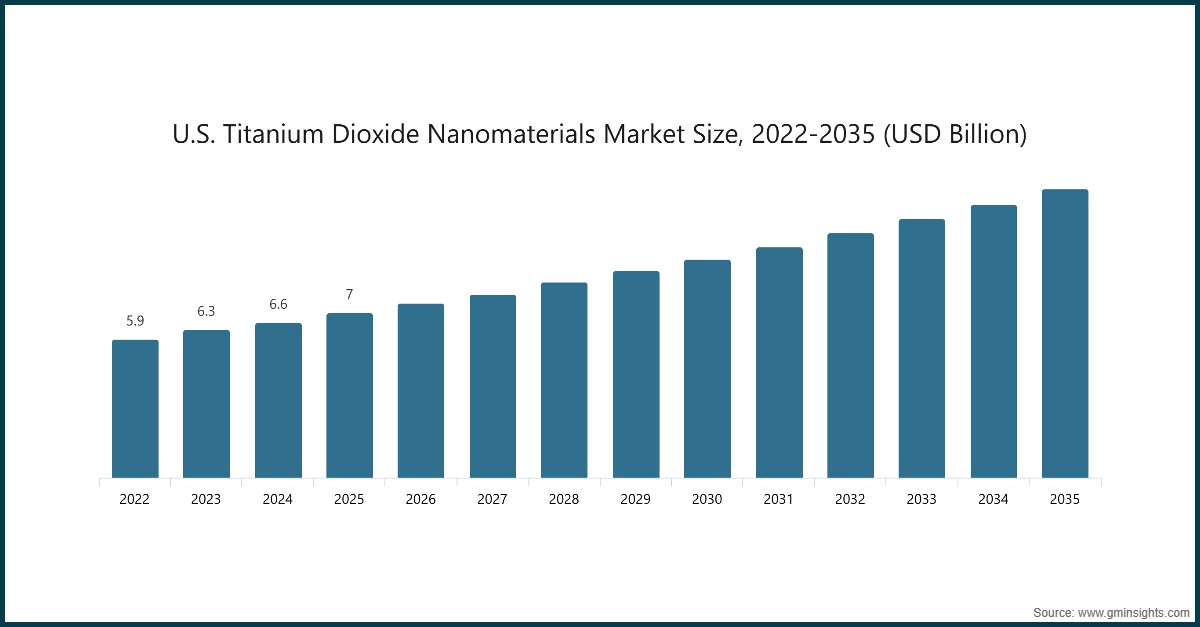
North America accounted for USD 8.2 billion in 2025 and is anticipated to show lucrative growth over the forecast period.
- North America receives a significant portion of its titanium dioxide nanomaterials market from the United States which benefits from its advanced nanotechnology research facilities and the operations of its major specialty chemical producers. The rising usage of nano-TiO₂ in modern coatings and electronic devices and environmental cleanup processes is creating an upward demand trend. The Canadian market grows because of its industrial production activities and its scientific research work while Mexico experiences increasing demand from the automotive and construction and plastics manufacturing sectors.
- The region experiences growth because of rising investments in advanced materials research and the growing use of renewable energy solutions and smart coating technologies and environmental purification systems. The industrial base of the region and its ongoing developments in material science research enable the market entry of nano-enabled products. The aerospace and healthcare and electronics sectors are driving market growth through their rising need for high-performance coatings and sustainable materials.
Europe accounted for USD 6.8 billion in 2025 and is anticipated to show lucrative growth over the forecast period.
- Germany controls a significant portion of the European titanium dioxide nanomaterials market because the country possesses strong chemical manufacturing facilities and advanced research centers for developing new materials. The country uses its existing chemical manufacturing network to supply various industries that need nano-TiO₂ for coatings and electronics and environmental technologies. France and the United Kingdom also contribute significantly through growing adoption in cosmetics and healthcare applications and advanced construction materials.
- The European market expansion is driven by technological advancements and rising consumer demand for sustainable materials. Industries are increasing their use of nano-TiO₂ because of the higher demand for functional coatings and self-cleaning surfaces and pollution-control technologies. The rapid development of nanomaterial-based solutions benefits from strong research institution and manufacturer collaboration and government programs that promote green technologies.
Asia Pacific market accounted for USD 5.9 billion in 2025 and is anticipated to show lucrative growth over the forecast period.
- China dominates the Asia Pacific titanium dioxide nanomaterials market because its chemical manufacturing capacity enables it to produce titanium-based materials through its complete supply chain. The growing industrial and infrastructure development in the region drives the need for nano-TiO₂ which is essential for coatings and construction materials and environmental purification technologies. Japan and South Korea also play important roles through their technological innovations and their use of nanomaterials in electronic and energy systems.
- The Asia Pacific market is expanding because of three factors which include increasing industrial development and rising construction projects and greater manufacturing sector utilization of advanced materials. The increasing funding for nanotechnology research and renewable energy technology development is stimulating the need for nano-Ti O2. The automotive industry and electronics and cosmetics sectors are three consumer markets that create significant demand for advanced functional materials.
Latin America market accounted for 5.5% market share in 2025 and is anticipated to show steady growth over the forecast period.
- Brazil holds a significant position in the Latin American titanium dioxide nanomaterials market because construction activities are increasing and the need for advanced coatings and paints is growing. The personal care industry in the country drives market expansion through rising consumption of nano-TiO₂ in sunscreen and skincare products. Mexico has become an important market because its manufacturing industry and automotive and packaging sectors are both expanding.
- The regional market is experiencing slow growth because infrastructure development and industrial modernization create a demand for high-performance materials. The demand for durable coatings and environmental remediation technologies and advanced construction materials is driving the adoption of nano-TiO₂. The Latin American market experiences continuous growth because the cosmetics and personal care industries expand while companies establish partnerships with global material suppliers.
Middle East and Africa market accounted for 4% market share in 2025 and is anticipated to show steady growth over the forecast period.
- Saudi Arabia and the United Arab Emirates hold a major share of the Middle East titanium dioxide nanomaterials market because their construction projects require advanced construction materials. The demand for nano-TiO₂ is increasing because it is used in reflective coatings and self-cleaning surfaces and protective building materials. South Africa contributes to regional development through its industrial applications in coatings and water treatment technologies.
- The market in the Middle East and Africa is growing because there is an increase in investments for infrastructure and renewable energy systems and environmental technology solutions. The photocatalytic properties of titanium dioxide nanomaterials are driving their use in air purification systems and water treatment systems and solar energy applications. The integration of advanced nanomaterials across multiple sectors is receiving further support from the growing emphasis on sustainable urban development and improved industrial efficiency.
Titanium Dioxide Nanomaterials Market Share
The titanium dioxide nanomaterials industry operates as a partial consolidation because two major global specialty chemical companies control most of the market's revenue stream. Key players such as Evonik Industries AG, Ishihara Sangyo Kaisha, Ltd., Huntsman Corporation, Croda International Plc, and Sakai Chemical Industry Co., Ltd. collectively accounts for 58.3% market share globally in 2025. The companies maintain market power through their wide range of nanomaterial products which they combine with their advanced manufacturing expertise and global distribution systems that support multiple industries including coatings and personal care and electronics and environmental applications.
Manufacturers need to remain competitive through their adoption of new technologies which enable them to produce goods in an environmentally friendly manner while they establish partnerships with other organizations. Companies are investing in R&D to develop high-performance nano-TiO₂ with enhanced photocatalytic efficiency and UV protection and surface-modified properties Which targets specialized needs. The companies expand their manufacturing capacity through partnership development and global supply chain strengthening activities which help them reach additional markets while their production methods meet environmental and sustainability standards.
Titanium Dioxide Nanomaterials Market Companies
Major players operating in titanium dioxide nanomaterials industry are:
- Evonik Industries AG
- Sigma-Aldrich
- ISHIHARA SANGYO KAISHA, LTD
- Huntsman International LLC
- Croda International Plc
- American Elements
- Sakai Chemical Industry Co., Ltd
- Titan Kogyo, Ltd
- Cinkarna Celje d.d.
- ACS Material
- Techinstro
The global specialty chemicals company Evonik Industries AG specializes in advanced nanomaterials and functional additives. The company produces AEROXIDE® nano-TiO₂ products for photocatalysis and coatings and energy applications in the titanium dioxide nanomaterials market. The company uses its surface modification and particle engineering expertise to develop materials which perform exceptionally in environmental and industrial technology applications.
Ishihara Sangyo Kaisha (ISK) is a leading Japanese manufacturer of titanium dioxide materials with a diversified portfolio including nano-grade TiO₂. The company produces high-purity TiO₂ materials which serve both electronic applications and environmental catalyst needs and advanced coating requirements. The company uses its strong research and development capabilities and titanium chemistry expertise to create new nanomaterial innovations.
Huntsman International LLC functions as a main division of Huntsman Corporation which provides specialized chemical products and titanium dioxide solutions. The company produces TiO₂ products which customers use in coatings and plastics and specialty materials while their nanostructured variants gain popularity for high-performance usage. The company's manufacturing plants across the world combined with its complete supply chain system enhance its ability to reach markets.
Croda International Plc is a specialty chemicals company which produces high-value ingredients and performance materials. The company develops TiO₂ nanomaterials through its advanced dispersions and surface-treated nanoparticles which serve cosmetics and personal care and UV protection formulation needs. The company develops premium products through its focus on sustainable chemistry and bio-based innovation.
Sakai Chemical Industry Co. Ltd. operates as a chemical manufacturer in Japan which produces both titanium dioxide and advanced inorganic materials. The company produces ultrafine TiO₂ and nano-scale TiO₂ which serve electronics and photocatalysis and functional coating applications. The company uses its strong technological capabilities and inorganic pigments expertise to supply advanced materials markets as a major supplier.
Titanium Dioxide Nanomaterials Market Report Attributes
| Key Takeaway | Details |
|---|---|
| Market Size & Growth | |
| Base Year | 2025 |
| Market Size in 2025 | USD 23.2 Billion |
| Market Size in 2026 | USD 24.5 Billion |
| Forecast Period 2026-2035 CAGR | 5.6% |
| Market Size in 2035 | USD 40 Billion |
| Key Market Trends | |
| Drivers | Impact |
| Increasing demand in electronics and optoelectronics. | Accelerates high-value demand for nano-grade TiO₂ with controlled morphology, strengthening premium pricing and margin potential. |
| Growing applications in healthcare and biotechnology. | Expands application diversification, driving innovation in functionalized and biocompatible TiO₂ nanomaterials. |
| Environmental sustainability and stringent regulations. | Stimulates adoption in green technologies while simultaneously increasing compliance-driven product development. |
| Pitfalls & Challenges | Impact |
| Health and environmental concerns regarding nanoparticle exposure. | Restrains market penetration in sensitive sectors due to regulatory scrutiny and safety validation requirements. |
| High Production Costs and Scale-Up Challenges | Limits commercialization at large scale, constraining cost competitiveness against conventional materials. |
| Opportunities: | Impact |
| Expanding Photocatalytic and Environmental Applications | Creates sustained demand from air, water, and self-cleaning infrastructure solutions, supporting long-term volume growth. |
| Rising Penetration in Energy Storage and Solar Technologies | Positions TiO₂ nanomaterials as a strategic enabler in renewable energy systems, enhancing future revenue potential. |
| Market Leaders (2025) | |
| Market Leader |
Market Share Approximately 14% |
| Top Players |
Collective Market Share Approximately 58.3% |
| Competitive Edge |
|
| Regional Insights | |
| Largest Market | North America |
| Fastest growing market | Latin America |
| Emerging countries | Brazil, Mexico, Argentina |
| Future outlook |
|
What are the growth opportunities in this market?
Titanium Dioxide Nanomaterials Industry News
- On 10th of October 2023, Chemours Company announced plans of closing down their manufacturing unit in Kuan Yin, Taiwan. This decision is developed in connection with the company’s strategy of improving the efficiency and the overall economics of their titanium technologies associated with the brand Ti-Pure. It particularly involves optimization of the manufacturing circuit for the nodes.
The titanium dioxide nanomaterials market research report includes in-depth coverage of the industry with estimates & forecast in terms of revenue (USD billion) & volume (Kilo Tons) from 2022 to 2035, for the following segments:
Market, By Grade
- Rutile
- Anatase
- Mixed Phase
Market, By Process
- Chloride
- Sulfate
- Sol-Gel Process
- Hydrothermal Process
Market, By Application
- Paints & Coatings
- Plastic
- Paper and Pulp
- Printing Inks
- Other
Market, By End Use Industry
- Construction & Building Materials
- Residential Construction
- Commercial & Infrastructure
- Automotive & Transportation
- Passenger Vehicles
- Commercial Vehicles
- Healthcare & Pharmaceuticals
- Medical Devices
- Pharmaceutical Formulations
- Antimicrobial Applications
- Consumer Goods
- Personal Care Products
- Household Products
- Electronics & Electrical
- Consumer Electronics
- Industrial Electronics
- Energy & Utilities
- Solar Energy
- Energy Storage
- Others
- Agriculture
- Aerospace
- Defense
The above information is provided for the following regions and countries:
- North America
- U.S.
- Canada
- Europe
- UK
- Germany
- France
- Italy
- Spain
- Rest of Europe
- Asia Pacific
- China
- India
- Japan
- South Korea
- Australia
- Rest of Asia Pacific
- Latin America
- Brazil
- Mexico
- Argentina
- Rest of Latin America
- MEA
- UAE
- Saudi Arabia
- South Africa
- Rest of Middle East and Africa
Frequently Asked Question(FAQ) :
What was the market size of the titanium dioxide nanomaterials in 2025?
The market size was USD 23.2 billion in 2025, with a CAGR of 5.6% expected through 2035. Increasing demand from electronics, optoelectronics, and environmental cleanup applications is driving market growth.
What is the projected value of the titanium dioxide nanomaterials market by 2035?
The market is poised to reach USD 40 billion by 2035, driven by advancements in renewable energy systems, personal care products, and construction materials.
What is the expected size of the titanium dioxide nanomaterials industry in 2026?
The market size is projected to reach USD 24.5 billion in 2026.
How much revenue did the anatase grade segment generate in 2025?
The anatase grade segment generated approximately USD 9.7 billion in 2025, due to its superior photocatalytic activity and applications in environmental purification and energy-related technologies.
What was the valuation of the sulfate production process segment in 2025?
The sulfate production process segment accounted for USD 8.8 billion in 2025, led by its cost-effective solutions for high-volume production in coatings, plastics, and pigments.
Which region leads the titanium dioxide nanomaterials sector?
North America leads the market, with the United States accounting for a significant share of USD 8.2 billion in 2025. This growth is fueled by advanced nanotechnology research and strong demand from coatings, electronics, and environmental cleanup applications.
What are the upcoming trends in the titanium dioxide nanomaterials market?
Trends include the adoption of nano-TiO₂ in renewable energy systems, increasing use in sunscreens and personal care products, deployment in environmental cleanup technologies, and advancements in self-cleaning and UV-protective coatings.
Who are the key players in the titanium dioxide nanomaterials industry?
Key players include Evonik Industries AG, Sigma-Aldrich, ISHIHARA SANGYO KAISHA, LTD, Huntsman International LLC, Croda International Plc, American Elements, Sakai Chemical Industry Co., Ltd, Titan Kogyo, Ltd, Cinkarna Celje d.d., ACS Material, and Techinstro.
Titanium Dioxide Nanomaterials Market Scope
Related Reports