Summary
Table of Content

Tire Pressure Monitoring System (TPMS) Market
Get a free sample of this report
Form submitted successfully!
Error submitting form. Please try again.
Thank you!
Your inquiry has been received. Our team will reach out to you with the required details via email. To ensure that you don't miss their response, kindly remember to check your spam folder as well!
Request Sectional Data
Thank you!
Your inquiry has been received. Our team will reach out to you with the required details via email. To ensure that you don't miss their response, kindly remember to check your spam folder as well!
Form submitted successfully!
Error submitting form. Please try again.
Tire Pressure Monitoring System Market Size
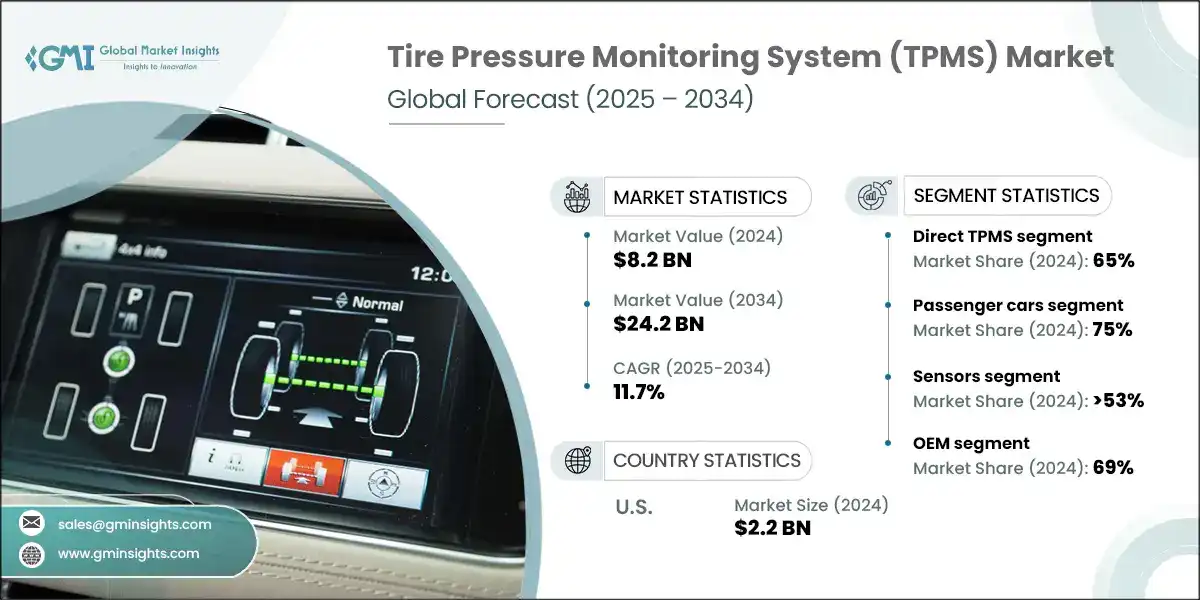
The global tire pressure monitoring system (TPMS) market size was estimated at USD 8.2 billion in 2024. The market is expected to grow from USD 8.9 billion in 2025 to USD 24.2 billion in 2034, at a CAGR of 11.7%.
Tire Pressure Monitoring System (TPMS) Market Key Takeaways
Market Size & Growth
- 2024 Market Size: USD 8.2 Billion
- 2034 Forecast Market Size: USD 24.2 Billion
- CAGR (2025–2034): 11.7%
Regional Dominance
- Largest Market: North America
- Fastest Growing Region: Asia Pacific
Key Market Drivers
- Stringent vehicle safety regulations.
- Rising consumer awareness about tire safety and fuel efficiency.
- Technological advancements in sensor accuracy and connectivity.
- Growing adoption of electric and autonomous vehicles.
- Expansion of fleet management and logistics operations.
Challenges
- High system and integration costs.
- Sensor durability and replacement issues.
Opportunity
- Integration of AI and predictive analytics in TPMS.
- Expansion into emerging automotive markets.
- Partnerships with OEMs and fleet operators.
- Sustainability-focused tire management solutions.
Key Players
- Market Leader: Continental AG led with over 28% market share in 2024.
- Leading Players: Top 5 players in this market include Continental AG, ZF Friedrichshafen AG, Delphi Technologies, Denso Corporation, Hella GmbH & Co. KGaA, which collectively held a market share of 47% in 2024.
Get Market Insights & Growth Opportunities
- The tire pressure monitoring system market is quickly becoming a crucial part of automobile safety and efficiency in the present day. In the move towards improving overall road safety and fuel efficiency as well as adherence to regulatory requirements by the auto makers and consumers, there has been a shift in interest towards more comprehensive and smart tire pressure monitoring systems rather than merely simple tire pressure cautions.
- Increasing demand for real-time tracking, predictive maintenance, and infotainment integration is driving TPMS adoption in passenger cars, commercial trucks, and specialty fleets, with consumers prioritizing safety, tire performance, and fuel efficiency.
- In 2021, the market size was USD 6.5 billion and is expected to be more than USD 15.3 billion in 2030. As road safety rules and regulations, advanced driver assistance systems (ADAS) usage and awareness of tire-related accidents increase, TPMS adoption is gaining more traction on a global scale. The market is also receiving an added impetus to its growth trajectory owing to the movement towards the adoption of intelligent connected, and sensor-based vehicle technologies.
- The post-pandemic TPMS market has shifted towards safety, regulatory compliance, and connected vehicle technologies. In 2024, manufacturers adopted intelligent systems with real-time diagnostics, enhancing reliability, efficiency, and proactive maintenance.
- Technology is playing an instrumental role in the further development of TPMS, and bringing more applications of it, other than simply checking pressure. Major players including Continental AG, Sensata Technologies and Denso Corporation are investing a lot on AI-driven data analytics, smart sensor miniaturization as well as wireless communication protocols.
- For instance, in March 2024, Continental presented the second-generation smart TPMS with cloud connectivity, predictive tire wear modeling and data combined with fleet management systems to provide tire health monitoring throughout.
- As the shift towards electric and automated vehicles accelerates, the TPMS market is evolving. Customers now prioritize TPMS solutions that enhance range, safety, and performance. Fleet operators are increasingly drawn to TPMS solutions that can monitor tire temperatures, provide immediate leak alerts, and seamlessly integrate with advanced driver assistance systems (ADAS).
- North America leads the market due to strict safety regulations like the TREAD Act, strong OEM adoption, and advanced automotive manufacturing. For instance, in May 2025, Denso Corporation expanded its U.S. TPMS facility to meet growing demand for connected tire monitoring solutions, reflecting OEMs' focus on safety technologies.
- Asia-Pacific leads the market's growth, spurred by rising automotive production, stricter safety regulations, and heightened consumer awareness of tire safety. Nations such as China, Japan, and India are seeing a spike in adoption, largely due to swift EV penetration and government mandates.
- For instance, in February 2025, ZF Friedrichshafen AG rolled out a budget-friendly TPMS solution in India, targeting both OEMs and the aftermarket, thus hastening adoption in these burgeoning markets.
To get key market trends
Tire Pressure Monitoring System Market Trends
- In early 2024, leading TPMS manufacturers such as Continental AG and Sensata Technologies began integrating AI-driven predictive analytics and cloud-based platforms into their systems to enhance accuracy, reduce false alerts, and provide proactive maintenance insights. This marks a broader industry shift toward intelligent, connected monitoring solutions that adapt to varying driving conditions and optimize tire performance in real time.
- More OEMs and fleet operators are implementing smart TPMS technology- with internet of things (IoT) based telematics platform and wireless data, as well as energy efficient sensor designs. These add-ons, which will likely be the industry standard by 2027, will reduce the amount of time, labor and costs to run the fleet, allow remote diagnostics and reduce the previously mentioned operational costs improving the long-term value of the TPMS investments.
- Increasing interest in sustainability and optimal resource use is making TPMS a pivotal driver of sustainable mobility as it significantly lowers fuel consumption, cuts CO 2 emissions, and increases tire life. Automotive manufacturers and their suppliers are implementing recyclable sensor materials and designing their sensors with low-power requirements, and regulatory organizations are promoting these changes by giving them environmental certification, a factor that is anticipated to increase tremendously by 2030.
- TPMS solutions now offer advanced features like predictive wear analysis, temperature monitoring, and cloud-based diagnostics. For instance, in May 2025, Continental AG partnered with a telematics provider to integrate TPMS data into fleet management for real-time optimization and predictive maintenance.
- Vehicle safety systems are increasingly personalized, with drivers seeking TPMS that offer tailored alerts and infotainment integration. In May 2025, Denso Corporation launched a configurable TPMS interface, enabling real-time tire safety advice.
- In the automotive industry, eco-mobility technology is gaining traction. Car users and fleet owners alike are increasingly seeking technologies that reduce fuel consumption, extend tire lifespans, and cut down on emissions. For instance, in April 2025, ZF Friedrichshafen AG unveiled a new line of energy-saving TPMS sensors, crafted from recyclable materials, underscoring the growing emphasis on sustainability in tire monitoring.
Tire Pressure Monitoring System Market Analysis

Learn more about the key segments shaping this market
Based on type, the tire pressure monitoring system market is divided into direct TPMS and indirect TPMS. Direct TPMS segment dominated the TPMS market accounting for around 65% in 2024 and is expected to grow at a CAGR of over 11% from 2025 to 2034.
- The direct TPMS segment holds the dominant share in the market due to its high accuracy, real-time monitoring capabilities, and compliance with stringent safety regulations. Direct TPMS uses individual pressure sensors mounted on each tire to measure pressure and transmit data directly to the vehicle’s electronic control unit (ECU). This precise measurement method enables early detection of pressure loss, improving vehicle safety, tire longevity, and fuel efficiency.
- Regulatory mandates like the U.S. TREAD Act and EU’s ECE R64 are driving direct TPMS adoption. Automakers prefer these systems for their detailed, tire-specific data, including temperature monitoring, crucial for vehicle performance.
- For instance, in March 2024, Continental AG unveiled an advanced direct TPMS, boasting predictive analytics and cloud data sharing. This innovation empowers fleet operators with proactive tire maintenance, significantly curtailing downtime.
- Indirect TPMS is gaining traction in cost-sensitive automotive markets with a steady CAGR of 11% from 2025 to 2034, offering a budget-friendly design, minimal maintenance needs, and integration with existing ABS/ESC systems, making it an appealing option for entry-level vehicles and regions with less stringent safety regulations.
- The indirect TPMS segment is gaining popularity in cost-sensitive markets due to its affordability and reliance on ABS or ESC systems to estimate tire pressure. While less precise than direct systems, it is a cost-effective solution for entry-level vehicles and emerging markets.
- Indirect TPMS is also valued for its lower maintenance requirements, as it eliminates the need for sensor battery replacements and complex sensor installations. This makes it an attractive option for regions where regulatory enforcement is less strict, but cost efficiency is a priority. Automakers often deploy indirect systems in smaller passenger cars to keep production costs down, while still offering a basic safety feature that meets minimum compliance standards in certain markets.
- Indirect TPMS requires less maintenance by avoiding sensor battery replacements and complex installations. Automakers use it in smaller passenger cars to reduce costs while meeting basic safety standards in cost-sensitive markets.
Learn more about the key segments shaping this market
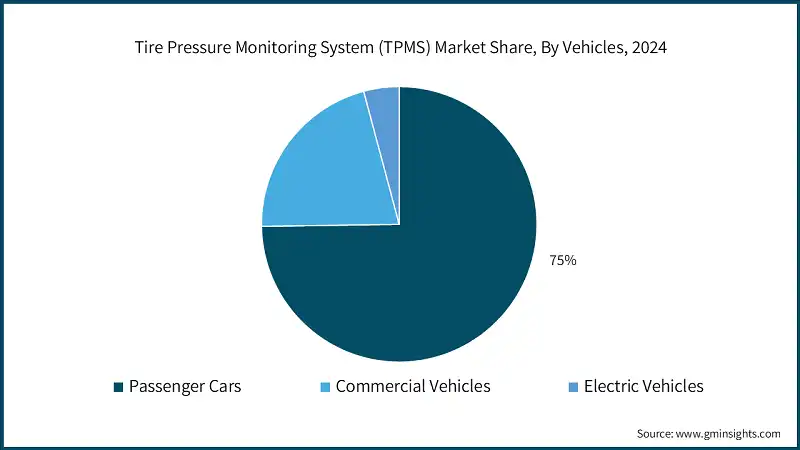
Based on vehicles, the tire pressure monitoring system market is segmented into passenger cars, commercial vehicles, and electric vehicles. The passenger cars segment dominates the market with 75% share in 2024, and the segment is expected to grow at a CAGR of around 12% from 2025 to 2034.
- Passenger cars segment becomes the main part of market across the world with the increased production volumes, consumer awareness regarding road safety, and regulation installation of the TPMS in prominent markets like North America, Europe, China, and Japan. Passenger cars can receive the greatest benefits of TPMS implementation because tire pressure affects gas consumption and stability and general driving comfort directly.
- One such factor is regulatory compliance involved in the general adoption of TPMS on passenger cars. Regulations like the U.S. TREAD Act and the EU ECE R64 have necessitated that all new passenger cars are fitted with TPMS and as such, OEMs have scrambled to either provide direct or indirect systems in premium and low-end models.
- Technology that includes temperature monitoring, predictive analytics, Bluetooth-connected sensors, and smartphone interface are also becoming the norm, as tech-savvy drivers prefer to be safe and comfortable. For instance, in April 2025, Denso Corporation released a sophisticated TPMS for passenger cars that has a mobile app interface and enables real-time monitoring of tires and predictive maintenance notification.
- The use of TPMSs in commercial vehicles is gradually increasing with a CAGR of approximately 11% from 2025 to 2034, being that safety, less downtime, and fewer operational expenses are key determinants in placing the units in the fleet. The implementation of TPMS into fleet management systems allows the operator to monitor the condition of tires and thereby prevent serious breakdowns that lead to the waste of resources and material and the deterioration of railroad traffic, long-haul transportation, construction, and even logistics.
- Smart TPMS systems in EVs, offering real-time monitoring of pressure, temperature, and load, are gaining traction due to the growing focus on range and battery efficiency. Although adoption is lower than in passenger cars, government incentives for EV production and safety measures are driving rapid market growth.
Based on components, the tire pressure monitoring system market is segmented into sensors, electronic control units (ECU), antenna, TPM warning light, and transceiver. The sensors segment dominates over 53% of the TPMS market, driven by demand for accurate, durable, and connected solutions.
- Rising demand for precision and wireless connectivity drives advancements, making them vital for OEM and aftermarket applications. Key features like real-time pressure and temperature monitoring, wireless data transmission, and extended battery life are essential for modern vehicle safety and efficiency.
- For instance, in March 2024, Continental AG released its 2nd generation TPMS sensor, with superior accuracy capabilities, Bluetooth connectivity, and predictive maintenance capabilities to be part of fleet telematics and connected vehicle platforms.
- Electronic control units (ECU) are the core of TPMS data processing and interpretation, the brain of the system. They process the signals of the sensors, initiate warnings and interface with other safety modules like ABS and ESC. Approximately 23% of TPMS market is ECU powered.
- For instance, in February 2025, Denso Corporation released an updated TPMS ECU to its line of products, to handle pressure trend analysis done using AI to offer adaptive warnings depending on different road conditions.
- The usage of antenna components is important to ensure the reliable transfer of the tire sensor data to the ECU and have accuracy and minimum interference of signals. They form about 11 percent of the TPMS market yet without antennas, the systems cannot work.
- Instances include June 2024 when ZF Friedrichshafen AG introduced a high-frequency low-power TPMS antenna to increase data accuracy in large commercial fleets. There is a steady increase in demand for antennas due to usage of wireless TPMS systems in both OEM and aftermarket markets.
- The TPM warning light and transceivers are critical to tire pressure monitoring systems. The warning light alerts drivers to pressure deviations, enhancing safety, while transceivers enable accurate wireless communication between tire sensors and the ECU. Together, they ensure system reliability and faster driver response.
Based on sales channel, the tire pressure monitoring system market is divided into OEM and aftermarket. OEM segment dominated the market accounting for around 69% in 2024 and is expected to grow at a CAGR of over 12% from 2025 to 2034.
- The OEM (Original Equipment Manufacturer) segment dominates the Tire Pressure Monitoring System (TPMS) market due to stringent safety regulations and growing demand for advanced features. Automotive manufacturers integrate TPMS into production lines to meet compliance, ensuring accurate tire pressure readings through seamless calibration with electronic control units.
- OEMs also benefit from the opportunity to enhance brand value by offering advanced TPMS technologies such as intelligent sensors, direct measurement systems, and integration with infotainment or mobile applications. This adds to vehicle appeal and customer satisfaction.
- OEM dominance is fueled by the rise in electric and autonomous vehicles, which require advanced monitoring systems. Automakers prefer direct TPMS solutions with predictive maintenance alerts to reduce downtime and boost fleet efficiency. Partnerships between TPMS suppliers and manufacturers drive innovation, increasing OEM adoption.
- The aftermarket segment of the TPMS market is growing with a CAGR of around 11% from 2025 to 2034, as vehicle owners replace faulty sensors, upgrade to direct systems, or retrofit older vehicles. Increased awareness of safety and fuel efficiency benefits, along with affordable universal TPMS kits, drives this growth. However, challenges like compatibility and calibration persist, though plug-and-play advancements are addressing these issues.
Looking for region specific data?
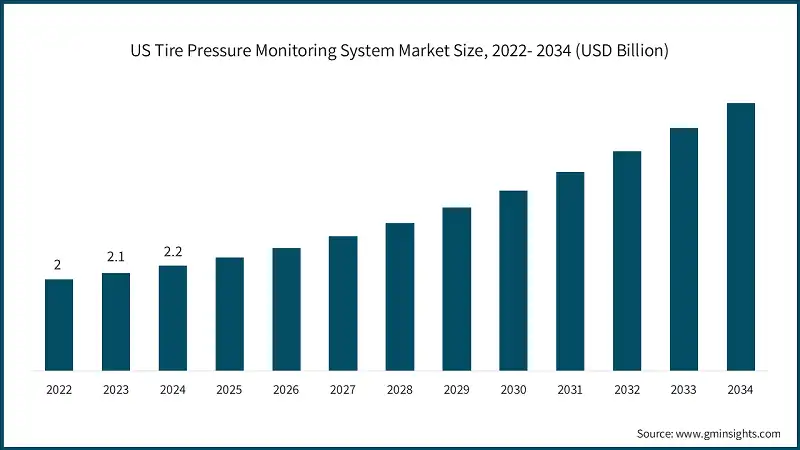
The US dominated the tire pressure monitoring system market in North America with around 82% share and generated USD 2.2 billion in revenue in 2024.
- The US market is leading in Tire Pressure Monitoring System (TPMS) industry because of the excellent base of making cars, strict vehicle safety laws, and good level of consumer recognition in tire care and safety on the road. It is a major market in OEM replacement and aftermarket purchases with a strong R&D and high level of technology adaptation.
- The US has a well-established regulatory background such as the enactment of required regulation like the TREAD Act that sets a steady TPMS demand amongst passenger cars, commercial vehicles and electric vehicles. The presence of reasonable standards and competent procedures of certification will lead automakers and suppliers to focus on advanced TPMS solutions.
- The US is the country of innovation in the TPMS market, and such features as AI-driven predictive maintenance, cloud-based sensor connections, and smartphone-integrated monitoring increase the workability and convenience of the systems. For instance, in May 2025, Sensata Technologies introduced a Bluetooth range of TPMS sensors to major automotive brands in the US, to increase visibility of real-time tire health and fleet management.
- The Canadian TPMS market is experiencing a progressive growth of about 5% CAGR from 2025 to 2034, which is attributed to growing number of vehicle ownership, modernization of fleet vehicles and heightened attention towards technologies of road safety. The increased need for durable and weather resistant sensors that can work in diverse climatic conditions has seen companies increase their product portfolio.
The tire pressure monitoring system market in Germany is projected to witness strong and sustained growth from 2025 to 2034, driven by increasing vehicle safety regulations, rising consumer awareness, and the country’s robust automotive manufacturing sector.
- Germany, recognized as Europe's automotive powerhouse, is set to see robust growth in its tire market with a strong CAGR of over 10% from 2025 to 2034. Home to global automotive giants like Volkswagen, BMW, and Mercedes-Benz, Germany's leading manufacturers are swiftly adopting advanced TPMS technologies. With a strong emphasis on safety, regulatory adherence, and innovation, these OEMs are fueling the demand for precise and dependable TPMS solutions.
- Germany, adhering to the EU regulations, such as UNECE R141, requires a fitment of TPMS on new cars, which supports its leadership in the market. This is a sound regulatory framework that besides enabling the widespread response of TPMS, it is expanding technological capabilities with continuous improvement to meet evolving safety and environmental standards.
- Germany's market leadership is bolstered by its emphasis on connected and autonomous vehicles, with TPMS being pivotal for safety and performance. German automakers and tech firms are pouring investments into merging TPMS data with telematics, fleet oversight, and AI-led predictive maintenance.
- For instance, in 2024, Continental AG, a prominent German automotive supplier, unveiled a smart TPMS solution. These offering boasts cloud connectivity and real-time tire health insights, specifically designed for commercial fleets, underscoring Germany's edge in innovation.
- France and Italy significantly influence the European TPMS industry due to their strong automotive sectors and increasing regulations. In France, rising vehicle numbers and government safety initiatives drive TPMS demand, while Italian manufacturers focus on domestic and export markets. Spain and the UK are also expanding their markets, driven by growing consumer awareness and the adoption of electric vehicles.
The tire pressure monitoring system market in China is expected to experience significant and promising growth from 2025 to 2034.
- Asia Pacific is one of the fastest-growing areas, with over 19% of the market in 2024. The tire pressure monitoring system (TPMS) market in China is expected to experience significant and promising growth of 11% from 2025 to 2034, driven primarily by the country’s rapid automotive industry expansion. As the world’s largest vehicle producer and consumer, China is witnessing increasing integration of TPMS as a standard safety feature across passenger cars, commercial vehicles, and electric vehicles.
- China's focus on electric mobility and smart transportation is driving TPMS market growth. The rising adoption of EVs, supported by favorable policies, increases the need for accurate tire pressure monitoring to enhance range and battery efficiency. Additionally, connected vehicle technologies and autonomous driving projects are boosting demand for IoT-enabled TPMS with real-time analytics and predictive maintenance.
- TPMS manufacturers are heavily investing in China's market by expanding production, enhancing R&D, and partnering with OEMs and fleet operators. These efforts address the rising demand for advanced, cost-effective tire monitoring systems suited to diverse driving conditions and vehicle types.
- India, Japan, and South Korea, alongside China, are key players in the APAC TPMS market. India’s growing vehicle ownership and government safety initiatives drive TPMS adoption. Japan leads in advanced TPMS technologies with major OEMs like Toyota and Honda. South Korea’s focus on electric and autonomous vehicles boosts demand for sophisticated TPMS solutions, contributing significantly to regional market growth.
Tire pressure monitoring system market in UAE is expected to experience significant and promising growth from 2025 to 2034.
- The United Arab Emirates (UAE) dominates the MEA tire pressure monitoring system (TPMS) market, supported by progressive automotive safety regulations, advanced vehicle technologies, and growing demand from both passenger and commercial vehicle segments. The UAE’s role as a regional logistics hub and its strong automotive aftermarket industry further reinforces its leadership in TPMS adoption and innovation.
- The TPMS market in the UAE is projected for robust growth of 8% from 2025 to 2034, driven by rising vehicle sales, increasing fleet modernization, and heightened awareness of road safety. Demand for sophisticated, connected TPMS solutions that integrate with smart fleet management systems is growing rapidly among commercial operators and luxury vehicle owners alike.
- Dubai leads the market, fueled by government support for smart mobility and vehicle safety initiatives. In March 2024, a major automotive supplier introduced an advanced Bluetooth-enabled TPMS sensor system tailored for the UAE’s diverse vehicle fleet, enhancing real-time tire health monitoring and predictive maintenance capabilities.
- Abu Dhabi and Sharjah are emerging as important hubs for TPMS growth, with expanding commercial fleets and increased regulatory focus on vehicle safety compliance. These emirates are encouraging adoption of next-generation TPMS technologies, including AI-enabled sensors and cloud-connected monitoring platforms, to boost fleet efficiency and reduce road incidents.
- Emerging opportunities in the MEA TPMS market are also appearing in countries such as Egypt, South Africa, and Morocco. These markets benefit from growing vehicle ownership, expanding commercial transport sectors, and investments in automotive infrastructure. Increasing consumer awareness and government efforts to improve road safety standards are driving demand for both OEM and aftermarket TPMS solutions, creating strong potential for market expansion in these regions.
The tire pressure monitoring system market in Brazil is expected to experience significant and promising growth from 2025 to 2034.
- Brazil is set to lead the Latin American tire pressure monitoring system (TPMS) market in 2024, with a projected CAGR of around 11% from 2025to 2034. Growth is driven by rising vehicle production, increasing safety regulations, and expanding commercial and passenger vehicle fleets. Demand for advanced TPMS technologies is also boosted by growing awareness of vehicle maintenance and fuel efficiency benefits.
- Regional and international TPMS suppliers such as Continental AG and Sensata Technologies are expanding their presence with localized manufacturing and distribution networks in Brazil. These companies are scaling offerings with improved sensor accuracy, wireless connectivity, and integration with fleet management systems, positioning Brazil as a key emerging market in Latin America for TPMS adoption and innovation.
- Mexico and Argentina are emerging markets in the Latin American TPMS sector, supported by increasing automotive production, government safety mandates, and rising aftermarket demand. Investment is focused on affordable, reliable TPMS solutions for passenger cars and commercial vehicles, especially in urban and industrial centers where fleet modernization is accelerating.
- New opportunities are developing in Chile, Colombia, and Peru, fueled by growing vehicle ownership, expanding logistics sectors, and improving regulatory frameworks that encourage TPMS integration. These countries are witnessing rising interest in connected vehicle technologies and telematics, creating fertile ground for advanced, IoT-enabled TPMS solutions tailored to diverse market needs.
Tire Pressure Monitoring System Market Share
- The top 7 companies in the TPMS industry are Continental, Denso, Sensata Technologies, ZF Friedrichshafen, NXP Semiconductors, Pacific Industrial, and Hella contributed around 49% of the market in 2024.
- Continental is a global leader in TPMS technology, known for delivering highly reliable, intelligent tire pressure sensors and integrated vehicle safety solutions. Continental’s systems offer real-time tire health monitoring, predictive maintenance alerts, and seamless integration with vehicle networks. Their focus on innovation, such as cloud connectivity and AI-powered analytics, caters to both passenger and commercial vehicle segments worldwide.
- Denso excels in advanced TPMS sensor technology, emphasizing durability, precision, and energy efficiency. Denso’s solutions support direct and indirect TPMS applications, with strong adoption in Asian and North American markets. Their systems often integrate with vehicle telematics platforms, enabling fleet operators to optimize tire performance and reduce maintenance costs through data-driven insights.
- Sensata Technologies stands out for its comprehensive portfolio of TPMS products, including Bluetooth-enabled sensors designed for enhanced user interaction via mobile apps. Sensata focuses on scalable, cost-effective solutions for OEMs and aftermarket customers, ensuring broad compatibility across vehicle types. Their global footprint and commitment to R&D help maintain leadership in evolving safety and connectivity demands.
- ZF Friedrichshafen offers robust TPMS systems with a focus on automotive safety and autonomous driving readiness. Their products combine sensor accuracy with advanced ECU technology to deliver precise tire pressure and temperature data, integrating seamlessly into vehicle stability and driver assistance systems. ZF’s strong presence in European and commercial vehicle markets supports its competitive edge.
- NXP Semiconductors provides critical semiconductor components for TPMS, including low-power transceivers and secure communication modules. NXP’s chips enable reliable wireless data transmission between tire sensors and vehicle control units, ensuring system responsiveness and data integrity. Their innovations support expanding TPMS applications in connected and autonomous vehicles.
- Pacific Industrial specializes in sensor manufacturing with a focus on high-precision TPMS components that withstand harsh environmental conditions. Their products are valued for reliability in both OEM and aftermarket sectors, especially in Asian markets. Pacific Industrial’s commitment to quality and customization helps address diverse automotive safety requirements.
- Hella integrates advanced TPMS warning lights and sensor technology into automotive safety systems, emphasizing driver awareness and regulatory compliance. Hella’s solutions enhance user interfaces with customizable dashboard indicators and integrate with digital instrument clusters. Their innovation in lighting and sensor technology supports a comprehensive approach to vehicle safety.
Tire Pressure Monitoring System Market Companies
Major players operating in the tire pressure monitoring system (TPMS) industry are:
- Continental
- Delphi Technologies
- Denso
- Hella
- NXP Semiconductors
- Pacific Industrial
- Robert Bosch
- Sensata Technologies
- Valeo
- ZF Friedrichshafen
- Continental AG and Sensata Technologies are leading the TPMS market by offering advanced sensor technology combined with smart connectivity. Continental focuses on integrating AI-powered analytics and cloud-enabled solutions for real-time tire health monitoring, while Sensata emphasizes scalable, Bluetooth-enabled sensors that cater to both OEM and aftermarket needs. Both companies balance innovation with reliability to meet the evolving demands of global automotive markets.
- Denso Corporation and ZF Friedrichshafen deliver robust TPMS systems known for precision, durability, and seamless integration with vehicle safety architectures. Denso’s solutions excel in energy efficiency and telematics compatibility, especially in Asian markets, while ZF emphasizes autonomous driving readiness and strong ECU-sensor synergy to enhance vehicle stability and driver assistance features.
- Delphi Technologies and Valeo focus on comprehensive TPMS offerings that blend sensor accuracy with electronic control units and transceiver technologies. Delphi prioritizes energy-efficient communication modules suitable for commercial fleets, and Valeo leverages its global automotive footprint to provide customizable, cost-effective systems aligned with stringent safety regulations.
- Hella GmbH and Robert Bosch emphasize integrated safety solutions, combining high-quality TPMS sensors with advanced warning light systems and digital dashboard interfaces. Hella enhances driver awareness with customizable alerts, while Bosch integrates TPMS data into broader vehicle diagnostic platforms, supporting predictive maintenance and connected car ecosystems.
- Pacific Industrial and NXP Semiconductors are key technology enablers in the TPMS ecosystem. Pacific Industrial specializes in manufacturing high-precision, durable sensors designed for harsh environments, while NXP provides essential semiconductor components such as low-power transceivers and secure communication chips.
Tire Pressure Monitoring System (TPMS) Market Report Attributes
| Key Takeaway | Details |
|---|---|
| Market Size & Growth | |
| Base Year | 2024 |
| Market Size in 2024 | USD 8.2 Billion |
| Forecast Period 2025 – 2034 CAGR | 11.7% |
| Market Size in 2034 | USD 24.2 Billion |
| Key Market Trends | |
| Drivers | Impact |
| Stringent vehicle safety regulations | Mandatory TPMS installation in new vehicles is accelerating global adoption. |
| Rising consumer awareness about tire safety and fuel efficiency | Increased understanding of tire maintenance benefits is boosting demand for advanced TPMS solutions. |
| Technological advancements in sensor accuracy and connectivity | Smarter, real-time monitoring systems are enhancing driver safety and vehicle performance. |
| Growing adoption of electric and autonomous vehicles | EVs and AVs require precise tire monitoring to optimize range, safety, and efficiency. |
| Expansion of fleet management and logistics operations | Fleet operators are integrating TPMS to reduce downtime, extend tire life, and improve operational efficiency. |
| Pitfalls & Challenges | Impact |
| High system and integration costs | Advanced TPMS with connectivity raises costs, limiting OEM adoption in cost-sensitive markets. |
| Sensor durability and replacement issues | Harsh conditions and battery limits increase maintenance costs. |
| Opportunities: | Impact |
| Integration of AI and predictive analytics in TPMS | With AI-driven insights, fleets and consumers can detect faults early, optimize tire performance, and minimize downtime. |
| Expansion into emerging automotive markets | Rising vehicle ownership in developing regions boosts TPMS adoption. |
| Partnerships with OEMs and fleet operators | Collaborations enhance advanced TPMS integration, driving market penetration and revenues. |
| Sustainability-focused tire management solutions | TPMS improving fuel efficiency and tire life attract eco-conscious consumers. |
| Market Leaders (2024) | |
| Market Leaders |
28% Market Share |
| Top Players |
Collective market share in 2024 is Collective Market Share is 47% |
| Competitive Edge |
|
| Regional Insights | |
| Largest Market | North America |
| Fastest Growing Market | Asia Pacific |
| Emerging Countries | Mexico, Thailand, Indonesia, Brazil, South Africa |
| Future outlook |
|
What are the growth opportunities in this market?
Tire Pressure Monitoring System Industry News
- In February 2025, Denso Corporation announced the release of an upgraded TPMS electronic control unit (ECU) platform. The new system supports AI-powered tire pressure trend analysis, improving vehicle safety by predicting potential tire issues under various driving conditions.
- In October 2024, NXP Semiconductors introduced a secure communication chip aimed at enhancing cybersecurity for TPMS in connected and autonomous vehicles. This chip addresses growing concerns over data protection and system integrity in modern automotive safety technologies.
- In June 2024, ZF Friedrichshafen unveiled a low-power, high-frequency TPMS antenna designed specifically for large commercial vehicle fleets. This technology enhances data transmission accuracy and signal stability, facilitating better tire monitoring in heavy-duty transport applications.
- In May 2024, Sensata Technologies introduced a new line of Bluetooth-enabled TPMS sensors designed to integrate seamlessly with smartphone apps. This innovation enhances user experience by allowing drivers to monitor tire pressure and receive alerts directly on their mobile devices, boosting aftermarket adoption.
- In April 2024, Delphi Technologies launched an energy-efficient TPMS transceiver with an extended communication range. This product addresses the needs of heavy-duty vehicles and fleet operators requiring reliable tire pressure data over longer distances.
- In March 2024, Continental AG launched its next-generation intelligent TPMS sensors equipped with cloud connectivity and AI-driven predictive maintenance features. These advanced sensors aim to improve fleet management efficiency and safety by providing real-time tire health insights, targeting commercial vehicle operators worldwide.
The tire pressure monitoring system (TPMS) market research report includes in-depth coverage of the industry with estimates & forecasts in terms of revenue ($ Mn) from 2021 to 2034, for the following segments:
Market, By Type
- Direct TPMS
- Indirect TPMS
Market, By Vehicles
- Passenger cars
- Sedans
- Hatchbacks
- SUVS
- Commercial vehicles
- Light commercial vehicles
- Medium commercial vehicles
- Heavy commercial vehicles
- Electric vehicles
Market, By Component
- Sensors
- Electronic control units (ECU)
- Antenna
- TPM warning light
- Transceivers
Market, By Sales Channel
- OEM
- Aftermarket
Market, By Technology Depth
- Conventional TPMS
- Intelligent TPMS
The above information is provided for the following regions and countries:
- North America
- US
- Canada
- Europe
- Germany
- UK
- France
- Italy
- Spain
- Russia
- Nordics
- Portugal
- Croatia
- Asia Pacific
- China
- India
- Japan
- Australia
- South Korea
- Singapore
- Thailand
- Indonesia
- Latin America
- Brazil
- Mexico
- Argentina
- MEA
- South Africa
- Saudi Arabia
- UAE
Frequently Asked Question(FAQ) :
What is the market size of the tire pressure monitoring system (TPMS) in 2024?
The market size was USD 8.2 billion in 2024, with a CAGR of 11.7% expected through 2034. Increasing focus on road safety, fuel efficiency, and regulatory compliance is driving market growth.
What is the projected value of the TPMS market by 2034?
The market is poised to reach USD 24.2 billion by 2034, driven by advancements in smart monitoring systems, IoT integration, and sustainability initiatives.
How much revenue did the direct TPMS segment generate in 2024?
The direct TPMS segment accounted for approximately 65% of the market in 2024 and is expected to witness over 11% CAGR till 2034.
What was the market share of the passenger cars segment in 2024?
The passenger cars segment dominated the market with a 75% share in 2024 and is set to expand at a CAGR of around 12% up to 2034.
What is the growth outlook for the sensors segment?
The sensors segment held over 53% of the market in 2024, led by demand for accurate, durable, and connected solutions.
Which region leads the TPMS sector?
The market size in the US was USD 2.2 billion in 2024, accounting for approximately 82% of the North American market share.
What are the upcoming trends in the TPMS market?
Trends include AI-powered analytics, IoT telematics, efficient sensors, cloud diagnostics, and sustainable innovations like recyclable materials and low-power sensors.
Who are the key players in the TPMS industry?
Key players include Continental, Delphi Technologies, Denso, Hella, NXP Semiconductors, Pacific Industrial, Robert Bosch, Sensata Technologies, Valeo, and ZF Friedrichshafen.
Tire Pressure Monitoring System (TPMS) Market Scope
Related Reports