Summary
Table of Content

Third-Party Logistics (3PL) Market
Get a free sample of this report
Form submitted successfully!
Error submitting form. Please try again.
Thank you!
Your inquiry has been received. Our team will reach out to you with the required details via email. To ensure that you don't miss their response, kindly remember to check your spam folder as well!
Request Sectional Data
Thank you!
Your inquiry has been received. Our team will reach out to you with the required details via email. To ensure that you don't miss their response, kindly remember to check your spam folder as well!
Form submitted successfully!
Error submitting form. Please try again.
Third-Party Logistics Market Size
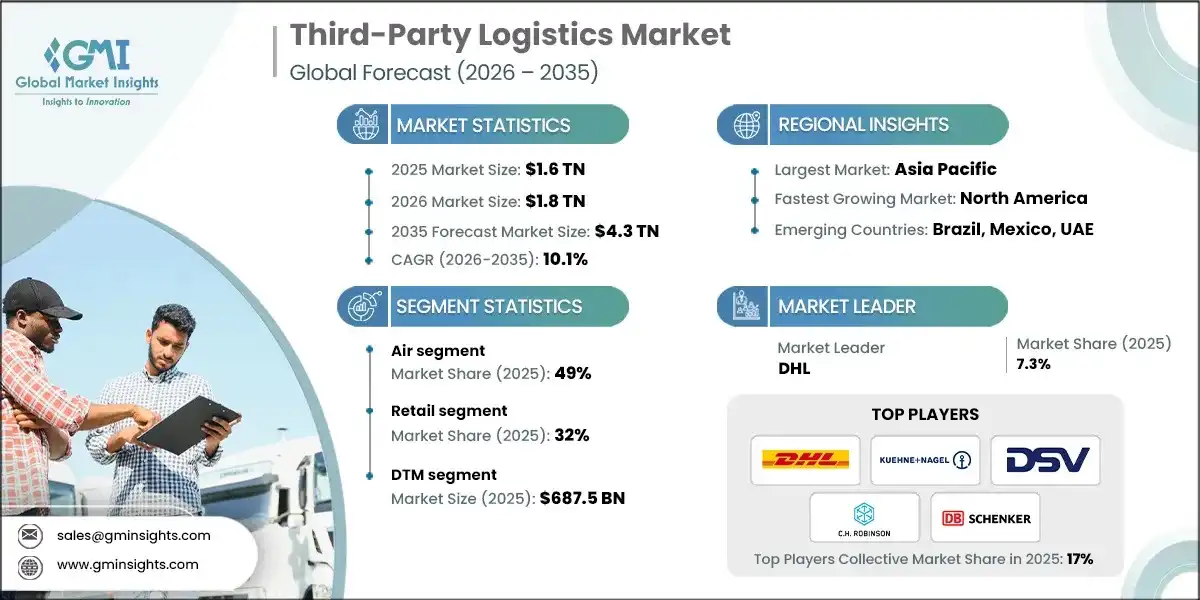
The global third-party logistics (3PL) market size was valued at USD 1.6 trillion in 2025. The market is expected to grow from USD 1.8 trillion in 2026 to USD 4.3 trillion in 2035, at a CAGR of 10.1%, according to latest report published by Global Market Insights Inc.
Third-Party Logistics (3PL) Market Key Takeaways
Market Size & Growth
- 2025 Market Size: USD 1.6 Trillion
- 2026 Market Size: USD 1.8 Trillion
- 2035 Forecast Market Size: USD 4.3 Trillion
- CAGR (2026–2035): 10.1%
Regional Dominance
- Largest Market: Asia Pacific
- Fastest Growing Region: North America
Key Market Drivers
- Rapid Growth of E-commerce & Omnichannel Retail.
- Rising Supply Chain Complexity & Global Trade.
- Technology Adoption & Digital Transformation.
- Cost Optimization & Asset-Light Business Models.
Challenges
- Rising Operational & Labor Costs.
- Regulatory & Compliance Complexity.
Opportunity
- Last-Mile Delivery & Value-Added Logistics Services.
- Digital & Sustainable Logistics Solutions.
Key Players
- Market Leader: DHL led with over 7.3% market share in 2025.
- Leading Players: Top 5 players in this market include DHL, Kuehne + Nagel International AG, DSV A/S (UTi Worldwide, Inc.), C.H Robinson, DB Schenker Logistics, which collectively held a market share of 17% in 2025.
Get Market Insights & Growth Opportunities
The third-party logistics market is projected to witness substantial growth in the coming years, driven by the rapid expansion of e-commerce, increasing globalization of supply chains, rising customer expectations for faster deliveries, and the growing complexity of logistics and distribution networks. As manufacturers, retailers, and e-commerce companies prioritize cost optimization, operational agility, real-time visibility, and scalability, outsourcing logistics functions to specialized 3PL providers is becoming essential to ensure efficient, reliable, and compliant supply chain operations.
Technological advancements such as cloud-based transportation management systems (TMS), warehouse management systems (WMS), AI- and ML-powered route optimization, IoT-enabled real-time tracking, robotics and warehouse automation, and data analytics platforms are transforming traditional logistics operations. These innovations enable end-to-end supply chain visibility, reduce transit times, improve inventory accuracy, enhance demand forecasting, and optimize transportation and warehousing efficiency. In parallel, the increasing adoption of omnichannel retail models, cross-border trade, and last-mile delivery solutions is driving demand for more integrated, flexible, and technology-enabled 3PL services.
In 2024, leading 3PL providers such as DHL Supply Chain, Kuehne+Nagel, DB Schenker, DSV, UPS Supply Chain Solutions, CEVA Logistics, Nippon Express, and XPO Logistics expanded their service portfolios. These companies invested heavily in digital logistics platforms, warehouse automation, AI-driven analytics, IoT-enabled tracking systems, and multimodal transportation capabilities to enhance operational efficiency, reduce logistics costs, and improve service reliability for manufacturers, retailers, and e-commerce businesses.
The 3PL ecosystem continues to evolve as advanced analytics, automation, real-time visibility platforms, and integrated logistics networks reshape global supply chain management. Industry stakeholders are increasingly prioritizing end-to-end, asset-light, technology-driven logistics solutions that improve transparency, reduce manual intervention, optimize transportation and warehousing performance, and support long-term compliance with trade, safety, and sustainability regulations. These advancements are redefining the 3PL market, enabling faster, more resilient, and cost-efficient logistics operations across global markets.
To get key market trends
Third-Party Logistics Market Trends
The demand for advanced third-party logistics (3PL) solutions is rapidly increasing, driven by growing collaboration among manufacturers, retailers, e-commerce companies, logistics service providers, technology vendors, and digital platform providers. These partnerships aim to enhance end-to-end supply chain visibility, transportation efficiency, inventory optimization, last-mile delivery performance, and regulatory compliance. Stakeholders are jointly developing integrated, modular, and data-driven logistics ecosystems incorporating AI- and ML-powered demand forecasting, route optimization, IoT-enabled real-time tracking, cloud-based transportation and warehouse management systems (TMS/WMS), predictive analytics, and digital freight platforms.
For instance, in 2024, leading 3PL providers such as DHL, Kuehne + Nagel, DSV, DB Schenker, and C.H. Robinson expanded collaborations with e-commerce platforms, manufacturing enterprises, and technology partners to deploy real-time shipment visibility platforms, automated warehousing solutions, AI-driven freight matching systems, and predictive supply chain analytics. These initiatives improved delivery reliability, reduced transit times, enhanced inventory accuracy, and increased operational efficiency across global distribution networks, fulfilment centers, and last-mile delivery operations.
Regional customization of logistics solutions is emerging as a key trend in the 3PL market. Leading providers are implementing localized service models, region-specific compliance frameworks, and tailored logistics workflows across Asia-Pacific, North America, Europe, Latin America, and the Middle East. These strategies support country-specific trade regulations, customs procedures, sustainability requirements, and infrastructure conditions, enabling efficient operations across diverse environments such as high-volume e-commerce hubs, cross-border trade corridors, industrial clusters, and urban last-mile delivery networks.
The rise of digital logistics startups and technology-driven freight platforms offering AI-enabled optimization, cloud-native logistics management, real-time tracking, and automated documentation is reshaping the competitive landscape. Companies developing predictive logistics engines, dynamic routing systems, autonomous warehouse solutions, and integrated multimodal platforms are enabling scalable and cost-efficient deployment of advanced 3PL services. These innovations empower both established logistics providers and emerging players to enhance supply chain transparency, improve service responsiveness, and accelerate digital transformation across the global logistics ecosystem.
The development of standardized, modular, and interoperable logistics platforms is transforming the 3PL market. Leading players such as DHL, Kuehne + Nagel, DSV, DB Schenker, and C.H. Robinson are deploying unified digital logistics architectures that support multimodal transportation, customizable service workflows, and compliance with regional trade, safety, and environmental regulations. These solutions improve scalability, enable real-time end-to-end supply chain monitoring, support seamless integration across shippers, carriers, warehouses, and customs authorities, and enhance overall reliability and resilience in global logistics operations.
Third-Party Logistics Market Analysis

Learn more about the key segments shaping this market
Based on mode, the market is divided into air, sea and rail & road. The air segment dominated the market, accounting for around 49% share in 2025 and is expected to grow at a CAGR of over 11.2% from 2026 to 2035.
- The air segment dominated the third-party logistics market, primarily due to its critical role in enabling time-sensitive, high-value, and express logistics operations. Strong demand from e-commerce, pharmaceuticals, electronics, and perishables has driven high adoption of air freight services for rapid cross-border deliveries, just-in-time inventory management, and premium supply chain requirements. Advanced air cargo handling, real-time tracking, priority shipping, and integrated express networks enhance speed, reliability, and service quality, making air logistics the preferred choice for urgent and high-value shipments.
- The sea freight segment serves as a cost-efficient and high-capacity solution for bulk commodities, containerized cargo, and international trade flows. It is widely used for long-distance transportation of manufactured goods and raw materials, particularly across Asia-Pacific, Europe, and North America. Meanwhile, the rail & road segment plays a vital role in regional and domestic logistics, supporting first-mile and last-mile connectivity, inland transportation, and intermodal freight movement, especially for e-commerce fulfillment and industrial supply chains.
- Although sea and rail & road modes are essential for large-volume and cost-optimized logistics operations, the speed, reliability, and global reach of air transport give it a clear competitive advantage in high-priority logistics use cases. Continuous advancements in air cargo digitalization, express logistics networks, cold chain air freight, and real-time shipment visibility further reinforce the dominance of the air segment, solidifying its position as a key growth driver within the market.

Learn more about the key segments shaping this market
Based on application, the third-party logistics market is divided into food & beverages, healthcare, retail, automotive, manufacturing, e-commerce & logistics, chemicals & petrochemicals and pharmaceuticals and others. The retail segment dominates the market, accounting for around 32% share in 2025, and the segment is expected to grow at a CAGR of over 9.6% from 2026 to 2035.
- The retail segment dominates the third-party logistics (3PL) market due to its high shipment volumes, fast inventory turnover, and strong dependence on efficient warehousing, fulfillment, and last-mile delivery services. Retailers, especially e-commerce and omnichannel players rely heavily on 3PL providers for order fulfillment, inventory optimization, reverse logistics, and same-day/next-day delivery, making retail the largest revenue-generating application segment.
- The food & beverages and healthcare segments also contribute significantly, driven by growing demand for cold chain logistics and regulatory-compliant handling of perishable goods and medical equipment. The pharmaceuticals segment, treated separately, requires highly specialized logistics services including strict temperature control, compliance with regulatory standards, serialization, and secure transportation, making it a high-value but smaller-volume segment.
- The automotive and manufacturing segments utilize 3PL services for inbound logistics, just-in-time deliveries, spare parts distribution, and cross-border trade, supporting operational continuity and cost efficiency. While these other applications play critical roles in the overall logistics ecosystem, the scale, frequency, and time-sensitive nature of retail logistics operations give this segment a clear advantage. Continuous growth in e-commerce, rising consumer expectations for rapid delivery, and advancements in digital fulfillment platforms, real-time inventory visibility, and last-mile optimization further reinforce the retail segment’s dominance in the global 3PL market.
Based on solutions, the market is divided into DCC, DTM, ITM, Warehousing & Distribution and Logistics Software. The DTM segment dominated the market and was valued at USD 687.5 billion in 2025.
- The DTM segment dominates the third-party logistics market, driven by its critical role in managing high-frequency, time-sensitive, and cost-optimized domestic freight movements. DTM solutions enable efficient route planning, carrier selection, shipment tracking, and last-mile delivery optimization, making them essential for e-commerce, retail, FMCG, and manufacturing supply chains. Their ability to support rapid fulfillment, just-in-time deliveries, and scalable operations positions DTM as the primary focus for shippers and logistics providers.
- The warehousing & distribution and ITM segments also contribute significantly to market growth. Warehousing & Distribution supports inventory management, order fulfillment, and omnichannel logistics, while ITM addresses cross-border trade, international freight forwarding, and customs compliance. Meanwhile, DCC solutions cater to long-term, dedicated fleet requirements, and Logistics Software enables visibility, analytics, and automation across logistics networks.
- Although these other solutions play critical roles in end-to-end supply chain operations, the frequency of use, operational flexibility, and direct impact on delivery performance give DTM a clear advantage. Continuous advancements in AI-driven route optimization, real-time shipment visibility, predictive analytics, and cloud-based transportation platforms further reinforce the dominance of the DTM segment, solidifying its position as the largest solution segment in the global 3PL market.
Looking for region specific data?
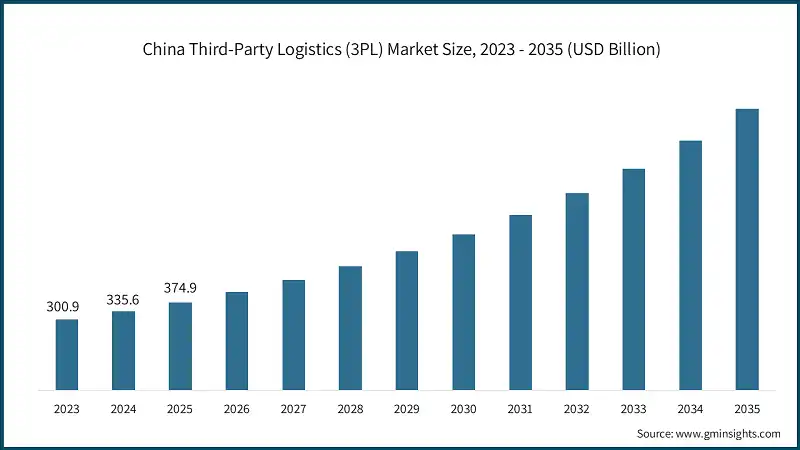
In 2025, China dominated the Asia Pacific third-party logistics market with around 57% market share and generated approximately USD 374.9 billion in revenue.
- Asia-Pacific dominated the market, supported by rapid growth in e-commerce, high manufacturing output, and increasing adoption of technology-enabled logistics solutions. The region is witnessing steady growth as manufacturers, retailers, and 3PL providers increasingly invest in AI-powered route optimization, real-time shipment tracking, cloud-based TMS/WMS, and automated fulfillment platforms. Advanced logistics infrastructure, high freight volumes, and rising regulatory standards continue to strengthen Asia-Pacific’s position in the global market.
- China represents the largest market in Asia-Pacific, driven by strong demand for multimodal transportation, last-mile delivery, predictive logistics analytics, and real-time supply chain visibility solutions. Major hubs such as Shanghai, Beijing, Shenzhen, and Guangzhou are experiencing high adoption of automated warehouses, digital freight management, and integrated logistics networks, enhancing operational efficiency, reducing transit times, and improving service reliability, cementing China’s dominance in the region.
- Other Asia-Pacific countries, including India, Japan, South Korea, and Southeast Asia, are emerging as high-growth markets, supported by expanding e-commerce, industrial production, and adoption of digital logistics platforms. India focuses on cost-effective domestic logistics, Japan emphasizes automated supply chains, and South Korea invests in smart, connected logistics solutions. Despite varying market maturity, these countries are increasingly adopting AI-enabled, cloud-based, and real-time 3PL solutions, reinforcing Asia-Pacific’s contribution to the market.
In 2025, US holds share of 86% in North America third-party logistics market and it will grow tremendously between 2026 and 2035.
- North America holds a major share of the 3PL market, supported by a mature e-commerce and retail ecosystem, well-established manufacturing and distribution networks, and widespread adoption of advanced logistics technologies. The region benefits from extensive use of AI-powered route optimization, IoT-enabled shipment tracking, cloud-based TMS/WMS, and automated warehouse and fulfillment solutions, positioning it as a global leader in efficient and technology-driven logistics operations.
- The United States accounts for the largest share within North America, driven by high e-commerce penetration, extensive industrial and retail supply chains, and stringent regulatory standards for trade, safety, and sustainability. Key logistics hubs such as California, Texas, Florida, and New York serve as primary centers for multimodal transportation, warehouse automation, digital freight platforms, and last-mile delivery optimization. Large-scale adoption of AI-enabled, cloud-integrated, and predictive logistics solutions, combined with robust carrier networks and fulfillment infrastructure, fuels market growth.
- Leading industry players in the U.S., including DHL, Kuehne + Nagel, DSV, DB Schenker, and C.H. Robinson, continue to expand their service portfolios, enhance predictive analytics and automation capabilities, and strengthen digital platforms and multimodal integration. Their ongoing investment in AI-driven route planning, real-time shipment visibility, automated warehousing, and cloud-enabled logistics management consolidates the U.S.’s dominant position in the North American market.
Germany holds share of 20% in Europe third-party logistics market in 2025 and it will grow tremendously between 2026 and 2035.
- Europe accounted for a significant share of the market, supported by a mature industrial base, advanced e-commerce and retail networks, and widespread adoption of technology-enabled logistics solutions. Countries across the region are expanding multimodal transport infrastructure, automated warehouses, and digital logistics platforms, while service providers focus on deploying AI-powered route optimization, real-time shipment tracking, cloud-based TMS/WMS, and predictive analytics. Strong technological infrastructure, regulatory compliance standards, and growing focus on sustainability and supply chain efficiency reinforce Europe’s position as a key regional market.
- Germany dominates the European 3PL market, supported by its advanced manufacturing and logistics ecosystem, stringent regulatory standards, and high adoption of digital supply chain solutions. Key logistics hubs such as Frankfurt, Hamburg, Munich, and Berlin are leading large-scale implementation of AI-driven route planning, real-time freight visibility, automated warehouse operations, and cloud-integrated logistics platforms. Investments in predictive analytics, multimodal transport optimization, and scalable digital solutions have strengthened operational efficiency, expanded service capabilities, and accelerated market growth, positioning Germany as the regional leader.
- Other major European countries, including France, the UK, Italy, and the Netherlands, are contributing to regional market expansion, driven by increasing adoption of technology-enabled logistics platforms, e-commerce fulfillment solutions, and automated warehousing systems. France focuses on high-volume urban logistics, the UK emphasizes advanced last-mile and omnichannel distribution, and Italy prioritizes industrial and manufacturing logistics. Despite varying levels of market maturity, Germany maintains its leading role in scale, technological innovation, and comprehensive 3PL service adoption within Europe.
Third-party logistics market in Brazil will experience significant growth between 2026 and 2035.
- Latin America holds a smaller share but is steadily expanding its presence in the Third-Party Logistics (3PL) market in 2025, driven by growing e-commerce, expanding manufacturing and retail operations, and rising adoption of technology-enabled logistics solutions. Companies across the region are gradually deploying AI-powered route optimization, real-time shipment tracking, cloud-based TMS/WMS, and automated fulfillment platforms. Strengthening transportation networks, expanding warehousing capabilities, and improving regulatory frameworks continue to support Latin America’s growing role in the market.
- Brazil dominates the Latin American 3PL market, supported by its large consumer base, high e-commerce volumes, and regulatory standards for trade, safety, and sustainability. Major urban hubs such as São Paulo, Rio de Janeiro, and Brasília host numerous logistics hubs, fulfillment centers, and industrial clusters that focus on multimodal transportation, last-mile delivery, predictive logistics analytics, and real-time supply chain visibility. Leading 3PL providers, including DHL, Kuehne + Nagel, DSV, DB Schenker, and C.H. Robinson, actively offer AI-driven logistics platforms, cloud-based management systems, and automated warehouse solutions to support Brazil’s dominant position in the regional market.
- Mexico represents the second largest and rapidly growing market, driven by expanding e-commerce, industrial production, and adoption of technology-enabled logistics platforms. Key cities such as Mexico City, Monterrey, and Guadalajara are witnessing higher demand for scalable, efficient, and integrated 3PL solutions, supported by digital freight management, predictive analytics, and multimodal transport optimization. These developments are contributing to the overall growth and modernization of Latin America’s market.
Third-party logistics market in UAE will experience significant growth between 2026 and 2035.
- MEA accounted for a modest share of the market in 2025, supported by gradual growth in e-commerce, industrial production, and increasing adoption of technology-enabled logistics solutions. Countries across the region are progressively implementing AI-powered route optimization, real-time shipment tracking, cloud-based TMS/WMS, and automated fulfillment platforms. Expansion of warehousing infrastructure, transportation networks, and regional trade hubs further supports MEA’s integration into the market.
- The UAE dominates the MEA 3PL market, driven by high adoption of advanced logistics solutions across e-commerce, retail, manufacturing, and industrial sectors. Key hubs such as Dubai and Abu Dhabi host major distribution centers, freight terminals, and logistics service providers that implement multimodal transportation, predictive analytics, real-time shipment visibility, and automated warehouse operations to improve operational efficiency, reduce transit times, and ensure compliance with regional trade and safety regulations.
- Leading 3PL providers, including DHL, Kuehne + Nagel, DB Schenker, DSV, and C.H. Robinson, are actively deploying AI-driven logistics platforms, cloud-enabled management systems, and automated warehousing solutions to strengthen the UAE’s position as the regional leader in third-party logistics. The adoption of advanced technologies and integrated logistics practices in the UAE is expected to drive further growth and set benchmarks for neighboring MEA markets.
Third-Party Logistics Market Share
The top 7 companies in the market are DHL, Kuehne + Nagel International AG, DSV A/S (UTi Worldwide, Inc.), C.H Robinson Worldwide, DB Schenker Logistics, SinoTrans (HK) Logistics Limited and Expeditors International of Washington. These companies hold around 19% of the market share in 2025.
- DHL is a global leader in third-party logistics (3PL), offering end-to-end solutions across transportation, warehousing, freight forwarding, and supply chain management. DHL emphasizes AI- and ML-powered route optimization, IoT-enabled real-time tracking, cloud-based TMS/WMS, and automation platforms to enhance operational efficiency, multimodal integration, and service reliability. Extensive global networks, partnerships with manufacturers and retailers, and scalable logistics platforms support large-scale deployment and reinforce its market leadership.
- Kuehne + Nagel International AG provides comprehensive 3PL services, including air, sea, and road freight, contract logistics, and integrated supply chain solutions. The company focuses on digital freight platforms, predictive analytics, real-time shipment visibility, and cloud-enabled supply chain management. Collaborations with global manufacturers, e-commerce players, and industrial clients, combined with advanced IT systems and multimodal capabilities, enable consistent performance and market expansion.
- DSV A/S (UTi Worldwide, Inc.) delivers integrated 3PL solutions encompassing road, air, sea, and rail transportation, warehousing, and supply chain optimization services. DSV emphasizes data-driven logistics planning, automated freight management, predictive analytics, and real-time visibility platforms. Its scalable global network, asset-light model, and digital tools reinforce operational efficiency and support growing market share.
- C.H. Robinson Worldwide offers technology-enabled 3PL solutions, specializing in freight brokerage, multimodal transportation, managed logistics, and supply chain consulting. The company focuses on AI-powered shipment matching, predictive logistics, real-time visibility, and cloud-based management systems. Extensive carrier networks, data-driven insights, and digital platforms enable agile, cost-effective operations and market expansion.
- DB Schenker Logistics delivers end-to-end 3PL services, including land transport, air and ocean freight, contract logistics, and supply chain management solutions. DB Schenker emphasizes automation, digital platforms, real-time shipment tracking, and sustainability-driven logistics innovations. Its global infrastructure, multimodal expertise, and integrated logistics systems support scalable and reliable service delivery, reinforcing its market position.
- SinoTrans (HK) Logistics Limited provides comprehensive 3PL services in Asia and global markets, focusing on freight forwarding, warehousing, multimodal transportation, and supply chain optimization. SinoTrans emphasizes digital freight management, real-time shipment tracking, predictive analytics, and cross-border compliance, leveraging regional expertise and global networks to expand market presence and operational efficiency.
- Expeditors International of Washington offers global 3PL solutions, including air and ocean freight forwarding, customs brokerage, contract logistics, and supply chain visibility platforms. The company emphasizes data-driven analytics, cloud-based shipment tracking, predictive logistics planning, and multimodal integration. Extensive global network, advanced IT systems, and customer-focused service models support market growth and strengthen its competitive position.
Third-Party Logistics Market Companies
Major players operating in the third-party logistics (3PL) industry include:
- DHL
- Kuehne + Nagel International AG
- DSV A/S (UTi Worldwide, Inc.)
- C.H Robinson Worldwide
- DB Schenker Logistics
- SinoTrans (HK) Logistics Limited
- Expeditors International of Washington
- XPO Logistics
- Nippon Express
- Ceva Logistics
- The Third-Party Logistics (3PL) market is highly competitive, with leading solution providers such as DHL, Kuehne + Nagel International AG, DB Schenker Logistics, DSV A/S (UTi Worldwide, Inc.), C.H. Robinson Worldwide, XPO Logistics, Expeditors International of Washington, Nippon Express, SinoTrans (HK) Logistics Limited, and Ceva Logistics occupying key segments across air, sea, rail & road transport, warehousing & distribution, domestic and international transportation management, and logistics software solutions.
- DHL, Kuehne + Nagel, and DB Schenker lead the market with comprehensive, end-to-end 3PL solutions, integrating AI- and ML-powered route optimization, IoT-enabled real-time tracking, cloud-based TMS/WMS, predictive logistics analytics, and multimodal transport management. These companies focus on enhancing operational efficiency, supply chain visibility, cost optimization, and service reliability across e-commerce, retail, manufacturing, and industrial sectors globally.
- DSV, C.H. Robinson, XPO Logistics, and Expeditors International specialize in scalable, flexible, and technology-driven logistics platforms, emphasizing automated freight management, multimodal transport optimization, real-time shipment monitoring, and predictive supply chain analytics. Their solutions support seamless integration with existing enterprise systems, enabling efficient logistics operations, reduced transit times, improved supply chain accuracy, and enhanced service performance.
- Overall, the market is characterized by rapid digitalization and technological adoption, with companies continuously developing AI-enabled, cloud-integrated, predictive, and automated logistics platforms. Market players are focused on delivering reliable, scalable, and high-performance 3PL solutions, improving supply chain transparency, operational efficiency, and service reliability across global networks, distribution centers, and transportation corridors.
Third-Party Logistics (3PL) Market Report Attributes
| Key Takeaway | Details |
|---|---|
| Market Size & Growth | |
| Base Year | 2025 |
| Market Size in 2025 | USD 1.6 Trillion |
| Market Size in 2026 | USD 1.8 Trillion |
| Forecast Period 2026-2035 CAGR | 10.1% |
| Market Size in 2035 | USD 4.3 Trillion |
| Key Market Trends | |
| Drivers | Impact |
| Rapid Growth of E-commerce & Omnichannel Retail | Increasing online retail penetration and omnichannel fulfillment models are driving demand for scalable warehousing, order fulfillment, and last-mile delivery services from 3PL providers. |
| Rising Supply Chain Complexity & Global Trade | Globalized manufacturing, cross-border trade, and multi-node distribution networks are pushing companies to outsource logistics operations to specialized 3PL firms for efficiency and reliability. |
| Technology Adoption & Digital Transformation | Deployment of AI/ML-driven analytics, IoT-based real-time tracking, cloud-based TMS/WMS, and warehouse automation is improving visibility, cost optimization, and service performance, accelerating 3PL adoption. |
| Cost Optimization & Asset-Light Business Models | Companies are increasingly outsourcing logistics to reduce capital expenditure, improve scalability, and convert fixed logistics costs into variable operating costs. |
| Pitfalls & Challenges | Impact |
| Rising Operational & Labor Costs | Increasing fuel prices, warehouse automation investments, and shortages of skilled logistics labor can pressure margins for 3PL providers. |
| Regulatory & Compliance Complexity | Diverse customs regulations, trade policies, environmental norms, and data security requirements across regions increase operational risk and compliance costs. |
| Opportunities: | Impact |
| Last-Mile Delivery & Value-Added Logistics Services | Growing demand for same-day/next-day delivery, reverse logistics, cold chain logistics, and customized fulfillment solutions presents strong expansion opportunities for 3PL providers. |
| Digital & Sustainable Logistics Solutions | Investments in AI-driven optimization, automation, carbon-neutral transportation, and green warehousing enable differentiation, efficiency gains, and long-term growth. |
| Market Leaders (2025) | |
| Market Leaders |
7.3% market share |
| Top Players |
|
| Competitive Edge |
|
| Regional Insights | |
| Largest Market | Asia Pacific |
| Fastest growing market | North America |
| Emerging countries | Brazil, Mexico, UAE |
| Future outlook |
|
What are the growth opportunities in this market?
Third-Party Logistics Industry News
- In March 2025, DHL launched an upgraded 3PL platform integrating AI- and ML-powered route optimization, IoT-enabled shipment tracking, and cloud-based TMS/WMS, aiming to enhance operational efficiency, reduce transit delays, and improve multimodal logistics management for global manufacturers, e-commerce companies, and retailers.
- In February 2025, Kuehne + Nagel International AG introduced a new predictive analytics module for its supply chain platform, featuring real-time freight visibility, multimodal transport optimization, and cloud-based reporting dashboards. The rollout focuses on improving delivery reliability, optimizing warehouse and transportation workflows, and supporting global supply chain operations across multiple industries.
- In January 2025, DB Schenker unveiled an AI-driven logistics solution for industrial and e-commerce clients, incorporating automated warehouse management, real-time performance monitoring, and predictive supply chain alerts. The initiative targets complex multimodal transport networks, high-volume e-commerce fulfillment, and industrial distribution, enabling faster deliveries and improved supply chain reliability.
- In December 2024, DSV A/S (UTi Worldwide, Inc.) expanded its 3PL offerings by adding cloud-enabled freight management, predictive shipment analytics, and automated multimodal tracking tools. The deployment aims to support manufacturers, retailers, and logistics partners with faster operations, improved inventory management, and enhanced service quality.
- In October 2024, C.H. Robinson, Expeditors International of Washington, and SinoTrans (HK) Logistics Limited launched integrated digital logistics platforms, including real-time shipment visibility, AI-powered predictive routing, and automated warehouse solutions. The move emphasizes scalable operations, enhanced multimodal coordination, and improved logistics efficiency across global supply chains for industrial, retail, and e-commerce clients.
The third-party logistics (3PL) market research report includes in-depth coverage of the industry with estimates & forecasts in terms of revenue ($ Bn) from 2022 to 2035, for the following segments:
Market, By Solution
- Dedicated contract carriage (DCC)
- Dedicated transportation management (DTM)
- International transportation management (ITM)
- Warehousing & distribution
- Logistics software
Market, By Mode
- Air
- Sea
- Rail & Road
Market, By Application
- Food & beverages
- Healthcare
- Retail
- Automotive
- Manufacturing
- E-commerce & Logistics
- Chemicals & Petrochemicals
- Pharmaceuticals
- Others
The above information is provided for the following regions and countries:
- North America
- US
- Canada
- Europe
- UK
- Germany
- France
- Italy
- Spain
- Belgium
- Netherlands
- Sweden
- Switzerland
- Austria
- Norway
- Denmark
- Asia Pacific
- China
- India
- Japan
- Australia
- Singapore
- South Korea
- Vietnam
- Indonesia
- Malaysia
- Thailand
- Philippines
- Latin America
- Brazil
- Mexico
- Argentina
- Chile
- Colombia
- Peru
- MEA
- South Africa
- Saudi Arabia
- UAE
- Egypt
- Israel
- Qatar
Frequently Asked Question(FAQ) :
What was the market size of the third-party logistics (3PL) in 2025?
The market size was valued at USD 1.6 trillion in 2025, with a CAGR of 10.1% expected through 2035. Growth is driven by the expansion of e-commerce, globalization of supply chains, and increasing demand for faster deliveries.
What is the projected value of the third-party logistics market by 2035?
The market is poised to reach USD 4.3 trillion by 2035, fueled by advancements in technology, rising outsourcing of logistics functions, and the growing complexity of distribution networks.
What is the expected size of the third-party logistics (3PL) industry in 2026?
The market size is projected to reach USD 1.8 trillion in 2026.
How much revenue did the air segment generate in 2025?
The air segment accounted for approximately 49% of the market share in 2025 and is expected to grow at a CAGR of over 11.2% from 2026 to 2035.
What was the market share of the retail segment in 2025?
The retail segment held a 32% market share in 2025 and is anticipated to expand at a CAGR of over 9.6% till 2035.
What was the valuation of the DTM segment in 2025?
The DTM segment was valued at USD 687.5 billion in 2025, led by its critical role in managing high-frequency, time-sensitive, and cost-optimized domestic freight movements.
Which region dominated the third-party logistics (3PL) sector in 2025?
Asia-Pacific dominated the market in 2025, with China accounting for 57% of the regional market share and generating approximately USD 374.9 billion in revenue.
What are the upcoming trends in the third-party logistics market?
Key trends include AI/ML-driven demand forecasting, IoT-based real-time tracking, cloud TMS/WMS, predictive analytics, digital freight platforms, and region-specific logistics customization.
Who are the key players in the third-party logistics industry?
Key players include DHL, Kuehne + Nagel International AG, DSV A/S (UTi Worldwide, Inc.), C.H. Robinson Worldwide, DB Schenker Logistics, XPO Logistics, Nippon Express, and Ceva Logistics.
Third-Party Logistics (3PL) Market Scope
Related Reports