Summary
Table of Content

Thermochromic Materials for Smart Windows Market
Get a free sample of this report
Form submitted successfully!
Error submitting form. Please try again.
Thank you!
Your inquiry has been received. Our team will reach out to you with the required details via email. To ensure that you don't miss their response, kindly remember to check your spam folder as well!
Request Sectional Data
Thank you!
Your inquiry has been received. Our team will reach out to you with the required details via email. To ensure that you don't miss their response, kindly remember to check your spam folder as well!
Form submitted successfully!
Error submitting form. Please try again.
Thermochromic Materials for Smart Windows Market Size
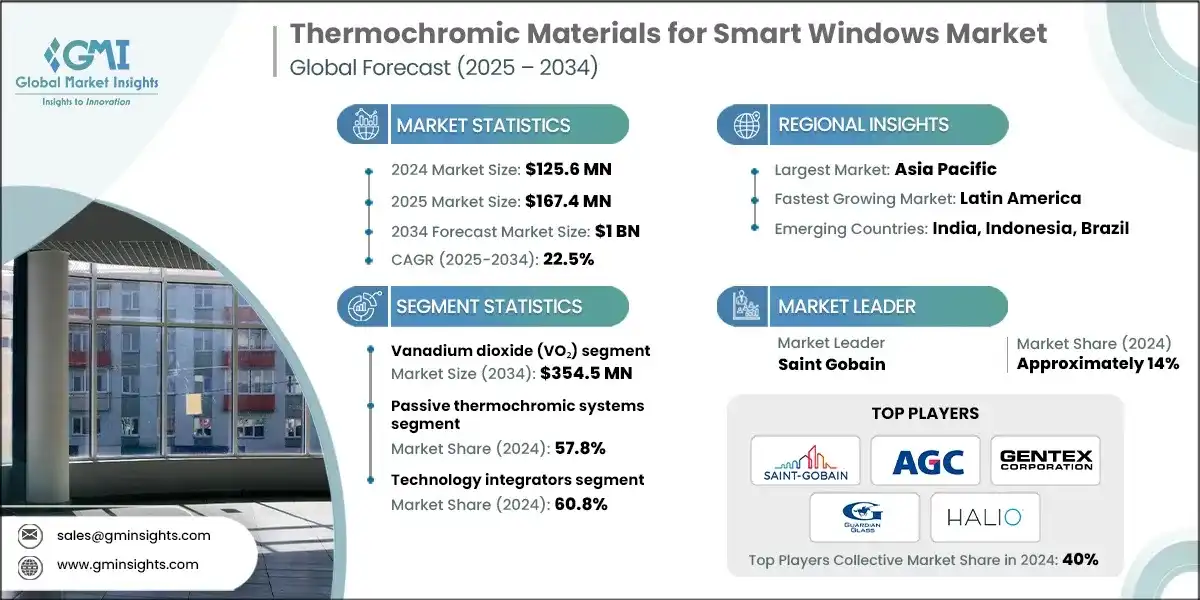
The global thermochromic materials for smart windows market was valued at USD 125.6 million in 2024. It is projected to expand from USD 167.4 million in 2025 to USD 1 billion by 2034, at a 22.5% CAGR, according to latest report published by Global Market Insights Inc. The momentum reflects tightening building-energy standards, step-change material innovations, and broader adoption of smart building platforms.
To get key market trends
Thermochromic smart windows are being integrated with IoT-enabled building automation to optimize energy performance and occupant comfort in real time; HVAC typically represents 40-60% of commercial building energy use, which heightens the value of envelope-level optimization.
Net zero energy building programs increasingly favor passive thermochromic glazing because it requires no external power; field tests show passive thermochromic windows can reduce building energy consumption by up to 20% versus conventional glazing. Additionally, Hybrid multi modal designs are maturing, combining VO2, perovskites, and electrochromic layers recent studies report as high as 87% visible transmittance alongside strong solar modulation in next gen films.
On near term dynamics, implying a sharp year over year climb attributable to code driven specifications, R&D proofs, and early hybrid deployments. The DOE analysis suggests that broad deployment could result in expected energy savings of approximately 0.6 quads (Residential) and 0.1 quads (Commercial) annually in the U.S.; a compelling macro level argument for specifying adaptive glazing in new buildings or in applications to existing buildings. In field studies, passive thermochromic glazing technologies have shown impacts of up to a 20% reduction in HVAC energy use, as compared to traditional glazing. This can hardly be overlooked as energy rates trended higher, further densifying payback periods.
By region, Asia Pacific led with market share propelled by construction volume and local manufacturing, followed by North America and Europe, each supported by building efficiency policy frameworks and established glass value chains. Because of this, the sector benefits from both top down (codes, incentives) and bottom up (occupant comfort, ESG targets) forces that reinforce the specification of advanced envelope solutions across climates. Cost down trajectories suggest 40–60% reductions by 2030 through roll to roll processing, solution deposition, and integration onto existing float glass lines, which is essential for broadening adoption into mid-market commercial and eventually residential segments.
Manufacturing capacity stood near 2.8 million m² annually in 2024 with utilization in the 45–50% band, and announced expansions point to roughly 12.5 million m² by 2028 as tier one producers add lines and integrators scale assembly for instance, Guardian’s coating investments and Halio’s platform expansion efforts. The numbers tell us capacity growth and process shifts are as central to the thesis as material science breakthroughs.
R&D intensity remains high. W doped VO2 lowering transition temperatures to the 20–25°C range and HiPIMS enabled durability to have addressed historic hurdles to mainstream use, while hydrogel films achieve up to 87% VLT with strong solar modulation, and response times near five seconds in recent lab work.
Thermochromic Materials for Smart Windows Market Report Attributes
| Key Takeaway | Details |
|---|---|
| Market Size & Growth | |
| Base Year | 2024 |
| Market Size in 2024 | USD 125.6 Million |
| Market Size in 2025 | USD 167.4 Million |
| Forecast Period 2025 - 2034 CAGR | 22.5% |
| Market Size in 2034 | USD 1 Billion |
| Key Market Trends | |
| Drivers | Impact |
| Stricter Energy Codes | Codes (IECC/ASHRAE/EPBD) elevate envelope performance baselines and pull through advanced glazing |
| Favorable Economics | Energy cost pressure + proven HVAC savings in field studies support faster paybacks |
| Material & Tech Advances | VO2/hydrogel/perovskite advances improve optics, speed, and longevity |
| Pitfalls & Challenges | Impact |
| Cost & Installation Hurdles | Upfront cost premium and install complexity slow retrofit adoption |
| Climate Performance Variability | Performance variability in extreme climates requires tailoring and protective stacks |
| Opportunities: | Impact |
| Hybrid Systems & Expanded Use | Hybrid thermochromic electrochromic + controls widen use cases across climate bands |
| Advanced Manufacturing | Roll to roll and solution processing slash costs and expand capacity |
| Market Leaders (2024) | |
| Market Leaders |
14% |
| Top Players |
Collective market share in 2024 is 40% |
| Competitive Edge |
|
| Regional Insights | |
| Largest Market | Asia Pacific |
| Fastest growing market | Latin America |
| Emerging countries | India, Indonesia, Brazil |
| Future outlook |
|
What are the growth opportunities in this market?
Thermochromic Materials for Smart Windows Market Trends
- IoT integration and building automation synchronization. Thermochromic smart windows are increasingly tied into BMS platforms that anticipate weather, occupancy, and real time price signals, then precondition spaces by modulating solar gain. Take Amsterdam’s The Edge integrated smart glass, and advanced controls produced a reported 28% better energy performance versus conventional smart glass baselines, pointing to the upside of predictive control when envelope and systems talk to each other.
- In tropical contexts like Singapore’s Marina Bay district, projects show 22% HVAC energy reductions when predictive control aligns tinting with diurnal weather patterns, underscoring how climate aware logic amplifies passive thermochromic behavior. The real driver here is orchestration: sensing, forecasting, and control algorithms convert material responsiveness into whole building outcomes. Expect adoption to step up through 2028 as major controls vendors Honeywell, Johnson Controls, Siemens produce thermochromic logic blocks and APIs for system integrators.
- Net zero energy and the rise of passive technologies. Because passive thermochromic glazing doesn’t draw power, it aligns neatly with NZEB requirements and certification regimes. U.S. energy codes (IECC 2021) and ASHRAE 90.1 push higher envelope performance, while Europe’s EPBD anchors nearly zero energy standards each creates a structural pull for adaptive glazing that maintains comfort without active energy input.
- Hybrid systems and multi modal switching. R&D is pushing beyond single mode thermochromics toward triband and multi modal stacks that pair thermochromic layers with electrochromic switching or radiative cooling functions. Recent lab results show films approaching ~92% solar modulation in optimized hybrids, with tunable response speeds and manual override when needed useful in mission critical spaces. Commercial development is accelerating: Kinestral’s Halio platform demonstrates thermochromic electrochromic combinations under unified software control, while ChromoGenics adapts hybrid stacks for Nordic climates where heating seasons dominate. Timeline wise, expect hybrid offerings to scale through 2026–2029 as cost curves improve and installers gain field experience.
- Advanced material development. VO2 is benefitting from W doping to push transition temperatures into the 20–25°C window ideal for temperate markets, while HiPIMS deposition improves microstructure and extends life; hydrogel based films are hitting up to 87% VLT with high solar modulation and five second response times in lab conditions two improvements that answer historical clarity and speed critiques.
Thermochromic Materials for Smart Windows Market Analysis
Learn more about the key segments shaping this market
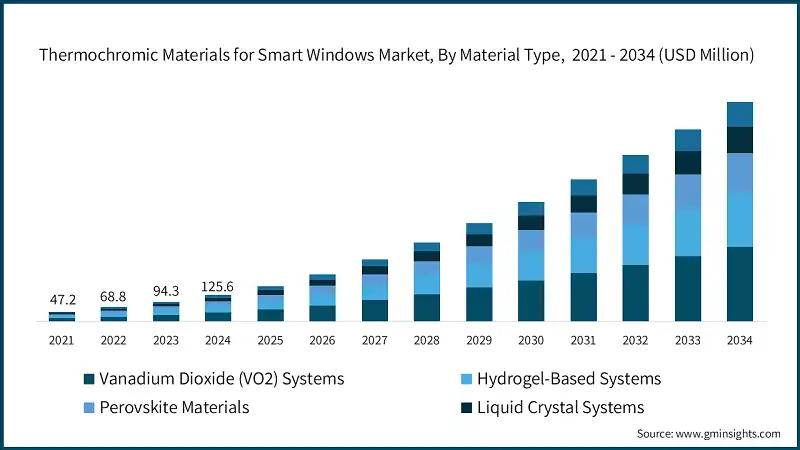
Based on material type, the market is divided into vanadium dioxide (VO2) systems, hydrogel-based systems, perovskite materials, liquid crystal systems, organic dye systems. Vanadium dioxide (VO2) segment generated a revenue of USD 43.7 million in 2024 and USD 354.5 Million in 2034 at a CAGR of 22.3%.
- The base VO2 metal insulator transition at ~68°C can be tuned down via tungsten, molybdenum, or fluorine, recent W doped films demonstrate transition temperatures as low as ~22°C in scalable processes, which materially broadens addressable geographies. HiPIMS and related sputter techniques are improving density and adhesion, with service life projections extending into the multi decade range under standard exposure regimes.
- Hydrogel based systems accounted for roughly 24.9% in 2024 and tracked a 22.4% CAGR outlook, driven by compatibility with conventional coating equipment and high visible transmittance recent papers report up to ~87% VLT while maintaining strong modulation, plus response times as low as five seconds via optimized polymer chain entanglement.
- Perovskites held about 16.4% with the fastest trajectory (23.7% CAGR) given tunable optics and solution processing conducive to roll to roll liquid crystal and organic dye systems round out the mix with ~12.8% and ~11.1%, respectively, capitalizing on mature supply chains and simpler chemistries.
Based on product form, the thermochromic materials for smart windows market is divided into thin film coatings, laminated interlayers, retrofit films, and complete window systems. The market leader in this category is the thin film coatings segment, attributed to its ability to provide a highly flexible, cost-effective, and superior optical performance
- Thin film coatings permit the application of thermochromic materials, applied uniformly over a large glass surface, with transparency and thermal responsivity. The integration of thin film coatings and processed glazing on an industrial scale supports widespread adoption in architectural and commercial projects as well.
- The innovation of nano-engineered thin films has resulted in massive improvements in the durability, color stability, and switching speed of the performance concerns previously integrated with thin film coatings. Thin film coatings are economically favorable, as they can be produced, compared to laminates or dispersed particle systems, and valued for their use in retrofits and new builds. The thin film coating segment continues to grow globally in smart window installations, given their compatibility with double and triple-pane insulated glass units (IGUs).
Based on technology & control, the thermochromic materials for smart windows market is divided into thin passive thermochromic systems, active thermochromic systems, and hybrid systems. Passive thermochromic systems represented about 57.8% in 2024 with ~22.4% CAGR as no power operation and low maintenance appeal dovetail with NZEB strategies field studies show 15–25% HVAC energy savings when specified appropriately, which resonates with owner operators under energy cost pressure.
- Active thermochromic formats (electrically assisted/manual override) made up ~24.8% and are attractive in Class A offices and institutional projects that need precise environmental control and BMS programmability.
- Hybrid architectures thermochromic electrochromic or thermochromic photovoltaic are the fastest risers at ~17.5% share and ~23.6% CAGR as they combine autonomous switching with on demand control and, in some designs, energy generation.
Learn more about the key segments shaping this market
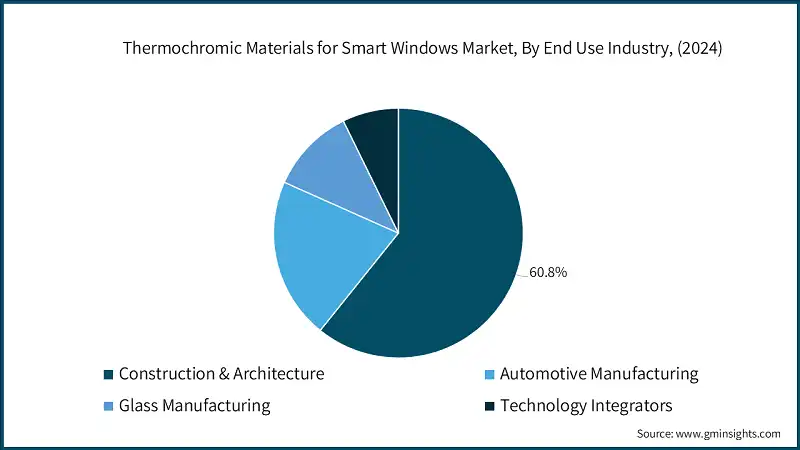
Based on end use industry, the thermochromic materials for smart windows market is divided into construction & architecture, automotive manufacturing, glass manufacturing, and technology integrators.
- The Construction & Architecture sector maintains the largest market share in the "By End Use Industry" section, a development attributed to several complementary forces. Three are accelerating the adoption of eco-sustainable building design: the increased need for energy efficient buildings, an expanded acceptance of green certifications, and muting design features that promote materials as part of the modern aesthetic of architectural design.
- Smart materials, for example, windows with thermochromic technology, provide responsive solar control, resulting in lower energy loads for HVAC systems, as well as decreased operating costs.
- Recent trends also demonstrate increasing usage patterns, including arrangements for thermochromic glazing, smart window designs, in high-performing facades, zero-energy buildings (ZEBs), and Leadership in Energy and Environmental Design (LEED) accredited interest. Color-neutral thermochromic films that produce superior aesthetic clarity, and which retain superior insulation performance are now transitioning toward acceptance in marketplaces.
Looking for region specific data?
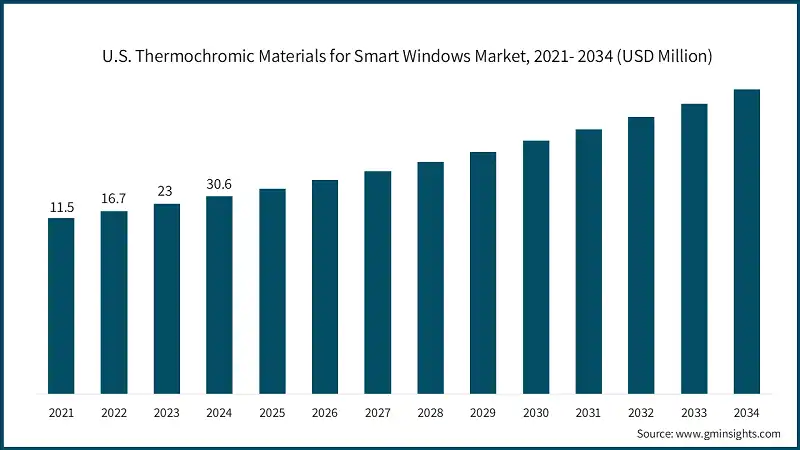
- North America’s thermochromic materials for smart windows market continues to scale on the back of IECC 2021 and ASHRAE 90.1 envelope requirements, with California’s Title 24 accelerating adoption in the U.S. and complementary codes in Canada aligning with net zero 2050 commitments. The U.S. market benefits from robust BMS/IoT adoption and a deep contractor base familiar with high performance glazing.
- Europe thermochromic materials for smart windows industry is driven by the EU’s EPBD, the Green Deal, and country level schemes that prioritize building decarbonization, Germany, the UK, France, Italy, and Spain show rising specifications in offices, airports, and public buildings.
- Asia Pacific thermochromic materials for smart windows market leads globally on construction volume, policy support, and manufacturing depth; the China market anchors regional demand, with Japan pushing innovation and code compliance, and India emerging on the back of smart city programs and high solar intensity.
- Adoption in Latin America is growing modestly, primarily in Brazil, Mexico, and Chile, where urban population growth and climate emergency building practices are surfacing. Despite limited large-scale adoption to this point, burgeoning energy efficiency and heat-harvesting awareness has driven architecture firms and builders to explore smarter façade materials, particularly in warmer climates. Notably, some private sector investments into ultra-class A commercial real estate, and resorts, are incorporating thermochromic glazing for occupant comfort in the tropics. Brazil's Energisa effort, and Mexico's energy efficiency inclusion in its National Development Plan, suggests that there will slowly be a regulatory shift toward smart infrastructure and eventually a vision for thermochromics.
- Thermochromic smart windows represent a specific opportunity for the Middle East and Africa (MEA) region due to their extreme climatic conditions and solar input. The UAE, Saudi Arabia, and Qatar lead the region with high-end commercial and institutional developments already embracing sustainable architecture.
Thermochromic Materials for Smart Windows Market Share
The market remains moderately fragmented, with the top five suppliers accounting for roughly 40% combined share in 2024 as established glass majors compete alongside specialized smart glass and materials innovators. Saint Gobain leads on installed base and integrated platform depth SageGlass’ portfolio of electrochromic systems is now paired with advances that reduce tint coloration (e.g., RealTone), and the organization’s footprint enables regional customization and cost control.
AGC Inc. follows, leveraging deep automotive and building channels and active work on VO2/hybrid stacks and sunroof applications for EVs that show 10–15% cabin control efficiency gains in testing. Gentex builds on electrochromic mirror expertise to move into cost focused smart glazing formats for residential and light commercial pilots, while Guardian Glass leverages a global float network and coating know how to bring thermochromic layers into established production flows.
Market concentration is likely to rise as capacity scales and cost curves favor vertically integrated players with software enabled controls. Expect partnership and M&A activity to focus on materials IP (VO2, hydrogels, perovskites), scalable deposition (roll to roll, solution processing), and building automation integration. On the flip side, emerging specialists can still win by focusing on climate specific performance, retrofit friendly retrofit films, and turnkey project delivery with performance guarantees.
Thermochromic Materials for Smart Windows Market Companies
Major players operating in the thermochromic materials for smart windows industry are:
- AGC Inc.
- Saint-Gobain S.A.
- PPG Industries Inc.
- Guardian Glass LLC
- View Inc.
- Nippon Sheet Glass Co. Ltd.
- Gentex Corporation
- ChromoGenics AB
- Halio Inc.
- Kinestral Technologies
- Saint Gobain: Has vertically integrated glass substrates, coating and systems, and provide project delivery at a scale; Their RealTone product responds to color rendering issues in electrochromics and expands the uses cases into high-end architecture.
- AGC Inc.: With a solid foothold in the automotive and building markets, they are developing thermochromic sunroofs for EVs, with the aim of improving the energy efficiency of the cabin while driving; They are also proceeding with research under the umbrella of VO2/hybrid research, with two universities in Japan.
- Gentex Corporation: Utilizes automotive EC experience in the prototyping of thermochromic residential windows that include IoT controls; there is a focus on manufacturability and cost for broad scale adoption.
- Guardian Glass: Investing in the coatings supply chain globally and integrating with float line production to provide thermochromic products at a lower cost in building projects.
- ChromoGenics AB: ConverLight products are specifically tuned to the Nordic climate; field tests in Sweden indicate the heating season energy savings achieved in commercial stock.
Thermochromic Materials for Smart Windows Industry News
- In Feb 2025, Saint Gobain launched SageGlass RealTone, eliminating the traditional blue tint while preserving performance an aesthetics milestone for premium architecture.
- In Jan 2025, Realme unveiled a thermochromic smartphone back panel, expanding public awareness of thermochromic materials beyond buildings.
- In Nov 2024, Marvin introduced a smart window and door line with voice commands and automated climate control integrating adaptive glazing.
- In Oct 2024, ACS Applied Materials & Interfaces published scalable VO2 synthesis achieving ~22°C transition via optimized W doping critical for temperate markets.
- In Sep 2024, Energy and Buildings reported hydrogel thermochromics with 5 second response times via polymer chain entanglement optimization.
- In Aug 2024, Rice University reported thermochromic polymers with 60 year estimated lifespans and rapid switching, addressing durability concerns.
The thermochromic materials for smart windows market research report includes in-depth coverage of the industry, with estimates & forecast in terms of revenue (USD Million) & volume (Tons) from 2021 to 2034, for the following segments:
Market, By Material Type
- Vanadium dioxide (vo2) systems
- Pure vo2 systems
- Tungsten-doped vo2
- Molybdenum-doped vo2
- Co-doped vo2 systems
- Core-shell vo2 nanostructures
- Hydrogel-based systems
- PNIPAM hydrogels
- HPC (hydroxypropyl cellulose) systems
- Composite hydrogels
- Physically cross-linked systems
- Chemically cross-linked systems
- Perovskite materials
- Halide perovskites
- Methylamine-switchable systems
- Hydration-responsive materials
- Liquid crystal systems
- Thermotropic liquid crystals
- Cholesteric liquid crystals
- Lc-polymer composites
- Organic dye systems
- LEUCO dyes
- SPIROPYRAN systems
- LETC (ligand exchange thermochromism) systems
Market, By Product Form
- Thin film coatings
- Sputtered films
- Solution-processed films
- CVD films
- Multilayer stacks & fabry-pérot cavities
- Laminated interlayers
- PVB (polyvinyl butyral) interlayers
- EVA (ethylene vinyl acetate) interlayers
- TPU (thermoplastic polyurethane) interlayers
- Retrofit films
- Self-adhesive films
- Static-cling films
- Liquid-applied films
- Complete window systems
- Single-glazed units
- Double-glazed IGUs
- Triple-glazed IGUs
- Vacuum-glazed units
Market, By Technology & Control
- Passive thermochromic systems
- Fixed transition temperature
- Broad-range switching
- Multi-stage switching
- Active thermochromic systems
- Electrically assisted systems
- IoT-enabled smart windows
- Sensor-controlled systems
- Hybrid systems
- Thermochromic-electrochromic
- Thermochromic-photovoltaic
- Thermochromic-photochromic
Market, By Manufacturing Process
- Vacuum-based methods
- Magnetron sputtering
- HIPIMS (high-power impulse magnetron sputtering)
- Pulsed laser deposition (PLD)
- Chemical vapor deposition (CVD)
- Atomic layer deposition (ALD)
- Solution-based methods
- Sol-gel processing
- Hydrothermal synthesis
- Spin coating
- Roll-to-roll coating
- Additive manufacturing
- Inkjet printing
- Screen printing
- 3D printing technologies
Market, By End Use Industry
- Construction & architecture
- General contractors
- Glazing contractors
- Architects & design firms
- Facility management companies
- Automotive manufacturing
- Original equipment manufacturers (OEMs)
- Tier 1 component suppliers
- Aftermarket & retrofit services
- Glass manufacturing
- Float glass manufacturers
- Coated glass manufacturers
- Laminated glass manufacturers
- Technology integrators
- Building automation system providers
- Smart home technology companies
- IoT platform providers
The above information is provided for the following regions and countries:
- North Americ
- U.S.
- Canada
- Europe
- Germany
- UK
- France
- Spain
- Italy
- Rest of Europe
- Asia Pacific
- China
- India
- Japan
- Australia
- South Korea
- Rest of Asia Pacific
- Latin America
- Brazil
- Mexico
- Argentina
- Rest of Latin America
- Middle East and Africa
- Saudi Arabia
- South Africa
- UAE
- Rest of Middle East and Africa
Frequently Asked Question(FAQ) :
What is the growth outlook for hydrogel-based systems from 2025 to 2034?
Hydrogel-based systems are projected to grow at a 22.4% CAGR through 2034, supported by compatibility with existing coating infrastructure and superior optical clarity, achieving up to 87% visible light transmittance (VLT) in recent studies.
What share did passive thermochromic systems hold in 2024?
The passive thermochromic systems segment accounted for 57.8% share in 2024, expanding at a 22.4% CAGR.
What is the market size of the U.S. thermochromic materials for smart windows market in 2024?
The market size was USD 30.6 million in 2024, driven by increasing adoption of energy-efficient glazing and the implementation of advanced building codes promoting sustainable construction practices.
Who are the key players in the thermochromic materials for smart windows industry?
Key players include Saint-Gobain S.A., AGC Inc., Guardian Glass LLC, Gentex Corporation, Halio Inc., Kinestral Technologies, PPG Industries Inc., ChromoGenics AB, Nippon Sheet Glass Co. Ltd., and View Inc.
What are the emerging trends in the thermochromic materials for smart windows market?
Key trends include IoT-enabled building automation, hybrid thermochromic–electrochromic systems, roll-to-roll manufacturing for cost reduction, and W-doped VO₂ and hydrogel innovations achieving faster response times and higher transparency for smart glazing.
What is the projected value of the thermochromic materials for smart windows market by 2034?
The market size for thermochromic materials for smart windows is expected to reach USD 1 billion by 2034, fueled by energy-efficient construction, hybrid material adoption, and broader use in commercial and residential buildings aligned with net-zero energy goals.
Which material segment dominated the thermochromic materials for smart windows market in 2024?
The vanadium dioxide (VO₂) systems segment led the market with a revenue of USD 43.7 million in 2024, driven by its tunable transition temperature, scalability through HiPIMS coating, and strong energy modulation capabilities.
What is the market size of the thermochromic materials for smart windows industry in 2024?
The market size was USD 125.6 million in 2024, with a CAGR of 22.5% expected through 2034, driven by tightening building-energy standards, rapid material innovations, and integration of smart glazing into automated building systems.
What is the current thermochromic materials for smart windows market size in 2025?
The market size is projected to reach USD 167.4 million in 2025.
Thermochromic Materials for Smart Windows Market Scope
Related Reports