Summary
Table of Content

Temperature Sensor Market
Get a free sample of this report
Form submitted successfully!
Error submitting form. Please try again.
Thank you!
Your inquiry has been received. Our team will reach out to you with the required details via email. To ensure that you don't miss their response, kindly remember to check your spam folder as well!
Request Sectional Data
Thank you!
Your inquiry has been received. Our team will reach out to you with the required details via email. To ensure that you don't miss their response, kindly remember to check your spam folder as well!
Form submitted successfully!
Error submitting form. Please try again.
Temperature Sensors Market Size
The growth of the temperature sensors market is attributed to automotive electrification and advanced thermal management systems, Growth of industrial automation and industry 4.0, Expansion of consumer electronics and IoT devices, and rising deployment of renewable energy and smart grids.
Temperature Sensor Market Key Takeaways
Market Size & Growth
- 2025 Market Size: USD 8.2 Billion
- 2026 Market Size: USD 9 Billion
- 2035 Forecast Market Size: USD 16.5 Billion
- CAGR (2026–2035): 7%
Regional Dominance
- Largest Market: Asia Pacific
- Fastest Growing Region: Asia Pacific
Key Market Drivers
- Automotive electrification and advanced thermal management systems.
- Growth of industrial automation and Industry 4.0.
- Expansion of consumer electronics and IoT devices.
- Stringent safety and quality regulations in healthcare and food.
- Rising deployment of renewable energy and smart grids.
Challenges
- Price pressure and sensor commoditization.
- Performance and reliability challenges in harsh environments.
Opportunity
- Adoption of wireless and smart temperature sensors.
- Increasing thermal monitoring needs in data centers and high-performance electronics.
Key Players
- Market Leader: · Honeywell International Inc. led with over 8.5% market share in 2025.
- Leading Players: Top 5 players in this market include Honeywell International Inc., Texas Instruments Incorporated, Analog Devices, Inc., STMicroelectronics, Robert Bosch GmbH., which collectively held a market share of 34.6% in 2025.
Get Market Insights & Growth Opportunities
The growing adoption of electric vehicles is fueling the demand for sophisticated temperature sensors in battery thermal management, power electronics, and cabin climate control systems. According to the IEA, more than 17 million EVs sold worldwide in 2024, a 25% increase from 2023, made up 20% of total car sales. As EVs requires accurate thermal management for efficiency, safety, and battery life, manufacturers are increasingly incorporating high-accuracy temperature sensors, thereby propelling the market growth in the automotive sector.
The growing demand for smartphones, wearables, and IoT-enabled devices is driving the requirement for compact and low-power temperature sensors. According to Statista, the third quarter of 2025 saw a total of 333.7 million smartphones shipped worldwide, which gives an indication of the adoption level. Temperature sensors are essential for ensuring the safety of devices, as well as their performance. The growing number of connected devices ensures sustained growth opportunities for manufacturers of temperature sensors.
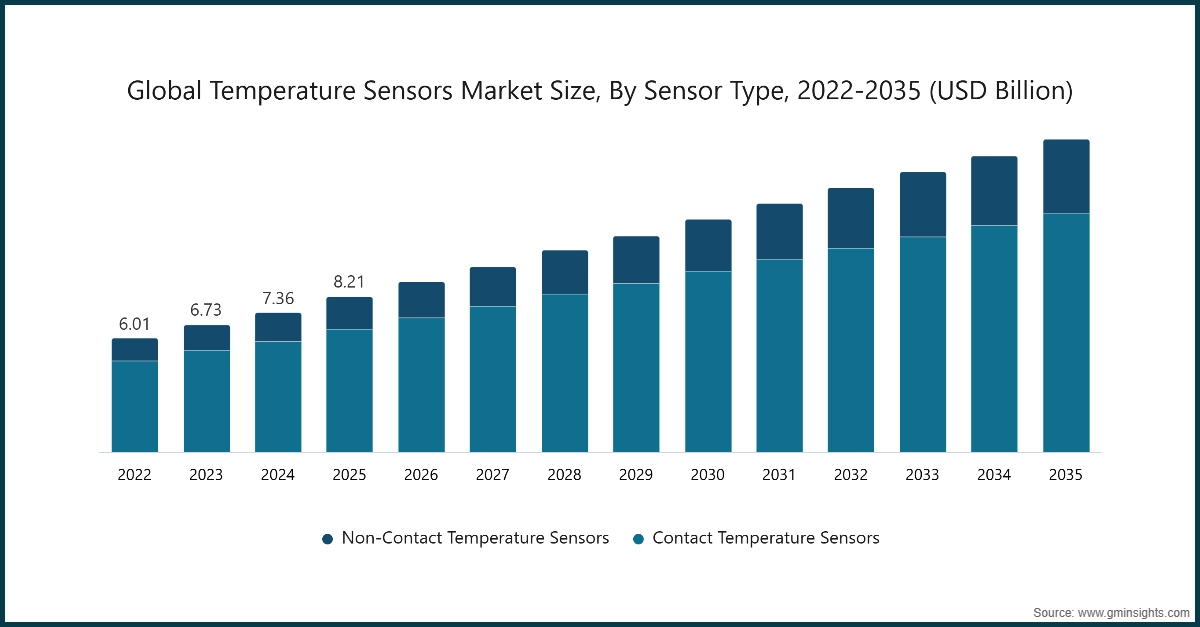
Between 2022 and 2025, the market witnessed considerable growth, increasing from USD 6 billion in 2022 to USD 8.2 billion in 2025 due to increasing industrial automation, stricter safety and quality regulations in healthcare and food processing, and rising demand for renewable energy and smart grid applications. These factors collectively boosted the adoption of temperature sensors across critical industrial and infrastructure applications.
The global temperature sensors market was valued at USD 8.2 billion with 826 million units in 2025. The market is expected to grow from USD 9 billion in 2026 to USD 13.1 billion in 2031 & USD 16.5 billion in 2035 and 1.4 billion units, growing at a value CAGR of 7% during the forecast period according to the latest report published by Global Market Insights Inc.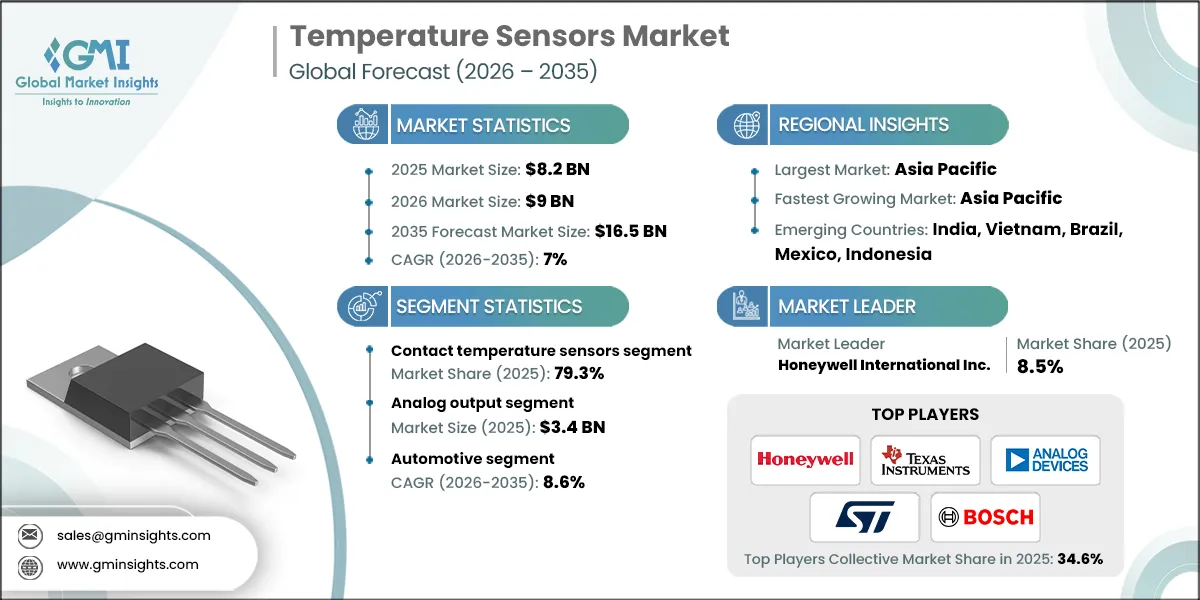
To get key market trends
Temperature Sensors Market Trends
- The temperature sensor market is increasingly merging with IoT platforms and smart connectivity solutions. This change allows real-time monitoring, predictive maintenance, and data-driven decision-making. Wireless sensors using protocols like LoRaWAN, Zigbee, NB-IoT, and 5G offer continuous temperature data for industrial automation, smart manufacturing, and building energy optimization. Studies from the U.S. Department of Energy suggest potential energy savings of 15 to 30% through smart HVAC systems. Standardized protocols from IEC ensure that different sectors can work together and expand easily.
- Advances in MEMS technology and semiconductor fabrication are driving sensors to a smaller footprint with increases in accuracy, speed, and power efficiency. Today's sensor ICs can achieve an accuracy of about ±0.1°C over wide ranges while pulling very little power. That level of performance makes it feasible to embed temperature sensing into compact consumer electronics, wearable health devices, medical implants, and automotive battery systems. New standards for calibration ensure traceable and reliable measurement for thermal management, medical diagnosis, and high-precision industrial operations.
- Medical applications are accelerating the adoption of temperature sensing, while the uses in continuous patient monitoring, vaccine cold chain management, and diagnosis continue to increase. Non-contact infrared and wearable sensors allow for early detection of fevers, reducing hospital readmissions and helping to manage chronic diseases more effectively. According to guidelines from the WHO, there is a need for continuous temperature documentation to preserve vaccine efficacy. The demand for highly precise, medically graded calibrated sensors because of regulatory standards like ISO 13485 and IEC 60601 fuels innovation for telehealth and remote monitoring in healthcare IoT solutions.
Temperature Sensors Market Analysis
Learn more about the key segments shaping this market
Based on the sensor type, the temperature sensors market is divided into contact temperature sensors, and non-contact temperature sensors.
- The contact temperature sensors segment accounted for 79.3% of the market in 2025 driven by RTDs, thermistors, thermocouples, and silicon ICs. These devices balance accuracy, cost, and durability for process control, automotive applications, and various devices. Thermocouples are essential for measuring extreme heat in metals and power generation. Modern techniques have improved their accuracy and cold-junction compensation, according to NIST references. Thermistors are common in high-volume electronics and batteries, where sensitivity and cost are key factors.
- The non-contact temperature sensors segment is anticipated to grow at a CAGR of 8.5% over the forecast period. This growth is due to rising demand in medical screening, thermal imaging for predictive maintenance, and quality control in moving or hazardous environments. The increasing need for thermal imaging, safety compliance, and fast, real-time temperature assessment boosts adoption in critical applications.
Based on the output type, the temperature sensors market is segmented into analog output sensors and digital output sensors.
- The analog output segment dominated the market in 2025 and was valued at USD 3.4 billion due to its widespread usage in industrial process control, automotive thermal management, and energy applications, where the continuous output of signals, strong noise immunity, compatibility with existing control infrastructure, and economical integration with PLCs and instrumentation remain essential.
- The digital output segment is expected to witness growth at a CAGR of 7.8% during the forecast period due to increasing applications in consumer electronics, automotive electronics, and IoT products. The reason for this growth can be associated with increasing demands for accuracy, digital calibration, ease of microcontroller interface, low power consumption, and support for communication protocols such as I²C, SPI, and 1-Wire.
Learn more about the key segments shaping this market
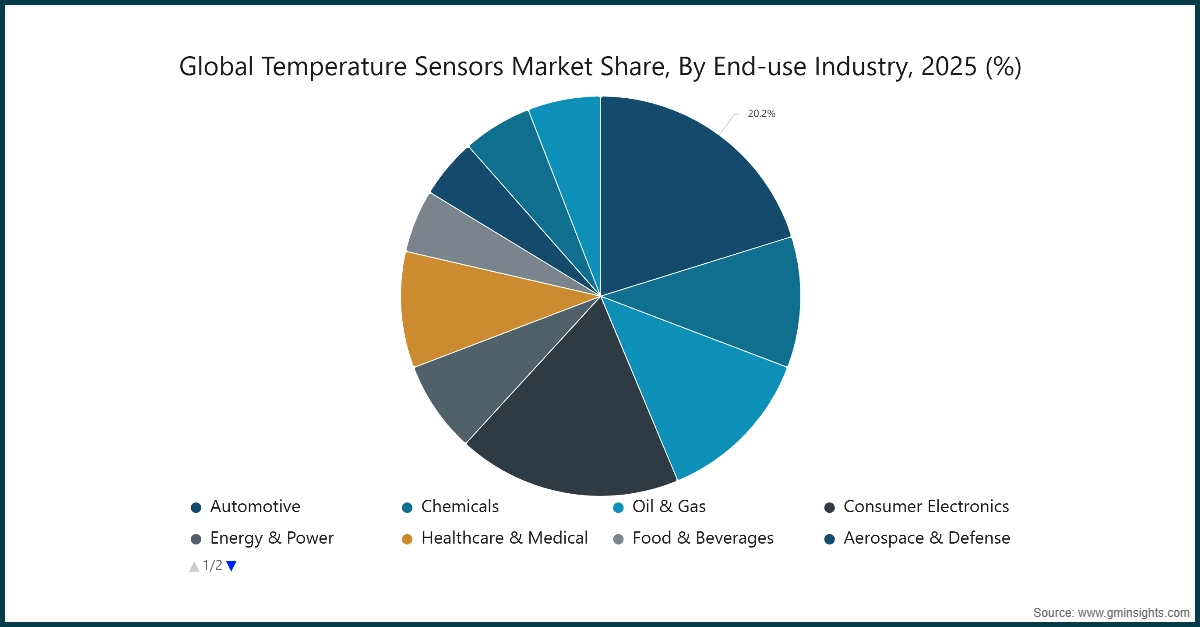
Based on the end-use industry, temperature sensors market is classified into automotive, chemicals, oil & gas, consumer electronics, energy & power, healthcare & medical, food & beverages, aerospace & defense, metals & mining, and others.
- Automotive segment is expected to grow at a CAGR of 8.6% during the forecast period. This sector dominates due to rapid electrification of vehicles, increasing adoption of advanced battery thermal management systems, stringent emission and safety regulations, and rising integration of temperature sensors in power electronics, in-cabin climate control, ADAS, and engine monitoring to ensure performance, safety, and reliability.
- The consumer electronics segment held a market share of 18.1% in 2025 driven by high-volume deployment of temperature sensors in smartphones, laptops, wearables, and smart home devices for thermal management, battery protection, and performance optimization, along with rapid product replacement cycles and increasing integration of compact, low-power sensor ICs in connected and multifunctional electronic systems.
Looking for region specific data?
North America Temperature Sensors Market
North America held a market share of 28.1% of market in 2025.
- The temperature sensor market in North America growing due to increased adoption of temperature sensors in the automobile electrical segment, the aerospace sector, and industrial automation applications in regions like North America. The rising adoption of smart manufacturing processes also leads to the increased use of advanced HVAC solutions in the market, whereas healthcare regulations have led to the growing need for accurate temperature sensors in the region.
- The region is witnessing quick adoption of wireless and IoT-enabled temperature sensors in smart buildings, data centers, and energy infrastructure. Investments in renewable energy, battery energy storage systems, and electric vehicle charging networks are also boosting demand for precise thermal monitoring to improve operational efficiency, safety, and system reliability.
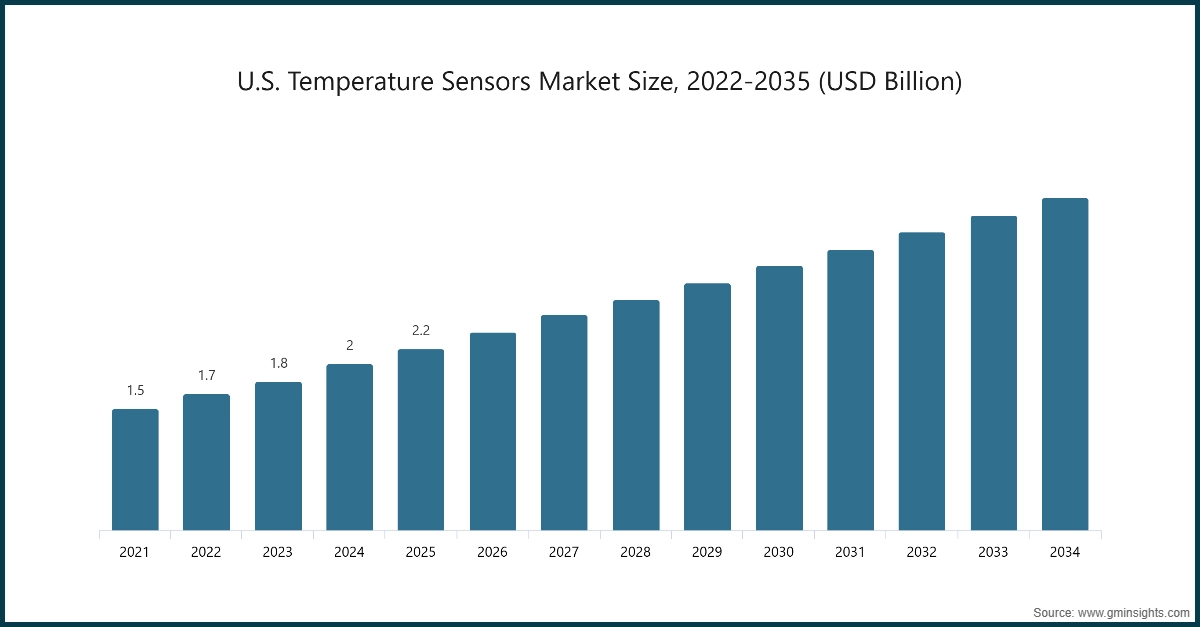
The U.S. temperature sensors market was valued at USD 1.4 billion and USD 1.7 billion in 2022 and 2023, respectively. The market size reached USD 2 billion in 2025, growing from USD 1.8 million in 2024.
- The U.S. market reflects strong demand in the electric vehicle sector, aerospace, and process control. The initiatives undertaken by the government in smart manufacturing, smart grid development, and semiconductor manufacturing are adding impetus to the adoption of high-performance temperature sensors for battery management in electric vehicles and power conversion in smart factories.
- Growth is further supported by rising deployment of temperature sensors in healthcare devices, pharmaceutical cold chains, and data centers. Increasing use of AI-driven thermal management and predictive maintenance solutions is boosting demand for digitally calibrated, networked, and high-reliability sensors in mission-critical applications.
Europe Temperature Sensors Market
Europe temperature sensors accounted for USD 1.9 billion in 2025 and is anticipated to show lucrative growth over the forecast period.
- Europe’s market is supported by strict environmental rules, increasing automotive electrification, and growing renewable energy capacity. The rise of Industry 4.0 practices in manufacturing is driving the need for precise and compatible temperature monitoring systems. These systems help improve process efficiency, energy use, and meet regulatory requirements.
- There is an increasing application of temperature sensors in smart buildings, district heating networks, and pharmaceutical manufacturing. The focus on sustainability and energy efficiency is speeding up the use of better thermal management solutions in transportation, industrial automation, and healthcare facilities.
Germany dominates the Europe temperature sensors market, showcasing strong growth potential.
- The German market is fueled by the strong German automobile and manufacturing sectors. The application and adoption of temperature sensors can be increasingly seen in electric powertrains, batteries, and factory automation. The German Industry 4.0 leadership promotes precise and digitally networked temperature sensors for process monitoring and control in real-time.
- The increasing investments in renewable energy sources, hydrogen infrastructure networks, and smart grids are driving the growing requirement for robust thermal measurement. The strict standards for quality and safety in manufacturing and medical industries are constantly increasing the adoption of accurate temperature sensors.
Asia Pacific Temperature Sensors Market
The Asia Pacific dominated the market with a market share of 37.9% in 2025.
- Asia Pacific is the fastest-growing market, driven by rapid industrial growth, increasing electronics manufacturing, and more electric vehicle production. Rising automation in factories and widespread use of consumer electronics are boosting demand for compact, affordable, and high-volume temperature sensing solutions.
- Growth is further fueled by investments in renewable sources, smart cities, and data centers in leading countries such as China, Japan, South Korea, and India. The trend for IoT-enabled and wireless temperature sensors is growing at an increasingly rapid pace to enable energy, infrastructure, and smart manufacturing.
China temperature sensors market is estimated to grow with a significant CAGR, in the Asia Pacific market.
- The growth of China's market is driven by the mass production of EVs, batteries, and consumer electronics. The initiatives implemented by the Chinese government to promote semiconductor independence and smart manufacturing are driving the demand for locally made temperature sensors with precise temperature measurement.
- The rapid growth of renewable energy, ultra-high-voltage transmission networks, and data centers is raising the need for improved thermal monitoring. Integrating temperature sensors into industrial IoT platforms is also enhancing growth in the energy, transportation, and electronics sectors.
Latin American Temperature Sensors Market
Brazil leads the Latin American market, exhibiting significant growth during the 2026-2034.
- In Brazil's fast-growing market, automotive manufacturing, food processing, and energy infrastructure have been in growth. With the increase in automation at the factories and also because of the strict rules in pharmaceuticals and cold chain quality, the needs for reliable and cost-effective temperature monitoring solutions have increased.
- Investments in renewable energy, particularly solar and wind, along with modernization of power grids, are creating new opportunities for temperature sensors in thermal management and asset protection. Rising use of digital and wireless sensors is improving monitoring efficiency across industrial and utility sectors.
Middle East and Africa Temperature Sensors Market
UAE market to experience substantial growth in the Middle East and Africa market.
- The UAE market is driven by large investments in smart buildings, data centers, and energy infrastructure. With oil and gas companies expanding their operations and district cooling and HVAC systems being adopted commonly, there is thus a growing requirement for accurate and real-time temperature measurement solutions.
- The country’s focus on smart city development, renewable energy, and advanced healthcare facilities is further accelerating deployment of IoT-enabled and wireless temperature sensors. Emphasis on operational efficiency, safety, and sustainability is supporting sustained adoption across critical infrastructure projects.
Temperature Sensors Market Share
Major players operating in the temperature sensor industry include Honeywell International, Texas Instruments, Analog Devices, STM Microelectronics, and Robert Bosch. They collectively represented just about 34.6% of the market share in 2025. Their success derives from a portfolio that encompasses a range of temperature sensor products and applications, including analog and digital temperature sensors, contact and non-contact sensors, and automotive, industrial, aerospace, healthcare, and consumer applications. By emphasizing high levels of precision, robust performance, and durability, they lead other industry players.
These companies gain an edge by consistently investing in research and development, miniaturization, and advanced sensor ICs for precision and low-power performance. They provide integrated solutions in thermal management solutions, battery monitoring solutions, and industrial automation solutions. Their strong customer base, scalable manufacturing capacity in global locations, and focus on emerging and high-growth markets such as electric vehicles, Internet of Things, and renewable energy, further sustains their leadership position in the market.
Temperature Sensors Market Companies
Prominent players operating in the temperature sensors industry are as mentioned below:
- AMETEK.Inc.
- Amphenol Corporation
- ams-OSRAM AG.
- Analog Devices, Inc.
- E+E Elektronik Ges.m.b.H.
- Emerson Electric Co.
- Honeywell International Inc.
- Microchip Technology Inc.
- Murata Manufacturing Co., Ltd.
- NXP Semiconductors
- OMEGA Engineering inc.
- Robert Bosch GmbH.
- Semiconductor Components Industries, LLC
- SICK AG
- Siemens AG
- STMicroelectronics
- TE Connectivity
- Texas Instruments Incorporated
- Vishay Intertechnology, Inc.
Texas Instruments: Texas Instruments offers a wide range of analog and digital temperature sensors for automotive, industrial, and consumer electronics markets. Its advantage comes from superior IC design, low-power, high-accuracy sensors, and compatibility with microcontrollers and embedded systems. This allows for smooth integration in smart devices and automation solutions.
Honeywell International Inc.: Honeywell is a leading provider of temperature sensors in industrial, automotive, aerospace, and healthcare fields. The company uses reliable designs, a wide range of sensors, and global manufacturing to provide precise sensing solutions. Its strength comes from integrated thermal management systems, flexible production, and strong customer relationships in essential applications.
Analog Devices, Inc.: Analog Devices concentrate their development of temperature sensors with advanced signal processing abilities. Their product development targets aerospace, industry, healthcare, and vehicles. Their emphasis lies on low power dissipation and robust designs for those highly stressful applications.
STMicroelectronics: STMicroelectronics offers compact, low-power, and very accurate IC-based temperature sensors for automotive, industrial, and consumer applications. The company excels at integrating with microcontrollers, creating energy-efficient designs, and maintaining strong global distribution channels, which support high-volume deployment in both new and established markets.
Robert Bosch GmbH: Bosch specializes in automotive-grade and industrial temperature sensors, especially for electric vehicles, engine systems, and factory automation. Its competitive edge comes from strong engineering skills, reliable products, extensive global manufacturing, and a growing role in smart mobility and industrial IoT applications.
Temperature Sensor Market Report Attributes
| Key Takeaway | Details |
|---|---|
| Market Size & Growth | |
| Base Year | 2025 |
| Market Size in 2025 | USD 8.2 Billion |
| Market Size in 2026 | USD 9 Billion |
| Forecast Period 2026-2035 CAGR | 7% |
| Market Size in 2035 | USD 16.5 Billion |
| Key Market Trends | |
| Drivers | Impact |
| Automotive electrification and advanced thermal management systems | Drives 21% growth as EV adoption accelerates, increasing demand for high-accuracy sensors in battery management, power electronics, and in-cabin thermal monitoring. |
| Growth of industrial automation and Industry 4.0 | Supports 19% growth through deployment in process control, predictive maintenance, and smart manufacturing applications across factories and production lines. |
| Expansion of consumer electronics and IoT devices | Contributes 22% growth as smartphones, wearables, and connected devices require compact, low-power temperature sensors for thermal management and safety. |
| Stringent safety and quality regulations in healthcare and food | Adds 18% growth due to mandatory monitoring in medical devices, diagnostics, pharmaceuticals, and food processing, ensuring compliance with regulatory standards. |
| Rising deployment of renewable energy and smart grids | Accounts for 20% growth as temperature sensors enable efficient thermal management in power electronics, energy storage, and grid infrastructure. |
| Pitfalls & Challenges | Impact |
| Price pressure and sensor commoditization | Restrains market growth as intense competition drives down ASPs, limiting revenue expansion for sensor manufacturers. |
| Performance and reliability challenges in harsh environments | Limits growth due to higher calibration, maintenance costs, and durability issues in extreme industrial, automotive, and energy applications. |
| Opportunities: | Impact |
| Adoption of wireless and smart temperature sensors | Contributes 18% growth by enabling IIoT, remote monitoring, and smart building applications. |
| Increasing thermal monitoring needs in data centers and high-performance electronics | Adds 17% growth as precision sensors support cooling, energy efficiency, and system reliability. |
| Market Leaders (2025) | |
| Market Leader |
8.5% market share |
| Top Players |
Collective Market Share of 34.6% in 2025 |
| Competitive Edge |
|
| Regional Insights | |
| Largest Market | Asia Pacific |
| Fastest growing market | Asia Pacific |
| Emerging countries | India, Vietnam, Brazil, Mexico, Indonesia |
| Future outlook |
|
What are the growth opportunities in this market?
Temperature Sensors Industry News
- In December 2025, Sensirion launched the SHT40-AD1P-R2 and SHT41-AD1P-R2 digital humidity and temperature sensors. These sensors feature high accuracy (±1.8% RH and ±0.2°C), a removable protective cover for durability, and I2C interface for easy integration in industrial and consumer applications.
- In May 2025, Enless Wireless announced its LoRaWAN black bulb temperature sensor. This sensor optimizes HVAC control by detecting solar radiation effects early, enabling zone-based comfort adjustments and energy savings in commercial or industrial settings.
- In January 2025, Emerson launched the AVENTICS DS1 dew point sensor. This industrial sensor uniquely monitors dew point, temperature, humidity levels, and compressed air quality in real time from a single device.
The temperature sensors market research report includes in-depth coverage of the industry with estimates and forecast in terms of revenue (USD Million) and volume (Units) from 2022 – 2035 for the following segments:
Market, By Sensor Type
- Contact temperature sensors
- Thermocouples
- Resistance Temperature Detectors (RTDs)
- Thermistors
- Semiconductor/IC temperature sensors
- Non-contact temperature sensors
- Infrared (IR) temperature sensors
- Fiber Optic temperature sensors
Market, By Output Type
- Analog output sensors
- Digital output sensors
Market, By Connectivity
- Wired
- Wireless
Market, By End-use Industry
- Automotive
- Chemicals
- Oil & gas
- Consumer electronics
- Energy & power
- Healthcare & medical
- Food & beverages
- Aerospace & defense
- Metals & mining
- Others
The above information is provided for the following regions and countries:
- North America
- U.S.
- Canada
- Europe
- Germany
- UK
- France
- Spain
- Italy
- Netherlands
- Asia Pacific
- China
- India
- Japan
- Australia
- South Korea
- Latin America
- Brazil
- Mexico
- Argentina
- Middle East and Africa
- South Africa
- Saudi Arabia
- UAE
Frequently Asked Question(FAQ) :
What was the market size of the temperature sensors in 2025?
The market size was valued at USD 8.2 billion in 2025, growing at a CAGR of 7% during the forecast period. The market is driven by advancements in automotive electrification, industrial automation, and the expansion of IoT devices and renewable energy systems.
What is the projected value of the temperature sensors market by 2035?
The market is poised to reach USD 16.5 billion by 2035, fueled by innovations in MEMS technology, semiconductor fabrication, and increasing adoption in medical and automotive applications.
What is the expected size of the temperature sensors industry in 2026?
The market size is expected to reach USD 9 billion in 2026.
What was the market share of the contact temperature sensors segment in 2025?
The contact temperature sensors segment accounted for 79.3% of the market in 2025, led by the widespread use of RTDs, thermistors, thermocouples, and silicon ICs in process control, automotive, and industrial applications.
What was the valuation of the analog output segment in 2025?
The analog output segment was valued at USD 3.4 billion in 2025, owing to its extensive use in industrial process control, automotive thermal management, and energy applications.
What is the growth outlook for the automotive segment during the forecast period?
The automotive segment is expected to grow at a CAGR of 8.6% till 2035.
Which region held the largest market share in 2025?
North America held a 28.1% market share in 2025, supported by the adoption of temperature sensors in automotive electrical systems, aerospace, industrial automation, and healthcare applications.
What are the upcoming trends in the temperature sensors market?
Key trends include IoT-enabled temperature sensors, advances in MEMS technology, growing use in medical cold-chain management, and smart HVAC systems for energy optimization.
Who are the key players in the temperature sensors industry?
Prominent players include AMETEK.Inc., Amphenol Corporation, ams-OSRAM AG., Analog Devices, Inc., E+E Elektronik Ges.m.b.H., Emerson Electric Co., Murata Manufacturing Co., Ltd., NXP Semiconductors, and OMEGA Engineering Inc.
Temperature Sensor Market Scope
Related Reports