Summary
Table of Content

Telematics Systems Market
Get a free sample of this report
Form submitted successfully!
Error submitting form. Please try again.
Thank you!
Your inquiry has been received. Our team will reach out to you with the required details via email. To ensure that you don't miss their response, kindly remember to check your spam folder as well!
Request Sectional Data
Thank you!
Your inquiry has been received. Our team will reach out to you with the required details via email. To ensure that you don't miss their response, kindly remember to check your spam folder as well!
Form submitted successfully!
Error submitting form. Please try again.
Telematics Systems Market Size
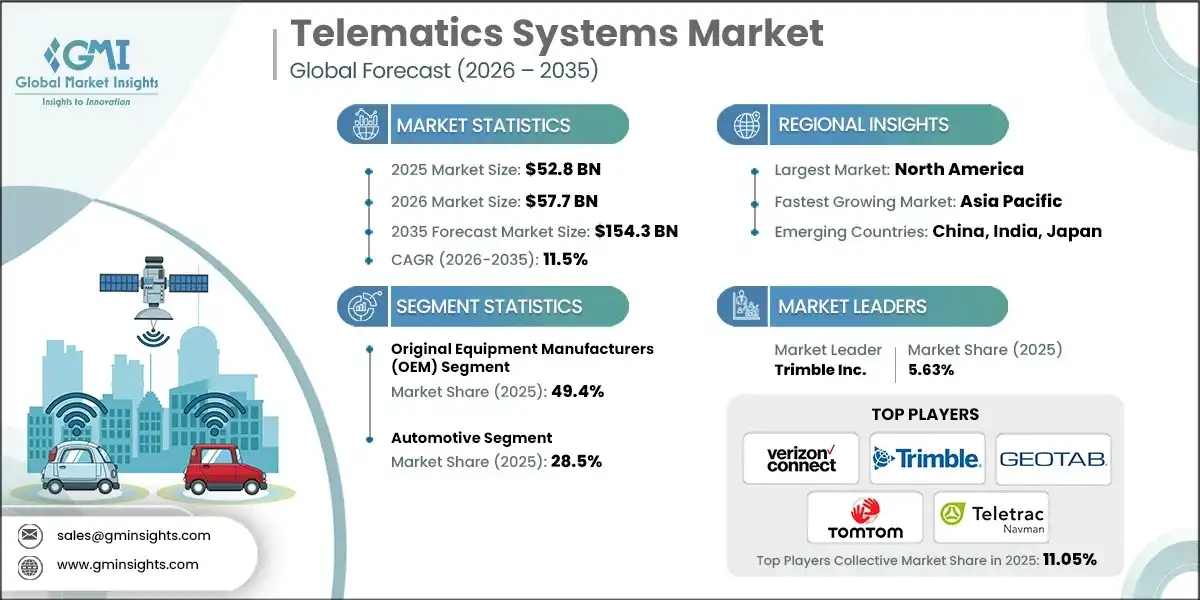
The global telematics systems market size was valued at USD 52.8 billion in 2025. The market is expected to grow from USD 57.7 billion in 2026 to USD 154.3 billion in 2035, at a CAGR of 11.5% during the forecast period according to the latest report published by Global Market Insights Inc.
Telematics Systems Market Key Takeaways
Market Size & Growth
- 2025 Market Size: USD 52.8 Billion
- 2026 Market Size: USD 57.7 Billion
- 2035 Forecast Market Size: USD 154.3 Billion
- CAGR (2026–2035): 11.5%
Key Market Drivers
- Rising Demand for Connected Vehicles.
- Increasing Demand for Fleet Management.
- Emerging Electric Vehicle Market.
- Cost Reduction and Operational Efficiency.
- Government Regulations and Safety Standards.
Challenges
- Data Security Concerns.
- High Initial Investment.
Opportunity
- Integration with Autonomous Vehicles.
- Telematics in Smart Cities.
Key Players
- Market Leader: Trimble Inc. led with over 5.63% market share in 2025.
- Leading Players: Top 5 players in this market include Trimble Inc., Verizon Connect (Verizon Communications Inc.), Geotab Inc., TomTom International BV, Teletrac Navman, which collectively held a market share of 11.05% in 2025.
Get Market Insights & Growth Opportunities
The telematics systems market is expected to grow due to an increase in demand for connectivity through connected vehicles, fleet management solutions, the emergence of an electric vehicle market, a desire by fleets for lower costs and improved operational efficiencies, and government mandates, regulations, and safety standards.
Expanding demand for connected vehicles serves as one of the largest contributing factors to the expansion of the telematics systems market. Connected vehicles utilize vehicle-to-everything (V2X) technology combined with smart infrastructure technology to provide communications among vehicles/assets/devices and the surrounding environment.
According to a report by the Federal Highway Administration (FHWA), nearly USD 96.5 million in grants were awarded to 16 states to support 20 connected vehicle projects, boosting the deployment of smart transportation systems across the country and creating additional demand for telematics products and services, which include real-time vehicle communication, vehicle tracking, and improved safety. The funding will foster innovation, which will help drive growth in the telematics systems market and increase the level of telematics solutions in use.
Telematics systems are supported significantly by the rapidly growing electric vehicle market. According to The Department of Energy (DOE), U.S. manufacturers are projected to sell more than one million light-duty electric vehicles (EVs) annually by 2023, reaching historic milestone sales figures; this represents four times the number sold in 2020.
The increasing adoption rate of EVs drives additional demand for advanced telematics systems, as they can provide real time data about battery status, available charging station locations, consumption of energy, and optimization of routes. Further, as more electric vehicles are adopted, there is an increased need to have telematics systems that can support the performance of electric vehicles and improve user experience, fueling faster continuous growth in the telematics systems market.
Between 2022 and 2024, the market witnessed considerable growth, increasing from USD 41.1 billion in 2022 to USD 48.5 billion in 2024. The ELD mandate and other government regulations concerning the implementation of telematics technologies continue to fuel the demand for telematics systems by helping to ensure that fleets are compliant with current government-established safety benchmarks.
The Federal Motor Carrier Safety Administration estimates that the ELD mandate will produce over USD 1 billion annually in benefits to the trucking industry while helping to save 26 lives and 562 injuries per year through the enforcement of strict hours-of-service (HOS) regulations. Telematics systems facilitate the automation of HOS tracking and improve driver safety, thereby allowing fleets to enhance their overall efficiency and accelerate the use of telematics solutions.
To get key market trends
Telematics Systems Market Trends
- Technological advancements in IoT devices, and cloud computing are creating opportunities for greater growth within the telemetry/telematics markets globally. Real-time data transmission from IoT Devices improved the system's ability to scale; IoT devices will continue to drive this new environment.
- Forecasts from the national institute of standards and technology (NIST) national cybersecurity center of excellence, (NCCoE) indicate that there will potentially be over 75 Billion IoT devices worldwide by 2025, signifying the fast pace of the expansion of connected technology adoption, which is expected to peak in 2025 – 2026 as IoT, 5G, and more advanced telematics systems are fully integrated into many industries, such as automotive and logistics.
- The trend toward continued integration of artificial intelligence (AI) and machine learning into telematics systems has increased significantly since 2019, largely due to advances in data analytics. Companies increasingly look to take advantage of predictive maintenance, route optimization, and analyzing driver behavior to improve fleet management and reduce vehicle reliance. AI and machine learning models can be used to predict non-recurring congestion up to 30 minutes before it occurs using telematics data for proactive management, as outlined in the federal highway administration report FHWA-HRT-23-107 from the U.S. Department of Transportation.
- As a result of the global deployment of 5G networks, the development of telematics through 5G has been accelerating since 2020 due to the increasing demand for ultra-high-speed data transmission and reliability for vehicle monitoring, vehicle-to-vehicle communication, and autonomous vehicle capabilities.
- According to the federal communications commission's (FCC) broadband data collection program, around 96% of American residential and commercial locations will have mobile 5G connectivity with minimum download speeds of 7 Mbps/uploaded speed of at least 1 Mbps; while, 92% of these areas will have mobile 5G connections that exceed minimum upload/download speed requirements of 35 Mbps or greater by December of 2024. Therefore, the tremendous growth of 5G adoption is expected to peak in the years 2025 to early 2026 and will offer new technological improvements in telematics and connected vehicles.
Telematics Systems Market Analysis
Learn more about the key segments shaping this market
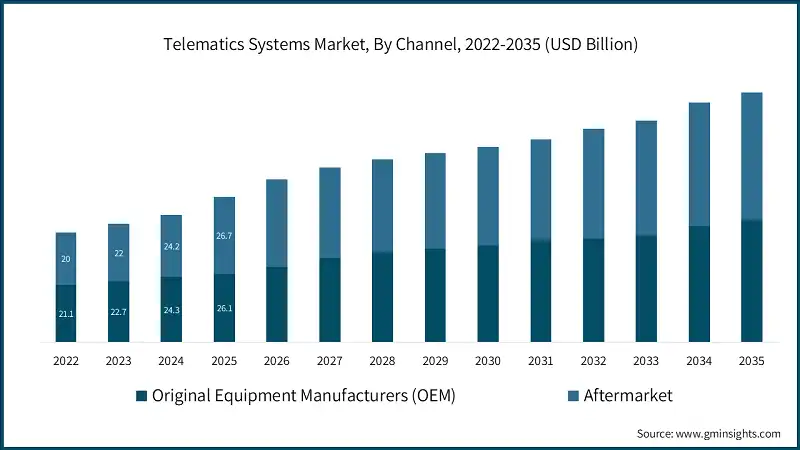
The telematics systems market was valued at USD 41.1 billion and USD 44.7 billion in 2022 and 2023, respectively. The market size reached USD 52.8 billion in 2025, growing from USD 48.5 billion in 2024.
Based on the channel, the market is divided into original equipment manufacturers (OEM), & aftermarket. The original equipment manufacturers (OEM) segment accounted for 49.4% of the market share in 2025.
- The OEMs by channel driven by multiple market drivers and trends including demand by the marketplace, advances in technology, efficient supply chains, customer preferences and overall strategic partnerships, which allow some OEMs to provide cost-effective, high-quality solutions across many different industries.
- To compete in an evolving marketplace and regulatory environment, companies must invest in developing innovative supply chains, developing customer-centric designs, investing in sustainable practices, and developing strategic partnerships to facilitate their integrations of advanced new technologies.
- The aftermarket segment was valued at USD 26.7 billion in 2025 and is anticipated to grow at a CAGR of 12.8% over the forecast years. Customers and products in the aftermarket by channel are driven by product lifecycle management (PLM) and demand for customization as well as low-cost, convenience and technological advances, along with an increased focus on online and direct-to-consumer sales.
- To remain relevant in the ever-changing marketplace and meet customer and market expectations, companies must continually improve and enhance their product quality, product supply chain agility, customization options, integrating advanced technologies and growing their online presence.
Learn more about the key segments shaping this market
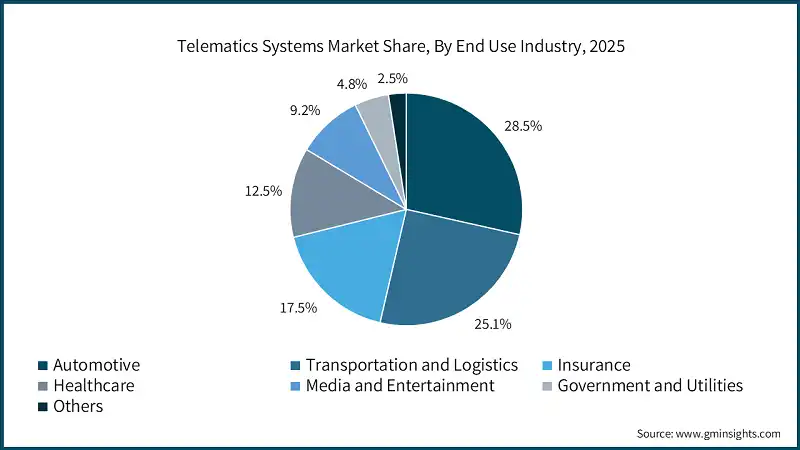
Based on the end-use industry, telematics systems market is classified into automotive, transportation and logistics, insurance, healthcare, media and entertainment, government and utilities & others. The automotive dominated the market in 2025 with a market share of 28.5%.
- The automotive sector is divided by usage based upon technological advancements related to safety; increased adoption of electric-powered automobiles; improved fuel efficiency; developing autonomous technologies; regulatory compliance; and consumer preference for desirable and sustainable driving experiences.
- Automobile manufacturers and companies engaged in the automotive sector should focus their efforts on producing electric automobiles, increasing the use of autonomous driving technology, improving fuel economy, introducing new safety features, and remaining compliant with current regulations to develop environmentally friendly consumer-based automotive products.
- The transportation and logistics segment is expected to witness growth at a CAGR of 13.5% during the forecast period. The transportation and logistics market is primarily driven by the demand for quick delivery, supply chain optimization, real-time shipment tracking, and overall improvements related to artificial intelligence and Internet of Things (IoT) technologies.
- Companies must prioritize efforts to establish optimized supply chain systems, implement predictive analytics via the integration of artificial intelligence, utilize eco-friendly solutions for the delivery of products, enhance the customer experience related to last-mile delivery, and capitalize on the cost savings and customer satisfaction resulting from increased levels of automation through enhanced efficiencies.
Looking for region specific data?
North America telematics systems market with a market share of 32.5% in 2025.
- In North America, the growth of the telematics market largely attributed to government mandated safety regulatory compliance, smart city initiatives promoting infrastructure development and enhancement, and technology-related advancements such as collision detection and autonomous driving applications.
- The combined reasons for this growth in North America include the increased growth of shared mobility services, the increasing demand for E-comm delivery services, and the requirement for fleet electrification and emission reduction goals.
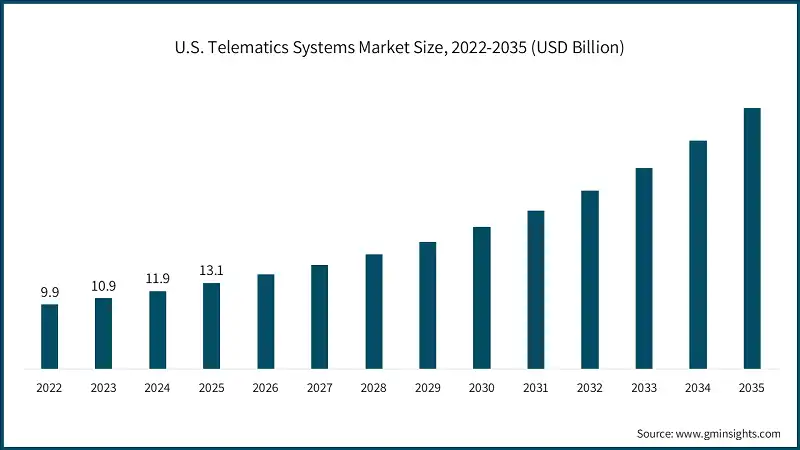
The U.S. telematics systems market was valued at USD 9.9 billion and USD 10.9 billion in 2022 and 2023, respectively. The market size reached USD 13.1 billion in 2025, growing from USD 11.9 billion in 2024.
- In The United States, the growing telematics market is being driven by the electronic logging device (ELD), the expansion of automated vehicle development, and the rising demand for fleet optimization, which improves efficiency and compliance.
- Manufacturers must focus on creating more sustainable and recyclable film solutions and incorporating automation into their production process to improve production efficiency.
Europe telematics systems market accounted for USD 11.2 billion in 2025 and is anticipated to show lucrative growth over the forecast period.
- Several factors support telematics systems in Europe, including the European Union's stringent emissions regulations, the growth of mobility as a service, and the increasing availability of infrastructure for electric vehicles. These factors drive innovation to develop and adopt telematics systems in Europe.
- Additional growth in Europe supports the EU green deal, sustainability targets, an increase in the number of advanced driver assistance systems (ADAS) being used, and an increase in cross-border fleet operations. These factors enhance both efficiency and safety.
Germany dominates the Europe telematics systems market, showcasing strong growth potential.
- Telematics is the leading edge of innovation in the supply chain sector, with the German government’s support of the development of telematic solutions for electric vehicles (EV) as well as other smart mobility products.
- Industry leaders are placing emphasis on the telematics systems and building out their product offerings that utilize telematics, as well as leveraging Germany’s leadership position in the automotive manufacturing industry to support their efforts.
The Asia Pacific telematics systems market is anticipated to grow at the highest CAGR of 13.6% during the analysis timeframe.
- The rapid growth and increasing urbanization across the Asia Pacific region, combined with government programs to promote smart city initiatives and rising growth in the middle class, driven demand for connected vehicle technology, and continue to propel the growth of telematics systems in the region.
- Factors contributing to the continued growth of telematics in the Asia Pacific region include the growth of e-commerce and logistics, increasing adoption of electric vehicles, and an increasing focus on providing consumers with safer roads.
China telematics systems market is estimated to grow with a significant CAGR, in the Asia Pacific market.
- The telematics systems market in China is growing due to government assistance in the growth of smart transportation, widespread use of electric vehicles (EVs), and the potential to significantly increase the amount of 5G infrastructure in the country which improve mobility and efficiency.
- Companies should focus on developing smart transportation solutions, integrating telematics with electric vehicles, leveraging 5G infrastructure for real-time data, and aligning with China's environmental and sustainability goals.
Brazil leads the Latin American telematics systems market, exhibiting remarkable growth during the analysis period.
- In Brazil, the increased growth of the telematics systems industry directly influenced by three main drivers include increased activity in logistics and transportation, increased demand for solutions that help manage fleet assets, and increased government support through safety and emissions tracking initiatives.
- Enhancing the use of telematics, as well as enhancing fleet management processes, such as improving fuel efficiency, and developing advanced driver assistance systems (ADAS), allow for continued growth in the logistics and transportation industry in Brazil through compliance with new regulations and increased operational demands.
South Africa telematics systems market to experience substantial growth in the Middle East and Africa market in 2025.
- In the Middle East and Africa region, South Africa holds a significant share of the telematics market due to its expanding transportation sector, growth in fleet management adoption, and an increasing demand for real-time vehicle tracking and maintenance solutions.
- In South Africa, telematics companies should focus on offering cost-effective fleet management solutions, integrating advanced tracking and diagnostics systems, and enhancing data security features to meet the growing needs of the logistics, transportation, and commercial sectors.
Telematics Systems Market Share
Trimble Inc., TomTom International BV, Verizon Connect, Geotab Inc., and Teletrac Navman are amongst the leading companies in providing the telematics systems and together they make up more than 11.05% of the market share as of 2025. All these companies are at the forefront of innovation in telematics with their use of advanced technology, including global positioning system (GPS) and real-time analysis capabilities, to provide solutions for fleet owners.
In addition, each company is in several different parts of the world, has established relationships with many customers, and collaborates with large industries, which has helped to establish them as leaders in the telematics market and sets the stage for the future.
In addition to large established companies like Trimble Inc., other smaller niche companies play an important role within the telematics systems industry. They develop solutions that target specific industries, but they also generate technological innovation by providing customized and cost-effective telematics technologies and servicing those industries.
Telematics Systems Market Companies
Prominent players operating in the telematics systems industry are as mentioned below:
- Trimble Inc.
- TomTom International BV
- Teletrac Navman
- Harman International Industries, Inc. (Samsung)
- Mix Telematics
- Octo Telematics
- Geotab Inc.
- Verizon Connect (Verizon Communications Inc.)
- PTC Inc.
- Sierra Wireless
- HERE Technologies
- Intel Corporation
- AT&T Inc.
- Robert Bosch GmbH
- Continental AG
- Trimble Inc.
Trimble Inc. focuses on GPS solutions and positioning systems. Beyond that, they are also known for easy product integration with other software, and for their industry-specific telematics (agriculture and construction). Data accuracy industry leaders are also reliable with a strong global market presence.
TomTom International BV does map and navigation and provides location-based services. They assist with fleet telematics and routing optimizations using real-time data and their navigation systems, and with partnerships with auto and logistics companies.
- Verizon Connect (Verizon Communications Inc.)
Verizon Connect applies telematics to assist their customers with more efficient fleet management. They provide real-time vehicle tracking, driving performance analysis, and cloud-based fleet telematics. Known for their telecom services, Verizon also provides fast and reliable telematics services. - Geotab Inc.
Geotab Inc. is the industry leader in open-platform telematics with the ability to provide custom data analytics, strong AI, and seamless integration with more than one third party. For transport and logistics companies, they use their technology to help optimize fleet use, streamline operations, and stay compliant with industry regulations. - Teletrac Navman
Teletrac Navman values customer satisfaction and strives to enrich the customer experience and optimize costs. They assist small to mid-range fleets globally and help enhance operational performance. Their telematics provide legally compliant telematics analytics with safety features and protection.
Telematics Systems Market Report Attributes
| Key Takeaway | Details |
|---|---|
| Market Size & Growth | |
| Base Year | 2025 |
| Market Size in 2025 | USD 52.8 Billion |
| Market Size in 2026 | USD 57.7 Billion |
| Forecast Period 2026-2035 CAGR | 11.5% |
| Market Size in 2035 | USD 154.3 Billion |
| Key Market Trends | |
| Drivers | Impact |
| Rising Demand for Connected Vehicles | Drives 28% growth as automakers increasingly integrate telematics for safety, navigation, and real-time vehicle data. |
| Increasing Demand for Fleet Management | Contributes 25% growth by optimizing vehicle performance, routes, and maintenance, benefiting logistics and transport. |
| Emerging Electric Vehicle Market | Supports 22% growth as telematics solutions enhance battery management, charging optimization, and energy efficiency. |
| Cost Reduction and Operational Efficiency | Accounts for 15% growth by helping businesses cut operational costs through route optimization, fuel monitoring, and data analysis. |
| Government Regulations and Safety Standards | Adds 10% growth as stricter regulations on vehicle safety and emissions push adoption of telematics for compliance tracking. |
| Pitfalls & Challenges | Impact |
| Data Security Concerns | Limits 20% of market growth as privacy risks, potential data breaches, and compliance issues with regulations (like GDPR) slow telematics adoption. |
| High Initial Investment | Restrains 18% of market growth as the high cost of installation, hardware, and infrastructure deters small businesses and organizations with limited budgets. |
| Opportunities: | Impact |
| Integration with Autonomous Vehicles | The integration of telematics with autonomous vehicles presents a significant opportunity for market growth. As autonomous technology advances, telematics systems will be crucial for real-time vehicle monitoring, route optimization, and data analysis. |
| Telematics in Smart Cities | As smart cities evolve, telematics systems are vital for optimizing urban transportation networks. Real-time data from vehicles and infrastructure helps manage traffic flow, reduce congestion, and improve public safety. |
| Market Leaders (2025) | |
| Market Leaders |
5.63% market share. |
| Top Players |
|
| Competitive Edge |
|
| Regional Insights | |
| Largest Market | North America |
| Fastest Growing Market | Asia Pacific |
| Emerging Country | China, India, Japan |
| Future Outlook |
|
What are the growth opportunities in this market?
Telematics Systems Industry News
- In February 2024, Rosmerta Technologies launched a driver monitoring and alert system that uses artificial intelligence for fleet operators. This system also integrates with a vehicle tracking and management system. It uses real-time data to monitor driver's safety and perform an AI analysis of driver behavior data, demonstrating the growing influence of telematics technology on improving road safety and increasing fleet management efficiency.
- In December 2023, TomTom announced a collaborative effort with Microsoft aimed at utilizing generative Artificial Intelligence (AI) to provide better in-car experiences for drivers. Using the power of Microsoft Azure, the Microsoft Azure AI Assistant enables drivers to interact with their vehicles using voice commands, enhancing their ability to navigate and control their vehicles.
- In May 2024, Ambarella announced new AI system-on-chip solutions (SoCs) CV75AX and CV72AX for fleet telematics that enhance AI performance capabilities. These SoCs support driver monitoring as well as multi-channel video capability for enhanced accuracy, efficiency and quality of images.
The telematics systems market research report includes in-depth coverage of the industry with estimates and forecast in terms of revenue in USD Million from 2022 to 2035 for the following segments:
Market, By Offering
- Hardware
- Services
Market, By Technology
- Global Positioning System (GPS)
- Cellular
- Satellite
- Wi-Fi
- Bluetooth
Market, By Vehicle Type
- Two-wheelers
- Passenger Cars
- Light Commercial Vehicles (LCVs)
- Heavy Commercial Vehicles (HCVs)
- Off-highway Vehicles
Market, By Channel
- Original Equipment Manufacturers (OEM)
- Aftermarket
Market, By Application
- Fleet Management
- Vehicle Tracking
- Satellite Navigation
- Vehicle Safety Communication
- Insurance Telematics
- Infotainment
- Remote Diagnostics
- Others
Market, By End Use Industry
- Automotive
- Transportation and Logistics
- Insurance
- Healthcare
- Media and Entertainment
- Government and Utilities
- Others
The above information is provided for the following regions and countries:
- North America
- U.S.
- Canada
- Europe
- Germany
- UK
- France
- Spain
- Italy
- Netherlands
- Asia Pacific
- China
- India
- Japan
- Australia
- South Korea
- Latin America
- Brazil
- Mexico
- Argentina
- Middle East and Africa
- South Africa
- Saudi Arabia
- UAE
Frequently Asked Question(FAQ) :
What was the market size of the telematics systems in 2025?
The market size was USD 52.8 billion in 2025, growing at a CAGR of 11.5% during the forecast period. The market is driven by increasing demand for connected vehicles, fleet management solutions, and government safety regulations.
What is the projected value of the telematics systems market by 2035?
The market is poised to reach USD 154.3 billion by 2035, fueled by advancements in IoT, 5G, and AI integration.
What is the expected size of the telematics systems industry in 2026?
The market size is projected to reach USD 57.7 billion in 2026.
What was the market share of the OEM segment in 2025?
The OEM segment accounted for 49.4% of the market share in 2025, led by technological advancements, efficient supply chains, and strategic partnerships.
What was the market share of the automotive sector in 2025?
The automotive sector dominated the market with a 28.5% share in 2025, supported by advancements in safety technologies, increased adoption of electric vehicles, and regulatory compliance.
Which region led the telematics systems sector in 2025?
North America led the market with a 32.5% share in 2025. The market is propelled by government safety mandates, smart city initiatives, and advancements in collision detection and autonomous driving technologies.
What are the upcoming trends in the telematics systems market?
Key trends include IoT and cloud integration, AI-based predictive maintenance and route optimization, 5G-enabled high-speed connectivity, and the growth of connected vehicle technologies.
Who are the key players in the telematics systems industry?
Prominent players include Trimble Inc., TomTom International BV, Teletrac Navman, Harman International Industries, Inc., Mix Telematics, Octo Telematics, Geotab Inc., Verizon Connect, PTC Inc., and Sierra Wireless.
Telematics Systems Market Scope
Related Reports