Summary
Table of Content

Tax Technology Market
Get a free sample of this report
Form submitted successfully!
Error submitting form. Please try again.
Thank you!
Your inquiry has been received. Our team will reach out to you with the required details via email. To ensure that you don't miss their response, kindly remember to check your spam folder as well!
Request Sectional Data
Thank you!
Your inquiry has been received. Our team will reach out to you with the required details via email. To ensure that you don't miss their response, kindly remember to check your spam folder as well!
Form submitted successfully!
Error submitting form. Please try again.
Tax Technology Market Size
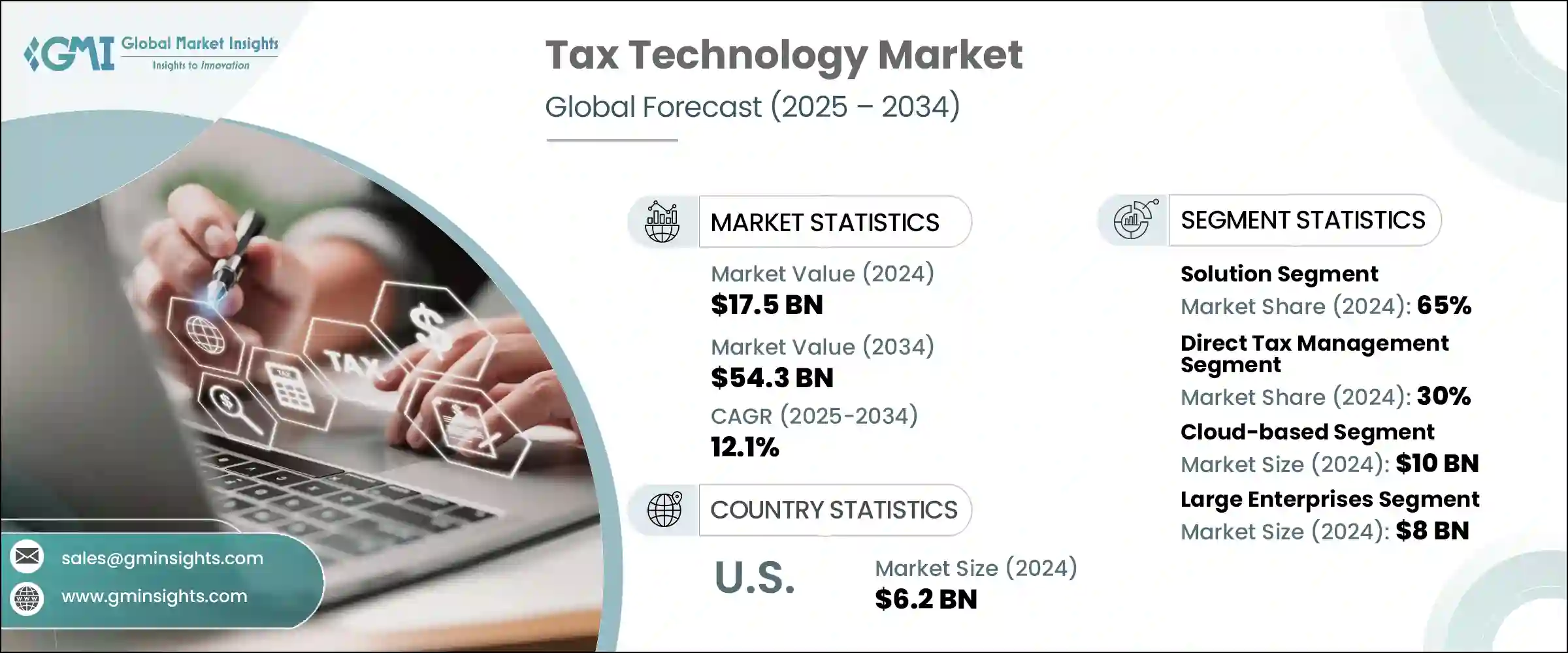
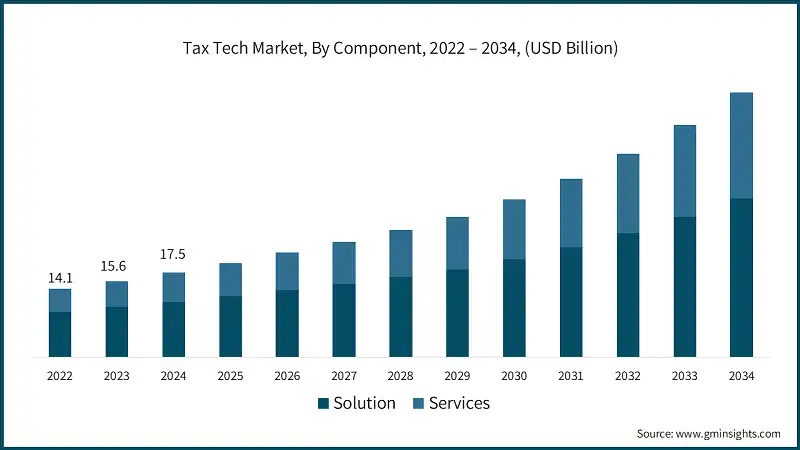
The global tax technology market size was valued at USD 17.5 billion in 2024. The market is expected to grow from USD 19.4 billion in 2025 to USD 54.3 billion in 2034, at a CAGR of 12.1%.
To get key market trends
- The tax technology industry is growing steadily due to heightened interest in faster, more precise, and automated compliance and reporting tools. As tax regulation grows more complicated and companies continue to expand their operations globally, the traditional tax compliance and reporting method of making tax calculations and filings manuals is becoming inadequate.
- To be competitive, organizations are choosing to move to smarter cloud-based technology that takes advantage of technology like artificial intelligence and machine learning to automate the entire spectrum of tax compliance and reporting from calculation to filing to audits. In general, the new technology minimizes human error, helps organizations stay compliant and lowers risk.
- One of the notable dynamics in the marketplace is the transition to cloud-based tax automation platforms. These solutions are becoming essential for medium and large businesses as well as accounting firms. The advantages of tax automation platforms include on-demand data processing, integration with ERP and accounting systems, and the ability to manage compliance in multiple regions.
- As tax laws change in the traditional tax compliance and reporting process, tax automation platforms help free up time/transform tax workflows and keep firms ahead of regulatory changes. For instance, Thomson Reuters has agreed to acquire SafeSend on a USD 600 million deal. Thomson Reuters will integrate SafeSend's tax automation solutions to help tax professionals improve efficiency, particularly as the U.S. faces a shortage of tax professionals. Thomson Reuters' acquisition of SafeSend gives them strength in the tax technology market.
- The COVID-19 pandemic has led to an explosion of tax technology usage in e-commerce. Prior to COVID-19, the norm for tax technology work was primarily on-premises. 13% of organizations have declined, in terms of on-premises workloads, post-COVID. Similarly, 50% of the organizations are in the process, and effort to lever tax technology in bring on-demand and on cloud systems.
- Some of the key features being focused on are the ability to register for taxes in new territories (67%) and manage domestic and foreign taxes on a single platform (65%). These developments represent the emerging reliance on streamlined global tax compliance systems post-COVID.
- North America remains the largest tax technology market in 2024 although tax laws will always be more tedious, along with a lot of digital compliance tools being used, in North America. The Asia Pacific region is the fastest growing market, due to expanding economies and increasingly complex tax laws that will always bring opportunities and challenges.
- In 2025, digital platforms in Japan will be required to collect VAT (Value Added Tax) where such platforms provide inbound B2C services from non- resident suppliers with taxable sales exceeding JPY 10 million (approx. USD 65,000) per period. This is a clear signal of how governments are taking digital enforcement of tax and the technology imperative for businesses to stay compliant.
Tax Technology Market Report Attributes
| Key Takeaway | Details |
|---|---|
| Market Size & Growth | |
| Base Year | 2024 |
| Market Size in 2024 | USD 17.5 Billion |
| Forecast Period 2025 - 2034 CAGR | 12.1% |
| Market Size in 2034 | USD 54.3 Billion |
| Key Market Trends | |
| Drivers | Impact |
| Digital transformation in tax function | Businesses are increasingly adopting AI, cloud, and APIs to replace legacy systems for compliance, reporting, and filing. |
| Growing complexity of global tax regulations | Frequent regulatory changes across borders are pushing companies to implement agile, automated solutions to remain compliant. |
| E-commerce and digital economy growth | The surge in cross-border online sales is creating a demand for platforms that can manage indirect tax, VAT, and digital goods tax calculations. |
| Data driven governance and transparency mandates | Governments are enforcing real-time data reporting, e-invoicing, and audit trails, driving adoption of cloud-native tax systems. |
| Pitfalls & Challenges | Impact |
| Staff skill gaps and change resistance | Enterprises struggle with training tax professionals on new platforms and aligning legacy teams with digital-first workflows. |
| Cost of integration and scalability | Despite long-term ROI, high initial implementation costs and integration complexities limit adoption, especially among mid-sized firms. |
| Opportunities | Impact |
| AI-Powered Tax Intelligence | AI and machine learning are increasingly being used for proactive audit defense, real-time tax rate recommendations, and risk flagging. |
| Global Compliance as Service (GCaaS) | With the globalization of businesses, tax technology vendors have an opportunity to offer unified platforms that handle multi-country compliance from a single interface. |
| Market Leaders (2024) | |
| Market Leader |
|
| Top Players |
Collective market share in 2024 is 24% |
| Competitive Edge |
|
| Regional Insights | |
| Largest Market | North America |
| Fastest Growing Market | Asia Pacific |
| Emerging Countries | India, Vietnam, Indonesia, Brazil, Nigeria |
| Future outlook |
|
What are the growth opportunities in this market?
Tax Technology Market Trends
- The tax tech landscape is changing rapidly, and artificial intelligence and machine learning are now key components which companies will implement tax processes. These are advanced tools that allow technology to help businesses to comply with changing regulations concerning tax obligations, obtain analytical insights in real time to address business questions about their financial data and massively reduce the manual work required in tax filings.
- As companies planning to expand their businesses internationally, tax tech platforms are responding by addressing increasingly complex cross-border issues, such as transfer pricing, withholding taxes, and treaty compliance. For example, in March 2023, Xero partnered with Parolla to address an opportunity for Irish businesses to easily file VAT3 returns and process SEPA payments through the Xero platform. This type of collaboration is particularly useful for small and mid-sized companies to help to reduce compliance obligations associated with taxes and take taxes out of their main systems.
- The cloud-based tax solutions are quickly becoming the norm. Their scalability, automatic updates, and easy integration with other business tools are highly appealing for tax departments. Also, the ability to have real-time tax reporting and compliance is becoming more critical given the trend of governments around the world requiring digital and live filing. Further, the accessibility of the cloud allows tax teams to collaborate from remote locations and manage obligations in multiple authorities, a desirable feature for globally operating companies.
- In January 2025, Wolters Kluwer added AI-powered research tool to its Canadian CCH iFirm platform, giving tax professionals fast, dual-language access to current tax information which improved the service the firm could provide to its tax clients. It highlights how much the tax industry is embracing smart, connected, cloud-based solutions.
- Blockchain technology has the potential to be highly effective in improving tax transparency, enhancing audit trails, and fighting tax fraud. In both the government and enterprise sectors, evaluations of blockchain's immutable ledger capabilities are used to enable real-time transactions verification and compliance, especially in sectors with complicated supply chains or when dealing with digital assets.
- In 2024, the Estonian Tax and Customs Board built upon its blockchain infrastructure and implemented a real-time monitoring solution for B2B transactions to ensure VAT compliance. It provided assurance that VAT liabilities were recorded and reported correctly and resulted in less opportunities for fraudulent activity and easier audits. Estonia's innovative approach has compelled a few other EU member states to start looking into similar initiatives as part of their digital tax transformations.
- Countries everywhere are requiring mandatory e-invoicing and continuous transaction controls (CTC) to collect tax in real-time and to reduced tax evasion. This means businesses must send tax authorities invoice data in real-time or just after the invoice is issued, so the tax tech platforms need to have real-time reporting capabilities.
- In 2023, the French authorities outlined plans to introduce mandatory e-invoicing and e-reporting for all domestic B2B transactions which implementing from July 2024. This legislative change has sped up innovation in the French tax tech space and pushed companies like SAP, Sovos, and Avalara to provide compliant solutions that respect French invoicing formats Factur-X and protocols for the real time transmission of data. The solutions facilitate compliance with complicated and frequently changing legislation meanwhile allowing businesses to operate effectively.
Tax Technology Market Analysis
Learn more about the key segments shaping this market
Based on component, the tax technology market is divided into solutions and services. The solution segment dominated the market accounting by around 65% in 2024 and is expected to grow at a CAGR of 11% through 2034.
- The tax technology market is positioned for significant growth in the solutions segment predominantly due to artificial intelligence, advanced automation workflows, real-time compliance and an analytics capability designed to facilitate smarter tax planning. With the increasing complexity of tax laws and changes in these laws from one jurisdiction to another, firms will increasingly depend on intelligent software to assist them in maintaining compliance and lowering the risk of errors.
- Several companies are moving to consolidated, cloud-based platforms that have everything tax-related like preparation, compliance, reporting in a one system tool. These modern tools can quickly pull in data, prefill documentation, and identify potential issues at the point of use based on the current tax law. This consolidates the tax operation, enabling tax teams to reduce the amount of manual work while lowering the risk of errors that could result in delay or penalties.
- For example, Ingram Micro is one of the largest distributors of information technology in the world, and they changed from legacy tax systems to Vertex Indirect Tax O Series, integrated with SAP S/4HANA. Being a smooth cloud-based platform to check out, all the ERP data sources were consolidated for tax calculation. While on average it used to take one to two weeks to implement a new tax category, it was reduced to one to two hours. Also, the system allowed for the global deployment scalability whilst ensuring better compliance through stronger controls and automated safeguards.
- The service segment grows more than 13% CAGR from 2025-2034. The Service segment is vital for businesses operating in a complex tax regulations due to it provides the identification between technology and real-life tax administration. With increasing technology and digitization, demand for Service segment continues to grow, especially for SMEs and multinational corporates looking for automated tax solutions that are proactive rather than reactive and have expert derived research and analysis.
- Specifically for managed services in the service segment of tax demand is growing as companies required to offload some of the in-house taxing load and reported through the use of AI tax analysis and reporting.
Learn more about the key segments shaping this market
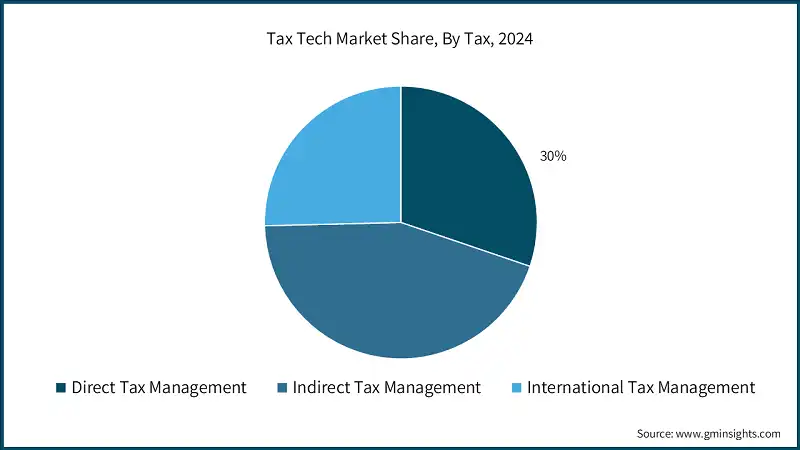
Based on tax, the tax technology market is categorized into direct tax management indirect, tax management, international tax management. The direct tax segment dominates the market with 30% share in 2024, and the segment is expected to grow at a CAGR of over 11.3% from 2025 to 2034.
- Cloud options for direct tax management are increasingly becoming the best choice in practice because of their scalability, built-in automatic updates and complex multi-jurisdictional tax requirements when factoring an organization's size. In addition, cloud solutions let organizations do regular real-time tax calculations, verify compliance through AI-based review, and integrate portals into their systems like ERP, payroll and accounting to support further connectivity in tax management.
- Cloud-enabled direct tax platforms have been valuable for organizations with international operations because they enable decision-making to take place faster than it would normally. The cloud-enabled direct tax platform also offers operational flexibility required to adapt to changing tax regulations and allows for a centralized position for organizations, reduced IT maintenance, and improved system reliability.
- In May 2025, Thomson Reuters upgraded its ONESOURCE platform to include cloud-native direct tax management capabilities, allowing clients to automate everything from tax return preparation to compliance and reporting. This shift represents a larger trend across the industry towards more connected, API-first ecosystems that simplify direct tax administration so that businesses can become more effective in a rapidly changing, and more complicated global taxes.
- The indirect tax management segment focuses on automated and streamlined compliance for VAT, GST, sales tax, and other consumption taxes across jurisdictions. The indirect tax management segment is estimated at over USD 7 billion in 2024.
- The introduction of e-invoicing mandates, real-time reporting, and cross-border e-commerce means companies are turning to more AI-led tax engines, ERP integrated, and cloud-based solutions for the management of complex rates, exemptions, or filings.
- This segment has seen exceptional growth in line with digitization of tax authorities globally as companies are reducing their potential for manual errors and audit risks, and improving efficiencies in a retail, manufacturing, and SaaS environment.
Based on deployment mode, the tax technology market is divided into cloud-based, on-premises, and hybrid. The cloud-based segment dominated the market accounting for USD 10 billion in 2024.
- Cloud-based tax platforms are quickly becoming the best choice for a lot of organizations due to their scalability, auto-update capabilities, and their ability to manage compliance in multiple jurisdictions. Cloud-based tax platforms also have seamless integration with an organization's accounting systems, enterprise resource planning ERP software solutions, and document management systems providing real-time tax data processing, AI powered reporting, and an accurate and fast-moving business.
- Cloud-native tax tools are strategically appealing to companies with a global presence. These tools allow remote teams to collaborate easier, respond to ever evolving and new regulatory changes, and make decisions faster by relying on data. Cloud capability easily allows central management of tax processes with limited IT resource support, more consistent system uptime, and less rigorous IT maintenance than pre-cloud systems.
- A recent example of the shift towards API-first cloud was seen in November 2024, when STAAH's Max Channel Manager was made available in Oracle Cloud Marketplace. This integration allows hospitality businesses to completely optimise their tax workflows across Oracle Cloud Infrastructure (OCI) with others like OPERA Cloud, and OHIP. It highlights the shift to connected, API-first cloud ecosystems that deliver greater efficiency and flexibility for tax management in a fast materials world.
Based on organization size, the tax technology market is divided into large enterprises, small and medium enterprises (SMEs), and individual taxpayers and professionals. The large enterprises segment dominated the market accounting for USD 8 billion in 2024.
- Global companies like Amazon, Microsoft, and GE use centralized, data-based tax management platforms to help standardize approaches from jurisdiction to jurisdiction, avoid audit risks, and keep pace with the ever-changing global tax framework. Clearly, companies like Amazon, Microsoft, and GE also face their respective challenges that are not entirely limited to changing regulatory environments as there are also implications relating to cross-border taxation and the need to manage ever-growing digital requirements like real-time reporting and e-invoicing.
- Large organizations have larger budgets and an in-house tax team. As a result, they often use technologies earlier if comparing all technological advances from blockchain enabled VAT and GST, cloud-based tax compliance, AI-enabled tax engines, and predictive analytics, which will help organizations to streamline operations, improve accuracy, and enhance decision-making in a rapidly changing tax environment.
- For example, KPMG, working with Microsoft has released the “Digital Gateway”; a cloud-native SaaS platform created using Microsoft Azure, to provide large organizations with real-time visibility of their tax and finance data across more than 140 jurisdictions. The platform integrates advanced technologies, including artificial intelligence, machine learning and predictive analytics to optimize global tax operations.
Looking for region specific data?
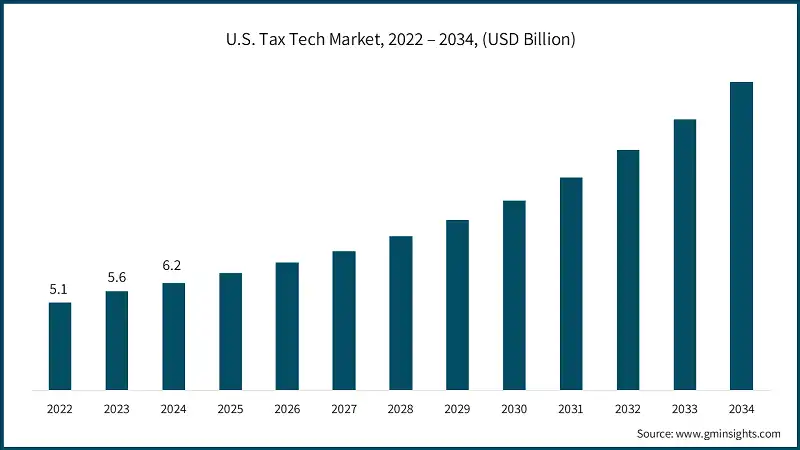
US dominated the North America tax technology market with around 80% share and revenue of USD 6.2 billion in 2024.
- The US market is thriving with demographic changes to an increasingly digitized economy and partnerships to leading tax technology providers like Intuit, Thomson Reuters and Avalara. This is evident from the progression of cloud-based compliance capabilities and AI tax compliance engines.
- Public policy of federal e-filing, widespread digitization across sectors, and the increasing availability of low-code and no-code tax solutions to minimize IT consumption and improve speed to deployment and integration of tax into business functions are helping fuel growth.
- The tax technology market growth is increasing due to partnerships tech companies, academic institutions and accounting firms have established with the intent of upskilling tax talent. Upskilling tax talent is part of the larger movement toward digital transformation in finance across the landscape of enterprise organizations. Organizations, large and small, are motivated by the talent shortages in tax advisory and the increasing risk of tax audit exposure, leading to investments in automated tax workflows with AI, and tax-compliance monitoring in a real-time capacity, as well as tax integrated into ERP finance systems for business.
Predictions suggest that from 2025-2034, the UK tax tech market will grow tremendously.
- UK has clear growth potential in tax tech market from 2025 to 2034. It also stands to gain the most within Europe for tax technology adoption, and tax technology innovation, primarily because of a strong digital economy complemented by supporting regulatory push. Europe overall accounted for the second-largest global market share in 2024, with a tremendous 17.5% compound annual growth rate (CAGR).
- The huge amount of growth within the region is by new cross-border compliance obligations, mandatory digital invoices, and the continued digitization of VAT. In the UK, the government's "Making Tax Digital" (MTD) initiative has mandated digital tax systems for an entire range of businesses, further increasing demand for cloud-native platforms and automation solutions for reporting. HMRC also initiated a national pilot project, with fintech startups, to drive increased adoption especially from small and medium-sized businesses launched in June 2024.
- Germany and France are quickly catching up with increased adoption of e-invoicing and AI-enabled tax systems. In some countries including Sweden, Poland, and the Netherlands, new data privacy regulations such as GDPR, and the demand for expanded e-commerce tax compliance, continues to open new opportunities for tax technology providers.
The tax technology market in China is expected to see growth during the forecast period from 2025 to 2034.
- The market for automated tax compliance solutions in China is rapidly growing, as companies are faced with the accelerating need to comply with information and transaction-heavy forms of commerce. The tax technology market is expanding, as the number of formal domestic businesses continues to increase, formal regulation recognizes how complex the tax code is becoming, through individual operating codes, the value added tax (VAT), digital services tax, cross-border e-commerce, increasing regulatory enforcement and increased consumer awareness.
- Each business is under pressure to have a tax management capability in place, as manual processes are not scalable to match the volume of and speed of movement to fully digital transactions and cloud finance operations.
- The regulatory shift to a fully digital tax architecture is being reinforced by the policy initiatives behind an agenda such as "Digital China," as well as the "Golden Tax System Phase III," used to reinforce the agenda behind companies adopting AI-laden tax engines, e-invoicing solutions, and real-time reporting technology, which calculates tax liabilities, offsets apparent discrepancies, and submits on time.
- At the same time, there is a rising adoption of mobile-first payment platforms like WeChat Pay, Alipay, JD Finance generating an explosion of transaction line-narrative data, as companies can utilize tax technology solutions, to utilize the data to extract deeper insight and segmentation of their transaction data and represents the potential of automated reporting and operating within regulatory limits.
- For example, India has one of the largest emerging markets for tax technology. The Goods and Services Tax Network (GSTN) is revolutionizing the efficiency of the digital indirect tax collection. India has made e-invoicing compulsory for B2B transactions; real-time invoice validation and periodic reconciliation which are driving companies towards adopting cloud-based and AI-driven tax platforms. India has over 13 million GST registered taxpayers and an expanding ecosystem of APIs, fintech players to support bigger and more complex key transactions. With other challenges to face, the growth in this area will continue in India.
- Singapore is considered a regional champion in tax digitalization. The Inland Revenue Authority of Singapore (IRAS) provides an extensive suite of digital tax services through its IRAS e-Services platform, which allows individuals and entities to file returns, make payments, and communicate digitally with as little human involvement as possible. The use of APIs (application programming interfaces) enables businesses to automate tax submissions from their accounting and finance systems directly.
The tax technology market in Brazil is projected to experience growth during the forecast period from 2025 to 2034.
- The different taxes at the federal/state/local levels have made the tax system complex, assisting in tax noncompliance by businesses. To navigate with this complex tax-world scenario, companies are looking for automated tax solutions. The demand for smart, rule-based software technology is rising that can automate real-time filings, audit readiness, and reporting through multiple authorities.
- This demand for automated tax compliance is fostered by the digital evolution of the Brazilian economy, alongside an ongoing discourse for tax reform. Companies are also investing in digital infrastructure prior to the big event, COP30, in Belém in 2025, and using automated tax tooling for compliance minimization of manual effort, hence reducing opportunity for penalties.
- Tax tools are created alongside Brazilian digital payments and e-commerce industries to allow real-time viewing of tax liabilities, exemptions, and sector-specific regulations by companies-the exact freedom they require to stay compliant in this rapidly diverging environment. For example, In April 2024, a São Paulo-based accounting platform, Contabilizei, launched a successful AI tax engine that was built for microbusinesses and freelancers. The tax engine has a valuable mobile interface that allows users to easily complete their tax submissions, automatically calculates what taxes they owe, and automatically flags errors in their classification.
- For instance, in Argentina tax technology utilization has accelerated due to changes arising from the many national and provincial taxes facing firms in the country. The Argentine government is promoting e-filing and e-invoicing tax initiatives through the Administración Federal de Ingresos Públicos (AFIP) and is pushing firms towards the cloud for tax compliance to enhance accuracy and reduce administrative requirements.
- In Mexico, tax digitization is being driven by a compliance requirement that all companies in the country adopt the Comprobante Fiscal Digital por Internet (CFDI) electronic invoicing system, which requires firms to ensure tax compliance is embedded in their own accounting software. As firms in Mexico have increasingly turned to automated tax engines and real-time reporting and analytics tools to fulfil regulatory tax obligations, they can become ready for audits as part of a broader strategy to increase tax compliance and ensure tax compliance to combat tax evasion and transparency.
The UAE tax technology market is expected to grow between 2025 and 2034, driven by the country’s expanding tax landscape and digital transformation agenda.
- The contemporary corporate tax and compliance currently have for VAT in addition to the UAE's aims to develop its economy as part of Vision 2040 while to diversify the economy with the recent Dubai Economic Agenda D33 is creating a strong push for smart tax platforms for the UAE.
- The UAE would develop into a global center for business, considering that almost every type of business in trade and finance is adopting AI tax solutions based on the ability to do real-time calculations, accurate reporting, and simplified preparation of returns; either local or international.
- The UAE Government is committed to smart cities and has significant support for the establishment of a robust cloud and mobile ecosystem supporting the rapid implementation of new tax technologies. Businesses are moving towards cloud-based tax engines, implementing e-invoicing solutions and other digital solutions that provide real-time audits and analytics to support their business, are changing regulations, and are looking for efficiencies.
- In December 2024, a multinational organization doing business out of Dubai is implementing a corporate tax compliance platform using Thomson Reuters software into all of their subsidiaries, and it will be fully integrated throughout the entire organization. The new tax compliance platform will automatically calculate tax, pull relevant data from the multiple ERP systems OR using AI for predictive modelling better decision making, provides comprehensive over-sight open up operational complexities for their large complex business needs.
- Saudi Arabia is evolving its tax technology ecosystem aligned with the Saudi Vision 2030 economic transformation plan. After implementing VAT and introducing corporate taxes, businesses in Saudi Arabia are empowering themselves with cloud-based tax compliance solutions and AI-enabled reporting tools that will help companies improve processes with more regulatory expectations for digitalized economies.
- With investments in digital infrastructure and digitizing regulatory environments, more businesses are now automating tax and compliance processes allowing more chances of error and more transparency.
Tax Technology Market Share
The top 7 companies in the market are Intuit, Microsoft, PwC, Thomson Reuters, Vertex, Oracle, and SAP SE. These companies hold around 16% of the market share in 2024.
- Intuit, known for TurboTax and QuickBooks, has a strong potential to remain leading the personal and small business tax markets with their easy-to-use cloud platforms. Recently, it has shifted its focus to automation, which incorporates machine learning to help users prepare their taxes and respond to local, state, and international changes in regulations. Intuit's platforms are very large for small firms, start-ups and independent contractors.
- Microsoft offers tax analytics and compliance tools as a part of Microsoft Dynamics 365. The state of indirect taxes, allowing multinational companies to manage taxes such as VAT/GST and sales tax as part of compliance, is improved due to that application's ability to allow compliance in real time and across different countries. The value of Microsoft is in taking its ERP skills and extending their abilities with tax engines and AI to produce a friction-free experience.
- PwC has developed enterprise-level tax technology offerings that combine powerful digital technologies with in-depth tax practice capabilities. PwC offers proprietary tools for risk assessment, automated reporting, and compliance in a global context for multinational clients dealing with OECD, BEPS, and ESG tax reporting.
- Thomson Reuters is still big in enterprise tax technology, and it still offers ONESOURCE, Checkpoint, and others to help any enterprise with e-filing, transferring pricing documentation, audit defense, or tax planning. Thomson Reuters notably acquired SafeSend for USD 600 million in January 2025 and expanded their capabilities to include client collaboration and automated tax return delivery.
- Vertex helps businesses automate calculating sales, use and value added taxes, in several markets. Vertex solutions are integrated into core ERP systems such as SAP, Oracle, and Microsoft, leading to popularity among e-commerce, retail and manufacturing firms that need to consider complex product taxability and jurisdictional rules.
- Oracle has a wide range of enterprise software offerings tax management integrated throughout Oracle Fusion Cloud ERP and OPERA systems. Oracle provides tax solutions to large organizations to automate indirect tax processes, manage tax provisioning and compliance, while using existing financial systems. Oracle differentiates through delivering scalable solutions for global firms with large, integrated tax departments and the ability to meet financial oversight and auditability requirements.
- SAP SE is a leading provider of enterprise technology with tax-related features in the SAP S/4HANA and SAP Analytics Cloud platforms. SAP enables companies to comply with tax obligations regardless of industry, through integrated tax compliance, analytics and reporting. SAP brings proactive tax planning, early detection of tax related issues with AI and machine learning and can connect in real time with tax authorities and other regulatory agencies around the world.
Tax Technology Market Companies
Major players operating in the tax technology industry include:
- Intuit
- Microsoft
- Oracle
- PwC
- Ryan
- SAP
- Thomson Reuters
- Vertex
- Wolters Kluwer
- Intuit has made its mark in the industry offering their user-friendly tax preparation tools, Turbo Tax and QuickBooks for small businesses and individual taxpayers. Microsoft does not provide tax solutions independently. It supplies cloud infrastructure, business intelligence and ERP systems that are integrated with tax software.
- Oracle is focused on the needs of large enterprises and delivers sophisticated tax reporting and compliance capabilities through its ERP Cloud, to help companies operate with the appropriate tax solutions in their complex tax environment. PwC uses its expertise for innovative tax advisory capabilities. PwC offers automation and AI services that help businesses modernize their tax functions. Ryan specializes in corporate tax solutions designed to streamline income tax recovery, facilitate property tax compliance and manage sales tax.
- SAP is unique by providing real-time tax reporting and automation with global compliance tools within a broader ERP ecosystem. Meanwhile, Thomson Reuters are well-established in the market and their ONESOURCE and UltraTax CS platforms primarily offer cloud-based compliance, e-filing and timely updates for businesses and tax professionals.
- Vertex focuses on automating indirect taxes such as sales and VAT taxes and easy integration with many of the main ERP systems while Wolters Kluwer have an extensive suite of both accounting and tax software products under its CCH brand, providing businesses, and corporate tax teams advanced compliance features, and cloud-first capabilities. Together these companies are innovating tax technology to improve accuracy, increase efficiency and keep organizations compliant amid changing regulations.
Tax Technology Industry News
- In March 2025, the IRS made a substantial reduction to its audit and supportive staff, eliminating over 11,000 employees about 11% of the workforce. This cutback means tax authorities will contact more businesses and that businesses will manage their own compliance and reporting through tax technology. With few IRS employees available, audits and inquiries will likely take longer which is putting pressure on banks and companies to maintain accurate, automated records. There is significantly greater demand for AI-driven tax technology that assures compliance as it occurs and reduces the reliance on manual tax knowledge.
- In June 2025, Vertex announced Vertex Velocity, a tax compliance ecosystem designed to appeal to fast-growing startups with limited resources, and larger, mid-sized businesses that need to manage complicated environment and transaction tracking. Vertex Velocity is mobile responsive, user-friendly, and most importantly, scalable.
- Most users can set up an account and are immediately able to automate their sales tax calculations and continue to monitor and govern where nexus exists in the context of sales tax for each state, or country, through a single, optimized interface. Vertex Velocity is ideal for companies with limited in-house tax employee resources where regulatory, reporting, complexity conflates tax technology and usage by users.
- In April 2025, PwC and Microsoft made a strategic partnership to incorporate machine learning and generative AI into PwC’s Tax Function of the Future initiative. This partnership is powered by Microsoft Azure and OpenAI technologies to develop AI-driven tax bots and predictive models for audit risk assessment. This partnership will change how large organizations manage tax data, automate reporting, and respond to regulatory changes.
- In November 2024, Intuit announced it added Tink Tax, a high-growth new startup that focuses on automation of compliance for small digital businesses and gig workers. The digital first tools and intelligent algorithms of Tink Tax will significantly enhance Intuit's QuickBooks and TurboTax product, allowing freelancers, independent contractors, and creators across the globe to file tax returns more accurately and in real time.
The tax technology market research report includes in-depth coverage of the industry with estimates & forecast in terms of revenue ($Bn) from 2021 to 2034, for the following segments:
Market, By Component
- Software
- Tax preparation software
- Tax compliance management
- Tax analytics and reporting
- Tax planning tools
- Services
- Consulting and advisory
- Implementation services
- Support and maintenance
- Managed tax services
Market, By Tax
- Direct tax management
- Income tax
- Corporate tax
- Capital gains tax
- Indirect tax management
- Sales tax
- Value added tax (VAT)
- Goods and services tax (GST)
- Excise tax
- International tax management
- Transfer pricing
- Withholding tax
- Treaty management
Market, By Deployment Mode
- Cloud-based
- Public
- Private
- Hybrid
- On-Premises
- Hybrid
Market, By Organization Size
- Large enterprises
- Small and Medium Enterprises (SME)
- Individual taxpayers and professionals
Market, By Application
- Tax return preparation
- Tax compliance management
- Tax planning and strategy
- Tax risk management
- Tax audit support
- Tax research and advisory
- Tax reporting and analytics
- Others
Market, By End Use
- Banking, Financial Services, and Insurance (BFSI)
- Retail and e-commerce
- Manufacturing and automotive
- Healthcare and life sciences
- Technology and telecommunications
- Energy and utilities
- Government and public sector
- Professional services
- Real estate and construction
- Transportation and logistics
- Others
The above information is provided for the following regions and countries:
- North America
- U.S.
- Canada
- Europe
- UK
- Germany
- France
- Italy
- Spain
- Belgium
- Netherlands
- Sweden
- Asia Pacific
- China
- India
- Japan
- Australia
- Singapore
- South Korea
- Vietnam
- Indonesia
- Latin America
- Brazil
- Mexico
- Argentina
- MEA
- South Africa
- Saudi Arabia
- UAE
- Nigeria
Frequently Asked Question(FAQ) :
Who are the key players in the tax technology industry?
Key players include Intuit, Microsoft, PwC, Thomson Reuters, Vertex, Oracle, SAP SE, Wolters Kluwer, and Ryan.
What are the upcoming trends in the tax technology market?
Trends include AI-powered audit and compliance tools, cloud-native platforms, real-time tax reporting, blockchain for transparency, and mandatory e-invoicing mandates globally.
What is the growth outlook for the service segment from 2025 to 2034?
The service segment is projected to grow at a CAGR of over 13% from 2025 to 2034.
Which region leads the tax technology sector?
North America leads with over 80% of the regional revenue in the U.S. alone, totaling USD 6.2 billion in 2024, fueled by widespread digitization and federal e-filing mandates.
What was the valuation of the cloud-based deployment segment in 2024?
Cloud-based deployment accounted for USD 10 billion in 2024, due to scalability, integration capabilities, and remote accessibility.
What is the projected value of the tax technology market by 2034?
The market for tax technology is projected to reach USD 54.3 billion by 2034, driven by AI adoption, cloud-native platforms, and global compliance needs.
How much revenue did the solutions segment generate in 2024?
The solutions segment generated approximately USD 11.4 billion, dominating the market with a 65% share in 2024.
What is the market size of the tax technology in 2024?
The market size was USD 17.5 billion in 2024, with a CAGR of 12.1% expected through 2034. Rising demand for automation, AI-based compliance, and global tax regulation complexity is driving the market growth.
Tax Technology Market Scope
Related Reports