Summary
Table of Content

Sweet Biscuits Market
Get a free sample of this report
Form submitted successfully!
Error submitting form. Please try again.
Thank you!
Your inquiry has been received. Our team will reach out to you with the required details via email. To ensure that you don't miss their response, kindly remember to check your spam folder as well!
Request Sectional Data
Thank you!
Your inquiry has been received. Our team will reach out to you with the required details via email. To ensure that you don't miss their response, kindly remember to check your spam folder as well!
Form submitted successfully!
Error submitting form. Please try again.
Sweet Biscuits Market Size
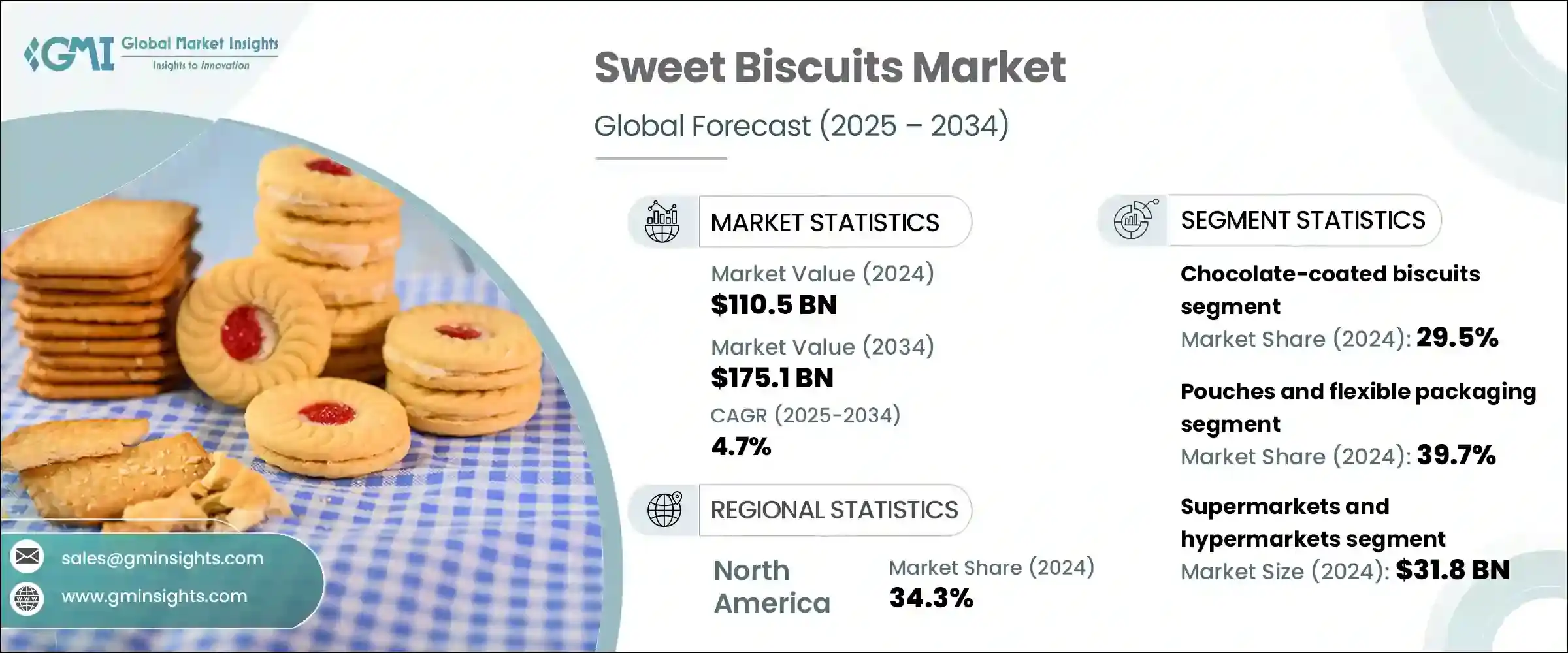
The global sweet biscuits market size was estimated at USD 110.5 billion in 2024. The market is expected to grow from USD 115.5 billion in 2025 to USD 175.1 billion in 2034, at a CAGR of 4.7%.
Sweet Biscuits Market Key Takeaways
Market Size & Growth
- 2024 Market Size: USD 110.5 Billion
- 2034 Forecast Market Size: USD 175.1 Billion
- CAGR (2025–2034): 4.7%
Key Market Drivers
- Changing Consumer Preferences for Snacking.
- Growing Urbanization and Busy Lifestyles.
- Product Innovation and Flavors.
Challenges
- Health Concerns and Rising Demand for Healthy Alternatives.
- Intense Market Competition.
Opportunity
- Introduction of Healthier and Organic Variants.
- Emerging Markets and Rural Penetration.
- Product Innovation with Unique Flavors and Ingredients.
- E-commerce and Direct-to-Consumer Sales Channels.
- Sustainable Packaging and Eco-friendly Initiatives.
Key Players
- Market Leader: Mondelēz International led with over 17.3% market share in 2024.
- Leading Players: Top 5 players in this market include Mondelez International, Inc., Nestlé S.A., Ferrero Group, Mars, Incorporated, Grupo Bimbo, which collectively held a market share of 43.5% in 2024.
Get Market Insights & Growth Opportunities
The expanding consumer demand for quick, enjoyable snacks and the rise of urbanization drives growth in the sweet biscuit market. Currently valued at several billion dollars, the sweet biscuit market consists of major regions such as North America, Europe, and Asia-Pacific, which are characterized by the changing lifestyles of people and positive trends in disposable incomes.
Presently, the industry's competitive environment presents the need for leading players to innovate with better formulations, organic ingredients, and unique flavours to keep pace with the ever-changing tastes of consumers. Developments in recent times have also tended toward increased health concerns with the resulting demand for reduced sugar and gluten-free items.
- Future trends show increased popularity, mainly due to product innovations, premiumization, and an increase in functional biscuits for added health benefits, including probiotics and vitamins. There will most probably be opportunities for faster growth through emerging markets, which include Africa and Asia, driven by urbanization and changing dietary habits. The sweet biscuit industry promises strong growth and adaptation to health trends and consumer preference.
- For instance, Britannia's launch of flagship health-oriented biscuits imbued with micronutrients and probiotics that answer the functional food needs of Indian consumers and the introduction of organic biscuit lines under the company, along with gourmet ones by Mondelez, are meant to meet the health-conscious premium-seeking consumers in Europe. Emerging markets such as Kenya and South Africa include Blue Ribbon brands, which have mushroomed their inexpensive, homegrown sweet biscuit varieties, further boosted by increasing - incomes and urbanization.
- Similarly, in Asia, companies such as Indofood, Indonesia, and several Vietnamese startups are reportedly growing rapidly by developing healthier, casual snacks in response to changing dietary habits. Those are innovations in product form, health benefits, and market expansion according to urbanization or urbanization-induced products that lead to an emerging, promising future for the industry.
- In 2022, the global snack manufacturer, Pladis Global, took over the Burton's Biscuit Company, a notable biscuit manufacturing company based in the UK. The acquisition was inclusive of popular brands such as Maryland Cookies, Jammie Dodgers, Wagon Wheels, and Chocobakes. The deal added significant breadth to the product portfolio of Pladis and expanded its footprint in the UK and Europe.
- Burton's Biscuit Company was recognized for its innovative and popular biscuit offerings, hence making it a prized acquisition to the global operations of Pladis. Plans were made to leverage the established brand equity of Burton in opening up its distribution channels, thus enhancing growth in the competitive sweet biscuits category.
- North America has a decent portion of 34.3% market share, due to advancement in technology and innovations.
- By product type, the chocolate-coated biscuits segment holds the sweet biscuits market share of 29.5% because of its smooth, rich chocolate taste, appealing to diverse consumer preferences.
- By packaging type segment, pouches and flexible packaging are the largest as it is largely used to lightweight, convenient, and resealable options that preserve freshness, extend shelf life, and enhance visual appeal for consumers and it holds the market share of 39.7%.
- Based on the distribution channels, supermarkets and hypermarkets dominate, having a large market share of 28.7%. The supermarkets and hypermarkets stock a vast number of sweet biscuits, ensuring accessibility and competitive pricing worldwide, thus giving a choice to consumers.
To get key market trends
Sweet Biscuits Market Trends
The sweet biscuit industry is undergoing significant changes with ever-changing consumer preferences targeting health and wellness. Awareness of diet-and-health linkage is creating an increased demand for healthier options amongst sweet biscuit consumers. In response to this, manufacturers are innovating and launching a greater assortment of low-sugar, gluten-free, and organic biscuits targeted at health-conscious consumers who desire a bit of indulgence without compromising their health goals.
In addition to innovation in flavors, companies are working with natural ingredients, superfoods, and interesting flavor combinations to lure more adventurous customers, while still conveying health benefits. Convenience acts as an additional driving factor that demands the design of portable, grab-and-go biscuit types that fit into busy lifestyles. These evolving characteristics reflect a wider trend towards healthier sweet biscuits that compensate with high flavor and convenience, away from the increasing focus on nutrition and wellness by consumers.
- One exciting trend is that of flavor innovation wherein different players in the industry offer more unique/exotic flavours or functional ingredients such as probiotics, vitamins, and superfoods for added health benefits. The emergence of premium and artisan products reflects the orientation towards indulgence and quality, which appeals to morally conscious consumers who would like to share adrenaline-pumping unique experiences. Innovative packaging designs that focus on sustainability and convenience are on the rise to accommodate a lifestyle that requires on-the-go consumption.
- For instances, today brands are also offering low-sugar and gluten-free organic biscuits from LÄRABAR, which situates these brands within the health-conscious consumer bracket. Flavour innovations now involve some very exotic variants like salted caramel or probiotic-infused biscuits, appealing to adventurous tastes. Premium and artisanal products like handcrafted biscuits with unique ingredients focus on quality and indulgence. Packaging trends also had eco-friendly, resealable pouches for on-the-go snacking. All this is toward meeting consumer demand for healthier, tasty, and convenient treats, causing further growth and differentiation in this highly competitive sweet biscuit industry.
- Furthermore, various e-commerce sales channels are gaining ground and extending the sweet biscuits market's reach for direct-to-consumer sales. All in all, market trends take sweet biscuits on a path toward healthier, innovative, and more convenient products, due to changing consumer lifestyles and preferences. All these elements contribute to a dynamic and competitive environment for sweet biscuits.
Sweet Biscuits Market Analysis
Learn more about the key segments shaping this market
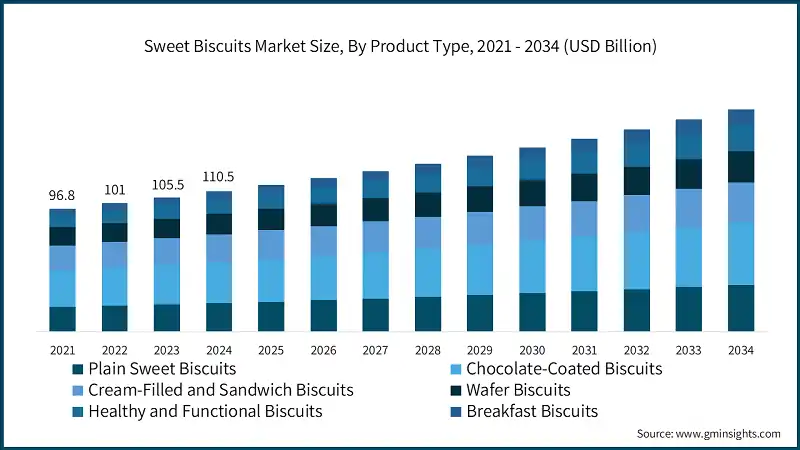
The sweet biscuits market by product type is segmented into plain sweet biscuits, chocolate-coated biscuits, cream-filled and sandwich biscuits, wafer biscuits, healthy and functional biscuits and breakfast biscuits. The chocolate-coated biscuits accounted for 29.5% of the market share in 2024 with a market size of USD 32.6 billion and is expected to attain a market size of about USD 49 billion at about CAGR of 4.2%.
- Plain sweet biscuits constitute the growth potential, increasing from USD 22.4 billion in 2024 to around USD 36.8 billion in 2034 at a 5.1% CAGR owing to enhancing consumer interests in health and gourmet foods. Novel fillings with fruit and exotic flavours and even some functional ingredients such as probiotics are turning cream-filled and sandwich biscuits into more appealing products to taste-and-health-benefit-oriented consumers.
- The sweet biscuits market from cream-filled and sandwich biscuits will grow to approximately USD 31.5 billion in 2034 at a CAGR of 3.9%, with combination of bold flavors, natural ingredients, and health-conscious formulations to cater to evolving consumer preferences. Sandwich biscuits and cream-filled biscuits have a layered structure and can be filled with cream, chocolate, fruit, etc. Since they possess rich flavors, smooth textures, and a myriad of flavors, they are widely accepted among the entire cross-section of consumers as treats or snacks.
- The wafer biscuits will rise from USD 16.3 billion to about USD 24.5 billion at a CAGR of 4.2%. Light, crispy wafers are getting more and more popular among the consumers because, besides their texture and versatility, they are often flavored and have other tastes such as chocolate, vanilla, and fruits. They also, at times, come with functional ingredients like probiotics, antioxidants, or superfoods to give them more benefits. Healthy snacking is a trend that has made many new entries into the sweet biscuits market in the development of healthy and functional biscuits loaded with essential vitamins, minerals, dietary fiber, or superfoods to help health-conscious consumers find healthy alternatives.
- Healthier breakfast biscuits have also taken shape, serving as a quick source of energy-rich nutrition for busy lifestyles. They are often made from grains, oats, or fortified with added nutrients, providing a healthy start to the day in line with the growing transition to easy-to-prepare, wholesome breakfast alternatives. This shift is indicative of a larger consumer movement towards coupling convenience with health and wellness in some of their snack and meal options.
Learn more about the key segments shaping this market
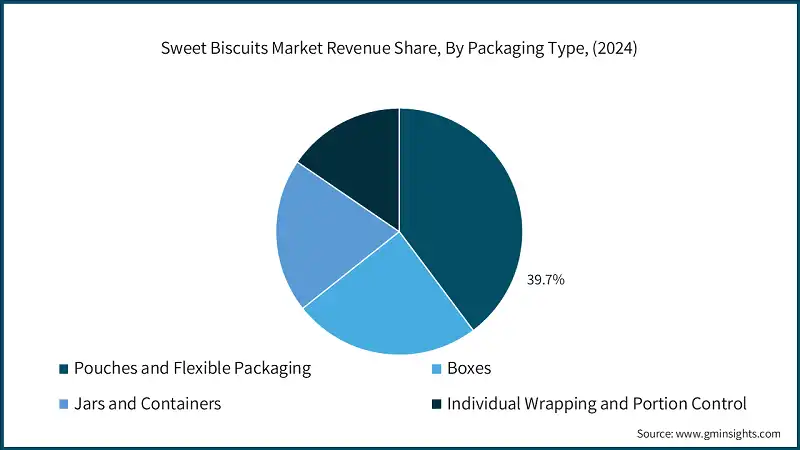
The sweet biscuits market is segmented into pouches and flexible packaging, boxes, jars and containers and individual wrapping and portion control based on packaging. Pouches and flexible packaging form made up 39.7% of the market in 2024 and expected to grow at a faster rate of 4.5% CAGR to reach a wider consumer base.
- Sweet biscuit packaging trends are generally inclined towards three basic guiding principles: convenience, sustainability, and innovation. The increasing popularity of pouches and flexible packaging can be attributed to their lightness, re-sealability, compactness, ease of carrying, and freshness-preserving features. The advantages these have for consumers who lead full lives and want their snacking or storage options to be quick and easy make them alluring.
- Boxes have always represented the most standard and conventional form of packaging; however, brands are now investing in creatively designed boxes styled with graphics that attract attention and advanced materials. Such packaging not only garners interest in retail but also assists rounds of brand identity and differentiation in an overcrowded marketplace.
- The increasing popularity of jars and containers - again, especially for premium or artisanal biscuit lines - is another viable path forward when considering flexibility and boxes. The reusable presentation contributes to the perception of higher quality and freshness. Moreover, trendy considerations such as single wraps and portion-controlled packaging fit mieux in the consumers' hectic ways of life and growing health consciousness. These formats help better portion control, reduce wastage, and enhance shelf life, ensuring the product stays fresh for longer.
- In the sweet biscuit market, making packaging strategies aims to somehow entice consumers through innovative designs and functional elements and favor sustainability with eco-friendly materials. These trends seek to enhance user experience, convenience, and environmental cognizance among stakeholders' approaches in a balanced equation that serves consumers and the environment.
The sweet biscuits market by distribution channel is segmented into supermarkets and hypermarkets, convenience stores, e-commerce and online retail, specialty food stores, food service and institutional sales and traditional trade and independent retailers. The supermarkets and hypermarkets accounted for 28.7% of the market share in 2024 with a market size of USD 31.8 billion.
- With an increasing emphasis on modern trade formats such as supermarkets and hypermarkets, which continue to dominate sales through product range, displays, and easy access for a consumer seeking a one-stop shopping place, distribution channels in the sweet biscuits market show a growing emphasis on this area. These outlets thus offer the advantage of visibility and promotional opportunities for a brand that can, therefore, result in sales volumes.
- They are also beginning to offer some digital integration in terms of online ordering and home delivery, banking more on consumer convenience. The expanding size and presence of these outlets, combined with the ability to stock countless product lines covering every price range from premium to economy, make them very important cogs in the distribution wheel that would enhance brand development and consumer accessibility in the market.
Looking for region specific data?
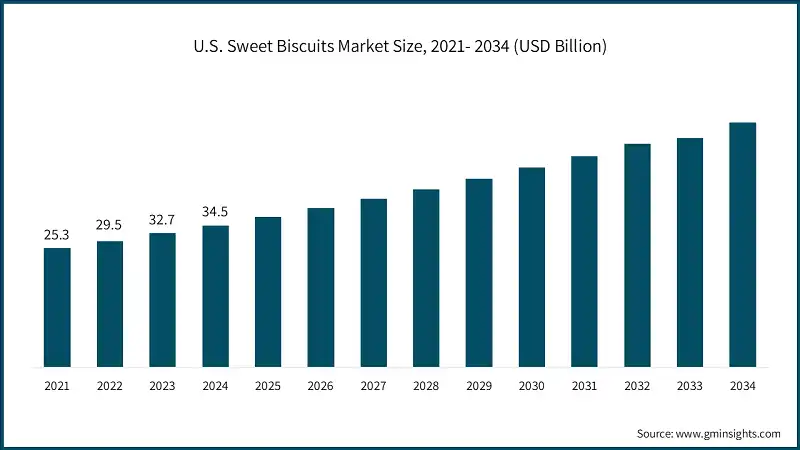
The sweet biscuits market is dominated by North America, accounting for 34.3% of total revenue in 2024.
- Regional trends in the sweet biscuits industry have shown consumers to have varied preferences and growth dynamics.
- North America and Europe continue to dominate with a CAGR of 4% and 4.5% respectively, owing to higher disposable incomes, health-oriented innovations, and premium products, especially with organic and gluten-free options. Asia-Pacific is experiencing rapid growth on the back of fast-developing urbanization trends, changing lifestyles, and increasing snack consumption, particularly in China and India.
- The sweet biscuits market is growing tremendously in Latin America and the Middle East because of increasing disposable incomes, urbanization, and changing patterns in consumer preferences for more diverse flavours and innovations. The consumers in these regions are more inclined towards premium and health-oriented options, thus diversifying the products. The African market is also picking up rapidly, with increased demand for affordable, locally produced biscuits that cater to regional tastes and price sensitivities.
- Overall, regional variations in the market for sweet biscuits mirror differences in underlying cultural preferences, levels of economic development, and changes in consumer lifestyles. These factors influence potential product offerings worldwide, their marketing strategies, and market opportunities, thus making the industry perennially dynamic and adaptable to local tastes.
Sweet Biscuits Market Share
The Mondelez International, Inc., Nestlé S.A., Ferrero Group, Mars, Incorporation and Grupo Bimbo are significant 5 players in the sweet biscuits market with respect to innovation and distribution. These companies are all contributing their quota through innovations and branding strategies as well as extensive distribution networks. For example, under the umbrella of Mondelez, one would find Oreo, among other brand products, leading in product innovation and global reach. Aside from a rich portfolio, Nestlé focuses more on health-conscious and premium products.
One generally identifies the Ferrero Group with its premium, luxurious biscuits holding consumers by loyalty. Mars, Inc. extends the snack range into sweet biscuits thereby making this product range even larger. Group Bimbo is the bakery leader majorly concerned with the cost-effective biscuits available in emerging markets. These giants make substantial contributions to sweet biscuits market trends, consumer preferences, and the competitive landscape through strategic investments in their respective product offerings.
Mondelez International: Mondelez innovates new flavors and health-focused products, forming strategic partnerships with retailers and tech firms to enhance distribution. They collaborate on sustainable packaging initiatives and digital marketing campaigns, expanding their footprint in emerging markets and driving consumer engagement through innovative product launches.
Nestlé S.A.: Nestlé emphasizes health-conscious and premium sweet biscuits, leveraging R&D for new formulations. They partner with local companies to expand distribution and collaborate on sustainable sourcing initiatives. Nestlé also invests in digital marketing and e-commerce collaborations to reach wider audiences and promote innovative, nutritious products.
Ferrero Group: Ferrero focuses on premium, indulgent biscuit innovations, introducing limited editions and unique flavor combinations. They form strategic alliances with retail chains and collaborate on marketing campaigns emphasizing quality and tradition. Ferrero invests in sustainable sourcing and environmentally friendly packaging to enhance brand reputation.
Mars, Inc.: Mars innovates with new snack-inspired sweet biscuits, integrating popular flavors and healthier options. They partner with retailers and technology firms for omnichannel marketing and distribution. Mars also collaborates on sustainability initiatives, including responsible sourcing and eco-friendly packaging, to align with consumer values.
Grupo Bimbo: Grupo Bimbo expands through innovations in affordable, convenient sweet biscuits tailored for emerging markets. They form strategic alliances with local distributors and collaborate on sustainable manufacturing processes. Bimbo emphasizes product reformulation for health, digital marketing, and expanding its product portfolio to meet diverse consumer needs.
Sweet Biscuits Market Companies
Major players operating in the sweet biscuits industry are:
- Mondelez International, Inc.
- Nestlé S.A.
- Ferrero Group
- Mars, Incorporated
- Pladis (United Biscuits)
- Britannia Industries Limited
- Parle Products Pvt. Ltd.
- ITC Limited
- Grupo Bimbo
- Lotus Bakeries
- UNIBIC Foods India Pvt. Ltd.
- Anmol Industries Ltd.
- Bisk Farm (SAJ Food Products)
- Burton's Biscuit Company
- Walkers Shortbread Ltd.
- Kellogg Company
Sweet Biscuits Market Report Attributes
| Key Takeaway | Details |
|---|---|
| Market Size & Growth | |
| Base Year | 2024 |
| Market Size in 2024 | USD 110.5 Billion |
| Forecast Period 2025 – 2034 CAGR | 4.7% |
| Market Size in 2034 | USD 175.1 Billion |
| Key Market Trends | |
| Drivers | Impact |
| Changing Consumer Preferences for Snacking | Increasing demand for convenient, on-the-go snack options has boosted the popularity of sweet biscuits. Consumers prefer quick, portable treats, leading to innovation in product formats and flavours, and expanding market reach. |
| Growing Urbanization and Busy Lifestyles | Urban lifestyles with busy schedules drive consumers to seek easy-to-eat, packaged foods like sweet biscuits. This trend has resulted in higher sales volumes and the expansion of retail channels, including supermarkets and convenience stores. |
| Product Innovation and Flavors | Introduction of new flavours, ingredients (such as healthier options with reduced sugar or added nutrients), and packaging has attracted a broader consumer base, including health-conscious customers. This innovation sustains market growth and competitive advantage |
| Pitfalls & Challenges | Impact |
| Health Concerns and Rising Demand for Healthy Alternatives | Increasing awareness of health issues related to high sugar and calorie content has led consumers to seek healthier snack options. This challenge pressures manufacturers to reformulate products, which can increase production costs and affect traditional recipes. Failure to adapt may result in declining sales and loss of market share. |
| Intense Market Competition | The market is highly competitive, with numerous local and international brands vying for consumer attention. This competition can lead to price wars, reduced profit margins, and increased marketing expenses. Companies must continuously innovate and differentiate their products to maintain market position, which can strain resources. |
| Opportunities: | Impact |
| Introduction of Healthier and Organic Variants | Expands consumer base by appealing to health-conscious buyers, driving sales growth. |
| Emerging Markets and Rural Penetration | Opens new revenue streams as rural and developing regions adopt packaged snacks. |
| Product Innovation with Unique Flavors and Ingredients | Attracts adventurous consumers and differentiates brands in a crowded market |
| E-commerce and Direct-to-Consumer Sales Channels | Increases market reach and provides personalized marketing opportunities. |
| Sustainable Packaging and Eco-friendly Initiatives | Enhances brand image and appeals to environmentally conscious consumers. |
| Market Leaders (2024) | |
| Market Leaders |
17.3% Market Share |
| Top Players |
Collective market share in 2024 is 43.5% |
| Competitive Edge |
|
| Regional Insights | |
| Largest Market | North America |
| Fastest growing market | Asia Pacific |
| Emerging countries | India, China, Brazil |
| Future outlook |
|
What are the growth opportunities in this market?
Sweet Biscuits Industry News:
- In November 2023, Barilla, Milma launched premium dark chocolate and butter Sweet Biscuits, targeting health-conscious consumers, marking its foray into the dark chocolate segment and expanding its product portfolio to meet evolving consumer preferences.
The sweet biscuits market research report includes an in-depth coverage of the industry with estimates and forecast in terms of revenue in USD Billion from 2021 – 2034 for the following segments:
Market, By Product Type
- Plain Sweet Biscuits
- Chocolate-Coated Biscuits
- Cream-Filled and Sandwich Biscuits
- Wafer Biscuits
- Healthy and Functional Biscuits
- Breakfast Biscuits
Market, By Packaging Type
- Pouches and Flexible Packaging
- Boxes
- Jars and Containers
- Individual Wrapping and Portion Control
Market, By Distribution Channel
- Supermarkets and Hypermarkets
- Convenience stores
- E-commerce and online retail
- Specialty food stores
- Food service and Institutional sales
- Traditional trade and independent retailers
The above information is provided for the following regions and countries:
- North America
- U.S.
- Canada
- Europe
- Germany
- UK
- France
- Spain
- Italy
- Netherlands
- Asia Pacific
- China
- India
- Japan
- Australia
- South Korea
- Latin America
- Brazil
- Mexico
- Argentina
- Middle East and Africa
- Saudi Arabia
- South Africa
- UAE
Frequently Asked Question(FAQ) :
What is the market size of the sweet biscuits in 2024?
The market size was estimated at USD 110.5 billion in 2024, with a CAGR of 4.7% expected through 2034. Increasing urbanization and demand for convenient snacks are driving market growth.
What is the projected value of the sweet biscuits market by 2034?
The market is poised to reach USD 175.1 billion by 2034, driven by changing consumer lifestyles, rising disposable incomes, and innovations in product offerings.
How much revenue did the plain sweet biscuits segment generate in 2024?
The plain sweet biscuits segment generated USD 22.4 billion in 2024, with a projected CAGR of 5.1% through 2034.
What was the market share of pouches and flexible packaging in 2024?
Pouches and flexible packaging accounted for 39.7% of the market in 2024, led by their convenience, sustainability, and freshness-preserving features.
What is the growth outlook for supermarkets and hypermarkets in the sweet biscuits market?
Supermarkets and hypermarkets held a 28.7% market share in 2024. These outlets are expected to grow due to their product variety, visibility, and promotional opportunities.
Which region leads the sweet biscuits sector?
North America leads the market, accounting for 34.3% of total revenue in 2024, supported by strong consumer demand and established distribution networks.
What are the upcoming trends in the sweet biscuits market?
Trends include the introduction of functional ingredients like probiotics, novel fruit and exotic flavors, sustainable packaging solutions, and increasing demand for health-oriented products.
Who are the key players in the sweet biscuits industry?
Key players include Mondelez International, Inc., Nestlé S.A., Ferrero Group, Mars, Incorporated, Pladis, Britannia Industries Limited, Parle Products Pvt. Ltd., ITC Limited, Grupo Bimbo, Lotus Bakeries, UNIBIC Foods India Pvt. Ltd.
Sweet Biscuits Market Scope
Related Reports