Summary
Table of Content

Surgical Table Market
Get a free sample of this report
Form submitted successfully!
Error submitting form. Please try again.
Thank you!
Your inquiry has been received. Our team will reach out to you with the required details via email. To ensure that you don't miss their response, kindly remember to check your spam folder as well!
Request Sectional Data
Thank you!
Your inquiry has been received. Our team will reach out to you with the required details via email. To ensure that you don't miss their response, kindly remember to check your spam folder as well!
Form submitted successfully!
Error submitting form. Please try again.
Surgical Table Market Size
The market is driven by numerous factors such as rising number of surgical procedures globally, growing healthcare expenditure coupled with improving healthcare infrastructure in emerging markets. This along with technological advancements in surgical tables and increasing number of hospitals and ambulatory surgical centers, is further augmenting the demand for surgical tables.
Increasing prevalence of chronic diseases and the need for better patient positioning and safety are expected to fuel the industry's growth. GETINGE, Stryker, STERIS Healthcare, Baxter, and MIZUHO OSI are among the leading players operating in the market. These players primarily focus on product innovation, geographic expansion, and integration of advanced technologies in tables, utlizing their strong R&D infrastructure, and collaboration with local or regional healthcare providers.
The market increased from USD 1.3 billion in 2022 and reached USD 1.5 billion in 2024, with the historical growth rate of 6%. An increase in the number of surgical procedures performed across the globe is one of the key drivers attributed to the growing demand for surgical tables. Rising prevalence of chronic diseases, trauma, along with increasing aging population and continued expansion of access to surgical procedures are fueling surgical procedure volumes across general, orthopedic, cardiovascular, and minimally invasive surgeries. Hospital and healthcare facilities have implemented guidelines where each operating room must be outfitted with appropriately designed and reliable surgical tables to enhance accuracy, patient safety, and efficiency of operating room flows. This along with an increase in surgical throughput is leading to increasing need for replacement of existing surgical tables, which in turn is driving the demand for repeat purchases. As surgical care becomes more accessible across regions, the installed base of surgical infrastructure is continuing to expand.
Surgical Table Market Key Takeaways
Market Size & Growth
- 2025 Market Size: USD 1.57 Billion
- 2026 Market Size: USD 1.64 Billion
- 2035 Forecast Market Size: USD 2.2 Billion
- CAGR (2026–2035): 3.4%
Regional Dominance
- Largest Market: North America
- Fastest Growing Region: Asia Pacific
Key Market Drivers
- Rising number of surgical procedures globally.
- Technological advancements in surgical tables.
- Rising healthcare expenditure coupled with improving infrastructure in emerging markets.
- Increasing number of hospitals and ambulatory surgical centers.
Challenges
- High cost of composite surgical tables.
Opportunity
- Growing demand for electric and hybrid surgical tables.
- Rising medical tourism in emerging economies.
Key Players
- Market Leader: STERIS Healthcare led with over 10% market share in 2025.
- Leading Players: Top 5 players in this market include GETINGE, Stryker, STERIS Healthcare, Baxter, MIZUHO OSI, which collectively held a market share of 38% in 2025.
Get Market Insights & Growth Opportunities
Additionally, innovation in the design of surgical tables continues to improve their clinical value and increase their market acceptance. Examples of advancements include the use of electric and electro-hydraulic controls, carbon fiber tabletops, increased weight capacity, and multi-axis positioning capabilities, all of which provide more variety and improved precision in surgical procedures performed on these tables. Integration with imaging systems and robotic platforms allows seamless compatibility with modern surgical environments. Innovations, such as these, provide surgeons with better ergonomics, reduce the chance of patient repositioning, and faciitate performance of complex procedures. As a result, healthcare providers are upgrading equipment that are considered to be legacy surgical tables. In addition, as operating rooms become more efficient and clinical outcomes improve, many healthcare providers are increasingly seeking technologically advanced surgical tables as an essential capital investment.
A surgical table is a specialized medical device designed to support and precisely position a patient during surgical procedures, enabling optimal access, stability, and safety for both patients and surgical teams across various types of surgeries.
The global surgical table market was estimated at USD 1.57 billion in 2025. The market is expected to grow from USD 1.64 billion in 2026 to USD 2.2 billion in 2035, at a CAGR of 3.4% during the forecast period, according to the latest report published by Global Market Insights Inc.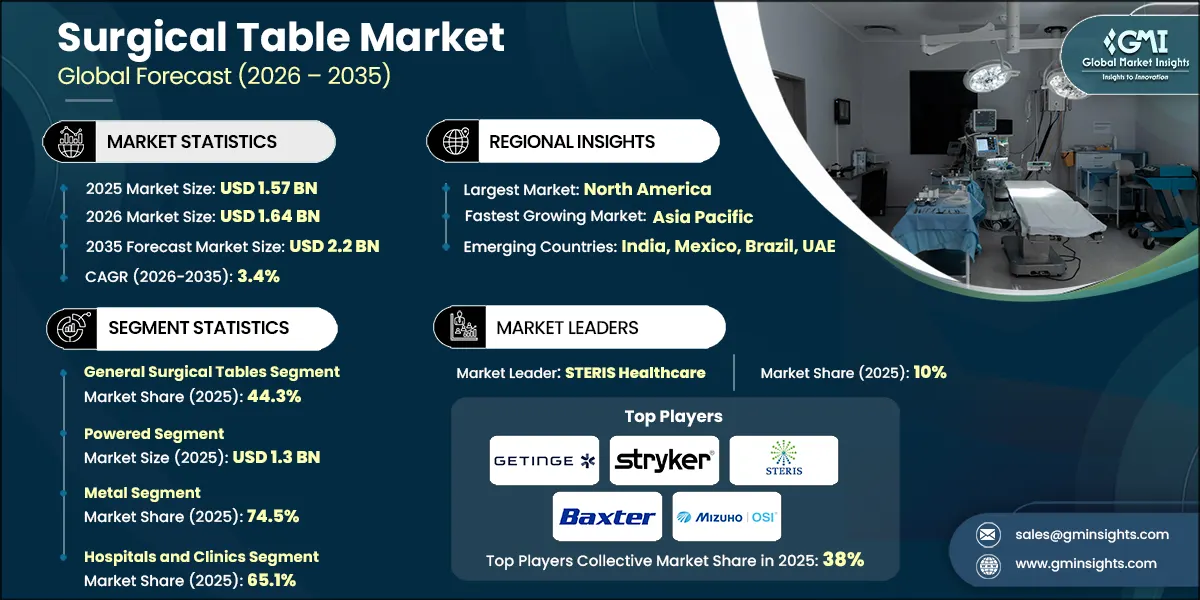
To get key market trends
Surgical Table Market Trends
Focus on ergonomics and patient safety, expansion of ambulatory surgical centers (ASCs), integration of surgical tables with imaging and robotic systems, shift toward minimally invasive surgeries, and increasing adoption of electrically powered surgical tables are among the key trends shaping the market growth.
- Table design innovations are strongly influenced by surgeons' comfort and patient outcomes. This includes the introduction of features such as greater weight capacity, pressure-relief surfaces, and ergonomic control systems to minimize long-term musculoskeletal stress on surgeons and complications resulting from surgery.
- Additionally, the rapid growth of outpatient & day-care surgical centers is creating an increased demand for compact, mobile & cost-effective surgical tables. Ambulatory surgery centers focus on speedy setup, versatility, and maximum use of space, creating a need for manufacturers to design flexible, modular tables specifically for such facilities.
- Further, there is a consistent rise in the adoption of real-time imaging in operating rooms for robotic-assisted surgeries. As a result, specially designed surgical tables that integrate seamlessly with C-arms, imaging systems, and robotic platforms are becoming more common as they increase accuracy in procedures and minimize patient repositioning.
- In addition, healthcare organizations are increasingly shifting from manual tables to electric, and electro-hydraulic (EH) tables to enhance efficiency and ergonomics for the surgeon. Electric operating tables have a smoother, more precise way of positioning the patient, reducing physical stress on staff, increasing patient safety, and improving intraoperative workflow, thereby supporting increased surgical capacity.
Surgical Table Market Analysis
Learn more about the key segments shaping this market
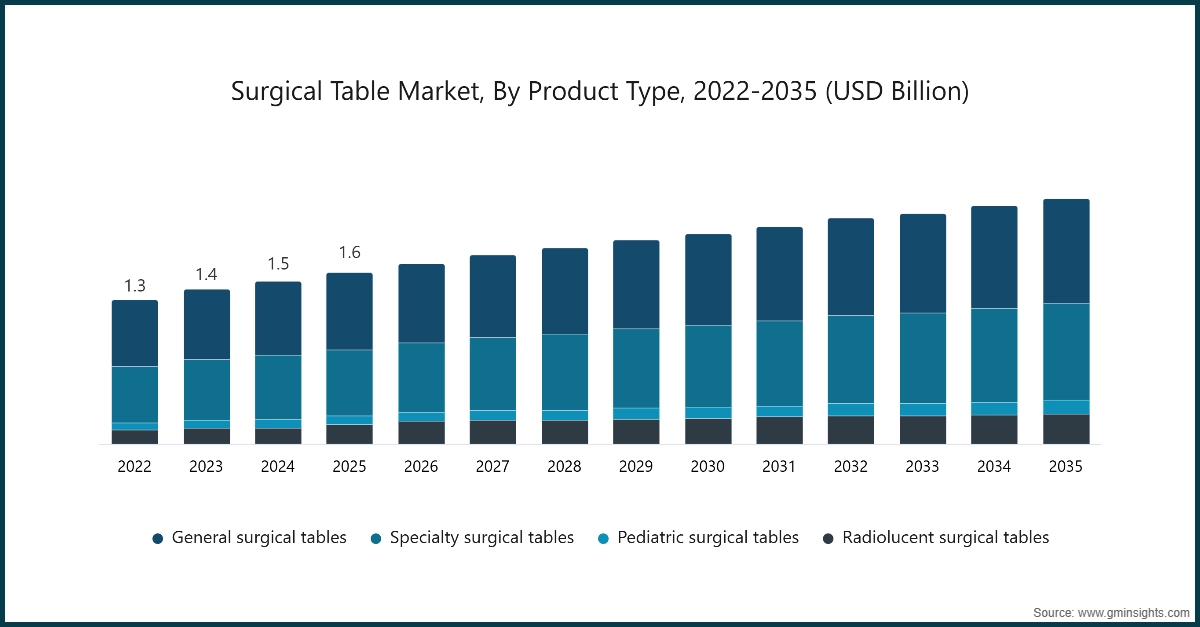
In 2022, the market was valued at USD 1.3 billion and grew to USD 1.4 billion in 2023, reaching USD 1.5 billion by 2024. Need for better patient positioning and safety coupled with innovation in lightweight and mobile surgical tables are among the key factors contributing to industry growth.
Based on product type, the global surgical table market is segmented into general surgical tables, specialty surgical tables, pediatric surgical tables, and radiolucent surgical tables. The general surgical tables segment accounted for a majority share of 44.3% in 2025. Demand for ergonomically designed surgical tables is anticipated to fuel the segmental growth. The segment is expected to reach USD 947.3 million by 2035, growing at a CAGR of 3% during the forecast period.
- General surgery tables have the largest installed base, supporting a very broad range of general surgical procedures, including abdomen, endocrine system, and vascular system, among other different minor interventions. Due to their versatility, flexible adjustable positioning, and compatibility with most standard surgical accessories, they are an essential item in both hospital and ambulatory surgical center settings.
- Further, continually evolving features in surgical tables such as electric controls, enhanced weight capacity, and improved ergonomics are further contributing to streamlining the workflow of these tables, facilitating surgical workflow in different types of environments.
- The specialty surgical tables segment was valued at USD 604.9 million in 2025. Various surgical procedures, such as orthopedic, neurosurgical, cardiovascular, spinal, and bariatric surgery, are guided by specialty surgical tables. These tables are used to achieve precise positioning of the patient and provide stability during surgery.
- Specialty surgical tables enable the use of advanced articulation and a higher load capacity as well as provide compatibility with imaging or robotic systems for complex interventions. The growth of specialty surgeries and minimal access surgical techniques has stimulated an increase in the demand for procedure-specific surgical tables throughout tertiary hospitals and specialty centers.
- Furthermore, while specialty surgical tables are more expensive than traditional surgical tables, they provide greater surgical accuracy, improved patient outcomes, and enhanced ergonomics for the surgeon, all of which are important aspects of modern surgery and the operation of high-acuity operating rooms.
Based on device type, the global surgical table market is segmented into powered, and non-powered. The powered segment accounted for a leading share and was valued at USD 1.3 billion in 2025.
- Modern operating rooms are increasingly using powered surgical tables due to their ability to provide better positioning than traditional mechanical tables and ease of use.
- Powered surgical tables allow users to make smooth and accurate adjustments, thus increasing the efficiency of surgical procedures. Powered surgical tables are now commonly used in many high-volume hospitals and specialty centers that perform complex and minimally invasive procedures.
- Additionally, powered tables are more compatible with imaging systems and have higher weight capacities than mechanical tables, as well as programmable controls, all of which add to the overall value of the powered surgical table.
- The non-powered segment was valued at USD 239.3 million in 2025. Non-powered versions, including manual and mechanically powered models, are frequently utilized in medical institutions due to cost factors. Key features such as basic functionality, durability, ease of use, and low acquisition and maintenance costs, add to the attractiveness of non-powered tables for small hospitals, clinics, and facilities with low surgical volume.
- Further, these are well-suited for use in developing regions, emergency or backup ORs where reliability and ease of maintenance are high priorities.
- Furthermore, affordable price and extended service life of the nonpowered surgical tables continue to drive overall demand from public healthcare systems.
Based on material, the global surgical table market is segmented into metal, and composite. The metal segment accounted for a dominating share of 74.5% in 2025.
- Due to their strength, durability, and cost-effectiveness, a significant percentage of healthcare facilities have traditionally utilized all-metal surgical tables. Made from stainless steel or aluminum, metal surgical tables have a high load-bearing capacity and provide excellent resistance to wear; therefore, they are commonly used for general surgical procedures.
- Additionally, metal surgical tables are also frequently seen at facilities in which imaging compatibility is not a major consideration. These tables are attractive options because they are generally less expensive and are easier to maintain than other surgical table materials.
- Thus, metal surgical tables continue to have a dominant share of total installations in many settings, including general surgery and the emerging market setting.
- The composite segment is expected to record the fastest growth with a CAGR of 3.9% over the forecast period. The use of composite surgical tables constructed with or having carbon fiber components is becoming more common in sophisticated surgical environments.
- Composite tables are substantially light radiolucent and are suitable for use with imaging equipment, such as C-arms and intraoperative CT scanners. Composite material allows for clear images to be obtained throughout a procedure without the need to reposition patients and is used to support minimally invasive surgery, orthopedic and spinal surgery.
- Composite surgical tables typically cost more than traditional metal tables but are being increasingly utilized in tertiary care hospitals and in specialty centers that focus on precision surgery and advanced surgical processes. Hence, the benefits provided by composite surgical tables are gradually replacing traditional metal surgical tables in high-end operating theatres.
Learn more about the key segments shaping this market
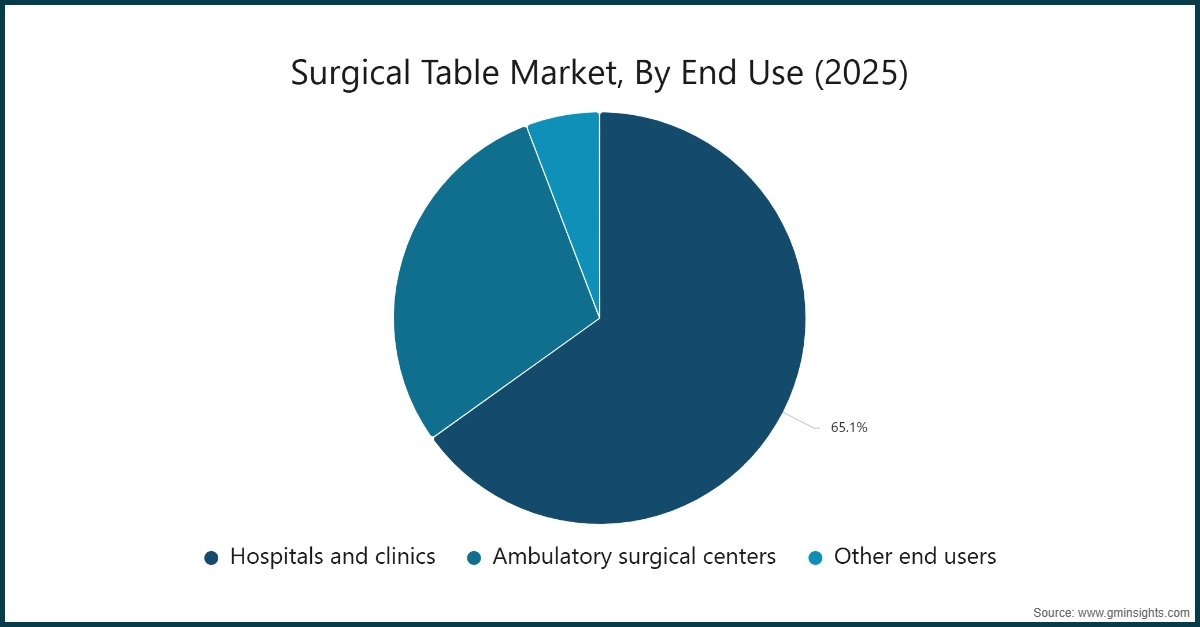
Based on end use, the surgical table market is segmented into hospitals and clinics, ambulatory surgical centers, and other end-users. The hospitals segment accounted for the leading market share of 65.1% in 2025.
- Surgical tables are predominantly used by hospitals and clinics because they offer a broad variety of types of operations performed with a large volume of procedures. These facilities require multiple table types, including general and specialty models, to support diverse surgical disciplines.
- Additionally, large hospitals are increasingly purchasing powered surgical tables that can be used with imaging equipment to improve efficiency and outcomes, while small emergency care clinics are focused on the need to have a general-purpose surgical table that is versatile, cost-efficient, and compatible with imaging equipment.
- Further, continued development of operating rooms may continue to provide the segment with ongoing and sustained demand for surgical tables.
- The ambulatory surgical centers segment was valued at USD 456.9 million in 2025. The market growth is being driven by the shift toward outpatient and same‑day surgeries. The design of potentially smaller, portable, and multi-configurational surgical tables supports the quick turnover of patients and maximizes the efficient use of space.
- In addition, mid-level powered and non-powered tables designed with the capability of performing multiple types of procedures in one table provide cost control for ASCs, which may influence the demand for these products.
- Moreover, as ASCs expand their global footprint and are performing more complex types of surgical procedures, the demand for ergonomic and durable tables that balance performance with operational efficiency continues to rise.
Looking for region specific data?
North America Surgical Table Market
North America market accounted for majority share of 35.1% in 2025 in the global surgical table industry and is anticipated to show notable growth over the forecast period.
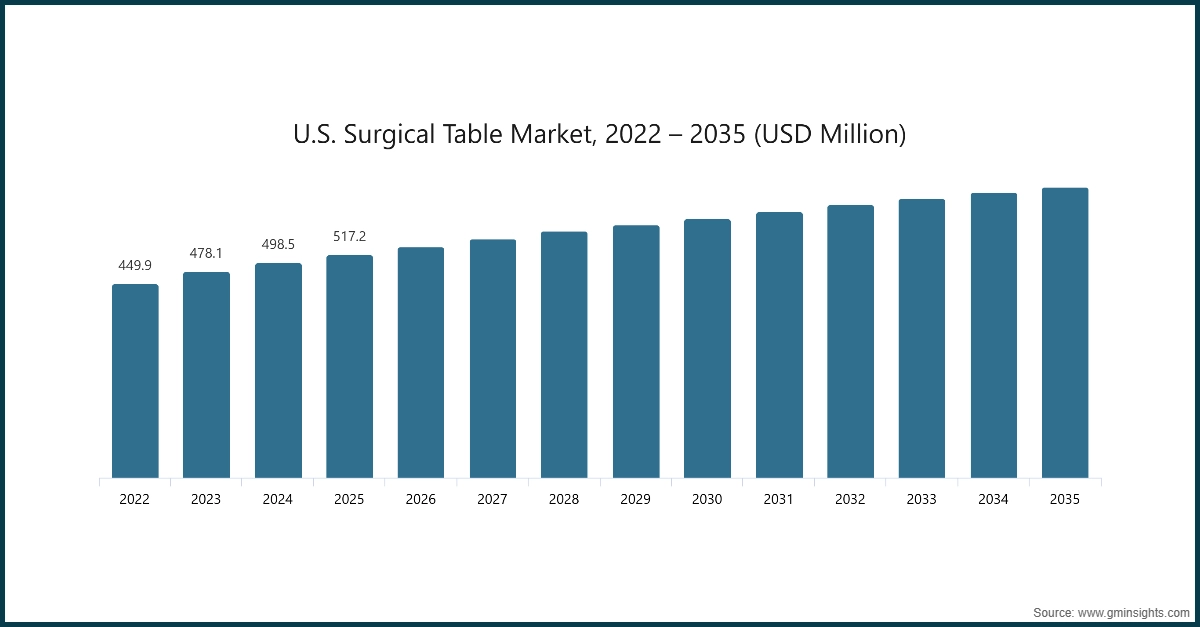
- The U.S. market was valued at USD 449.9 million and USD 478.1 million in 2022 and 2023, respectively. In 2025 the market size was valued at USD 517.2 million from USD 498.5 million in 2024. Increasing adoption of modular and customizable tables is projected to fuel the market growth.
- The North America surgical table industry is expanding due to factors including a large volume of surgeries performed, well-developed healthcare facilities, and the early adoption of innovative medical devices and technologies. The continued investment by hospitals & ambulatory surgical centers in electric and imaging-compatible surgical tables is supporting the growth of minimally invasive, orthopedic, and robotic-assisted surgical techniques. The replacement of old manual surgical tables that provide limited support for patient safety, surgeon ergonomics, or operating room efficiency is expected to continue with an emphasis on these factors being part of the decision-making process.
- Additionally, there are also a number of specialty hospitals and outpatient surgical centers in the region that have a higher number of surgical procedures requiring both versatile and procedure-specific table designs, which further supports the growth of surgical tables.
- In addition, the continued renovation of operating rooms, along with the introduction of improved workflow for digital surgery, may further increase demand for premium-quality surgical tables.
- Moreover, regulatory standards governing the design and performance of surgical devices and equipment as well as clinical practice guidelines may continue to promote the use of technologically advanced durable medical equipment, thereby supporting ongoing growth in the market in North America.
Europe Surgical Table Market
Europe accounted for a significant share of the global market and was valued at USD 455.6 million in 2025.
- Strongly established public health care systems and a commitment to high-quality and standardized surgical care are providing a strong foundation for the growth of surgical table sales in Europe. The increasing popularity and demand for both minimally invasive and specialty surgical procedures are encouraging hospitals to invest in new high-tech surgical tables that are capable of better positioning and greater imaging compatibility.
- Additionally, replacement purchases are anticipated to be a key contributor to growth, as health care systems work to replace their aging operating room infrastructure.
- Further, the growing focus on ergonomics and staff safety in hospitals may impact purchasing decisions, especially in high-volume hospitals. In terms of the sale of advanced systems, Western Europe is at the forefront, however, Central and Eastern regions are experiencing growth due to the modernization of health care infrastructure and expanded surgical capacity.
- Lastly, important factors that influence the market in terms of providing value to customers in both the premium and mid-range surgical table segments are cost efficiency and long-term durability.
Asia Pacific Surgical Table Market
The Asia Pacific market accounted for a substantial share of the market and was valued at USD 420.4 million in 2025.
- The market growth rate in the Asia Pacific region is among the fastest globally. Growth is attributed to improvements in the area’s infrastructure and increased surgical volume due to expanded access to surgical care. In addition, increased urbanization and population growth have increased the need for doctors, hospitals, specialty centers, and outpatient surgical facilities.
- Additionally, both the governments and private providers' continued investment in expanding operating rooms creates a strong demand for both manual and advanced surgical tables. In addition, increased medical tourism, primarily to countries known for lower-cost and higher-quality surgery, creates further demand for surgical tables within this region.
- Further, while premium care hospitals typically adopt electric or imaging-compatible surgical tables, facilities that are price-sensitive continue to create demand for manual and mid-range surgical table solutions.
Latin America Surgical Table Market
The Latin American market is anticipated to exhibit remarkable growth during the analysis period.
- Growth of the market in Latin America is supported by gradual improvements in healthcare infrastructure and increasing access to surgical services. Expansion of private hospitals and specialty clinics is creating new demand for operating room equipment, including surgical tables.
- Additionally, rising awareness of advanced surgical techniques is encouraging adoption of electrically powered and adjustable tables in urban healthcare facilities.
- Moreover, public healthcare investments and modernization of existing hospitals are also contributing to replacement demand. Overall, market growth is steady, with increasing preference for versatile surgical tables that balance functionality, reliability, and affordability.
Middle East and Africa Surgical Table Market
The Middle East and Africa market is expected to experience substantial growth over the analysis timeframe.
- The MEA surgical table industry is growing through infrastructure development, healthcare modernization, and increasing investments in hospital capacity. Middle Eastern countries are expanding advanced healthcare facilities and specialty hospitals, driving demand for technologically advanced surgical tables suited for complex procedures.
- Medical tourism and government-backed healthcare initiatives further support adoption of premium operating room equipment.
- Moreover, cost sensitivity remains high, favoring manual and mid-range tables, particularly in public hospitals. Overall, the region presents long-term growth opportunities as surgical access improves, and healthcare systems continue to evolve.
Surgical Table Market Share
The surgical table industry is moderately consolidated in nature. It features a combination of global medical technology companies and smaller specialty companies competing based on technology, price, application, and geographic presence. The major multinationals dominate the high-end market with electric and imaging-compatible surgical tables that integrate with larger operating room systems. Factors pushing this competition among large players include strong brand recognition, long-term hospital contracts, and bundled capital equipment offerings.
Additionally, mid-sized and niche players focus on procedure-specific tables, such as orthopedic, neurosurgical, or bariatric applications, differentiating through customization, precision positioning, and clinical specialization. These companies also distinguish themselves through product innovation and through collaborative efforts with surgeons rather than scale.
Further, technology-based differentiation has an increasing impact on the level of competition due to features including electro-hydraulic controls, carbon fiber tabletops, heavier weight capacities, compatibility with robotic and imaging systems, etc. In addition, as small and mid-sized hospitals and ASCs continue to utilize less expensive options for manual-style or mid-range tables, regional manufacturers find themselves staying competitive.
Furthermore, emerging markets are witnessing an increase in participation from local and regional manufacturers and operating at a lower cost, whereas global manufacturers have been able to expand their reach through distribution and localized manufacturing. Overall, competition within the industry is largely influenced by product innovation, versatility within the clinical space, after-sale service, and alignment with current and future surgical workflows.
Surgical Table Market Companies
Few of the prominent players operating in the global surgical table industry include:
- ALVO Medical
- AMTAI Medical Equipment, Inc.
- Baxter
- FAMED Lodz
- Getinge
- medifa GmbH
- Merivaara Corp
- Mizuho OSI
- Narang Medical Limited
- SKYTRON
- STERIS Healthcare
- Stille
- Stryker
- Baxter
Leverages its strong brand presence by offering reliable, standardized surgical tables aligned with broader acute care equipment solutions, focusing on safety, compatibility, and long-term customer relationships.
Strengthens its portfolio by integrating surgical tables with sterilization, operating room infrastructure, and workflow solutions, positioning itself as a comprehensive partner for surgical environment optimization.
Specializes in procedure-specific surgical tables and patient positioning systems, particularly for orthopedic and neurosurgery, targeting high-acuity hospitals requiring precision, customization, and advanced positioning capabilities.
Surgical Table Market Report Attributes
| Key Takeaway | Details |
|---|---|
| Market Size & Growth | |
| Base Year | 2025 |
| Market Size in 2025 | USD 1.57 Billion |
| Market Size in 2026 | USD 1.64 Billion |
| Forecast Period 2026-2035 CAGR | 3.4% |
| Market Size in 2035 | USD 2.2 Billion |
| Key Market Trends | |
| Drivers | Impact |
| Rising number of surgical procedures globally | Directly increases demand for surgical tables across specialties, expanding installed base and accelerating replacement cycles in operating rooms. |
| Technological advancements in surgical tables | Encourages hospitals to upgrade legacy equipment, improving surgical precision, workflow efficiency, and compatibility with modern operating room technologies. |
| Rising healthcare expenditure coupled with improving infrastructure in emerging markets | Supports expansion of operating rooms and surgical capacity, driving first-time procurement of surgical tables across public and private facilities. |
| Increasing number of hospitals and ambulatory surgical centers | Creates steady demand for new surgical tables, particularly versatile and space-efficient models suited for high-volume surgical environments. |
| Pitfalls & Challenges | Impact |
| High cost of composite surgical tables | Limits adoption among cost-sensitive hospitals, delaying upgrades and favoring basic or refurbished tables over advanced composite models. |
| Opportunities: | Impact |
| Growing demand for electric and hybrid surgical tables | Will accelerate market growth as providers prioritize automation, ergonomics, and multi-procedure compatibility to improve surgical efficiency and staff safety. |
| Rising medical tourism in emerging economies | Expected to boost demand for advanced surgical tables as hospitals upgrade infrastructure to attract international patients and perform complex procedures. |
| Market Leaders (2025) | |
| Market Leader |
Market Share for STERIS Healthcare is 10% |
| Top Players |
Top 5 Players Collective Market Share is 38% |
| Competitive Edge |
|
| Regional Insights | |
| Largest Market | North America |
| Fastest growing market | Asia Pacific |
| Emerging countries | India, Mexico, Brazil, UAE |
| Future outlook |
|
What are the growth opportunities in this market?
Surgical Table Industry News
- In January 2025, Mindray announced the launch of the HyBase V6 Surgical Table. The HyBase V6 Surgical Table advances surgical innovation with enhanced versatility and precision. This development resulted in the entry of Mindray North America into the surgical table market and expanded its innovative portfolio in the operating room (OR) space.
- In August 2024, Getinge announced the launch of an operating room table and surgical light for the medtech market in India. The introduction of Maquet Corin, a state-of-the-art operating room (OR) table, offers an intuitive and simple interface that aims to streamline workflow and enhance teamwork among surgical staff. This product launch improved the company's presence in the Indian market.
- In February 2023, Baxter and Intuitive partnered to develop a surgical table designed for the da Vinci Xi System. The jointly developed product, the TS7000dV Surgical Table, by Baxter and Intuitive, was designed to lessen some of the challenges surgeons face during procedures.
The global surgical table market research report includes an in-depth coverage of the industry with estimates and forecasts in terms of revenue in (USD Million) and volume (Units) from 2022 - 2035 for the following segments:
Market, By Product Type
- General surgical tables
- Specialty surgical tables
- Bariatric
- Neurology
- Urology
- Orthopedic
- Other specialty surgical tables
- Pediatric surgical tables
- Radiolucent surgical tables
Market, By Device Type
- Powered
- Electric
- Hydraulic
- Hybrid
- Non-powered
Market, By Material
- Metal
- Composite
Market, By End Use
- Hospitals and clinics
- Ambulatory surgical centers
- Other end-users
The above information is provided for the following regions and countries:
- North America
- U.S.
- Canada
- Europe
- Germany
- UK
- France
- Spain
- Italy
- Netherlands
- Asia Pacific
- China
- Japan
- India
- Australia
- South Korea
- Latin America
- Brazil
- Mexico
- Argentina
- MEA
- South Africa
- Saudi Arabia
- UAE
Frequently Asked Question(FAQ) :
What is the market size of the surgical table market in 2025?
The global market size was estimated at USD 1.57 billion in 2025. The market growth is driven by the rising number of surgical procedures worldwide, expanding healthcare infrastructure, and increasing adoption of advanced operating room equipment across hospitals and ambulatory surgical centers.
What is the current surgical table market size in 2026?
The surgical table industry is projected to reach USD 1.64 billion in 2026. Growth is supported by continued investments in operating room modernization, increasing demand for powered tables, and expansion of surgical capacity in emerging markets.
What is the projected value of the surgical table market by 2035?
The market is expected to reach USD 2.2 billion by 2035, growing at a CAGR of 3.4% during 2026–2035. Industry expansion is fueled by technological advancements such as electric and imaging-compatible tables, rising chronic disease burden, and growing preference for minimally invasive and robotic-assisted surgeries.
How much revenue did the general surgical tables segment generate in the surgical table market?
The general surgical tables segment accounted for 44.3% share of the market in 2025 and is expected to reach USD 947.3 million by 2035. Segment growth in the surgical table industry is driven by its wide application across multiple surgical disciplines and strong installed base in hospitals and ambulatory surgical centers.
What was the valuation of the powered device type segment in the surgical table industry in 2025?
The powered segment was valued at USD 1.3 billion in 2025, leading the market. Increasing adoption of electric and electro-hydraulic tables in the market due to improved ergonomics, workflow efficiency, and compatibility with imaging systems is accelerating segment growth.
What is the growth outlook for composite surgical tables in the surgical table market during the forecast period?
The composite segment in the market is projected to grow at a CAGR of 3.9% through 2035. Rising use of carbon fiber radiolucent tables for minimally invasive, orthopedic, and spinal procedures is driving demand across advanced surgical environments within the market.
Which region leads the surgical table market?
North America accounted for 35.1% share of the global market in 2025. The U.S. surgical table industry was valued at USD 517.2 million in 2025, driven by high surgical volumes and increasing adoption of modular, imaging-compatible, and electric surgical tables.
What are the upcoming trends in the market?
Key trends in the surgical table industry include growing adoption of electrically powered tables, integration with imaging and robotic systems, expansion of ambulatory surgical centers, and increasing focus on surgeon ergonomics and patient safety. Additionally, demand for radiolucent composite materials and modular designs is reshaping product innovation strategies.
Who are the key players in the surgical table industry?
Key companies operating in the industry include Getinge, Stryker, STERIS Healthcare, Baxter, MIZUHO OSI, ALVO Medical, Merivaara Corp, medifa GmbH, SKYTRON, and Stille. These market participants focus on product innovation, imaging integration, geographic expansion, and strategic partnerships to strengthen their competitive position.
Surgical Table Market Scope
Related Reports