Summary
Table of Content

Sunglasses Market
Get a free sample of this report
Form submitted successfully!
Error submitting form. Please try again.
Thank you!
Your inquiry has been received. Our team will reach out to you with the required details via email. To ensure that you don't miss their response, kindly remember to check your spam folder as well!
Request Sectional Data
Thank you!
Your inquiry has been received. Our team will reach out to you with the required details via email. To ensure that you don't miss their response, kindly remember to check your spam folder as well!
Form submitted successfully!
Error submitting form. Please try again.
Sunglasses Market Size
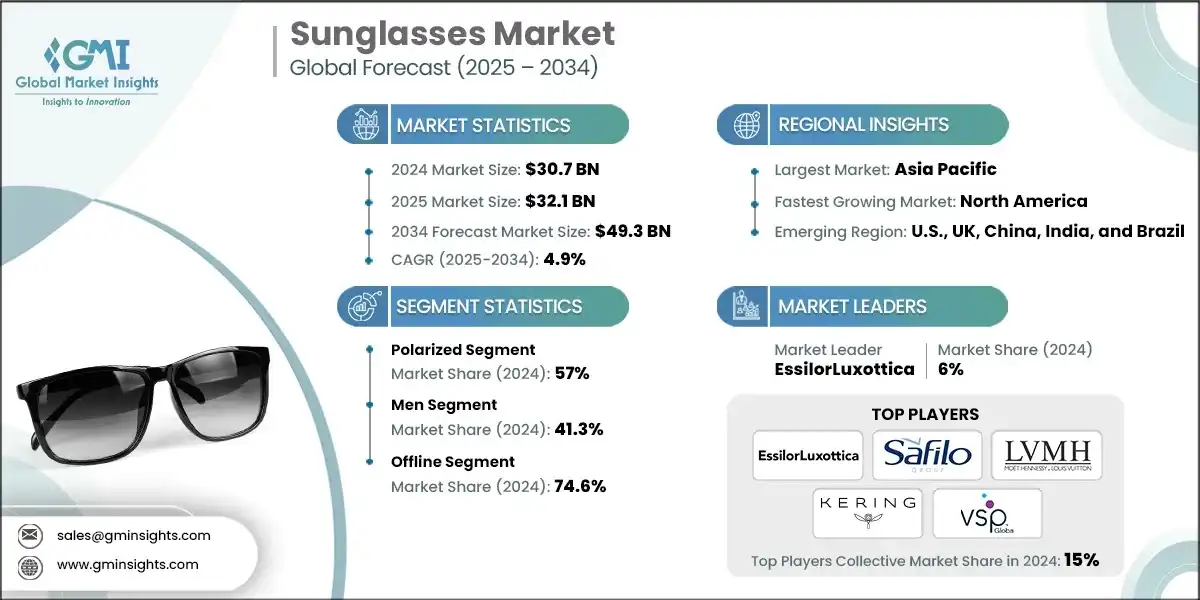
The global sunglasses market was estimated at USD 30.7 billion in 2024. The market is expected to grow from USD 32.1 billion in 2025 to USD 49.3 billion in 2034, at a CAGR of 4.9%, according to Global Market Insights Inc.
Sunglasses Market Key Takeaways
Market Size & Growth
- 2024 Market Size: USD 30.7 Billion
- 2034 Forecast Market Size: USD 49.3 Billion
- CAGR (2025–2034): 4.9%
Key Market Drivers
- Rising consumer focus on eye health and UV protection.
- Growing fashion and lifestyle appeal.
- Expansion of e-commerce and omnichannel retailing.
Challenges
- High competition and market saturation.
- Economic sensitivity and fluctuating disposable income.
Opportunity
- Rising focus on eye health and UV protection..
- Demand for eco-friendly sunglasses.
Key Players
- Market Leader: EssilorLuxottica led with over 6% market share in 2024.
- Leading Players: Top 5 players in this market include EssilorLuxottica, Safilo Group, LVMH Moët Hennessy Louis Vuitton, Kering SA, VSP Global, which collectively held a market share of 15% in 2024.
Get Market Insights & Growth Opportunities
- The sunglasses industry is on an incredible growth trajectory with improved customer awareness of eye health and UV protection driving demand for protective eyewear. Furthermore, fashion accessories and customized sunglasses is becoming more popular so there is growing demand for stylish protective eyewear. Leading advances in the sunglasses industry include the mass production of photochromic and polarized lenses, the use of lightweight yet durable materials, and new technologies such as smart sunglasses that include wearable technology.
- In 2024, manufacturers are focused on producing sustainable and eco-friendly products while innovating the online shopping experience using digital widgets such as try-ons and virtual recommendations. The sunglasses market is ongoing through technological innovation, growing user-affinity for sustainability, and experience-based consumer marketing that centers around combination of both health protection and style at an affordable price point. Brands are trying to engage consumers through better designs, deliberately high levels of storytelling and migrating towards omnichannel options to enhance customer loyalty in a crowded market.
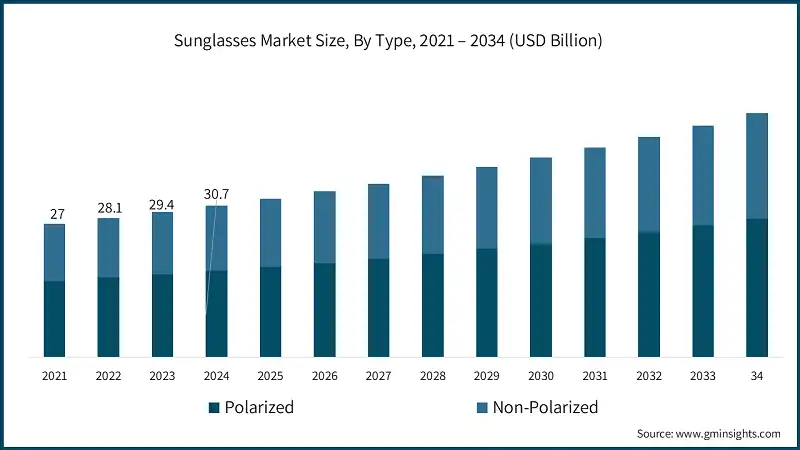
- The sunglasses market has grown from USD 27 billion in 2021, due to rising awareness of protecting eye health, combined with the knowledge of the harmful UV effects. More brands are emphasizing fashion accessories and creating demand for stylish personalized sunglasses. There continue to be huge technological improvements which include the production of polarized and photochromatic lenses. Sustainable innovations have also helped to develop eco-friendly products, which are even more attractive for the consumers.
- In the sunglasses industry, the polarized segment is the dominant segment, because of their incredible glare reduction and UV protection quality, which enhances visual comfort and safety when engaged in an outdoor activity. Rising awareness of eye health benefits has made polarized sunglasses the superior option to non-polarized sunglasses.
- The Asia Pacific leads the sunglasses market due to the large and growing population, rising disposable incomes and rapid urbanization. There is an increasing awareness of fashion and a focus on eye health from consumers, especially younger consumers. There has also been an increase in e-commerce platforms and outdoor recreational activities which impacted sales in Asia Pacific and resulted in the largest market and dominated region globally.
- North America is the fastest-growing region in the sunglasses market due to increasing consumer awareness about eye health and UV Protection along with demand for premium and designer eyewear in relation to eye health. The region has many demographic advantages, comparatively high disposable incomes, growing adoption of advanced lens technologies, and an increasing popularity of outdoor activities. The development and rising consumer usage of e-commerce platforms which offer purchasing sunglasses will further facilitate the market topical trends.
To get key market trends
Sunglasses Market Trends
- The sunglasses industry is rapidly shifting to polarized and UV-protective lenses, as consumers become aware of their eye health. Brands that offer these technologies with style have succeeded in taking mileage from the trend. This trend is a result of a general increase in outdoor activity along with public health initiatives that emphasize preventing UV damage. The demand for polarized and UV protective sunglasses has been gradually increasing since the early 2020's and is projected to steadily increase through the next decade.
- Sustainability is becoming a fundamental principle in the sunglasses space, with a growing number of brands adopting recycled, biodegradable, sustainable and eco-friendly materials in their products. Today's consumers are increasingly open to buying products that match their environmental values, and sustainability is being used as a differentiator through social responsibility and transparency. Sustainability has been a central theme for some time now. Sustainability is expected to become a common characteristic of sunglasses by mid-2020's as consumer awareness increases and the world's governments tighten environmental regulations.
- E-commerce is growing fast and advancements in virtual try-on technology are changing the way consumers buy sunglasses. Digital tools enable consumers to view how frames fit and look, which minimizes hesitation and adds confidence in purchasing when shopping on what it's like to buy sunglasses. The pandemic accelerated the trend, and it is expected to continue and grow throughout the 2020's, with brands investing in an online shopping experience without the pain points often many consumers perceive to shopping online.
- Fashion and personalization are gaining more traction in the sunglasses sector, as consumers continue to seek sunglasses that showcase their personal style. Companies offer customized frames, lenses, and exclusive collections according to market needs. This trend also has been developing in the last few years, and it will be yet another attributed force that pushes consumers to want more individuality and more newness in their accessories.
Sunglasses Market Analysis
Learn more about the key segments shaping this market
Based on type, the market is segmented into polarized and non-polarized. In 2024, the polarized segment dominates the market with 57% market share, and the segment is expected to grow at a CAGR of 4.9% from 2025 to 2034.
- The polarized segment is the most significant segment of the sunglasses market because they provided much higher glare reduction characteristics and UV protection, improving visual comfort and safety with outdoor tasks, ranging from driving to sporting activities. It is expected that consumer knowledge around eye care will drive further demand.
- Polarized lenses offer improved visual acuity and eye protective value versus non-polarized sunglasses, particularly in bright or reflective environments. Thus, polarized lenses are in the lead in market potential growth and consumer preference while non-polarized lens choices remain high regarding personal preference with respect to style and price. The non-polarized segment accounts for 43% of the market share and is to grow at CAGR 5%.
Learn more about the key segments shaping this market
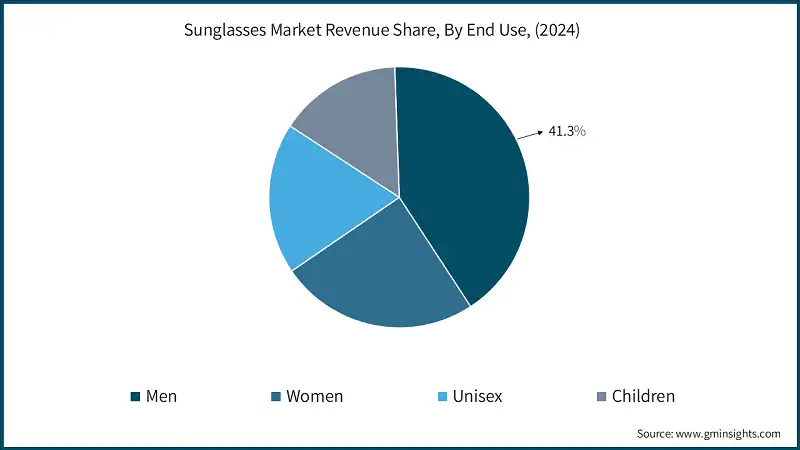
Based on end use, the sunglasses market is segmented into men, women, unisex and children. In 2024, the men segment dominates the market with 41.3% market share, and the segment is expected to grow at a CAGR of 5% from 2025 to 2034.
- The men’s segment dominates the sunglasses industry, driven by upward shifts in awareness about eye protection, growth in outdoor activities, and increasing preference for functional and stylish eyewear. There is also strong market demand for performance and sports sunglasses.
- Comparatively, the women's, unisex, and children's segments place greater importance on fashion and versatility within the multipliers. The women's and unisex segments continue to have strong growth rates as the style trends are part of the marketplace, whereas although still small, the children's segment is also experiencing expansion from greater parental emphasis on UV protection and safety.
- In this market, unisex segment accounts for 18.8% of the market share and is to grow at CAGR 5.4%.
Based on the distribution channel, the sunglasses market is segmented as online and offline. In 2024, the offline segment dominates the market with 74.6% market share, and the segment is expected to grow at a CAGR of over 4.7% from 2025 to 2034.
- The offline segment dominates the market due to the personal shopping experience, the ability to try a product before buying, and the availability and wide distribution of retail and specialist stores. Customers build trust, which leads to strong growth in sales.
- The online segment offers convenience and more variability in products but has challenges, like not having a try on option, and worry about fit and authenticity. Overall, an increasing trend in e-commerce buying and virtual try on technologies are increasing online sales and growing acceptance. In this market, online segment accounts for 25.4% of the market share and is to grow at CAGR 5.5%.
Looking for region specific data?
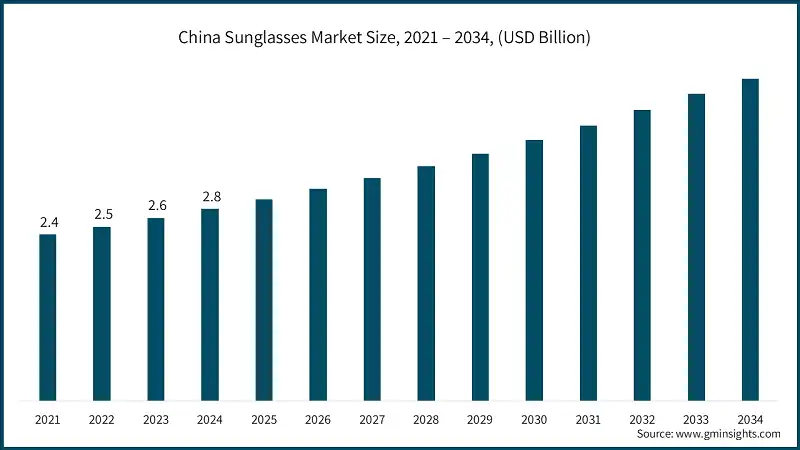
In Asia Pacific China dominated the sunglasses market with around 28.8% market share and estimated to reach revenue of USD 4.6 billion by 2034.
- China dominates the market due to massive population and fast urbanization which creates demand for products related to lifestyle and fashion. A rising disposable income and growing middle class have enabled many consumers to spend on sunglasses, while greater awareness of eye health and UV protection, and an expanding retail and e-commerce distribution network, provide China with a strong position within and ongoing growth in the sunglasses category.
In Europe, the Germany sunglasses market is expected to experience significant growth and promising growth from 2025 to 2034.
- Germany’s sunglasses industry is poised for significant growth from 2025 to 2034, driven by high consumer awareness of eye health and fashions. Additionally, better purchasing power due to wealthier aging population and demand for high-quality and sustainable products fuel demand.
- The retail infrastructure in Germany is already solid, and e-commerce growth is expected to continue. All these factors offer a great market in Germany, which should be an important and growing market for both global and local eyewear brands in Europe.
In North America, U.S. sunglasses market is expected to experience significant growth and promising growth from 2025 to 2034.
- The U.S. market is poised for significant growth due to an increase in consumer awareness of eye health and UV protection. Due to strong disposable income, a large and diverse population, and a strong outdoor sports culture in the U.S., there is support for increased demand for sunglasses.
- Supporting the increase in demand is innovation in lens technology, an increase in premium and designer brands, retail and e-commerce access, and increasing fashionable and sustainable trends, which will help to ensure the U.S. market remains influential.
In MEA, the South Africa sunglasses market is expected to experience significant growth and promising growth from 2025 to 2034.
- South Africa’s market is poised for significant growth, driven by increasing urbanization and disposable income. With rising consumer awareness of the harmful impact of UV exposure, along with outdoor lifestyle culture, the demand for protective eyewear is advancing.
- The growing retail networks and e-commerce will make sunglasses more accessible to consumers. This market will also benefit from the large young population embracing fashion trends, with South Africa becoming a pivotal growth source in the MEA region.
Sunglasses Market Share
EssilorLuxottica leads with 6% market share due to their high-quality pigments and wide range of unique, artist-preferred colors. The top 5 companies are EssilorLuxottica, Safilo Group, LVMH Moët Hennessy Louis Vuitton, Kering SA, and VSP Global, collectively hold 15% of the market, indicating fragmented market concentration.
- EssilorLuxottica is one of the key global players in the eyewear sector, combining Essilor's lens technologies expertise with Luxottica's extensive retail and frame manufacturing presence. They have a dominant position in the sunglasses sector with their many premium and luxury brands. Their strength is in their ability to package stylish products with advanced lens technology supported by a vertically aligned supply chain through a global retail presence which to brands like Sunglass Hut to create an experience.
- Safilo Group designs, produces and distributes premium sunglasses and optical frames including licensed luxury brands like Dior, Fendi and Hugo Boss. Their unique selling proposition is emphasis on making careful and attractive products supported by a unique emphasis on innovation through licensing. Safilo has a strong focus around economic responsibility and sustainability and plans to suppress planned obsolescence and manufacturing waste.
- LVMH operates across the sunglasses segment throughout its family of luxury fashion brands such Louis Vuitton, Dior and Celine. LVMH positional strength comes from its luxury stature, exclusiveness, high fashion design and high- quality craftsmanship. Their key strategy relies heavily on chief attributes including brand ethos and heritage, innovation in design, uniqueness of products through exclusivity including limited editions and high-quality exclusive materials.
- Kering is a parent company of numerous luxury eyewear brands like Gucci, Saint Laurent, and Balenciaga. Their strategy leverages unique fashion house origins to deliver eye-catching and trendsetting designs while taking an eco-conscious stance, using sustainable materials and methods of production in their eyewear. Kering crafts eyewear with strong brand recognition that is both a statement design piece and responsible luxury.
- VSP Global is primarily an eye care services company that branched out into eyewear by supplying private label sunglasses and frames and selling branded sunglasses and other eyewear. They have established a unique position by linking eye care service and eyewear products, which offers them unique sales possibilities with personalized vision solutions and added value in market saturation in the eye care space.
Sunglasses Market Companies
Major players operating in the sunglasses industry are:
- EssilorLuxottica
- Fielmann
- Johnson & Johnson Vision Care
- Luxottica Group
- Kering SA
- LVMH Moet Hennessy Louis Vuitton
- Marchon Eyewear
- Marcolin
- Michael Kors Holdings
- Oakley
- Quay Australia
- Safilo Group
- VSP Global
- Warby Parker
- Zenni Optical
- EssilorLuxottica has a myriad of sunglasses brands in its portfolio, such as Ray-Ban, Oakley, as well as Persol, and its retail presence at points of sale is very large Sunglass Hut, LensCrafters, etc. It has a strong financial position with revenues greater than USD 27 billion annually and is presently the industry leader financially and with design, integrating technical lens manufacturing with fashionable framed sunglasses. Recently it has innovated with the launch of Ray-Ban Meta smart glasses in connection with Meta to offer designer augmented reality eyewear. The established vertically integrated supply chain and retail stores contribute to its ability to innovate quickly and release its products globally.
- Safilo Group is the premier Italian eyewear manufacturer with a longstanding history of design and craftsmanship with revenue exceed USD 660 million. Safilo has a wide portfolio of owned and licensed brands, such as Carrera and Polaroid, as well as higher end brands, such as Levi's and Hugo Boss. One of the more recent sustainability strategies at Safilo was the launch of sunglasses from ocean plastics, consistent with the emphasis on brands to be responsible for what they sell to consumers. We also found that Safilo had undertaken a transition to digital to improve customer experience, and to streamline its business operations. In an environment of competitors creating products while being socially responsible and innovative, Safilo's thoughtful approach to brand management sets it apart from the competition.
Sunglasses Market Report Attributes
| Key Takeaway | Details |
|---|---|
| Market Size & Growth | |
| Base Year | 2024 |
| Market Size in 2024 | USD 30.7 Billion |
| Forecast Period 2025 - 2034 CAGR | 4.9% |
| Market Size in 2034 | USD 49.3 Billion |
| Key Market Trends | |
| Drivers | Impact |
| Rising consumer focus on eye health and UV protection | Boosts demand of high-quality, functional sunglasses. |
| Growing fashion and lifestyle appeal | Increase impulse purchases and brand-driven buying behavior. |
| Expansion of e-commerce and omnichannel retailing | Enhances market reach and convenience, driving sales growth. |
| Pitfalls & Challenges | Impact |
| High competition and market saturation | Pressures pricing and brand differentiation. |
| Economic sensitivity and fluctuating disposable income | Reduces consumer spending on non-essential eyewear. |
| Opportunities: | Impact |
| Rising focus on eye health and UV protection. | Encourages innovation in protective lens technologies. |
| Demand for eco-friendly sunglasses | Opens new market segments and strengthens brand image. |
| Market Leaders (2024) | |
| Market Leaders |
6% market share |
| Top Players |
Collective market share in 2024 is 15% |
| Competitive Edge |
|
| Regional Insights | |
| Largest Market | Asia Pacific |
| Fastest Growing Market | North America |
| Emerging Country | U.S., UK, China, India, and Brazil |
| Future Outlook |
|
What are the growth opportunities in this market?
Sunglasses Industry News
- In July 2025, Johnson & Johnson announced that they will participate in the Morgan Stanley 23rd Annual Global Healthcare Conference. During which company leadership will participate in a Fireside Chat to discuss strategic priorities related to vision care products, advances, including eye health and eye protection products. Participating will allow Johnson & Johnson to discuss their recent updates and outlook on consumers in the eyewear and sunglass category.
- In September 2024, Italian eyewear manufacturer Marcolin entered into an exclusive multi-year licensing agreement with the American fashion retailer Abercrombie & Fitch Co. (ANF.N). Under this agreement, Marcolin will produce and distribute a new line of sunglasses and optical frames under the Abercrombie & Fitch brand.
- In October 2024, EssilorLuxottica acquired the Supreme® brand from VF Corporation, a prominent company in branded lifestyle apparel, footwear, and accessories. The acquisition aligns with EssilorLuxottica’s strategic goal to diversify its brand portfolio by integrating a prominent name in streetwear with a strong following among young, fashion-forward consumers.
- In July 2024, Fielmann Group completed the acquisition of U.S. based Shopko Optical entering them to be more globally represented in the North America sunglasses and eyewear markets. With integration of Shopko, Fielmann raised their revenue forecast for 2024 to a prospective €2.3 billion. Former Shopko CEO Russ Steinhorst was hired as CFO of the newly formed Fielmann USA, maintaining a structured thinking leadership sequence as the brand moved to strengthen their omnichannel presence in the U.S. market.
The sunglasses market research report includes in-depth coverage of the industry, with estimates & forecasts in terms of revenue (USD Billion) and Volume (Million Units) from 2021 to 2034, for the following segments:
Market, By Type
- Polarized
- Non-polarized
Market, By Frame Material
- Plastic
- Metal
- Others
Market, By Lens Material
- CR-39 (allyl diglycol carbonate)
- Polycarbonate
- Polyurethane
- Others (glass, etc.)
Market, By Coating
- Anti-reflective coating
- Scratch-resistant coating
- UV protection
- Blue light filtering
- Others
Market, By Design style
- Full rim
- Half rim
- Rimless
Market, By Price
- Low
- Medium
- High
Market, By Application
- Sports
- Fashion
- Safety/protective (e.g., industrial, lab)
- Prescription eyewear
- Reading glasses
- Driving glasses
Market, By End Use
- Men
- Women
- Unisex
- Children
Market, By Distribution Channel
- Online
- E-commerce
- Company website
- Offline
- Specialty store
- Hypermarket/supermarket
- Retailers
The above information is provided for the following regions and countries:
- North America
- U.S.
- Canada
- Europe
- Germany
- UK
- France
- Italy
- Spain
- Asia Pacific
- China
- Japan
- India
- South Korea
- Australia
- Latin America
- Brazil
- Mexico
- Argentina
- MEA
- South Africa
- Saudi Arabia
- UAE
Frequently Asked Question(FAQ) :
What is the market size of the sunglasses industry in 2024?
The global market size for sunglasses was valued at USD 30.7 billion in 2024, with a CAGR of 4.9% expected through 2034 driven by rising fashion appeal, lifestyle demand, and awareness of UV protection.
What is the current sunglasses market size in 2025?
The market size for sunglasses is projected to reach USD 32.1 billion in 2025.
What is the projected value of the sunglasses market by 2034?
The sunglasses industry is expected to grow to USD 49.3 billion by 2034, fueled by innovations like smart sunglasses, polarized lenses, and eco-friendly materials.
How much revenue did the polarized sunglasses segment generate in 2024?
The polarized segment held a 57% market share in 2024.
What was the valuation of the offline distribution channel in 2024?
The offline segment dominated with 74.6% market share in 2024.
What is the growth outlook for the online distribution channel from 2025 to 2034?
The online segment is projected to grow at a 5.5% CAGR through 2034.
Which region leads the sunglasses market?
The Asia Pacific region dominated in 2024, led by China with 28.8% share and a projected USD 4.6 billion by 2034. Growth is driven by a large consumer base, rising disposable incomes, and strong e-commerce adoption.
What are the upcoming trends in the sunglasses industry?
Key trends include adoption of sustainable and eco-friendly materials, expansion of smart sunglasses, personalized frame designs, and growth in omnichannel retailing.
Who are the key players in the sunglasses market?
Major players include EssilorLuxottica, Safilo Group, LVMH Moët Hennessy Louis Vuitton, Kering SA, VSP Global, Fielmann, Marcolin, Johnson & Johnson Vision Care, Warby Parker, and Zenni Optical.
Sunglasses Market Scope
Related Reports