Summary
Table of Content

Structured Cabling Market
Get a free sample of this report
Form submitted successfully!
Error submitting form. Please try again.
Thank you!
Your inquiry has been received. Our team will reach out to you with the required details via email. To ensure that you don't miss their response, kindly remember to check your spam folder as well!
Request Sectional Data
Thank you!
Your inquiry has been received. Our team will reach out to you with the required details via email. To ensure that you don't miss their response, kindly remember to check your spam folder as well!
Form submitted successfully!
Error submitting form. Please try again.
Structured Cabling Market Size
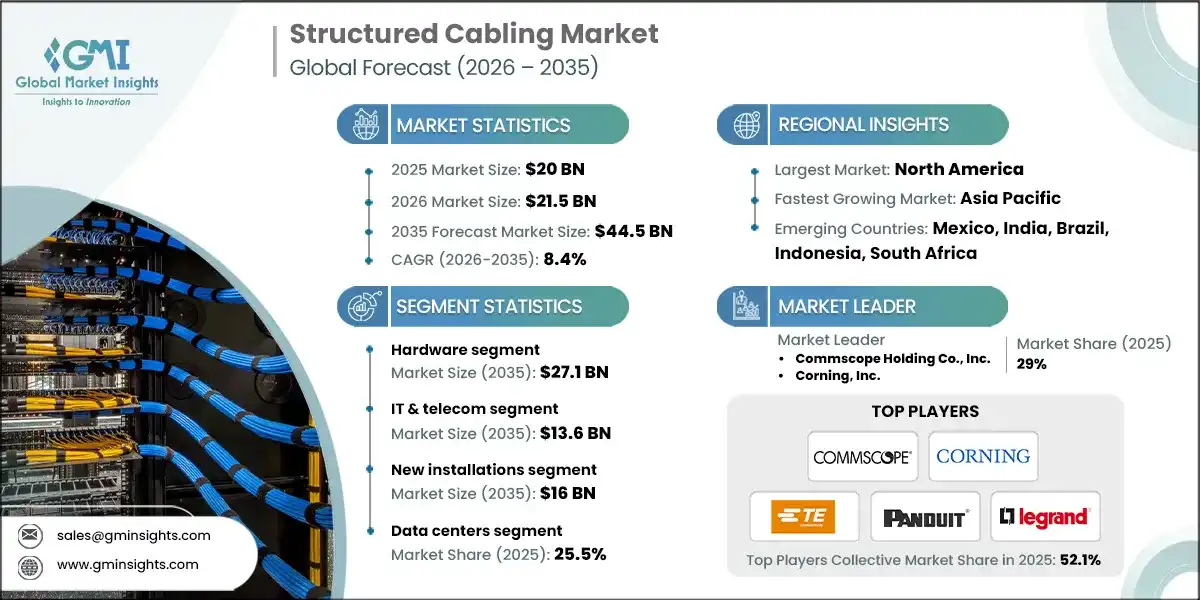
The global structured cabling market was valued at USD 20 billion in 2025. The market is expected to grow from USD 21.5 billion in 2026 to USD 31.8 million by 2031 and USD 44.5 billion by 2035, growing at a CAGR of 8.4% during the forecast period of 2026-2035.
To get key market trends
- The structured cabling market is fueled by growing data centers, high-speed networks, IoT adoption, and the expansion of 5G and edge computing, driving demand for scalable and high-performance network infrastructure.
- The increasing establishment of data centers and cloud-based services is leading to excessive data traffic and the demand for performance structured cabling to provide the necessary flexibility and dependable connectivity within the enterprise and industrial networks of emerging economies such as India. According to IBEF, India's value of data center was estimated to reach USD 4.5 billion in 2023, and USD 11.6 billion by 2032. Thus, the rapidly escalating demand compels manufacturers to design and offer modular, high capacity and future-proof data cabling solutions for the market.
- The primary driver for the structured cabling market is the unprecedented expansion of the IoT, connected devices, and smart building deployments. There is a growing need for easily-accessible, rapid, and adaptable network infrastructure as GSMA Intelligence forecasts over 38 billion IoT connections by 2030. As smart buildings continue to evolve, structured cabling solutions will provide seamless connectivity and efficient data transmission and support for sophisticated ecosystems. This will be a vital component for businesses and digital industrial complexes.
- In 2025, North America accounted for 38.2% share of the structured cabling market. In North America, factors such as rapid data center expansion, increased adoption of IoT and smart building technologies, and modernization of legacy network infrastructure are driving the market. The continuing demand for high-speed connectivity, cloud services, and networking solutions for enterprises are driving investments into newer cabling technologies within the commercial and industrial marketplace.
Structured Cabling Market Report Attributes
| Key Takeaway | Details |
|---|---|
| Market Size & Growth | |
| Base Year | 2025 |
| Market Size in 2025 | USD 20 Billion |
| Market Size in 2026 | USD 21.5 Billion |
| Forecast Period 2026 - 2035 CAGR | 8.4% |
| Market Size in 2035 | USD 44.5 Billion |
| Key Market Trends | |
| Drivers | Impact |
| Expansion of data centers and cloud infrastructure | The expansion of data centers and cloud infrastructure is expected to drive 22% growth in the structured cabling market, supporting increased storage, computing capabilities, and seamless data management. |
| Rising adoption of high-speed networks and bandwidth-intensive applications | Rising adoption of high-speed networks and bandwidth-intensive applications is projected to drive 18% growth, enabling faster communication and enhanced enterprise and industrial connectivity. |
| Growth of IoT, connected devices, and smart building deployments | Growth of IoT, connected devices, and smart building deployments is anticipated to drive 20% growth, facilitating seamless device integration, automation, and efficient building management. |
| Expansion of 5G infrastructure and edge computing ecosystems | Expansion of 5G infrastructure and edge computing ecosystems is expected to drive 25% growth, supporting low-latency, high-speed networks and next-generation digital services. |
| Pitfalls & Challenges | Impact |
| High initial installation and deployment costs | High initial installation and deployment costs may limit adoption of structured cabling solutions, particularly for small and medium-sized enterprises, slowing market growth. |
| Complexity in upgrading legacy cabling infrastructure | Complexity in upgrading legacy cabling infrastructure poses challenges for enterprises seeking to modernize networks, potentially delaying large-scale deployment. |
| Opportunities: | Impact |
| Expansion of hyperscale and colocation data centers | Expansion of hyperscale and colocation data centers is driving demand for high-performance, scalable cabling solutions to support increased data traffic and cloud services. |
| Growing adoption of smart cities and intelligent building systems | Growing adoption of smart cities and intelligent building systems is boosting structured cabling requirements for seamless connectivity, automation, and efficient infrastructure management. |
| Rising demand for fiber-optic cabling in high-speed networks | Rising demand for fiber-optic cabling in high-speed networks is accelerating market growth by enabling faster, more reliable, and future-proof data transmission. |
| Integration of structured cabling with IoT and Industry 4.0 infrastructure | Integration of structured cabling with IoT and Industry 4.0 infrastructure is enhancing connectivity, operational efficiency, and network scalability across industrial and commercial applications. |
| Market Leaders (2025) | |
| Market Leaders |
Top 2 players held 29% market share |
| Top Players |
|
| Competitive Edge |
|
| Regional Insights | |
| Largest Market | North America |
| Fastest growing market | Asia Pacific |
| Emerging countries | Mexico, India, Brazil, Indonesia, South Africa |
| Future outlook |
|
What are the growth opportunities in this market?
Structured Cabling Market Trends
- Enterprises are increasingly adopting unified network architectures that consolidate voice, data, and video transmission, driving demand for high-performance structured cabling to enable scalable, easily managed networks between 2025 and 2032.
- The rise of hybrid work models from 2024 to 2030 is pushing organizations to upgrade in-building network infrastructure, deploying robust cabling systems that ensure reliable connectivity, higher bandwidth, and seamless access for distributed workforces.
- Smart office and intelligent facility deployments are expected to expand during 2026 to 2032, encouraging adoption of structured cabling solutions that integrate sensors, automation systems, and centralized building management platforms.
- Demand for Fiber-to-the-Desk (FTTD) solutions is projected to grow between 2025 and 2031 as enterprises seek future-proof networks with superior bandwidth, low latency, and enhanced signal integrity for next-generation applications.
- The increasing deployment of Power over Ethernet (PoE) devices from 2026 to 2032 is driving preference for advanced copper cabling capable of supporting higher power delivery for smart lighting, security, and IoT devices.
Structured Cabling Market Analysis
Learn more about the key segments shaping this market
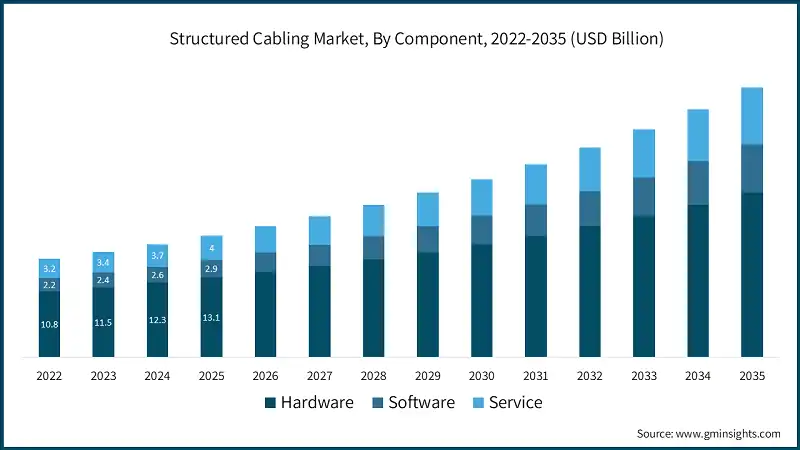
On the basis of component, the market is segmented into hardware, software and service.
- The hardware segment is anticipated to reach USD 27.1 billion by 2035. The demand for advanced cabling components, including high-speed switches, connectors, and fiber-optic systems, is rising due to increasing data traffic, network modernization, and the expansion of enterprise and industrial networks. High-performance hardware is becoming critical to ensure low latency, reliable connectivity, and support for next-generation technologies.
- Manufacturers should focus on developing durable, high-performance hardware that can handle high data loads, support scalability, and maintain long-term reliability across diverse applications.
- The software segment is anticipated to grow at a CAGR of 10.7% during the forecast period 2026 - 2035. Network management, monitoring, and automation solutions are increasingly important as organizations seek efficient, secure, and cost-effective operations. Integration of analytics, AI-driven monitoring, and predictive maintenance is driving better network performance, reduced downtime, and optimized resource utilization.
- Manufacturers should invest in intelligent software platforms that offer seamless integration, real-time monitoring, predictive analytics, and enhanced cybersecurity features to meet evolving enterprise and industrial network needs.
Learn more about the key segments shaping this market
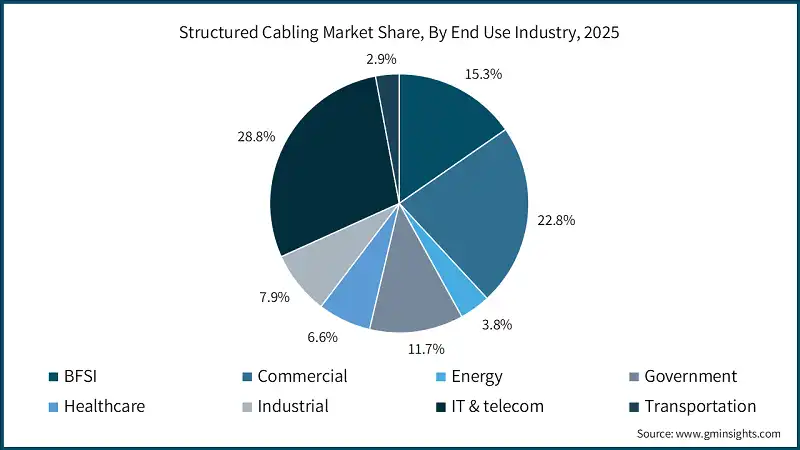
On the basis of end use industry, the structured cabling market is segmented into BFSI, commercial, energy, government, healthcare, industrial, IT & telecom, and transportation.
- The IT & telecom market is anticipated to reach USD 13.6 billion by 2035. The market in IT and telecom is expanding rapidly due to growing data centers, 5G rollout, cloud adoption, and high-bandwidth requirements. Currently, businesses are requiring a new type of low-latency, high-density networks capable of accommodating increasing connectivity and digital transformation initiatives.
- Manufacturers should develop solutions that support high-density cabling, low-latency transmission, and future-proof network expansion while offering easy installation and maintenance to meet dynamic IT and telecom demands.
- Commercial segment is anticipated to grow at a CAGR of 9.9% during the forecast period 2026 - 2035. The commercial sector is growing due to the initiated integration of intelligent structures, the Internet of Things (IoT), digital work environment changes, and enterprise system automation. There is a need for reliable, scalable, and flexible cabling systems for efficient connectivity, communication, and operational efficiency in workplaces, retail, and commercial buildings.
- Manufacturers should offer adaptable, easy-to-install, and scalable cabling solutions that can accommodate evolving smart building requirements, integrate with IoT devices, and ensure uninterrupted connectivity across commercial environments.
On the basis of installation, the structured cabling market is segmented into new installations and upgrades & maintenance.
- The new installations market is anticipated to reach USD 16 billion by 2035. Growth in new installations is primarily driven by the rapid construction of data centers, expansion of enterprise campuses, adoption of high-speed network architectures (Cat6A, Cat8, and fiber), and increasing digital transformation initiatives across commercial, industrial, and institutional buildings.
- To capture growth in new installations, manufacturers should focus on developing end-to-end cabling solutions optimized for high-speed data environments, offer integrated fiber-rich product portfolios, and collaborate early with EPC firms, data center builders, and IT integrators.
- Upgrades & maintenance segment is anticipated to grow at a CAGR of 8.1% during the forecast period 2026 - 2035. Upgrades & maintenance are growing faster than new installations due to rising demand for network modernization, migration from copper to fiber, upgrades to support higher speeds (10G/25G/40G/100G), and the need to accommodate new PoE-powered devices, smart-building systems, and intensified cybersecurity requirements. Aging cabling infrastructure in commercial buildings, manufacturing facilities, and campuses is reaching capacity limits, driving retrofit cycles.
- To capitalize on the rapidly expanding upgrades & maintenance segment, manufacturers should prioritize retrofit-friendly product lines such as slim-profile patch cords, bend-insensitive fiber, easy-pull cable designs, and pre-terminated solutions that minimize downtime. They should offer diagnostic and network-assessment services, create upgrade pathways (e.g., Cat5e/6 to Cat6A or fiber migration kits), and support integrators with training and tools for fast retrofits.
On the basis of application, the structured cabling market is divided into data centers, local area networks (LANs), telecommunications, wide area networks (WANs), and others.
- The data centers segment held a market share of 25.5% in 2025. Hyperscale and enterprise data centers are experiencing rapid growth and are fueling the demand for structured cabling. Data centers rely on high-density, scalable and high-speed cabling solutions to sustain cloud services, virtualization and rising data traffic.
- Manufacturers should focus on delivering robust, high-capacity cabling systems that assure reliability, ease of deployment, and future-proof performance.
- The local area networks (LANs) segment is anticipated to grow at a CAGR of 7.7% during the forecast period 2026 - 2035. There is a growing need for LAN cabling solutions due to enterprise digitization, smart building projects, and IoT Integration. Due to the need for internal communications and a multitude of connected devices, organizations need high speed, flexible and secure network technology infrastructure.
- Manufacturers need to design fully customizable and convenient to install LAN solutions that accommodate additional remote working users and the interconnection of smart building technologies.
Looking for region specific data?
North America structured cabling market held 38.2% share in 2025 and is anticipated to grow at a CAGR of 7.3% during the forecast period 2026 - 2035. The current expansion of industrial communication in North America is facilitated by automation, IIoT, and smart factory implementation. North America’s emphasis on wireless technologies and 5G network deployment allows instantaneous data transmission and predictive maintenance in the manufacturing and processing industries.
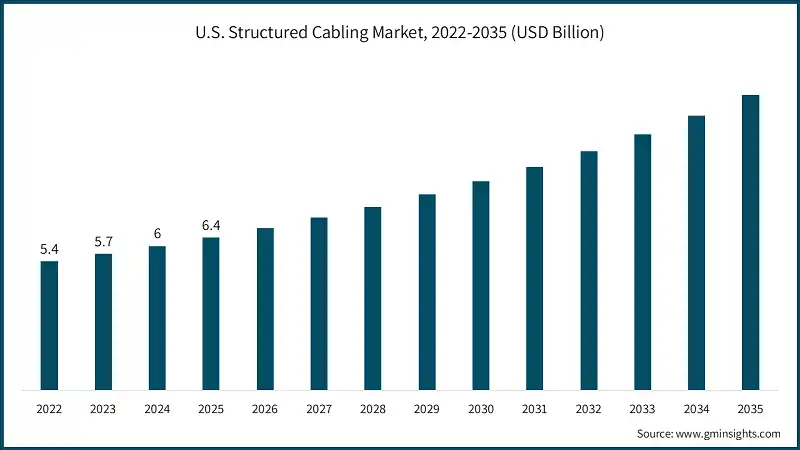
- The U.S. dominated the market with USD 6.3 billion in 2025. As per Statista, there were 4,165 data centers in the United States by November 2025. The surging data centers and increasing enterprise utilization of cloud computing, edge infrastructure and high-speed networking, are spurring the need for data structured cabling that is durable, low-latency, and is more scalable.
- To assist with the rapid growth and modernization of data centers throughout the United States, manufacturers need to focus on versatile, high-performance, and easily deployable cabling solutions.
- Canada structured cabling market is anticipated to grow at a 9.4% CAGR during the forecast period 2026 – 2035. The growing investment in smart cities, AI-based infrastructure, and data center expansion, and other areas will contribute to the steady growth of the Canadian market.
- Manufacturers should incorporate AI-enabled network monitoring and predictive maintenance capabilities into their offerings to enhance reliability and operational efficiency in Canadian industrial and enterprise networks.
Europe accounted for 32.3% of the global structured cabling market in 2025. Recent developments in industrial and enterprise sectors in Europe such as the implementation of high-speed networks, cloud infrastructure, and smart factories have boosted the adoption of structured cabling in the region. The further investments in IoT and digitalization are also supporting the modernizing of networks.
- Germany is anticipated to grow at a 8.7% CAGR during the forecast period 2026 - 2035. In September 2025, Vodafone Germany initiated a nationwide spectrum optimization program across its cable fiber optic network, which included a frequency switch and the adoption of the NorDig-LCN standard to enhance network performance and free up capacity for faster internet speeds.
- Manufacturers ought to include scalable and compatible cabling solutions to enable network optimization and rapid data transfer.
- UK's structured cabling market is anticipated to reach USD 3.8 billion by 2035. The market continues to grow as enterprises and data centers invest in more high-performance networks and smart infrastructures. Reliable and scalable cabling solutions are in high demand, driven by the increase in cloud computing, the IoT, and digitalization initiatives.
- Given the ongoing expansion of the enterprise and industrial network infrastructure, manufacturers must focus on developing modular, energy-efficient, and high-bandwidth cabling systems.
Asia-Pacific held a share of 23.1% in the global structured cabling market and is the fastest-growing region with a 10.1% CAGR during the forecast period. There has been notable expansion in structured cabling in the area due to industrial development, implementation of smart city programs, adoption of cloud computing and 5G technologies in businesses, and industrialization.
- The structured cabling industry in China is anticipated to reach USD 5.1 billion by the year 2035. Due to the development of Chinese hyperscale data centers and 5G infrastructures, there is a demand for high speed and high capacity structured cabling systems.
- Manufactures should invest in flexible, fiber-optic, and future-proof inventory to accommodate the ever-growing business and telecom networks in China.
- Japan's market was valued at USD 778.30 million in 2025. There is a growing need for low latency and high performance structured cabling systems because of Japan’s growing acceptance of Industry 4.0, automation, and robotics within its manufacturing sector.
- Manufacturers should develop durable, high-speed, and standardized cabling solutions to support industrial automation, smart factories, and next-generation enterprise networks in Japan.
- India's structured cabling market is anticipated to grow at a CAGR of over 13% during the forecast period. India’s growing IT parks, smart city initiatives, and digital transformation programs are accelerating the need for reliable and flexible cabling infrastructure across enterprises.
- Manufacturers should provide cost-effective, modular, and energy-efficient cabling solutions that can adapt to India’s rapid network growth and diverse enterprise requirements.
Latin America market held 4.1% market share in 2025 and is anticipated to grow at a 7.8% CAGR during the forecast period. The market in Latin America is growing as enterprises and telecom operators invest in cloud infrastructure, data centers, and smart city projects to enhance connectivity and digital services.
In 2024, the Middle East and Africa structured cabling market held a share of 2.3% and is anticipated to grow at a 0.7% CAGR during the forecast period 2026 - 2035. The MEA market is expanding due to growing investments in digital infrastructure, industrial automation, smart cities, and high-speed connectivity projects across the region.
- Saudi Arabia accounted for an 62.5% market share in 2025. Saudi Arabia has made substantial investments into the construction of smart cities, the development of 5G networks, and the expansion of data centers which propels the need for advanced structured cabling technology.
- To facilitate and support the needs of the digital change and industrial network improvements within the country, manufacturers have to concentrate on providing durable faster and level standardized cabling systems.
- The UAE accounted for a share of 15.4% in the market in 2025. There is an increased demand for cutting-edge, high-speed, and reliable cabling systems, as the UAE is fast-tracking the installation of smart buildings, AI-supported frameworks, and business networking systems.
- To support the United Arab Emirates' sophisticated business and industrial networks, manufacturers need to offer modular, energy-efficient, and scalable cabling solutions.
Structured Cabling Market Share
The key players in the structured cabling industry are Commscope Holding Co., Inc., Corning, Inc., TE Connectivity, Panduit Corporation, and Legrand. Collectively, these companies held more than 52.1% of the market in 2025.
- Commscope Holding Co., Inc. led the structured cabling market with a 15.4% share in 2025. The company focuses on providing network infrastructure solutions comprising fiber and copper cabling systems, connectivity devices, and sophisticated tools for network administration. The company's strong position within the market stems from the global reach and specific alliances within the IT, telecom, and enterprise industries.
- Corning held a 13.6% market share in 2025. Corning is a leader in providing high-quality transmission solutions across optical fiber, cabling, and connectivity. Corning's mastery in glass and fiber technologies and partnerships with telecom operators and data center providers fortifies its position in structured cabling.
- TE Connectivity captured 10.3% of the market in 2025. TE Connectivity is recognized for innovative development of integrated cable, connection, and networking solutions for the commercial, industrial, and telecom industries. The cutting-edge technology of TE Connectivity focuses on high-density, scalable systems and outstanding customer service, establishing them as a notable competitor in the market.
- Panduit Corporation held a 7.3% market share in 2025. The company offers interconnected systems, information system management, and intelligent networking devices for private and business systems infrastructures. The focus of Panduit on integrated systems, reliability, and service to the customer strengthens their competitive positioning in the marketplaces.
- Legrand accounted for 5.5% of the market in 2025. The company offers cable solutions, network enclosures, and connectivity solutions for commercial, IT, and industrial settings. Legrand's market presence benefits from its collaborations, distinct products, and focus on modular solutions that can be easily deployed.
Structured Cabling Market Companies
Major players operating in the structured cabling industry are:
- ABB Ltd.
- Anixter International
- CA Technologies
- Cisco Systems, Inc.
- Commscope Holding Co., Inc.
- Corning, Inc.
- Fujitsu
- General Cable Technologies Corporation
- Legrand
- Commscope Holding Co., Inc., Corning, Inc., TE Connectivity, Panduit Corporation, and Legrand are considered leaders in the structured cabling market. They hold leading market share due to their integrated cabling and connectivity solutions, substantial international growth in the IT, telecom, and enterprise verticals, sustained market innovation, their extensive network of partnerships, and robust R&D capabilities.
- Companies included in the category of challengers are ABB Ltd., Anixter International, CA Technologies, Cisco Systems, Inc., Fujitsu, Nexans S.A., Reichle & De-Massari AG, and Rittal GmbH & Co. KG. These companies have been competing in the market based on various network infrastructures, customized solutions for commercial and industrial applications, strong client engagement, and integrating their offerings with large-scale IT and telecom projects to increase their market share.
- General Cable Technologies Corporation and The Siemon Company are categorized as followers. Their strengths include cost-effective cabling solutions, niche applications in enterprise and industrial networks, and a regional market focus. Although their innovation is moderate, they continue to serve specific commercial, IT, and industrial clients efficiently.
- Nexans S.A. and Anixter International are acknowledged as niche players in the market. These companies concentrate on specialized cabling and connectivity solutions for targeted industry segments. They use patented technology, custom solutions, and specialized implementations to gain competitive advantages and service certain clients in the commercial, industrial, and telecom verticals.
Structured Cabling Industry News
- In March 2024, Legrand, a global specialist in electrical and digital building infrastructures announced the acquisition of Mechanical Support Systems (MSS) a cable management solution provider. This acquisition is expected to help company strengthen its position in New Zealand.
- In May 2023, Amplix, a communication and technology service provider announced the acquisition of Intervale Technologies, Inc. This acquisition is expected to help company increase its customer base and increase its market share.
The structured cabling market research report includes in-depth coverage of the industry with estimates & forecasts in terms of revenue (USD Million) from 2022 to 2035, for the following segments:
Market, By Components
- Hardware
- Cables
- Copper cable
- Category 5E (Cat 5E)
- Category 6 (Cat 6)
- Category 6A (Cat 6A)
- Category 7 (Cat 7)
- Category 8 (Cat 8)
- Fiber-optic cable
- Single-mode
- Multi-mode
- Copper cable
- Communication outlet system
- Patch cables & cable assemblies
- Patch panels & cross connects
- Racks & cable management
- Cables
- Software
- Service
- Consulting
- Installation & deployment
- Maintenance & support
Market, By Installation Type
- New Installations
- Upgrades & Maintenance
Market, By Application
- Data Centers
- Local Area Networks (LANs)
- Telecommunications
- Wide Area Networks (WANs)
- Others
Market, By End Use Industry
- BFSI
- Commercial
- Energy
- Government
- Healthcare
- Industrial
- IT & telecom
- Transportation
The above information is provided for the following regions and countries:
- North America
- U.S.
- Canada
- Europe
- Germany
- UK
- France
- Spain
- Italy
- Netherlands
- Asia Pacific
- China
- India
- Japan
- Australia
- South Korea
- Latin America
- Brazil
- Mexico
- Argentina
- Middle East and Africa
- Saudi Arabia
- South Africa
- UAE
Frequently Asked Question(FAQ) :
Who are the key players in the structured cabling market?
Key industry players include Commscope Holding Co., Inc., Corning Inc., TE Connectivity, Panduit Corporation, Legrand, Cisco Systems, Anixter International, Nexans S.A., Rittal GmbH & Co. KG, and Fujitsu.
What are the upcoming trends in the structured cabling industry?
Key trends include fiber-optics adoption, Power over Ethernet (PoE) expansion, and deployment of high-density cabling to support 5G and edge computing.
What is the growth outlook for the software component from 2026 to 2035?
The software segment is projected to grow at a 10.7% CAGR during 2026–2035.This growth is driven by rising adoption of network monitoring, automation, and AI-based analytics platforms.
Which region leads the structured cabling market?
The U.S. market reached USD 6.3 billion in 2025, making it the most dominant regional market.
What was the valuation of the new installations segment in 2035?
New installations are expected to reach USD 16 billion by 2035. This segment is expanding as organizations build new data centers, smart offices, and high-speed network architectures.
How much revenue did the hardware component segment generate by 2035?
The hardware segment is anticipated to reach USD 27.1 billion by 2035. Demand is driven by high-speed cables, connectors, and fiber systems essential for enterprise, industrial, and data center networks.
What is the projected value of the structured cabling market by 2035?
The market size for structured cabling is expected to reach USD 44.5 billion by 2035, supported by a CAGR of 8.4% from 2026–2035.
What is the market size of the structured cabling industry in 2025?
The market size was USD 20 billion in 2025, reflecting strong demand from data centers, IT & telecom networks, and enterprise digitalization.
What is the current structured cabling market size in 2026?
The market is projected to reach USD 21.5 billion in 2026. This growth is influenced by modernization of enterprise networks, IoT expansion, and rising bandwidth requirements.
Structured Cabling Market Scope
Related Reports