Summary
Table of Content

Standing Desk Market
Get a free sample of this report
Form submitted successfully!
Error submitting form. Please try again.
Thank you!
Your inquiry has been received. Our team will reach out to you with the required details via email. To ensure that you don't miss their response, kindly remember to check your spam folder as well!
Request Sectional Data
Thank you!
Your inquiry has been received. Our team will reach out to you with the required details via email. To ensure that you don't miss their response, kindly remember to check your spam folder as well!
Form submitted successfully!
Error submitting form. Please try again.
Standing Desk Market Size
The standing desk market was estimated at USD 8.6 billion in 2025. The market is expected to grow from USD 9.1 billion in 2026 to USD 15.1 billion in 2035, at a CAGR of 5.8% according to latest report published by Global Market Insights Inc.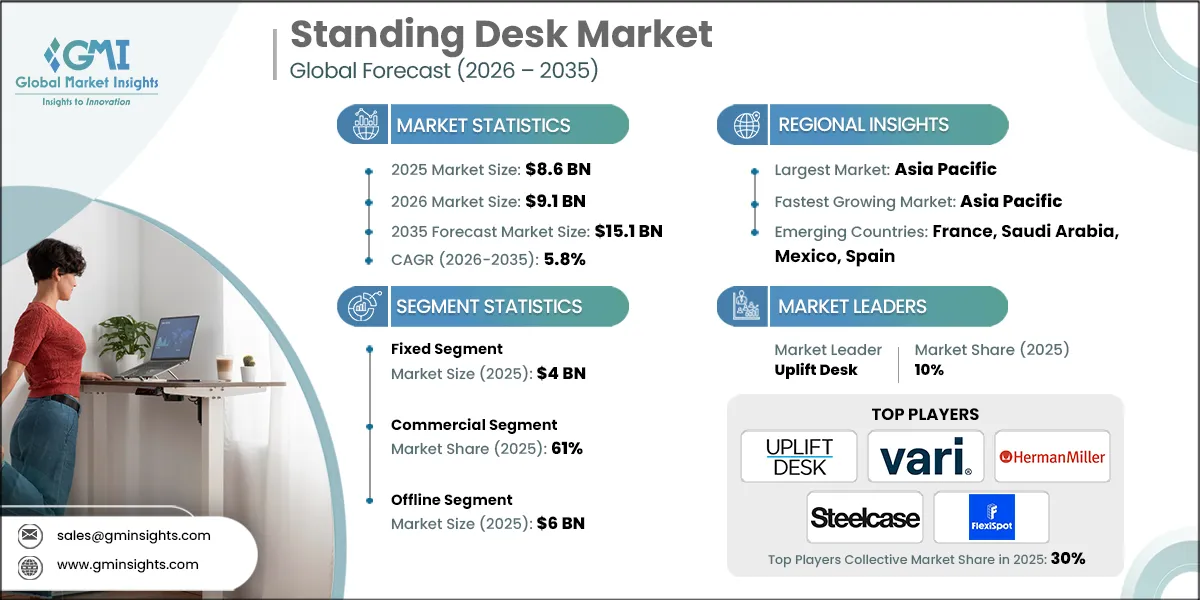
Standing Desk Market Key Takeaways
Market Size & Growth
- 2025 Market Size: USD 8.6 Billion
- 2026 Market Size: USD 9.1 Billion
- 2035 Forecast Market Size: USD 15.1 Billion
- CAGR (2026–2035): 5.8%
Regional Dominance
- Largest Market: Asia Pacific
- Fastest Growing Region: Asia Pacific
Key Market Drivers
- Rising awareness of health & wellness.
- Expansion of hybrid and remote working.
- Innovations in desk technology.
Challenges
- High purchase costs.
- Space limitations.
Opportunity
- Smart & connected standing desks.
- Sustainable & eco-friendly designs.
Key Players
- Market Leader: Uplift Desk led with over 10% market share in 2025.
- Leading Players: Top 5 players in this market include Uplift Desk, Vari, Herman Miller, Steelcase, FlexiSpot, which collectively held a market share of 30% in 2025.
Get Market Insights & Growth Opportunities
To get key market trends
The increased awareness of health and wellness has contributed to the increasing demand for standing desks because consumers have become more educated about the harmful effects associated with sitting for long periods of time. Research studies show that sitting too long can lead to many problems including musculoskeletal injury, back/neck pain, and decreased metabolic rate. As a result, consumers are looking for furniture that will help them to be more active while working at their desks. Standing desks will address these concerns by allowing users to switch between sitting and standing, help improve posture, increase blood circulation, and reduce overall sedentary time. Standing desks have also become a popular solution in today’s workplace and home offices, as people strive to achieve optimal ergonomic comfort and long-term physical health through day-to-day use of furniture.
Corporate wellness programs that emphasize ergonomics are driving the health-driven change described above. Workspaces are increasingly equipped with height-adjustable standing desks to create environments that increase employee productivity, prevent workplace injuries, and increase employees’ satisfaction. As a result of the rise of both hybrid and remote work, many consumers are now looking for standing desks in their homes to re-create the ergonomic environment of an office. Increased awareness of the cognitive and physical benefits of using a standing desk means that standing desks are becoming an integral element in the health-conscious workplaces of the future.
As consumers working remotely continue to look for ways to stay productive and comfortable while working outside of the traditional office setting, standing desks have gained popularity among many users because they can provide support for long periods of working on a computer. Standing desks have become a great way for individuals to keep themselves in the correct position for being physically active regardless of where they are located. Also influencing this trend is the increase in the number of people who are taking virtual courses both students and adults therefore looking for the type of desk that will provide them with the ability to work comfortably for long periods of time on the computer. As virtual courses become part of the educational process, standing desks will become a key component to allow users to stay focused, remain physically active, and provide a more active work and study environment.
The trend towards using standing desks continues to increase due to the increase in cities' demand for healthier, more dynamic work environments. Standing desks give users the ability to utilize both sitting and standing position, reducing the amount of time through physical strain caused by sitting for long periods of time, as well as promoting better posture and enhancing concentration. Increasing amounts of businesses implementing standing desk solutions indicates the workplace trend towards creating healthier, more ergonomic workspaces. Therefore, in creating a modern, productivity-based workstation, standing desks are becoming an integral part.
Standing Desk Market Trends
The evolution of today's standing desk industry has been influenced by several factors in addition to just the workplace. The growing awareness of sedentary lifestyle risks and changing work habits such as hybrid work models, along with the desire for flexible and tech-friendly workspaces, have increased the demand for more advanced standing desk solutions that are customized, visually appealing, and offer enhanced functionality. To meet these and other factors, manufacturers are producing increasingly sophisticated and sustainable designs to ensure their new standing desks use technology, provide personalization, and will have applications in both corporate and home environments.
- The growth of technology integrated into standing desks is causing many users to obtain data-driven, personalized information about their working/health habits with age-based app-controlled height settings, posture reminders, usage trackers and smart sensors. This growth resembles the general trend toward smart work environments where furniture interacts with digital ecosystems, which contributes to increased productivity and employee well-being.
- The emergence of environmental consciousness affects many buying decisions. Manufacturers are responding by producing more environmentally friendly products made from greener materials such as bamboo, recycled metal, and low VOC finishes. Sustainability is rapidly becoming an important product differentiator, and consumers and companies are looking for product options that provide employee wellness while being environmentally responsible. The increase in demand for globally sustainable and responsible corporate ESG commitments will create further value for the company brand.
- Customers are looking for workstations that can meet their specific needs whether it be different room sizes or styles; modular designs with interchangeable tabletops, removable accessories and cable management systems can provide an adaptable workstation solution that meets all current trends. Designs that are compact and/or folding systems will suit individuals living in small apartment spaces and/or shared workspaces or that have use as multi-purpose execution increasing the potential customer base by a much larger margin than before.
Standing Desk Market Analysis
Learn more about the key segments shaping this market
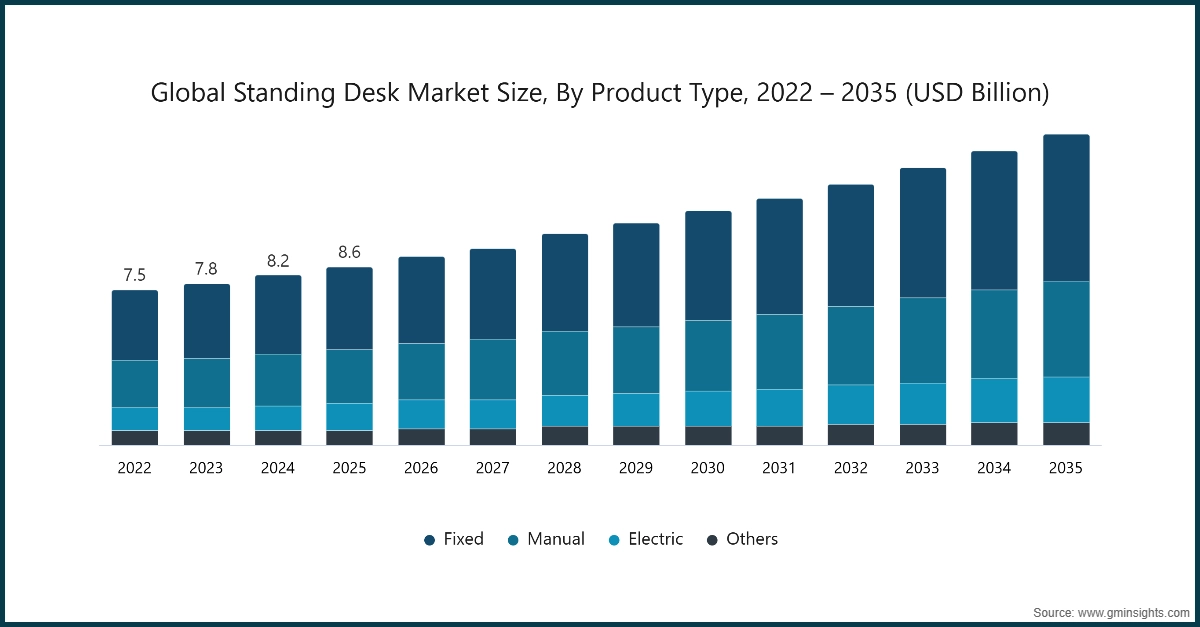
Based on product type, the market is divided fixed, manual, electric and others. In 2025, fixed segment generated a revenue of USD 4 billion.
- Non-adjustable workstations, also known as fixed standing desks, feature an established working surface that enables users to work wholly within a standing posture due to their permanently heightened design. Because of their construction method, these desks are substantially constructed, allowing for stability and a long-lasting product, while their design is clean and minimalistic these types of desks do not have adjustable parts and therefore there is no adjustment mechanism. Users of fixed standing desks prefer a clean, simple aesthetic to aesthetically pleasing performance.
- Fixed standing desks can be found in various workplace contexts, for example, in collaboration areas, creative spaces, retail back-office and manufacturing laboratories where working in a standing position has been established. By allowing continuous movement, fixed standing desks can assist to minimize the adverse consequences of working in a seated position for extended time periods, whilst also promoting active working habits. There are some limitations with respect to the level of personalization possible with use of fixed standing desks due to the lack of variably height adjustability, however, these desks do lend themselves well to perform very repetitive movements or occupy shared team workspaces where users frequently rotate workstations. Reduced risk of user error is associated with the simple construction of fixed standing desks, providing equal workspace results across your entire organization.
- A fixed standing desk usually costs less to set up and service than an electric or manual height adjustable desk because it has no moving parts so there won't be a chance of mechanical failure at the time of installation or service. Therefore, they are very easy to maintain and extremely inexpensive for large companies or organizations to use. As more companies learn about the health advantages of using a standing desk, usage of fixed standing desks will not only grow in popularity; fixed standing desks will be the desk of choice for people who want a long term, robust and cost-efficient way to create a new work habit of standing while working.
Learn more about the key segments shaping this market
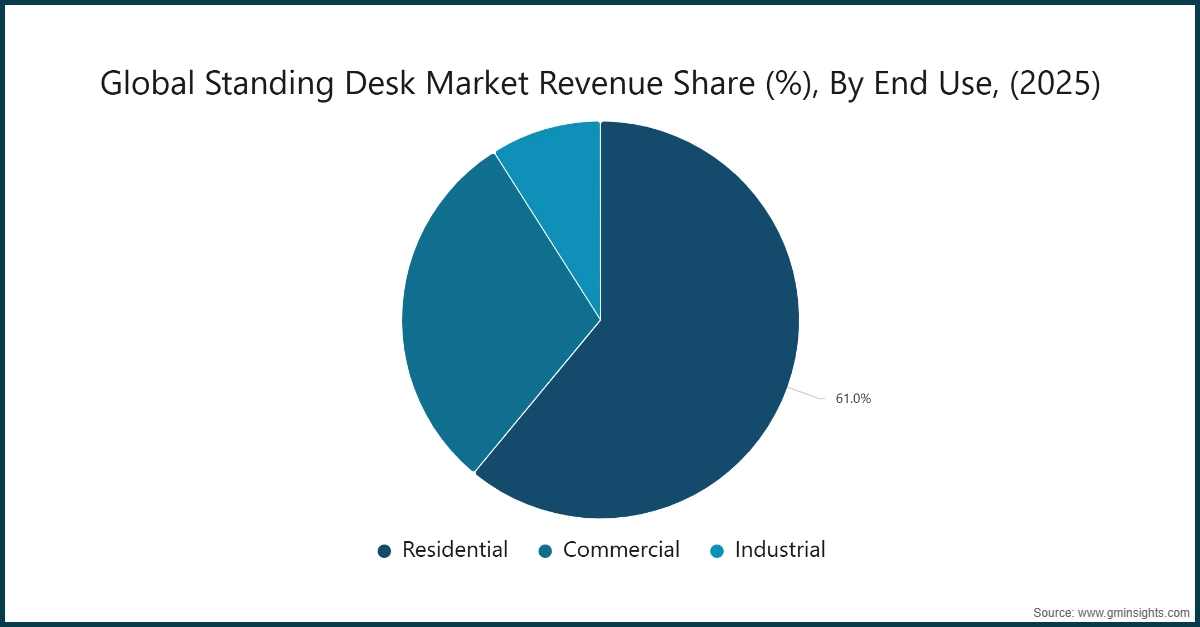
Based on end user, the standing desk market is segmented in residential, commercial and industrial. The commercial segment held around 61% of the market share in 2025.
- The growth of the home segment of the standing desk industry has gained momentum as more people want to create comfortable and productive environments while working from home. With remote and hybrid employment becoming part of the long-term landscape, people are increasingly purchasing ergonomic furniture that will help them be productive and work long hours at a computer. Standing desks design for home typically emphasize compactness, visual versatility, and simple setup so that they can fit well into the small spaces of bedrooms, living rooms or apartments.
- Typically, unlike offices, residential areas often require furniture that will match or blend into the existing décor. Because of this, many standing desks designed for home have an emphasis on natural wood finishes, minimalist-style designs, and an array of colors that allow them to match almost any interior design. The combination of this emphasis on visual appeal plus the ergonomic benefits of standing desks have made them not only functional pieces of furniture but also have turned them into lifestyle products that increase the overall value of a home workspace.
- Further, as more consumers turn toward wellness and work-life balance, so has their residential market demand increased. The overall awareness of how our daily habits related to posture/ movement/ physical comfort can impact our energy levels and health long term has grown. Standing desks create an easy opportunity to add more movement to our daily lives, making them very popular with freelancers, students, remotely employed individuals, etc., who want to establish healthier working practices while at home. With an ongoing expansion of the wellness culture, residential demand for ergonomic furniture, such as standing desks, also continues to grow.
Based on distribution channel, the standing desk market is segmented into online and offline. In 2025, offline segment held the largest market share, generating a revenue of USD 6 billion.
- Physical furniture stores, office-supply stores, ergonomic showrooms, and large essential home improvement outlets make up the offline channel of distribution for standing desks. By allowing customers to see, touch, and try the products, all these channels provide customers with the opportunity to experience how well the standing desk will work before they purchase it. Since the main factors influencing the decision to purchase a standing desk include how stable and long the standing desk is, how well it fits with their body and space, and the quality of its surface, the ability to see in person the desk they plan to buy can give them more confidence in their purchase.
- There are many corporate clients, educational institutions, and healthcare facilities that purchase large numbers of standing desks and require customized workspace planning. Retailers provide many services to assist in reducing the perceived complexity of purchasing a height-adjustable or modular desk, such as on-site consultation for workspace planning, assisting with assembly, handling the warranty, and providing post-purchase support. Thus, offline channels are still a viable option for customers purchasing relevant desks despite the growing popularity of online retailers. Customers want to feel secure in knowing the standing desk they are buying will work as planned. Providing customers with the ability to interact directly with the product and with trained sales associates will help them in making a better-informed decision and assist them in their purchase decision for a high-involvement piece of furniture.
Looking for region specific data?
North America Standing Desk Market
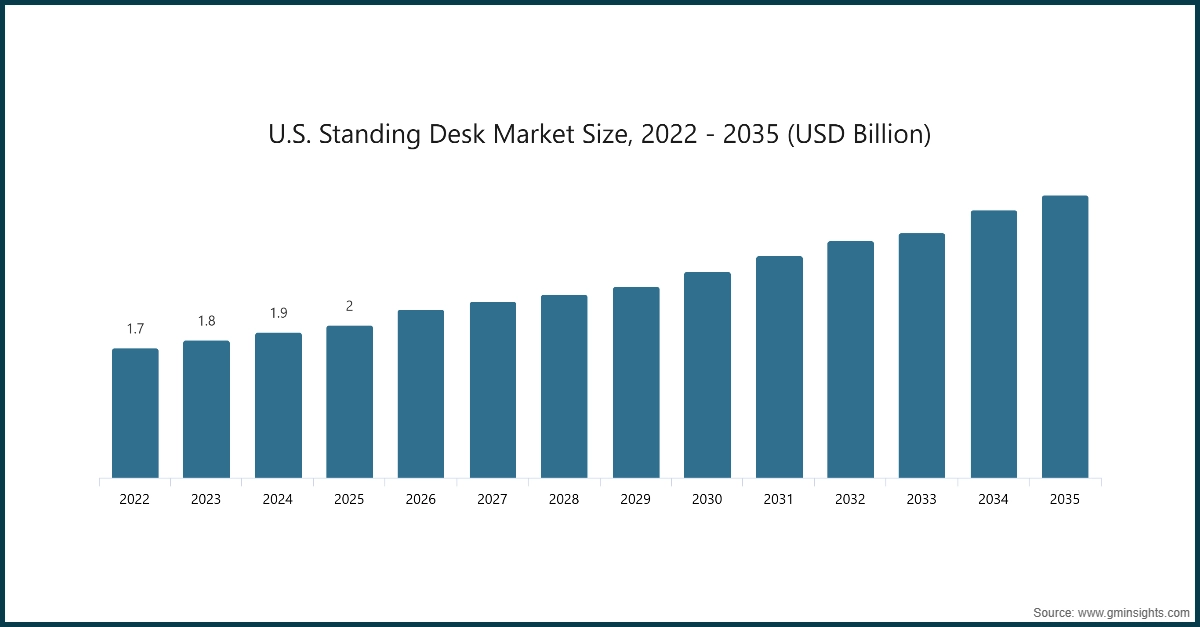
In 2025, the U.S dominated the North America standing desk industry, accounting for around 89% share and generating USD 2 billion revenue in the same year.
The standing desk market in America continues to grow quickly because of increased understanding and recognition of ergonomic-related issues in offices. Consumers and businesses in America continue to focus on wellness, productivity, and the modern workplace while increasing the availability of both adjustable and fixed height desk options. Demand has only strengthened due to increasing remote work with the number of households purchasing ergonomic home office solutions; moreover, the number of companies adopting corporate wellness programs and developing new technologies for their workplaces has helped make the U.S. the leader in terms of the development of innovative standing desk products and the adoption of premium standing desks.
- The North American market remains very positive toward the use of ergonomic office solutions. As more companies modernize their workstations, and as more individuals place greater importance on their own comfort and health at home, ergonomic office solutions, primarily standing desks, are now being integrated into the workplace, educational facilities, and collaborative settings. These changes have been driven by a cultural shift toward more active workstyles and the need for long-term wellness. The large retail presence in North America and the well-developed e-commerce infrastructure have promoted growth within the markets. The high level of disposable income in North America is further contributing to market growth. North America's commitment to sustainability, technological advancements in the workplace, and the creation of flexible workspaces will continue to create demand from both the business sector and the residential sector.
Europe Standing Desk Market
Europe market held 22.5% share in 2025 and is expected to grow at 5.8% CAGR during the forecast period.
- Europe has long been one of the most mature markets for desk standing, influenced in part by regulatory frameworks that promote healthy workplaces as well as a strong historical commitment to employee wellbeing; an extensive culture of using ergonomically designed products exists across almost all sectors of business within Europe. In fact, due to progressive employment legislation and an overall emphasis on work/life balance within their cultures, many companies located in Northern and Western European countries were among the first to incorporate ergonomic furniture into the workplace.
- Besides health concerns, European consumers value high-quality design, eco-friendliness, and durability when purchasing products these values have led to the development of premium-priced standing desk options made from environmentally friendly materials and designed using simple, Scandinavian-inspired designs. As telecommuting becomes more prevalent throughout Europe, demand for home office standing desks has remained high. Strong governmental support through regulation, environmental consideration when designing products, and a design-focused consumer base make Europe a stable and innovative market for standing desks.
Asia Pacific Standing Desk Market
The Asia Pacific held a market share of 31.5% in 2025 and is anticipated to grow with a CAGR of around 6.4% from 2026 to 2035.
- The Asia-Pacific Region has rapidly developed into one of the largest growing markets for standing desks because of urbanization happening at a fast pace; an increasing number of businesses; and emerging technology educational institutions, call centers; IT parks; and are growing around Asia-Pacific. As offices are being upgraded, there has been an increase in companies modernizing their office design with a focus on employee health. In addition, the rapidly growing middle class in this region has also influenced the uptake of the technology associated with global workplace trends. The addition of standing desks to the ergonomic tool kit will continue as colleges and universities; call centers; information technology; co-working spaces; and educational institutions grow in APAC.
- The Asia Pacific region is unique in the speed and scale of its transformation. Remote and hybrid work models are now increasingly popular, which has resulted in millions of working professionals creating ergonomic home-office setups. Manufacturers in this region can produce products at competitive prices and rapidly innovate new products. A unique combination of low cost, greater focus on healthy living and evolving workplace culture, puts the Asia-Pacific region in a position to lead the world in the growth of standing desk usage.
Latin America Standing Desk Market
Latin America market is growing at a CAGR of 3% during the forecast period.
- The standing desk industry in Latin America is continuing to grow as both businesses and consumers prioritize health, comfort and creating a modern workspace. While the rate of growth has been slower than in North America and Europe, a growing awareness of the importance of postural health as well as the benefits of ergonomic office furniture has led to a much quicker rate of growth in Latin America. Cities throughout Mexico, Brazil, Chile and Colombia are increasingly seeing growth in standing desk demand as businesses and multinational corporations are developing regional business centers, and the increased growth of co-working or collaborative workspaces.
- The shift towards remote work has also helped drive residential demand as individuals look to create ergonomic workstations that allow them to spend extended periods of time working from home. However, price sensitivity continues to be an important driver of standing desk demand in Latin America, where there are more mid-range, affordable standing desk products being sold than there are high-end, premium standing desks. As economies stabilize and digital transformation efforts continue to grow, the market will continue to experience strong growth due primarily to the relatively young workforce across Latin America, the continued improvements in workplace standards and significantly increased focus on employee wellness and health.
Standing Desk Market Share
Uplift Desk is leading with 10% market share. Uplift Desk, Vari, Herman Miller, Steelcase, FlexiSpot, collectively hold around 30%, indicating moderately fragmented market concentration. These prominent players are proactively involved in strategic endeavors, such as mergers & acquisitions, facility expansions & collaborations, to expand their product portfolios, extend their reach to a broad customer base, and strengthen their market position.
Vari is considered one of the original creators of the standing-desk movement and became popular with its user-friendly and easy-to-use desktop converters, then moved into complete office furniture systems. The company markets itself as a flexible workplace solution provider and has a lot of height-adjustable desks, modular office configurations and accessories that enhance and encourage active work styles. Vari's commitment to user-friendliness, quick assembly and durability has provided them with an established reputation among businesses and home-based offices who require dependable ergonomic improvements.
Uplift Desk is the leading provider of customizable electric standing desks. Users can choose from many different types of desktop surfaces and desk frame types and have several accessories and ergonomic add-on options. The company has focused on providing stability and high-quality construction, enabling Uplift's customers to create long-lasting home-office arrangements that will accommodate their needs both now and in the foreseeable future. Due to its strong customer marketing and smooth height adjustment and sturdy desk frames, Uplift Desk has become the preeminent provider of standing desks in the premium standing-desk industry.
Standing Desk Market Companies
Major players operating in the standing desk industry are:
- Autonomous
- Branch Furniture
- Fezibo
- FlexiSpot
- Fully
- Global Furniture Group
- Haworth
- Herman Miller
- Humanscale
- iMovR
- Secretlab
- StandDesk
- Steelcase
- Uplift Desk
- Vari
iMovR is known for their advanced ergonomic engineering specializes in developing standing desks and a variety of treadmill-desk solutions. Their product line has been engineered with an emphasis on precision, long-term durability, and user comfort. They also pride themselves on producing their products in America, putting forth a strong commitment to all aspects of manufacturing, paying great attention to detailed craftsmanship, and providing their customers with highly customizable options regarding their desktop sizes, finishes, and specialty ergonomic accessories. Many of their customers are health-minded professionals looking for high-performance workstations that will hold up under heavy daily use.
Secretlab has gained popularity due to their premium-quality gaming chairs but has also recently branched out into making desks. One example is their new line of MAGNUS desks, which focus on durability and source efficiency with the added benefit of having a magnetic accessory system. Combining gaming style with the practicality associated with a sophisticated workstation is what sets these products apart. Despite being created for gamers, the aesthetics used within these desks allow for use by creators and other professionals who wish to have an aesthetically pleasing, organized work environment. Unique characteristics of the MAGNUS desks are the designed materials; solid metal construction, streamlined appearance, and ease of cable-route functionality.
Standing Desk Market Report Attributes
| Key Takeaway | Details |
|---|---|
| Market Size & Growth | |
| Base Year | 2025 |
| Market Size in 2025 | USD 8.6 Billion |
| Market Size in 2026 | USD 9.1 Billion |
| Forecast Period 2026-2035 CAGR | 5.8% |
| Market Size in 2035 | USD 15.1 Billion |
| Key Market Trends | |
| Drivers | Impact |
| Rising awareness of health & wellness | Encourages people to adopt ergonomic furniture widely because they want to avoid long-term, unhealthy sedentary lifestyles. |
| Expansion of hybrid and remote working | Creates a more significant residential market for furniture as consumers purchase ergonomic furniture that will be used for many years in their home office. |
| Innovations in desk technology | Improves customer experience and drives market growth from new smart features and more significant functionality. |
| Pitfalls & Challenges | Impact |
| High purchase costs | Slows the use of ergonomic furniture for consumers and businesses that have lower budgets. |
| Space limitations | Limits the ability to use ergonomic furniture in smaller homes and businesses where there is not enough room for the larger workstations. |
| Opportunities: | Impact |
| Smart & connected standing desks | Increases the overall attractiveness of ergonomic furniture to the consumers that are looking for data-driven, personalized ergonomic support. |
| Sustainable & eco-friendly designs | Attracts to environmentally conscious consumers and increases distinctions and differentiation in brands. |
| Market Leaders (2025) | |
| Market Leader |
10% market share |
| Top Players |
The collective market share in 2025 is 30% |
| Competitive Edge |
|
| Regional Insights | |
| Largest market | Asia Pacific |
| Fastest growing market | Asia Pacific |
| Emerging countries | France, Saudi Arabia, Mexico, Spain |
| Future Outlook |
|
What are the growth opportunities in this market?
Standing Desk Industry News
- In November 2025, FlexiSpot unveiled the E7 Pro 2026 Edition equipped with a significantly quieter and more stable dual‑motor lifting system, enhanced structural robustness, and smarter energy‑efficient performance designed to elevate long-term ergonomic use.
- In April 2025, Autonomous introduced the SmartDesk 5 featuring integrated 120V/15A power outlets, an upgraded hidden cable‑management system, a reinforced C‑frame supporting roughly 330 pounds, and a wide ergonomic height range of approximately 29.5 to 48.5 inches.
- In February 2025, Herman Miller launched the Spout Sit‑to‑Stand Table featuring four synchronized in‑line motor actuators, a lift capacity of up to 400 pounds, under‑surface magnetic cable‑management components, and multiple size configurations starting from 24×48 inches up to 48×84 inches.
- In July 2025, Secretlab rolled out the Magnus Pro sit‑to‑stand metal desk equipped with a precision electric lift system covering a height range of about 25.6 to 49.2 inches, a fully integrated power‑supply column, a concealed full‑width cable tray, and a magnetic accessory ecosystem for complete cable organization.
The standing desk market research report includes in-depth coverage of the industry with estimates & forecasts in terms of revenue (USD Billion) & volume (Thousand Units) from 2022 to 2035, for the following segments:
Market, By Product Type
- Fixed
- Manual
- Electric
- Others (converter, etc.)
Market, By Material
- Wood
- Metal
- Glass
- Composite material
- Others (bamboo, etc.)
Market, By Design
- Traditional desks
- L-shaped desks
- U-shaped desks
- Convertible desks
Market, By Price Range
- Low
- Medium
- High
Market, By End Use
- Residential
- Commercial
- Industrial
Market, By Distribution Channel
- Online
- E-commerce
- Brand websites
- Offline
- Supermarkets
- Specialty stores
- Others (Departmental stores, etc.)
The above information is provided for the following regions and countries:
- North America
- U.S.
- Canada
- Europe
- Germany
- UK
- France
- Italy
- Spain
- Asia Pacific
- China
- India
- Japan
- Australia
- South Korea
- Latin America
- Brazil
- Mexico
- Argentina
- Middle East and Africa
- South Africa
- Saudi Arabia
- UAE
Frequently Asked Question(FAQ) :
What is the market size of the standing desk in 2025?
The market size was USD 8.6 billion in 2025, with a CAGR of 5.8% expected through 2035 driven by rising health and wellness awareness, expansion of hybrid and remote working, and innovations in desk technology.
What is the projected value of the standing desk market by 2035?
The standing desk market is expected to reach USD 15.1 billion by 2035, propelled by development of smart and connected standing desks and increasing adoption of sustainable and eco-friendly designs.
What is the current standing desk market size in 2026?
The market size is projected to reach USD 9.1 billion in 2026.
What was the market value of the fixed product type segment in 2025?
The fixed standing desk segment generated USD 4 billion in revenue in 2025, leading the market due to durability, stability, and cost-effectiveness.
What was the market share of the commercial end-use segment in 2025?
The commercial segment held 61% market share in 2025, dominating due to corporate wellness programs and workplace modernization initiatives.
What was the market value of the offline distribution channel in 2025?
The offline distribution channel generated USD 6 billion in revenue in 2025, leading due to customers' preference for physical product evaluation before purchase.
Which region leads the standing desk market?
Asia Pacific is both the largest and fastest-growing market with 31.5% market share in 2025 and anticipated CAGR of 6.4% from 2026 to 2035, while the U.S. dominated North America with 89% regional share generating USD 2 billion.
What are the upcoming trends in the standing desk market?
Key trends include integration of technology with app-controlled height settings and posture reminders, growing emphasis on sustainable materials like bamboo and recycled metal, increasing demand for modular and customizable designs, and development of compact and folding systems for small spaces.
Who are the key players in the standing desk market?
Key players include Uplift Desk, Vari, Herman Miller, Steelcase, FlexiSpot, Autonomous, Branch Furniture, Fezibo, Fully, Global Furniture Group, Haworth, Humanscale, iMovR, Secretlab, and StandDesk.
Standing Desk Market Scope
Related Reports