Summary
Table of Content

Sports Lighting Market
Get a free sample of this report
Form submitted successfully!
Error submitting form. Please try again.
Thank you!
Your inquiry has been received. Our team will reach out to you with the required details via email. To ensure that you don't miss their response, kindly remember to check your spam folder as well!
Request Sectional Data
Thank you!
Your inquiry has been received. Our team will reach out to you with the required details via email. To ensure that you don't miss their response, kindly remember to check your spam folder as well!
Form submitted successfully!
Error submitting form. Please try again.
Sports Lighting Market Size
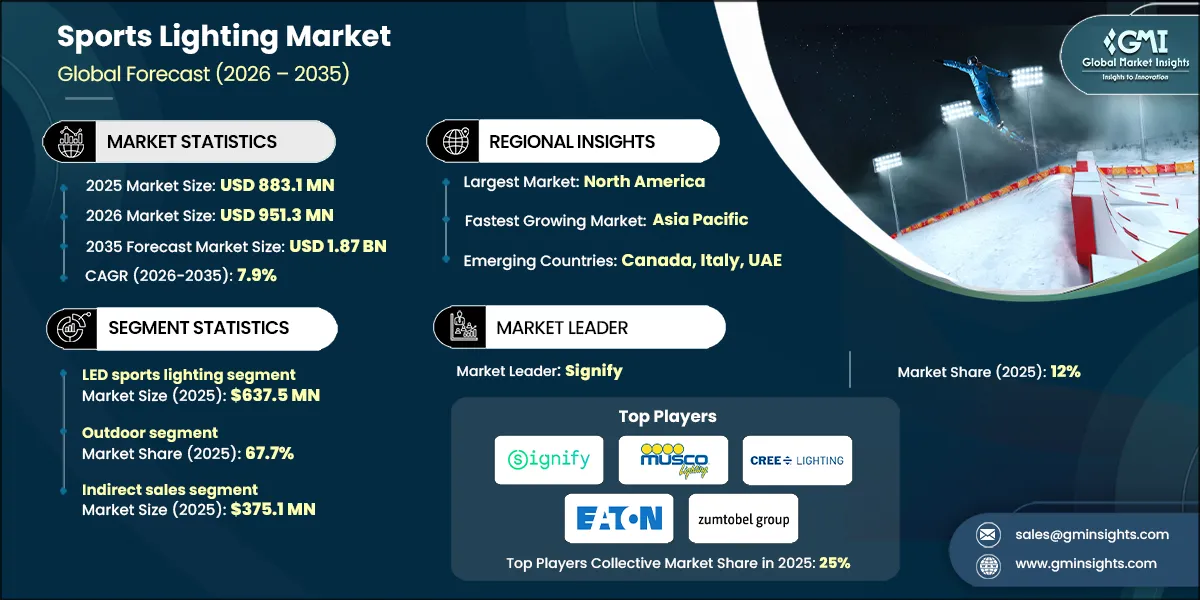
The sports lighting market was estimated at USD 883.1 million in 2025. The market is expected to grow from USD 951.3 million in 2026 to USD 1.87 billion in 2035, at a CAGR of 7.9% according to latest report published by Global Market Insights Inc.
Sports Lighting Market Key Takeaways
Market Size & Growth
- 2025 Market Size: USD 883.1 Million
- 2026 Market Size: USD 951.3 Million
- 2035 Forecast Market Size: USD 1.87 Billion
- CAGR (2026–2035): 7.9%
Regional Dominance
- Largest Market: North America
- Fastest Growing Region: Asia Pacific
Key Market Drivers
- LED adoption & energy efficiency.
- High-definition broadcast requirements.
- Energy efficiency mandates.
Challenges
- High initial cost.
- Supply chain risks.
Opportunity
- Smart lighting integration.
- Sustainability & ESG alignment.
Key Players
- Market Leader: Signify led with over 12% market share in 2025.
- Leading Players: Top 5 players in this market include Signify, Musco Lighting, Cree Lighting, Eaton, Zumtobel Group, which collectively held a market share of 25% in 2025.
Get Market Insights & Growth Opportunities
Sports lighting has changed dramatically since switching from older metal-halide and HID lamp to LED lights. LED lighting is much more energy-efficient than previous versions. This means that by using this type of lighting, stadium operators can reduce their electricity bill significantly. With most stadiums having high electric bills for lighting, switching to LED will save them a lot of money, particularly in larger venues. LEDs also have a much longer life than previous models, lasting typically over 50,000 hours, so stadiums will not have to spend as often on replacing the bulbs. With LEDs providing illumination and color rendering consistency, they provide the best visibility for both athletes and spectators.
LED lighting increase productivity and efficiency in sports lighting, but additional benefits of using LED Lighting help organizations and consumers reduce their carbon footprint and therefore achieve their sustainability goals through the reduction of energy consumption by the production of carbon dioxide. Since LEDs produce less heat compared to other types of lighting fixtures, users also benefit by limiting the amount of energy required for air conditioning and increasing overall energy efficiency. In addition, several LED systems now offer smart control technology that allows users to control the scheduling of the dimming and lighting in the facility and therefore utilize the effectiveness of those lighting options during games and practices better. These combined characteristics of efficiency, longevity, and flexibility will continue to drive the evolution of contemporary sports lighting solutions.
With the advent of 4K and 8K high-definition broadcasts, broadcasters now impose strict requirements for lighting at the facilities of many professional sports teams. The needs are for uniformity of the illumination across all areas of the field with no color distortion, flickering, or any other issues will ensure the viewer has a clear image. Poor lighting can result in excessive shadowing, inconsistent brightness, and color variations; these elements will not only degrade the quality of the broadcast, but they can also impede sponsorship and advertising revenue.
There are several lighting options available to the sports facility owners that meet or exceed the required lux levels and color temperature specifications for the use of broadcast media. LEDs provide the best solution due to their ability to offer the greatest amount of control over the distribution of light and their capability of illuminating instantly, not requiring the warm-up time required by previous lighting options. In addition, smart lighting service providers now offer the ability for operators to adapt the brightness and color of lighting dynamically for the different views of cameras used to capture the sporting events. When combined, these features allow both audiences at stadiums and those watching remotely through high-definition cameras to have an immersive experience and make compliance with high-definition broadcast requirements of worldwide importance when upgrading the lighting of sports facilities.
To get key market trends
Sports Lighting Market Trends
The market for lighting systems in stadiums and sports complexes is rapidly evolving due to advancements in technology, increasing focus on sustainability, and changing consumer needs. LED technology has led to an increase in the use of intelligent lighting systems within today’s sports facilities, all of which have been developed specifically for maximizing performance while also lowering operating expenses and meeting stringent broadcast standards. In addition to LEDs, the use of IoT (Internet of Things), adaptive lighting systems, and other technological advances are allowing facility operators to provide greater levels of entertainment value to fans and improved management of the facility through these technologies.
- Modern sports lighting has evolved into a fully integrated LED lighting technology system because of LED’s superior efficiency compared to traditional metal halide fixtures. LED fixtures consume an estimated 70% less electricity than their traditional counterparts resulting in lower overall operating costs for professional sports teams who typically have larger facilities requiring significant amounts of lighting. In addition, due to the extended lifetime of LED maintenance and replacement costs are greatly reduced because most LED fixtures are rated at 50,000+ hours of life.
- Light Emitting Diode (LED) technology is driving the sports lighting industry toward adopting Internet of Things (IoT)-based solutions for converting existing ’dumb’ lights into intelligent lights. The incorporation of smart lighting systems creates opportunities to monitor lights from a distance, automating scheduling based on time-dependent events and controlling the brightness level of the lights. This flexibility maximizes the efficiency of energy consumption, while also providing increased operational flexibility for venue operators.
- In addition to increased demand for HD TV broadcasts, there has also been an increase in the popularity of 4K and 8K television broadcasts, which means that Sports Light Farmers will now need to provide more consistent and higher-quality experience to their customers. To create the desired visual effects, lighting for professional sporting events must conform to extensive lighting requirements defined by Lux, uniformity and Color Renderings. In addition, advanced LED lighting systems are well suited to provide the necessary degree of control over the distribution of lighting throughout the facility and allow for immediate activation of the lights, eliminating the need for warm-up times.
- As environmental responsibility becomes increasingly important to sports franchises across the globe, more facilities are being forced to decrease their own carbon footprints to meet their goals associated with ESG (Environmental, Social and Governance) standards. Most venues use energy efficient LED products and provide a significant contribution toward the establishment of a clean and sustainable environment. Many stadiums are currently interested in exploring the integration of renewable energy sources to further improve upon the sustainability of their lighting systems.
Sports Lighting Market Analysis
Learn more about the key segments shaping this market
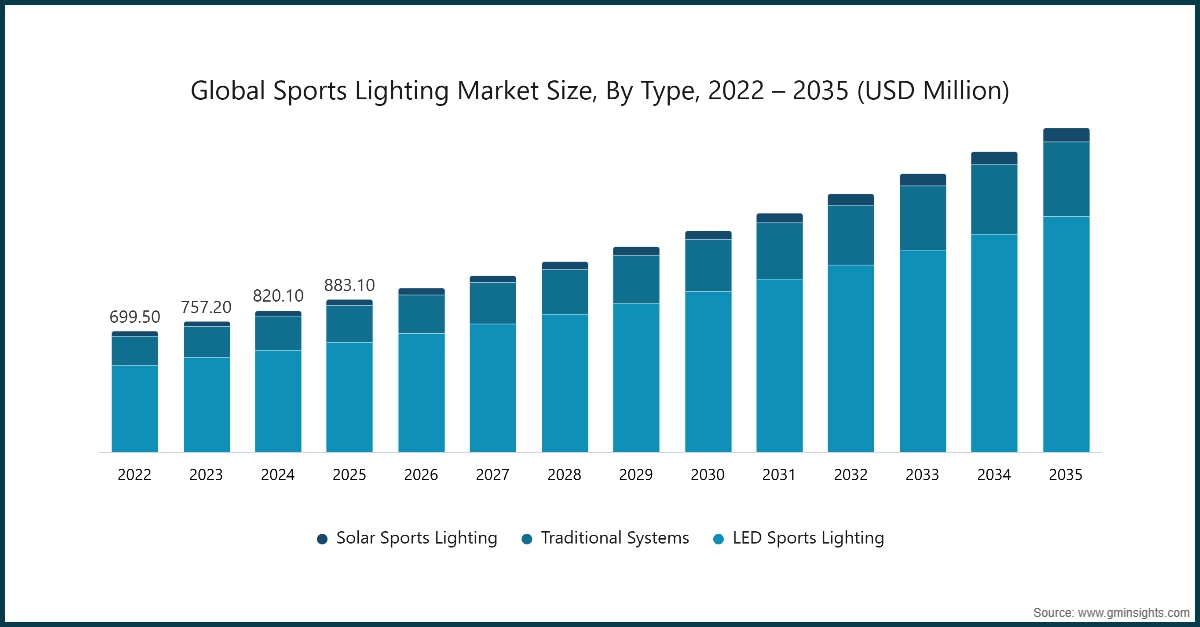
Based on type, the sports lighting market is divided into LED sports lighting, traditional systems and solar sports lighting. In 2025, LED sports lighting held the major market share, generating a revenue of USD 637.5 million.
- LED sports lighting provides an exceptionally high level of performance, efficiency, and value to modern stadiums, arenas, and athletic/recreational facilities compared to traditional metal halide or high-pressure sodium (HPS) lighting systems. In addition to providing illumination, superior color rendering, and the ability to turn on instantly without waiting for upping as is typical of most conventional lighting technologies, LED sports lighting maximizes visibility for players, officials, spectators, and others within a professional sporting event while meeting the unique needs of professional sports events.
- The most notable advantage of LED sports lighting is that it is more energy-efficient than traditional lighting systems. LEDs require 50% – 70% less energy compared with traditional systems. Therefore, there are significant savings in energy costs to venue owners. Also, because LEDs have a long lifespan typically 50,000 hours or more, they require much less maintenance and replacement, making them ideal for large stadiums where the mechanics of maintaining and replacing lighting systems can be complex and costly. Furthermore, LEDs use less energy to produce heat; therefore, they require less energy to cool down, which improves energy efficiency overall.
- In addition to being energy-efficient, LEDs offer numerous other features that make them suitable for the sports and entertainment industry. Many of the most recent LED sports lighting systems feature digital controls that allow an operator to easily adjust the level of brightness, color temperature as well as create dynamic visual effects and lighting displays. This capability is especially important for venues that host a multitude of event types including concerts, festivals, etc. Additionally, many LED fixtures comply with the highest standards of digital high-def quality and are therefore able to provide exceptionally high-quality visual images to viewers on all forms of media including television, streaming, etc.
Learn more about the key segments shaping this market
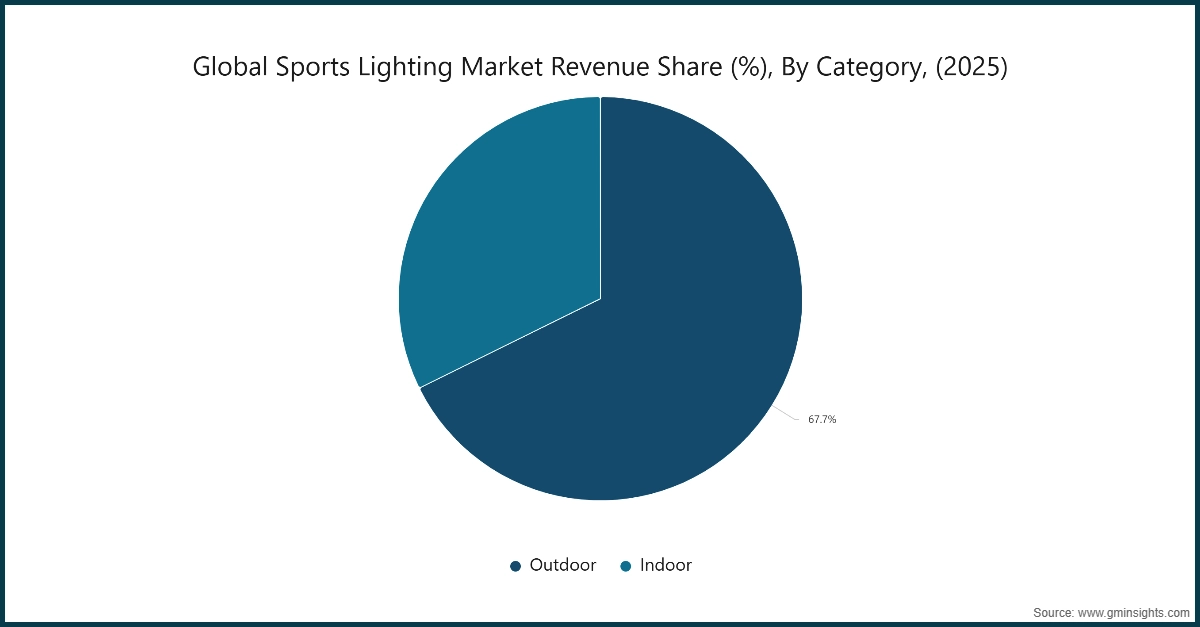
Based on category, the market is segmented into outdoor and indoor. The outdoor segment held around 67.7% of the global sports lighting market share in 2025.
- Safe, vibrant and effective use of remote sport lights is important to improve athletic performance and provide a safe environment for both athletes and fans; there are many challenges associated with outdoor sports lighting, including unpredictable weather, wide open areas with multiple playing fields, and a need for the same level of lighting to be delivered across multiple areas of a venue. Therefore, to meet the professional athlete and spectator requirements established by international standards, properly designed outdoor sports field lights provide the necessary lighting to enable athletes to perform at their maximum potential and give spectators the best view of their team.
- To provide outdoor sports lighting solutions that are effective and efficient, outdoor sports facilities are using more LED lighting solutions. LEDs offer built-in protection against extreme weather elements, such as wind, rain and temperature changes, making them an excellent choice for stadiums, training facilities, and recreational fields. Due to their extended life expectancy, LEDs greatly reduce the cost of maintaining lights in outdoor facilities, where maintenance of light fixtures is often both time-consuming and expensive to perform. Furthermore, with superior light control capabilities, LEDs provide a consistent source of lighting coverage across multiple areas of an outdoor facility while minimizing the light that spills into the surrounding areas of the facility.
- The use of technology and sustainability in outdoor sports lighting is continuing to evolve. In addition to providing the basic function of light, there has been an increase in smart technology integration and eco-friendly practices used in these systems. Through IoT connectivity, facility managers can monitor and control the level of lighting for their facility remotely, based upon relevant factors such as scheduling for events, occupancy, and changes in weather patterns.
Based on distribution channel, the sports lighting market is segmented into direct sales and indirect sales. In 2025, indirect sales segment generating a revenue of USD 375.1 million.
- Sales by intermediaries to end-users are referred to as indirect sales. These intermediaries include distributors, dealers, resellers, agents, or third-party online platforms that connect a manufacturer with its customers. By utilizing the expertise and networks of these partners, a business can grow its market presence from a distance without needing to invest in direct sales models. This gives companies the ability to explore new marketplaces, save on overhead expenses, and focus on their core functions like design and promotion.
- The leading advantage of using the indirect sales model is scalability and access to new markets. A business can gain a foothold in a geographic area where it does not physically operate by forming relationships with local resellers or distributors who can assist in navigating the local business climate. This means potential rapid entry into new markets. On the downside, the indirect sales model presents some serious challenges for an organization, including reduced control over prices, the customer experience, and how customers perceive the brand. In addition, an organization needs a very thorough plan for maintaining the appropriate level of oversight over several partners to ensure their compliance and consistently provide high-quality service across all their distribution channels. For these reasons, indirect sales remain a highly effective vehicle for many organizations seeking to increase their financial growth and expand into other parts of the world.
Looking for region specific data?
North America Sports Lighting Market
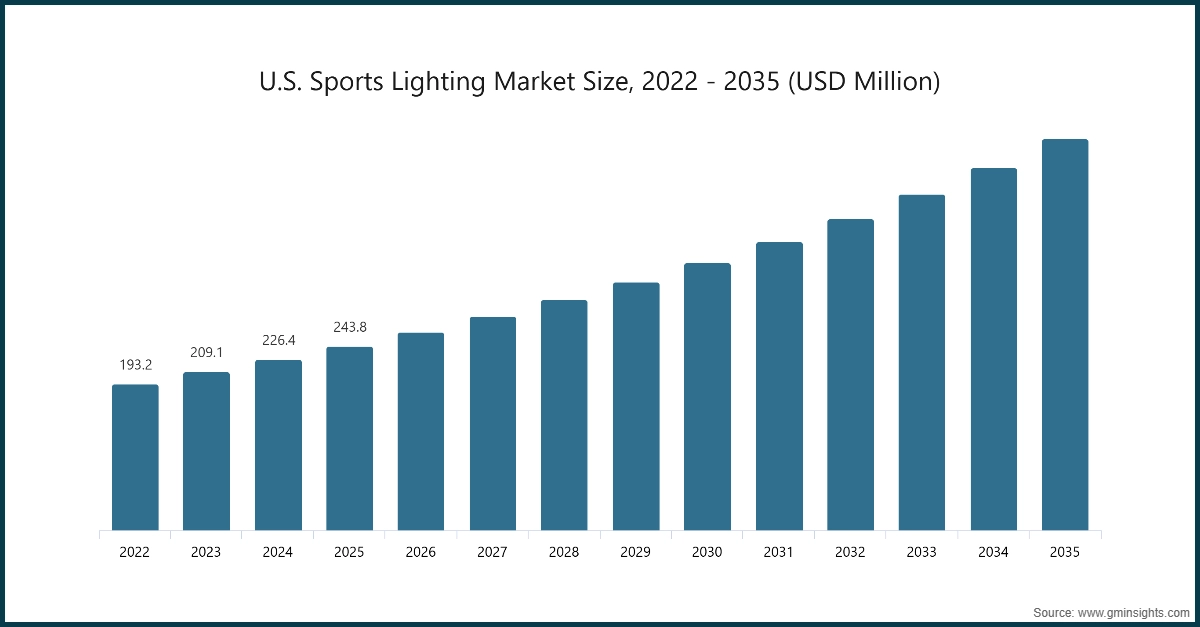
In 2025, the U.S dominated the North America sports lighting industry, accounting for around 79.7% share and generating around USD 243.8 million revenue in the same year.
- The U.S. market growth is driven by modernization of stadiums and arenas and increased demand for energy-efficient solution. The adoption of LED’s continues to surge due to State and Federal legislation that mandates energy usage, the need to meet the sustainability goals of each respective organization, and the demands of providing high-definition television broadcasts for professional sports associations. In addition, the movement toward smart stadiums require substantial investment in Internet of Things (IoT) enabled lighting systems that allow for remote management, dynamic effects, and enhanced fan experiences.
- The North American sports lighting market, which includes both Canada and the U.S., is characterized by an abundance of technological advancement and the use of a high percentage of LED lighting systems. The abundance of technological advancement and the advancement of a developed infrastructure will continue to drive advancements in North America as its sports culture grows and evolves to conform to international standards. The green movement is further driving the growth of the North American market, with government incentives for energy-efficient products being instrumental in this growth.
Europe Sports Lighting Market
Europe market held 25.1% share in 2025 and is expected to grow at 7.9% CAGR during the forecast period.
- The European Sporting Light Markets are well-developed and heavily policed for conformity to energy usage laws, with a strong focus on energy efficiency and sustainability. This is largely due to the rapid deployment of LED Technology, driven by very strict EU regulations regarding energy performance and environmental impact as per the EU Ecodesign Regulation. The major sports stadiums in Germany, the UK and France, among other European nations, have converted their lighting systems to LEDs to follow international broadcasting standards and to lessen their carbon footprints.
- In addition to a strong focus on sustainability, there has also been a large growth in new technologies centered around the smart stadium concept throughout Europe. Today, most of the IoT-enabled stages are linked with a comprehensive facility management system and offer sports organizations access to real-time and predictive maintenance. Increasingly, sports organizations are also using dynamic lighting effects during entertainment and audience engagement at many of their largest venues. While many sports organizations in Europe are currently incentivized to invest in new and innovative eco-friendly technologies through government subsidy and Green Certifications, Europe remains the leader in the field of sustainable and technologically advanced sports lighting.
Asia Pacific Sports Lighting Market
The Asia Pacific held a market share of around 28.6% in 2025 and is anticipated to grow with a CAGR of around 8.4% from 2026 to 2035.
- The sports lighting sector is poised for continued growth across Asia Pacific. The rapid pace of urbanization across APAC has led to higher disposable income and an increase in investment into sports infrastructure. In APAC countries like China, India, and Japan are in the process of building new stadiums and modernizing current stadium facilities so that they can accommodate the international sporting events i.e., Asian Games and the Olympics. Properly designed LED products meet the requirements for all levels of professional sports, which makes LED an attractive option for many countries in APAC. Several APAC countries have implemented initiatives backed by their government to promote energy efficiency and the development of smart cities.
- The rise of technological innovation in Asia-Pacific region can be seen through an increasing adoption of smart lighting technology in premium stadiums. Smart lighting allows for remote control of lighting systems; adaptive brightness depending on activity level; and offers dynamic effects to improve the users' experience. Furthermore, increases in popularity of e-sports and growth of indoor sports venues will drive demand for further advanced lighting systems. Furthermore, as concerns about sustainability increase and APAC markets continue to use LED systems along with increasing amounts of renewable energy sources, APAC markets will become leading areas for future growth in sporting venue lighting solutions.
Latin America Sports Lighting Market
Latin America market is growing at a CAGR of 7.1% during the forecast period.
- The sports lighting industry in Latin America is projected to grow as the sports culture of the region is growing and many major tournaments including Copa América as well as FIFA World Cup qualifiers are causing investments in modern stadiums and community sports facility across Brazil, Mexico and Argentina. Along with a rise in popularity of night-time sporting events, the need for superior quality light for sporting events has also generated increased demand for high-performing and energy-efficient advanced LED lighting solutions.
- In addition, the region has begun to embrace innovation through the introduction of smart lighting systems as they are being implemented in premium venues throughout the region. Smart lighting systems feature remote control capability, adaptive brightness as well as dynamic effects that enhance fan engagement and create unforgettable moments for fans attending live events. Sustainable solutions are an increasing focus of sports organizations, and more sports organizations are looking at integrating energy-efficient products in addition to eco-friendly lighting to align with the global environmental movement. As a result, LATAM was a key segment for both LED and smart sports lighting solutions, innovative products, advanced technologies, and sustainable initiatives.
Sports Lighting Market Share
Signify is leading with 12% market share. Signify, Musco Lighting, Cree Lighting, Eaton, Zumtobel Group collectively hold around 25%, indicating moderately fragmented market concentration. These prominent players are proactively involved in strategic endeavors, such as mergers & acquisitions, facility expansions & collaborations, to expand their product portfolios, extend their reach to a broad customer base, and strengthen their market position.
ACUITY Brands is the leading global manufacturer of advanced technology lighting solutions for sports, commercial, and outdoor applications with some of the most innovative and efficient LED lighting systems available today along with state-of-the-art controls that enable intelligent lighting solutions to be provided for those applications. Acuity Brands is focused on producing energy-efficient, sustainable, and technologically advanced lighting solutions using IoT integration with all of their products including the high-quality LED luminaires and control platforms in their product line so that sports facilities, commercial spaces, and outdoor venues can be upgraded through the installation of Acuity Brands' products.
Signify based in Europe and North America, is another leading global manufacturer of LED and connected lighting solutions. Signify has developed an integrated smart lighting platform to deliver smart lighting for sports, commercial and outdoor applications called Interact Sports. The interact sports platform provides a range of features that allow venue operators to provide remote monitoring of their venue's lighting, multiple stages of adaptive brightness control, and dynamic effects for fan engagement. Signify has extensive experience in designing lighting systems that meet the international broadcast standard, as well as providing energy-efficient lighting systems for some of the largest sports venues in the world.
Sports Lighting Market Companies
Major players operating in the sports lighting industry are:
- Acuity Brands
- AEON LED
- Bajaj Illumination
- Cooper Lighting Solutions
- Cree Lighting
- Eaton
- GE
- Havells India Limited
- Musco Lighting
- Schreder
- Signify N.V.
- SITECO
- Thorn Lighting
- Transrail
- Zumtobel Group
Musco Lighting specializes in providing lighting solutions for sporting events, stadiums, and arenas, providing quality, personalized solutions with superior illumination through its highly developed LED systems. Musco has built an outstanding reputation as the leading provider of LED lighting systems that provide even bright illumination; excellent color rendering; and minimal glare to ensure that both the athlete and the viewer are provided with optimal viewing conditions. Smart control and energy-saving technology also help lower operational costs, while still supporting high-definition broadcast standards and sustainability objectives for many venues.
Cooper Lighting Solutions is a leader when it comes to commercial, industrial, and sporting lighting by providing innovative and energy-efficient lighting products. The products cooper has in-house included LED luminaries as well as advanced control systems. They have been engineered so customers can improve their work performance, reduce the amount of energy used, and exceed their sustainability goals. Cooper’s mission is to integrate smart technologies into their lighting products. These technologies will provide remote monitoring capability, transitional lighting capability, and Internet of Things (IoT) Connections to all modern stadiums and outdoor sports venues.
Sports Lighting Market Report Attributes
| Key Takeaway | Details |
|---|---|
| Market Size & Growth | |
| Base Year | 2025 |
| Market Size in 2025 | USD 883.1 Million |
| Market Size in 2026 | USD 951.3 Million |
| Forecast Period 2026-2035 CAGR | 7.9% |
| Market Size in 2035 | USD 1.87 Billion |
| Key Market Trends | |
| Drivers | Impact |
| LED adoption & energy efficiency | Reduced energy usage and maintenance at sporting venues have a major impact on achieving large cost savings and sustainability goals. |
| High-definition broadcast requirements | Advanced lighting technologies deliver consistent levels of illumination and superior quality of color rendering will encourage sports venues to invest in these technologies for broadcasting ultra-high definition (UHD). |
| Energy efficiency mandates | The trend toward the use of Eco-friendly LED on all levels is being accelerated in order to meet worldwide green certification and comply with regulatory guidelines. |
| Pitfalls & Challenges | Impact |
| High initial cost | An obstacle to adopting advanced LED and smart lighting systems in small to medium-sized venues is the need for large upfront investments. |
| Supply chain risks | The dependency of all LED projects on the availability of semiconductors and components creates costly project delays and variability in total project cost. |
| Opportunities: | Impact |
| Smart lighting integration | In addition, it is becoming increasingly important for Sports Lighting to connect with cloud services and mobile applications so that users can manage their printers remotely and have flexibility. |
| Sustainability & ESG alignment | As more agencies look to reduce their impact on the environment, many manufacturers are now beginning to employ environmentally friendly materials and implement energy-saving printing technologies. |
| Market Leaders (2025) | |
| Market Leader |
12% market share |
| Top Players |
The collective market share in 2025 is 25% |
| Competitive Edge |
|
| Regional Insights | |
| Largest market | North America |
| Fastest growing market | Asia Pacific |
| Emerging countries | Canada, Italy, UAE |
| Future Outlook |
|
What are the growth opportunities in this market?
Sports Lighting Industry News
- In December 2025, Musco Lighting delivered Norway’s Ullevaal Stadium with a truly exceptional state-of-the-art LED floodlight system, which was certified to meet FIFA’s highest standards for professional sports lighting. The design of this new system is highly advanced, providing the ability to create uniform illumination throughout an entire soccer pitch for ultra-HD television broadcasts while adhering to the strictest international lighting regulations. The system provides extremely high levels of TLCI (Television Lighting Consistency Index), which enhances color reproduction and eliminates flicker to ensure pixel-perfect slow-motion replay capabilities and quality broadcast standards.
- In May 2025, Acuity Brands acquired M3 innovation, a sports lighting startup, for its innovative MAKO sports lighting system that incorporates modularized LED-based technology and enables connectivity via cloud technology with an emphasis to reduce both installation and maintenance costs. Once M3's integration into Acuity is completed M3's product line will be included in Acuity's existing portfolio of products marketed via lithonia lighting and Holophane brand names. With this acquisition Acuity will further strengthen its foothold within the smart sports lighting market segment.
- In April 2025, Transrail detailed several new orders and outlined the growth of the Poles & Lighting business unit that provides high-masted poles and advanced LED lighting systems for large sporting and infrastructure projects. The company also showcased the effectiveness of its products installed at well-known Indian venues such as the M. Chinnaswamy Stadium, where strong high-masted poles and energy-efficient LED floodlights provide optimal light coverage for professional sporting events.
- In April 2025, Cree Lighting created the ultimate solution for illegal lighting in sports venues and eco-sensitive areas. This game-changing low blue outdoor lighting available throughout Cree's area fixture collection addresses all these needs with its unique low blue spectral emissions at 1900K color temperature and 50 CRI (Color Rendering Index). The product lines incorporate advanced optics engineered to provide visual comfort and uniform distribution, while utilizing Lumileds NightScape Technology designed to meet or exceed the highest efficacy standards for large-area illumination.
The sports lighting market research report includes in-depth coverage of the industry with estimates & forecasts in terms of revenue (USD Million) & volume (Thousand Units) from 2022 to 2035, for the following segments:
Market, By Type
- LED sports lighting
- Traditional lighting systems
- Solar sports lighting
Market, By Fixture Type
- Floodlights
- High-bay lights
Market, By Category
- Outdoor
- Indoor
Market, By Price
- Low
- Medium
- High
Market, By Power Type
- Upto 50W
- 50-100W
- 100-200W
- 150-200W
- Above 200W
Market, By Application
- Basketball
- Volleyball
- Tennis & racquet sports
- Football/Soccer
- Cricket
- Badminton
- Others (Rugby, baseball, ice hockey, etc.)
Market, By End User
- Professional sports arenas
- Educational institutions
- Municipalities/recreational facilities
- Sports complex
- Training academies
Market, By Distribution Channel
- Direct sales
- Indirect Sales
The above information is provided for the following regions and countries:
North America
- U.S.
- Canada
Europe
- Germany
- UK
- France
- Italy
- Spain
Asia Pacific
- China
- India
- Japan
- Australia
- South Korea
Latin America
- Brazil
- Mexico
- Argentina
Middle East and Africa
- South Africa
- Saudi Arabia
- UAE
Frequently Asked Question(FAQ) :
What is the market size of the sports lighting in 2025?
The market size was USD 883.1 million in 2025, with a CAGR of 7.9% expected through 2035 driven by LED adoption, energy efficiency mandates, and high-definition broadcast requirements.
What is the projected value of the sports lighting market by 2035?
The global market for sports lighting is expected to reach USD 1,879.1 million by 2035, propelled by smart lighting integration, sustainability goals, and technological advancements in LED systems.
What is the current sports lighting market size in 2026?
The market size is projected to reach USD 951.3 million in 2026.
How much revenue did the LED sports lighting segment generate in 2025?
LED sports lighting generated USD 637.5 million in 2025, leading the market with superior energy efficiency and performance capabilities.
What was the market share of the outdoor category segment in 2025?
The outdoor segment held 67.7% market share in 2025, accounting for the largest portion of the global sports lighting market.
What is the growth outlook for the Asia Pacific region from 2026 to 2035?
The Asia Pacific sports lighting market is projected to grow at an 8.4% CAGR till 2035, driven by rapid urbanization, rising disposable income, and increased investment in sports infrastructure.
Which region leads the sports lighting market?
North America dominated the market, with the U.S. accounting for 79.7% of the regional share and generating USD 243.8 million in revenue in 2025. Modernization of stadiums and energy-efficient solutions fuel the region's dominance.
What are the upcoming trends in the sports lighting market?
Key trends include integration of IoT-enabled smart lighting systems, adoption of renewable energy sources with LED technology, dynamic lighting effects for fan engagement, and carbon-neutral solutions aligned with ESG criteria.
Who are the key players in the sports lighting market?
Key players include Signify N.V., Musco Lighting, Cree Lighting, Eaton, Zumtobel Group, Acuity Brands, AEON LED, Bajaj Illumination, Cooper Lighting Solutions, GE, Havells India Limited, Schreder, SITECO, Thorn Lighting, and Transrail.
Sports Lighting Market Scope
Related Reports