Summary
Table of Content

Sports Bra Market
Get a free sample of this report
Form submitted successfully!
Error submitting form. Please try again.
Thank you!
Your inquiry has been received. Our team will reach out to you with the required details via email. To ensure that you don't miss their response, kindly remember to check your spam folder as well!
Request Sectional Data
Thank you!
Your inquiry has been received. Our team will reach out to you with the required details via email. To ensure that you don't miss their response, kindly remember to check your spam folder as well!
Form submitted successfully!
Error submitting form. Please try again.
Sports Bra Market Size
The heightened trend of fitness enthusiasts participating more in the fitness industry, the popularity of sportswear apparel, and the resultant awareness of consumers towards their wellness have dramatically driven the demand for sophisticated sports bras, especially with the expansion of major sportswear companies. Major companies are strengthening their positions globally through the addition of products under performance apparel, as well as technological improvements and broad material innovations. Unlike daily bras, which often cannot offer the needful that modern fitness requires, sports bras’ functionality is capable of meeting the demands of the modern consumer.
Sports Bra Market Key Takeaways
Market Size & Growth
- 2025 Market Size: USD 16 Billion
- 2026 Market Size: USD 16.9 Billion
- 2035 Forecast Market Size: USD 27.7 Billion
- CAGR (2026–2035): 5%
Regional Dominance
- Largest Market: North America
- Fastest Growing Region: Asia Pacific
Key Market Drivers
- Rise in women’s fitness participation & athleisure adoption.
- Smart sizing, digital fit tools & virtual try-ons.
- Sustainability & eco-conscious materials.
Challenges
- High cost of premium performance bras.
- Proliferation of counterfeits in online channels.
Opportunity
- AI-driven fit personalization.
- Travel-friendly, lightweight & seamless designs.
Key Players
- Market Leader: Nike, Inc. led with over 7% market share in 2025.
- Leading Players: Top 5 players in this market include Nike, Inc., Adidas AG, Hanesbrands Inc., Under Armour, Inc., Puma SE, which collectively held a market share of 35% in 2025.
Get Market Insights & Growth Opportunities
Modern sports bra systems are now more sustainable too, utilizing materials ranging from recycled polyester to organic cotton blends, bamboo, and long-lasting spandex materials. We are now witnessing a shift towards more seamless knitting technologies and bonding processes with minimal waste during production. This follows the overall trend towards more conducive sustainable wearables, particularly in North America and European markets, where sustainability has now become a purchasing trigger.
"The market performance is the result of the synergy created by the integration of digital technology, the expansion of omnichannel retailing, and the ongoing cycles of high-efficiency product development." Technology advances, which include 3D knitting, AI-based fit solutions, body-mapping innovations, and precise compression technology, are slowly changing the basic sports bra from a rudimentary piece of clothing towards a sophisticated product for providing support during physical impact. Across the industry, there has been a clear preference identified for smart fit solutions, breathable materials, and adaptive comfort systems capable of reacting well for a range of physical activity, body types, and sweat conditions.
As a result, brands increasingly focus on enhancing the user experience through advanced cooling fabrics, quick‑dry technology, zoned compression mapping, and flexible support structures. The addition of front closures, convertible straps, and post-surgery friendly designs further expands inclusivity and accessibility for diverse consumer groups.
The sports bra market is an everyday lifestyle market, driven by at‑home workouts, athleisure wear, and the need for comfort all day long. Compared to traditional bras, sports bras automatically adapt to the user through compression + encapsulation systems, high-recovery spandex, and shape‑retention technologies, reducing discomfort in bounce, pressure points, and straps. As sportswear brands optimize their E‑commerce platforms for fit guidance and minimize return complexity, sports bras are increasingly becoming a repeat-purchase category worldwide.
Strong efficiency and comfort performance have made sports bras essential not only for athletes but also for casual wearers looking for regular and dependable support. Low‑Impact categories combined account for more than 70% of global revenues. Their resilience is fueled by durability, multi‑activity versatility, and a consumer preference for engineered support. Meanwhile, Seamless and Front‑Closure Sports Bras continue to gain popularity for their everyday wear comfort and ease, and accessibility-especially within the 31–45 and 46–60 year age brackets, which collectively represent 70% of total market value.
The global sports bra market was estimated at USD 16 billion in 2025. The market is expected to grow from USD 16.9 billion in 2026 to USD 27.7 billion in 2035, at a CAGR of 5% according to latest report published by Global Market Insights Inc.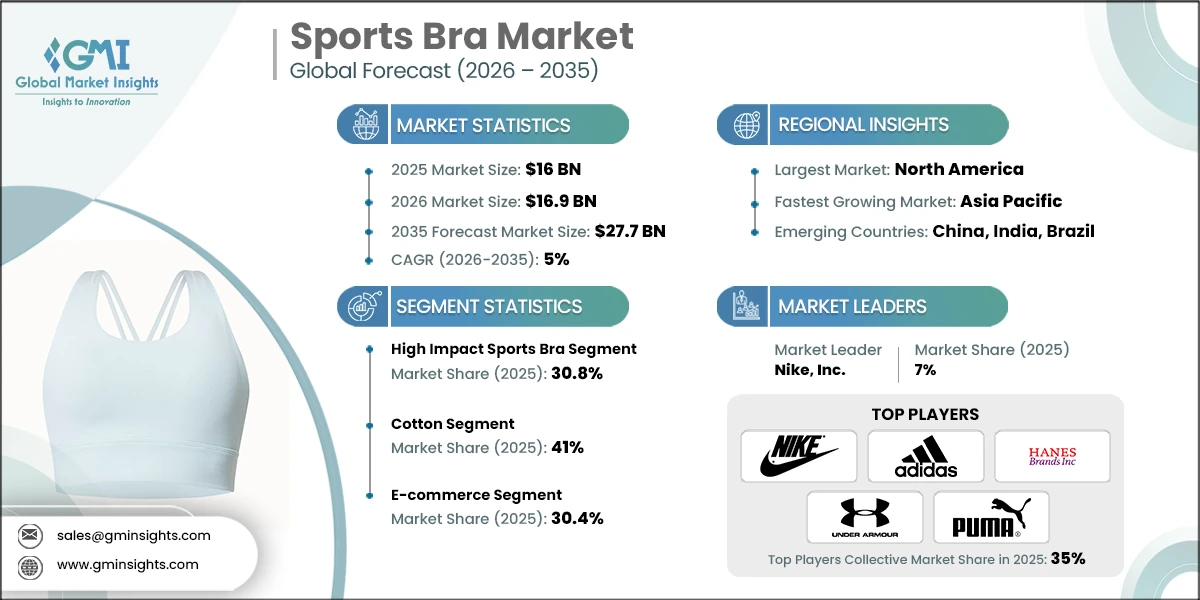
To get key market trends
Sports Bra Market Trends
The Sports Bra industry, with quite an extensive global base, is undergoing an utter revolution through the sheer opportunities offered due to innovative performance-focused sports bras, various substantial developments in material technology, and diversified product propositions by leading sports and apparel makers. Well-known companies such as Nike, Adidas, Puma, Under Armour, Calvin Klein, and Hanesbrands Inc. are pushing out cutting-edge sports bras with features such as enhanced support systems, seamless construction methods, moisture-management systems, and fit technologies, which serve as an added advantage to modern consumers, meeting their needs and desires for performance and their lifestyles as well.
- Technology Advancement and Product Innovation: Sports bras are also becoming more sophisticated as technology developers are applying performance engineering, technical fabrics, and body-responsive construction methods.
- Seamless knitting and bonding edges to prevent any chafing: Moisture-wicking polyester blends, high-recovery spandex fabrics, breathable cotton composites AI-assisted fit guidance, digital size recommendations, and try-on technologies improve accuracy in online commerce. Leading brands are investing in temperature adaptive fabrics, mesh ventilation systems, and 3D pattern engineering technologies to enhance support stability, comfort, and product life during intense exercise activities.
- Expansion of e-commerce and subscription-based models of retail: Strong performance by Direct-to-Consumer (DTC) and social commerce channels has emerged as perhaps the most significant driver of growth among all contributors to the market for sports bras.
- Evidence for the rise of online retail: Broad availability of size options and fit options like consumer desire to have easy returns, size tools, and digital fit calculators. Subscription models with replacement cycles, delivery of multiple products in one pack, and reward systems. These platforms not only increase consumer convenience levels but also improve their long-term interaction with brand ecosystems.
- Sustainable design, wellness-based materials: Sustainability has emerged as a key trend in sports bra product innovation, with designers developing products that decrease product waste, feature environmentally friendly materials, and help the product last longer by using materials that can be recycled. This is achieved through: recycled polyester, organic cotton, bamboo fibers, biodegradable blends, etc. Low-waste seamless manufacture, which reduces textile wastes. Eco-conscious dyeing processes and long-lasting elasticity systems.
Sports Bra Market Analysis
Learn more about the key segments shaping this market
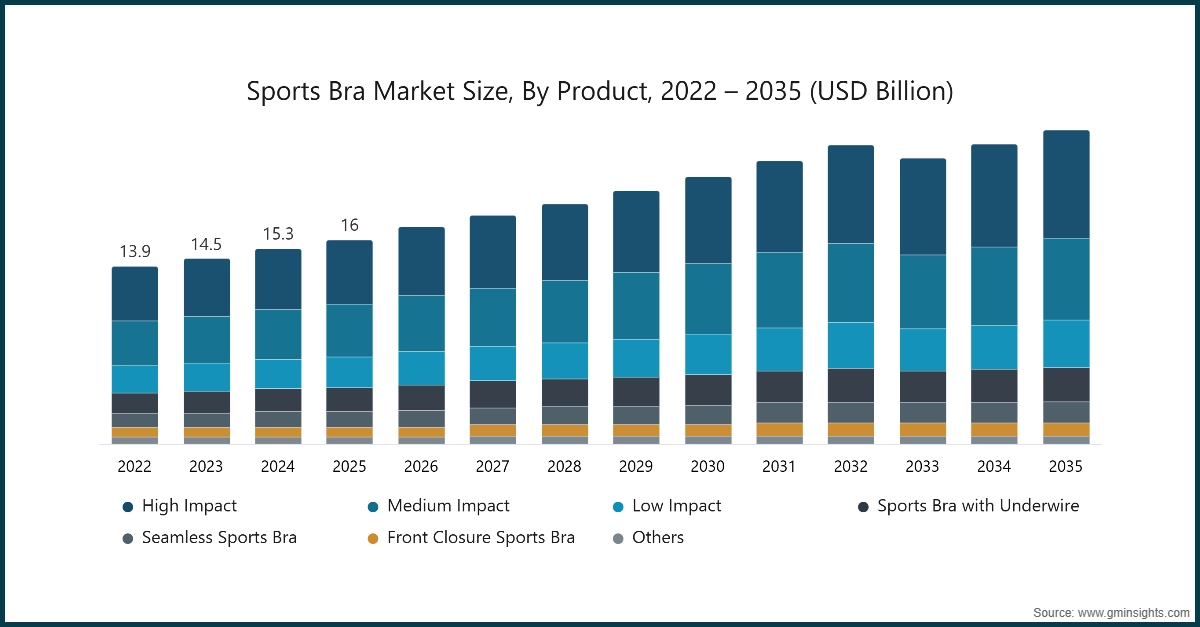
Based on the product type, the market is divided into high impact, medium impact, low impact, sports bra with underwire, seamless sports bra, front closure sports bra, and others. The high‑impact sports bra segment held the largest share, accounting for 30.8% of the global sports bra market in 2025 with the value at USD 4.9 billion.
- The rising need for enhanced stability, bounce control, and performance-driven support during activities like running, HIIT, and aerobics is strongly encouraging growth in the high-impact segment.
- High‑impact and medium‑impact sports bras together form over 55% of total market value, reflecting consumer preference for high-support, durable, and versatile encapsulation systems.
- Low‑Impact and Seamless Sports Bras show steady growth rates supported by consistent demand from yoga, Pilates, wellness routines, and all‑day athleisure wear.
Learn more about the key segments shaping this market
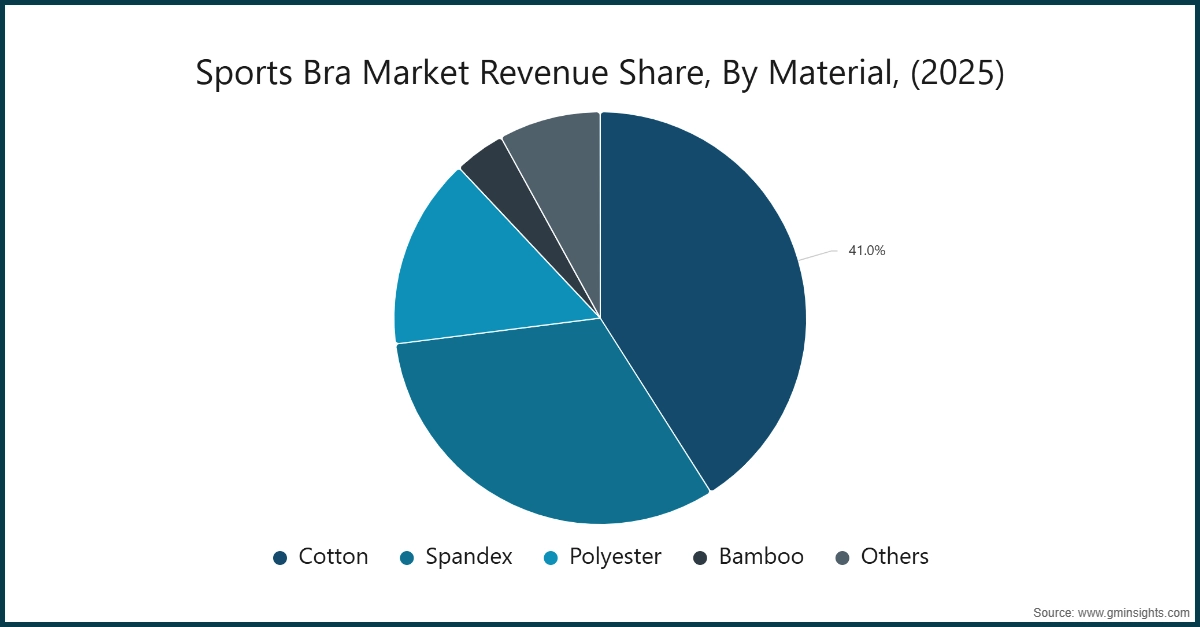
Based on material, the market is categorized into cotton, spandex, polyester, bamboo, others. In 2025, cotton held the dominant market share of 41% and is anticipated to grow through the years.
- Cotton is renowned for its softness and natural breathability. Sports bras made from cotton are highly favored for their comfort, making them suitable for low-impact activities and everyday wear.
- Cotton is less likely to cause skin irritation compared to synthetic materials, appealing to consumers with sensitive skin or allergies. Cotton sports bras are often priced lower than those made from advanced synthetic materials, making them an economical choice for budget-conscious consumers.
- Bamboo and eco-friendly blends continue to expand steadily driven by sustainability awareness and preference for anti‑odor, hypoallergenic fabrics.
Based on the distribution channel, the Sports Bra market is segmented into Wholesaler/Distributor, Specialty Store, Hypermarket/Supermarket, E‑commerce, and Others. In 2025, E‑commerce held the largest share at 30.4%, reflecting the industry's rapid shift toward digital and omnichannel retailing.
- E‑commerce leads the market and is also the fastest-growing channel driven by the convenience of at-home delivery, broad size availability, detailed fit guides, and strong adoption of DTC brand websites.
- Specialty stores represent 20% of the market and remain important for in‑person fittings, expert recommendations, and premium brand accessibility.
- Hypermarket/Supermarket channels captured 25.2% of the market, supported by mass availability, value pricing, and high footfalls.
North America Sports Bra Market
Looking for region specific data?
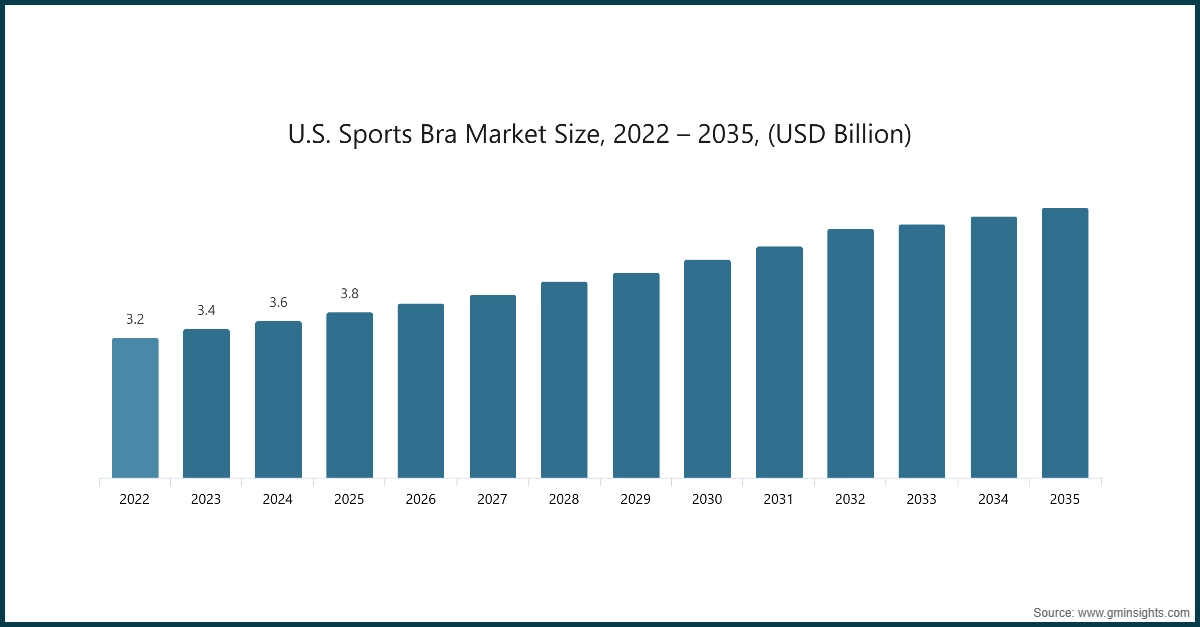
In 2025, North America is a key regional market with an estimated value of USD 3.8 billion and a projected growth rate of 5.2% through 2035.
- The U.S. leads the region, valued at USD 3.1 billion in 2025, supported by strong demand for high‑impact sports bras and premium athletic apparel.
- Growth in the U.S. market is driven by widespread adoption of fitness routines, athleisure lifestyle trends, and strong penetration of E‑commerce, the fastest-growing channel.
- The region shows high preference for engineered support systems, seamless construction, and moisture‑wicking polyester blends, meeting the needs of consumers seeking both comfort and performance.
- The demand is further fueled by rising awareness of breast health, enhanced focus on self‑care, and the shift toward at‑home fitness, reducing dependency on physical retail stores.
Europe Sports Bra Market
Europe is a significant market estimated at USD 3.6 billion in 2025, with a projected growth rate of 5.0% through 2032. Germany leads the region with the strongest growth rate of 5.6%, driven by high adoption of premium performance wear.
- The European market benefits from strong consumer preference for sustainable fabrics, such as organic cotton and recycled polyester, aligning with regional ESG priorities.
- Sustainability regulations encourage brands to adopt eco‑friendly production, low‑waste seamless knitting, and recyclable materials.
- Countries such as France, Italy, and Spain exhibit steady demand due to modernization of fitness clubs and studio workouts that require high‑quality impact‑specific bras.
- Europe’s manufacturing excellence supports advanced ergonomic contouring, multi‑density padding, and durable strap architecture, which enhance long-term comfort.
Asia Pacific Sports Bra Market
Asia Pacific is a rapidly expanding regional market. It has an estimated market value of USD 5.0 billion in 2025 with a projected growth rate of 5.6% from 2026 to 2035.
- The rapid growth results from massive urbanization and an expanding middle class that requires modern lifestyle.
- Rising demand for high-quality production and better personal aesthetics influences the market, The shift toward modern lifestyle apparel, digital fitness platforms, and athleisure trends is driving consumers from traditional bras to performance-oriented sports bras.
- Countries such as Japan and Australia are significant contributors, favoring technologically advanced sports bras with features like zoned support, breathable mesh integration, and seamless construction.
Latin America Sports Bra Market
Latin America represents a developing segment expected to reach USD 1.3 billion by 2025, growing at a rate of 2.6% from 2026 to 2035.
- Overall growth is steady as increasing urbanization, and a growing retail sector boost the demand for professional grooming and hygiene products.
- Growth remains steady due to rising urbanization, expanding retail networks, and increasing interest in affordable performance wear.
- Market players focus on cost‑effective, durable sports bras to address diverse economic conditions across the region.
Sports Bra Market Share
Adidas AG is leading with a 7% market share. Adidas AG, Berkshire Hathaway, Bonobos, Calvin Klein, Giorgio Armani S.p.A., Hanesbrands Inc., Hugo Boss AG, Jockey International, Inc. collectively held around 35% market share. These prominent players are proactively involved in strategic endeavours, such as mergers & acquisitions, facility expansions & collaborations, to expand their product portfolios, extend their reach to a broader customer base, and strengthen their market position.
Nike introduced a new range of adaptive high‑support sports bras, featuring dynamic compression panels and 360-degree stretch to accommodate fluctuating breast movement during high‑impact training. The collection also integrates soft, breathable mesh zones for enhanced ventilation. According to the company’s product team, the update reinforces Nike’s long-term commitment to fit accuracy, bounce control, and athlete‑tested performance across diverse body types.
Sports Bra Market Companies
Major players operating in the sports bra industry are:
- Adidas AG
- Berkshire Hathaway
- Bonobos
- Calvin Klein
- Giorgio Armani S.p.A.
- Hanesbrands Inc.
- Hugo Boss AG
- Jockey International, Inc.
- Mack Weldon
- Nike, Inc.
- Puma SE
- Ralph Lauren Corporation
- Saxx Underwear Co.
- Tommy Hilfiger
- Under Armour, Inc.
Adidas unveiled its upgraded FORMOTION 2.0 Sports Bra Series, designed with body‑mapped support zones using newly refined warp‑knit engineering. These bras utilize recycled polyester yarns and improved strap geometry for reduced shoulder pressure. A senior designer noted that the series delivers greater stability during multidirectional movement, offering an optimal balance of compression and comfort for running and HIIT workouts.
Sports Bra Market Report Attributes
| Key Takeaway | Details |
|---|---|
| Market Size & Growth | |
| Base Year | 2025 |
| Market Size in 2025 | USD 16 Billion |
| Market Size in 2026 | USD 16.9 Billion |
| Forecast Period 2026-2035 CAGR | 5% |
| Market Size in 2035 | USD 27.7 Billion |
| Key Market Trends | |
| Drivers | Impact |
| Rise in women’s fitness participation & athleisure adoption | The normalization of daily fitness routines, hybrid workouts, and athleisure fashion is driving strong demand for High-Impact and Medium-Impact sports bras, which together account for over 55% of global sales |
| Smart sizing, digital fit tools & virtual try-ons | The shift toward digital-first retail requires sports bras that support AI-based size recommendations, detailed fit guides, and precise support labels, boosting the performance of the E‑commerce channel |
| Sustainability & eco-conscious materials | Consumer demand for wellness-oriented apparel is pushing brands to adopt recycled polyester, organic cotton, bamboo fibers, and low-waste seamless production, aligning with global ESG goals and minimizing environmental impact. |
| Pitfalls & Challenges | Impact |
| High cost of premium performance bras | Advanced sports bras featuring zoned compression, bonded seams, and engineered support structures come at higher price points, limiting mass adoption in price-sensitive regions such as LATAM and MEA. |
| Proliferation of counterfeits in online channels | Low-quality replicas sold through e-commerce undermine brand trust by offering poor support stability, weak spandex recovery, and non-breathable fabrics, increasing return rates and safety concerns (e.g., skin irritation) |
| Opportunities: | Impact |
| AI-driven fit personalization | Smart fit tools analyzing bust shape, support requirement, and movement intensity create new revenue pathways for customized impact-level recommendations and long-term consumer retention. |
| Travel-friendly, lightweight & seamless designs | The rise of global travel, hybrid routines, and gym-to-street wear boosts demand for lightweight, packable, seamless sports bras, which offer comfort without compromising support across diverse activities. |
| Market Leaders (2025) | |
| Market Leader |
7% market share |
| Top Players |
Consolidate share of 35% |
| Competitive Edge |
|
| Regional Insights | |
| Largest Market | North America |
| Fastest growing market | Asia Pacific |
| Emerging countries | China, India, Brazil |
| Future outlook |
|
What are the growth opportunities in this market?
Sports Bra Market News
- In November 2025, Puma introduced two new performance-focused sports bras: a High‑Impact Stability Bra engineered with reinforced underband anchoring for intense cardio, and a Seamless Studio Bra designed for yoga and Pilates with ultra‑soft, stretchable fabric. Both models feature improved moisture-wicking technology and a flexible strap system for unrestricted movement. Puma highlighted that these products address the expanding need for category‑specific support solutions within women’s training.
- In July 2025, Under Armour launched its LiftSense Precision Support Bra, incorporating a support-adaptive fabric that adjusts compression in real time based on movement intensity. This design focuses on energy efficiency during training, offering targeted stability during high-bounce activities and soft stretch recovery during cooldown periods.
- In 2025, Hanesbrands expanded its ComfortFlex Fit line with modular strap attachments and a collection of lightweight front‑closure bras aimed at enhancing accessibility. These designs offer quick-wear functionality, making them popular among consumers prioritizing convenience, post‑surgery ease, and all-day wearability.
- In September 2024, Under Armour refreshed its Infinity High Impact Bra, featuring a one‑piece molded pad engineered to mimic the body’s natural movement patterns. The design included improved padding durability, enhanced breathability, and a wider adjustable back clasp. According to the brand’s product team, the upgraded model delivers greater consistency in bounce reduction across repeated wash cycles.
- In January 2024, Calvin Klein introduced its Eco‑Soft Seamless Bra Collection, produced with a new blend of plant‑derived fibers and recycled elastane. The bras feature seamless rib mapping to contour the body while maintaining breathability. The design emphasizes soft-touch comfort and everyday wear, appealing to the rapidly expanding athleisure category.
- In January 2024, Jockey launched its AirLite Performance Bra, built using a micro‑ventilation fabric that keeps the body cool during longer workout sessions. The bra’s structure incorporates a minimalist frame and reduced stitching, lowering skin irritation and improving mobility. The company highlighted its use of reduced‑plastic packaging, supporting its sustainability goals.
- In 2024, Puma continued strengthening its performance wear lineup through the release of the DryCell Ultra Bra, using a breathable fabric blend designed to maintain shape retention during extended workouts. The model features a smoother bonded edge design that reduces friction and ensures stability during mid‑intensity training sessions.
The sports bra market research report includes in-depth coverage of the industry with estimates & forecasts in terms of revenue (USD Billion) from 2022 to 2035, for the following segments:
Market, By Product
- High Impact
- Medium Impact
- Low Impact
- Sports Bra with Underwire
- Seamless Sports Bra
- Front Closure Sports Bra
- Others (Underwired, etc.)
Market, By Material
- Cotton
- Spandex
- Polyester
- Bamboo
- Others
Market, By Age Group
- 15 - 30
- 31 – 45
- 46 – 60
- Above 60
Market, By Distribution Channel
- Wholesaler/Distributor
- Specialty store
- Hypermarket/Supermarket
- E-commerce
- Others
The above information is provided for the following regions and countries:
- North America
- U.S.
- Canada
- Europe
- UK
- Germany
- France
- Italy
- Spain
- Russia
- Rest of Europe
- Asia Pacific
- China
- India
- Japan
- South Korea
- Australia
- Rest of Asia Pacific
- Latin America
- Brazil
- Mexico
- Rest of Latin America
- MEA
- UAE
- Saudi Arabia
- South Africa
- Rest of MEA
Frequently Asked Question(FAQ) :
What was the market size of the sports bra market in 2025?
The market size was USD 16 billion in 2025, with a CAGR of 5% expected through 2035, driven by advancements in material technology, innovative product designs, and the expansion of e-commerce channels.
What is the projected value of the sports bra market by 2035?
The market is expected to reach USD 27.7 billion by 2035, fueled by increasing consumer demand for performance-focused sports bras and the adoption of advanced fit and fabric technologies.
What is the projected size of the sports bra market in 2026?
The sports bra market is expected to reach USD 16.9 billion in 2026.
How much revenue did the high-impact sports bra segment generate?
The high-impact sports bra segment generated USD 4.9 billion in 2025, accounting for 30.8% of the global market share.
What was the valuation of the cotton material segment?
The cotton material segment held a dominant 41% market share and generated significant revenue in 2025.
Which region leads the sports bra market?
North America led the market with a valuation of USD 3.8 billion in 2025 and a projected growth rate of 5.2% through 2035, driven by strong consumer demand and a well-established retail infrastructure.
What are the upcoming trends in the sports bra market?
Key trends include the adoption of seamless knitting technologies, AI-assisted fit guidance, temperature-adaptive fabrics, and the expansion of Direct-to-Consumer (DTC) and subscription-based retail models.
Who are the key players in the sports bra market?
Key players include Adidas AG, Berkshire Hathaway, Bonobos, Calvin Klein, Giorgio Armani S.p.A., Hanesbrands Inc., Hugo Boss AG, Jockey International, Inc., Mack Weldon, Nike, Inc., and Puma SE.
Sports Bra Market Scope
Related Reports