Summary
Table of Content

Spintronics Devices for Automotive Applications Market
Get a free sample of this report
Form submitted successfully!
Error submitting form. Please try again.
Thank you!
Your inquiry has been received. Our team will reach out to you with the required details via email. To ensure that you don't miss their response, kindly remember to check your spam folder as well!
Request Sectional Data
Thank you!
Your inquiry has been received. Our team will reach out to you with the required details via email. To ensure that you don't miss their response, kindly remember to check your spam folder as well!
Form submitted successfully!
Error submitting form. Please try again.
Spintronics Devices for Automotive Applications Market Size
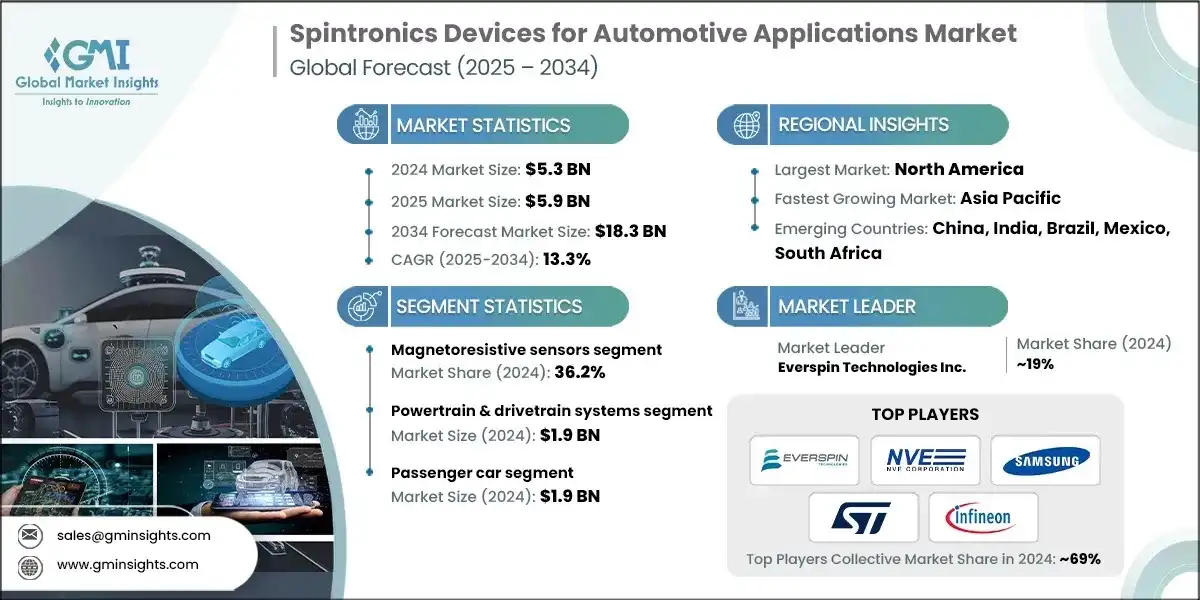
The global spintronics devices for automotive applications market was valued at USD 5.3 billion in 2024. The market is expected to grow from USD 5.9 billion in 2025 to USD 18.3 billion in 2034, at a CAGR of 13.3% during the forecast period according to the latest report published by Global Market Insights Inc.
To get key market trends
The growth of the global spintronics devices for automotive applications industry can be attributed to the increasing adoption of electric and autonomous vehicles, demand for energy-efficient electronic components, and advancements in magnetic sensors for vehicle safety and control systems. In addition, growing emphasis on reducing power consumption, improving data storage, and enhancing performance of infotainment and navigation systems is fueling the adoption of spintronics technology in automotive applications.
The demand for spintronics devices in automotive applications is being driven by the increasing integration of advanced electronics in vehicles, including electric and hybrid models. Spintronics-based sensors and memory devices offer faster data processing, lower power consumption, and enhanced magnetic sensing capabilities. Automakers are adopting these technologies to improve efficiency, reliability, and performance in systems such as electric powertrains, ADAS, and battery management. The growing focus on architecture and intelligent vehicle architectures is further fueling the adoption of spintronic components to support next-generation automotive designs. For instance, in October 2025, With the rapid adoption of electric vehicles, NVE Corporation expanded its presence in the automotive sector by integrating spintronic sensors into battery management systems and motor control units to improve efficiency and performance. Its strategic partnerships with Tier-1 suppliers and pursuit of IATF 16949 certification demonstrated its commitment to automotive quality standards and strengthened its position in the growing market.
Spintronics is revolutionizing automotive electronics by providing solutions that offer both lower power consumption and faster data processing compared to traditional electronics. Recent advancements in spintronic devices have led to the development of energy-efficient components that are ideal for modern, low-energy electronics. For instance, in August 2025, Scientists have found that electron spin loss, previously regarded as wasted energy, must be utilized to trigger magnetization switching in spintronic devices, increasing efficiency by up to three times. This scalable, semiconductor-compatible approach has the potential to accelerate the creation of ultra-low-power AI chips and memory technologies.
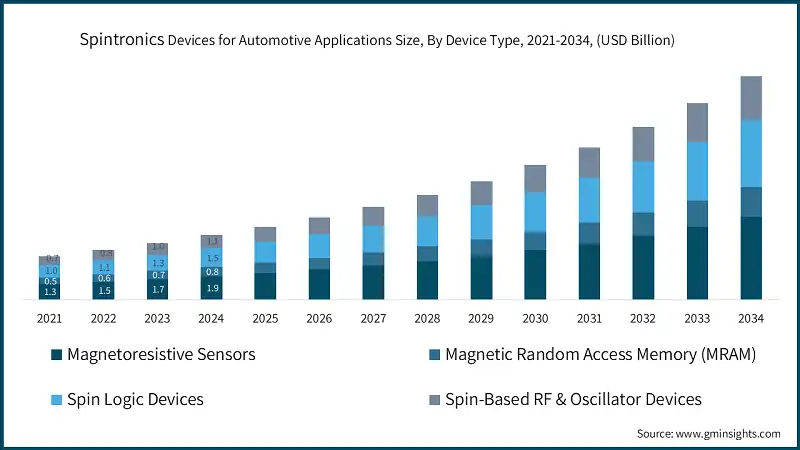
Between 2021 and 2023, the spintronics devices market for automotive applications experienced significant growth, rising from USD 3.5 billion in 2021 to USD 4.6 billion in 2023. A major trend during this period was the increasing adoption of electric and hybrid vehicles, which drive demand for energy-efficient, high-performance sensors and memory devices. For instance, October 2025, Hyundai India planned to launch eight hybrid models by the end of the decade and is expected to increase demand for spintronics devices in automotive applications. Hybrid vehicles rely on advanced battery management systems, electric powertrains, and energy-efficient sensors all areas where spintronic devices enhance performance, reduce power consumption, and improve data processing. This expansion in hybrid offerings is expected to drive automakers to adopt spintronics technologies to meet efficiency and reliability requirements.
Spintronics devices for automotive applications involve using the intrinsic spin of electrons, along with their charge, to develop advanced sensors, memory, and data-processing components for vehicles. These devices enhance energy efficiency, speed, and performance in systems such as electric powertrains, battery management, and advanced driver-assistance systems. By leveraging spin-based phenomena, spintronics addresses fundamental challenges in automotive electronics, enabling more compact, reliable, and efficient vehicle systems rather than merely improving traditional electronic functions.
Spintronics Devices for Automotive Applications Market Report Attributes
| Key Takeaway | Details |
|---|---|
| Market Size & Growth | |
| Base Year | 2024 |
| Market Size in 2024 | USD 5.3 Billion |
| Market Size in 2025 | USD 5.9 Billion |
| Forecast Period 2025 – 2034 CAGR | 13.3% |
| Market Size in 2034 | USD 18.3 Billion |
| Key Market Trends | |
| Drivers | Impact |
| Rising Adoption of Electric and Hybrid Vehicles | Vehicles require advanced sensors, memory, and power management systems to optimize battery performance and energy efficiency. |
| Increasing Integration of Advanced Driver-Assistance Systems (ADAS) | Technologies require precise magnetic sensors, faster data processing, and energy-efficient components to enhance vehicle safety, navigation accuracy, and real-time performance in modern automotive systems. |
| Demand for Energy-Efficient and Compact Automotive Electronics | Offer low power consumption, high data processing speed, and miniaturized design, making them ideal for modern vehicles with advanced infotainment, control, and safety systems. |
| Technological Advancements in MRAM and TMR/GMR sensors | Provide faster data storage, higher reliability, and superior magnetic sensing capabilities essential for electric vehicles, ADAS, and other smart automotive systems. |
| Pitfalls & Challenges | Impact |
| High Manufacturing and Development Costs | As the complex fabrication process, need for specialized materials, and integration challenges limit large-scale production and increase overall system costs for automotive manufacturers. |
| Limited Large-Scale Production Infrastructure | As the lack of advanced fabrication facilities and standardized manufacturing processes restricts mass production, increasing costs and delaying the widespread adoption of spintronics technologies in vehicles. |
| Opportunities: | Impact |
| Expansion in Electric Vehicle and Hybrid Markets. | Technologies enhance energy efficiency, enable precise motor control, and improve battery management, making them essential components for next-generation electric mobility and smart automotive systems. |
| Development of Next-Generation Automotive Memory Solutions (MRAM) | As MRAM provides faster data processing, non-volatility, and durability, supporting advanced driver-assistance, infotainment, and autonomous driving systems in modern automotive architectures. |
| Market Leaders (2024) | |
| Market Leaders |
~19% market share. |
| Top Players |
Collective market share in 2024 is ~69% |
| Competitive Edge |
|
| Regional Insights | |
| Largest Market | North America |
| Fastest growing market | Asia Pacific |
| Emerging countries | China, India, Brazil, Mexico, South Africa |
| Future outlook |
|
What are the growth opportunities in this market?
Spintronics Devices for Automotive Applications Market Trends
- A key trend shaping the spintronics devices for automotive applications industry is the integration of energy-efficient MRAM and advanced magnetic sensors in electric vehicles and ADAS, enhancing performance, safety, and reliability.
- For instance, as of October 2023, Everspin Technologies announced the expansion of its leading industrial high-density STT-MRAM lineup, the EMxxLX series. The updated series features a new 4Mb capacity, a more compact package, and an extended industrial operating temperature up to 1050C.
- Regulatory bodies and automotive standards organizations in key markets, including South Korea, the U.S., and Europe, are increasingly supporting faster adoption of advanced spintronics devices through guidelines and certifications, promoting innovation and safety in electric and autonomous vehicles.
- Growing success in integrating spintronics devices in electric vehicles, battery management systems, and advanced driver-assistance systems (ADAS) has boosted confidence among automakers, encouraging further investment and adoption across automotive manufacturers globally.
- Another key trend is the move toward highly energy-efficient and compact automotive electronics. Advances in MRAM, TMR, and GMR sensor technologies enable more precise control, faster data processing, and reduced power consumption, supporting next-generation vehicle architectures.
- Additionally, spintronics devices are being increasingly applied beyond conventional automotive electronics into areas such as autonomous navigation, in-vehicle infotainment systems, and electric powertrain management, expanding market potential and attracting investments from Tier-1 suppliers and semiconductor companies.
- Further, growing investments by automotive manufacturers and technology providers are accelerating R&D and commercialization of spintronics solutions. For example, leading automakers and semiconductor companies have collectively invested billions in spintronic sensor and MRAM development, strengthening innovation pipelines.
- Thus, as the portfolio of spintronics devices for automotive applications continues to expand across electric, hybrid, and autonomous vehicles, the market is expected to grow significantly in the coming years.
Spintronics Devices for Automotive Applications Market Analysis
Learn more about the key segments shaping this market
Based on the device type, the global market is divided into magnetoresistive sensors, magnetic random access memory (mram), spin logic devices, spin-based RF & oscillator devices. The magnetoresistive sensors include anisotropic magnetoresistance (AMR) sensors, giant magnetoresistance (GMR) sensors, and tunneling magnetoresistance (TMR) sensors. The magnetoresistive sensors segment accounted for 36.2% of the market in 2024.
- Magnetoresistive sensors hold a significant market share in the market due to their high efficiency in detecting magnetic fields and enabling precise control in automotive systems.
- Sensors such as TMR and GMR are preferred for their sensitivity, reliability, and ability to operate under varying temperatures and conditions, which is crucial for applications in electric vehicles, ADAS, and autonomous driving systems.
- The widespread adoption of magnetoresistive sensors is also supported by established manufacturing processes, robust supply chains, and proven performance in automotive-grade components, ensuring durability and long-term operation.
- While emerging technologies like spin-orbit torque sensors are being researched, magnetoresistive sensors remain the dominant choice, driving innovation and growth in the market due to their proven reliability and efficiency.
- The spin logic devices segment of the spintronics devices for automotive applications industry was valued at USD 1.5 billion in 2024 and is expected to grow at a CAGR of 13.9% during the forecast period. This segment includes MRAM, TMR sensors, GMR sensors, and other spin-based memory and logic components.
- Spin logic devices offer high energy efficiency, fast data processing, and durability compared to conventional semiconductor components. They provide reliable performance under extreme temperatures and harsh automotive environments, making them highly suitable for electric vehicles, ADAS, and autonomous driving applications, driving their adoption across the automotive industry.
Based on the automotive application, the spintronics devices for automotive applications market are segmented into powertrain & drivetrain systems, safety & adas systems, body & comfort systems, and others. The powertrain & drivetrain systems segment dominated the market in 2024 with a revenue of USD 1.9 billion.
- In powertrain and drivetrain systems, spintronics devices for automotive applications enable precise control of electric motors and energy flow, improving efficiency and performance across multiple vehicle systems, including battery management, regenerative braking, and torque distribution.
- Additionally, advancements in sensor technology, MRAM integration, and AI-driven control modules have enhanced the precision, reliability, and responsiveness of spintronics devices in automotive applications.
- These innovations improve vehicle performance, reduce energy consumption, and ensure long-term durability, adoption across electric, hybrid, and autonomous vehicles, and supporting significant growth within the spintronics devices for automotive applications industry.
- The safety & ADAS systems is anticipated to witness growth at a CAGR of 14.8% over the analysis period, reaching USD 5.4 billion by 2034.
- This safety & ADAS systems is experiencing rapid growth due to its ability to enhance vehicle safety, navigation accuracy, and collision avoidance through precise and responsive magnetic sensing and spintronic memory integration. These technologies enable reliable detection and real-time decision-making in advanced driver-assistance systems.
- As a result, safety and ADAS systems are becoming a key focus for automakers, driving the adoption of spintronics devices and contributing significantly to overall market expansion.
Learn more about the key segments shaping this market
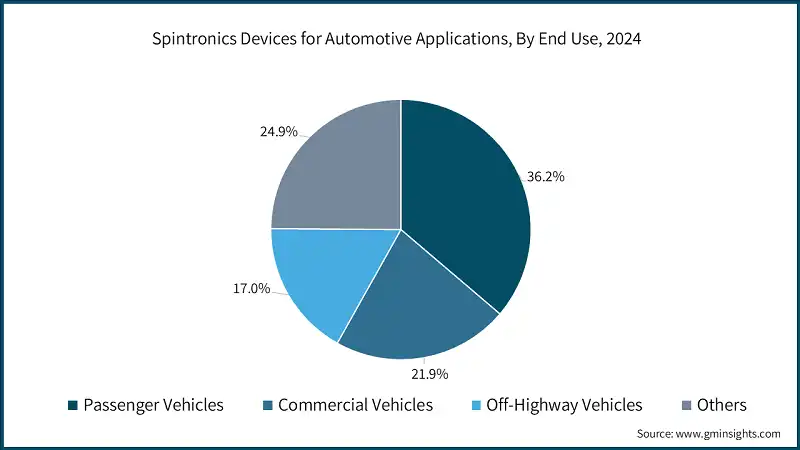
- The passenger vehicles segment in the spintronics devices for automotive applications industry plays a crucial role in integrating advanced sensors, MRAM, and magnetic logic components to enhance vehicle performance, energy efficiency, and safety features.
- The growing adoption of electric and hybrid passenger vehicles, coupled with increasing integration of ADAS and autonomous functionalities, is driving demand for spintronics devices. Proven reliability and efficiency in real-world automotive applications are boosting confidence among manufacturers and suppliers, encouraging further investment and innovation in this segment.
- On the other hand, the commercial vehicles segment in the market is anticipated to grow at a CAGR of 14.9% during the forecast period.
- Commercial vehicles increasingly integrate spintronic sensors, MRAM, and autonomous navigation systems to enhance fleet efficiency, safety, and real-time monitoring. These technologies support route optimization, predictive maintenance, and energy management in trucks, buses, and logistics vehicles.
- Additionally, commercial vehicles offer high-value use cases for spintronics devices by enabling large-scale deployment of advanced driver-assistance systems, precise motor control, and robust connectivity solutions, driving adoption and supporting segmental growth in the South Korean and global markets.
Looking for region specific data?
- A favorable regulatory environment, strong financial and investment support, advanced healthcare infrastructure, and robust research and development ecosystem are key factors driving regional market growth.
- A favorable regulatory environment, strong financial and investment support, advanced automotive infrastructure, and a robust research and development ecosystem are key factors driving regional growth of the market.
- North America, particularly the U.S., has a well-established R&D ecosystem in automotive electronics and robotics. Leading universities, research centers, and semiconductor companies actively contribute to advancements in spintronics devices for electric vehicles, ADAS, and autonomous driving, fostering innovation and attracting investments.
- Furthermore, increasing adoption of electric and autonomous vehicles, along with rising demand for energy-efficient and compact automotive electronics, has created substantial opportunities for spintronics devices in the region.Additionally, supportive government policies, incentives, and collaboration programs with automakers and technology providers further fuel market growth.
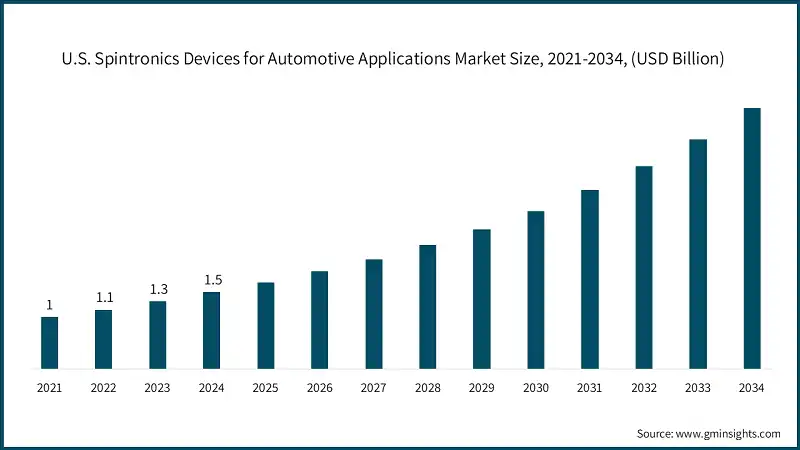
The U.S. spintronics devices for automotive applications market was valued at USD 1 billion and USD 1.1 billion in 2021 and 2022, respectively. The market size reached USD 1.5 billion in 2024, growing from USD 1.3 billion in 2023.
- The U.S. continues to dominate the market, driven by its robust biotechnology ecosystem, substantial research funding, and a favorable regulatory environment.
- The U.S. continues to lead the spintronics devices for automotive applications industry, driven by its strong automotive industry, advanced semiconductor ecosystem, and supportive regulatory framework.
- The country is home to leading automakers, semiconductor manufacturers, and technology providers, benefiting from a robust pipeline of innovative spintronics devices and advanced sensor and MRAM technologies.
- Additionally, the presence of top-tier research institutions, specialized R&D centers, and extensive collaborations between academia and industry further accelerates the development, testing, and commercialization of next-generation spintronics solutions for electric, hybrid, and autonomous vehicles.
Europe Spintronics devices for automotive applications Market Europe market accounted for USD 1.1 billion in 2024 and is anticipated to show lucrative growth over the forecast period. Germany dominates the Europe spintronics devices for automotive applications market, showcasing strong growth potential. The Asia Pacific market is anticipated to grow at the highest CAGR of 14.5% during the analysis timeframe. China spintronics devices for automotive applications market is estimated to grow with a significant CAGR 15.3% from 2025 to 2034, in the Asia Pacific market. The Latin America spintronics devices for automotive applications market, valued at USD 0.4 billion in 2024, is driven by the growing adoption of electric and hybrid vehicles and advanced automotive electronics. The Middle East and Africa market is projected to reach USD 1.1 billion by 2034, driven by increasing adoption of electric vehicles and advanced automotive technologies in the region. UAE market to experience substantial growth in the Middle East and Africa spintronics devices for automotive applications industry in 2024. The competitive landscape of the spintronics devices for automotive applications industry is defined by intense innovation and collaboration among leading semiconductor companies, automotive electronics firms, and research institutions. Top players such as Everspin Technologies Inc., NVE Corporation, Samsung Electronics Co., Ltd., STMicroelectronics N.V., and Infineon Technologies AG hold a combined market share of approximately 69% globally. These companies are continuously investing in research and development to advance spintronic sensors, MRAM, and other high-performance components, enhancing energy efficiency, speed, and reliability in electric, hybrid, and autonomous vehicles. The market also witnesses strategic partnerships, mergers, and acquisitions aimed at accelerating commercialization, expanding geographic presence, and gaining competitive advantage in next-generation automotive technologies. Additionally, smaller and niche players in the market contribute by developing specialized solutions, innovative sensor designs, and advanced spintronic technologies. This dynamic environment promotes rapid technological advancements, fosters competitive differentiation, and drives overall market growth and diversification across automotive applications. Prominent players operating in the spintronics devices for automotive applications industry are as mentioned below: Everspin Technologies Inc. is a leading player in the market, holding a market share of approximately 19%. The company is recognized for its high-performance MRAM solutions and magnetic sensors, which enhance energy efficiency, speed, and reliability in electric, hybrid, and autonomous vehicles. Continuous R&D and innovation drive its strong market presence. NVE Corporation is a pioneer in the spintronics devices for automotive applications industry, renowned for its innovative magnetic sensors and MRAM technologies. The company focuses on energy-efficient, high-speed, and durable solutions for electric, hybrid, and autonomous vehicles. Its strong R&D capabilities, strategic partnerships with automotive manufacturers, and advanced product portfolio position it for continued growth and market leadership. Samsung Electronics Co., Ltd.Asia Pacific Spintronics devices for automotive applications Market
Spintronics Devices for Automotive Applications Market Share
Spintronics Devices for Automotive Applications Market Companies
Samsung Electronics Co., Ltd. is a key player in the market, focusing on developing advanced MRAM solutions, high-performance magnetic sensors, and semiconductor components for electric, hybrid, and autonomous vehicles. The company leverages its extensive R&D capabilities, technological expertise, and strong market presence to drive innovation and adoption globally.Spintronics Devices for Automotive Applications Industry News
The spintronics devices for automotive applications market research report includes in-depth coverage of the industry with estimates and forecast in terms of revenue in USD Billion from 2021 – 2034 for the following segments:
Market, By Device Type
- Magnetoresistive Sensors
- Anisotropic Magnetoresistance (AMR) Sensors
- Giant Magnetoresistance (GMR) Sensors
- Tunneling Magnetoresistance (TMR) Sensors
- Magnetic Random Access Memory (MRAM)
- Toggle MRAM
- Spin-Transfer Torque MRAM (STT-MRAM)
- Spin-Orbit Torque MRAM (SOT-MRAM)
- Spin Logic Devices
- Spin Field-Effect Transistors (Spin-FETs)
- Magnetic Tunnel Junction Logic
- All-Spin Logic Devices
- Spin-Based RF & Oscillator Devices
- Spin-Torque Oscillators
- Spin-Wave Devices
Market, By Automotive Application
- Powertrain & Drivetrain Systems
- Safety & ADAS Systems
- Body & Comfort Systems
- Others
Market, By End Use
- Passenger Vehicles
- Commercial Vehicles
- Off-Highway Vehicles
- Others
The above information is provided for the following regions and countries:
- North America
- U.S.
- Canada
- Europe
- Germany
- UK
- France
- Spain
- Italy
- Netherlands
- Asia Pacific
- China
- India
- Japan
- Australia
- South Korea
- Latin America
- Brazil
- Mexico
- Argentina
- Middle East and Africa
- South Africa
- Saudi Arabia
- UAE
Frequently Asked Question(FAQ) :
Who are the key players in the spintronics devices for automotive applications market?
Key players include Everspin Technologies Inc., NVE Corporation, Samsung Electronics Co., Ltd., STMicroelectronics N.V., and Infineon Technologies AG, collectively holding around 69% market share.
What are the upcoming trends in the spintronics devices for automotive applications industry?
Key trends include rapid integration of MRAM and advanced magnetic sensors in electric and hybrid vehicles, adoption of spin-based memory for AI-driven systems, and expansion of spintronics technology in ADAS, infotainment, and powertrain applications.
What is the projected value of the spintronics devices for automotive applications market by 2034?
The market is expected to reach USD 18.3 billion by 2034, propelled by advancements in MRAM, TMR/GMR sensors, and growing integration in ADAS and autonomous vehicle systems.
How much revenue did the magnetoresistive sensors segment generate in 2024?
The magnetoresistive sensors segment accounted for 36.2% share in 2024.
What was the valuation of the powertrain & drivetrain systems segment in 2024?
The powertrain & drivetrain systems segment generated USD 1.9 billion in 2024, driven by the integration of spintronic sensors for efficient energy management, motor control, and regenerative braking in electric vehicles.
What is the market size of the spintronics devices for automotive applications industry in 2024?
The market size was USD 5.3 billion in 2024, growing with a CAGR of 13.3% from 2025 to 2034. Growth is driven by increasing adoption of electric and hybrid vehicles and demand for energy-efficient automotive electronics.
What is the growth outlook for the safety & ADAS systems segment from 2025 to 2034?
The safety & ADAS systems segment is projected to grow at a CAGR of 14.8%, reaching USD 5.4 billion by 2034.
What is the current spintronics devices for automotive applications market size in 2025?
The market size is projected to reach USD 5.9 billion in 2025.
Spintronics Devices for Automotive Applications Market Scope
Related Reports