Summary
Table of Content

Specialty Small Kitchen Appliances Market
Get a free sample of this report
Form submitted successfully!
Error submitting form. Please try again.
Thank you!
Your inquiry has been received. Our team will reach out to you with the required details via email. To ensure that you don't miss their response, kindly remember to check your spam folder as well!
Request Sectional Data
Thank you!
Your inquiry has been received. Our team will reach out to you with the required details via email. To ensure that you don't miss their response, kindly remember to check your spam folder as well!
Form submitted successfully!
Error submitting form. Please try again.
Specialty Small Kitchen Appliances Market Size
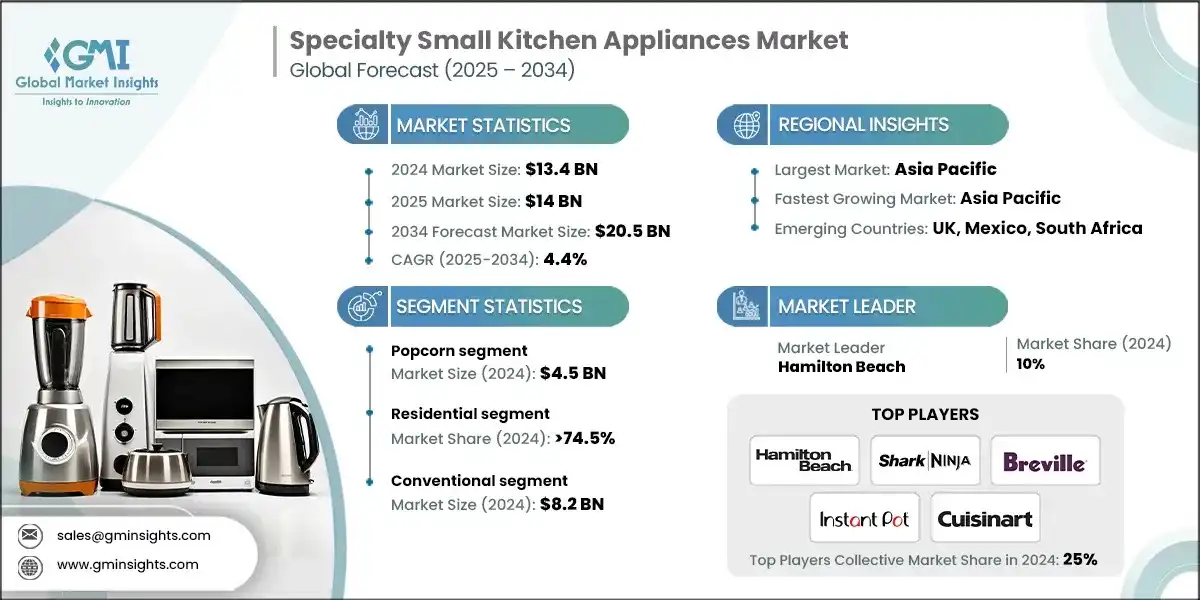
The specialty small kitchen appliances market was estimated at USD 13.4 billion in 2024. The market is expected to grow from USD 14 billion in 2025 to USD 20.5 billion in 2034, at a CAGR of 4.4% according to latest report published by Global Market Insights Inc.
Specialty Small Kitchen Appliances Market Key Takeaways
Market Size & Growth
- 2024 Market Size: USD 13.4 Billion
- 2025 Market Size: USD 14 Billion
- 2034 Forecast Market Size: USD 20.5 Billion
- CAGR (2025–2034): 4.4%
Key Market Drivers
- Changing lifestyles & convenience demand.
- Health & home-cooking trends.
- Technological innovation.
Challenges
- High competition & market saturation.
- Rising costs & economic instability.
Opportunity
- Multi-functional & space-saving designs.
- Smart & connected appliances.
Key Players
- Market Leader: Hamilton Beach led with over 10% market share in 2024.
- Leading Players: Top 5 players in this market include Hamilton Beach, SharkNinja, Breville, Instant Pot, Cuisinart, which collectively held a market share of 25% in 2024.
Get Market Insights & Growth Opportunities
Today's fast-moving society makes it difficult for people to have enough time to prepare food for themselves, which has led them to want appliances that can help them cook faster and take less time to prepare. Many of the more modern cooking appliances, e.g., air fryers, multi-cookers, and single serve coffee makers provide consumers with the ability to create delicious meals quickly and easily, as they don't have to sacrifice taste or quality. For example, products such as air fryers and multi-cookers have multiple pre-set meal modes and automated timers; therefore, consumers can cook their meals while doing other things.
Consumers' desires for compact and user-friendly cooking appliances stem from the rise of dual-income households and urban living. When shopping for new cooking equipment, most customers want devices that fit in their small kitchens but provide the versatility of being able to cook multiple meals at one time. It is also important to note that consumers' desire for compact and user-friendly appliances is not solely about saving time; it reflects a larger need for consumers to be able to prepare meals in an environmentally friendly way and to fit them into their increasingly busy lives.
The growing demand for healthy lifestyle choices has been a significant influence on the growth of the specialty kitchen appliance market. Consumers are becoming more knowledgeable about how important it is to prepare their meals instead of eating out or consuming prepackaged food and, therefore, there is a growing demand for specialty appliances that encourage and support healthy eating. Kitchen appliances, such as juicing machines, blending machines, and air-frying machines, allow the user to easily create healthy meals without using large amounts of oil and chemical additives, which coincide with the growing trend toward a wellness-oriented lifestyle.
In addition, the COVID-19 pandemic has contributed to the rapid rise of cooking from home, with many Americans converting their kitchens into the focal point of their lives every day. With the potential growth of cooking from home after COVID-19 , consumers now look for cost-effective healthy eating options and specialty appliances that facilitate healthy cooking will have considerable momentum going forward, creating a considerable opportunity to grow brands that innovate in this space.
To get key market trends
Specialty Small Kitchen Appliances Market Trends
The specialty small kitchen appliances sector is changing quickly. Modern customers are looking for multi-functional products with a combination of convenience, healthy options, and smart technologies. Manufacturers are launching new products, including many innovative designs, to meet this demand. Trends like convenience for creating health-filled meals, compact/space-saving appliances, connected to the Internet, and eco-friendly products are all creating competition and providing scalable opportunities in the global market.
- There are now many more customers who want to promote health and nutrition awareness. Many customers want to eat healthier and require a means to prepare food in a way that uses fewer calories or a more healthful way compared to traditional cooking methods. People are also becoming more impressed with appliances that help prepare delicious crisps using very little oil such as, air fryers and ways to quickly cook vegetables and proteins using steamers and slow cookers. The juicing and blending of smoothies has exploded in popularity as a result of the increasing popularity of eating plant-based foods.
- Advancements in smart technology are turning traditional kitchen appliances into smart and connected devices. The ability to control appliances remotely through wireless connections (Wi-Fi), apps, and smart speakers has enabled consumers to personalize their cooking experience by being able to create customized cooking settings and access step-by-step recipe guides via their devices. For example, consumers can set their smart coffee maker to be ready to brew at a certain time via an app. Meanwhile, some connected ovens can automatically adjust temperatures based on directions from recipes.
- The growth of cities and the trend toward smaller living spaces has resulted in many consumers needing compact and easily stored kitchen appliances. These consumers desire products that allow for multiple uses to save space and maximize the number of pots and pans used to cook meals. An example of this is the multi-cooker, which can be used as a pressure cooker, slow cooker, and rice cooker. Other examples of products that are combining multiple functions include toaster oven/air fryers. Additionally, with a growing number of single-person households and a large rental market, portability and ergonomics are critical elements for many consumers.
- Environmental concerns are changing the way people are buying things. People want energy-efficient appliances that create less waste. Environmental certification, recyclability and low power mode have become standard requirements for consumers when purchasing appliances. This has resulted in many brands designing eco-friendly packaging and repairable items to prolong the useful life of their products. In addition, younger consumers are very receptive to messaging about sustainability, to include reducing carbon footprints and zero waste cooking.
Specialty Small Kitchen Appliances Market Analysis

Learn more about the key segments shaping this market
Based on product type, the market is divided into popcorn machines, ice cream makers, waffle makers, soda makers and others. The popcorn segment generated a revenue of USD 4.5 billion in 2024.
- Popcorn machines are on the rise and have become one of the most popular specialty kitchen appliances because of the convenience and fun factor. This fits into the new wave of at-home entertainment and the desire of consumers to recreate the experience of going to a movie theatre while enjoying their favourite streaming service or having family gatherings. These machines come in a variety of shapes and sizes from stylish air poppers to retro electric popcorn makers, making them both functionally useful as well as visually appealing.
- The leading reason behind the rapid growth in popcorn makers can be attributed directly to the rise in healthier eating patterns among consumers. A growing number of people view air poppers as a healthy, low-calorie option and are therefore inclined toward these types of machines. array of developments will result in greater convenience for the user experience and allow manufacturers to position their popcorn makers as components of a modern lifestyle rather than just tools used to make snacks.
- Popcorn makers are quickly evolving beyond simply satisfying individuals' needs by providing methods of making popcorn. Urban areas often have smaller spaces in which to operate and consume popcorn. As consumers become increasingly aware of their carbon footprint and the impact that their choices have on the environment, popcorn makers have entered this conversation. By implementing environmentally responsible materials such as BPA-free materials and incorporating energy-efficient heating systems, companies are responding to the needs of eco-conscious consumers.
Learn more about the key segments shaping this market
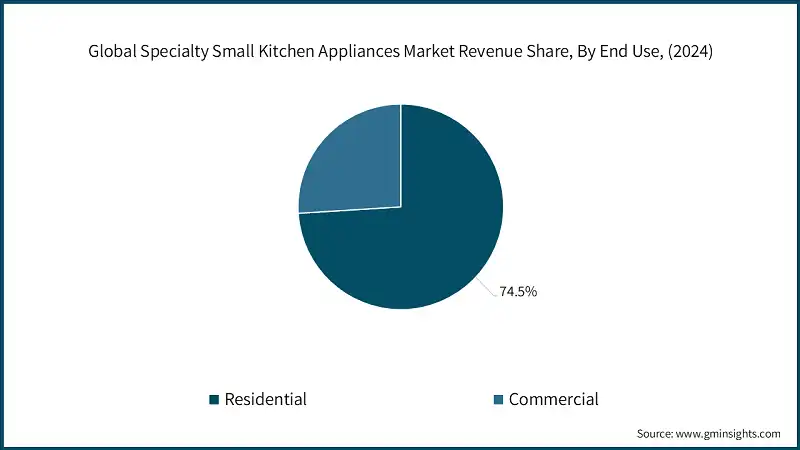
Based on end use, the market is segmented into residential and commercial. The residential segment accounted for over 74.5% of the global specialty small kitchen appliances market share in 2024.
- Individual homeowners are the most significant customer segment for all home appliances. This segment includes small-sized homes and large-sized homes. People in this segment are looking for convenient, time-saving solutions that enhance their lifestyle. For example, busy professionals and families in urban areas need kitchen appliances that make it easy to prepare meals while still providing quality. The compact and multi-usage designs of appliances are tabularly appealing to most consumers with smaller kitchens, while homeowners who are savvy with electronics and gadgets are drawn to the premium look and feel of the appliances, along with their smart features.
- As consumers become more health-conscious, homeowners' purchasing decisions will be directly affected by health-related factors as well. More consumers are becoming health-conscious and want to purchase kitchen appliances that will enable them to prepare healthy meals at home, for example: air fryers; juicers; and steamers. This trend towards purchasing kitchen appliances to help prepare healthy meals at home aligns with the broader trend of preparing home-cooked meals to control the diet and to limit the use of simple processed foods.
- In addition to providing cooking capabilities, many home appliance purchasers are looking for appliances that create a social atmosphere and provide a comfortable place to relax and enjoy leisure time with friends and family. Appliances such as popcorn machines, barista-style beverage dispensers, and dessert making machines provide additional entertainment options for the home. Furthermore, many residential consumers want to add a personal touch to their kitchens through personalized, customizable smart appliances with features such as app-based controls, recipe customization, and voice-command functionality.
Based on function, the specialty small kitchen appliances market is segmented into conventional and smart. The conventional segment generated a revenue of USD 8.2 billion in 2024.
- In conventional appliances, consumers can easily operate an appliance with simple functions while not having high tech features, like smart technology, or performing multiple tasks. Consumers tend to buy conventional products because they provide ease of use, reliability, and low cost. The conventional appliance segment is important in both developed and emerging markets because it is where households put more weight on basic needs than on high-tech functionality.
- Households that use conventional appliances tend to live in regions with less digital adoption and high levels of price sensitivity. The consumers who use conventional appliances are generally much more comfortable with manual control and basic cooking methods, such as a traditional coffee maker, basic blender, or basic food processor. Consumers who use conventional appliances also tend to be older because they may not be comfortable using new smart technologies. Conventional appliances are also very low maintenance, which allows them to have long product life cycles, making them appealing to consumers who want a cost-effective product.
Looking for region specific data?
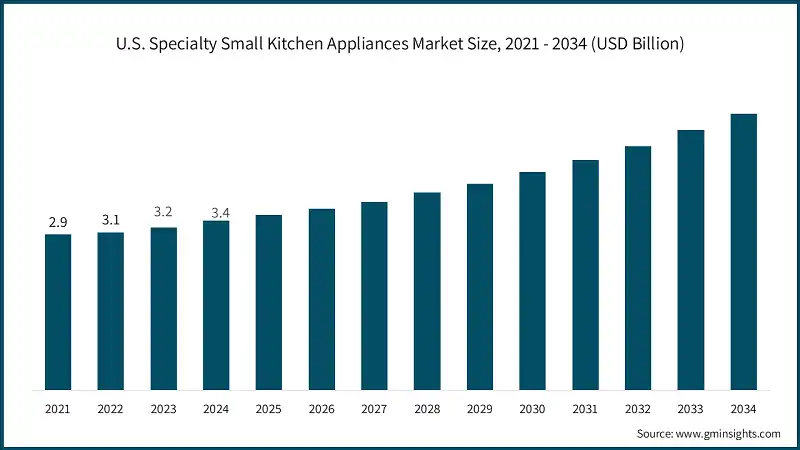
U.S dominated the North America specialty small kitchen appliances market with around 84% share and generating around USD 3.4 billion revenue in 2024.
- The U.S. is experiencing significant consumer demand for specialty kitchen appliances through the demand for convenience and wellness products, as well as luxury goods. Consumers are turning to specialty kitchen appliances such as air fryers, juicers and smart coffee makers that save them time and support healthy eating; also driving growth in specialty kitchen appliance sales is the home entertainment segment. It has become popular amongst consumers to make café or theater-like experiences in their homes by using appliances such as popcorn machines and beverage dispensers. Consumer trends toward greater disposable income and overall population growth lead to an increasing amount of money available for consumers to purchase specialty kitchen appliances which are marketed through e-commerce and influencer marketing to attract tech-savvy consumers.
- There are also similarities and differences in trends across North America; while the U.S. and Canada continue to demonstrate increasing interest in compact and multi-functional appliances, growing urbanization and smaller living spaces are pushing both countries toward the growing popularity of compact and multi-functional appliances. Health-related specialty kitchen appliances continue to be a focus for both Canada and the U.S. are witnessing increased consumer interest in sustainability and purchasing energy efficient and environmentally friendly appliances for their homes. Furthermore, the retail infrastructures of both countries are extensive and capable of meeting the increasing demand for specialty kitchen appliances through both online retail and a variety of retail channels, both physical and digital. Many manufacturers who cater to consumers in both countries also utilize innovative marketing techniques to create brand awareness among consumers in developing countries.
Europe specialty small kitchen appliances market, Germany leads with 22.5% share in 2024 and is expected to grow at 3.7% CAGR during the forecast period.
- The European market for specialty small kitchen appliances is shaped by a unique blend of tradition and modernity. To Europeans, the term “small kitchen appliance” refers to any device designed primarily for food preparation. These devices often have a unique aesthetic appeal, combining elements from various traditional cooking methods with modern designs to create an energy-efficient product. Additionally, there is a significant trend towards healthy living; consumers prefer to use small kitchen appliances such as steamers or juicers that promote a balanced diet. Most European consumers also have a very strong interest in the environment, and therefore, they look for small kitchen appliances made of sustainable materials with low energy consumption, consistent with strict regulations imposed by governments on sustainability and consumer awareness.
- In addition to the above, one of the most prominent characteristics of Europe’s specialty small kitchen appliance market is the preference for high-quality design and compact size. The increased number of urbanized cities in Europe, such as London, Paris, Berlin, etc., has caused many people to live in smaller spaces. Therefore, consumers are looking for products that save space without compromising aesthetic appeal. The consumer profile is one of the key drivers of this trend. Products that have an elegant design and are multifunctional have a much higher likelihood of being successful. The growing popularity of entertaining at home and creating artisanal cooking experiences has led to increased interest in specialty small kitchen appliances such as espresso machines and bread makers, which continue to enhance the image of Europe as a culinary superpower.
The Asia Pacific leads the specialty small kitchen appliances market; China leads with revenue share of around 32% in 2024 and is anticipated to grow with a CAGR of around 5.5% from 2025 to 2034.
- The Asia-Pacific region is leading the worldwide specialty kitchen appliance market, primarily due to a hyper-urbanized society, increased disposable income, and a considerable cultural focus on home-cooked meals. The people of Asia and the Pacific put a considerable amount of value on having convenience, flexibility, and technology in their kitchens but also want kitchen appliances that fit the social and cultural diversities found within this region. Due to the limited space found in many densely populated cities, the compact size and multi-functionality of kitchen appliances will be extremely popular in Asia-Pacific. The trending growth of health-conscious diets, including a higher interest in the use of small appliances that help achieve oil-free cooking and the preservation of nutrients, is helping to drive the demand for kitchen appliance sales in this region.
- The adoption of advanced technology is one of the main factors supporting the demand for specialty kitchen appliances in Asia and the Pacific. Smart KitchenAid appliances with app connectivity, voice activation, and automation are very attractive to younger and more tech-savvy consumers. Online sales and e-commerce platforms are the most prominent distribution channels in Asia-Pacific because they provide customers with an extensive selection of products and competitive pricing. The diversity that exists across Asia-Pacific provides an opportunity for localized product development; therefore, many kitchen appliance manufacturers are developing products designed to fit local markets. This adaptability makes the Asia-Pacific market the most dynamic and influential for specialty kitchen appliances.
Latin America specialty small kitchen appliances markets are growing at a CAGR of 2.9% during the forecast period.
- The market for specialty appliances in Latin America is expanding at a steady rate and is primarily driven by urbanization and the growing middle class in this region. Affordability and durability are most important to the consumers of this region; therefore, traditional appliances are being purchased in large numbers, as well as an increase in interest and demand for multi-functional appliances. Additionally, many families have a tradition of cooking at home, so there is significant demand for kitchen appliances such as blenders, food processors, and coffee makers.
- Distribution channels in LATAM are rapidly changing with an increase in e-commerce along with traditional brick and mortar retail channels. Price sensitivity continues to present challenges for companies operating in Latin America; thus, companies concentrate their efforts on developing cost-effective appliances while sustaining quality. In metropolitan areas where space is limited, compact appliances are highly desirable. Likewise, consumers in LATAM are attracted to aesthetically pleasing and colorful equipment designs which are reflective of the region's cultural preferences.
Specialty Small Kitchen Appliances Market Share
Hamilton Beach is leading with 10% market share. Hamilton Beach, SharkNinja, Breville, Instant Pot and Cuisinart collectively hold around 25%, indicating moderately fragmented market concentration. These prominent players are proactively involved in strategic endeavors, such as mergers & acquisitions, facility expansions & collaborations, to expand their product portfolios, extend their reach to a broad customer base, and strengthen their market position.
Hamilton Beach brand has become a recognized name in the United States for small kitchen appliances because they create useful and affordable specialty items such as Waffle Machines, Ice Cream Makers, Popcorn Popper Machines and Countertop Cookers which make cooking more convenient. The company emphasizes creating appliances with high-quality materials and uncomplicated operation so they will appeal to families looking for functional yet cost-effective designs, thus making Hamilton Beach a major player in the specialty kitchen appliance market.
SharkNinja brand has created a solid reputation within the specialty kitchen appliance category by introducing cutting edge products into the marketplace including Multi-Functional Cookers, Air Fryers and High-Performance Blenders. Although Ninja brand was initially known for Smart Cooking Systems, the product line also includes appliances that focus on providing services for the home and wellness trends that focus on promoting physical fitness. Their emphasis on technologically advanced convenience and attractive designs help them establish themselves as a high-end option in today’s modern kitchens.
Specialty Small Kitchen Appliances Market Companies
Major players operating in the specialty small kitchen appliances industry are:
- Black+Decker
- Breville
- Chefman
- COSORI
- Cuisinart
- Dash
- De'Longhi
- Gourmia
- Hamilton Beach
- Instant Pot
- KitchenAid
- Le Creuset
- Miele
- SharkNinja
- Smeg
Smeg and Italian Company retails quality kitchen appliances that have a distinctive retro design, combined with a modern technology. The Smeg range includes stylish products such as waffle makers, toasters and coffee machines. The company's products are highly regarded by consumers because of their performance and aesthetics. Due to this Smeg products are a highly desired item in luxury kitchens and design-oriented kitchens worldwide.
Breville is a company that specializes exclusively in high-end specialty appliances, especially countertop products. Breville has positioned itself as one of the top brands for premium coffee makers, air fryers, blenders, and smart ovens and targets those consumers who value product design and performance. Breville uses technology to add value for consumers by offering products with innovative features, such as app integration and precision control of cooking temperature. Customers also identify Breville as a lifestyle brand, which makes the company appealing to those who are looking for professional results in their own kitchen while also being conscious of health issues and focused on home entertainment.
Specialty Small Kitchen Appliances Market Report Attributes
| Key Takeaway | Details |
|---|---|
| Market Size & Growth | |
| Base Year | 2024 |
| Market Size in 2024 | USD 13.4 Billion |
| Market Size in 2025 | USD 14 Billion |
| Forecast Period 2025 - 2034 CAGR | 4.4% |
| Market Size in 2034 | USD 20.5 Billion |
| Key Market Trends | |
| Drivers | Impact |
| Changing lifestyles & convenience demand | Consumer demand for convenience in their kitchens continues to rise due to increasing numbers of single-member households and a growing busy lifestyle. |
| Health & home-cooking trends | The increase in health-conscious or do-it-yourself cooks has further fueled consumer interest in appliances, such as air fryers, cold frost yogurt makers, and soda machines. As a result, portion control and the use of fresh ingredients have increased product growth. |
| Technological innovation | Recently, technological advancements, such as smart connectivity, integration with apps, programmable capabilities, and others, have changed specialty kitchen appliances from simply being an appliance used to cook food to becoming a highly sophisticated and advanced appliance with additional value-added features for consumers. |
| Pitfalls & Challenges | Impact |
| High competition & market saturation | With so many new brands being introduced, differentiating from competitors is more difficult. Therefore, firms will be forced to generate innovative designs, increase their products functionality, and develop a strong promotional strategy to be differentiated from their competition. |
| Rising costs & economic instability | Rising raw material costs along with economic uncertainties globally can have a negative effect on companies ability to produce products competitively priced. |
| Opportunities: | Impact |
| Multi-functional & space-saving designs | Urban environments have created a higher demand for compact and multi-functional appliances, allowing for maximum use from a minimal amount of space. Products that provide superior functionality with a smaller physical size continue to gain significant consumer appeal. |
| Smart & connected appliances | Integrating IoT technology and enabling voice-activated technology has become a significant differentiating factor for companies within the smart appliance marketplace. The smart features associated with IoT technology provide companies to reach their target audience, primarily tech-savvy consumers, which provides great brand loyalty for these companies. |
| Market Leaders (2024) | |
| Market Leaders |
10% market share |
| Top Players |
The collective market share in 2024 is 25% |
| Competitive Edge |
|
| Regional Insights | |
| Largest Market | Asia Pacific |
| Fastest Growing Market | Asia Pacific |
| Emerging Country | UK, Mexico, South Africa |
| Future Outlook |
|
What are the growth opportunities in this market?
Specialty Small Kitchen Appliances Industry News
- In June 2025, Breville will also release the InFizz Fusion Sparkling Beverage Carbonator, providing a truly innovative and user-friendly way of creating carbonated beverages from virtually any type of liquid, including plain water, soda, flavored juices, mixed cocktails, etc. The InFizz uses the FusionCap technology for controlled carbonation and ease of use.
- In July 2025, Dash released a new product called the SmartStore Stirring Popcorn Maker. This popcorn machine can make hot-oil popcorn from up to three quarts of uncooked kernels. It was developed as a convenient and versatile popcorn maker that also comes with features such as a built-in stirring rod for evenly heating the kernels, a lid that doubles as a bowl and a butter melting tray for quickly melting butter for drizzling over the finished popcorn.
- In July 2025, Cuisinart has added to its specialization appliance line with the addition of a 6 in 1 Slushy & Soft Serve Maker to its New Arrivals Collection. The multifunctional appliance meets growing consumer demand for convenience and premium design options for making frozen treats with creative possibilities in their own homes.
- In May 2025, Breville announced the introduction of the Smart Scoop Ice Cream & Gelato Maker a luxury appliance specifically engineered for those with a passion for frozen confections. Utilizing a compressor and offering numerous levels of hardness to choose from, as well as an automatic function, this equipment ensures users achieve multiple varieties of texture with professional accuracy, while continuing to make the user experience simple and maintaining the integrity of finished product results.
- In March 2025, Gourmia introduced their Belgian waffle maker, an easy-to-use appliance with an upright storage design, adjustable browning options, and BPA-free ceramic nonstick cooking plates to ensure that your waffle-making experience will be the best it can be! Their waffle maker has been placed on Amazon for cooks looking for a compact appliance for their kitchen and affordable but high-quality option.
The specialty small kitchen appliances market research report includes in-depth coverage of the industry with estimates & forecasts in terms of revenue (USD Billion) and volume (Thousand Units) from 2021 to 2034, for the following segments:
Market, By Product Type
- Popcorn machines
- Ice cream makers
- Waffle makers
- Soda maker
- Others (hot dog machines etc.)
Market, By Function
- Conventional
- Smart
- Wi-Fi
- Bluetooth
- Others (Zigbee technology, etc.)
Market, By End Use
- Residential
- Commercial
Market, By Price
- Low
- Medium
- High
Market, By Distribution Channel
- Online
- E-commerce
- Company websites
- Offline
- Specialty stores
- Individual stores
- Others
The above information is provided for the following regions and countries:
- North America
- U.S.
- Canada
- Europe
- Germany
- UK
- France
- Italy
- Spain
- Asia Pacific
- China
- India
- Japan
- Australia
- South Korea
- Latin America
- Brazil
- Mexico
- Argentina
- Middle East and Africa
- South Africa
- Saudi Arabia
- UAE
Frequently Asked Question(FAQ) :
What is the market size of the specialty small kitchen appliances in 2024?
The market size was USD 13.4 billion in 2024, with a CAGR of 4.4% expected through 2034 driven by consumer demand for time-saving and fast-cooking appliances in today's busy lifestyles.
What is the projected value of the specialty small kitchen appliances market by 2034?
The specialty small kitchen appliances market is expected to reach USD 20.5 billion by 2034, propelled by health-conscious cooking trends, smart technology integration, and demand for multi-functional compact designs.
What is the current specialty small kitchen appliances market size in 2025?
The market size is projected to reach USD 14 billion in 2025.
How much revenue did the popcorn machines segment generate in 2024?
Popcorn machines generated USD 4.5 billion in 2024, leading the product type segment driven by at-home entertainment trends and healthier snacking preferences.
What was the valuation of the residential segment in 2024?
The residential segment held 74.5% market share in 2024, dominating the end-use category as homeowners seek convenient, time-saving solutions for meal preparation and entertainment.
Which region leads the specialty small kitchen appliances market?
North America held 84% share with USD 3.4 billion in 2024, due to rising demand for convenience, wellness, and premium kitchen appliances.
What are the upcoming trends in the specialty small kitchen appliances market?
Key trends include health and nutrition-focused appliances, smart technology integration with Wi-Fi and app connectivity, compact space-saving multi-functional designs, and environmentally sustainable energy-efficient products with eco-friendly materials.
Who are the key players in the specialty small kitchen appliances market?
Key players include Hamilton Beach, SharkNinja, Breville, Instant Pot, Cuisinart, Black+Decker, Chefman, COSORI, Dash, De'Longhi, Gourmia, KitchenAid, Le Creuset, Miele, and Smeg.
Specialty Small Kitchen Appliances Market Scope
Related Reports