Summary
Table of Content

Specialty Fruits and Berries Market
Get a free sample of this report
Form submitted successfully!
Error submitting form. Please try again.
Thank you!
Your inquiry has been received. Our team will reach out to you with the required details via email. To ensure that you don't miss their response, kindly remember to check your spam folder as well!
Request Sectional Data
Thank you!
Your inquiry has been received. Our team will reach out to you with the required details via email. To ensure that you don't miss their response, kindly remember to check your spam folder as well!
Form submitted successfully!
Error submitting form. Please try again.
Specialty Fruits and Berries Market
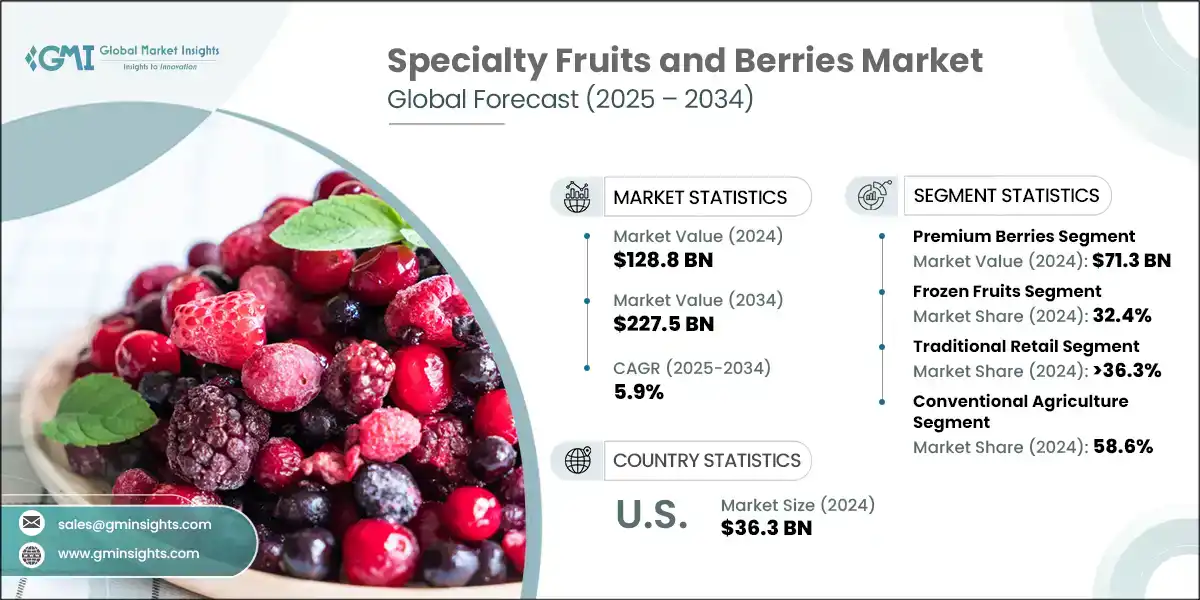
The global specialty fruits and berries market size reached USD 128.8 billion in 2024. The market is expected to grow from USD 135.8 billion in 2025 to USD 227.5 billion in 2034, at a CAGR of 5.9%.
Specialty Fruits and Berries Market Key Takeaways
Market Size & Growth
- 2024 Market Size: USD 128.8 Billion
- 2034 Forecast Market Size: USD 227.5 Billion
- CAGR (2025–2034): 5.9%
Regional Dominance
- Largest Market: North America
- Fastest Growing Region: Asia Pacific
Key Market Drivers
- Rising consumer demand for exotic and nutrient-rich fruits and berries..
- Growing health awareness and preference for natural, functional foods..
- Expansion of premium retail and e-commerce distribution channels globally..
- Increasing popularity of plant-based diets boosting specialty fruit consumption..
Challenges
- High perishability and complex cold chain logistics increase operational costs..
- Limited awareness and accessibility in emerging markets restrict market growth..
Opportunity
- Innovation in value-added products like juices, jams, and supplements..
- Expansion into untapped markets with rising disposable incomes..
Key Players
- Market Leader: Dole Food Inc led with over 8.1% market share in 2024.
- Leading Players: Top 5 players in this market include Dole Food Inc, Berry World Group, Costa Group Holdings Limited, Driscoll's Inc., Exotic Tropical Fruits LLC, which collectively held a market share of 42.7% in 2024.
Get Market Insights & Growth Opportunities
- The specialty fruits and berries market is expanding rapidly as consumers pay more attention to wellbeing, health, and premium food products. There is a huge range of product types that fall under specialty fruits and berries, including premium berries which account for 55.3% of market share where other specialty fruits such as goji, acai, and elderberry are estimated to grow at a CAGR of 6.7%.
- The nutraceutical and supplements category is prominent in North America and Europe as clients are more frequently seeking functional food and superfood with health benefits. Foodservice and hospitality category is growing at a CAGR at 7.1% as it acts as a prominent value driver for the Asia-Pacific region as urbanization and elevated disposable income drive demand for premium and exotic fruits.
- The pathways through which these products will move are changing as both traditional retail and direct-to-consumer pathways continue to grow food service distribution, as well as wholesale/B2B, are still quite important, especially in markets where there is a strong food manufacturing base.
- The cultivation methods of these products are changing and diversifying traditional agriculture is still the most prevalent, but there is now greater emphasis on organic cultivation, greenhouse/protected cultivation, and hydroponic or soilless systems. Europe is leading in organic and greenhouse production, while regions in the Asia-Pacific are adopting hydroponic systems very quickly as a way to satisfy urban demands.
- On a regional scale, North America is still the largest market by a long way for premium berries and fruits through health trends combining with innovation in food processing. Europe is notable in its focus of organic and greenhouse produce, while Asia-Pacific is the quickest growing market, fueled by foodservice growth and improved consumer income.
- Latin America and the Middle East and Africa are also emerging, developing their modern agricultural practices and developing their potential for exporting. Overall, the specialty fruits and berries market is slated for growth due to innovations in products, applications and sustainable agricultural practices.
To get key market trends
Specialty Fruits and Berries Market Trends
- The desire for foods that provide health benefits beyond basic nutrition is driving consumer demand for specialty fruits and berries that are high in antioxidants, vitamins, and phytonutrients. Blueberries, acai, goji berries and exotic fruits like dragon fruit are being utilized in a variety of functional foods, beverages and supplements.
- The trend towards functional foods containing specialty fruits and berries is growing rapidly in North America and Europe. In both markets, consumers are health conscious and are fueling product innovation in fortified snacks, juices and nutraceuticals. In the coming years, trends supporting immune support, anti-aging, and overall wellness will be a major focus.
- Sustainability and organic production is becoming more and more integrated into the specialty fruits and berries consumer base. Consumers know more about environmental impact and are encouraged to find products grown sustainably or with minimal input of chemical products. The demand for organic production has increased, as indicated by the rise of organic farming, greenhouse crops, and hydroponic systems, especially in European nations and Asia-Pacific.
- Producers are spending time and money on certifications and ways to transparently trace everything. The ways in which consumers are prioritizing traceability, carbon footprint reduction, and pesticides free produce is helping drive behavior and is in turn, growing interest in premium and sustainably grown specialty fruits and berries.
Specialty Fruits and Berries Market Analysis
Learn more about the key segments shaping this market
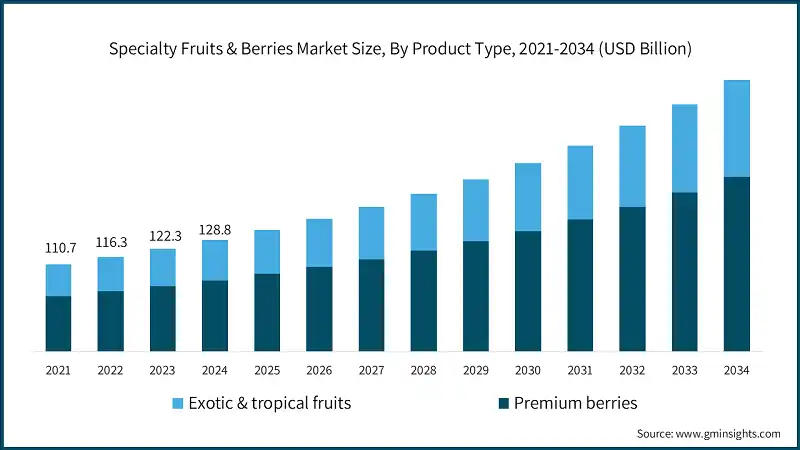
Based on product type, the specialty fruits and berries market is segmented into premium berries, exotic and topical fruits. Premium berries holds a significant share at a valuation of USD 71.3 billion in 2024.
- Premium berries are led by blueberries which represented just over 37.3% of the revenue in 2024, buoyed by tight supply and strong demand in North America and Europe. The strawberries market is forecasted to reach over USD 34.2 billion by 2034, representing a CAGR of 4.8%. Strawberries and raspberries remain extremely popular in both fresh and processed applications and niche berries such as acai and elderberry are linking into the nutraceutical world.
- Exotic and tropical fruits that include dragon fruit, passion fruit and others, are advancing quickly and gaining popularity particularly within the Asia-Pacific, where dragon fruit imports increased in volume in 2023. The imports of half of the varieties of kiwi imported into North America and Europe are seeing a double-digit growth rate with increased usage in health foods and beverages.
Learn more about the key segments shaping this market
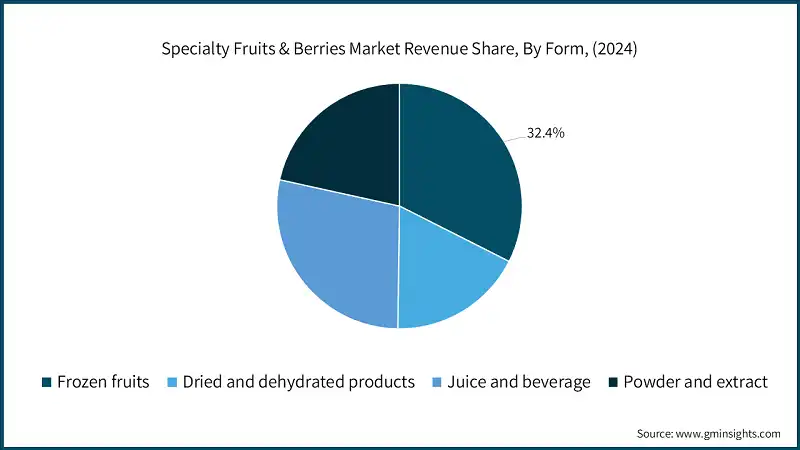
Based on forms, the specialty fruits and berries market is segmented into frozen fruits, dried and dehydrated products, juice and beverage, and powder and extract.
- Frozen fruits hold the largest share of 32.4% in the market due to its shelf stability, usability throughout the year as well as convenience. The frozen product segment is of great importance to foodservice operations and value-driven consumers who prioritize nutritional and quality flavor retention.
- Dried/dehydrated, is growing at a growth rate of 7.1% as demand for healthy, single-serve snack options and ingredient usage is on the rise. Dried/dehydrated products are popular in Europe and North America with an increasing number of consumers desiring single-serve, convenient, on-the-go nutrition.
- Juice and beverage applications are growing rapidly with other berry-based drinks projected to reach USD 39.8 billion globally by 2026. The juice and beverage market is benefitting as awareness for natural ingredients continues to rise and the trend for natural and functional drinks with antioxidants become a priority in consumer purchases. Powders and extracts are more popular products for use in a range of supplements, nutraceuticals and cosmetics products.
Based on application, the specialty fruits and berries market is segmented into fresh consumption and retail, food processing and manufacturing, nutraceutical and supplement industry, cosmetic and personal care applications, foodservice and hospitality, and industrial and B2B applications.
- Fresh consumption and retail is the highest application segment, contributing 38.1% of fruit sales as consumers shift towards healthy, natural, ready-to-eat snacks and ingredients. The food processing and manufacturing segment for berries and exotic fruit are also valuable as berries and exotic fruits are widely used in common commodities including yogurts, baked goods, jams, sauces, and beverages. This category will benefit from the more value-added and convenient foods that are being demanded by consumers.
- The nutraceutical and supplement sector is growing at a rapid pace with a 5% CAGR, and berry-based supplements and extracts are gaining market share in North America and Europe as a result of their perceived antioxidant, anti-inflammatory, and immune-boosting properties. At the food service and hospitality levels, particularly in the Asia-Pacific region, premium and exotic fruits are increasingly encountered.
Based on the distribution channel the specialty fruits and berries market is segmented into traditional retail channels, direct-to-consumer channels, foodservice distribution, wholesale and B2B channels.
- Traditional retail is by far the biggest channel representing over 36.3% of global sales, as supermarkets, hypermarkets and specialty stores remain the first points of purchase for fresh and processed fruit.
- The direct-to-consumer channel has experienced substantial growth, especially during the pandemic, with online grocery platforms and e-commerce becoming mainstream channels for purchasing fruit products. This channel drive growth by opening up the convenience of purchasing by disposable income, changing shopping behavior, speed of home delivery, and COVID impacts.
- Foodservice distribution is critical in regions such as Asia-Pacific where the focus is on consumer demand from restaurants, hotels and cafes for premium and exotic fruits, elevating upscale dining and enhancing innovative premium fruit menu items.
- Wholesale and business-to-business channels are necessary for the wholesale supply of large-scale buyers’ food manufacturers, institutional buyers and caterers providing affordable high-quality ingredients for a variety of placements.
Based on cultivation channel the specialty fruits and berries market is segmented into conventional agriculture, organic cultivation, greenhouse and protected cultivation, hydroponic and soilless systems.
- Manufacturers are trying to meet the demands for sustainability, quality, and availability throughout the year. Conventional agriculture still comprises 58.6% of global production, but its share is declining while alternative models gain traction.
- Organic cultivation is growing beyond 7.4% CAGR yearly, specifically in Europe and North America, where consumers engage in premiums for pesticide-free and sustainably grown produce.
- Greenhouse and protected cultivation are becoming increasingly popular as methods for producing specialty fruits and berries, especially when traditional expectations of agriculture are challenged or when arable land is limited.
- Hydroponic and soilless systems are also expanding rapidly in Asia Pacific. Urbanization, improved technologies and the need to utilize less land for the production of a growing world population all support the increased use of aquaponic hydroponic systems.
Looking for region specific data?
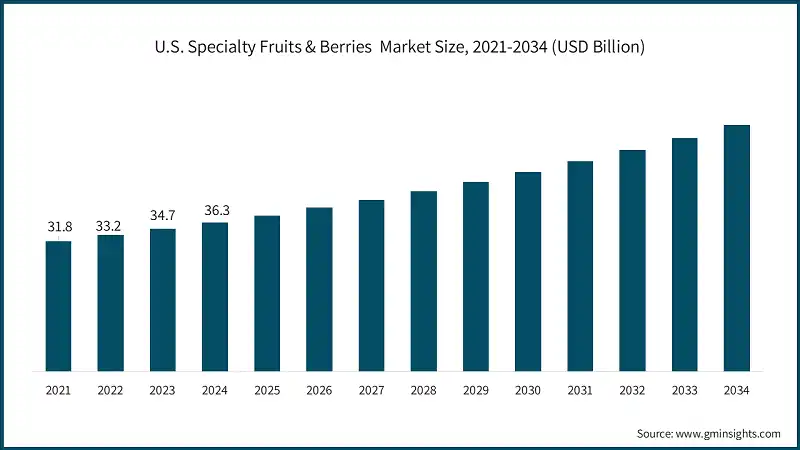
U.S. dominated the specialty fruits and berries market in North America with around 80.1% share and generated USD 36.3 billion in revenue in 2024.
- The U.S. consumes more than 25% of global production. The highly consumed specialty fruits are blueberries, strawberries and raspberries. The major states producing specialty fruits are California, Oregon, and Washington.
- U.S. higher consumer awareness of the health benefits of specialty fruit, demand for fresh and organic produce, and strong retail and food service demand for specialty fruits.
- The U.S. also plays a vital role in berry based functional food, fortified food and drink, supplements innovation. Exotic fruit imports, like dragon fruit or acai, signify that market expectations are changing for exotic and super food and gross specialty fruit consumption across the board.
The specialty fruits and berries market in India is projected to experience robust and sustained growth from 2025 to 2034.
- The specialty fruits and berries market is growing quickly in India, due to rising disposable income, urbanization, and growing consumer awareness of health benefit. Existing fruits, such as mango and guava, will stay in the limelight, but the demand is increasing for both imported and locally grown specialty fruits and berries such as blueberries, strawberries, and raspberries particularly in urban metro markets.
- The market has also been encouraged by modern retail, e-commerce, and from the foodservice sector; berries are increasingly used in desserts, yogurts, and beverages. While strawberries are produced in places like Mahabaleshwar, the production of blueberries and blackberries through imports is increasing.
- While the space is still relatively small in comparison to Western countries, drivers for specialty fruits in India are leading to predictions of double-digit growth in specialty fruit over the next five years based on changing dietary preferences and greater availability.
The specialty fruits and berries market in Germany is forecasted to optimistic growth between 2025 and 2034.
- Germany is a dominant market in Europe for specialty fruits and berries, accounting for a significant portion of consumption and imports. German consumers are very interested in consuming organic and sustainably produced fruits and berries, with preferences for strawberries, blueberries, and raspberries.
- Germany has a very mature market with multiple markets and specialty retail outlets selling multiple varieties of berries and specialty fruit year-round. The demand for exotic fruit is growing in the German market as consumers have shown interest in various types of kiwis, pomegranates and dragon fruit, which is a sign of consumers evolving desirable new/exotic flavors and interest in superfoods.
- Germany is also an importer/distributor for the whole European market. It imports large volumes of berries from Spain, Poland and Austria, and increasingly from overseas. The market for berries and specialty fruits will continue to grow in Germany, with continuous demands for health, wellness, and sustainability.
The specialty fruits and berries market in Brazil is projected to undergo remarkable and steady growth from 2025 to 2034.
- Brazil is a strong producer and strong consumer of specialty fruits and berries. It has a large domestic market and an appreciably growing sized export market. Brazil is famous for its native superfruits such as acai and guarana used in various products, including juices, smoothie, and health supplements.
- Brazilian production of strawberries and blueberries is also increasing, especially in southern states. The driving factors of domestic consumption are increased health awareness, urbanization, and the demand for functional foods. Brazil exports significant quantities of acai and other exotic fruits to North America, Europe, and Asia, in order to take advantage of international superfood trends.
- The foodservice industry, including juice bars and health-focused cafes, is an important part of the specialty fruit promotion. Brazil has the logistical challenges to deal within distribution, but the specialty fruit market will continue with a steady growth trajectory, driven by innovation, export market potential, and growing domestic demand.
Saudi Arabia’s specialty fruits and berries market is set to experience dynamic and substantial expansion during the period from 2025 to 2034.
- Saudi Arabia’s market growth is led by a younger and more health-conscious population Saudi Arabia, like other Gulf Cooperation Council (GCC) countries, imports almost all of its specialty fruits and berries, but demand for blueberries, strawberries, and raspberries is developing as more high-income consumers in major metropolitan areas, such as Riyadh and Jeddah become aware of berries and specialty fruits.
- The government is promoting local high-value crop production through investment in new agriculture technology such as hydroponics and greenhouses. Both retailers and supermarkets are expanding their specialty fruits-offerings, not only through imports but increased domestic turnovers, and foodservice is including berries as options for desserts, cocktails, or simply menu items classified as premium.
Specialty Fruits and Berries Market Share
The top 5 companies in the specialty fruits and berries industry include berry world group, costa group holdings limited, dole food inc, driscoll's inc, and exotic tropical fruits llc representing around 41.3% of the market in 2024.
- The specialty fruits and berries market is fiercely competitive and fragmented, with many multinational brands, leading local companies, and emerging niche companies.
- These companies are focused on identifying new berry varieties and nutrition and developing improved shelf-life performance programs/work and sustainable practices, to meet the evolving needs of the consumer. There are some local producers, particularly in Europe, Latin America and Asia-pacific, that are specializing in specialty or indigenous fruits
- The growth of organically grown and sustainably cultivated products has increased competition from organic certified organic growers and cooperatives, particularly in Europe and North America. E-commerce & natural direct-to-consumer models provide pathways, and brand opportunities to start-ups and smaller branded retailers to tap into niche segments.
- There is ongoing strategic alignments partnerships, mergers, and acquisition activity, as companies look to expand productive portfolios and direct access to wider geographical locations.
Specialty Fruits and Berries Market Companies
Driscoll's Inc.: Driscoll's Inc. is a global leader in fresh berry production and marketing, specifically strawberries, blueberries, raspberries and blackberries. With a large network of independent growers Driscoll's sells in more than 20 countries. Driscoll's focuses on innovation, quality, and sustainability, all to sell top quality berries to retail and consumer customers around the world.
Naturipe Farms LLC: Naturipe Farms LLC is one of the largest growers and marketers of fresh berries in North America and with a growing international presence. Naturipe is a partnership of family farms, emphasizing innovative sustainable farming, a year-round supply of fresh berries, and as essential to our business model, we are focused on developing new products. Naturipe sells to many of the largest retail and foodservice companies in North America, Europe, and Asia.
Wish Farms: Wish Farms is a family-owned berry grower and marketer headquartered in Florida, USA, that specializes in a variety of berries, including strawberries, blueberries, blackberries, and raspberries. As a family business, they believe in innovative farming practices, traceability, and offer fresh berries to retail companies, and foodservice partners across the United States. They take sustainability and community engagement seriously.
Costa Group Holdings Limited: Costa Group Holdings Limited is Australia’s largest horticultural grower and marketer of berries, avocados, citrus and other crops; Costa is one of the largest suppliers of fresh berries in domestic and export markets; they are primarily focused on sustainability and using technology and producing 365 per year while working with major contracts in Australia and internationally.
BerryWorld Group: BerryWorld Group is a breeder, grower, and marketer of berries, including strawberries, raspberries, blueberries, and blackberries. Based in the UK, BerryWorld has operations throughout Europe, Africa, and the Americas and is working on a variety of development, quality, and sustainability, to provide consumers and retailers with premium berries globally.
Major players operating in the specialty fruits and berries market are:
- Berry World Group
- Costa Group Holdings Limited
- Dole Food Inc
- Driscoll's Inc.
- Exotic Tropical Fruits LLC
- Frutos Tropicales Europe
- Hortifrut S.A.
- Naturipe Farms LLC
- Omer Decugis & Cie
- Planasa
- TFC Holland
- Wish Farms
Specialty Fruits and Berries Market Report Attributes
| Key Takeaway | Details |
|---|---|
| Market Size & Growth | |
| Base Year | 2024 |
| Market Size in 2024 | USD 128.8 Billion |
| Forecast Period 2025 – 2034 CAGR | 5.9% |
| Market Size in 2034 | USD 227.5 Billion |
| Key Market Trends | |
| Drivers | Impact |
| Rising consumer demand for exotic and nutrient-rich fruits and berries. | Expands market size and encourages producers to diversify offerings to meet evolving consumer preferences. |
| Growing health awareness and preference for natural, functional foods. | Increased wellness focus drives consumers to specialty fruits, boosting sales and encouraging innovation. |
| Expansion of premium retail and e-commerce distribution channels globally. | Wider availability through modern retail and online platforms makes specialty fruits more accessible. |
| Increasing popularity of plant-based diets boosting specialty fruit consumption. | Shift towards plant-based eating increases demand for specialty fruits as healthy, sustainable options. |
| Pitfalls & Challenges | Impact |
| High perishability and complex cold chain logistics increase operational costs. | Maintaining freshness during transport raises costs, impacting profitability and limiting market reach. |
| Limited awareness and accessibility in emerging markets restrict market growth. | Lack of consumer education and distribution infrastructure slows adoption and sales growth. |
| Opportunities: | Impact |
| Innovation in value-added products like juices, jams, and supplements. | New products attract diverse consumer segments and increase revenue streams for producers and retailers. |
| Expansion into untapped markets with rising disposable incomes. | Entering new regions with growing middle classes offers significant growth potential for specialty fruits. |
| Market Leaders (2024) | |
| Market Leaders |
8.1% market share in 2024 |
| Top Players |
Collective market share 42.7% in 2024 |
| Competitive Edge |
|
| Regional Insights | |
| Largest Market | North America |
| Fastest Growing Market | Asia Pacific |
| Emerging Countries | India, Vietnam, Philippines, Indonesia, Brazil, Egypt |
| Future outlook |
|
What are the growth opportunities in this market?
Specialty Fruits and Berries Industry News
- In December 2024, Okanagan specialty fruits and prevar launched a multiyear research and development partnership to enhance apple and pear breeding by applying genome editing and biotechnology techniques. The partnership will officially commence in January 2025 and will deliver better cultivars by 2029 in the first pre-commercial products of that research.
- In February 2024, Döhler North America announced expansion plans at their Cartersville plant, doubling the production capacity and increasing production lines of flavors and syrups and enhancing their ability to act quickly, improve quality, innovate, and use this new production strategy to support investments from Döhler to the 'flavor' industry for North America and the Americas as a whole.
- In March 2023, India announced, through its ministry of agriculture and farmers welfare, plans to expand kamalam production from 3000 hectares to 50,000 hectares in five years with the support of the MIDH scheme. The kamalam scheme will include the development of a kadalam center of excellence in Bengaluru to boost domestic production, reduce imports, and promote value addition.
The specialty fruits and berries market research report includes in-depth coverage of the industry with estimates & forecasts in terms of revenue (USD Billion) and volume (Tons) from 2021 to 2034, for the following segments:
Market, By Product Type
- Premium berries
- Blueberries
- Strawberries
- Raspberries
- Others (goji, acai, elderberry)
- Exotic & tropical fruits
- Dragon fruit
- Passion fruit
- Others (kiwi, pomegranate)
Market, By Form
- Frozen fruits
- Dried and dehydrated products
- Juice and beverage
- Powder and extract
Market, By Application
- Fresh consumption and retail
- Food processing and manufacturing
- Nutraceutical and supplement industry
- Cosmetic and personal care applications
- Foodservice and hospitality
- Industrial and B2B applications
Market, By Distribution Channel
- Traditional retail channels
- Direct-to-consumer channels
- Foodservice distribution
- Wholesale and B2B channels
Market, By Cultivation Channel
- Conventional agriculture
- Organic cultivation
- Greenhouse and protected cultivation
- Hydroponic and soilless systems
The above information is provided for the following regions and countries:
- North America
- U.S.
- Canada
- Europe
- Germany
- UK
- France
- Italy
- Spain
- Rest of Europe
- Asia Pacific
- China
- India
- Japan
- Australia
- South Korea
- Rest of Asia Pacific
- Latin America
- Brazil
- Mexico
- Argentina
- Rest of Latin America
- MEA
- South Africa
- Saudi Arabia
- UAE
- Rest of Middle East & Africa
Frequently Asked Question(FAQ) :
What is the market size of the specialty fruits and berries in 2024?
The market size reached USD 128.8 billion in 2024, driven by increasing consumer focus on health, wellness, and premium food products.
What is the projected value of the specialty fruits and berries market by 2034?
The market is poised to reach USD 227.5 billion by 2034, growing at a CAGR of 5.9% during the forecast period.
What is the market share of premium berries in 2024?
Premium berries held a significant market share, valued at USD 71.3 billion in 2024, with blueberries contributing over 37.3% of the revenue.
What is the market share of frozen fruits in 2024?
Frozen fruits accounted for the largest share of 32.4% in 2024, owing to their shelf stability, year-round usability, and convenience.
What is the growth outlook for the nutraceutical and supplement sector?
The nutraceutical and supplement sector is expected to grow at a CAGR of 5% from 2025 to 2034.
Which region leads the specialty fruits and berries sector?
The U.S. dominates the North American market with an 80.1% share, generating USD 36.3 billion in revenue in 2024.
What are the upcoming trends in the specialty fruits and berries market?
Trends include demand for functional foods, sustainability, traceability, premium products, and antioxidant-rich, low-chemical, sustainably grown produce.
Who are the key players in the specialty fruits and berries industry?
Key players include Berry World Group, Costa Group Holdings Limited, Dole Food Inc, Driscoll's Inc., Exotic Tropical Fruits LLC, Frutos Tropicales Europe, Hortifrut S.A., Naturipe Farms LLC, Omar Decugis & Cie, Planasa, TFC Holland, and Wish Farms.
Specialty Fruits and Berries Market Scope
Related Reports