Summary
Table of Content

Specialty Crops for Nutraceuticals Market
Get a free sample of this report
Form submitted successfully!
Error submitting form. Please try again.
Thank you!
Your inquiry has been received. Our team will reach out to you with the required details via email. To ensure that you don't miss their response, kindly remember to check your spam folder as well!
Request Sectional Data
Thank you!
Your inquiry has been received. Our team will reach out to you with the required details via email. To ensure that you don't miss their response, kindly remember to check your spam folder as well!
Form submitted successfully!
Error submitting form. Please try again.
Specialty Crops for Nutraceuticals Market Size
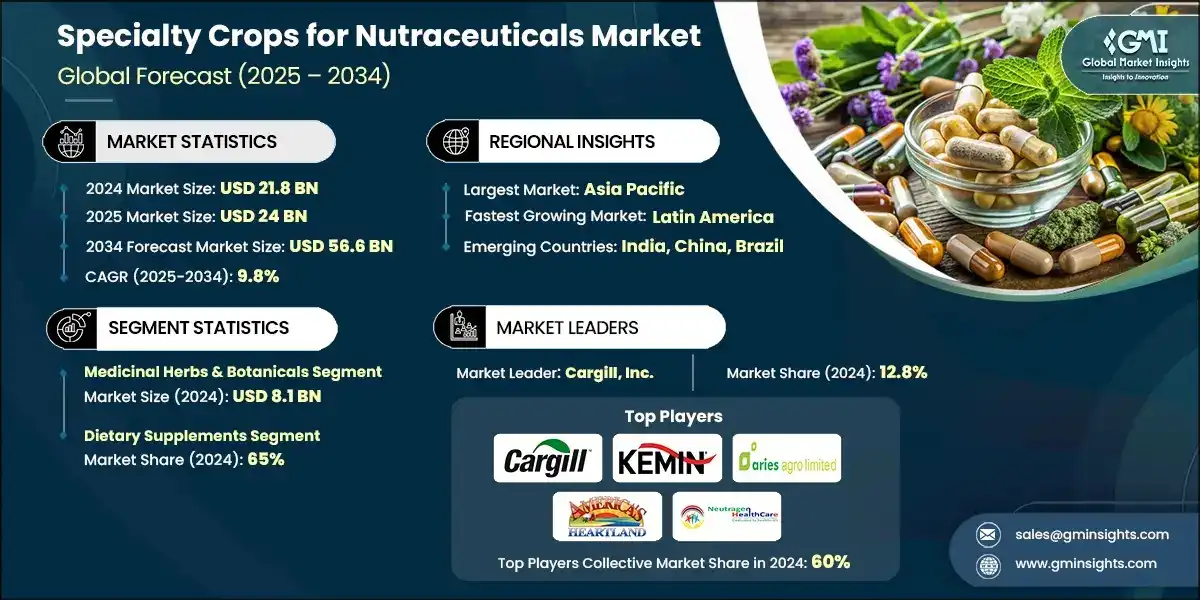
The global specialty crops for nutraceuticals market was valued at USD 21.8 billion in 2024. The market is expected to grow from USD 24 billion in 2025 to USD 56.6 billion in 2034 at a CAGR of 9.8%, according to latest report published by Global Market Insights Inc. The market growth is driven by increasing consumer awareness of preventive healthcare and the rising demand for natural, plant-based health solutions.
To get key market trends
- Along with medicinal herbs, nutritional fruits, tree nuts, seeds, and vegetables are the specialty crops that are specifically engineered for bioactive compounds and attributes for health enhancement. They serve direct raw materials for dietary supplements and functional foods while pharmaceutical applications reinforce that they convert agriculture into healthcare.
- These trends of wellness fading and the whole world tilting towards preventive medicine have created an unprecedented demand for such nutraceutical ingredients. The COVID-19 pandemic has certainly catalyzed consumer interest in immune-supporting botanicals, with adaptogenic herbs and antioxidant-rich berries seeing particularly strong growth among supplement formulations.
- That market growth will be continued by cultivation of more medicinal herbs and other botanicals whose specific needs are cultivation conditions or post- harvest processing. However, with the new technology of controlled environment agriculture (CEA) and precision farming, predictable year-round supplies of nutraceutical crops are becoming reality.
Specialty Crops for Nutraceuticals Market Report Attributes
| Key Takeaway | Details |
|---|---|
| Market Size & Growth | |
| Base Year | 2024 |
| Market Size in 2024 | USD 21.8 Billion |
| Market Size in 2025 | USD 24 Billion |
| Forecast Period 2025 – 2034 CAGR | 9.8% |
| Market Size in 2034 | USD 56.6 Billion |
| Key Market Trends | |
| Drivers | Impact |
| Rising demand for immune-supporting botanicals | Adaptogenic herbs and antioxidant-rich crops driving supplement market expansion |
| Expansion of functional food applications | Growing integration of specialty crop extracts in mainstream food and beverage products |
| Advances in controlled environment agriculture | Year-round production capabilities improving supply chain reliability and crop quality |
| Pitfalls & Challenges | Impact |
| Quality standardization and regulatory compliance | Varying global standards creating barriers for international trade and market entry |
| Opportunities: | Impact |
| Personalized nutrition and targeted health solutions | Custom formulations driving demand for specific bioactive compounds from specialty crops |
| Market Leaders (2024) | |
| Market Leaders |
Market Share 12.8% |
| Top Players |
Collective market share is 60% in 2024 |
| Competitive Edge |
|
| Regional Insights | |
| Largest Market | Asia Pacific |
| Fastest growing market | Latin America |
| Emerging country | India, China, Brazil |
| Future outlook |
|
What are the growth opportunities in this market?
Specialty Crops for Nutraceuticals Market Trends
- Medicinal herbs and botanicals dominating market growth - Medicinal herbs & botanicals dominate the largest share of the market, which is likely to reach USD 21.01 billion by the year 2034, accounting for 37.1% of the market. There is an increasing demand for adaptogenic herbs ashwagandha, rhodiola, and ginseng, which is further supported by increasing clinical research to validate the traditional medicinal use of these herbs as well as the growing demand among consumers for plant-based therapeutics.
- Dietary supplements driving application demand - The dietary supplements application segment is projected to reach USD 36.84 billion by 2034, 65% of the total market share. The above growth is attributed to the soaring global supplements market, rising consumer preferences for single-ingredient and health-targeted formulations, and prominence of personalized nutrition approaches that demand specific bioactive compounds from specialty crops.
- Organic cultivation methods gaining significant traction - Organic cultivation is expected to grab 28% market share by 2034, reaching USD 15.84 billion, basically due to premium pricing, consumer inclination for clean-label products, and regulatory advantages in some key markets. As more certification programs emerge, organic farming methods continue to improve, and retailer demand for sustainably sourced nutraceutical ingredients grows, the segment is benefitting.
Specialty Crops for Nutraceuticals Market Analysis
Learn more about the key segments shaping this market
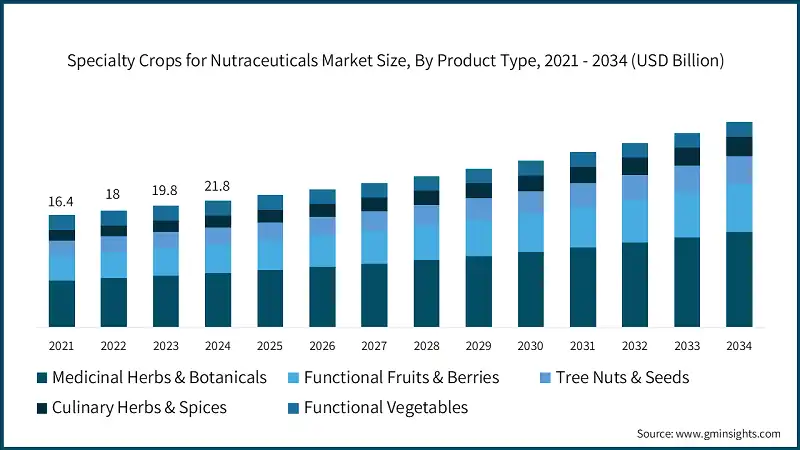
Market segments according to specialty crop classification for nutraceuticals include medicinal herbs & botanicals, functional fruits & berries, tree nuts & seeds, culinary herbs & spices, and functional vegetables.
- Medicinal Herbs & Botanicals, however, holds the largest market share with an anticipated growth from USD 8.1 billion in 2024 to USD 21.1 billion in 2034, backed by therapeutic acceptability and a trusted consumer base in plant medicines.
- Domination of that segment is owing to its ancient roots in traditional medicine that have now received endorsements from modern scientific literature. Ashwagandha, rhodiola, and holy basil are in unprecedented demand from consumers seeking natural solutions for stress management. The COVID-19 pandemic, furthermore, has increased interest in botanicals that support immunity, with echinacea, elderberry, and astragalus all growing triple digits in the supplement formulation arena. The most recent innovations include work on standardized extraction methods, and sustainable wildcrafting that ensure consistent potency while healing natural habitats.
Learn more about the key segments shaping this market
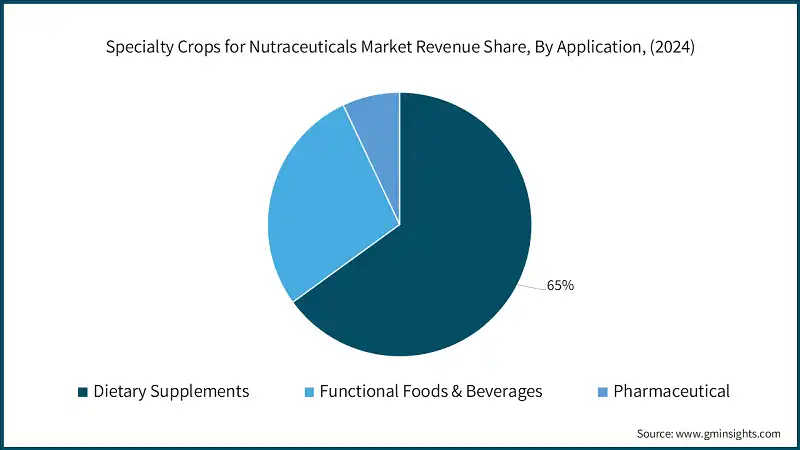
- Specialty crop for nutraceuticals market segments by application include dietary supplements, functional foods & beverages, and pharmaceutical uses. Dietary Supplements hold the larger applications share of around 65% of the total market in 2024, and it is anticipated to grow further towards USD 36.8 billion by 2034.
- The shift of consumer behavior towards preventive healthcare is propelling this segment's growth. Single-ingredient supplements of particular specialty crops are being favored more now than generic multivitamin products, with the targeted formulations for cognitive health, joint support, and metabolic wellness boosting sales growth the most. Major supplement companies are reaching out and investing heavily into supply chain partnerships with specialty crop growers with a view to ensure ingredient traceability and quality consistency. The emergence of personalized nutrition platforms creates additional demand for certain niche botanical ingredients with specified bioactive profiles.
- Cultivation methods divide the market into conventional cultivation, organic cultivation, and controlled environment agriculture. Conventional cultivation is the largest segment; it is projected to grow from USD 14.2 billion in 2024 owing to the factors like cost-effective treatment and availability of agricultural infrastructure.
- Traditional farming practices continue to dominate specialty crops, especially for high-volume ingredients such as turmeric, ginger, and commonly applied medicinal herbs. Conventional cultivation has also benefitted from decades of agricultural research, established pest management protocols, and lower production costs, which have put nutraceutical ingredients into the hands of mass-market consumers. Increasingly, this segment faces pressure to shift into sustainable practices with reduced chemical inputs as consumers become more conscious of environmental issues and residue concerns.
Looking for region specific data?
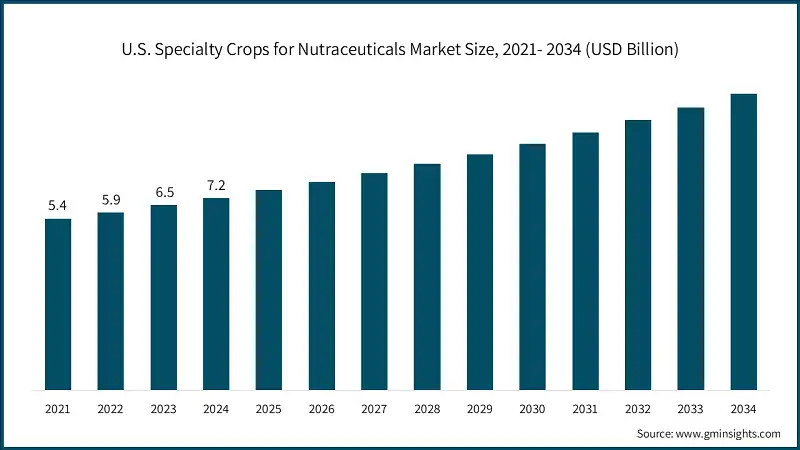
- Specialty crops for nutraceutical market in U.S. were pegged at USD 7.2 billion in 2024 and is expected to grow approximately to USD 14.16 billion by 2034. The region profited largely from high agricultural technology, strong research institutions, and sophisticated consumer demand for premium nutraceutical ingredients. States within agriculture such as California, Oregon, and Washington are witnessing a rise in the acreage of specialty crops for nutraceutical applications with an emphasized focus on organic and sustainably-grown varieties.
- Consumer health consciousness in U.S. helps spur demand for specialty crops to be sourced locally and thereby provide opportunities for local farmers to diversify into high-value medicinal plants and functional foods ingredients. The region's legal framework, with FDA oversight and organic certification programs, provides quality assurance that supports the crown price for nutraceutical crops grown in North America.
Specialty crops in nutraceuticals continue to cater to Europe, making it part of the sustainable agriculture initiatives whereby traditional herbal medicine is integrated into modern-day healthcare systems. The region is heavily tilted toward quality standards and traceability requirements that favor European-grown specialty crops over their imported competitors. The European regulation regarding novel foods and botanical ingredients poses challenges and opportunities for specialty crop producers.
The specialty crops for nutraceuticals market in Germany is projected to see substantial growth from 2025 to 2034.
- The German specialty crops for nutraceuticals market has ample opportunities for growth from 2025 to 2034. The country's dedication to sustainable agriculture and organic farming practices fits well into the nutraceutical industry's demand for clean and traceable ingredients. German consumers are oriented toward botanic ingredients sourced domestically, which facilitates the growing of medicinal herbs and functional crops in the country. The development of high-tech greenhouse and precision agricultural systems enable the sustained production of specialty crops for nutraceuticals.
The specialty crops for nutraceuticals market in China is projected to see substantial growth from 2025 to 2034.
- China's specialty crops for nutraceuticals market anticipates substantial expansion from 2025 to 2034. In terms of biodiversity, traditional medicine, and agricultural power, the country stands in the forefront of specialty crops production for nutraceutical applications on the global level. The support from the government in modernizing traditional Chinese medicine creates huge investment opportunities in standardized cultivation and processing of medicinal plants.
- The domestic nutraceutical market in China is booming, with rising incomes and health consciousness driving consumer demand for high-quality botanical ingredients. The Belt and Road Initiative facilitates the export of specialty crops to emerging markets, while local demand for functional foods and dietary supplements creates a buoyant market for locally grown nutraceutical crops.
The specialty crops for nutraceuticals market in Brazil is expected to grow at a significant pace from 2025 to 2034.
- Brazil's specialty crops for nutraceuticals market expects significant growth from 2025 to 2034. The country's tropical climate and biodiversity provide ideal conditions for cultivating exotic fruits, medicinal plants, and functional crops highly valued in global nutraceutical markets. Brazil's expanding agricultural technology sector and research institutions support development of sustainable cultivation practices for specialty crops.
- Government initiatives promoting agricultural diversification and value-added crop production create favorable conditions for specialty crop expansion. Brazil's growing middle class and increasing health consciousness drive domestic demand for nutraceutical products, while the country's export capabilities position it as a major supplier to North American and European markets.
The specialty crops for nutraceuticals market in Saudi Arabia is expected to grow at a significant pace from 2025 to 2034.
- Strong growth is expected for the Saudi specialty crops for nutraceuticals market through to 2034. Investment in agri-tech and sustainable agriculture forms a central pillar of the Kingdom's Vision 2030 economic diversification program. Saudi controlled environment agriculture initiatives run counter to prohibitive climate conditions, thus allowing the profitable cultivation of high-value specialty crops.
- The strategic location of the country brings easy exportation of specialty crops into the European and Asian markets, while emerging local demand for premium health products creates opportunities within the local market. Saudi investments into agricultural research and development particularly within desert agriculture and hydroponic systems make certain sustainable specialty crop production for nutraceutical applications.
Specialty Crops for Nutraceuticals Market Share
Companies such as Cargill, Kemin, Aries Agro, Americas Heartland, and Neutragen Healthcare are part of a diverse set in the specialty crops for nutraceuticals industry, each contributing a unique skill set to the supply, processing, and ingredient development of herbs for nutraceutical use. Cargill is one global agricultural organization with huge resource levels to source, process, and distribute specialty crops such as herbs, seeds, and nuts for nutraceutical applications via its extensive supply chain. Kemin specializes in bioactive extraction from botanicals and plants, emphasizing innovative ingredient development and quality assurance for health-conscious applications.
Aries Agro provides crop nutrition solutions and biostimulants for sustainable agriculture in the cultivation of high-value medicinal and functional crops. Americas Heartland is a regional supplier of botanicals, herbs, and specialty crops with a focus on maintaining quality and traceability to its nutraceutical manufacturers. Neutragen Healthcare specializes in the extraction, standardization, and safety of plant-based ingredients, offering high-quality botanical extracts for use in dietary supplements and functional foods with strict compliance to quality control and assurance.
Specialty Crops for Nutraceuticals Market Companies
Major players operating in the specialty crops for nutraceuticals industry are:
It has a full farm of crops that are specialty crops that are used for nutraceutical applications globally through its core capabilities of sourcing, processing, and distributing natural ingredients. Cargill, Inc. is a world company diversified toward agricultural commodities, food ingredients, and processing. Functional foods and dietary supplements from specialty crops based on several segments are covered in the operations. The world infrastructure by its nature includes a vast supply chain and hundreds of processing facilities for production at large-scale operational activities. Cargill takes great pride in saying that it improves quality standards and regulatory compliance over the entire product range.
Kemin refers back to the worldwide manufacturer of ingredients that are specifically nutritional, health, and functional but naturally derived. It develops and manufactures extracts and bioactives from special crops used in nutraceutical formulations, functional foods, and beverages. Kemin's product portfolio includes botanical extracts, antioxidants, and plant-based ingredients tailor-made for health and wellness purposes. Kemin concentrates on research and innovation that targets regulatory requirements defining consumer need for clean-label products. Also important are Kemin's global network of manufacturing plants and R&D facilities to support product development and supply.
Crop nutrition and protection input company, Aries Agro. In addition to the main products, specialty inputs are also imported for growing nutraceutical crops. Fertilizers, biostimulants, and crop health products all cater to a wide variety of products that focus on optimizing growth and quality of yield. Aries Agro specializes in innovative formulations and integrated crop management practices to increase the cultivation of high-value medicinal and functional crops. This approach revolves around manufacturing, distribution, and technical support to farmers and growers. The methodology improves crop quality intended for nutraceutical applications through the adoption of sustainable practices.
Americas Heartland is a regional supplier of agricultural and food ingredients. The company supplies raw materials and ingredients to the nutraceutical and functional food sectors for specialty crop production. All herbs, botanicals, and specialty crops are sourced with guaranteed quality and verified traceability throughout the supply chain, Process, package, and distribute according to customer specification for the production of dietary supplements and health products. Importantly, Americas Heartland emphasizes supply chain integrity and compliance within these standards throughout the industry. The company operates throughout North and South America to link growers to manufacturers.
It is an organization that deals with the development and supplication of plant-based ingredients applied in the nutraceutical and functional food industries. Extraction and processing of botanical materials, herbs, or specialty crops into bioactive compounds fit for health supplements have been done by the company as its major focus. Neutragen lays emphasis on quality control and safety, as well as standardization of their product range for the pharmaceutical and nutraceutical industries. These activities pursue the lines of research, extraction, and manufacturing, all within the frame of compliance with the regulatory standards to which the company aims. The company's goal is to give health and wellness products a trustworthy plant-derived ingredient source.
Specialty Crops for Nutraceuticals Industry News
- In October 2024, Cargill Inc. of Alberta entered into a strategic partnership with the University of California Davis Plant Sciences Department to develop advanced cultivation protocols for high-curcumin content turmeric varieties for nutraceutical applications. The idea is to optimize soil conditions, irrigation systems, and timing of harvests to enhance the sustainable agricultural practices of growing turmeric over 2,500 acres in California's Central Valley to develop curcuminoid concentrations.
- In September 2024, Kemin Industries struck a supply agreement in with the most eminent organic farms across Oregon and Washington for exclusive access to the top spearmint and rosemary crops for their Neumentix cognitive health ingredient line.
- In August 2024, Aries Agro Limited expanded a strategic collaboration with the Indian Council of Agricultural Research to fashion unique micronutrient formulations for the specific medicinal plant cultivation of 15,000 acres, all under Rajasthan and Gujarat. The joint venture will improve alkaloids in ashwagandha, boost winter cherry concentrations, and increase turmeric's curcumin levels through targeted nutrition programs by increasing bioactive compound yields by around 60%.
The specialty crops for nutraceuticals market research report includes in-depth coverage of the industry, with estimates & forecast in terms of revenue (USD Billion) & volume (Kilo Tons) from 2021 to 2034, for the following segments:
Market, By Product Type
- Medicinal herbs & botanicals
- Adaptogenic herbs
- Traditional medicinal plants
- Anti-inflammatory botanicals
- Others
- Functional fruits & berries
- Antioxidant-rich berries
- Citrus fruits for flavonoids
- Exotic fruits
- Tree nuts & seeds
- Omega-rich nuts
- Protein-rich seeds
- Specialty nuts
- Culinary herbs & spices
- Anti-inflammatory spices
- Aromatic herbs
- Exotic spices
- Functional vegetables
- Carotenoid-rich vegetables
- Cruciferous vegetables
- Allium vegetables
Market, By Application
- Dietary supplements
- Single-ingredient supplements
- Multi-ingredient formulations
- Targeted health supplements
- Functional foods & beverages
- Fortified foods with specialty crop extracts
- Functional beverages
- Probiotic foods enhanced with prebiotic specialty crops
- Pharmaceutical
- Botanical drugs
- Standardized plant medicines
- Clinical trial materials for botanical research
Market, By Cultivation Method
- Conventional cultivation
- Organic cultivation
- Controlled environment agriculture
The above information is provided for the following regions and countries:
- North America
- U.S.
- Canada
- Europe
- UK
- Germany
- France
- Italy
- Spain
- Rest of Europe
- Asia Pacific
- China
- India
- Japan
- South Korea
- Australia
- Rest of Asia Pacific
- Latin America
- Brazil
- Mexico
- Argentina
- Rest of Latin America
- Middle East & Africa
- UAE
- Saudi Arabia
- South Africa
- Rest of Middle East & Africa
Frequently Asked Question(FAQ) :
Who are the key players in the specialty crops for nutraceuticals industry?
Major players include Cargill, Kemin, Aries Agro, Americas Heartland, Neutragen Healthcare, Corteva Agriscience, Bayer Crop Science, Syngenta Group, and AeroFarms.
What are the upcoming trends in the specialty crops for nutraceuticals market?
Trends include growing demand for adaptogenic herbs, personalized nutrition, organic farming, and sustainable sourcing.
Which region leads the specialty crops for nutraceuticals sector?
The United States leads the market, with a valuation of USD 7.2 billion in 2024, projected to grow to USD 14.16 billion by 2034. Growth is driven by advanced agricultural technology, strong research institutions, and consumer demand for premium nutraceutical ingredients.
How much revenue will the medicinal herbs and botanicals segment generate by 2034?
The medicinal herbs and botanicals segment is anticipated to generate USD 21.01 billion by 2034, accounting for 37.1% of the total market share.
What was the market size of the specialty crops for nutraceuticals in 2024?
The market size was valued at USD 21.8 billion in 2024, growing at a CAGR of 9.8% during the forecast period.
What was the valuation of the dietary supplements segment in 2024?
The dietary supplements segment held 65% of the market share in 2024 and is set to expand to USD 36.84 billion by 2034.
What is the projected value of the specialty crops for nutraceuticals market by 2034?
The market is poised to reach USD 56.6 billion by 2034, driven by increasing consumer awareness of preventive healthcare and the demand for natural, plant-based health solutions.
What is the expected size of the specialty crops for nutraceuticals market in 2025?
The market size is expected to reach USD 24 billion in 2025.
Specialty Crops for Nutraceuticals Market Scope
Related Reports