Summary
Table of Content

Southeast Asia Recirculating Aquaculture System (RAS) Market
Get a free sample of this report
Form submitted successfully!
Error submitting form. Please try again.
Thank you!
Your inquiry has been received. Our team will reach out to you with the required details via email. To ensure that you don't miss their response, kindly remember to check your spam folder as well!
Request Sectional Data
Thank you!
Your inquiry has been received. Our team will reach out to you with the required details via email. To ensure that you don't miss their response, kindly remember to check your spam folder as well!
Form submitted successfully!
Error submitting form. Please try again.
Southeast Asia Recirculating Aquaculture System (RAS) Market Size
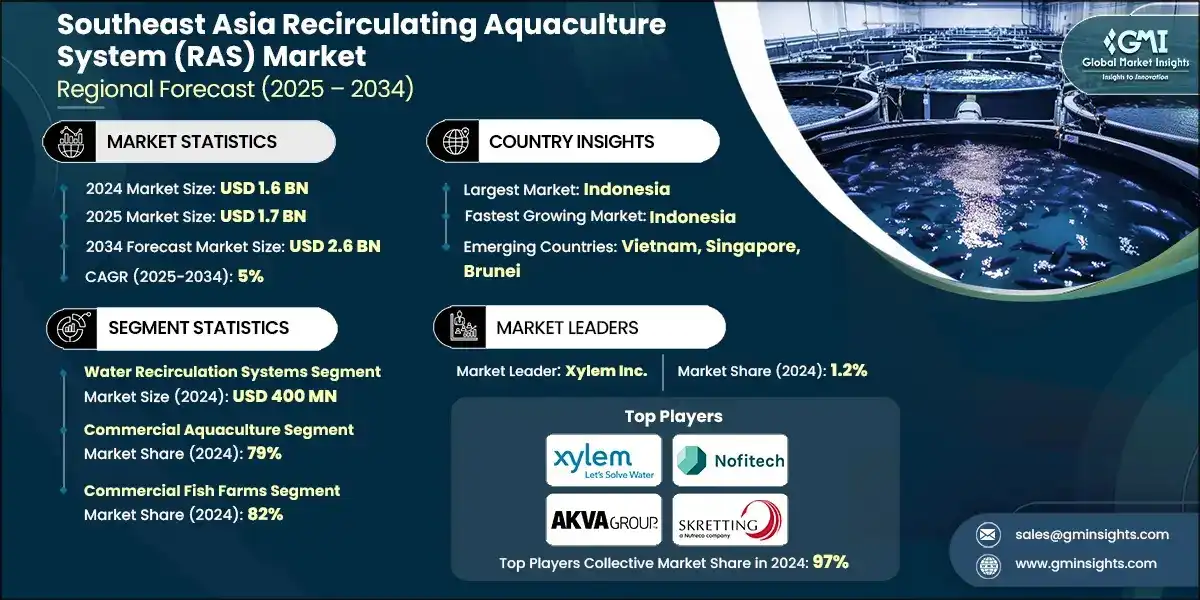
The Southeast Asia Recirculating Aquaculture System market was estimated at USD 1.6 billion in 2025. The market is expected to grow from USD 1.7 billion in 2026 to USD 2.6 billion in 2035, at a CAGR of 5%, according to latest report published by Global Market Insights Inc.
Southeast Asia Recirculating Aquaculture System (RAS) Market Key Takeaways
Market Size & Growth
- 2025 Market Size: USD 1.6 Billion
- 2026 Market Size: USD 1.7 Billion
- 2035 Forecast Market Size: USD 2.6 Billion
- CAGR (2026–2035): 5%
Regional Dominance
- Largest Market: Indonesia
- Fastest Growing Region: Indonesia
Key Market Drivers
- Rising Need for Sustainable and Controlled Aquaculture.
- Increasing Consumer Awareness of Seafood Safety and Quality.
- Advancements in Water Treatment and Automation Technologies.
Challenges
- High Initial Investment and Operational Complexity.
- Limited Technical Expertise and Workforce Skill Gaps.
Opportunity
- Urban and Near‑Urban Aquaculture Expansion.
- Integration of Digital Tools and Smart Farming Solutions.
Get Market Insights & Growth Opportunities
The Southeast Asian RAS (Recirculating Aquaculture System) market continues to grow, based on the increasing demand for sustainable, clean and consistent seafood supply throughout the region. With increasing coastal pressure and limited space in many of these same countries, many companies have begun to turn to RAS for an efficient method of farming fish, taking advantage of optimized water usage and the consistency of water quality, temperature and other environmental variables to achieve a sustainable product.
As producers continue to look for ways to protect their fish from environmental factors such as extreme weather, RAS provides a method to improve fish biosecurity through a more controlled production environment and the establishment of improved biosecurity and supply chain management processes. Additionally, rapid advances in water treatment/filtering technologies are improving the ability to manage RAS systems, providing aquaculture producers with reliable and proven commercial solutions, as well as improving supply continuity.
Another significant trend throughout the region is the development of urban/near-urban farms, where RAS technology is providing aquaculture farmers with the ability to locate farms closer to where consumers are located, thereby alleviating many logistical challenges associated with transporting fish long distances, as well as providing consumers with access to fresher seafood products. As a result of this trend towards urban agriculture, equipment manufacturers are incorporating more automated aquaculture monitoring and tracking tools into their RAS equipment to provide aquaculture producers with an efficient means of monitoring fish production and creating a healthier aquaculture environment, consistent with other worldwide trends.
To get key market trends
Southeast Asia Recirculating Aquaculture System Market Trends
The Southeast Asia RAS market is experiencing dynamic growth, driven by a confluence of factors aimed at enhancing sustainable seafood production.
- Focus on Sustainability and Environmental Compliance: As environmental awareness rises, RAS attracts interest in the region due to its low effluent water discharge with minimal ecological footprint. As the RAS technologies attract strict environmental compliances by farmers to reduce pollution and showcase eco-friendly aquaculture by attracting green-conscious consumers and investors.
- Growing foreign and domestic investment: The Southeast Asia RAS market is seeing considerable investment due to the perceived high profit margins from this business and sustainable production of fish using RAS technology. Such reasons are making domestic players and international aquaculture companies invest intensely in establishing new RAS farms and renovating their farms, which is quickening the pace for the adoption of technology and market expansion.
- Training and Development of Specific Skills: With an increase in the amount of sophistication surrounding RAS, the technology itself demands increased technical input from workers within the region. As a result, governments and private entities are providing tremendous investments into training programs and R&D centers to enable local expertise in RAS operation management, fish health management, and system design to spur industry growth in the long run.
Southeast Asia Recirculating Aquaculture System Market Analysis
Learn more about the key segments shaping this market
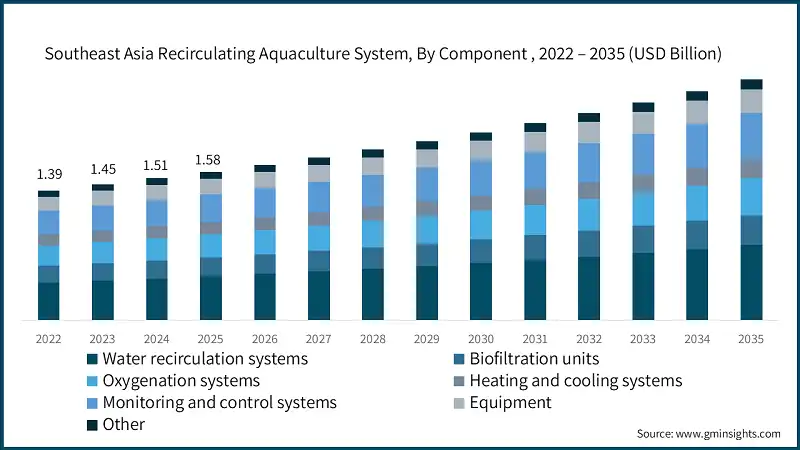
Based on components, the Southeast Asia Recirculating Aquaculture System market is divided into water recirculation systems, biofiltration units, oxygenation systems, heating and cooling systems, monitoring and control systems, equipment, and others. In 2025, water recirculation systems held the major market share, generating revenue of USD 400 million.
- Water recirculation systems are at the heart of RAS and provide efficient water reuse with as little discharge as possible. For operators in Southeast Asia, energy-efficient pumps, low-head designs, and smart flow control are some of the new technologies being implemented to decrease operation costs, especially for those regions with high tariffs on electricity. There is an increasing trend toward closed-loop systems to adhere to stricter effluent regulations. UV sterilization and ozone treatment are integrated into recirculation loops for pathogen control.
- Modular designs enable easy scalability from urban farms to large commercial units. IoT-enabled flow monitoring provides real-time optimization, while partnerships with engineering firms develop turnkey solutions. Increasing urbanization, water scarcity, and biosecurity need continue to spur demand.
- Ammonia and Nitrite removal remain some of the most important aspects, and Southeast Asia has widely started the adoption of MBBR and trickling filters due to their good performance in tropical climate conditions. Media with a high surface area and integrated denitrification zones address nitrate accumulation, while low-maintenance, self-cleaning designs help reduce labor costs.
- Research collaborations are focused on optimizing biofilter microbiomes for faster nitrification and resilience to salinity shifts. Advanced biofiltration systems are being merchandised as compliance enablers considering more stringent discharge norms. Demand is especially strong for marine RAS growing species like grouper, barramundi, and shrimp, where nitrogen control is considered paramount for maintaining water quality and productivity.
- Various oxygenation systems are evolving with microbubble and nanobubble technologies that are bringing improvement in gas transfer efficiency and health to fish. Liquid oxygen dosing and high-efficiency diffusers are being accepted by the operators of southeast Asia for maintaining DO levels in high-density tanks.
- Energy efficiency is enhanced by using variable speed blowers and smart aeration controls, thus reducing operational costs. Real-time sensors of DO and automated alarms minimized their loss. Sustainability benefits include reduced mortality and improved feed conversion ratios that further inspire confidence in the economies for the acceptance of such advanced life support systems
Learn more about the key segments shaping this market
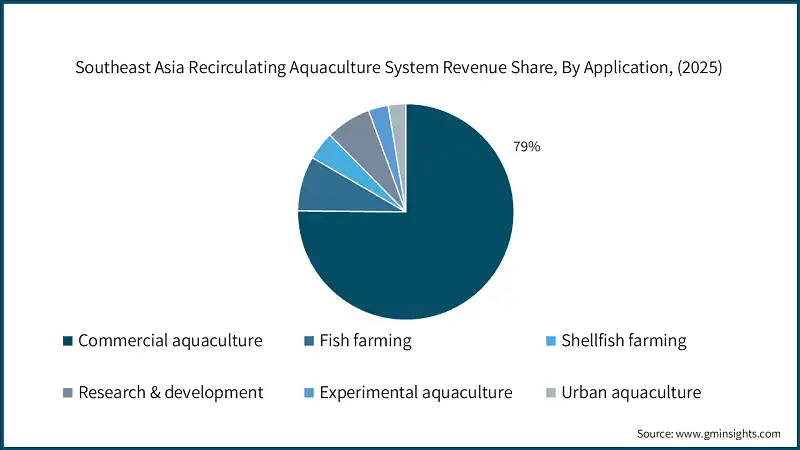
Based on application, the Southeast Asia recirculating aquaculture system market is segmented into commercial aquaculture, fish farming, shellfish farming, research & development, experimental aquaculture, and urban aquaculture. The commercial aquaculture segment held the largest share, accounting for 79% of the global Southeast Asia RAS market in 2025.
- Commercial aquaculture is on its growth trajectory due to increasing demand for seafood, increasing export opportunities, and a focus on sustainability. Recirculating Aquaculture Systems have emerged as one of the technologies of choice in Southeast Asia because of their potential to enhance productivity, resource use efficiency, and minimize environmental impact. In aquaculture, RAS provides improved water quality, reduction of diseases, and year-round production-a necessary tool to help meet the increasing demand for fish as a source of protein.
- Government initiatives promoting aquaculture further accelerate RAS deployment in this segment, underpinning its importance for the challenges related to food security and sustainability. The shellfish farming segment also benefits from the RAS, which keeps the environment controlled, enhancing growth rates while reducing risks of contamination. Shellfish adoption by consumers is on the rise, thereby making the need to be more sustainable in aquaculture practices, and RAS adoption in these areas continues to expand rapidly.
- Given that RAS enables the modeling of even extremely different aquatic environments, from studies of fish behavior to disease management and breeding techniques. That drives innovative technologies in aquaculture and contributes to the overall growth of the sector. Experimental aquaculture also makes use of RAS for testing innovative farming methods, species adaptability, and checking feed efficiency.
- Precise control by the RAS system encourages innovation and assists in the elaboration of technologies aimed at sustainable aquaculture development. Aquaculture, therefore, also becomes able and ready against continuous changes in challenges and opportunities. The flexibility in this trend is the main factor in keeping aquaculture viable for a longer time in the region.
Based on end user, the Southeast Asia recirculating aquaculture system market is segmented into commercial fish farms, research institutes, educational institutes, academic institutions. In 2025, commercial fish farms dominate the market with highest market share of 82%.
- Commercial fish farming end-users dominate the segment due to increasing seafood demand, urbanization, and the necessity for bio-secure, high-density production systems. Key trends include automation in feeding and water quality control, energy-efficient infrastructure, and integration with cold-chain logistics that help in maintaining freshness of the product. Premium species include salmon, grouper, and barramundi, supported by sustainability and traceability-focused branding.
- Operators are implementing IoT-enabled monitoring systems, AI-powered analytics, and fail-safe automation to minimize mortality rates and maximize Feed Conversion Ratios. Distribution networks are being increased through partnerships with retailers, e-commerce platforms, and food-service chains. While capital expenditure in aquaculture remains high, the return on investments is likely to improve because of premium pricing strategies and lowered disease risks.
- Research institutes make use of RAS for optimization at the species level, along with others, by conducting genetic advancements and innovative system designs. Controlled environment allows for experiments to be conducted on growth performance, feed efficiency, and disease resistance.
- Emerging trends include compact, high-precision systems, sensor integration, and real-time monitoring through data-driven analytics. Government and NGO funding is supporting projects on sustainability, climate resilience, and biosecurity. Indeed, institutes such as these are many times leading development in integrated systems, such as aquaponics and nutrient recovery, along with digital twins that allow predictive modeling. Moreover, research facilities often provide testbeds for commercial prototypes to enable seamless market rollouts, thereby enabling growth in innovation for the aquaculture industry.
- RAS installations for educational training programs, skill development, and demonstration projects are increasingly becoming a part of more educational institutes. This includes hands-on learning from small-scale modular systems and inclusion of aquaculture engineering, biology, and sustainability in the curriculum.
- More than that, industrial partnerships give students commercial experience that better prepares the graduates for the labor market. Institutes have been using IoT-enabled dashboards and simulations tools in teaching digital aquaculture management. With governments now emphasizing vocational training in sustainable aquaculture, such institutions have become key to meeting the workforce need and driving further growth in this sector.
Looking for region specific data?
Southeast Asia RAS Market
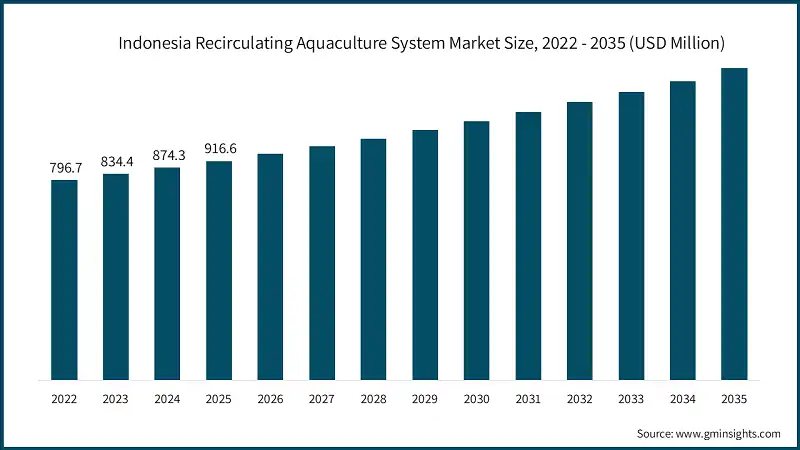
In 2025, the Indonesia dominated the Southeast Asia RAS market, accounting for around 58% and generating around USD 916 million revenue in the same year.
- The market landscape for RAS within Southeast Asia bears the stamp of the region's rising focus on aquaculture in terms of sustainability and efficiency, driven largely by advances within the broader Asia Pacific region relating to water treatment systems and controlled farming.
- Countries in the region are taking a keener interest in RAS in their quest to overcome issues concerning land, fluctuating water quality, and increasing demand for high-quality, cleaner seafood. This is further reinforced by rapid technological progress across the Asia Pacific aquaculture landscape in terms of water purification and automation of systems. System reliability has steadily improved and only serves to make RAS an increasingly interesting choice for those farmers looking to operate within predictable and environmentally responsible parameters.
- Within Southeast Asia, the adoption trend is varied, depending on the market maturity and policy direction. Singapore is at the forefront, backed by its supportive government for high tech food production with a use case of RAS to maximize output in its highly limited urban space with considerations for strict biosecurity and quality consistency
Southeast Asia Recirculating Aquaculture System Market Share
Nofitech is leading with 15% market share. Xylem, Nofitech, Eyvi, AKVA Group, Skretting collectively hold around 46%, indicating moderately fragmented market concentration. These prominent players are proactively involved in strategic endeavors, such as mergers & acquisitions, facility expansions & collaborations, to expand their product portfolios, extend their reach to a broad customer base, and strengthen their market position.
- Xylem provides essential water and wastewater treatment technologies for the RAS industry, with supply critical to operations: pumps, filtration systems, and disinfection solutions. Their cutting-edge water management solutions ensure that there is optimal water quality with resource efficiency, positioning them as a key enabler of sustainable RAS growth in Southeast Asia.
- Nofitech has over the years grown into a main supplier of complete RAS solutions and focuses on developing innovative, space-effective designs that would fit many species under aquaculture. Their modular and highly performing systems let them have efficient and effective fish farming in Southeast Asia, establishing them as one of the turnkey RAS project providers.
- Eyvi specializes in the design and installation of advanced water treatment and purification systems. They provide RAS facilities with several uncompromising methods of sustaining the water in prime conditions. Special filtration and waste removal technologies are their deal, ensuring that a healthy environment is created for any aquatic species, hence crucial for high-intensity RAS operations in the region.
Southeast Asia Recirculating Aquaculture System Market Companies
Major players operating in the Southeast Asia RAS market are:
- AKVA Group
- Aquacare Environment
- AquaMaof
- Billund Aquaculture
- Blue Planet Ecosystems
- Chongrui Tech (Fujian) Co. Ltd
- Clewer Aquaculture
- Eyvi
- eWater (China)
- FRD Japan
- Guangdong ZKAQUA Aquaculture Equipment Co. Ltd
- Hesy Aquaculture
- Nofitech
- PR Aqua
- Qingdao Haixing
- Qingdao Hishing Smart Equipment Co. Ltd
- RADAQUA
- Skretting
- Thomson (China)
- Xylem
AKVA Group is a global leader in aquaculture technology with its supply of complete RAS solutions, cage farming equipment, and software for the aquaculture industry. Their full value-chain offering includes design, operational support, and delivery of complete, reliable RAS infrastructure to their customers. The dominant position within Southeast Asia's fast-growing aquaculture market is secured.
Skretting is a global player in producing innovative and sustainable aquaculture feeds tailored for RAS environments and specific species. Their specialized diets optimize growth, health, and feed conversion ratios within closed systems, which makes them a crucial partner for operators in Southeast Asia striving for maximum productivity and profits.
Southeast Asia Recirculating Aquaculture System (RAS) Market Report Attributes
| Key Takeaway | Details |
|---|---|
| Market Size & Growth | |
| Base Year | 2025 |
| Market Size in 2025 | USD 1.6 Billion |
| Market Size in 2026 | USD 1.7 Billion |
| Forecast Period 2026-2035 CAGR | 5% |
| Market Size in 2035 | USD 2.6 Billion |
| Key Market Trends | |
| Drivers | Impact |
| Rising Need for Sustainable and Controlled Aquaculture | Producers across Southeast Asia are adopting RAS to reduce water usage, maintain consistent growing conditions, and improve biosecurity reflecting the broader AsiaPacific push for cleaner and more efficient aquaculture systems. |
| Increasing Consumer Awareness of Seafood Safety and Quality | Growing demand for highquality, contaminationfree seafood is motivating farms to invest in systems that offer greater control over water quality and production cycles. RAS aligns this shift by supporting reliable, yearround output. |
| Advancements in Water Treatment and Automation Technologies | Rapid technological progress in filtration, monitoring, and system automation across the Asia?Pacific region makes RAS more feasible and operationally efficient for Southeast Asian producers. |
| Pitfalls & Challenges | Impact |
| High Initial Investment and Operational Complexity | Many producers face cost barriers when considering RAS because the systems require significant upfront investment and skilled operation, limiting widespread adoption in developing markets. |
| Limited Technical Expertise and Workforce Skill Gaps | RAS requires ongoing technical management such as automated water quality monitoring posing challenges for operators who lack training or access to experienced technicians. |
| Opportunities: | Impact |
| Urban and Near‑Urban Aquaculture Expansion | RAS enables seafood production close to consumption hubs, reducing logistics burdens and supporting government goals for sustainable, self‑sufficient food production especially in urbanized markets like Singapore. |
| Integration of Digital Tools and Smart Farming Solutions | Growing use of robotics, AI‑driven monitoring, and advanced sensors in the Asia‑Pacific aquaculture sector opens opportunities to develop smarter, more efficient RAS operations across Southeast Asia. |
| Market Leaders (2025) | |
| Drivers | Impact |
| Rising Need for Sustainable and Controlled Aquaculture | Producers across Southeast Asia are adopting RAS to reduce water usage, maintain consistent growing conditions, and improve biosecurity reflecting the broader Asia Pacific push for cleaner and more efficient aquaculture systems. |
| Increasing Consumer Awareness of Seafood Safety and Quality | Growing demand for highn-quality, contamination free seafood is motivating farms to invest in systems that offer greater control over water quality and production cycles. RAS aligns this shift by supporting reliable, year round output. |
| Advancements in Water Treatment and Automation Technologies | Rapid technological progress in filtration, monitoring, and system automation across the Asia Pacific region makes RAS more feasible and operationally efficient for Southeast Asian producers. |
| Regional Insights | |
| Largest market | Indonesia |
| Fastest growing market | Indonesia |
| Emerging countries | Vietnam, Singapore, Brunei |
| Future outlook |
|
What are the growth opportunities in this market?
Southeast Asia Recirculating Aquaculture System Market News
- In February 2024, Barramundi Group secured a BND $15 million facility from a Bruneian financial institution to construct a RAS broodstock and hatchery center. This helps the company complement existing nursery operations, support 3,000-tonne land-based RAS expansion plans and mitigate viral disease risks endemic across Southeast Asia.
- In September 2024, Thailand's National Science and Technology Development Agency (NSTDA) developed a cost-effective RAS system for shrimp and sea bass cultivation. This helps local operators control cultivation quality, achieve faster return on investment, and access advanced IoT-enabled automation technologies at lower capital costs.
- In 2024, GIZ Vietnam and Can Tho University successfully tested improved RAS models on medium-sized shrimp farms in the Mekong Delta. This helps Vietnamese shrimp farmers achieve 90% water recirculation, increase survival rates to 85.9%, reduce farming cycles, and minimize environmental wastewater discharge.
- In 2023, Singapore's Blue Aqua International announced plans to establish the nation's first fully integrated land-based RAS trout farm producing 3,000 tonnes annually. This helps the company support Singapore's '30 by 30' food security goal, diversify local aquaculture species production, and advance sustainable urban aquaculture technology.
- In October 2023, Thai Union Group received a landmark $150 million Blue Loan from Asian Development Bank to expand RAS shrimp farms in Thailand. This helps the company advance sustainable shrimp production, adopt climate-resilient farming practices, and improve water management capabilities across its Southeast Asian aquaculture operations.
The Southeast Asia recirculating aquaculture system market research report includes in-depth coverage of the industry with estimates & forecasts in terms of revenue (USD Billion) and volume (Thousand Units) from 2022 to 2035, for the following segments:
Market, By Component
- Water recirculation systems
- Biofiltration units
- Oxygenation systems
- Heating and cooling systems
- Monitoring and control systems
- Equipment (tanks, pumps, aerators, etc.)
- Other
Market, By System Type
- Indoor RAS
- Outdoor RAS
- Modular RAS
- Containerized RAS
- Freshwater RAS
- Saltwater RAS
- Hybrid RAS
- Integrated systems
- Specialized systems
Market, By Fish Type
- Salmon
- Trout
- Grouper
- Sea bass
- Barramundi
- Tilapia
- Pangasius
- Mahseer
- Other (white shrimp, mud crab etc.)
Market, By Application
- Commercial aquaculture
- Fish farming
- Shellfish farming
- Research & development
- Experimental aquaculture
- Urban aquaculture
Market, By Species
- Finfish
- Shellfish
- Others
Market, By End Use Industry
- Commercial fish farms
- Supermarkets
- Seafood distributors
- Restaurants
- Research institutes
- Educational institutes
- Academic institutions
Market, By Distribution Channel
- Direct sales
- Indirect sales
The above information is provided for the following regions and countries:
- Singapore
- Brunei
- Indonesia
- Vietnam
- Philippines
- Malaysia
- Thailand
Frequently Asked Question(FAQ) :
What was the market size of the Southeast Asia Recirculating Aquaculture System market in 2025?
The market size was USD 1.6 billion in 2025, with a CAGR of 5% projected through 2035, driven by sustainable seafood production and increasing investments in RAS technology.
What is the projected value of the Southeast Asia Recirculating Aquaculture System market by 2035?
The market is expected to reach USD 2.6 billion by 2035, supported by advancements in RAS technology and growing environmental compliance requirements.
What was the revenue generated by the water recirculation systems segment in 2025?
The water recirculation systems segment generated USD 400 million in revenue in 2025, holding the largest share among components.
What was the market share of the commercial aquaculture segment in 2025?
The commercial aquaculture segment accounted for 79% of the Southeast Asia Recirculating Aquaculture System market in 2025.
What was the market share of commercial fish farms in 2025?
Commercial fish farms dominated the market with an 82% share in 2025.
Which country led the Southeast Asia Recirculating Aquaculture System market in 2025?
Indonesia led the market, capturing 58% of the share and generating approximately USD 916 million in revenue in 2025.
What are the key trends in the Southeast Asia Recirculating Aquaculture System market?
Key trends include a focus on sustainability and environmental compliance, increasing foreign and domestic investments, and the adoption of advanced RAS technologies to enhance production efficiency.
Who are the major players in the Southeast Asia Recirculating Aquaculture System market?
Major players include AKVA Group, Aquacare Environment, AquaMaof, Billund Aquaculture, Blue Planet Ecosystems, Chongrui Tech (Fujian) Co. Ltd, Clewer Aquaculture, Eyvi, and eWater (China).
Southeast Asia Recirculating Aquaculture System (RAS) Market Scope
Related Reports