Summary
Table of Content

Southeast Asia Microwave Oven Market
Get a free sample of this report
Form submitted successfully!
Error submitting form. Please try again.
Thank you!
Your inquiry has been received. Our team will reach out to you with the required details via email. To ensure that you don't miss their response, kindly remember to check your spam folder as well!
Request Sectional Data
Thank you!
Your inquiry has been received. Our team will reach out to you with the required details via email. To ensure that you don't miss their response, kindly remember to check your spam folder as well!
Form submitted successfully!
Error submitting form. Please try again.
Southeast Asia Microwave Oven Market Size
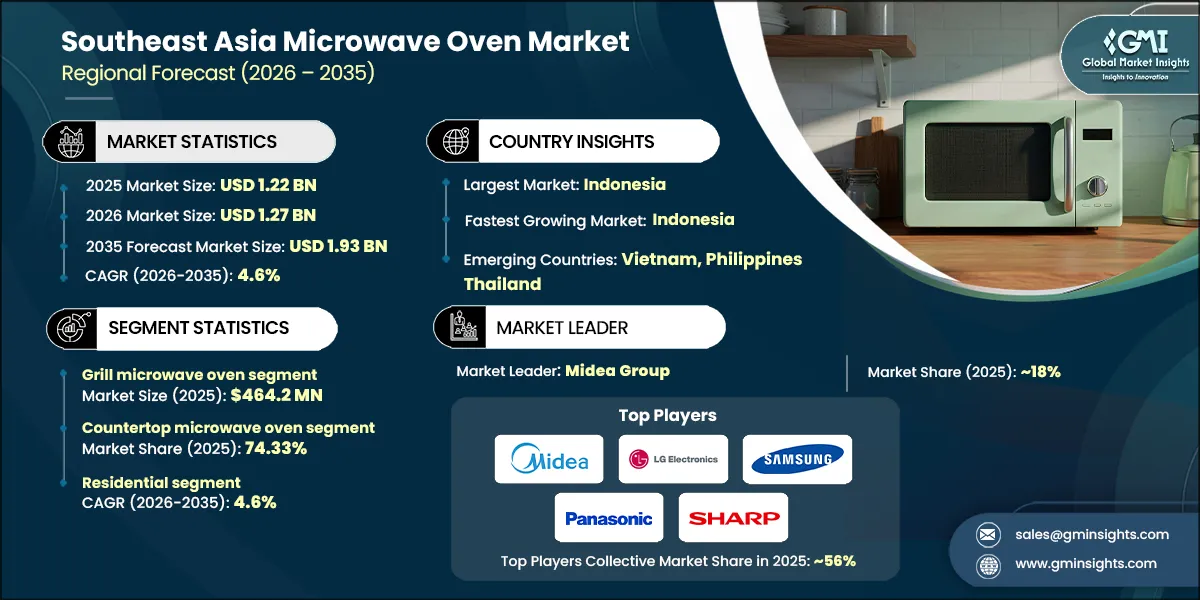
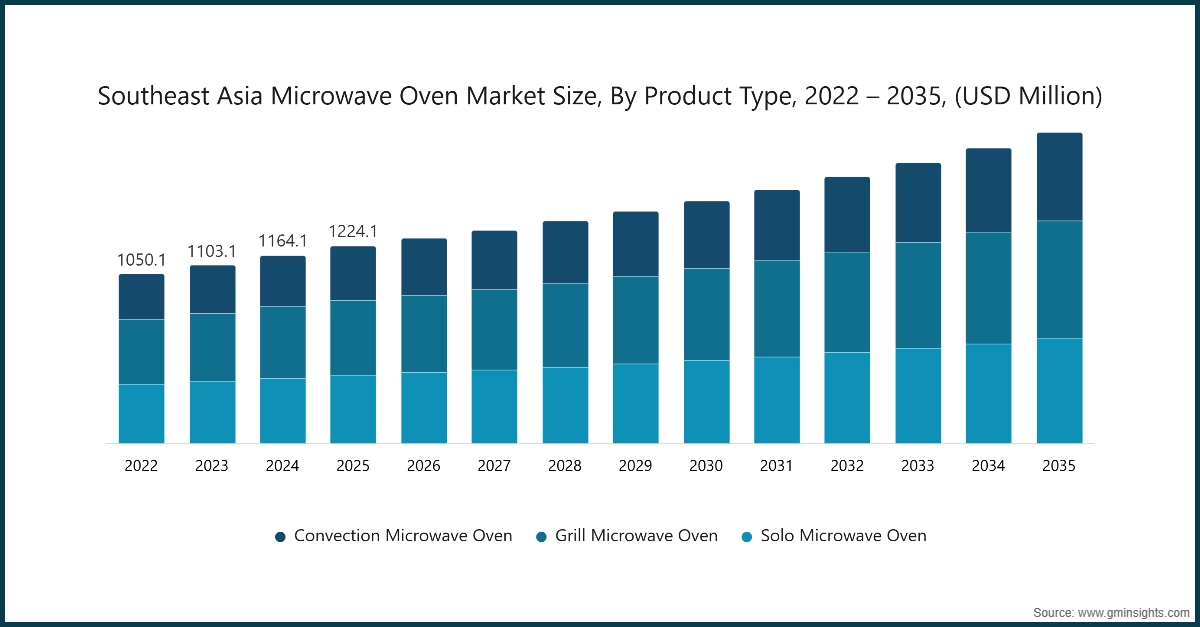
The Southeast Asia microwave oven market was estimated at USD 1.22 billion in 2025. The market is expected to grow from USD 1.27 billion in 2026 to USD 1.93 billion in 2035, at a CAGR of 4.6%, according to latest report published by Global Market Insights Inc.
Southeast Asia Microwave Oven Market Key Takeaways
Market Size & Growth
- 2025 Market Size: USD 1.22 Billion
- 2026 Market Size: USD 1.27 Billion
- 2035 Forecast Market Size: USD 1.93 Billion
- CAGR (2026–2035): 4.6%
Regional Dominance
- Largest Market: Indonesia
- Fastest Growing Region: Indonesia
Key Market Drivers
- Rapid urbanization and changing lifestyles.
- Expanding use in commercial foodservice.
- Rising disposable incomes.
Challenges
- Competition from alternative cooking appliances.
- Supply chain disruptions and component cost fluctuations.
Opportunity
- Smart and connected microwave oven features.
- Energy-efficient and eco-friendly designs.
Key Players
- Market Leader: Midea Group led with over market share of ~18% in 2025.
- Leading Players: Top 5 players in this market include Midea Group, LG Electronics, Samsung Electronics, Panasonic Corporation, Sharp Corporation, which collectively held a market share of 56% in 2025.
Get Market Insights & Growth Opportunities
- Microwave oven sales are growing in Southeast Asia due to rapid urbanization and changing lifestyles. The growth of the urban population is resulting in a greater demand for convenient kitchen appliances in residential homes. Living in cities typically limits kitchen space and as a result, consumers tend to buy smaller and multifunctional appliances. Microwave ovens enable quick meal preparation that accommodates busy urban work hours. Urban residents are increasingly valuing time efficiency in their lives, which has led to a preference for quicker-cooking options. Increased rates of employment also provide less time for traditional methods of preparing meals.
- Using a microwave oven requires very little effort and energy to reheat or prepare a meal. Several packaged or ready-to-eat meals sold in supermarkets require heating in a microwave oven. Additionally, the increased availability of microwave ovens at retail stores located in urban areas is resulting in a higher level of access and acceptance of these products. Changes in lifestyle have created demand for appliances that coincide with our modernized, simplified ways of eating. Microwave ovens are designed to fit our urban lifestyles because they require little time or effort to prepare food in them, no matter where we are living.
- The commercial foodservice industry is expanding its use of microwave ovens, which are driving the growth of the Southeast Asia microwave oven market. As restaurants and other food service establishments continue to adopt microwaves to accommodate their needs for better efficiency in terms of speed of meal preparation, commercial kitchens focus on purchasing equipment that can reduce cooking times while improving their ability to serve customers. During peak service hours, a microwave not only allows rapid reheating but can also be used for portioning. Foodservice operators rely upon consistent heating performance from each unit to meet food quality standards for the product.
- As more quick service restaurants open, there is an increase in demand for high-capacity, reliable, and efficient microwave oven units. Additionally, commercial establishments appreciate the space efficiency and simplification of kitchen workflow created using microwave ovens. Catering services also utilize microwaves to effectively handle large-volume orders. As businesses strive to improve work and service speed throughout the foodservice industry, continued growth in the use of this equipment will provide support in areas such as casual dining and cafes. Microwave ovens will continue to be an integral part of menu planning because they provide flexibility for cooking and reheating a large variety of food items. The growth of organized foodservice chains will create a sustainable cycle of replacement and upgrade of existing cooking and reheating equipment.
- Grill microwave ovens have a dominant presence in Southeast Asia microwave oven market. The combination of grill and reheat features allows for a diverse array of cooking options within residential settings. Urban consumers are leaning toward grill models based on their dual-use functionality and affordable pricing. There is an increasing demand for grilled snack foods and prepared meal solutions; therefore, the relevance of these products will continue to increase. Compact styling enables grill microwave ovens to fit easily within limited kitchen spaces found in most apartment and condo applications. Middle-class families are purchasing grill microwave ovens as lower-cost alternatives to convection models. The increased availability of grill microwave ovens through retail outlets has improved consumer awareness and access.
To get key market trends
Southeast Asia Microwave Oven Market Trends
- Due to urban lifestyles needing short cooking times, the Southeast Asian microwave oven industry continues to grow. Urban lifestyles combine a busy work schedule and home responsibilities, making time-saving items integral to everyday living. Microwave ovens cook efficiently by providing heat quickly and preparing food quickly in small living areas. The developing economy results in a shift in household compositions and buying habits across the region, as more people use these products, this indicates that there are changing household compositions and buying habits.
- Consumers across Southeast Asia have increased disposable income, allows households to purchase more modern kitchen appliances. As disposable income rises, people move away from purchasing low-priced items towards higher-quality products that allow for increased cooking productivity and convenience at home. As customers have greater ability to pay for appliances with advanced technology, such as multi-functional microwave ovens, this will lead to further market expansion and increased unit sales.
- Consumers in the region increasingly prefer energy-efficient and multi-functional microwave oven models. Energy regulations and cost-conscious consumers have led manufacturers to create products that consume less energy. Versatile models allow households to save money in three key areas: reheating, grilling, and baking. By providing the newest technology, these products provide success in a highly competitive marketplace.
- E-commerce and organized retail channels are expanding the availability of microwave ovens in Southeast Asia. With online platforms, consumers can easily compare different features, prices, and brands prior to making a purchase, resulting in more informed buying decisions. Retail expansion also provides promotional opportunities and convenient delivery options that make it easier for consumers to purchase microwave ovens. Distribution growth contributes to higher levels of market penetration in urban and peri-urban areas.
- The younger and more technically oriented consumers in Southeast Asia are increasingly interested in purchasing connected kitchen appliances, as there is currently an increase in the number of appliances available that have the capability of being controlled remotely by means of a smart phone app or with pre-set designs. These connected microwaves not only improve user experience but also conform to the trend of adopting smart homes throughout the South-East Asia region. The increased popularity of connected microwaves has led manufacturers to develop and create more advanced technologies within their products.
Southeast Asia Microwave Oven Market Analysis
Learn more about the key segments shaping this market
Based on product type, the Southeast Asia microwave oven market is categorized into convection microwave oven, grill microwave oven, and solo microwave oven. The grill microwave oven segment accounted for revenue of around USD 464.2 million in 2025 and is anticipated to grow at a CAGR of 4.5% from 2026 to 2035.
- In Southeast Asia, grill microwave ovens play an integral part in the total microwave oven industry . These units provide two functions; they can be used to both reheat and grill food depending on the needs of the user. Many urban families will often choose to use a grill microwave because of their combination of small size with their ability to cook a larger variety of meals. Increased consumption of ready-to-eat or pre-cooked, grilled foods contributes to the need for grill microwaves.
- The lower price on grill microwaves in comparison to convection microwaves provides an affordable option for many consumers, especially middle-class consumers. The shift toward modern kitchen designs is increasing the number of basic microwave ovens that will need to be replaced by grill microwaves. Retail promotions and availability of well-known brands in local markets are driving the growing adoption of grill microwave ovens in several Southeast Asian nations.
Based on structure, Southeast Asia microwave oven market consists of countertop microwave oven and built-in microwave oven. The countertop microwave oven emerged as leader and held 74.33% of the total market share in 2025 and is anticipated to grow at a CAGR of 4.3% from 2026 to 2035.
- Countertop microwave ovens lead the Southeast Asia microwave oven market by structure due to practical household suitability. Compact size supports easy placement in apartments and space-limited kitchens. Affordable pricing aligns well with budget-conscious consumers across urban and semi-urban regions. Simple installation eliminates the need for structural modifications or professional support.
- Rising rental housing increases preference for portable kitchen appliances. Functional versatility meets daily reheating and basic cooking needs efficiently. Wide availability across offline and online retail channels strengthens consistent sales performance.
Learn more about the key segments shaping this market
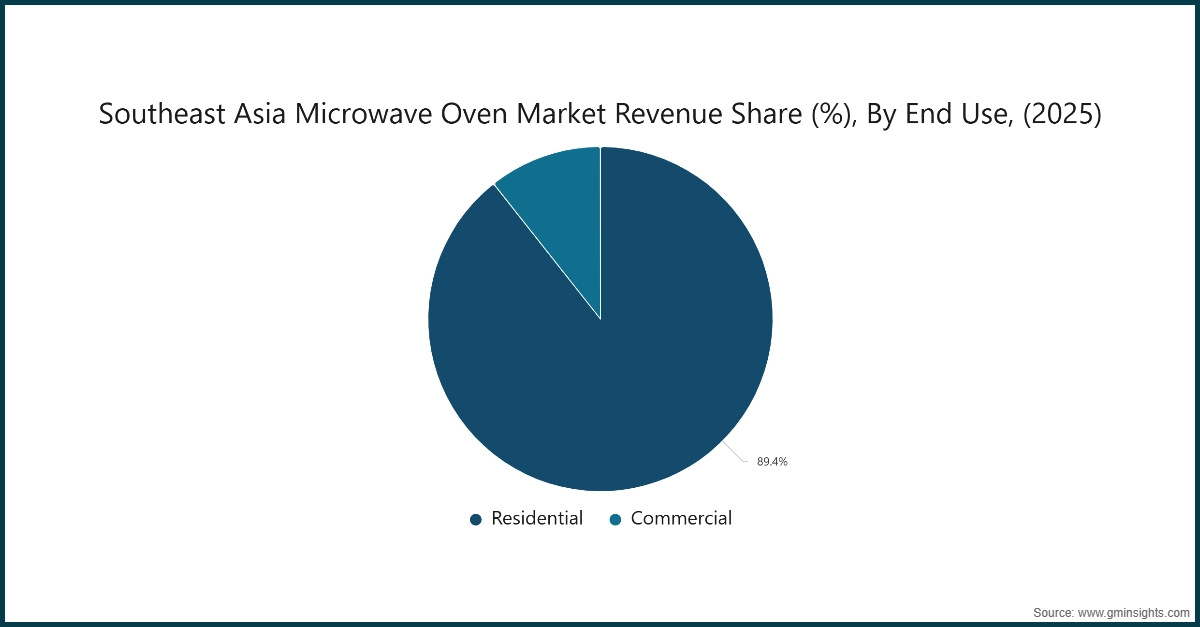
Based on end-use, Southeast Asia microwave oven market consists of residential and commercial. The residential segment in the market is expected to grow at a CAGR of 4.6% between 2026 and 2035.
- Residential end use leads the Southeast Asia microwave oven industry due to increasing household adoption. Rising urbanization encourages demand for convenient and time-saving cooking appliances. Busy lifestyles increase reliance on microwave ovens for quick meal preparation. Growing nuclear family structures support demand for compact kitchen solutions.
- Affordable appliance pricing improves penetration across middle-income households. Increased electricity access enables wider usage across developing urban regions. Preference for home-cooked meals sustains consistent residential demand. Expansion of modern housing projects further supports household appliance sales growth.
Indonesia Microwave Oven Market
Looking for region specific data?
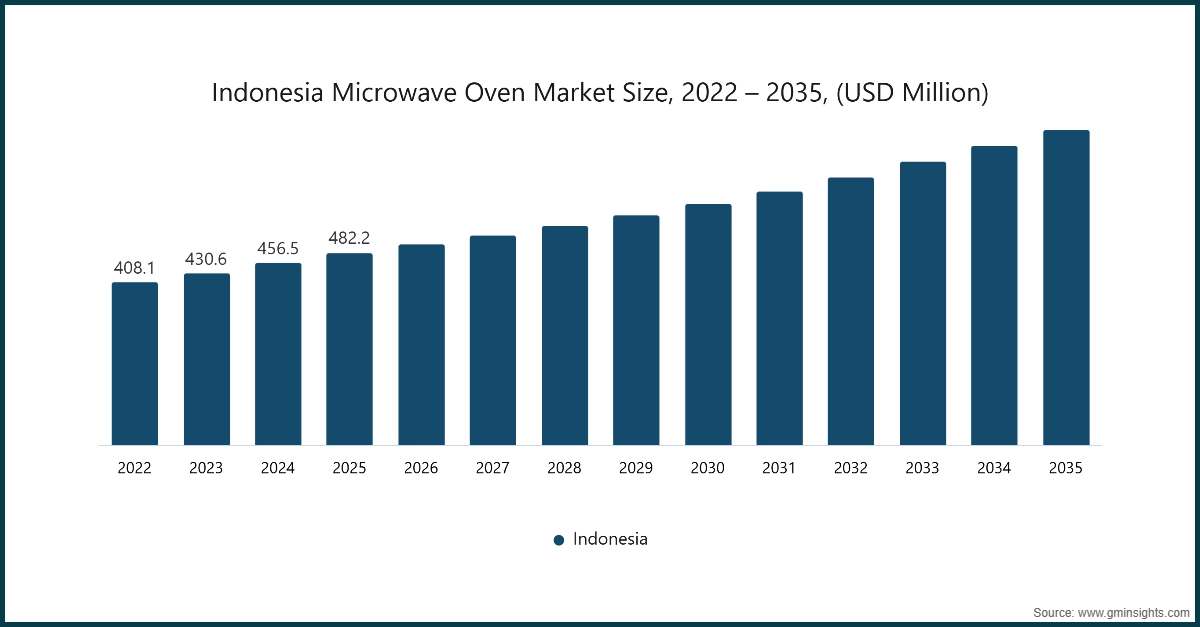
Indonesia dominates an overall Southeast Asia microwave oven industry and valued at USD 482.2 million in 2025 and is estimated to grow at a CAGR of 5.0% from 2026 to 2035.
- The market shows steady growth supported by rising urban household penetration. Increasing apartment living encourages adoption of compact and space-efficient kitchen appliances. Growing middle-income population drives demand for affordable and mid-range microwave models. Busy work schedules increase reliance on quick cooking and reheating solutions. Expansion of modern retail outlets improves product visibility and consumer access.
- Preference for simple functionality supports higher sales of basic solo microwave ovens. Electricity access improvement across urban areas enables wider appliance usage. Influence of Western cooking habits supports gradual changes in meal preparation patterns. Competitive pricing strategies help international brands expand market presence.
Vietnam Microwave Oven Market
Vietnam held 15.86% market share in 2025 and is anticipated to grow at a CAGR of 4.4% from 2026 to 2035.
- The Vietnam microwave oven industry grows steadily due to expanding urban middle-income households. Rising employment levels increase demand for convenient cooking appliances. Smaller kitchen sizes encourage preference for compact microwave designs. Young consumers show interest in entry-level models with essential features.
- Growth of modern retail chains improves appliance availability across cities. Increasing exposure to international cuisines influences microwave usage patterns. Competitive pricing attracts first-time buyers in residential segments. Improving household electrification supports broader appliance adoption nationwide.
Thailand Microwave Oven Market
Thailand is expected to experience significant and promising growth at a CAGR of 4.2% from 2026 to 2035.
- The Thailand microwave oven industry benefits from strong urban appliance penetration. High tourism activity supports demand from serviced apartments and rental housing. Consumers prefer combination microwave models supporting grilling and reheating functions. Established retail infrastructure enhances brand visibility and aftersales support.
- Rising dual-income households increase reliance on quick meal preparation. Brand trust strongly influences purchasing decisions among consumers. Stable electricity infrastructure supports consistent appliance usage. Replacement demand contributes to steady market performance.
Philippines Microwave Oven Market
Philippines held a significant market share in 2025 promising growth from 2026 to 2035.
- The Philippines microwave oven industry expands due to increasing apartment-based living. Long commuting hours increase dependence on convenient cooking solutions. Affordable solo microwave models dominate household purchases. Growth of e-commerce platforms improves access to home appliances. Younger population segments show rising acceptance of microwave cooking.
- Limited kitchen space supports demand for compact appliances. Promotional pricing strategies influence consumer buying behavior. Gradual income growth supports appliance ownership expansion.
Singapore Microwave Oven Market
Singapore held a significant market share in 2025 promising growth from 2026 to 2035.
- The Singapore microwave oven industry shows maturity supported by high household appliance penetration. Fast-paced lifestyles increase reliance on reheating and ready-meal preparation. Premium consumers prefer built-in and inverter microwave models. Strong preference for energy-efficient appliances shapes product selection.
- High living standards support frequent replacement cycles. Compact housing layouts encourage multifunctional appliance adoption. Well-developed retail networks ensure consistent product availability. Brand innovation supports sustained market competitiveness.
Malaysia Microwave Oven Market
Malaysia held a significant market share in 2025 promising growth from 2026 to 2035.
- The Malaysia microwave oven industry grows through expanding urban residential developments. Middle-income households drive demand for mid-range microwave appliances. Increasing female workforce participation supports convenient cooking preferences. Retail promotions influence purchasing decisions during festive seasons.
- Preference for countertop models supports steady residential demand. Growing modern trade presence enhances appliance accessibility. Exposure to international food trends influences microwave usage habits. Stable economic conditions support consistent household appliance spending.
Southeast Asia Microwave Oven Market Share
In 2025, the prominent manufacturers in Southeast Asia microwave oven industry are Siemens, Bonfiglioli Riduttori, SEW-EURODRIVE, Regal Rexnord Corporation, and Nidec Motor Corporation collectively held the market share of ~56%.
- Midea Group is the leading player in the Southeast Asia microwave oven industry, supported by large-scale manufacturing, competitive pricing, and a wide product range. The company offers solo, grill, and convection microwave ovens targeting both entry-level and mid-range consumers. Midea focuses on smart features, energy efficiency, and localized product designs. Its strong partnerships with regional retailers and e-commerce platforms support high sales volumes across Southeast Asia.
- LG Electronics holds a strong position in the Southeast Asia microwave oven industry through its focus on advanced cooking technology and modern design. The company integrates inverter technology, smart sensors, and user-friendly interfaces into its products. LG emphasizes durability and consistent cooking performance while expanding smart home compatibility. Its strong brand recognition, extensive service network, and presence across both urban and semi-urban markets support steady regional growth.
Southeast Asia Microwave Oven Market Companies
Major players operating in the Southeast Asia microwave oven industry include:
- Bajaj Electricals Limited
- Bosch Home Appliances
- Breville Group Limited
- Candy Hoover Group
- Electrolux AB
- Galanz Group Co.
- GE Appliances
- Haier Group
- LG Electronics
- Midea Group
- Panasonic Corporation
- Samsung
- Sharp Corporation
- Toshiba Corporation
- Whirlpool Corporation
Samsung is a major microwave oven supplier in Southeast Asia, known for premium design and digital innovation. The company focuses on ceramic enamel interiors, smart cooking presets, and connectivity features aligned with smart kitchen ecosystems. Samsung targets mid- to high-income consumers while maintaining broad retail availability. Its strong marketing capabilities, brand trust, and integration with broader home appliance portfolios strengthen its competitive position across the region.
Panasonic Corporation maintains a stable presence in the Southeast Asia microwave oven market through reliable performance and long product life. The company focuses on inverter technology, precise temperature control, and energy-efficient designs. Panasonic targets households seeking quality and durability rather than aggressive pricing. Its long-standing brand reputation, localized manufacturing in parts of Asia, and strong dealer relationships support consistent demand across Southeast Asian markets.
Sharp Corporation is a well-established brand in Southeast Asia’s microwave oven market, particularly in Indonesia and Thailand. The company emphasizes simple operation, durable construction, and affordable pricing. Sharp focuses on mass-market models suited for daily household use. Its strong offline retail presence, brand familiarity, and emphasis on practical features help maintain relevance in price-sensitive Southeast Asian consumer segments.
Southeast Asia Microwave Oven Market Report Attributes
| Key Takeaway | Details |
|---|---|
| Market Size & Growth | |
| Base Year | 2025 |
| Market Size in 2025 | USD 1.22 Billion |
| Market Size in 2026 | USD 1.27 Billion |
| Forecast Period 2026-2035 CAGR | 4.6% |
| Market Size in 2035 | USD 1.93 Billion |
| Key Market Trends | |
| Drivers | Impact |
| Rapid urbanization and changing lifestyles | Increasing urban populations and busier daily routines boost demand for convenient cooking solutions like microwave ovens in Southeast Asian households. |
| Expanding use in commercial foodservice | Growth in restaurants, fast food chains, and institutional kitchens increases demand for microwave ovens for quick reheating and food preparation. |
| Rising disposable incomes | Growing middle-class purchasing power in countries such as Malaysia, Indonesia, and Thailand supports higher adoption of household appliances including microwave ovens |
| Pitfalls & Challenges | Impact |
| Competition from alternative cooking appliances | Air fryers, induction cooktops, and multi-function appliances reduce demand for traditional microwave ovens as consumers explore healthier or more versatile options. |
| Supply chain disruptions and component cost fluctuations | Developing microwave ovens that consume less power aligns with sustainability trends and can appeal to environmentally conscious consumers. |
| Opportunities: | Impact |
| Smart and connected microwave oven features | Integration of IoT, remote control, and app connectivity could attract tech-savvy customers and differentiate products in the market. |
| Energy-efficient and eco-friendly designs | Demand for eco-friendly technologies positions manufacturers to capture market share with low-energy loss and greener gearbox solutions. |
| Market Leaders (2025) | |
| Market Leader |
Market share of ~18% |
| Top Players |
Collective market share of ~56% |
| Competitive Edge |
|
| Regional Insights | |
| Largest Market | Indonesia |
| Fastest growing market | Indonesia |
| Emerging countries | Vietnam, Philippines, Thailand |
| Future outlook |
|
What are the growth opportunities in this market?
Southeast Asia Microwave Oven Industry News
- In February 2025, Panasonic Corporation launched the NN-CD88 4-in-One Air Fry Convection Microwave Oven. This new model combines microwave, oven, grill and air-fry functions in a single 34 L unit with an air fry basket for crispy cooking without preheating. The product reflects Panasonic’s ongoing expansion of multifunction microwave oven offerings globally.
- In January 2025, Samsung Electronics showcased advanced AI-enabled home appliance innovations at CES 2025, including connected and smart kitchen solutions that demonstrate its broader microwave and home appliance strategy. The event highlighted Samsung’s focus on intelligent home ecosystems integrating appliances with AI and digital platforms.
- In 2025, Haier Group continued its regional expansion with progress in Southeast Asia and other global markets, building product portfolio growth and distribution channels in key regions for major appliances, including microwave ovens marketed under Haier and associated brands.
- In late 2025, Whirlpool Corporation filed a patent dispute with the U.S. International Trade Commission against Samsung, LG, Midea, and Haier concerning over-the-range microwave hood combination products, a development that reflects competitive dynamics among major microwave oven manufacturers with global implications including Asia Pacific supply sources.
The Southeast Asia microwave oven market research report includes in-depth coverage of the industry, with estimates & forecast in terms of revenue (USD Million) and volume (Thousand Units) from 2022 to 2035, for the following segments:
Market, By Product Type
- Convection Microwave Oven
- Grill Microwave Oven
- Solo Microwave Oven
Market, By Structure
- Countertop Microwave Oven
- Built-In Microwave Oven
Market, By Capacity
- Upto 20 liters
- 21 - 25 liters
- 26 - 30 liters
- Above 30 liters
Market, By Power
- Low power (under 700W)
- Medium power (700W-1000W)
- High power (above 1000W)
Market, By Price Range
- Low (Under USD 50)
- Medium (USD 50 - USD 100)
- High (Above USD 100)
Market, By End Use
- Residential
- Commercial
Market, By Distribution Channel
- Online
- E-commerce website
- Company website
- Offline
- Hypermarkets and supermarkets
- Specialty stores
- Others
The above information is provided for the following regions and countries:
- Indonesia
- Vietnam
- Thailand
- Philippines
- Singapore
- Malaysia
Frequently Asked Question(FAQ) :
What was the market size of the Southeast Asia microwave oven in 2025?
The market size was USD 1.22 billion in 2025, growing at a CAGR of 4.6% from 2026 to 2035. The market is driven by rapid urbanization and changing consumer lifestyles.
What is the projected value of the Southeast Asia microwave oven market by 2035?
The market is poised to reach USD 1.93 billion by 2035, fueled by increasing demand for convenient and multifunctional kitchen appliances.
What is the expected size of the Southeast Asia microwave oven industry in 2026?
The market size is projected to reach USD 1.27 billion in 2026.
How much revenue did the grill microwave oven segment generate in 2025?
The grill microwave oven segment generated approximately USD 464.2 million in 2025 and is anticipated to grow at a CAGR of 4.5% till 2035.
What was the market share of the countertop microwave oven segment in 2025?
The countertop microwave oven segment held 74.33% of the total market share in 2025 and is expected to witness 4.3% CAGR up to 2035.
What is the growth outlook for the residential segment from 2026 to 2035?
The residential segment is projected to observe around 4.6% CAGR through 2035, led by rising urbanization, busy lifestyles, and the demand for compact kitchen solutions.
Which country dominates the Southeast Asia microwave oven sector?
Indonesia leads the market, valued at USD 482.2 million in 2025, and is expected to showcase over 5% CAGR till 2035.
What are the upcoming trends in the Southeast Asia microwave oven market?
Rising demand for energy-efficient, multifunctional microwaves, growth of e-commerce and organized retail, and increasing adoption of connected, smart home-compatible appliances.
Who are the key players in the Southeast Asia microwave oven industry?
Key players include Bajaj Electricals Limited, Bosch Home Appliances, Breville Group Limited, Candy Hoover Group, Electrolux AB, Galanz Group Co., GE Appliances, Haier Group, LG Electronics, and Midea Group.
Southeast Asia Microwave Oven Market Scope
Related Reports