Summary
Table of Content

Southeast Asia K-Beauty Products and Services Market
Get a free sample of this report
Form submitted successfully!
Error submitting form. Please try again.
Thank you!
Your inquiry has been received. Our team will reach out to you with the required details via email. To ensure that you don't miss their response, kindly remember to check your spam folder as well!
Request Sectional Data
Thank you!
Your inquiry has been received. Our team will reach out to you with the required details via email. To ensure that you don't miss their response, kindly remember to check your spam folder as well!
Form submitted successfully!
Error submitting form. Please try again.
Southeast Asia K-Beauty Products and Services Market Size
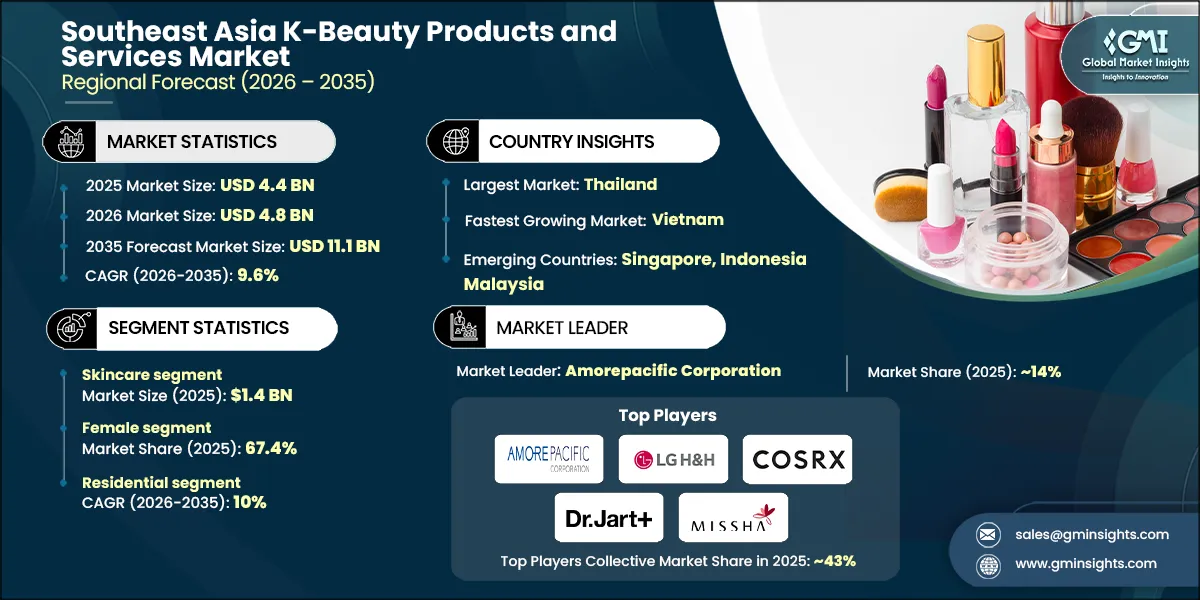
The Southeast Asia K-beauty products and services market was estimated at USD 4.4 billion in 2025. The market is expected to grow from USD 4.8 billion in 2026 to USD 11.1 billion in 2035, at a CAGR of 9.6%, according to latest report published by Global Market Insights Inc.
Southeast Asia K-Beauty Products and Services Market Key Takeaways
Market Size & Growth
- 2025 Market Size: USD 4.4 Billion
- 2026 Market Size: USD 4.8 Billion
- 2035 Forecast Market Size: USD 11.1 Billion
- CAGR (2026–2035): 9.6%
Regional Dominance
- Largest Market: Thailand
- Fastest Growing Region: Vietnam
Key Market Drivers
- Influence of Korean pop culture.
- Rapid growth in online marketplaces and e-commerce.
- Expansion of distribution channels and local retail presence.
Challenges
- Intense competition and market saturation.
- Regulatory divergence and compliance complexity.
Opportunity
- Personalization and tech-enabled beauty services.
- Growth in clean, sustainable, and ethical products.
Key Players
- Market Leader: Amorepacific Corporation led with over market share of ~14% in 2025.
- Leading Players: Top 5 players in this market include Amorepacific Corporation, LG Household & Health Care, COSRX, Dr. Jart+, MISSHA, which collectively held a market share of 43% in 2025.
Get Market Insights & Growth Opportunities
- As the popularity of Korean pop culture continues to rise, the demand for K-Beauty products and services in Southeast Asia is also on an upward trend. Many YouTube videos that feature popular Korean artists demonstrating their beauty regimes attract a larger audience than any other form of entertainment in this region. As consumers are exposed to a vast number of media depicting the ideals of Korean beauty and showcasing celebrities with clear, healthy skin, there is a high increase in awareness of what the Korean standard for beauty is. Consumers have begun to associate K-Beauty brands with high quality, innovative products and aspirational lifestyles as represented in entertainment media.
- Social media platforms significantly enhance the speed at which fans discover new products and engage with K-Beauty brands through celebrity endorsements. Retailers are responding by increasing the availability of authentic K-Beauty products throughout Southeast Asia. Beauty service providers are leveraging Korean beauty techniques to fulfill demand from consumers who want to have the same types of looks that they see through Korean entertainment.
- The rapid expansion of e-commerce platforms has led to the growth of K-Beauty products and services within Southeast Asia's online market. Digital channels have improved consumer access to Korean beauty brands through their availability in many different country locations in the region, and the online marketplace provides a huge number of products to choose from where consumers can compare their options in terms of formulation, price point and consumer reviews easily. E-commerce platforms provide an avenue for brands to create visibility through targeted promotions and through digital campaigns led by social media influencers. Consumers are increasingly favouring online channels because of the convenience associated with purchasing and the ability to have products delivered directly to their home/office.
- Consumers feel more comfortable making purchases for beauty products online because of the secure payment systems and the ability to return products under flexible return policies. Cross-border e-commerce provides for a quicker introduction of new K-beauty products to Southeast Asia than would have been previously possible. Online platforms enable brands and consumers to interact directly through personalized product recommendations. The increase in the number of smartphone users will result in consumers shopping online for beauty products more frequently. Ecommerce analytics is being used by beauty brands to align their product offerings with the preferences of local consumers. The expansion of digital retail will result in greater consistency in sales volume and penetration of the brands.
- The skincare industry is the largest portion of the K-Beauty products and services market in Southeast Asia. There is increasing awareness of the importance of skin health, resulting in high demand for cleansers, toners, serums and moisturizers. Korean skincare routines place an emphasis on prevention and keeping skin well-hydrated, making them attractive given the climate conditions in the region. The growing number of beauty influencers and social media have sped up the time it takes to test and adopt products. Products are also lighter weight and can be readily used each day, suited to the humidity of the region. A higher disposable income allows consumers to spend more on quality skincare products. The increase in the number of retail stores selling quality products is making these products accessible in urban markets.
To get key market trends
Southeast Asia K-Beauty Products and Services Market Trends
- K-beauty products and services are experiencing major expansion in the Southeast Asian market, with online sales particularly strong among K-beauty products. E-commerce platforms based in this region report increase in order volume for both Korean skincare and makeup products recently. Rapid digital adoption enabled individual consumers to browse through a variety of K-beauty product offerings online, compare them, and then purchase them before visiting stores. This growth also expands the reach of both established and less established Korean brands.
- Gen Z consumers are a significant force behind the growth of K-beauty in Southeast Asia. These young consumers are looking for affordable K-beauty products that deliver visible results, while also meeting other complex requirements. This group of consumers often desire new formulations and trend-based items that are promoted by influencers using social media. Their frequent engagement leads to a high level of repeat purchase of K-beauty products.
- Popular beauty culture in Korea and perceptions of the beauty lifestyle that K-beauty products offer resonate strongly with consumers in Southeast Asia. Consumers view beauty routines that feature clear, youthful skin and are heavily influenced by media and entertainment, so they frequently trust Korean skincare products made with innovative ingredients and have high-quality standards. These types of cultural associations continue to sustain consumer interest in K-beauty products.
- An increasing number of countries in Southeast Asia are experiencing larger import increases in Korean cosmetic products. For instance, there has been a significant increase in the number of Korean cosmetics imported into Vietnam due to growing demand for these products domestically. The driver of this increase has been greater product awareness on the part of consumers, as well as an increase in the number of consumers able to purchase these products through global distribution channels. The increase in the quantity of K-Beauty products imported demonstrates the region’s untapped market potential.
- K-Beauty companies are beginning to customize their products for skin types and climatic conditions found in Southeast Asia. Examples of such customized formulations include products designed for tropical climates that focus on hydration, oil control, and calming properties. Offering localized products to meet the needs and wants of consumers in each country improves the relevance of their products and increases their brand loyalty among consumers.
Southeast Asia K-Beauty Products and Services Market Analysis
Learn more about the key segments shaping this market
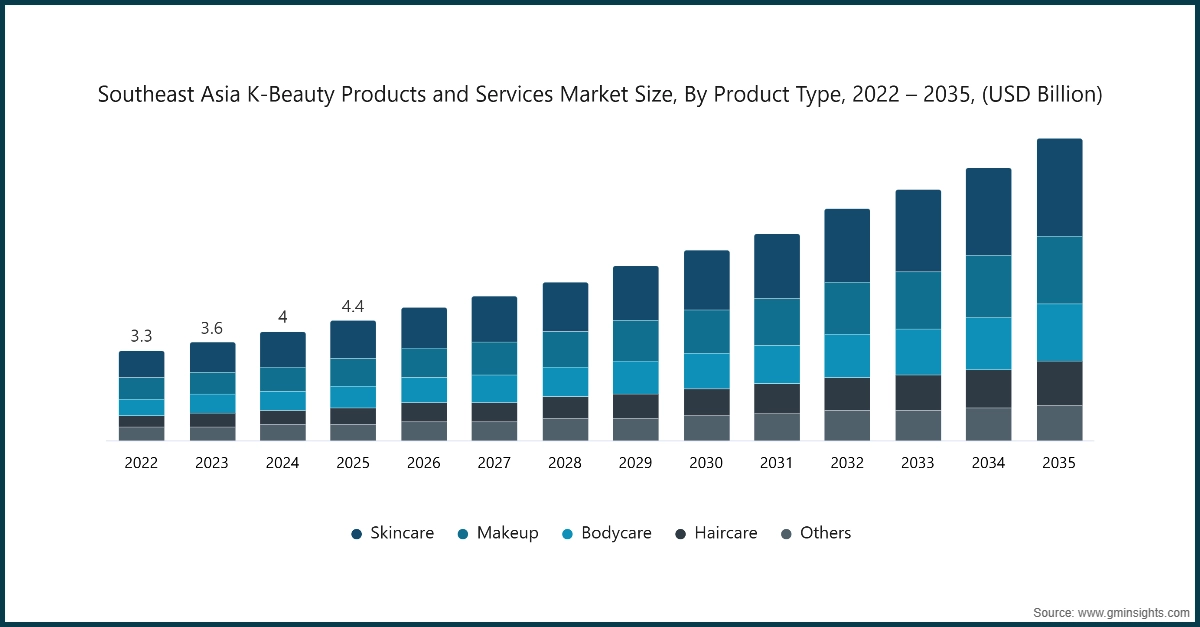
Based on product type, the Southeast Asia K-beauty products and services market is categorized into skincare, makeup, bodycare, haircare, and others. The skincare segment accounted for revenue of around USD 1.4 billion in 2025 and is anticipated to grow at a CAGR of 9.9% from 2026 to 2035.
- Skincare dominates the market due to strong consumer focus on skin health. Preventive skincare routines encourage daily use of cleansers, essences, and moisturizers. Regional climate conditions increase demand for lightweight and hydrating formulations. Influence of Korean beauty trends strengthens trust in skincare efficacy.
- High product variety supports personalized skincare solutions across skin types. Affordable entry-level products improve accessibility among younger consumers. Strong presence across online and offline channels supports sustained segment leadership.
Based on gender, Southeast Asia K-beauty products and services market consist of female and male. The female emerged as leader and held 67.4% of the total market share in 2025 and is anticipated to grow at a CAGR of 9.8% from 2026 to 2035.
- Female consumers lead market share due to strong beauty awareness across Southeast Asia. Daily skincare routines drive consistent purchasing of K-Beauty products among women. Social media influence significantly shapes female preferences toward Korean beauty trends. Wide product variety supports targeted solutions addressing diverse skin concerns.
- Higher spending willingness enables frequent trials of premium skincare and cosmetics. Retail marketing strategies primarily focus on female buyers to maximize sales volumes. Cultural emphasis on appearance reinforces sustained demand from female consumer segments.
Learn more about the key segments shaping this market
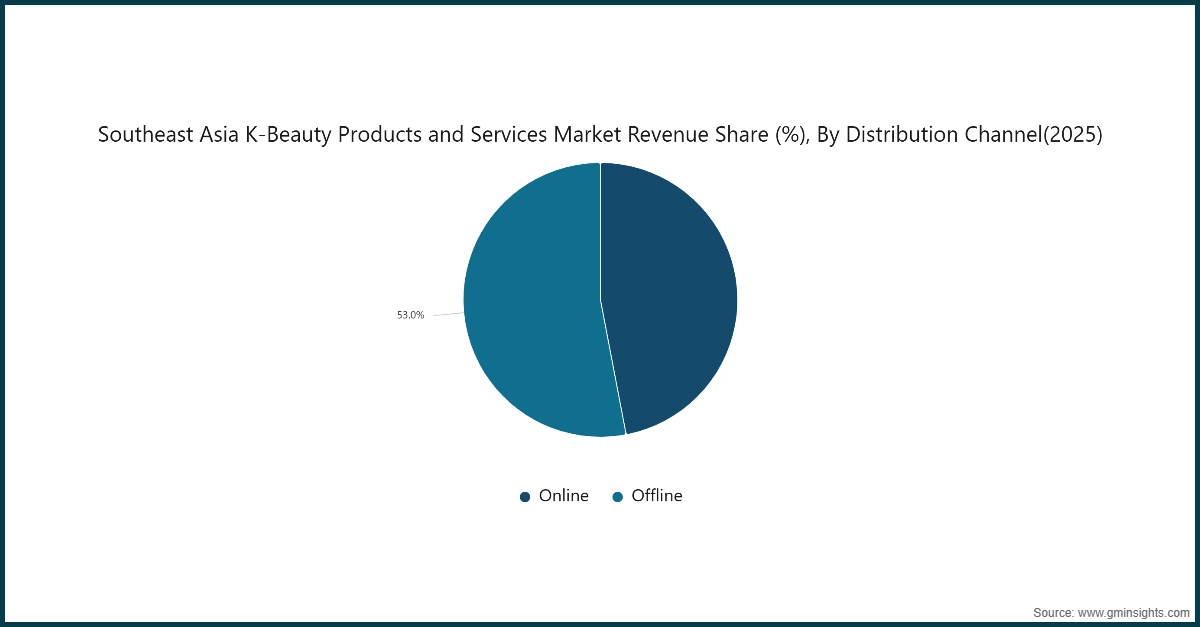
Based on distribution channel, Southeast Asia K-beauty products and services market consists of online and offline. The residential segment in the market is expected to grow at a CAGR of 10% between 2026 and 2035.
- Offline distribution channels lead the Southeast Asia K-Beauty products and services market due to strong consumer trust. Physical retail stores allow product testing, which increases purchase confidence among buyers. Beauty advisors provide personalized recommendations supporting informed purchasing decisions. High mall foot traffic strengthens visibility of K-Beauty brands across urban centers.
- Immediate product availability encourages impulse buying during promotional events. Established specialty stores enhance brand authenticity perception. Expansion of retail networks across major cities sustains offline channel dominance.
Thailand K-Beauty Products and Services Market
Looking for region specific data?
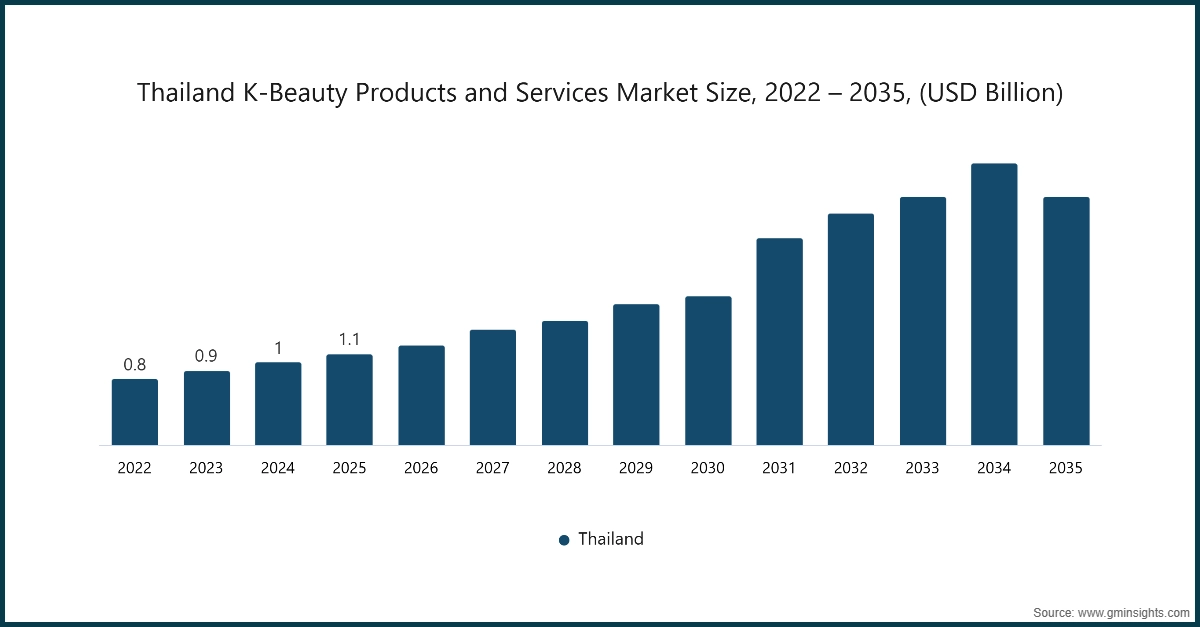
Thailand dominates an overall Southeast Asia K-beauty products and services market and valued at USD 1.1 billion in 2025 and is estimated to grow at a CAGR of 10.5% from 2026 to 2035.
- The Thailand K-beauty products and services market shows strong growth driven by beauty-conscious consumers. High social media influence increases awareness of Korean skincare routines and product benefits. Preference for glass skin aesthetics supports demand for hydrating and brightening formulations. Expansion of specialty beauty retailers improves access to authentic K-beauty brands. Dermatology clinics promote Korean-inspired treatments, supporting service segment growth.
- Younger consumers drive sales through frequent product experimentation and trend adoption. Affordable pricing compared to luxury brands increases mass-market appeal. Cultural alignment with skincare-focused beauty standards sustains long-term demand. Tourism recovery supports sales through duty-free and urban retail channels.
Singapore K-Beauty Products and Services Market
Singapore held 21.2% market share in 2025 and is anticipated to grow at a CAGR of 10% from 2026 to 2035.
- The Singapore K-beauty products and services market is well established and highly premium-oriented. High disposable income supports strong demand for advanced Korean skincare formulations. Consumers show preference for dermatologist-tested and clinically proven K-beauty brands. Presence of flagship stores and exclusive distributors strengthens brand credibility.
- Professional aesthetic clinics drive demand for Korean-inspired facial treatments. Digital marketing and influencer collaborations accelerate product discovery. High awareness of ingredient transparency shapes informed purchasing decisions. Frequent product upgrades support steady replacement demand in the market.
Indonesia K-Beauty Products and Services Market
Indonesia is expected to experience significant and promising growth at a CAGR of 9.5% from 2026 to 2035.
The Indonesia K-beauty products and services market grows through strong youth population influence. Korean pop culture significantly shapes beauty trends and skincare routines. Affordable K-beauty brands attract mass-market consumers across urban areas. Rising online shopping adoption expands access to imported beauty products.
- Humid climate drives demand for lightweight and oil-control formulations. Growing halal-certified K-beauty offerings increase consumer trust. Beauty service adoption rises through Korean-style skincare clinics. Urbanization supports expanding demand across major cities.
Malaysia K-Beauty Products and Services Market
Malaysia held a significant market share in 2025 promising growth from 2026 to 2035.
- The Malaysia K-beauty products and services market benefits from multicultural beauty preferences. Consumers favor multifunctional skincare products addressing hydration and brightening needs. Expansion of modern beauty retail outlets improves brand accessibility. Moderate pricing supports steady adoption among middle-income consumers.
- Growing interest in preventive skincare drives regular product usage. Korean facial services gain popularity within urban wellness centers. Social media education influences skincare routine adoption. Stable purchasing behavior supports consistent market growth.
Vietnam K-Beauty Products and Services Market
Vietnam held a significant market share in 2025 promising growth from 2026 to 2035.
- The Vietnam K-beauty products and services market expand due to rising beauty awareness. Young consumers show strong interest in Korean skincare routines. Growth of specialty cosmetic stores improves product availability. Price-sensitive buyers prefer entry-level K-beauty brands.
- Increasing disposable income supports gradual shift toward premium products. Skincare-focused beauty services gain traction in metropolitan areas. Online beauty platforms influence product trial and brand discovery. Urban lifestyle changes support expanding skincare consumption.
Philippines K-Beauty Products and Services Market
Philippines held a significant market share in 2025 promising growth from 2026 to 2035.
The Philippines K-beauty products and services market grows through strong digital influence. Social media platforms increase exposure to Korean beauty trends. Climate conditions drive demand for lightweight and soothing skincare products. Affordable K-beauty brands attract young and first-time users.
- E-commerce growth improves nationwide product access. Salon partnerships promote Korean-inspired skincare treatments. Rising beauty consciousness supports increased skincare routine adoption. Urban youth populations sustain long-term market expansion.
Southeast Asia K-Beauty Products and Services Market Share
- In 2025, the prominent manufacturers in market are Amorepacific Corporation, LG Household & Health Care, COSRX, Dr. Jart+, and MISSHA collectively held the market share of ~43%.
- Amorepacific Corporation leads the Southeast Asia K-beauty market with a diversified portfolio spanning premium, mid-range, and mass skincare brands. The company emphasizes skin science, natural ingredients, and dermatology-backed formulations. Amorepacific actively localizes product offerings and marketing strategies to suit tropical climates and diverse skin types. Its strong digital presence, retail partnerships, and brand equity support sustained leadership across Southeast Asian beauty markets.
- LG Household & Health Care holds a strong position in Southeast Asia through its focus on premium skincare and cosmetic brands. The company emphasizes advanced formulation technology, fermentation-based ingredients, and anti-aging solutions. LG targets urban and higher-income consumers through selective retail and online channels. Its investment in brand storytelling, influencer marketing, and regional distribution partnerships supports steady growth in competitive K-beauty segments.
Southeast Asia K-Beauty Products and Services Market Companies
Major players operating in the Southeast Asia K-beauty products and services industry include:
Amorepacific Corporation
- COSRX
- MISSHA
- Able C&C Co.
- APR Corp
- Dr. Jart+
- LG Household & Health Care
- Klairs
- Halley Medical Aesthetics
- Cosmax Inc.
- Kolmar Korea
- Cosmecca Korea Co.
- Ethical Korea Cosmetics Co.
- Intercos Korea
- Hanacos
COSRX is a fast-growing player in the Southeast Asia K-beauty market, driven by its minimalist formulations and dermatology-inspired skincare solutions. The brand focuses on sensitive skin, acne care, and barrier repair products. COSRX benefits from strong word-of-mouth promotion, social media visibility, and affordability. Its emphasis on effective ingredients and simple routines resonates well with younger consumers and first-time K-beauty buyers in the region.
Dr. Jart+ is known in Southeast Asia for combining dermatological science with creative branding. The company focuses on skin barrier repair, sun protection, and corrective skincare solutions. Dr. Jart+ appeals to consumers seeking clinical efficacy with premium positioning. Its strong presence in specialty beauty retailers and online platforms, along with targeted marketing campaigns, supports brand differentiation and stable market penetration across Southeast Asia.
MISSHA maintains a solid presence in the Southeast Asia K-beauty market by offering affordable skincare and cosmetics with functional benefits. The brand focuses on value-for-money products, including essences, sunscreens, and base makeup. MISSHA leverages wide product availability and frequent product launches to stay competitive. Its accessibility through both offline stores and e-commerce platforms supports continued relevance in price-sensitive consumer segments.
Southeast Asia K-Beauty Products and Services Market Report Attributes
| Key Takeaway | Details |
|---|---|
| Market Size & Growth | |
| Base Year | 2025 |
| Market Size in 2025 | USD 4.4 Billion |
| Market Size in 2026 | USD 4.8 Billion |
| Forecast Period 2026-2035 CAGR | 9.6% |
| Market Size in 2035 | USD 11.1 Billion |
| Key Market Trends | |
| Drivers | Impact |
| Influence of Korean pop culture | K-Beauty gains traction across Southeast Asia as K-pop, K-dramas, and celebrity endorsements shape beauty trends and boost demand for Korean cosmetics and skincare routines. |
| Rapid growth in online marketplaces and e-commerce | Platforms like Shopee and Lazada significantly expand product accessibility and sales volume, accelerating regional market penetration |
| Expansion of distribution channels and local retail presence | Dedicated K-Beauty flagship stores, pop-ups, and localized distribution networks improve brand visibility and availability in key Southeast Asian cities. |
| Pitfalls & Challenges | Impact |
| Intense competition and market saturation | A proliferation of both Korean and local brands creates competitive pressure, making differentiation and customer retention more difficult |
| Regulatory divergence and compliance complexity | Varying cosmetic regulations, ingredient restrictions, and labeling requirements across Southeast Asian countries increase operational costs and slow market entry. |
| Opportunities: | Impact |
| Personalization and tech-enabled beauty services | AI-based skin analysis, virtual consultations, and tailored recommendations offer elevated consumer experiences and higher conversion rates. |
| Growth in clean, sustainable, and ethical products | Rising demand for eco-friendly, cruelty-free beauty options presents a lucrative segment for brands that can align with consumer values. |
| Market Leaders (2025) | |
| Market Leader |
Market share of ~14% |
| Top Players |
Collective market share of ~43% |
| Competitive Edge |
|
| Regional Insights | |
| Largest Market | Thailand |
| Fastest growing market | Vietnam |
| Emerging countries | Singapore, Indonesia, Malaysia |
| Future outlook |
|
What are the growth opportunities in this market?
Southeast Asia K-Beauty Products and Services Industry News
- In January 2026, K-Beauty and tech innovation firms including APR and Kolmar Korea participated in CES 2026, showcasing AI-driven beauty tech platforms such as interactive booths and personalized beauty devices. Amorepacific and LG Household & Health Care also participated, with both highlighting advanced beauty technologies and personalized skincare solutions.
- In August 2025, COSRX showcased its brand at KCON LA 2025, highlighting its viral skincare portfolio and launching new haircare products to global audiences. COSRX transformed its booth into a key destination at the three-day Korean culture and beauty festival, drawing significant consumer engagement and brand visibility in North America, which supports broader international K-Beauty recognition.
- In 2025, Amorepacific Holdings announced strong consolidated sales and profit growth, driven by expanded product portfolios and global marketing campaigns. Sales increased by 15.7 % to KRW 1.1648 trillion and operating profit rose by 55.2 % in the first quarter of 2025, led by robust performance in overseas markets and diversified key brands.
- In 2025, MISSHA announced price adjustments for its products as Korean cosmetics brands responded to rising costs and growing global demand, including markets in the U.S., Japan, and beyond. MISSHA and other brands in the portfolio implemented price increases for select products in early 2025.
The Southeast Asia K-beauty products and services market research report includes in-depth coverage of the industry, with estimates & forecast in terms of revenue (USD Billion) and volume (Thousand Units) from 2022 to 2035, for the following segments:
Market, By Product Type
- Skincare
- Makeup
- Bodycare
- Haircare
- Others
Market, By Gender
- Female
- Male
Market, By Distribution Channel
- Online
- Offline
The above information is provided for the following regions and countries:
- Thailand
- Singapore
- Indonesia
- Malaysia
- Vietnam
- Philippines
- Rest of SEA
Frequently Asked Question(FAQ) :
What was the market size of the Southeast Asia K-beauty products and services market in 2025?
The market size was USD 4.4 billion in 2025, driven by the increasing popularity of Korean skincare and makeup products across the region.
What is the projected value of the Southeast Asia K-beauty products and services industry by 2035?
The market is expected to reach USD 11.1 billion by 2035, growing at a CAGR of 9.6% during the forecast period.
What is the projected size of the Southeast Asia K-beauty products and services market in 2026?
The market is expected to grow to USD 4.8 billion in 2026.
What was the market share of the skincare segment in 2025?
The skincare segment accounted for approximately USD 1.4 billion in revenue in 2025 and is anticipated to grow at a CAGR of 9.9% from 2026 to 2035.
What is the growth rate of the residential segment in the Southeast Asia K-beauty products and services market?
The residential segment is projected to grow at a CAGR of 10% between 2026 and 2035.
Which country dominated the Southeast Asia K-beauty products and services industry in 2025?
Thailand led the market with a valuation of USD 1.1 billion in 2025 and is expected to grow at a CAGR of 10.5% from 2026 to 2035.
What are the key trends in the Southeast Asia K-beauty products and services market?
Key trends include the rapid growth of online sales through e-commerce platforms, the influence of Gen Z consumers seeking affordable and effective products, and the increasing demand for trend-based items promoted by social media influencers.
Southeast Asia K-Beauty Products and Services Market Scope
Related Reports