Summary
Table of Content

Solar-Integrated Construction Materials Market
Get a free sample of this report
Form submitted successfully!
Error submitting form. Please try again.
Thank you!
Your inquiry has been received. Our team will reach out to you with the required details via email. To ensure that you don't miss their response, kindly remember to check your spam folder as well!
Request Sectional Data
Thank you!
Your inquiry has been received. Our team will reach out to you with the required details via email. To ensure that you don't miss their response, kindly remember to check your spam folder as well!
Form submitted successfully!
Error submitting form. Please try again.
Solar-Integrated Construction Materials Market Size
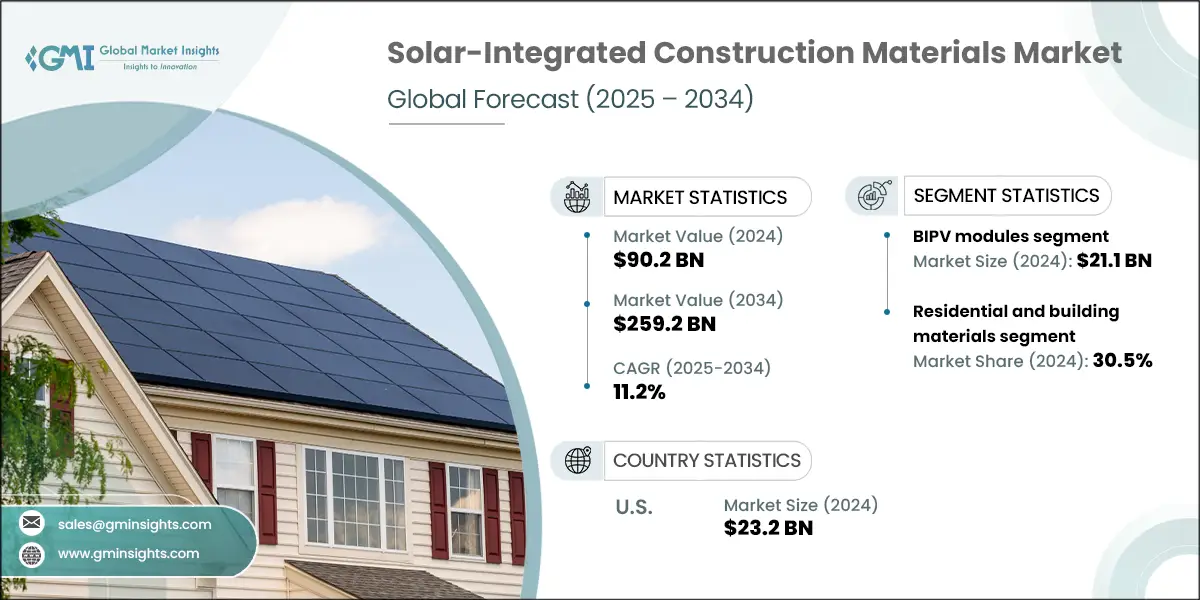
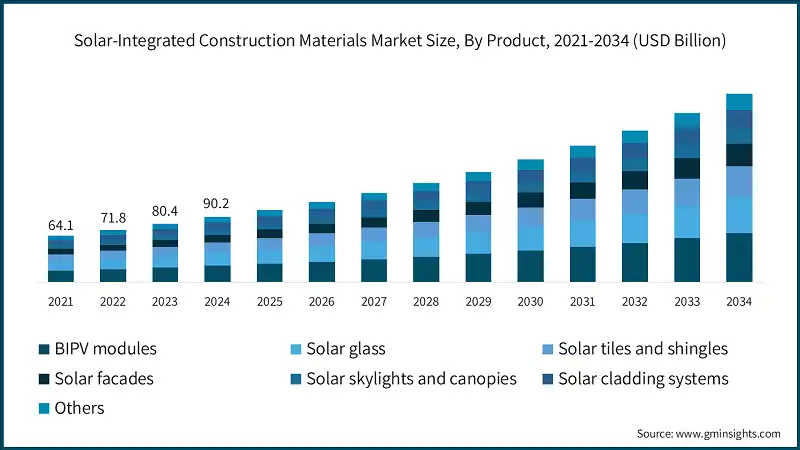
The global solar-integrated construction materials market was valued at USD 90.2 billion in 2024. The market is expected to grow from USD 100 billion in 2025 to USD 259.2 billion in 2034, at a CAGR of 11.2%.
To get key market trends
- The term solar-integrated construction materials can be defined as construction products embedded with solar technologies, especially photovoltaic panels, which serve as part of the construction elements of facades, windows, roofing, etc. Through such products, the buildings can indulge in on-site development of renewable energy, thus reducing to a greater extent the consumption of conventional energy sources and enhancing energy efficiency. The factors contributing to the increasing use of such materials across the world include intensified government policy support and financial incentives, as well as global trends in sustainable development and climate change mitigation.
- In addition, according to the International Energy Agency, buildings and construction sectors accounted for 36% of final energy use along with 39% of energy-related and process carbon dioxide (CO2) emissions in 2018, making a compelling case for greener solutions. As stated by the "Better Buildings Challenge" of the U.S. Department of Energy, buildings account for 74% of U.S. electricity use as well as 39% of energy-related CO2 emissions, for which the federal government sets for establishing a national goal across the building sector. This goal targets net-zero emissions by 2045, driving architects and developers directly to specify solar-integrated envelopes offsetting consumption onsite. At the municipal level, New York City Local Law 97 compels buildings exceeding 25,000 ft² to reduce their emissions by 40% by 2030 and by 80% by 2050.
- Furthermore, the rising demand for solar-integrated construction materials can also be supported by the booming development programs of smart cities focusing on energy-efficient, sustainable, and resilient urban infrastructure. For example, the incorporation of solar solutions has now become a key facility for achieving sustainability goals as cities like Singapore and Dubai invest heavily in smart city initiatives. According to IMD's inaugural Smart City Index, Singapore is the smartest city in the world. Dubai's leaders exemplify the world in what a smart city should look like even with green energy solutions and self-driving cars; infrastructure powered by AI.
- The largest market continues to be attributed to rapid urbanization and supportive government aid, whereas North America emerges as the fastest-roaring market mainly driven by technological innovations and supportive policies. Such trends succinctly speak on how policy, innovation, and urban development transform the world's expanding footprint in terms of solar-integrated construction materials.
Solar-Integrated Construction Materials Market Report Attributes
| Key Takeaway | Details |
|---|---|
| Market Size & Growth | |
| Base Year | 2024 |
| Market Size in 2024 | USD 90.2 Billion |
| Forecast Period 2025 - 2034 CAGR | 11.2% |
| Market Size in 2034 | USD 259.2 Billion |
| Key Market Trends | |
| Drivers | Impact |
| Growing demand for sustainable construction | Accelerates market growth and innovation in solar-integrated materials |
| Energy efficiency regulations and building codes | Drives demand for compliant, high-performance materials |
| Smart city development programs | Expands market opportunities in urban infrastructure |
| Pitfalls & Challenges | Impact |
| Technical integration challenges | May slow deployment and increase costs |
| Limited awareness among architects and engineers | Reduces market penetration and growth rate |
| Opportunities: | Impact |
| IoT and smart building integration | Opens avenues for innovative, connected solar solutions |
| Emerging perovskite solar cell technology | Potentially revolutionizes solar material applications |
| Market Leaders (2024) | |
| Market Leaders |
10.2% Market Share |
| Top Players |
Collective Market Share in 2024 is 40.7% |
| Competitive Edge |
|
| Regional Insights | |
| Largest Market | Asia Pacific |
| Fastest growing market | North America |
| Emerging country | India, China, Brazil, Mexico, and South Africa |
| Future outlook |
|
What are the growth opportunities in this market?
Solar-Integrated Construction Materials Market Trends
- Technological advancement: Bifacial and perovskite solar panels, the newest generation of PV cells, are more efficient and, because of the good integration potential, allow better, more attractive and functional design solutions as applied to building surfaces. An announcement on the funding of USD 34 million in March 2024 for 11 projects, which intend to develop new tools to help grid operators and planners in the integration of solar energy use and optimal renewable energy use, is made. Continuous improvement on the efficiency and durability of PV technologies thus lowers cost and widens its applicability, making solar integration diminutive in terms of building types and, making it more feasible.
- Regulatory framework: Governments worldwide modify their building codes and standards to make their countries encourage renewable energy use and sustainability with existing structures. These changes also reflect the revised Energy Performance of Buildings Directive (EPBD) in the European Union, which now requires structures with solar technology to be set by 2030. Solar integration is also included in the major criteria now under the U.S. Green Building Council's LEED certification. These legal frameworks encourage developers and architects to involve solar-integrated materials in buildings, thus increasing demand in the market, which ultimately boosts innovation in the products.
- Consumer preference for sustainable and smart buildings: Pocketbooks of consumers and enterprises get increasingly lighter demand for energy-efficient, eco-friendly buildings, working together with intelligent technologies. Adoption of such smart buildings optimized for energy consumption use in conjunction with solar energy solutions for occupant comfort is also increasing according to the Building Technologies Office of the U.S. Department of Energy. Energy costs along with economic rebates from the government are further catalysts which enhance the integration of solar materials in new and refurbished buildings.
Solar-Integrated Construction Materials Market Analysis
Learn more about the key segments shaping this market
The market by product is segmented into BIPV modules, solar glass, solar tiles and shingles, solar facades, solar skylights and canopies, solar cladding systems and others. BIPV modules generated USD 21.1 billion in 2024.
- BIPV modules are multi-functional and more oriented toward building envelopes that also perform as structural support and energy generation systems. Their wide applications, for example on facades and roofs as well as windows, position these multifaceted innovations as highly debated for architects and developers to meet sustainability standards.
- In terms of applications, solar glass is by far the most important segment in the landscape because of its transparency and energy production features, which allow it to find heavy applications in skylights, curtain walls, and building facades. Solar glass therefore programs architecture while satisfying the energy needs of architects.
- Solar tiles and shingles are fast emerging as the most aesthetically attractive alternatives to conventional roofing materials. Their likeness to conventional shingles reduces their adoption barriers in the residential marketplace.
- Solar facades and skylights are gradually invading the commercial big league and urban developments to use natural light for holding renewable energy. It is all owing to the increasing emphasis on smart energy-efficient building design of form and function.
- Although solar cladding systems constitute a relatively small segment today, they are expected to experience growth as they offer multifunctional solutions and have the potential to surpass building envelope efficiency performance. Their capability promises greater consumer market appeal, being insulation, weatherproof, and generation systems in line with changing building codes and sustainability requirements.
Learn more about the key segments shaping this market
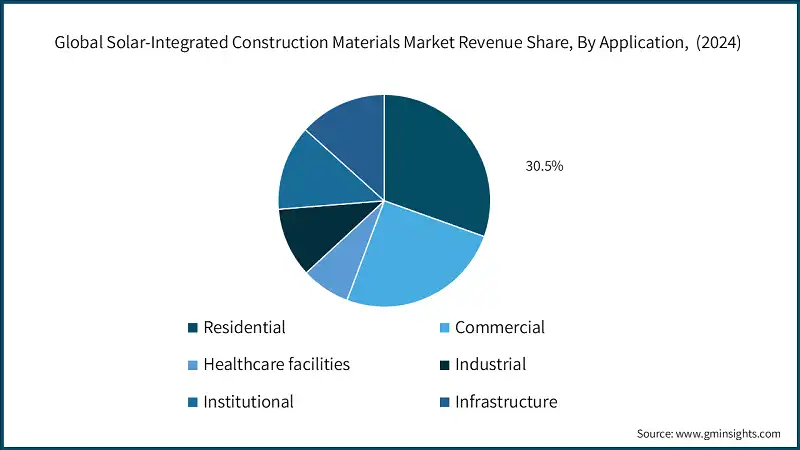
Based on application, the solar-integrated construction materials market is segmented into residential, commercial, healthcare facilities, industrial, institutional and infrastructure. Residential and building materials made up 30.5% of the market in 2024.
- Growing consumer awareness and increasing demand for energy-efficient homes influences residential applications at present. The increasing government incentives, tax credits, and building codes to help in reducing consumer carbon footprints directly drive the adoption of solar-integrated construction materials in residential buildings.
- The commercial sector will have vast opportunities in the future because cost savings and sustainability commitments are the very things businesses and developers are looking for. Use of solar-integrated materials in retail and office buildings will include significant energy savings along with fulfilling corporate social responsibility goals yet revolutionizing the architectural design of buildings and their energy management systems.
- There is increasing integration of solar-based materials in health facilities so that energy reliability as well as operational costs in remote or off-grid areas are effectively reduced as well.
- Industrial use is extended as factories and warehouses also make arrangements to catch solar light within their structures to have a buffer against high energy consumption and provisions in the regulation. With energy independence and cost savings critical drivers for this, large solar-integrated systems become a dominant feature in the industrial milieu.
- Institutional and infrastructure projects include government buildings, airports, and hubs of transportation, which utilize solar-integrated materials to meet green building standards, as well as create public sustainability campaigns.
Based on technology, the solar-integrated construction materials market is segmented into Crystalline silicon technology, Thin-film technology, Perovskite technology, Organic photovoltaics (OPV), Hybrid technologies and Emerging technologies. Construction leads the market in 2024.
- Crystalline silicon would be the major segment due to their very well-established manufacturing processes, high efficiencies, and large-scale deployment in big construction projects. Proven durability and cost-effectiveness continue to feed large installations of solar-integrated building materials, making them the top performers in terms of market growth.
- Thin-film is succeeding as it can be flexible, lightweight, and easily attached to various surfaces of buildings. In general, efficiency is lower when compared to crystalline silicon but improvements are promising that boost the image for innovative architectural projects, as well as projects for retrofits. States that encourage renewables through policy measures are pushing thin-film in urban areas where space is optimally used.
- Perovskite technology comes up with great prospects for the next generation in terms of efficiency potential and lower affordability to manufacture. Its compatibility with flexible substrates is completely in line with the emerging aesthetics and trend of adaptable building-integrated solar solutions.
- Lightweight, semi-transparent, and flexible, organic photovoltaics (OPV) are well suited for aesthetic designs and incorporation into windows. Although now less efficient than other technologies, innovation is driving improvement in OPV's efficiency and durability, caving a niche but growing market for specialized architectural applications.
- Hybrid and new technologies combine advantages derived from the existing ones and optimize them as far as efficiency, aesthetics, and flexibility are concerned. Continuous improvement of technology and complementing supportive regulatory frameworks are expected to further enhance growth in these segments, diversifying the market.
Looking for region specific data?
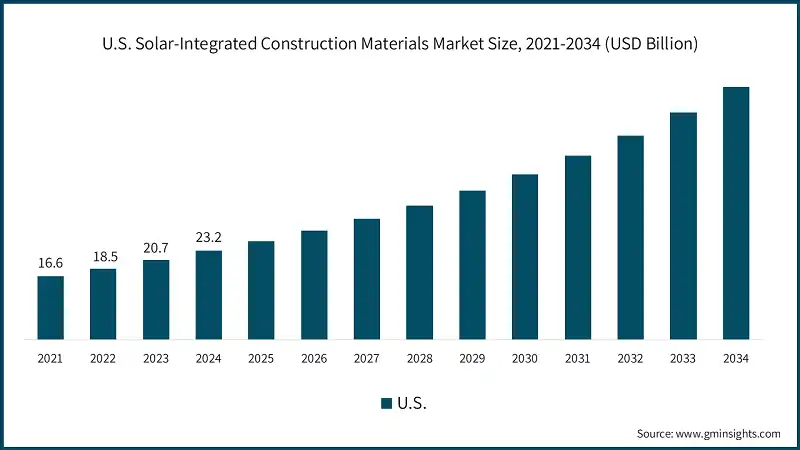
U.S. solar-integrated construction materials market was accounted for USD 23.2 billion in 2024.
- The U.S. market thrives on its manufacturing, R&D investments, and the recent push toward green building practices. The increasing adoption of solar-integrated materials in residential, commercial, and industrial projects toward meeting sustainability goals is contributing critically to the growth.
- Demand for solar-integrated solutions in Canada is driven by its emphasis on sustainable development, green building standards, and climate commitments. Furthermore, the push from consumers for eco-friendly energy-saving building solutions is helping to create a conducive environment for market growth. The integration of solar materials into new construction and retrofitting projects aptly meets Canada's sustainability and carbon reduction targets, rendering it one of the larger markets in North America.
Germany will have a robust growth rate between 2025 and 2034.
- Germany is at the forefront of introducing solar-integrated construction materials in Europe since it lays great emphasis on sustainability, innovations in technology, and principles of the circular economy. Projects related to the use of recycled, bio-based, and eco-friendly polymers in construction have strong support from R&D funding and collaboration of the industry.
- The pursuit of net-zero emissions by 2050 by the UK has accelerated the adoption of solar-integrated construction materials. The incorporation of Building Information Modeling (BIM), smart building technologies, and digital twin platforms encourages the development of innovative solar solutions designed for the urban environment.
The China solar-integrated construction materials market is believed to experience a big boom from 2025 to 2034.
- With the support of government commitments to sustainable urban development, green building regulations, and heavy investment in infrastructure, China is fast making forays into the market. Competitive advantages are offered for the efficient production of solar materials owing to large-scale manufacturing capabilities, extrusion systems, and advanced printing technologies.
- Demand for innovative construction techniques incorporating solar integration is brought about by India's rapid urbanization, population explosion, and housing shortages. The National Solar Mission and green building policies support a favourable environment for market expansion.
The UAE solar-integrated construction materials market is projected to grow significantly between 2025 and 2034.
- Smart buildings, sustainable urban development, and renewable energy focus align the regional strategy with Vision 2021 and Dubai's Green Building Regulations. Major projects such as Masdar City and Dubai Solar Park show how solar materials could be incorporated within urban infrastructure.
- The transformation of Saudi Arabia into a new hub for innovative construction solutions is stimulated by strategic initiatives focused on carbon reduction and green infrastructure promotion.
Brazil will generate much in terms of growth from 2025 to 2034.
- For Brazil, Latin America's taken spotlight on affordable housing and sustainable construction moves the market forward. Brazil is increasingly incorporating solar-integrated solutions into infrastructure projects to improve energy efficiency.
- Argentina is set to ramp up the utilization of recycled and bio-based materials for constructions. Sustainable urban development and energy efficiency are also key goals in sync with regional trends. Growth is expected to remain modest but bright, with scaling opportunities as infrastructure investments ramp up and environmental regulation plateaus, paving the way for more application of solar-integrated construction materials.
Solar-Integrated Construction Materials Market Share
- The market is moderately consolidated, with the top five players-Tesla, First Solar, Onyx Solar, Mitrex Solar and Panasonic Corporation; they account together around 40.7% of the overall market share.
- These leading businesses are progressing their competitive edge through constant R&D work to produce real innovations in the area of high-performance and sustainable solar materials that will meet changing regulations and market demands.
- Portfolio expansion emphasizes multifunctional solar materials with improved properties such as adhesion, durability, and environmental resistance, very important gums for construction, retrofit projects, and urban infrastructure.
- Strategic collaborations with construction companies; green construction associations and technology providers enable such companies to reach out to new markets and undertake mega-projects in smart cities and sustainable infrastructure.
- Continuous improvement holds for all these regions across North America, Europe, and Asia-Pacific to enhance growth and innovation, setting up new industry standards and driving future growth consistent with global sustainability goals.
Solar-Integrated Construction Materials Market Companies
Major players operating in the solar-integrated construction materials industry are:
- AGC Inc
- Canadian Solar
- First Solar
- Guardian Glass
- JA Solar
- JinkoSolar
- LONGi
- Mitrex Solar
- Onyx Solar
- Panasonic Corporation
- Saule Technologies
- Sisecam Group
- SunPower Corporation
- Tesla
- Trina Solar
Tesla bringing forward a unified solar solution that includes solar roof tiles and Powerwall energy storage systems. The advanced photovoltaic glass as well as seamless integration within building structures can facilitate the sustainable energy generation associated with construction projects.
First Solar manufactures thin film photovoltaic modules, which are designed specifically for building-integrated applications. Their technology has high efficiency, durability, and sustainability, which make their solar materials compatible for roofs, facades, and even for large urban infrastructure. First Solar has been investing massively in R&D and hence excels in developing innovative solar mechanisms with improved performance under all climate conditions for the global sustainable construction development.
Onyx Solar designs transparent, semi-transparent and opaque photovoltaic glass solutions built for architectural integration. While stacking good aesthetics with high energy output, their solar materials find their applicability in the facades, skylights, and windows of commercial and public buildings. The proprietary technology of Onyx Solar maximizes deriving natural daylight while generating electricity to facilitate the construction of sustainable yet stunning structures in tune with modern green building standards in the hands of architects and constructors.
Mitrex Solar with their innovative photovoltaic materials are designed to be smoothly integrated with architectural designs they would give both aesthetic appeal in addition to energy efficiency. With lightweight, durable, and customizable solar panels, Mitrex technology supports scalable solar integration throughout construction projects around the globe, transitioning toward totally sustainable, energy-generating buildings.
Panasonic Corporation has advanced a technology in building-integrated photovoltaics and energy management systems. Their solar modules can be applied to rooftops, facades, and even windows while considering aspects of high efficiency, reliability, and environmental sustainability. Panasonic is in the great position to leverage its competence in electronics and renewable energy in developing integrated solar solutions that enhance energy independence in buildings as well as in support of eco-friendly construction and smart city initiatives at a global level.
Solar-Integrated Construction Materials Industry News
- April 2024: Mitrex introduces innovative building-integrated photovoltaic (BIPV) solutions, transforming building exteriors into self-sufficient energy systems. Their solar cladding and glass railing blend seamlessly with architectural aesthetics, promoting sustainable, energy-generating structures without compromising design.
- July 2023, APL Apollo Tubes and Ornate Solar announced their strategic partnership to develop India's first integrated solar roofing solution, combining their expertise in structural steel and solar energy to create innovative, sustainable energy solutions.
- June 2025, Solarium Green Energy Limited announced the launch of solar module manufacturing plant in Ahmedabad, Gujarat, marking its re-entry into India’s rooftop solar sector and expanding its renewable energy production capabilities.
- March 2025, Goldi Solar launched India’s first AI-powered solar manufacturing facility in Surat, Gujarat, with a 14GW capacity. The innovative plant featured automated stringers capable of producing 10,000 cells per hour, enhancing efficiency and reducing waste.
The solar-integrated construction materials market research report includes an in-depth coverage of the industry with estimates and forecast in terms of revenue in USD Billion and volume in terms of Kilo Tons from 2021–2034 for the following segments:
Market, By Product
- BIPV modules
- Crystalline silicon BIPV modules
- Thin-film BIPV modules
- Perovskite BIPV modules
- Solar glass
- Transparent solar glass
- Semi-transparent solar glass
- Colored solar glass
- Solar tiles and shingles
- Ceramic solar tiles
- Polymer solar tiles
- Integrated solar shingles
- Solar facades
- Curtain wall solar systems
- Ventilated solar facades
- Double-skin solar facades
- Solar skylights and canopies
- Transparent solar skylights
- Semi-transparent solar canopies
- Solar cladding systems
- Others
- Solar insulation materials
- Solar membrane systems
- Flexible solar films
Market, By Application
- Residential applications
- Single-family homes
- Multi-family residential buildings
- Residential retrofits
- Commercial applications
- Office buildings
- Retail and shopping centers
- Hotels and hospitality
- Educational institutions
- Healthcare facilities
- Industrial applications
- Manufacturing facilities
- Warehouses and distribution centers
- Industrial retrofits
- Institutional applications
- Government buildings
- Religious buildings
- Cultural and recreational facilities
- Infrastructure applications
- Transportation hubs
- Parking structures
- Bridge and tunnel integration
Market, By Technology
- Crystalline silicon technology
- Monocrystalline silicon
- Polycrystalline silicon
- Thin-film technology
- Amorphous silicon (a-Si)
- Cadmium telluride (CdTe)
- Copper indium gallium selenide (CIGS)
- Perovskite technology
- Lead-based perovskites
- Lead-free perovskites
- Perovskite-silicon tandems
- Organic photovoltaics (OPV)
- Small molecule OPV
- Polymer OPV
- Hybrid technologies
- Perovskite-organic hybrids
- Silicon-perovskite tandems
- Emerging technologies
- Quantum dot solar cells
- Dye-sensitized solar cells
The above information is provided for the following regions and countries:
- North America
- U.S.
- Canada
- Europe
- Germany
- UK
- France
- Spain
- Italy
- Rest of Europe
- Asia Pacific
- China
- India
- Japan
- Australia
- South Korea
- Rest of Asia Pacific
- Latin America
- Brazil
- Mexico
- Argentina
- Rest of Latin America
- Middle East and Africa
- Saudi Arabia
- South Africa
- UAE
- Rest of Middle East & Africa
Frequently Asked Question(FAQ) :
Who are the key players in the solar-integrated construction materials market?
Key players include AGC Inc, Canadian Solar, First Solar, Guardian Glass, JA Solar, JinkoSolar, LONGi, Mitrex Solar, and Onyx Solar.
What are the upcoming trends in the solar-integrated construction materials industry?
Key trends include advancements in bifacial and perovskite solar panels, increased funding for solar energy integration tools, and the growing feasibility of solar integration across diverse building types.
Which region leads the solar-integrated construction materials market?
The U.S. market led with a valuation of USD 23.2 billion in 2024, driven by strong manufacturing, R&D investments, and a focus on green building practices.
What was the market share of residential and building materials in 2024?
Residential and building materials accounted for 30.5% of the market in 2024, supported by increasing consumer awareness and government incentives for energy-efficient homes.
How much revenue did BIPV modules generate in 2024?
BIPV modules generated USD 21.1 billion in 2024, driven by their multifunctional applications in facades, roofs, and windows.
What is the projected size of the solar-integrated construction materials market in 2025?
The market is expected to reach USD 100 billion in 2025.
What is the projected value of the solar-integrated construction materials market by 2034?
The market is expected to reach USD 259.2 billion by 2034, fueled by technological innovations, government incentives, and growing demand for sustainable construction materials.
What was the market size of the solar-integrated construction materials in 2024?
The market size was USD 90.2 billion in 2024, with a CAGR of 11.2% expected through 2034, driven by advancements in photovoltaic technologies and increasing adoption of energy-efficient building solutions.
Solar-Integrated Construction Materials Market Scope
Related Reports