Summary
Table of Content

Soil Monitoring Market
Get a free sample of this report
Form submitted successfully!
Error submitting form. Please try again.
Thank you!
Your inquiry has been received. Our team will reach out to you with the required details via email. To ensure that you don't miss their response, kindly remember to check your spam folder as well!
Request Sectional Data
Thank you!
Your inquiry has been received. Our team will reach out to you with the required details via email. To ensure that you don't miss their response, kindly remember to check your spam folder as well!
Form submitted successfully!
Error submitting form. Please try again.
Soil Monitoring Market Size
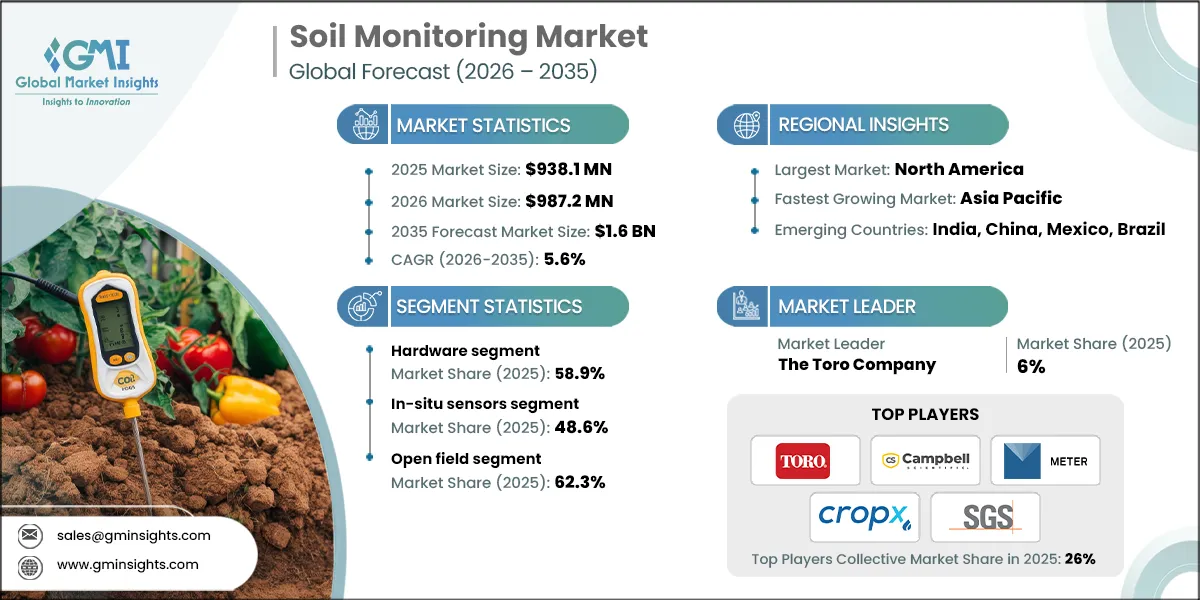
The soil monitoring market was estimated at USD 938.1 million in 2025. The market is expected to grow from USD 987.2 million in 2026 to USD 1.6 billion in 2035, at a CAGR of 5.6% according to latest report published by Global Market Insights Inc.
Soil Monitoring Market Key Takeaways
Market Size & Growth
- 2025 Market Size: USD 938.1 Million
- 2026 Market Size: USD 987.2 Million
- 2035 Forecast Market Size: USD 1.6 Billion
- CAGR (2026–2035): 5.6%
Regional Dominance
- Largest Market: North America
- Fastest Growing Region: Asia-Pacific
Key Market Drivers
- Adoption of Precision Agriculture.
- Global Food Security & Population Growth.
- Emphasis on Resource Conservation.
Challenges
- High Initial Hardware & Installation Costs.
- Technical Complexity & Data Integration.
Opportunity
- AI-Driven Predictive Analytics.
- Expansion of the "Sensing-as-a-Service" Model.
Key Players
- Market Leader: The Toro Company led with over 6% market share in 2025.
- Leading Players: Top 5 players in this market include The Toro Company, Campbell Scientific, Inc., METER Group, Inc, CropX Technologies., SGS SA, which collectively held a market share of 26% in 2025.
Get Market Insights & Growth Opportunities
Awareness of and emphasis on environmental sustainability continue to fuel the demand for soil monitoring systems, and this is further accelerated by the sudden rise in mergers and acquisitions between industry leaders. When major players like John Deere, Trimble, and AGCO come together in strategic ventures-such as PTx Trimble JV-the market sees greater innovation, broader product portfolios, and increased presence across the globe. Traditional methods of testing soil-manual, periodic, and often laboratory-based-are giving way to real-time digital solutions.
Soil monitoring presents a more viable alternative that offers accurate data on moisture, pH, and nutrient levels to allow "micro-dosing" of fertilizers and water, thus minimizing environmental runoff and helping protect the local ecosystem. This, therefore, creates the basic commercial viability for such equipment on account of growing food security needs and high agricultural productivity yields in North America, along with growing government subsidies related to "Smart Farming" in Europe and the Asia-Pacific region. More and more, consumers and professionals involved in agriculture are looking for effective mechanized ways to conduct crop management and are abandoning older, more time-consuming methods of manual sampling.
Ground sensing is considered a cleaner and faster method than aerial sensing and offers scientifically accurate results since the data is obtained directly from the root zone. With an increasing need for faster and less disturbing approaches in managing resources for commercial farming and research organizations, soil measurement technologies are slowly but surely gaining popularity. Some of the already recognized benefits of such technologies include optimizing irrigation timing, combating water waste, and preventing soil degradation in terms of conditions such as salinization or nutrient deficiencies. It's quite evident that this sector is affected by an increasingly recognized benefit associated with the use of regenerative agriculture, thus leading to an overall recognition of such advanced technology. Additionally, the persistent developments in IoT edge computing are expected to boost overall usability and analytics decision-making.
Thus, innovation in sensor technologies stands at the backbone of the growing progress being exhibited by this industry by making mere sensors more robust pieces of heavy machinery with multi-variable input capabilities. Notably, this industry is also witnessing a shift in favor of wireless sensors based on IoT technology for improved data transmission in controlling huge tracts of land.
Another critical domain that satellite-based remote sensing encompasses involves increasing demands for coverage, which has led to the advent of hybrid models that can merge images from satellites with those from ground sensors.
The key factor propelling the soil monitoring market is the huge increase in precision agriculture adoption, along with the industry’s need to efficiently use resources. Unlike conventional soil sampling methods where soil is assessed by taking random samples and making educated guesses regarding soil composition, soil sensors offer a real-time view of the underground soil conditions.
This efficiency has been well-received in large-scale commercial farms that aim to maximize ROI as well as in the government sector, which aims to implement resilient land management. This can be seen in the market composition, as the Hardware & Sensing segment has been taking the largest market revenue pie. This is due to the rugged nature of the hardware, as it is accurate enough to suit the modern grower. Further, AI & Machine Learning is taking a significantly important place as it provides predictive analysis of pest infestations & yield prediction. Additionally, AI and Machine Learning are playing an increasingly critical role, offering predictive analytics for pest outbreaks and yield forecasting. These interconnected trends underscore the market's vitality and its capacity to serve a broad spectrum of environmental and agricultural needs.
To get key market trends
Soil Monitoring Market Trends
The soil monitoring sector is experiencing an ever-evolving industry trend fueled by the increasing adoption of innovative product launches and developments by major players in the industry. Major players in the sector have launched the latest sensing models with advanced technologies including multi-parameter NPK sensors, better wireless connectivity (LoRaWAN/5G networks), and AI-analytical predictive tools. These technologies have managed to meet the rising demands of the end-users who require the latest and accurate solutions for land management. The adoption rate of these trends by the industry indicates the sector's willingness to be innovative at all costs and provide the end-users with the latest technologies to make the process more accurate and efficient in agriculture.
- Technology Development and Product Innovations: Notably, there is a major focus on developing advanced and self-autonomous monitoring solutions, such as the integration of IoT-based wireless sensor networks. Various firms are working on developing high-accurate capacitance sensors and rugged electrochemical sensors to ensure effective nutrient monitoring. Advances in Edge AI Computing enable sensors to analyze and process the data right on the sensors, enabling instant irrigation and fertilizer notifications.
- Enhancement in Precision Agriculture and Agronomic Solutions: The growth in the smart agriculture and agronomist market is being fueled by the increase in the number of companies under this category. Companies under the sector include farm management companies and crop consulting companies, which contribute the most to the total market share. The requirement for efficient soil monitoring systems remains constant, and this is driven by the need for site-specific nutrient application and high detail soil mapping, which is fueled by both expanded commercial farms and CEA facilities such as vertical farms and greenhouses.
- Sustainable Land Management and Regenerative Agriculture: Efficient land monitoring avoids overuse of chemical fertilizer and water, enabling more effective underground ecosystems and helping to reclaim degraded areas. Soil Organic Carbon tracking allows for global efforts in sequestration and "Green Deal" sustainable programs, paying farmers to improve underground ecosystems.
- More Severe Weather Events: The effects of climate change continue to cause more extremes of meteorological events that involve prolonged drought, flash flooding, and unendurable heatwaves. This is now presenting an urgent need for monitoring moisture stress to help safeguard crop yields. This requires a sustained need for soil monitoring systems amongst disaster recovery organizations, large-scale agribusiness, and water management authorities who seek ways in which soil erosion and salinization risks could be mitigated.
- Emphasis on Urban Forestry and Landscape Management: Municipalities and property management companies are giving more focus to proactive maintenance for environmental cooling and aesthetics of urban green spaces. It involves regular monitoring of soil health in public parks, street-side trees, and sports turf. The need for the maintenance of city lands throughout the year and infrastructure in "Smart City" results in consistent demand for integrated commercial-grade soil sensors.
Soil Monitoring Market Analysis
Learn more about the key segments shaping this market
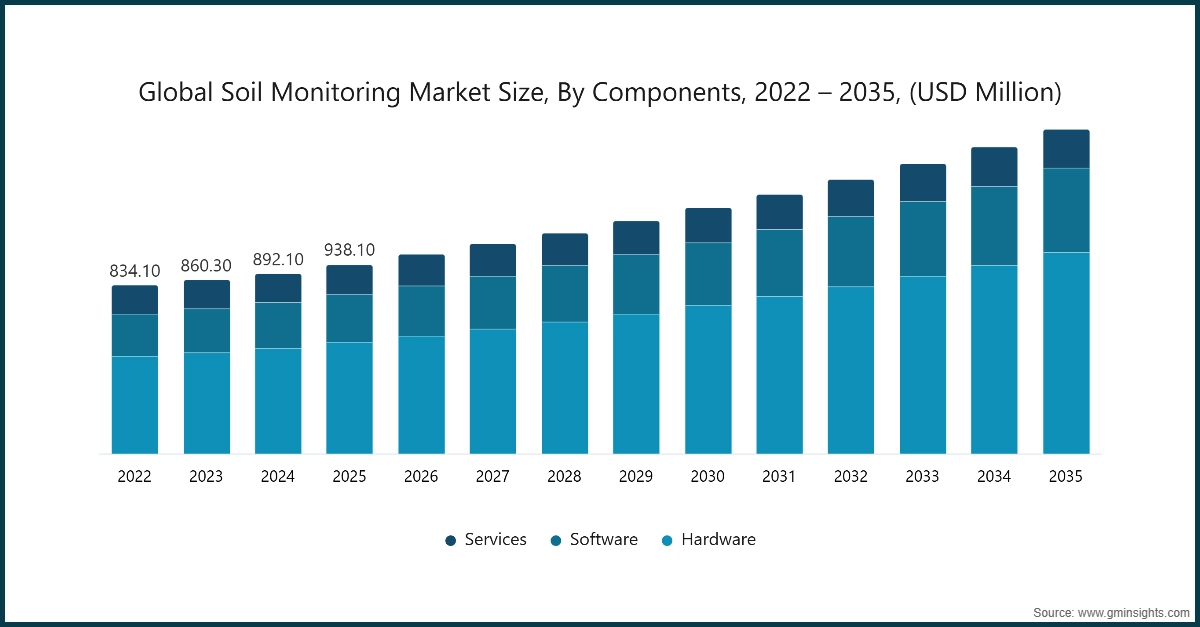
Based on the component, the soil monitoring market is segmented into hardware, software and services. In 2025, hardware held a major market share of 58.9%, generating a revenue of USD 552.2 million.
- Hardware segment represents the largest portion of the market and shows a steady growth rate with a CAGR of 6.1%. The dominance of hardware is driven by the essential need for physical sensors, probes, and iot-enabled devices that provide the foundational real-time data on moisture, nutrients, and ph levels.
- Software segment maintains a solid growth rate, representing the digital platforms and analytical tools used to process and visualize subterranean data. As farms move toward digital integration, software is becoming the critical layer that transforms raw sensor data into actionable irrigation and fertilization maps.
- Services segment is the smallest and shows a lower growth profile. This trend is consistent with a market where hardware is becoming more "plug-and-play" and user-friendly, reducing the constant need for manual professional intervention and onsite consulting.
Learn more about the key segments shaping this market
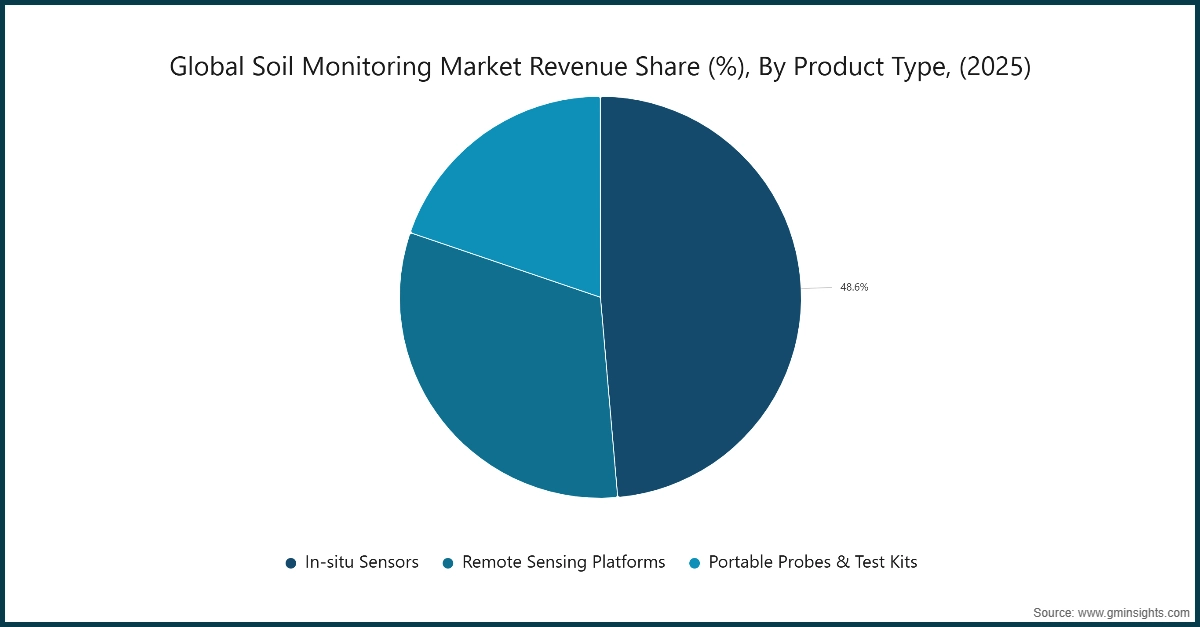
Based on the product type, the soil monitoring market is segmented into in-situ sensors, remote sensing platforms and portable probes & test kits. In 2025, In-situ sensors held the major market share of 48.6%, generating a revenue of USD 456.3 million.
- In-situ sensors segment represents the largest portion of the market and shows the highest growth rate, CAGR, of 6.1%. These sensors provide high-resolution, continuous data directly from the root zone, highlighting the industry's shift towards smart, autonomous technology that maximizes efficiency and minimizes manual sampling.
- Remote sensing platforms segment maintains a solid market presence, utilizing satellites and drones to offer a macro-view of soil health. This offers a balance of wide-area performance and cost-effectiveness for large-scale land management projects.
- Portable probes & test kits segment is the smallest and represents manual or hand-held units. This trend is consistent with a market that is mechanizing and moving toward permanent, automated installations to reduce labor time and increase site efficiency.
Based on the application type, the soil monitoring market is segmented into open field, protected cultivation and forestry. In 2025, Open field held the major market share of 62.3%, generating a revenue of USD 584.7 million.
- Open field segment represents the largest portion of the market and shows the highest projected growth rate CAGR of 5.8% from 2026-2035. This dominance is driven by the massive scale of global agriculture and the increasing adoption of precision farming techniques in large-scale crop production.
- Protected cultivation segment (greenhouses and vertical farms) maintains a significant share, perfectly meeting the modern grower’s need for precise environmental control. These systems require high accuracy monitoring to ensure optimal nutrient delivery in controlled environments.
- Forestry segment is primarily utilized for large-scale land management, afforestation, and timber production. This channel is essential for national or governmental environmental projects that have the internal infrastructure for long-term ecosystem monitoring.
North America Soil Monitoring Market
Looking for region specific data?
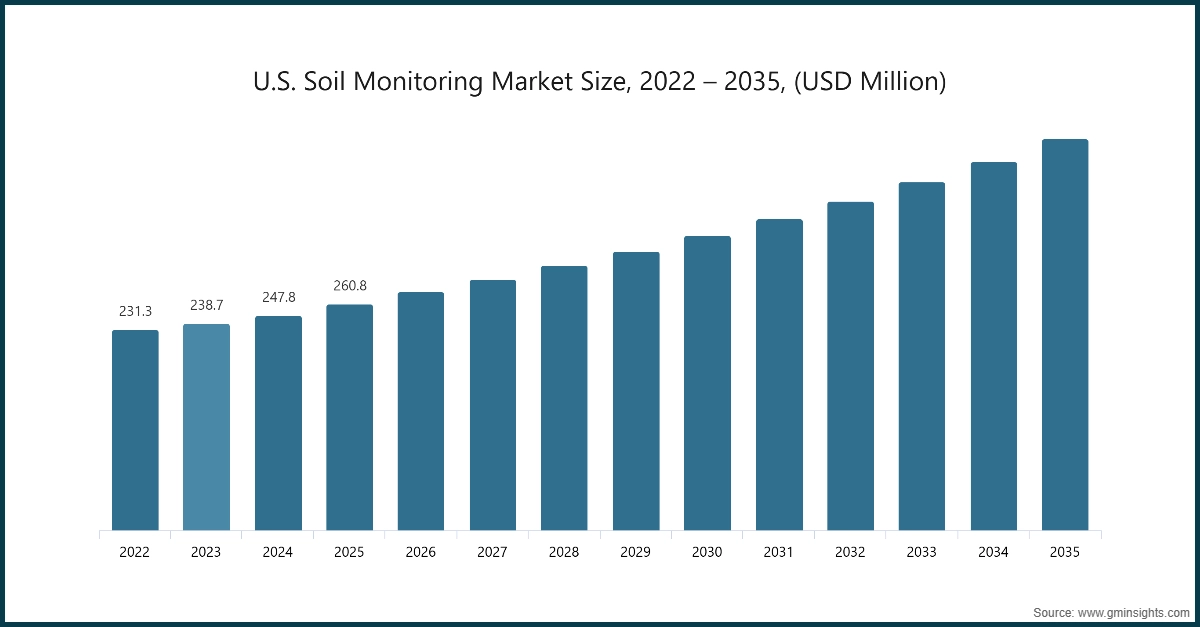
In 2025, North America is the largest market for soil monitoring. It has an estimated market value of USD 308.5 million in 2025 with a projected growth rate of 5.6% through 2035.
- The U.S. leads the region by showing a strong growth rate of 5.7%. This growth comes from a mature market with high levels of mechanization and the presence of leading agtech companies like Trimble and John Deere.
- Soil monitoring sensors are essential tools for large-scale commercial farmers, research institutions, and environmental agencies involved in precision irrigation and nutrient management.
- The North American market meets this need by offering advanced ground-based sensing and satellite imagery integration that support sustainable land-use practices and high-yield agricultural operations across the continent.
- Strict environmental regulations and climate-focused policies also increase demand for specialized monitoring to track soil carbon and prevent chemical runoff, fueling the region's steady financial trajectory.
Europe Soil Monitoring Market
Europe is the third-largest market estimated at USD 249.7 million in 2025 with a projected growth rate of 5%. Germany leads the region with a market value of USD 60.3 million in 2025 due to its strong focus on sustainable agriculture and digital farming initiatives.
- The European market benefits from strict sustainability efforts and the "EU soil monitoring & resilience law," which encourages the adoption of real-time data tracking for soil health kpis.
- The larger European market also gains from industry 4.0 initiatives that improve data connectivity, lessen environmental impact, and encourage innovation in sensor design and wireless telemetry.
- These efforts make Europe a competitive landscape for new technologies and sustainable practices. Countries like France and Italy experience steady growth driven by the need for water conservation and high-value vineyard management.
- The integration of Iot-enabled devices helps minimize the environmental footprint of farming, positioning Europe as a leader in eco-friendly and climate-resilient industrial practices.
Asia Pacific Soil Monitoring Market
Asia Pacific is the second largest and fastest-growing regional market. It has an estimated market value of USD 236.8 million in 2025 with a projected growth rate of 6.6% from 2026 to 2035.
- China holds the largest market share in the region valued at USD 77.1 million in 2025, while India shows a high sub-regional growth rate of 6.6%.
- The rapid growth in Asia Pacific results from significant urbanization, a massive agricultural sector, and increased government investment in food security and "smart village" projects.
- Rising awareness about resource costs and the quest for better operational efficiency influence the growth of the construction and forestry sectors, promoting the use of affordable and durable sensor networks.
- Countries like Australia and Japan are also important players, requiring reliable equipment for disaster recovery, drought management, and high-tech greenhouse automation.
Latin America Soil Monitoring Market
Latin America represents a smaller but vital segment of the global soil monitoring industry reached USD 80.2 million in 2025, growing at a rate of 5.1% from 2026 to 2035.
- Brazil is the main driver in the region with the largest market value of USD 38.7 million in 2025 and a growth rate of 5.4%.
- Overall growth is bolstered by the expansion of commercial soybean and corn belts, where precision agriculture is becoming essential for maintaining global export competitiveness.
- Increasing urbanization and a focus on land reclamation are boosting demand for professional soil health services in both agricultural development and public works projects.
- Market players are focusing on durable hardware and cost-effective mobile test kits to cater to large estates and growing agribusiness firms seeking to optimize their soil fertility.
Soil Monitoring Market Share
The Toro Company is leading with 6% market share, The Toro Company, Campbell Scientific, Inc., METER Group, Inc., SGS SA, CropX Technologies. collectively hold around 26%, indicating moderately fragmented market concentration. These prominent players are proactively involved in strategic endeavors, such as mergers & acquisitions, facility expansions & collaborations, to expand their product portfolios, extend their reach to a broad customer base, and strengthen their market position.
In February 2025, the toro company partnered with terrarad to introduce an innovative software solution for precise irrigation control. The new spatial adjust software, designed to work seamlessly with the toro lynx central control platform, aims to transform irrigation management. This software leverages terrarad's turfrad smart sensors, which are integrated into toro equipment to monitor soil moisture levels during mowing, allowing for high-resolution ground-truth data collection without additional labor.
In May 2024, stevens water monitoring systems, inc. completed the acquisition of dyacon's weather instrument products. This strategic move expanded stevens' environmental portfolio within the meteorological and soil analysis sectors. The integration of these instruments allows for a more comprehensive early-warning solution for agriculture and research, enabling users to analyze the direct correlation between atmospheric conditions and soil moisture using a unified hardware ecosystem.
Soil Monitoring Market Companies
Major players operating in the soil monitoring industry are:
- Acclima, Inc.
- Arable Labs, Inc.
- Campbell Scientific, Inc.
- CropX Technologies
- Delta-T Devices Ltd
- EarthOptics
- Element Materials Technology
- HydroPoint Data Systems, Inc.
- Irrometer Company, Inc.
- METER Group, Inc.
- SGS SA
- Sentek Technologies
- Soil Scout Oy
- Spectrum Technologies, Inc.
- The Toro Company
In September 2024, METER Group unveiled the atmos 41 gen 2, its next-generation all-in-one weather station designed to integrate deeply with soil monitoring networks. The device features enhanced durability and faster scan rates that comply with world meteorological organization guidelines. This launch emphasizes the company's commitment to providing researchers and agricultural professionals with high-precision, low-maintenance tools that simplify the complex task of environmental data collection.
Soil Monitoring Market Report Attributes
| Key Takeaway | Details |
|---|---|
| Market Size & Growth | |
| Base Year | 2025 |
| Market Size in 2025 | USD 938.1 Million |
| Market Size in 2026 | USD 987.2 Million |
| Forecast Period 2026-2035 CAGR | 5.6% |
| Market Size in 2035 | USD 1.6 Billion |
| Key Market Trends | |
| Drivers | Impact |
| Adoption of Precision Agriculture | The shift toward data-driven farming requires real-time monitoring of soil moisture, NPK levels, and pH. This drives consistent demand for high-accuracy ground-based sensors and wireless telemetry systems. |
| Global Food Security & Population Growth | Increasing pressure to maximize crop yields on limited arable land necessitates efficient, routine soil health analysis, boosting sales of IoT-enabled sensors and decision-support software. |
| Emphasis on Resource Conservation | Soil monitoring allows for "more with less" by optimizing irrigation and fertilizer application. Regulatory support for water conservation and nitrogen leaching prevention promotes adoption across large-scale commercial farms. |
| Pitfalls & Challenges | Impact |
| High Initial Hardware & Installation Costs | The substantial upfront capital for advanced sensor networks and site-specific calibration, combined with recurring data subscription costs, limits adoption among smallholder farmers. |
| Technical Complexity & Data Integration | Operating sophisticated IoT probes involves a learning curve. The need for seamless integration with existing Farm Management Information Systems (FMIS) increases operational complexity for end-users. |
| Opportunities: | Impact |
| AI-Driven Predictive Analytics | Integrating AI and Machine Learning allows for predictive soil behavior modeling and automated irrigation events. This significantly boosts operational efficiency and reduces manual field scouting. |
| Expansion of the "Sensing-as-a-Service" Model | Service-led models allow contractors and farmers to access high-quality soil data through subscriptions or rentals without significant capital investment, expanding market penetration in emerging regions. |
| Market Leaders (2025) | |
| Market Leader |
6% market share |
| Top Players |
Consolidate share of 26% |
| Competitive Edge |
|
| Regional Insights | |
| Largest Market | North America |
| Fastest growing market | Asia-Pacific |
| Emerging countries | China, India, Brazil, Mexico |
| Future outlook |
|
What are the growth opportunities in this market?
Soil Monitoring Industry News
- In November 2025, Soil Scout Oy introduced two new advanced sensors: the Happi100 Scout (a specialized soil oxygen sensor) and the Hydra100 Scout (a redesigned multi-parameter unit for moisture, salinity, and temperature). The Happi100 is a unique underground sensor designed for high-precision turf management, featuring a lithium battery with a 10-year lifespan when buried, while the Hydra100 simplifies site maintenance with a more robust hydraulic-sealed casing and improved antenna efficiency.
- In July 2025, METER Group, Inc. launched the USGA Moisture Meter, a handheld unit developed in collaboration with the United States Golf Association. This device is equipped with proprietary CDX technology, which automatically adjusts for soil texture and salinity to maximize reading accuracy; the tool also boasts a seamless integration with the DEACON technology platform for real-time course playability mapping.
- In 2024, Arable Labs, Inc. continued to emphasize its powerful Mark 3 sensing platform, which uses a 22-band spectrometer and a research-grade thermal sensor (meeting precision standards within 1 degree Celsius) and incorporates their Arable Vision automatic image-capture system to enhance performance in large-scale crop monitoring. This system provides a holistic view of the field by combining weather, plant health, and soil data in a single maintenance-free device.
- In 2025, Sentek Technologies continued to offer their specialized, high-performance Drill & Drop Bluetooth probes for professional horticulture. This focus on high mobility and lower overhead allows growers to collect soil profile data directly on their smartphones without the need for complex cellular or satellite modems, making it an ideal solution for vegetable crops and nurseries.
- In September 2024, CropX Technologies introduced the redesigned Strato 1 in-field weather station, tailored to work alongside its soil sensing array for precision irrigation. This new iteration boasts robust performance in detecting micro-climates and managing water use through advanced evapotranspiration (ET) monitoring. Powered by an AI-assisted analytics engine, it features seamless integration with the ReinCloud 3 platform, allowing for diverse materials and data visualizations in one unified location.
The soil monitoring market research report includes in-depth coverage of the industry with estimates & forecasts in terms of revenue (USD Billion) and volume (Thousand Units) from 2021 to 2034, for the following segments:
Market, By Component
- Hardware
- Software
- Services
Market, By Product Type
- In-situ Sensors
- Remote Sensing Platforms
- Portable Probes & Test Kits
Market, By Application Type
- Open Field
- Protected Cultivation
- Forestry
Market, By End-User
- Large Commercial Farms
- Smallholder & Cooperative Farms
- Research Institutes & Universities
- Government & NGOs
The above information is provided for the following regions and countries:
- North America
- U.S.
- Canada
- Europe
- Germany
- UK
- France
- Italy
- Spain
- Asia Pacific
- China
- India
- Japan
- Australia
- South Korea
- Latin America
- Brazil
- Mexico
- Argentina
- Middle East and Africa
- South Africa
- Saudi Arabia
- UAE
Frequently Asked Question(FAQ) :
What was the market size of the soil monitoring in 2025?
The market size was USD 938.1 million in 2025, with a CAGR of 5.6% expected through 2035. The growth is driven by increasing awareness of environmental sustainability and the adoption of real-time digital solutions.
What is the projected value of the soil monitoring market by 2035?
The market is poised to reach USD 1.6 billion by 2035, fueled by advancements in IoT-based sensors, AI-driven analytics, and the growing need for precision agriculture.
What is the expected size of the soil monitoring industry in 2026?
The market size is projected to reach USD 987.2 million in 2026.
How much revenue did the hardware segment generate in 2025?
The hardware segment generated approximately USD 552.2 million in 2025, accounting for 58.9% of the market share.
What was the valuation of the in-situ sensors segment in 2025?
The in-situ sensors segment accounted for USD 456.3 million in 2025, holding a 48.6% market share.
What is the growth outlook for the soil monitoring sector in North America?
North America led the market with a valuation of USD 308.5 million in 2025 and is projected to grow at a CAGR of 5.6% through 2035. The market is led by advancements in smart agriculture and agronomic solutions.
What are the upcoming trends in the soil monitoring market?
Key trends include IoT-based wireless sensor networks, AI-driven predictive tools, edge AI for real-time processing, sustainable land management practices, and soil monitoring systems for urban forestry and landscaping.
Who are the key players in the soil monitoring industry?
Key players include Acclima, Inc., Arable Labs, Inc., Campbell Scientific, Inc., CropX Technologies, Delta-T Devices Ltd, EarthOptics, HydroPoint Data Systems, Inc., Irrometer Company, Inc., METER Group, Inc., and SGS SA.
Soil Monitoring Market Scope
Related Reports